
What Is Natural Language Processing And How It Drives Business Growth
At its core, Natural Language Processing (NLP) is the technology that teaches computers how to make sense of human language. For a business leader, this isn't abstract science; it's a strategic asset. NLP is the essential bridge between the unstructured, nuanced way customers communicate—through calls, emails, and reviews—and the structured, logical way your business systems operate.
This technology is the engine behind significant operational efficiency and deeper customer intelligence. For any modern CXO, understanding NLP is no longer optional; it's a powerful tool for unlocking scalable growth and a sustainable competitive advantage.
What Is Natural Language Processing For Business Leaders?
Imagine having a strategic analyst who could instantly read, comprehend, and categorize every single customer email, support ticket, social media comment, and call transcript your company receives. That’s NLP in action. It is the core intelligence driving the tools transforming modern business, from sophisticated chatbots to Voice AI that can manage entire customer journeys autonomously.
The strategic value of NLP lies in its ability to move beyond simple keyword matching. It is designed to decipher the intent behind the words. For example, when a customer says, "My order hasn't arrived," the intent is not just about the words "order" and "arrived"; it's a service request requiring immediate action on a specific order number. Similarly, it deciphers sentiment—is the customer mildly annoyed or on the verge of churn?
This capability is a game-changer for scaling a business without compromising on customer experience. Instead of a support team manually wading through an ocean of incoming requests, NLP can deliver immediate, measurable business outcomes:
- Pinpoint urgency and revenue opportunities: An NLP model can distinguish a complaint ("Your app keeps crashing") from a high-value sales inquiry ("I'd like a quote for 100 enterprise licenses"), routing each to the appropriate team in real-time. A leading B2B software company saw a 15% increase in qualified leads passed to sales by using NLP to prioritize inquiries from enterprise domains.
- Automate issue routing with precision: A customer email stating "My payment failed again" can be automatically routed to the billing department, while "I can't log in" goes to technical support, reducing resolution time by an average of 40%.
- Proactively manage customer churn: By analyzing sentiment from support calls, an NLP system can flag a frustrated customer and trigger an alert for a retention specialist to intervene, a tactic that has been shown to reduce churn by up to 5%.
The Strategic Value of Understanding Language
The real power of NLP is its ability to transform messy, unstructured data—conversations, feedback, reviews—into structured, actionable intelligence. Human language is full of ambiguity and context, which traditional software cannot handle. NLP tackles this by breaking language down into its core components so a machine can analyze it. This involves advanced techniques like converting words into numerical representations, a process detailed in our guide on word embedding and text vectorization.
By mastering language at scale, you unlock a massive strategic advantage. Once you grasp the fundamentals of NLP, you can see how it powers higher-level concepts like conversational AI, which can automate entire customer journeys and deliver hyper-personalized experiences.
For a CXO, NLP provides a direct line to the voice of the customer, at scale. It transforms mountains of raw feedback into clear signals, revealing what customers truly want, where your service is failing, and where opportunities for growth lie.
This capability is fuelling explosive market growth. India's NLP market, currently valued at USD 6.6 billion, is on a trajectory to hit an incredible USD 96.33 billion by 2035. That’s a compound annual growth rate (CAGR) of 27.6%, driven by the huge demand for automation in sectors like BFSI and e-commerce.
Understanding what NLP is and what it can do is the first step in positioning your organisation to ride this wave and gain a real competitive edge.
How NLP Works: The Engine Behind Intelligent Automation
To truly grasp what Natural Language Processing can do for your business, it’s useful to understand its core mechanics from a leadership perspective. This isn't a deep dive for engineers; it's a CXO's guide to how this technology converts chaotic human language into clear, bottom-line results. At its heart, NLP functions like a sophisticated data refinery for language.
It begins by taking a complex human sentence and deconstructing it into pieces a computer can process. Consider a typical customer email: "I am really unhappy with my recent order, the delivery was late and the box was damaged." To a machine, this is just a meaningless string of characters.
Breaking Down Language Into Data
The first step is tokenization. Think of it as a digital assembly line that breaks the sentence into individual words or ‘tokens’: ‘I’, ‘am’, ‘unhappy’, ‘delivery’, and ‘late’. Each token becomes a discrete piece of data that the system can begin to analyze. This is the foundational step for turning a wall of text into structured information.
However, a list of words is not enough. The system must understand the meaning and relationship between them. This is where a powerful technique called word embeddings comes into play. Imagine it as a vast, multi-dimensional map where words with similar meanings are located near each other.
On this map, the system learns that ‘unhappy’ is contextually close to ‘frustrated’ and ‘disappointed,’ while ‘late delivery’ is related to ‘delayed shipment.’ This is how an AI can identify the core issue, even if customers use different phrasing. For example, a system can analyze 10,000 unique customer complaints and accurately group 2,500 of them under a single business-relevant category like "Logistics & Fulfillment Issues," providing a clear signal for operational improvement.
This diagram gives a great high-level view of NLP acting as that critical bridge between human language and computer data.
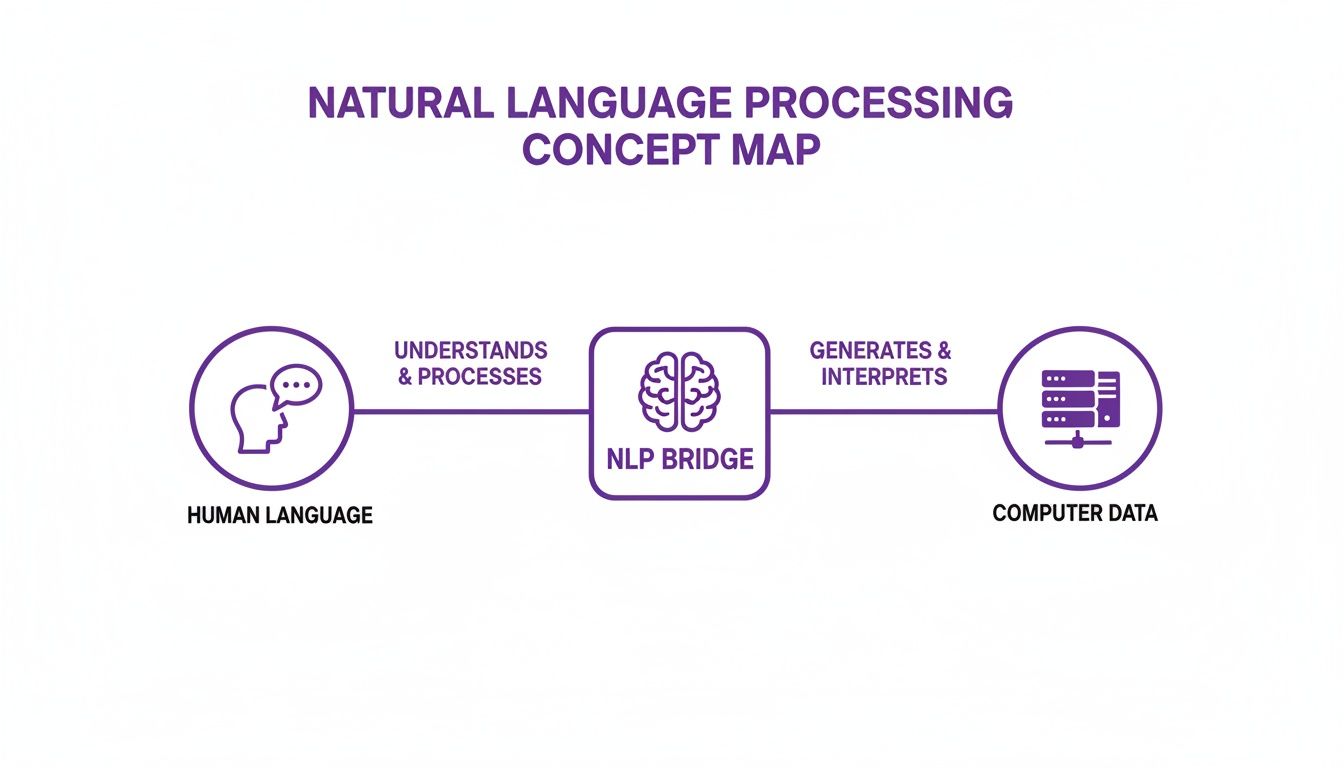
As you can see, NLP is the essential interpreter that translates our often-chaotic way of speaking into the structured information that powers intelligent action.
Understanding Context With Advanced Models
The real breakthrough, however, comes from modern AI architectures like transformer models. These are the powerful brains of the operation. Older systems read words sequentially, often missing the broader context. Transformers, in contrast, analyze the entire sentence at once to understand relationships between words, much like a human does.
For a business leader, this is the most critical part. It’s what allows a Voice AI to understand that when a customer says "I need to check my balance," the word 'balance' means account funds for a bank, but available credit for a credit card company. This contextual awareness is the key to accurate, human-like interaction.
This contextual understanding is built through advanced machine learning. Getting to grips with how NLP works means appreciating the fundamentals of Machine Learning for Businesses, as this is what fuels its ability to learn and automate intelligently. These models are trained on billions of data points—from web pages to conversation logs—which teaches them grammar, nuance, and intent with astounding accuracy.
The inner workings of these models—specifically how they process information through encoders and decoders—are what make them so effective at handling complex, human-like conversations. If you're curious about the mechanics, you can dive deeper into how encoders and decoders in transformer models work to produce such powerful results. This is the engine that allows an NLP system to not just read words, but to understand what a customer means, how they feel, and what business action to take next.
Real-World NLP Applications Driving Revenue and Efficiency
Understanding the theory of Natural Language Processing is one thing; seeing its direct impact on the P&L is what matters to a business leader. NLP is no longer a futuristic technology—it is a proven profit center, driving tangible revenue growth and significant operational efficiencies. Those abstract concepts like tokenization and transformer models translate directly into measurable business outcomes.
Across every major industry, companies are deploying NLP to solve high-stakes business challenges. From automating customer conversations to qualifying sales leads with over 90% accuracy, these applications demonstrate how understanding language at scale creates a powerful, defensible competitive advantage. The focus has shifted from simple cost reduction to genuine value creation, turning everyday conversations into strategic assets.
This trend is accelerating rapidly. A recent survey showed that 60% of Indian firms are already planning to integrate human expertise with AI tools like NLP. They're not just experimenting; they are projecting a 20% increase in workforce productivity and more accurate business forecasting as a direct result. Speech-based NLP, in particular, is seeing a massive surge in adoption. You can dig into more details about India's NLP adoption on Statista.com.
Let’s examine the practical, data-backed examples of how this is unfolding in key industries.
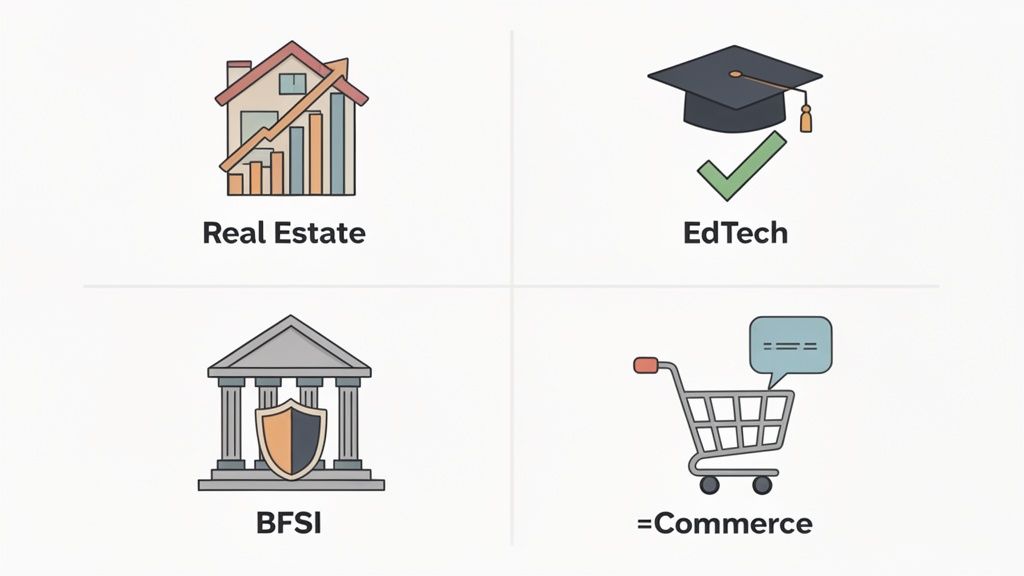
EdTech: Streamlining Admissions and Counselling
The EdTech sector faces an overwhelming volume of student inquiries, forcing admissions teams to spend up to 70% of their time on low-intent or unqualified leads. This resource drain is a major bottleneck to growth. NLP-driven Voice AI is reversing this by deploying an intelligent "AI counsellor" as the first point of contact.
These AI agents can handle thousands of concurrent calls, asking targeted qualifying questions about a prospect's academic background, course interest, and budget. For example, it can ask, "Are you looking for a postgraduate program in data science?" and based on the response, "Do you meet the minimum requirement of a bachelor's degree in a quantitative field?". The result is a pre-qualified pipeline of genuinely interested candidates.
One of the most powerful metrics we've seen comes from this pre-qualification stage. AI counsellors are hitting 97% accuracy in matching the right leads to human teams. This means your best counsellors are only talking to people who are actually ready to enrol, which massively boosts conversion rates and, frankly, team morale.
Real Estate: Converting Interest into Site Visits
In real estate, speed to lead is everything; a prospect's interest cools within minutes. A missed call is a lost opportunity. NLP-powered agents solve this by providing 24/7 availability, engaging potential buyers the moment they inquire. The AI can answer initial questions ("Does this property have parking?"), check availability, and schedule a site visit—all without human intervention.
This level of automation drives impressive, measurable results. By ensuring every lead is contacted within seconds, NLP solutions have been proven to:
- Bump up lead-to-booking rates from a typical 2% to over 8%—a fourfold improvement in sales efficiency.
- Boost connection rates from 47% to as high as 91%, drastically increasing the number of engaged prospects.
- Free up agents from hours of scheduling calls, allowing them to focus on high-value activities like negotiations and closing deals.
This empowers a small team to manage a massive lead funnel, effectively scaling the business without a proportional increase in headcount.
BFSI: Enhancing Compliance and Customer Onboarding
In the highly regulated Banking, Financial Services, and Insurance (BFSI) sector, accuracy and compliance are paramount. NLP is being deployed to streamline complex, manual processes like Know Your Customer (KYC) verification, reducing onboarding time from days to hours.
An automated Voice AI agent can guide a new customer through the initial KYC steps, collecting information and answering common questions like "Which ID documents are acceptable?". This not only accelerates onboarding but also reduces human error by over 80%, ensuring a consistent and compliant process every time.
By automating this foundational stage, financial institutions free up expert human agents. Instead of chasing documents, they can focus on high-value advisory services, building deeper customer relationships, and managing complex financial products—a direct impact on both risk mitigation and revenue generation.
E-commerce: Automating Support and Driving Satisfaction
E-commerce brands face a daily deluge of customer inquiries about order status ("Where is my package?"), returns, and product details. Handling this volume manually results in high operational costs and long wait times. NLP-powered chatbots and voice agents provide the solution, automating responses to these FAQs 24/7.
A clothing retailer, for example, can use an NLP bot to answer "What is your return policy?" instantly, deflecting thousands of routine calls from their support center. This automation can slash support costs by 30% while improving customer satisfaction scores (CSAT) by 15% due to immediate resolutions. Furthermore, the NLP system analyzes the sentiment in these conversations, automatically flagging a frustrated customer for escalation to a human agent. This proactive support prevents negative reviews and reduces customer churn, directly protecting the brand's reputation and bottom line.
NLP Impact Across Key Industries
The practical applications of NLP are not just theoretical; they are delivering concrete, measurable results across the board. The following table breaks down how different industries are seeing tangible uplifts by integrating NLP into their core operations.
| Industry | Primary Use Case with NLP | Reported Business Uplift (Data Backed) |
|---|---|---|
| Real Estate | 24/7 Lead Qualification & Site Visit Scheduling | 4x increase in lead-to-booking rates (from 2% to over 8%) |
| EdTech | AI-Powered Student Counselling & Lead Filtering | 97% accuracy in qualifying high-intent student leads for human teams |
| BFSI | Automated KYC & Customer Onboarding | Significant reduction in onboarding time and human error, improving compliance |
| E-commerce | Automated Customer Support for FAQs & Order Tracking | Drastic reduction in support ticket volume and wait times, boosting customer satisfaction |
As the data shows, the impact is direct and significant. From quadrupling conversion rates to achieving near-perfect lead qualification, NLP is proving to be a critical tool for any business focused on efficiency and growth.
A Strategic Roadmap for Bringing NLP into Your Organisation
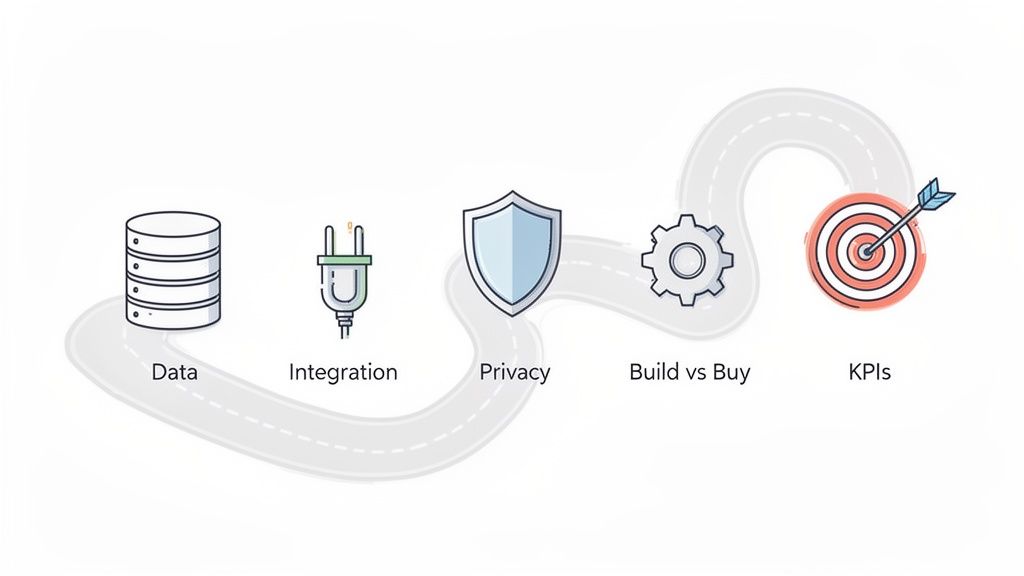
Implementing Natural Language Processing is a strategic business decision, not merely a technology upgrade. For any director or executive, a successful NLP rollout requires a clear framework—one that aligns this powerful technology with tangible business goals long before any code is written.
This roadmap is designed for leaders who need to make smart, informed decisions to guarantee a significant return on investment from their NLP initiative. Let's walk through the practical steps, from defining success metrics to choosing the right deployment model for your organization.
Defining Clear Goals and KPIs
The first step is to define what success looks like in concrete, measurable terms. Ambiguous goals like “improving efficiency” are insufficient. A successful NLP project is anchored to specific Key Performance Indicators (KPIs) that are directly tied to the bottom line.
Consider goals that are sharp and data-driven:
- Financial KPI: Reduce average cost-per-call by 30% within six months by automating Tier-1 support queries.
- Sales KPI: Increase sales-qualified leads by 25% in the next quarter by implementing a 24/7 AI agent for instant lead follow-up.
- Operational KPI: Decrease customer support ticket volume by 60% for repetitive issues like "password reset" or "order status" by deploying a Voice AI agent.
Setting these benchmarks from the outset provides clear direction and a straightforward method for measuring real-world impact, transforming a technology initiative into a measurable business strategy.
Addressing Data and Integration Needs
A common concern among leaders is the perceived need for massive, perfectly curated datasets. This is a misconception. Modern NLP solutions come with sophisticated, pre-trained models that have already mastered general language. You are not starting from zero.
Your primary role is to fine-tune these models with your company's specific context—product names, industry jargon, and unique customer phrases. The other critical component is integration. The NLP system must seamlessly connect with your existing tech stack, such as your CRM (e.g., Salesforce, HubSpot) or helpdesk software. A well-integrated solution ensures that the intelligence generated by NLP flows directly into your team's daily workflows, eliminating data silos and maximizing adoption.
If you want to dig deeper into getting your data ready, our guide on what is data labeling is a great place to start.
Navigating the Build vs. Buy Decision
This is a critical strategic decision: do you build a custom NLP solution from scratch or buy a specialized platform? Building in-house requires hiring an expensive data science team, significant infrastructure investment, and a long-term commitment to ongoing maintenance and model updates. For most organizations, this path is too slow, risky, and costly.
For the vast majority of businesses, buying a specialised platform is the more strategic choice. It provides immediate access to enterprise-grade, pre-trained models and dedicated expert support, allowing you to deploy powerful NLP capabilities in weeks, not years, and at a fraction of the total cost of ownership.
This approach lets your team focus on leveraging the technology to solve business problems, rather than getting bogged down in the complexities of AI model development.
Ensuring Privacy and Scalability
Finally, any discussion of NLP must address data privacy and compliance. As a leader, you are responsible for ensuring that any platform you adopt adheres to strict security protocols and data protection regulations like GDPR or CCPA, especially in sensitive sectors like BFSI and healthcare.
Scalability is the other side of this coin. Your chosen solution must be able to handle fluctuating business demand—scaling up seamlessly to manage thousands of concurrent calls during a product launch and scaling back down during off-peak periods. A robust, cloud-native platform provides this elasticity, ensuring consistent performance as your business grows without requiring costly infrastructure overhauls. A little foresight here ensures your initial investment continues to deliver value for years to come.
The Future of NLP and Its Impact on Your Business
Natural Language Processing is rapidly evolving from a task automation tool into a core driver of business intelligence. For forward-thinking leaders, the relevant question is no longer "what is NLP?" but "where is this technology taking my business?" The answer is clear: NLP is shifting from a reactive engine that answers queries to a proactive one that anticipates customer needs and informs strategic decisions.
Investing in foundational NLP technology today is not just about immediate ROI. It's about positioning your organization to capitalize on the next wave of AI-driven innovation that will define market leaders.
Hyper-Personalisation at Scale
The next major frontier for NLP is hyper-personalisation. Imagine a Voice AI that accesses a customer's entire history in real-time. It knows their past purchases, previous support issues, and even their communication preferences.
With this deep context, the AI can deliver truly tailored experiences. For instance, for a customer with a history of positive feedback, it might offer an exclusive loyalty discount. For another who previously reported a shipping issue, it might proactively say, "I see your last order was delayed. I've flagged your new order for priority shipping." This level of personalization, delivered across thousands of interactions daily, builds a level of brand loyalty that is impossible for human teams to achieve at scale.
The takeaway for business leaders is direct: tomorrow's market share will be won by companies that make every customer feel uniquely seen and understood. NLP is the key that unlocks this capability at an enterprise level, turning routine conversations into real relationship-building moments.
The Rise of Multimodal AI
Another significant advancement is the emergence of multimodal AI. Today's NLP excels at text and voice, but the systems of tomorrow will integrate and understand information from multiple inputs simultaneously—voice, text, and even visual cues from a video call.
For your business, this means a far more accurate and empathetic understanding of every interaction. An AI could detect a customer's frustration not only from the words they use but from their tone of voice and facial expressions during a video support call. This allows for powerful new interventions, such as automatically escalating a call to a senior human agent the moment the AI senses heightened distress, long before the customer explicitly complains.
Capitalising on Explosive Market Growth
These advancements are not distant possibilities; they are being fueled by a rapidly expanding NLP market, creating a massive opportunity for businesses ready to invest.
India's NLP market is on a trajectory for meteoric growth, projected to reach USD 28,280.4 million by 2030 at an astounding CAGR of 47.7%. This makes it the fastest-growing market in the Asia Pacific region, outpacing even China in growth rate. This boom is enabling businesses to transform unstructured data into insights that can boost workforce productivity by up to 20%. You can learn more about India's NLP market outlook on grandviewresearch.com.
Adopting a robust Voice AI solution now is your strategic entry point. It positions your organization to seamlessly integrate these future capabilities, ensuring you aren’t just keeping up, but leading the charge in intelligent customer engagement.
Common Questions About Putting NLP to Work
It’s natural for business leaders to have questions when considering a new technology. When evaluating what Natural Language Processing is and its practical application for your organization, certain key concerns often arise. Here are direct answers to the most common questions from a business perspective.
How Much Technical Skill Do We Need In-House to Use NLP?
Surprisingly little. Modern enterprise-grade NLP platforms are designed as low-code or no-code solutions, abstracting away the underlying complexity. The provider handles the heavy lifting—model training, infrastructure management, and algorithm updates.
Your team’s role is to apply their business expertise. They will use intuitive visual interfaces to define conversation flows and business logic. For example, a marketing manager, not a data scientist, could design a flow that asks leads about their company size and budget, then routes them accordingly. The focus is on business outcomes, not technical implementation.
Is NLP Secure Enough for Regulated Industries Like Finance and Healthcare?
Absolutely. For any enterprise-grade application, security and compliance are non-negotiable, core features. Leading NLP platforms are architected to meet stringent data privacy regulations like GDPR, HIPAA, and PCI-DSS.
When selecting a partner, demand proof of their security posture. They should provide documentation on their data encryption protocols (both in transit and at rest), access control measures, and independent security audits (e.g., SOC 2 certification). This ensures sensitive customer data remains protected, mitigating regulatory and reputational risk.
Key Takeaway: The barrier to entry is much lower than you might think. Your team can focus on the strategy and workflow design, while the core technology is already built, tested, and ready to be tailored to your business goals.
What Kind of ROI Should We Expect From Voice AI?
The ROI is typically swift and multi-faceted. We consistently see clients achieve concrete, measurable returns across different departments:
- Sales: A 4x increase in lead-to-booking rates (from 2% to 8%) by ensuring immediate, 24/7 lead engagement.
- Operations: A 30-50% reduction in operational costs by automating routine inbound and outbound calls.
- Customer Service: A jump in connection rates from an average of 47% to over 91%, meaning more customers are successfully engaged.
Beyond these hard metrics, the strategic ROI lies in reallocating your human capital. When AI handles the high-volume, repetitive tasks, your talented agents can focus on complex, high-value interactions that drive revenue and build customer loyalty.
How Does NLP Deal with Different Languages and Dialects?
This is a key strength of modern NLP. The best models are not trained on a single language but on vast, diverse global datasets encompassing multiple languages, accents, and regional dialects.
A high-quality Voice AI platform can be configured to operate seamlessly across different geographies. It can understand a caller with a Texan accent as easily as one with a Scottish brogue, and it can switch between Hindi and English in the same conversation (a concept known as "Hinglish"). This is essential for any business serving a global or multilingual customer base, ensuring a consistent and effective customer experience for all.
Ready to see how a truly human-like Voice AI can change your customer conversations and deliver real growth? Find out what DialNexa can do for your business.
Explore our solutions and book a demo today to get started.

[…] a plain-English explanation of the language systems behind these workflows, this primer on natural language processing for non-technical teams is a useful […]
Excellent insights on how NLP transforms unstructured conversations into actionable business intelligence and measurable growth. The real-world examples and industry use cases clearly show why NLP is becoming a strategic advantage for customer experience, automation, and revenue generation.
[…] to meaning detection. If your team wants a non-technical explanation of how this layer works, this practical NLP overview is a useful […]