

Lead Generation for Mortgage: A Strategic Playbook for Executive Leaders
For mortgage executives, the competitive landscape has fundamentally shifted. Generating a predictable stream of high-quality leads is no longer a game of chance or volume. It's about engineering a scalable, data-driven system that consistently attracts high-intent borrowers, transforming the marketing function from a cost centre into a predictable revenue engine. This requires a strategic pivot away from outdated, high-effort tactics toward a cohesive framework built on three pillars: precision targeting, a multi-channel presence, and intelligent automation.
Get these right, and you're not just generating leads; you're building a sustainable competitive advantage and a measurable return on investment.
Rethinking Mortgage Lead Generation for Executive Leaders
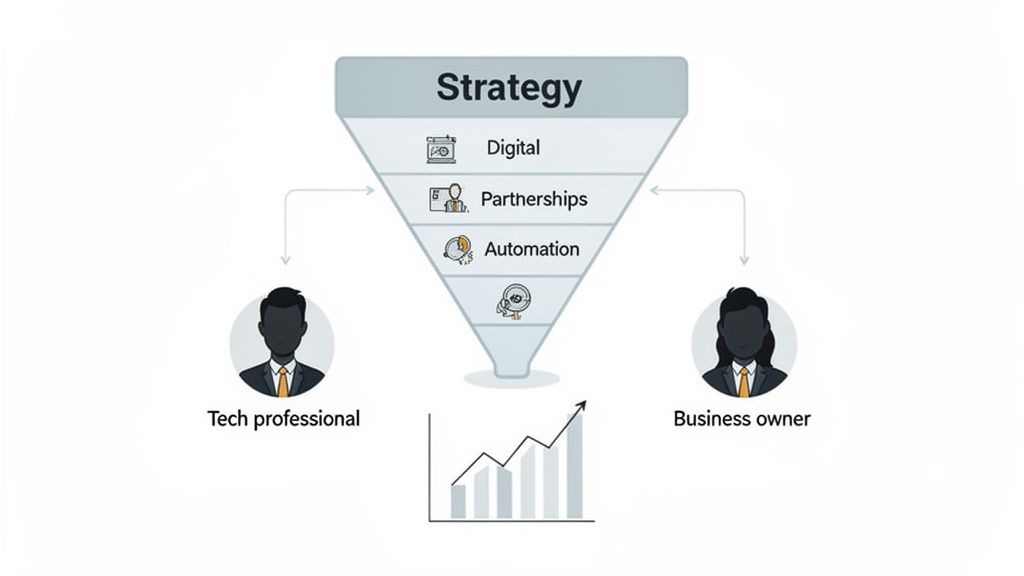
Let's be blunt: the traditional mortgage lead playbook is broken. It was built on high-effort, low-return activities that create a feast-or-famine pipeline, leaving business growth to chance. For today's executive, the real goal is to build a system—a powerful asset that delivers qualified opportunities day in and day out, with a clear line of sight to ROI.
This requires a fundamental shift in mindset. Instead of simply chasing individual leads, we need to architect an entire lead generation ecosystem. This system doesn't just capture initial interest; it nurtures it from the very first click all the way to closing, optimising for cost and efficiency at every step. To do this well, it’s crucial to be grounded in solid lead generation best practices.
This table illustrates the fundamental shift in thinking required for leadership to build a future-proof lead generation engine.
Strategic Shift in Mortgage Lead Generation
| Attribute | Traditional Approach (High Effort, Low ROI) | Modern Approach (Strategic, High ROI) |
|---|---|---|
| Focus | Volume of leads (quantity over quality) | Quality and conversion potential of leads |
| Methodology | Disconnected tactics (cold calls, generic ads) | Integrated, multi-channel system |
| Targeting | Broad, demographic-based | Precise, persona-driven targeting with behavioural data |
| Technology | Manual processes, basic CRM | AI-powered automation, advanced analytics |
| Measurement | Cost per lead (CPL) | Customer acquisition cost (CAC), LTV, and pipeline velocity |
| Pipeline Health | Unpredictable, inconsistent flow | Predictable, scalable, and forecastable |
The takeaway for leadership is clear: moving from a reactive, tactical approach to a proactive, strategic one turns your marketing function from a cost centre into a predictable revenue driver.
From Tactics to Strategic Systems
A truly strategic approach always starts with a deep, almost obsessive, understanding of your ideal borrower. We have to go far beyond broad demographics and build out precise customer personas that feel like real people with real problems we can solve.
Here are a couple of practical examples:
- The Salaried Tech Professional: Think of a 32-year-old software engineer in Bengaluru, earning ₹25-30 lakh per annum. They're looking for their first home, likely a 2BHK in the ₹80 lakh to ₹1.2 crore range. Their primary pain points? Securing the most competitive interest rate (every 0.25% matters over 20 years) and a fast, frictionless, digital-first application process that doesn't demand multiple physical visits.
- The Business Owner: Now picture a 45-year-old entrepreneur in Mumbai who owns a small manufacturing unit with an annual turnover of ₹5 crores. They need to unlock capital for expansion by taking a loan against property. Their needs are completely different. They value flexible repayment terms, a higher LTV ratio, and an expert who can navigate complex income documentation. A standard, rigid process will lose their business.
When you define your audience with this level of clarity, everything else falls into place. Your ad copy becomes more compelling, your channel selection gets smarter, and the follow-up scripts—whether used by your team or an AI agent—resonate perfectly. This precision ensures every marketing rupee is spent attracting the exact borrowers you're best equipped to serve.
For leadership, the ultimate goal is to transform lead generation from a cost centre into a predictable revenue driver. This is achieved by creating a repeatable process where every input (marketing spend) generates a measurable and optimised output (closed loans).
Capitalising on a Growing Market
The timing for refining your strategy couldn't be better. The India housing loan market is enormous—valued at USD 329.9 billion in 2024—and it's not slowing down. Projections show it rocketing to USD 773.8 billion by 2033, growing at a robust CAGR of 8.90%.
This explosive growth, fuelled by government initiatives like the Pradhan Mantri Awas Yojana (PMAY) and a burgeoning middle class, is creating a surge in demand, especially in tier-2 and tier-3 cities where growth rates are 1.5x that of metros.
This isn't just about more volume; it's about connecting with the right borrowers in these rapidly emerging markets. A strategic, persona-driven approach is the only way to capture this incredible opportunity profitably and at scale, building a foundation for sustainable growth in an increasingly competitive field.
Weaving Together a High-Intent, Multi-Channel Strategy
A flood of leads is a vanity metric if none are qualified to convert. Pouring budget and team energy into chasing low-intent prospects is a direct path to margin erosion and burnout. The art of profitable lead generation lies in building a diversified mix of channels that consistently deliver serious borrowers who are actively in-market.
This means abandoning single-channel dependency. A robust strategy blends the precision of digital marketing with the high-trust referrals from offline partnerships. It’s about creating an ecosystem where channels reinforce each other, producing a predictable pipeline instead of erratic lead flow.
Mastering Digital Channels to Find Ready-to-Act Borrowers
Simply activating ads is a recipe for wasted capital. Winning online requires hyper-targeted campaigns that capture borrowers at the precise moment of intent. This involves a strategic interplay between paid advertising for immediate results and organic content for long-term, low-cost lead generation.
For paid campaigns on platforms like Google or Meta, precision is paramount. Generic ads attract "tyre-kickers," driving up your Cost Per Qualified Lead (CPQL).
- Go Deep on Keywords: Target long-tail, high-intent keywords like "best home loan interest rates for salaried employees" or "loan against property process in Mumbai". These queries come from users deep in their research phase. We've seen campaigns targeting these specific phrases achieve a 2-3x higher lead-to-application rate than those using broad terms like "home loans".
- Clone Your Best Customers: Utilise lookalike audiences. By uploading a list of your successfully closed loans (hashed for privacy) to a platform like Meta, its algorithm can identify and target new users who share thousands of similar data points. This is one of the most powerful tools for finding your next best customer at scale.
- Don't Let Good Leads Slip Away: A user who engages with your online mortgage calculator but doesn't complete the form is a high-value prospect. A retargeting campaign can follow them with ads showcasing compelling testimonials or highlighting a 24-hour approval promise. This simple tactic can increase overall conversion rates by up to 40%.
Beyond the immediate impact of paid ads, creating genuinely useful content is your ticket to a low-cost, long-term lead engine. A single, well-optimised blog post can pull in organic traffic for years. A huge part of this is making sure your website itself is structured correctly, which you can learn more about in our guide on on-page SEO signals.
The strategic sweet spot is combining the speed of paid ads with the compounding value of organic content. Ads capture immediate demand, while content builds brand authority and delivers a steady stream of high-quality inbound leads over the long term.
Building High-Yield Offline Partnerships
While digital provides scale, nothing beats the conversion rates of warm, pre-vetted leads from trusted offline partners. These aren't casual networking relationships; they are structured, mutually beneficial partnerships that generate a consistent flow of referral business. The key is to identify partners whose clients have a natural, recurring need for mortgage financing.
- Real Estate Developers: Establish formal agreements to become the preferred lender for new housing projects. This provides exclusive access to hundreds of buyers at the point of purchase. For a 200-unit apartment complex, securing preferred status could mean 50-100 direct loan applications with minimal acquisition cost.
- Wealth Managers and Financial Advisors: These professionals serve as trusted advisors to high-net-worth individuals (HNIs) who frequently require loans against property for investment or business purposes. By offering a white-glove, seamless service, you can become their go-to partner, creating a powerful referral engine for high-value loans.
- Corporate HR Departments: This is a fantastic, often overlooked channel. Partner with large corporations to offer their employees exclusive home loan benefits, such as a 0.10% interest rate reduction or waived processing fees. This positions your firm as the default choice for a large, creditworthy, salaried workforce.
This multi-channel approach is particularly powerful in a market where homeownership is a major goal. In India's booming mortgage market, for example, purchase mortgages are expected to make up a massive 70.68% share in 2025. Government initiatives, like subsidies and allowing 90% loan-to-value (LTV) ratios for loans under INR 30 lakh, have opened the door for millions of salaried professionals. This has created a huge pool of qualified borrowers, especially in tier-2 cities. For more on this, you can dig into the dynamics of the Indian mortgage market on Mordor Intelligence.
Ultimately, a multi-channel strategy is about de-risking your lead flow and maximising pipeline value. By strategically allocating resources between high-intent digital campaigns and structured offline partnerships, you're not just generating leads—you're building a resilient, predictable engine for sustainable growth.
Building a Funnel That Actually Converts Leads
You’ve done the hard work of driving high-intent traffic to your website. But this is where most businesses fail: turning that fleeting interest into a tangible opportunity. In the mortgage game, speed is everything.
Every second of delay in contacting a new lead exponentially decreases your chance of conversion. The data is unequivocal: studies show that reaching out to a web lead within five minutes makes you nine times more likely to convert them.
This makes your lead capture and qualification funnel your most critical business asset. It’s not just a "contact us" form. It’s an engine engineered for speed, designed to capture essential data and initiate qualification instantly, eliminating the manual delays that kill deals.
Your Landing Page: The First Handshake
Think of your landing page as the digital front door to your business. Its sole purpose is to convert a visitor into a lead by persuading them to share their information. A cluttered, confusing page with a weak message will cause them to bounce. For executives, optimising these pages isn't a minor tweak—it's a direct lever to lower your customer acquisition cost (CAC).
Every high-performing landing page must have these elements:
- A No-Nonsense Value Proposition: Your headline must immediately answer the visitor's core question: "What's in it for me?" A generic headline like "Home Loan Services" is ineffective. A powerful alternative like "Get a Pre-Approved Home Loan Offer in 24 Hours" promises a specific, valuable, time-bound outcome.
- Simple, Mobile-Friendly Forms: In 2024, with over 50% of web traffic coming from mobile, your forms must be frictionless on a small screen. Start with the absolute minimum: name, phone, and email. Data shows that every additional field can decrease your conversion rate by up to 11%.
- Proof You’re the Real Deal: Trust is non-negotiable. Displaying testimonials, logos of real estate partners, or the number of loans you've successfully closed builds immediate credibility. A simple quote like, "The process was incredibly fast and transparent," can be the final nudge a hesitant prospect needs.
This flowchart shows how leads from different channels should all feed into one central capture system.
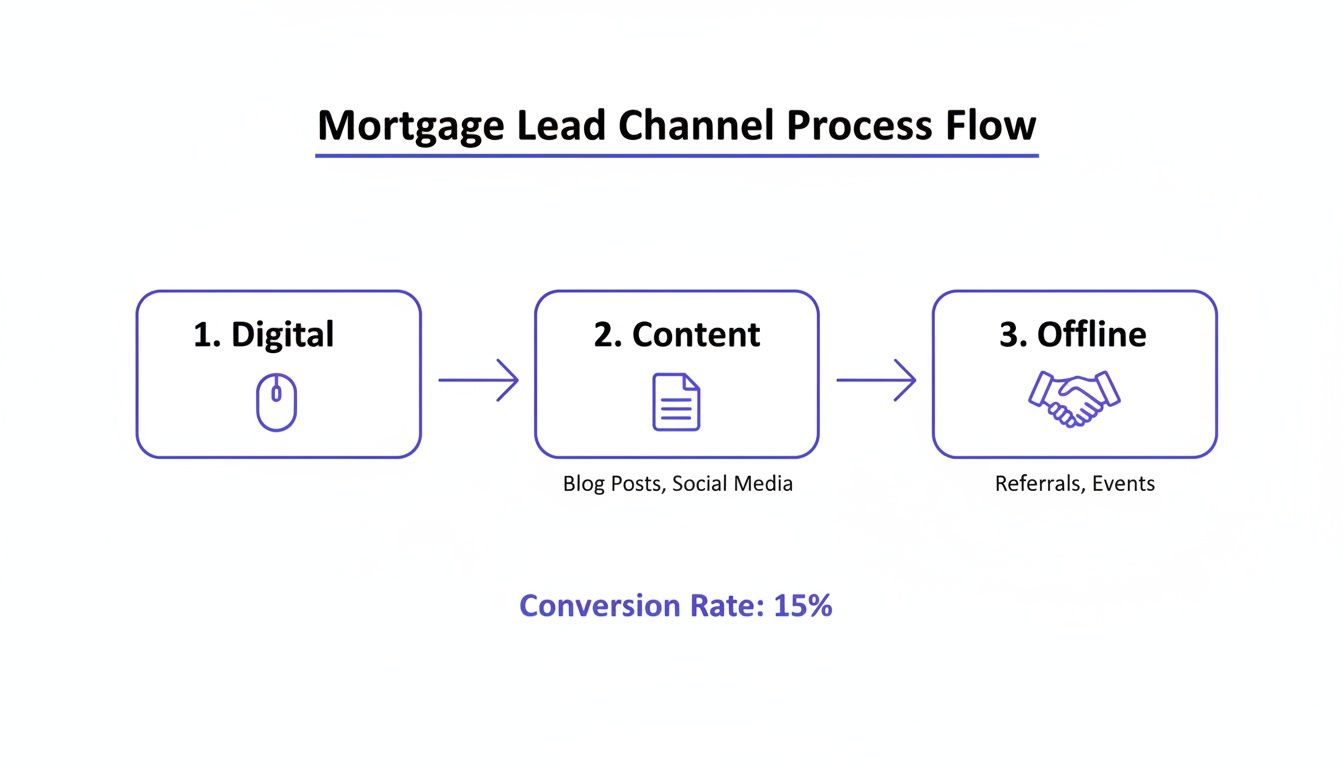
As you can see, whether a lead comes from a digital ad, a blog post, or a referral, it must go into an optimised funnel. To really dig into why people are leaving your pages, it's worth learning how to audit bounce and exit rate analytics to increase conversions.
Automate Qualification to Engage Instantly
This is where you can achieve massive operational leverage. The traditional model—a form submission lands in an inbox, waiting for a loan officer to manually follow up—is a recipe for failure. That delay, whether hours or days, is precisely where leads go cold.
Practical Scenario: A prospect fills out your form at 8 PM. With the old model, they hear nothing until 10 AM the next day, by which time they've already spoken to two competitors. With an automated system, their phone rings in under 60 seconds. That immediate, 24/7 engagement fundamentally changes the outcome.
This isn't science fiction; it's the operational reality of modern Voice AI. The moment a lead is captured, an automated workflow triggers an AI agent to place a call. This is not a robotic, spammy call. It’s a smart, conversational tool designed to qualify leads with speed and precision.
Here's how a real-world AI qualification flow operates:
- The Instant Call: A lead submits your form. Within 60 seconds, their phone rings. The AI introduces itself: "Hi, this is a call from ABC Mortgages regarding the home loan enquiry you just made. Do you have a moment to confirm a few details?"
- Gathering Key Info: The AI asks essential qualifying questions conversationally.
- "To help us find the best options, could you confirm the loan amount you have in mind?"
- "And are you a salaried professional or self-employed?"
- "Great, and which city are you looking to buy a property in?"
- Smart Routing: The AI instantly processes the answers. If the lead meets your pre-defined criteria (e.g., salaried, loan amount > ₹50 lakh), it proceeds. If not, the process stops, saving your team's valuable time.
- Hands-Free Scheduling: The AI seamlessly books the next step: "Excellent. Based on your requirements, our senior loan advisor is the best person to help. They have availability tomorrow at 11 AM or 2 PM. Which time works for you?" The appointment is then automatically created in the correct loan officer's calendar.
This automated system transforms your funnel. It guarantees every lead receives immediate attention, shields your loan officers from unqualified prospects, and ensures they only spend their time on pre-vetted, high-potential conversations.
Scaling Outreach and Follow-Up with Voice AI

Inconsistent follow-up is the silent killer of any mortgage pipeline. It’s a scenario every executive has witnessed: a high-intent lead enters the system at 9 PM on a Tuesday, only to languish until a loan officer sees it the next afternoon. By then, they’ve already engaged with two competitors. That’s how a valuable lead, acquired at significant cost, becomes a wasted marketing expense.
This isn't a small leak; it's a massive hole in the revenue bucket. The solution isn't demanding more from your team; it's re-architecting the outreach process itself. It requires a shift from a manual, high-cost operation to a data-driven, automated asset that functions 24/7. This is precisely where Voice AI provides a solution for speed and scale with ruthless efficiency.
Overcoming the Manual Bottleneck with Intelligent Automation
The traditional approach of manual dialling by loan officers or call centres is fundamentally broken. Human agents are limited by working hours, call capacity, and variable performance. It's no surprise the industry average connect rate for manual dialling often struggles to surpass 50%. This means half of your marketing spend is potentially wasted before a conversation even begins.
Voice AI completely inverts this model.
By automating the first touchpoint, you guarantee every lead receives a call within seconds of their enquiry, regardless of the time of day. These are not the clunky, robotic calls of the past. Today's conversational AI agents can hold human-like conversations, building rapport while systematically qualifying the lead against your specific criteria.
The impact on key performance indicators (KPIs) is dramatic. For mortgage lead specialists like DialNexa, the results are clear. They have seen connect rates jump from a typical 47% with manual dialling to a consistent 91% using Voice AI agents. They are converting raw leads into qualified, sales-ready opportunities with 97% accuracy, matching the judgment of human experts. This is a strategic game-changer.
Deploying Proven Conversation Flows for Key Scenarios
The strategic power of Voice AI lies in its ability to execute multiple, tailored conversation flows simultaneously and at scale. You can design specific scripts to handle different stages of the borrower journey, ensuring every interaction is consistent, compliant, and effective. This transforms chaotic, ad-hoc follow-up into a reliable, measurable system.
Here are a few high-impact scenarios where Voice AI excels:
- Instant Lead Qualification: The moment a lead enters your CRM, the AI calls. "Hi, I see you enquired about a home loan. To quickly find the best options, could you tell me if you're a salaried professional or self-employed?" This single, immediate question filters out unqualified leads instantly, saving countless hours for your sales team.
- Document Collection Nudges: Chasing borrowers for documents is a notorious time-sink. An AI agent can manage this with friendly, persistent reminders. "Hi Priya, just a quick call from XYZ Mortgages. We're still awaiting your PAN card and salary slips to move your application to the next stage. Do you need any help finding where to upload them?" This can reduce the document collection cycle time by an average of 3-4 days.
- Waking Up Old Leads: Your CRM is a goldmine of dormant leads. An AI can systematically work through this list with a soft re-engagement script. "Hi Rahul, this is a call from XYZ. You spoke with us about a home loan six months ago. We've just launched new products with lower interest rates and wanted to see if you were still in the market." This can reactivate 5-10% of your "dead" leads for nearly zero incremental cost.
For leadership, the strategic advantage is crystal clear. By implementing Voice AI, you can transform a standard 2% lead-to-booking rate into a predictable 8% or higher. This isn’t just a small bump; it fundamentally changes your unit economics and overall profitability.
From Cost Centre to Strategic Asset
By automating the repetitive, low-value tasks of outreach, Voice AI liberates your skilled loan officers to focus on what they do best: building relationships and closing deals with qualified, high-intent borrowers. They spend their days engaged in valuable conversations, not chasing down leads and leaving voicemails.
This is the key to scalable growth. It allows you to handle a significantly larger volume of enquiries without proportionally increasing headcount, thereby protecting your margins. The AI-driven system becomes a predictable engine that turns marketing spend into qualified appointments, making forecasting more accurate and growth far more sustainable. To see more on how this technology is reshaping the industry, you can read about revolutionising outbound communication for mortgage brokers with Voice AI.
Measuring ROI and Optimising Your Lead Generation Engine
In the mortgage business, you can't manage what you don't measure. A modern lead generation for mortgage programme cannot operate on guesswork or vanity metrics like website clicks. For executives, the only language that matters is the language of business outcomes. This necessitates a robust analytics framework that tracks performance from initial ad spend directly to closed-loan revenue.
Your entire strategy lives or dies by your ability to track the KPIs that connect marketing investment to revenue. It’s about shifting the internal conversation from, "How many leads did we get?" to "What was our customer acquisition cost and the resulting lifetime value?" This is how you transform marketing from a perceived cost centre into a predictable, data-backed revenue engine.
Moving Beyond Vanity Metrics to Business Impact
The first step is establishing a single source of truth—an executive dashboard that provides a clear view of performance, with the ability to drill down into channels, campaigns, and even individual loan officer productivity. This transparency is what enables agile, data-informed decisions on budget allocation.
Instead of getting lost in metrics like impressions or click-through rates, your focus must be on the KPIs that measure the true health and efficiency of your sales pipeline.
As a leader, your dashboard shouldn't be a complex spreadsheet of marketing activities. It should be a clear, concise report on business health, answering one key question: Is our lead generation engine operating profitably and at scale?
Here are the core metrics that should be on every mortgage executive's radar:
- Cost Per Qualified Lead (CPQL): Far more insightful than Cost Per Lead (CPL), this metric tells you the precise cost to generate a lead that meets your pre-defined qualification criteria and is ready for a sales conversation.
- Loan Application Rate: Of all the qualified leads you generate, what percentage takes the crucial next step and submits a full loan application? A low rate here (e.g., below 10%) signals a potential friction point in your process or a disconnect in your messaging.
- Customer Acquisition Cost (CAC): The ultimate bottom-line metric. It calculates the total sales and marketing cost required to acquire one new, funded loan. A healthy business model requires a CAC that is significantly lower than your Loan Lifetime Value (LTV).
To get a clearer picture of how to approach these numbers, let’s look at the key performance indicators you should be tracking.
Key Performance Indicators for Mortgage Lead Generation
The table below breaks down the essential metrics executives should track to measure the health and ROI of their lead generation efforts. It’s not just about knowing the numbers; it’s about understanding what they mean and what actions to take.
| KPI | What It Measures | Industry Benchmark (Example) | Optimisation Strategy |
|---|---|---|---|
| Cost Per Qualified Lead (CPQL) | The marketing cost to acquire one pre-vetted, sales-ready lead. | ₹2,500 – ₹5,000 | Refine ad targeting to niche audiences, A/B test landing page headlines, and use AI to qualify leads instantly and cost-effectively. |
| Loan Application Rate | The percentage of qualified leads that submit a formal application. | 15% – 25% | Simplify the application form (reduce fields by 20%), offer live chat support, and deploy automated SMS/email reminders to combat abandonment. |
| Customer Acquisition Cost (CAC) | Total cost to acquire one closed loan, including all marketing and sales expenses. | ₹50,000 – ₹80,000 | Optimise the entire funnel from CPQL to closing rate. A 10% improvement in conversion at each stage can lower CAC by over 25%. |
Tracking these KPIs provides a clear, data-backed view of your funnel's performance, helping you pinpoint exactly where to focus your optimisation efforts for the biggest impact.
Creating a Continuous Optimisation Loop
Data is only valuable when acted upon. The most successful mortgage lead generation programs operate on a continuous loop: test, measure, and refine. This data-first culture ensures that every component of your funnel is constantly being improved to maximize performance.
This isn’t about making high-risk gambles. It’s a disciplined process of incremental improvement, typically through A/B testing, where you systematically test variables to see what resonates with your target borrowers.
- Ad Copy & Creatives: Test different value propositions. For instance, does an ad focused on "Lowest Interest Rates Guaranteed" outperform one highlighting "24-Hour Approval" for your salaried professional persona?
- Landing Page Elements: Experiment with your calls-to-action. Does a button that says "Get Pre-Approved Now" convert better than "Check Your Eligibility"? Even a simple color change can lift conversion by a few percentage points.
- AI Call Scripts: A major advantage of using a Voice AI is the ability to A/B test entire conversation flows. For example, does asking about employment type before the desired loan amount improve qualification rates by reducing call duration for non-target leads?
By isolating and testing one variable at a time, you can systematically improve conversion rates at every stage. A 5% improvement on your landing page and another 5% lift from an optimised AI script might seem small, but these gains compound across thousands of leads, dramatically lowering your CAC and building a machine for predictable, profitable growth.
Scaling Up Without Breaking Down: Future-Proofing Your Mortgage Business
Rapid growth is the objective, but it introduces significant operational and compliance risks. When lead volume scales from hundreds to thousands per day, legacy systems buckle. The challenge isn't just handling more calls; it's building an operational backbone that can scale without cracking under the weight of regulatory scrutiny and security threats.
For executives, the goal is to create a system that not only manages growth but actively shields the business from liability. This requires a tech stack that is both powerful and adaptable. Seamless CRM integration is table stakes; lead data must flow instantly and accurately. The real leverage comes from API-driven automation that handles lead assignment, schedules follow-ups, and logs every interaction without manual intervention, slashing the risk of costly human errors.
Building a Tech Stack That Bends, Not Breaks
As you scale, the sheer volume of documentation can grind your operation to a halt. This is a classic bottleneck. To get ahead of it, you must integrate smart technology like mortgage banking document automation solutions. These tools do more than just accelerate processing; they enforce consistency and accuracy, which is critical for regulatory audits.
Your technology must also be agile enough to pivot with market trends. Consider the current landscape: in 2025, floating-rate loans are projected to hold an 83.40% share of India's home loan market as borrowers anticipate rate cuts. This shift is creating a massive wave of refinance enquiries. Simultaneously, the loan against property (LAP) market is growing at a 15.02% CAGR as SMEs leverage home equity for capital. A scalable system allows you to spin up targeted campaigns to capture these specific opportunities in real-time. You can get more details on these mortgage lead generation trends on Boomsourcing.com.
Locking Down Compliance and Data Security
In the mortgage industry, data isn’t just an asset; it's a significant liability if mishandled. We deal with PAN details, salary slips, and bank statements—highly sensitive information that demands an obsessive focus on security. Your systems must be fortresses, with end-to-end encryption protecting data at rest and in transit.
This is where a tool like Voice AI offers a dual advantage of efficiency and compliance.
Every single conversation a Voice AI agent has is automatically recorded and transcribed. This creates a complete, immutable, and auditable trail of every interaction. For compliance teams, this is invaluable. It provides verifiable proof that mandatory disclosures were delivered correctly, every single time.
This automated record-keeping eliminates human error from critical compliance scripts, such as obtaining consent to contact or reading out licensing information. It guarantees that every lead interaction adheres to regulatory standards, building a robust, defensible compliance posture that protects the company as it scales.
By strategically layering automation, prioritising data security, and leveraging technology to enforce compliance, you are not just building a lead generation machine. You are building a resilient, future-proof business designed to thrive and lead in a demanding industry.
At DialNexa, we provide the scalable Voice AI infrastructure to help you grow your mortgage operations safely and efficiently. Our agents ensure every lead is contacted instantly while maintaining perfect compliance through auditable, recorded interactions. Discover how our human-like AI can future-proof your business.

[…] That matters for both clients and referral partners. Stronger operational follow-up supports data-driven mortgage lead strategies because leads convert better when the process behind them is timely and […]
[…] adjacent partnership models, mortgage lead generation workflows are worth studying because financing education often starts before a site visit and can materially […]
This is an insightful and data-driven guide that brilliantly reframes mortgage lead generation as a scalable revenue engine rather than a collection of disconnected tactics. The emphasis on AI, multi-channel strategies, and measurable ROI provides a powerful blueprint for sustainable growth in a rapidly evolving market.
Excellent breakdown of modern mortgage lead generation strategies! The practical insights, data-backed approach, and focus on AI-driven automation make this a highly valuable guide for driving scalable business growth.