

AI in Real Estate Industry: CXO Guide for 2026
$404.9 billion. That is the projected size of the global AI-in-real-estate market in 2026, with forecasts reaching $1,303.09 billion by 2030 at a 33.9% CAGR according to The Business Research Company's AI in real estate market report. For an Indian executive team, that number matters less as a global headline and more as a signal that AI has moved from experimentation into commercial infrastructure.
Most boardroom conversations still frame ai in real estate industry around valuation engines, dashboards, and website chatbots. That framing is incomplete. In India, the sharper commercial question is operational: which AI use case changes revenue velocity fastest in a market where buyers enquire across multiple channels, compare projects aggressively, and still expect a human-quality response before they commit to a site visit?
The answer, in many organisations, isn't another analytics layer. It's AI that improves speed-to-lead, qualification quality, and site-visit booking discipline at scale, especially across phone-led and multilingual workflows.
Table of Contents
- The Inevitable Shift AI in the Real Estate Industry
- Decoding AI for Real Estate Executives
- Core AI Applications Transforming the Value Chain
- The C-Suite View Business Benefits and Strategic KPIs
- A Phased Roadmap for AI Implementation
- AI in Action Indian Real Estate Scenarios
- Future Frontiers and Mitigating Critical Risks
The Inevitable Shift AI in the Real Estate Industry
Indian real estate loses revenue in the first few minutes after an enquiry arrives. In many firms, that loss has less to do with weak demand than with slow response, inconsistent qualification, and missed follow-up across languages, channels, and project teams.
That is why AI has moved from an innovation topic to an operating model decision. A developer or brokerage that can respond to every inbound lead, qualify intent in the customer's preferred language, and book site visits without delay starts with a structural advantage over competitors still relying on manual call-backs and fragmented CRM workflows.
In India, the highest-return use case is often not automated valuation or website chat. It is Voice AI applied to speed-to-lead. The commercial logic is straightforward. Residential sales teams handle large enquiry volumes from property portals, digital campaigns, broker referrals, and walk-in spillover. Only a small share of those enquiries are sales-ready. If the filtering process depends on agent availability, language fit, and manual scheduling, conversion slows and acquisition cost rises.
This makes ai in real estate industry a workflow redesign agenda, not a software buying exercise. The winners won't be the firms with the most AI tools. They will be the firms that apply AI at the points where response time affects conversion, where qualification quality affects sales productivity, and where inconsistent follow-up weakens customer experience.
Board-level implication: AI is becoming part of revenue infrastructure. It now influences lead monetisation, sales efficiency, and service consistency.
For leaders tracking the broader shift in PropTech and large language model adoption, this overview of generative AI in real estate is a useful complement, placing automation, content, and decision support in a wider commercial context.
A practical executive lens starts with three questions:
- Where do leads leak first: missed calls, delayed callbacks, weak screening, or poor handoff to project sales teams?
- Where does language reduce conversion: Hindi, English, Tamil, Telugu, Marathi, or other customer preferences that frontline teams cannot cover consistently?
- Where does administrative drag slow revenue teams down: follow-ups, site-visit scheduling, CRM updates, or broker coordination?
Executives who answer these questions candidly usually find that early AI value appears in narrow, repeatable tasks with measurable commercial outcomes. In the Indian context, multilingual Voice AI stands out because it improves contact rates, protects media spend, and gives human sales teams more time for high-intent conversations and on-site closure.
For a plain-English explanation of the language systems behind these workflows, this primer on natural language processing for non-technical teams is a useful reference.
Decoding AI for Real Estate Executives
AI is easiest to understand when you stop treating it as one technology. In practice, it behaves like a team of specialised digital staff. One acts like a super-analyst. Another acts like a super-agent. A third acts like a super-inspector.

AI as a commercial workforce layer
For a CXO, that analogy matters because it ties capability to business function.
Machine learning works like a super-analyst. It reviews historical sales, listing behaviour, local inventory movement, and comparable properties far faster than an analyst team could manage manually. In real estate, this is what powers pricing support, forecasting, and lead scoring.
Natural language processing, or NLP, works like a super-agent. It understands what buyers say or type, extracts intent, and keeps a conversation moving. In practical terms, that means screening inbound enquiries, answering routine questions, and capturing budget, location, and timeline requirements. If you want a plain-English primer, this explanation of natural language processing is useful for non-technical leadership teams.
What each AI capability does in practice
Computer vision works like a super-inspector. It analyses photos and visual inputs to identify property attributes that influence pricing and desirability. That matters because two homes with the same broad location can still differ meaningfully on condition, fit-out, view, floor, or amenity access.
These capabilities become commercially useful when they are embedded into business workflows:
- For developers: AI can support launch pricing, demand sensing, enquiry routing, and project-specific follow-up.
- For brokerages: AI can help teams qualify large inbound volumes, rank serious buyers, and reduce wasted advisor time.
- For asset operators: AI can streamline repetitive service interactions, document handling, and issue triage.
AI should be judged like a business hire. If it doesn't improve throughput, judgement quality, response speed, or cost structure, it's not solving the right problem.
A common mistake is to ask whether AI can replace a broker, sales manager, or valuation professional. That's the wrong lens. The better question is where AI can absorb the repetitive front-end load so experienced staff can spend more time on negotiation, persuasion, exceptions, and relationship building.
That distinction is critical in the Indian market. Buyers still want trust signals. They still ask layered questions. They still compare multiple options before they commit. AI works best when it handles scale and consistency, while human teams handle nuance and closure.
Core AI Applications Transforming the Value Chain
Real estate firms rarely need one monolithic AI programme. They need targeted applications across the value chain. The most effective deployments solve a specific commercial friction point first, then extend into adjacent workflows.
Lead generation and sales acceleration
The highest-ROI use case for many Indian teams is inbound and outbound lead handling. Speed matters most in this area, and inconsistency costs the most. A prospect who calls after seeing a listing or campaign doesn't want a delayed callback. They want clarity on price range, location fit, inventory type, and next steps immediately.
This is why voice-led qualification deserves more executive attention than it gets. Matterport's analysis of AI in real estate notes that Morgan Stanley estimates AI could automate 37% of tasks in real-estate-related firms. In an Indian developer or brokerage setting, that automation is most commercially useful when it standardises first response, captures buyer constraints, and routes high-intent enquiries to closers quickly.
A practical sales workflow often looks like this:
- First contact handling: AI answers calls or initiates follow-up without queue delays.
- Qualification logic: It captures budget, preferred micro-market, property type, purchase timeline, and financing intent.
- Routing decision: It passes high-intent leads to the relevant project team and filters low-intent or incomplete enquiries into nurture flows.
- Booking action: It moves qualified prospects towards a site visit, callback, or meeting.
For teams exploring call operations in more depth, this guide to data for real estate calling is relevant because lead quality in calling programmes depends heavily on the structure and freshness of the underlying data.
Valuation and market analytics
Valuation remains important, but executives should understand what makes AI-based valuation reliable and what undermines it. The central challenge is not model sophistication alone. It is input quality.
According to CData Labs' analysis of real estate data strategy, automated valuation models perform better when they ingest richer signals than basic records alone, including listing details, live market activity, geospatial enrichment, and computer-vision features from photos. The same analysis notes that timely updates matter because stale comparable data can materially weaken estimate quality.
That has a direct implication for India. In dense urban markets, a project's tower, facing, floor level, view, and amenity adjacency can drive meaningful pricing variation. A simplistic model won't capture that. A better approach combines multiple local feeds, updates frequently, and treats valuation as a living operational process rather than a quarterly reporting tool.
Practical rule: If your comparables arrive late, your pricing intelligence arrives late too.
Post-sales operations and portfolio management
The third application cluster sits after the sale or lease. Here, AI is less visible to the customer but still valuable to the enterprise.
It can help with:
- Document handling: extracting, sorting, and summarising repetitive paperwork
- Resident or tenant service workflows: triaging requests and standardising responses
- Smart property management: supporting issue detection, energy workflows, and recurring service coordination
The strategic point is simple. AI creates value when it removes low-judgement work from skilled teams. In sales, that means fewer missed or weakly qualified calls. In valuation, it means more responsive pricing. In operations, it means less administrative drag.
The C-Suite View Business Benefits and Strategic KPIs
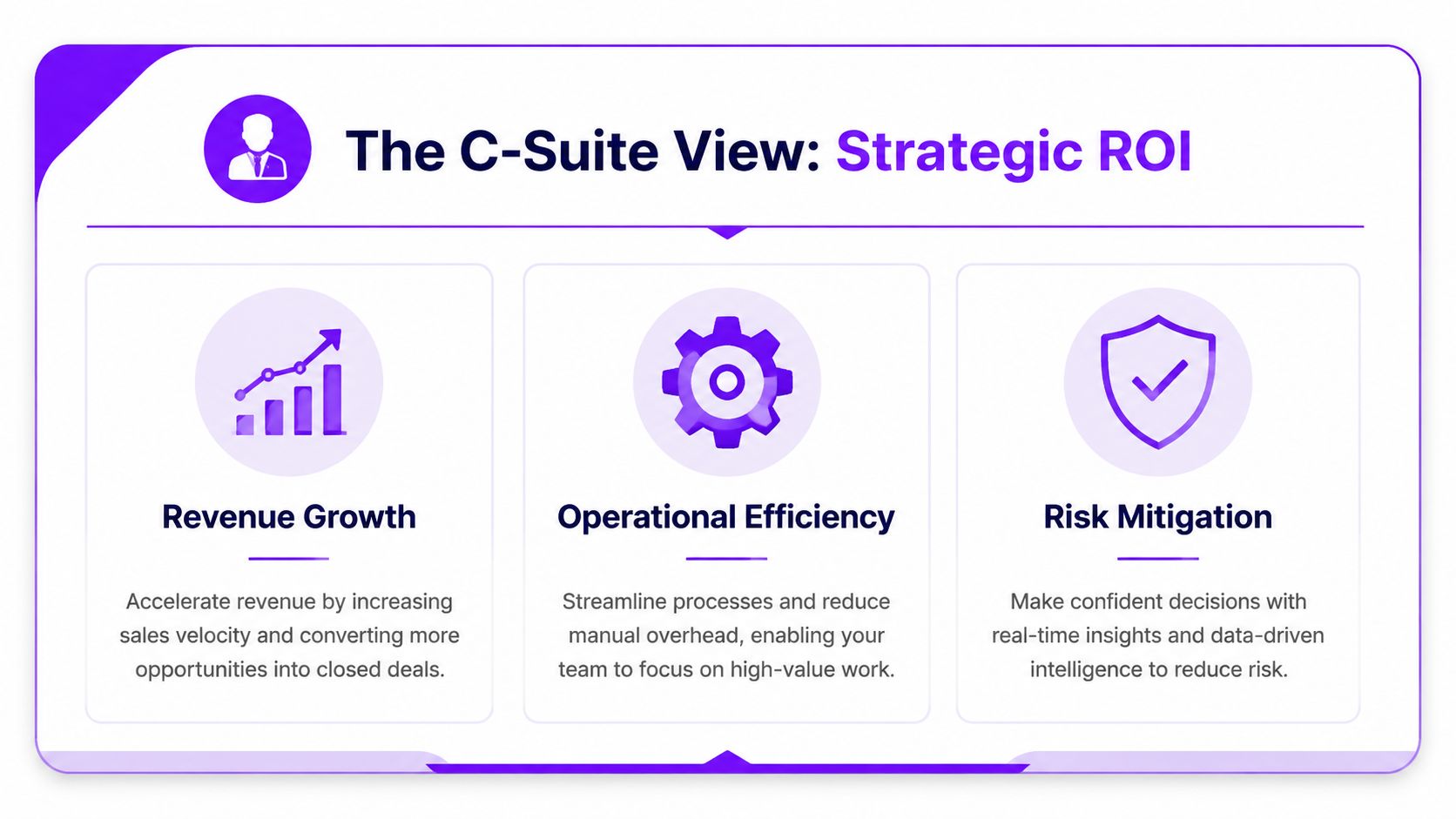
Executives don't buy AI applications. They fund operating outcomes. The right business case therefore starts with three impact lines: revenue growth, efficiency gain, and risk control.
A useful benchmark comes from the broader market. According to Jadhavar Business Intelligence's market report on artificial intelligence in real estate, over one-third of real estate firms globally use AI for areas such as property valuation and lead generation. The same report cites operational cost reductions of 10–20%, and notes that AI-powered automated valuation models can assess thousands of properties with accuracy levels exceeding 80–85% in mature markets. For Indian executive teams, the exact number is less important than the pattern. AI is already delivering measurable commercial outcomes when applied to repeatable workflows.
Where executives should expect value
Revenue growth comes from faster response, better prioritisation, and stronger conversion discipline. A sales team that speaks first to high-intent buyers will usually outperform one that treats all enquiries equally.
Operational efficiency comes from automation of repetitive tasks. That includes first-response handling, basic qualification, reminders, scheduling support, and document workflows. Cost reduction matters, but so does management visibility. Standardised AI workflows make process leakage easier to detect.
Risk mitigation is the least discussed benefit and often the most durable. Better data capture, consistent qualification logic, clearer logs, and structured documentation all improve management control.
The strongest AI business case usually combines one visible gain for revenue teams and one quieter gain for operations or compliance.
Mapping AI applications to executive KPIs
| AI Application | Primary Business Benefit | Affected KPI |
|---|---|---|
| Voice AI for inbound lead qualification | Faster first response and better lead screening | Lead response time, qualified lead rate, site visits booked |
| AI-assisted lead scoring | Better prioritisation of sales effort | Sales productivity, conversion quality, follow-up efficiency |
| Automated valuation models | More consistent pricing support | Pricing accuracy, time to quote, absorption planning |
| Predictive market analysis | Better launch and inventory decisions | Sales velocity, inventory mix alignment, pricing discipline |
| Document automation | Lower manual processing load | Turnaround time, back-office productivity, error reduction |
| AI for property operations | More consistent service workflows | Service response consistency, operating efficiency |
A leadership team should also insist on one principle. Every AI initiative must attach to a KPI already reviewed by the executive committee. If the metric is not already part of management reporting, the project risks drifting into innovation theatre.
A Phased Roadmap for AI Implementation
Most failed AI programmes share one trait. They start too broad. Real estate firms get better outcomes when they begin with a narrow workflow that is commercially painful, operationally repetitive, and easy to measure.

Phase one audit and prioritise
Start with a process audit, not a vendor shortlist. Identify where the organisation loses time, money, or opportunities. In many Indian firms, the shortlist includes missed calls, weak lead qualification, delayed follow-up, and inconsistent booking of site visits.
A useful audit looks at four questions:
- Where does the current process fail most often
- Which tasks repeat at high volume
- What data is already captured and what is missing
- Which KPI can prove business impact fastest
At this stage, don't aim for a perfect enterprise architecture. Aim for a decision on the first use case.
Phase two pilot and prove
The pilot should be contained. One city, one project cluster, one campaign source, or one call queue is usually enough. The point is to compare performance before and after the intervention using existing business measures such as contact rates, qualified lead share, and site-visit booking discipline.
A strong pilot has these traits:
- Clear ownership: one business leader, one operations lead, one technology counterpart
- Tight scope: no sprawling requirements list
- Defined handoff rules: when AI continues, when a human takes over
- Review cadence: leadership sees the operating data regularly
Start where your team already complains the loudest. That usually marks the process with the clearest hidden cost.
Phase three scale and govern
Once a pilot shows measurable value, scale should focus on integration and governance. That means linking AI outputs into CRM, standardising qualification logic across teams, and ensuring managers can audit interactions, exceptions, and outcomes.
Three things become important at scale:
- Data discipline: keep lead fields, call outcomes, and disposition codes clean
- Policy discipline: define approval rules, escalation thresholds, and compliance checks
- People discipline: train teams on how to work with AI rather than around it
This is also where procurement decisions become more practical. A firm may combine internal analytics, CRM-native automation, and specialist tools. For voice-led workflows, products such as DialNexa can be used to handle qualification and booking conversations at scale, provided the deployment is tied to a clear process and management KPI rather than treated as a stand-alone experiment.
AI in Action Indian Real Estate Scenarios
The strategic value of AI becomes clearer when placed inside an actual operating model. Two Indian scenarios illustrate where returns are most likely to show up.

Scenario one pricing a new tower with better market signals
A residential developer is preparing to launch a new tower in a competitive urban corridor. The traditional pricing process relies on periodic comp reviews, broker sentiment, and internal judgement. That works, but it often struggles with micro-market variation. A higher floor in the same building, a different facing, or stronger amenity access can shift buyer willingness materially.
An AI-led pricing workflow improves the process by ingesting listing-level data, local inventory movement, geospatial context, and image-based property features. Instead of treating pricing as a one-time pre-launch decision, the developer treats it as an adaptive process. Sales heads can then review emerging demand patterns and adjust inventory strategy more precisely.
This doesn't remove human judgement. It sharpens it. The leadership gain is better pricing confidence and faster reaction when the local market shifts.
Scenario two multilingual calling and site-visit conversion
The larger opportunity in India often sits elsewhere. A multi-city brokerage or developer may already generate substantial enquiry volume through portals, campaigns, broker referrals, and walk-in interest. The core issue is that the process is still phone-heavy, language-sensitive, and operationally inconsistent.
That challenge is still under-discussed in public coverage. PwC's discussion of AI moving into real estate supports the broader point that administrative and customer-facing tasks are increasingly being optimized with AI, while the practical Indian gap remains multilingual qualification and follow-up at scale. That is where many firms lose intent before a salesperson even speaks to the buyer.
A voice AI layer changes the sequence. It can answer immediately, ask structured discovery questions, recognise whether the buyer prefers Hindi, English, or another language, and move the enquiry towards a qualified booking path. For teams evaluating execution models, this practical guide to enterprise AI solutions is helpful because it focuses on deployable workflows rather than abstract AI ambition. For a step-by-step operating playbook on AI-led lead qualification and site-visit booking, see this AI for real estate leads guide.
The workflow is especially useful when paired with a dedicated AI voice agent for real estate approach that handles missed calls, first-touch qualification, and site-visit scheduling logic.
A short product walkthrough can help illustrate how this category works in practice:
The executive insight is straightforward. In India, AI's highest immediate ROI often comes from preserving intent between the first enquiry and the first serious sales conversation. That is less glamorous than predictive dashboards. It is usually more valuable.
Future Frontiers and Mitigating Critical Risks
The next phase of ai in real estate industry will create value less from novelty and more from integration. Better recommendations, richer digital asset views, and smarter building operations will matter. For Indian developers and brokers, though, the more immediate frontier is operational: AI systems that connect enquiry intake, multilingual voice qualification, appointment scheduling, document checks, and CRM workflows into one governed process.
That distinction matters at the executive level. Many firms will invest in visible AI features. The stronger commercial outcome will usually come from fixing the points where revenue leaks, compliance risk builds, or manual coordination slows decisions.
What is likely to expand next
Three capabilities are likely to mature over the next few years.
First, recommendation systems will improve as firms combine search behaviour, budget signals, micro-market trends, and channel data. That can improve match quality, but only if the underlying data is clean and current.
Second, pricing, absorption, and demand forecasting will become more responsive to local market shifts. This is useful for inventory release strategy, campaign timing, and discount control, especially in markets where buyer sentiment changes quickly.
Third, operational AI will move deeper into post-enquiry and post-sale workflows. In India, that includes multilingual voice systems for follow-up, site-visit coordination, collections reminders, resident support, and service-ticket triage. The strategic advantage is not just lower service cost. It is faster response times, better conversion discipline, and more consistent execution across projects and cities.
The three executive risks that need active management
Compliance is the first board-level risk. Real estate is document-heavy and regulation-sensitive. AI systems should operate within approval controls, privacy requirements, consent standards, and audit trails, particularly where customer communication, KYC, or transaction-related records are involved. Human review remains necessary for high-stakes decisions.
Cost is the second. AI projects fail less because the models are weak and more because ownership is vague, workflows are poorly defined, or teams cannot tie deployment to a business metric. A narrower use case with clear KPIs usually produces better returns than a broad platform rollout with unclear accountability.
Culture is the third. Sales, channel, and operations teams will resist tools they do not trust, especially if those tools appear to interfere with client relationships. Adoption improves when leaders define where AI handles repetition, where managers intervene, and how performance will be measured.
A final risk is often underestimated: bad data handled at scale. The National Association of Realtors' discussion of AI ROI for land professionals points to practical value in reconciling conflicting parcel records, summarising zoning issues, and spotting suspicious transaction patterns. In India's fragmented and document-heavy property environment, this means some of the most defensible ROI may come from reducing avoidable errors, compliance exposure, and fraud risk rather than from replacing labour.
Firms that build AI as a managed operating capability, with governance, ownership, and measurable workflow outcomes, will scale faster without adding equivalent process friction.
If your team is assessing where Voice AI fits into lead qualification, site-visit booking, or high-volume customer conversations, DialNexa Labs Private Limited is one option to evaluate. Its platform is built for human-like voice workflows across industries including real estate, with use cases centred on qualification, presales, support, and structured call handling at scale.

[…] The company focuses on human-like voice AI agents for qualification, presales, support, and routing. For developers, brokerages, and channel sales networks, that means automating property discovery calls, booking site visits, sending reminders, handling basic KYC guidance, and routing prospects to the right human team at the right stage. The strategic value is straightforward. Sales capacity is expensive, and repetitive calling work rarely deserves top-performing agents. DialNexa shifts that workload into software while keeping human closers focused on high-intent conversations. Its positioning is clear in these real estate voice agent workflows for property teams, and the broader category context is outlined in this analysis of how AI is being applied across the real estate industry. […]
This is an excellent and practical analysis of how AI can create measurable business value in Indian real estate. The focus on multilingual Voice AI, speed-to-lead, and KPI-driven implementation offers a realistic roadmap for CXOs looking to improve conversion, efficiency, and customer experience.