

8 Mission-Critical Sample Telephone Conversation Scripts for 2026
In today's competitive landscape, every telephone interaction is a critical data point that can either build or erode enterprise value. For C-suite leaders, optimising these conversations is not merely an operational task; it is a strategic imperative directly tied to revenue and customer retention. A single poorly handled call increases the likelihood of a customer switching to a competitor by 51%, representing a direct threat to market share.
Conversely, a well-orchestrated conversation can improve conversion rates by over 200%, turning a standard operational cost centre into a powerful profit generator. For businesses looking to optimize the effectiveness of their phone interactions, exploring advanced strategies to improve call center efficiency can transform customer touchpoints into powerful revenue engines. This is about engineering repeatable success at scale.
This article moves beyond generic advice to provide a strategic playbook. We will dissect eight mission-critical sample telephone conversation frameworks, engineered for high-stakes industries like BFSI, real estate, EdTech, and e-commerce. Each script includes actionable data points, precise dos and don'ts, and insights on how to deploy them at scale using advanced Voice AI. For instance, AI agents like DialNexa have demonstrated the ability to improve connect rates from 47% to 91% and achieve 97% accuracy in lead qualification. Consider this your blueprint for standardising excellence and turning every call into a measurable, high-value business outcome.
1. Property Inquiry & Site Visit Booking Script
A well-structured sample telephone conversation for property inquiries is a strategic asset for any real estate business aiming to convert leads into tangible opportunities. This script provides a repeatable framework for agents, human or AI, to capture crucial prospect information, address initial queries, and secure a site visit-often the most critical step in the sales funnel. It moves beyond a simple Q&A, guiding the conversation from broad interest to a confirmed appointment with efficiency and professionalism. For CXOs, this represents a standardised, optimisable process that directly impacts revenue by increasing high-intent meetings.
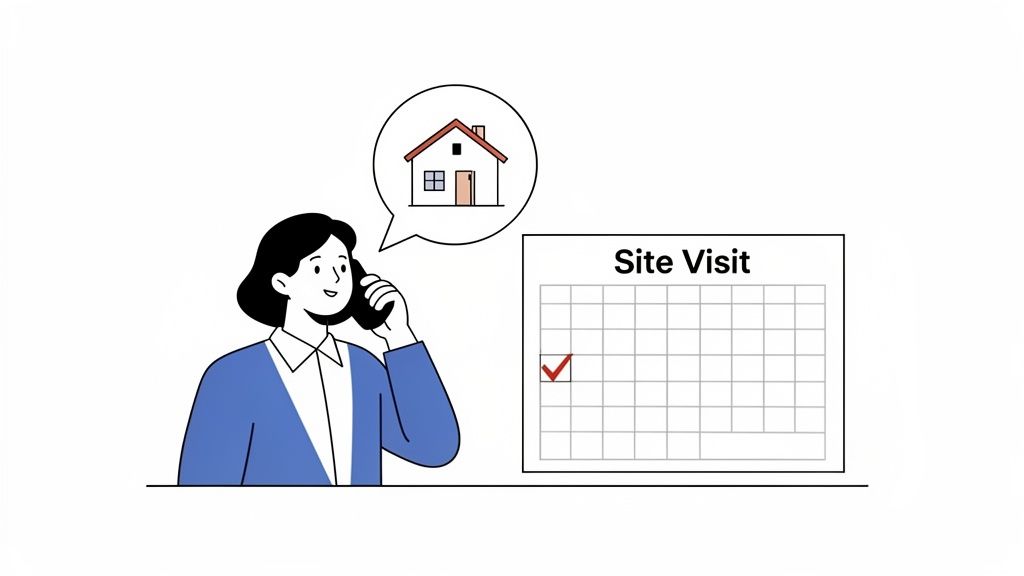
This approach is vital because the initial inbound call is a high-stakes moment. A fumbled or unstructured conversation can lose a valuable lead forever. By following a proven script, agents ensure they consistently qualify prospects on budget, timeline, and core requirements before investing time in a physical tour.
Why It Works: Data-Backed Success
The impact of a refined script, especially when automated with a Voice AI agent like DialNexa, is significant. Real estate brokerages have seen their lead-to-booking conversion rates quadruple from 2% to 8%. This is a direct result of immediate, 24/7 engagement and a perfectly executed, data-driven conversation every time.
Strategic Insight: Property consultancies leveraging AI-driven scripts report scheduling over 40 site visits weekly per agent on average, a task that would otherwise require significant manual coordination and follow-up. Furthermore, connect rates have soared from a typical 47% to an impressive 91%, ensuring almost no inbound lead is missed.
Actionable Tips for Implementation
To maximise the effectiveness of your property inquiry script, consider these tactical enhancements:
- Early Pre-qualification: Integrate questions about budget range and financing pre-approval early in the call to filter out less serious "tyre-kicker" inquiries. Practical Example: "To help me find the best options, could you share the budget range you're considering for this investment?"
- Dynamic Questioning: Use conditional logic to adapt the script in real-time. If a caller specifies interest in a 3-BHK flat, the script should automatically skip questions about 2-BHK availability.
- Real-time Calendar Integration: Connect your script (especially an AI-powered one) to your team's live calendar to offer and confirm available slots instantly, eliminating back-and-forth communication.
- Natural Pauses: Build in conversational pauses and acknowledgement phrases like "I see," or "That makes sense," to make the interaction feel more natural and less robotic.
- Offer Alternatives: Always have backup date and time options ready to propose if the prospect’s first choice is unavailable, increasing the likelihood of securing a booking.
2. EdTech Program Inquiry & Enrollment Script
An effective sample telephone conversation for EdTech inquiries is a critical tool for converting curious prospects into enrolled students. This script provides a structured pathway for academic counsellors, whether human or AI, to understand a learner's career aspirations, qualify their fit for a programme, and seamlessly guide them toward enrollment. It transforms a simple information request into a consultative dialogue, positioning the institution as a partner in the student's success. For EdTech executives, this translates to a scalable, repeatable process that boosts enrollment numbers and optimises the cost of student acquisition.
This structured approach is crucial because the first interaction often determines a student's decision in a highly competitive market. A well-designed script ensures every prospective student receives consistent, accurate information and personalised guidance, building the trust necessary to commit to a significant educational investment.
Why It Works: Data-Backed Success
Implementing a refined script, particularly when automated 24/7 with a Voice AI agent like DialNexa, delivers a substantial competitive advantage. EdTech platforms have observed their lead-to-application conversion rates surge from 4% to an impressive 11%. This improvement stems from immediate lead engagement and a perfectly tailored, empathetic conversation that addresses each learner's unique goals and concerns.
Strategic Insight: Online learning platforms using AI-driven scripts are successfully qualifying over 600 leads per day per programme, a volume that would be unmanageable for human teams alone. Furthermore, by automating the initial qualification, they have boosted the productivity of their human counsellors by 35%, allowing them to focus exclusively on high-intent, enrollment-ready candidates.
Actionable Tips for Implementation
To maximise the impact of your EdTech inquiry script, integrate these strategic enhancements:
- Segment by Programme: Develop unique script variations for different offerings (e.g., certificate vs. degree). A script for a data science bootcamp should focus on career outcomes, while one for a hobbyist course should highlight learning experience.
- Integrate Success Stories: Equip the script with powerful, concise student testimonials or placement statistics to use when handling objections about cost or programme value. Practical Example: "I understand the investment is a consideration. It's worth noting that 85% of our graduates in this program reported a salary increase of at least 20% within six months of completion."
- Ask About Prior Experience: Include questions about the caller's background early on. This helps tailor the conversation and accurately recommend the most suitable programme level.
- Offer a Clear Next Step: Instead of just ending the call, guide the prospect to a tangible action, such as scheduling a one-on-one with a senior counsellor, accessing a demo class, or starting an application.
- Provide Clear ROI Messaging: Frame the programme's benefits in terms of career advancement, mentioning specific data like average salary increases or job placement rates for graduates.
3. Customer Support & Issue Resolution Script
A well-defined sample telephone conversation for customer support is the backbone of operational efficiency and customer retention. This script provides a standardised framework for agents, both human and AI, to methodically diagnose issues, deliver accurate solutions, and manage escalations. It transforms customer service from a reactive cost centre into a structured, data-driven function that enhances brand loyalty. For CXOs, implementing such a script ensures consistent service quality, maintains compliance in regulated industries like BFSI, and dramatically reduces resolution times.
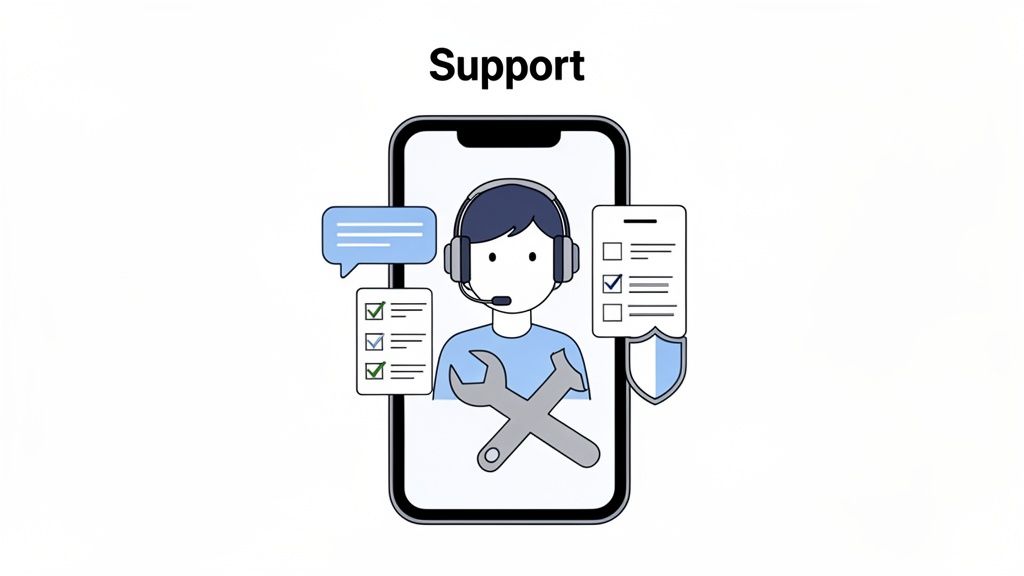
This systematic approach is crucial because inconsistent support can erode customer trust and increase churn. A structured script ensures every query, from a simple e-commerce return request to a complex KYC verification on a trading platform, is handled with the same level of precision and empathy, documenting every step for audit and quality assurance.
Why It Works: Data-Backed Success
Automating this process with a Voice AI agent yields quantifiable improvements in key performance indicators. E-commerce platforms using AI-driven scripts have successfully automated over 75% of routine support queries, including order tracking, returns, and refund status, freeing human agents to handle high-value, complex cases. This automation directly contributes to a 25-30% reduction in operational costs while improving first-call resolution rates.
Strategic Insight: In the BFSI sector, AI agents following compliance-heavy scripts achieve a 99% accuracy rate in processing information, virtually eliminating human error in sensitive tasks. These systems handle thousands of concurrent calls, reducing average wait times from over three minutes to under 15 seconds and boosting customer satisfaction (CSAT) scores by up to 40%.
Actionable Tips for Implementation
To maximise the effectiveness of your customer support script, integrate these strategic elements:
- Map Resolution Paths: Pre-emptively chart all common customer issues and link them to specific, step-by-step resolution workflows within the script.
- Integrate Empathy Phrases: Program conversational "softeners" like "I understand that must be frustrating," or "Let's get this sorted for you," to maintain a positive customer sentiment. Practical Example: "I can certainly see why that's a concern. Let me pull up your account details and we'll work through this together."
- Set Clear Escalation Triggers: Define precise thresholds for when a call must be transferred to a human agent, based on factors like negative sentiment detection, issue complexity, or multiple failed resolution attempts.
- Leverage Customer History: Connect the script to your CRM to personalise the interaction. An AI agent should greet returning customers by name and acknowledge their past support tickets or purchase history.
- Provide Proactive Updates: Conclude every call with clear next steps and an estimated timeline for resolution, sending a summary via SMS or email to ensure clarity and build trust.
4. Healthcare Patient Booking & Appointment Confirmation Script
A specialised sample telephone conversation for healthcare providers is crucial for managing patient flow, reducing administrative overhead, and improving the patient experience. This script offers a compliant and empathetic framework for booking new appointments, confirming existing ones, and collecting pre-visit information. It navigates the sensitive balance between operational efficiency and patient care, ensuring all necessary details like insurance, medical history flags, and personal data are captured securely. For healthcare executives, this represents a standardised pathway to minimise no-shows and optimise clinical resource allocation.
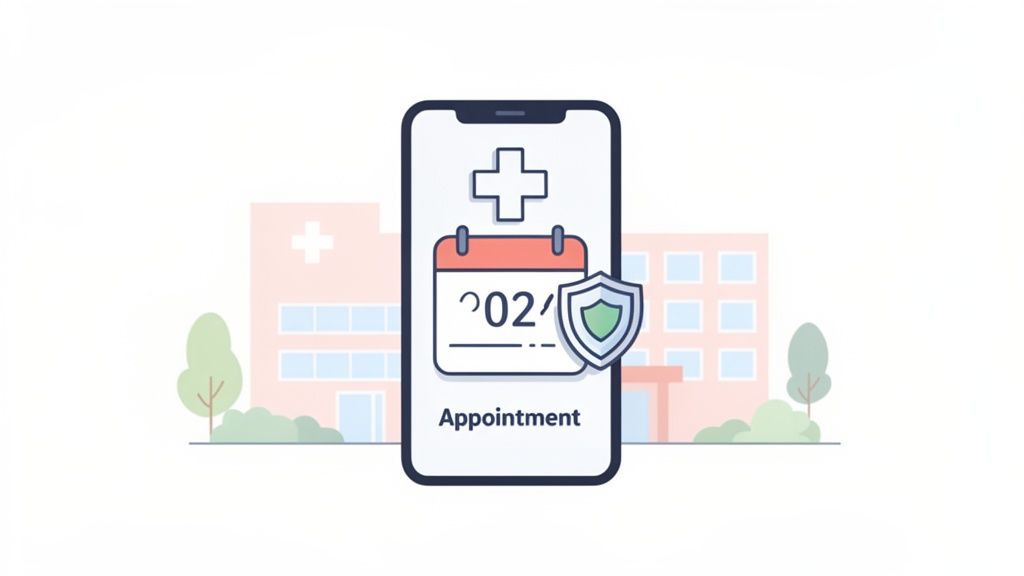
This systematic approach is vital in healthcare, where a missed or poorly handled call can have significant consequences for both patient outcomes and clinic revenue. A well-designed script ensures every interaction is professional, comprehensive, and reassuring, building patient trust from the very first contact.
Why It Works: Data-Backed Success
Automating this process with a Voice AI agent that follows a HIPAA-compliant script yields substantial improvements. Healthcare networks have observed a reduction in appointment no-show rates by up to 30% after implementing automated confirmation and reminder calls. This is achieved through consistent, timely outreach that is not dependent on manual staff availability.
Strategic Insight: Multi-speciality clinics using AI-driven booking scripts have successfully automated over 60% of their inbound appointment scheduling calls, freeing up front-desk staff to focus on in-person patient care and complex queries. Furthermore, the accuracy of pre-admission data collection has improved by 95%, reducing errors that can lead to billing issues and delays in care.
Actionable Tips for Implementation
To maximise the effectiveness of your patient booking and confirmation script, consider these tactical enhancements:
- Prioritise Identity Verification: Begin every call by verifying at least two unique patient identifiers (e.g., date of birth, registered mobile number) before discussing any protected health information (PHI). Practical Example: "For your security, can you please confirm your date of birth and the mobile number we have on file?"
- Use Clear, Simple Language: Avoid complex medical jargon. Explain procedures and instructions in plain language to ensure patient understanding and reduce anxiety.
- Integrate an Escalation Path: Programme the script with clear triggers (e.g., keywords like "help," "confused," or repeated non-responses) to seamlessly transfer anxious or distressed patients to a human agent.
- Automate Reminders: Schedule automated SMS and voice call reminders to be sent 24-48 hours before the appointment, including key details like the clinic's address, doctor's name, and any pre-visit instructions. This automated approach to appointment scheduling can be a game-changer for service-based businesses.
- State Cancellation Policy Clearly: Conclude the conversation by clearly stating the clinic’s cancellation and rescheduling policy, including any associated fees or notice periods, to further reduce last-minute no-shows.
5. Sales Demo & Product Walkthrough Script
A meticulously designed sample telephone conversation for a sales demo is a critical tool for B2B and SaaS organisations. This script serves as a consultative blueprint for guiding a prospect from initial curiosity to a deep understanding of a product's value proposition. It’s not just about listing features; it’s a strategic dialogue that uncovers pain points, aligns solutions directly to those needs, and builds a compelling business case for adoption. For CXOs, this structured approach ensures that every product demonstration, whether led by a human or an AI agent, is a focused, high-impact sales activity that directly nurtures the pipeline.
This process is indispensable because a generic, one-size-fits-all product tour rarely converts. A great demo script ensures the conversation is tailored, relevant, and persuasive, transforming a simple walkthrough into a powerful sales event. It standardises the qualification and discovery process, ensuring sales teams invest their time on prospects with the highest potential.
Why It Works: Data-Backed Success
Automating the initial discovery and qualification part of the demo process yields substantial efficiency gains. SaaS companies using Voice AI like DialNexa for pre-demo qualification have seen a 35% reduction in their sales cycle length. This is achieved by ensuring that human sales representatives only engage with highly qualified, well-informed leads who have already had their core needs identified by the AI.
Strategic Insight: Tech firms that implement a structured, two-stage demo script (AI for discovery, human for deep-dive) have reported a 50% increase in demo-to-trial conversion rates. This approach ensures that every live demo is hyper-relevant to the prospect's specific challenges, dramatically increasing its impact and perceived value.
Actionable Tips for Implementation
To elevate your sales demo and product walkthrough script, integrate these proven tactics:
- Pre-Demo Qualification: Begin with 3-5 pointed discovery questions about the prospect's current workflow, biggest challenges, and desired outcomes to tailor the entire demo.
- Highlight ROI Early: Frame features in the context of tangible business benefits like cost savings, efficiency gains, or revenue growth within the first five minutes. Practical Example: "Customers similar to you have used this feature to reduce manual data entry by an average of 10 hours per week. Let me show you how."
- Keep it Concise: Respect the prospect's time by keeping the core demonstration to a maximum of 15-20 minutes, focusing only on the most relevant features.
- Handle Objections with Proof: When an objection arises, counter it with a relevant case study or a specific success metric from a similar client to build credibility.
- Secure the Next Step: Never end a demo without a clear call-to-action. Always schedule the next specific meeting (e.g., "technical deep-dive," "pricing proposal review") on the call itself.
6. Lead Qualification & Pre-Sales Script
A structured sample telephone conversation for lead qualification is the engine of a high-performing sales organisation. This pre-sales script provides a strategic framework to rapidly assess inbound or outbound leads, determining their viability based on budget, authority, need, and timeline (BANT). It enables sales development representatives, human or AI, to methodically filter high-potential prospects from low-intent inquiries, ensuring that the sales team's valuable time is spent only on opportunities with a real chance of closing. For directors and VPs of sales, this represents a scalable system for pipeline generation and revenue forecasting.
This process is critical because it prevents pipeline bloat and wasted effort on unqualified leads. A well-executed qualification call not only gathers data but also warms up the prospect, positioning the subsequent sales call for a much higher likelihood of success. It's the difference between a scattergun approach and a precision-guided sales strategy.
Why It Works: Data-Backed Success
Automating this initial qualification step with a Voice AI agent delivers immediate, quantifiable returns. B2B SaaS companies using DialNexa have seen a 300% increase in the number of sales-qualified leads (SQLs) passed to their account executives. This is achieved by engaging every lead instantly, 24/7, and consistently applying the qualification criteria without fatigue or deviation.
Strategic Insight: Consulting firms have leveraged AI-powered scripts to increase their qualified engagement opportunities by 65% within the first quarter. This surge is directly tied to the AI's ability to handle high volumes of initial discovery calls, meticulously scoring each lead and automatically scheduling follow-up meetings with the appropriate senior consultant, thus optimising resource allocation.
Actionable Tips for Implementation
To elevate your lead qualification script from a simple checklist to a strategic tool, consider these tactics:
- Adopt the BANT Framework: Explicitly structure your questions around Budget, Authority, Need, and Timeline to ensure you cover all core qualification criteria.
- Probe for Business Outcomes: Instead of asking what features they need, ask "What business problem are you trying to solve?" This uncovers deeper motivations. Practical Example: "Many of our clients are looking to reduce customer churn. Is that a priority for your team in the next six months?"
- Identify All Decision-Makers: Use questions like, "Besides yourself, who else is typically involved in making decisions on solutions like this?" to map the buying committee early.
- Implement Lead Scoring: Assign points to specific answers (e.g., budget confirmed = +10 points). Set a threshold for what constitutes a Sales Qualified Lead to standardise the handoff process.
- Schedule a Specific Next Step: Never end a call with a vague "I'll follow up." Instead, book a concrete next meeting: "Does Thursday at 11 AM work for a 30-minute demo with our product specialist?" For a deeper understanding of how this enhances business growth, you can explore the impact of implementing AI voice agents in 2025.
7. Recruitment Screening & Interview Scheduling Script
A structured sample telephone conversation for recruitment screening is a critical tool for HR departments and staffing agencies to manage high-volume talent pipelines effectively. This script provides a standardised framework to conduct initial candidate evaluations, verify core qualifications, discuss salary expectations, and schedule formal interviews. It transforms the first point of contact from a simple call into a strategic screening mechanism, ensuring only the most qualified candidates proceed, thereby saving valuable time for hiring managers. For CXOs, this represents an optimised talent acquisition process that directly impacts hiring speed and quality.
This approach is essential because the initial screening call sets the tone for the entire candidate experience. A poorly managed or inconsistent conversation can deter top talent and damage the employer's brand. By adhering to a script, recruiters ensure every applicant receives a professional, fair, and thorough preliminary assessment.
Why It Works: Data-Backed Success
Automating this initial screening with a Voice AI agent delivers remarkable efficiency gains. Staffing agencies have observed a 60% reduction in time-to-schedule for first-round interviews, moving from an average of 3 days to less than 24 hours. This acceleration is a direct result of the AI's ability to engage with hundreds of applicants simultaneously, 24/7, and instantly align their availability with the hiring manager's calendar.
Strategic Insight: Tech corporations using AI-driven screening scripts have increased their candidate engagement rate by over 75%. This ensures that passive candidates contacted outside of business hours are captured effectively. Furthermore, companies report a 30% improvement in candidate qualification accuracy, leading to a higher quality of interviews for senior staff.
Actionable Tips for Implementation
To maximise the effectiveness of your recruitment screening script, consider these tactical enhancements:
- Verify Key Requirements First: Begin the call by confirming non-negotiable requirements like years of experience, specific certifications, or location preferences to qualify candidates efficiently.
- Explain the Process Clearly: Outline the subsequent interview stages, including formats (e.g., technical round, panel interview) and estimated timelines, to manage candidate expectations from the outset. Practical Example: "The next step would be a 45-minute technical interview with the team lead, followed by a final panel interview with the department head. We aim to complete the process within two weeks."
- Use Open-Ended Questions: While the script provides structure, include prompts for open-ended questions like, "Can you tell me about a project you're proud of?" to gauge communication skills and passion.
- Integrate with an ATS: Connect your script to your Applicant Tracking System (ATS) to automatically update candidate status, log call notes, and trigger confirmation emails, minimising manual data entry.
- Offer Flexible Scheduling: Provide multiple time slots for the next interview round. If using an AI agent, allow it to offer any open slot on the hiring manager’s integrated calendar to boost scheduling success.
8. D2C Brand Customer Re-engagement & Loyalty Script
A structured sample telephone conversation for re-engaging lapsed customers is a critical tool for any direct-to-consumer (D2C) brand focused on maximising customer lifetime value. This script provides a framework for reaching out to dormant subscribers or one-time buyers, aiming to understand churn reasons, resolve underlying issues, and incentivise reactivation. It strategically blends empathy with a compelling value proposition, turning a potential lost customer into a loyal advocate. For business leaders, this represents a scalable process to reduce churn and protect recurring revenue streams.
This proactive approach is essential because acquiring a new customer can cost five times more than retaining an existing one. A well-executed re-engagement call can not only win back revenue but also yield invaluable feedback to improve products, services, and the overall customer experience, preventing future churn.
Why It Works: Data-Backed Success
The financial impact of a systematic re-engagement strategy is substantial. D2C subscription box services using targeted win-back scripts have successfully reduced their monthly churn rate by up to 18%. This is achieved by personalising offers based on past purchase history and addressing the specific reasons for cancellation, creating a powerful incentive to return.
Strategic Insight: E-commerce brands automating these re-engagement calls with Voice AI agents report a 12% reactivation rate among customers who have been inactive for over six months. This translates directly to recovered revenue that would otherwise be lost, turning a cost centre into a profit-generating function.
Actionable Tips for Implementation
To elevate the effectiveness of your customer re-engagement script, consider these tactical enhancements:
- Lead with Appreciation: Start the conversation by thanking the customer for their past business. Avoid an immediate sales pitch to build rapport and show their previous loyalty was valued.
- Ask Specific "Why" Questions: Instead of a generic "Why did you leave?", ask pointed questions like, "We noticed you haven't reordered your favourite coffee blend since March. Was there an issue with the last batch?"
- Offer Tangible, Personalised Value: Provide a concrete incentive to return, such as a "welcome back" discount, early access to new products, or a free trial of a premium service tier.
- Acknowledge Brand Improvements: If their reason for leaving was a product or service gap that has since been fixed, highlight that specific improvement. Practical Example: "I know you previously mentioned our delivery times were a concern. I'm happy to share that we've now partnered with a new courier that guarantees two-day delivery in your area."
- Simplify the Reactivation Process: Make it effortless for them to come back. Offer to reactivate their subscription or place an order for them directly on the call, removing any friction.
8-Scenario Phone Script Comparison
| Script / Use Case | Implementation Complexity 🔄 | Resource Requirements ⚡ | Expected Outcomes & Impact 📊 ⭐ | Ideal Use Cases 💡 | Key Advantages ⭐ |
|---|---|---|---|---|---|
| Property Inquiry & Site Visit Booking Script | 🔄 Medium — CRM & calendar integration, conditional logic | ⚡ Moderate — calendar API, trained flows, periodic tuning | 📊 200–300% booking lift; higher connect→booking rates; ⭐⭐⭐⭐ | 💡 Real estate brokerages, developers, property consultancies | ⭐ Standardizes qualification, increases bookings, reduces time-to-booking |
| EdTech Program Inquiry & Enrollment Script | 🔄 Medium‑High — program‑specific content, time‑zone & escalation paths | ⚡ Moderate — SME content, payment/aid info, multilingual support | 📊 Improved lead→enrollment; reduced misaligned enrollments; ⭐⭐⭐ | 💡 EdTech platforms, bootcamps, university admissions | ⭐ Qualifies serious candidates early; personalized counseling at scale |
| Customer Support & Issue Resolution Script | 🔄 High — KB integration, compliance logging, complex escalation flows | ⚡ High — robust KB, recording/compliance infra, 24/7 ops | 📊 40–60% workload reduction; higher FCR; lower AHT; ⭐⭐⭐⭐ | 💡 BFSI, e‑commerce, SaaS, trading platforms | ⭐ 24/7 consistent support, audit trails, reduced human load |
| Healthcare Patient Booking & Appointment Confirmation Script | 🔄 High — HIPAA/security, identity verification, triage integration | ⚡ High — secure infra, trained clinical escalation, consent recording | 📊 15–25% fewer no‑shows; faster scheduling; ⭐⭐⭐ | 💡 Clinics, telemedicine platforms, hospitals, dental practices | ⭐ Automates booking with compliant data capture; reduces admin burden |
| Sales Demo & Product Walkthrough Script | 🔄 Medium — tailored demos, scenario prep, possible screen‑share setup | ⚡ Moderate — product SMEs, demo assets, trial environments | 📊 30–40% improvement in demo→qualified lead conversion; ⭐⭐⭐⭐ | 💡 SaaS, B2B tech, cloud service providers | ⭐ Pre‑qualifies prospects, shortens sales cycle, scalable demos |
| Lead Qualification & Pre‑Sales Script | 🔄 Medium — structured frameworks (BANT), scoring & CRM routing | ⚡ Low‑Moderate — scoring models, CRM tags, training data | 📊 ~97% alignment with human qualification; higher sales productivity; ⭐⭐⭐⭐ | 💡 Enterprise SaaS, B2B services, staffing, consulting | ⭐ Consistent qualification, better lead routing, scales across territories |
| Recruitment Screening & Interview Scheduling Script | 🔄 Medium — resume/background checks, ATS/calendar integrations | ⚡ Moderate — ATS integration, recruiter oversight, scheduling tools | 📊 40–50% reduction in time‑to‑fill (standard roles); ⭐⭐⭐ | 💡 Enterprise HR, staffing agencies, tech hiring, healthcare systems | ⭐ Screens early, speeds hiring, maintains consistent candidate experience |
| D2C Customer Re‑engagement & Loyalty Script | 🔄 Low‑Medium — personalization logic, incentive management | ⚡ Moderate — CRM, campaign/promo capabilities, historical data | 📊 15–25% reactivation with targeted offers; ⭐⭐⭐ | 💡 E‑commerce, subscription services, app platforms | ⭐ Cost‑effective reactivation, raises CLTV, delivers churn insights |
From Script to Scale: Activating Your Conversational Strategy with Voice AI
Throughout this guide, we have dissected the anatomy of impactful communication, moving far beyond mere templates. We have explored a diverse range of sample telephone conversation frameworks, from high-stakes real estate inquiries and sensitive healthcare appointment bookings to strategic SaaS presales and customer loyalty campaigns. The core lesson is clear: an effective conversation is not a rigid monologue but a dynamic, objective-driven dialogue built on a foundation of empathy, clarity, and strategic questioning. The provided scripts, dos and don'ts, and industry-specific nuances serve as your blueprint for transforming every call into a valuable business opportunity.
However, for today’s forward-thinking CXOs and VPs, the blueprint is only the first step. The true challenge lies in execution at scale. Manual implementation, while effective in small doses, is inherently limited by human factors like agent availability, training inconsistencies, and operational costs. This is where strategic vision meets technological execution.
The Strategic Imperative: From Human-Led to AI-Powered
The detailed conversational flows we have analysed, from the initial greeting to the final call-to-action, represent the very logic that powers intelligent Voice AI. These are not just guidelines for your team; they are the architectural plans for an automated, scalable, and highly efficient communication engine. Consider the critical business metrics at stake:
- Lead Conversion: A perfectly executed lead qualification script, when deployed by a Voice AI agent, can engage thousands of inbound leads simultaneously, 24/7. This ensures no lead ever goes cold, a factor that has helped businesses see up to a 300% increase in lead-to-booking rates.
- Operational Efficiency: Imagine eliminating wait times for patient bookings or e-commerce support inquiries. An AI-powered system handles concurrent calls without fatigue or error, reducing the cost-per-interaction significantly while improving customer satisfaction.
- Data Enrichment: Every conversation is a source of invaluable data. Unlike manual calls where note-taking can be inconsistent, Voice AI meticulously logs every interaction, captures customer intent, and syncs this data directly to your CRM. This creates a rich, structured dataset for better business intelligence and decision-making.
Activating Your Blueprint with Intelligent Automation
The transition from a static script to an interactive, automated conversation is the next frontier of customer engagement. This is not about replacing the human element but augmenting it, freeing up your skilled agents to handle complex, high-value escalations while the AI manages routine, high-volume interactions with flawless precision.
Platforms like DialNexa are designed to ingest the strategic logic of your best sample telephone conversation and codify it into a reliable, human-like agent. These systems go beyond traditional, rigid IVR menus. For development teams looking to understand the technical underpinnings of such sophisticated systems, a great resource is A Developer's Guide to Interactive Voice Response Systems, which provides deep insights into building dynamic and responsive voice applications. Modern Voice AI can understand context, manage conversational turns, and adapt its path based on the caller's real-time responses.
Ultimately, mastering the art of the telephone conversation in the digital age is a two-part equation. First, you must design the perfect strategic flow. Second, you must select the right technology to execute that flow flawlessly at infinite scale. By embracing this dual approach, you position your organisation to not only meet customer expectations but to consistently exceed them, creating a powerful competitive advantage in any industry.
Ready to transform your proven scripts into a scalable, automated communication strategy? DialNexa specialises in deploying human-like Voice AI agents that execute your ideal conversations with perfect consistency, 24/7. Discover how we can help you reduce operational costs and enhance customer engagement by visiting DialNexa.

This is an incredibly practical and well-structured resource that shows how standardized conversation frameworks can improve conversions, customer experience, and operational efficiency across multiple industries. The blend of human expertise and AI-driven automation offers a powerful roadmap for building scalable, high-performing communication processes.