

AI for Real Estate Agents: A CXO’s Guide to Driving Growth
Most executives still frame ai for real estate agents as a productivity tool for individual brokers. That view is already outdated. This shift is competitive. 82% of real estate professionals are currently using AI in their operations, and 92% are either using it or planning to implement it, according to NARPR's analysis of agent adoption. Once adoption reaches that level, AI stops being an experiment and becomes table stakes.
The strategic question isn't whether your organisation should adopt AI. It's where AI creates the fastest operational advantage, where human review must stay in place, and which use cases move revenue, conversion, margin, or service levels.
Table of Contents
- The New Competitive Edge in Property
- The Real Business Case for AI in Real Estate
- Mapping AI Applications Across the Value Chain
- The High-ROI Frontier of Voice AI
- A Strategic Framework for AI Implementation
- Building Your AI-Powered Organisation
The New Competitive Edge in Property
AI is already separating fast operators from slow ones in real estate. The gap is no longer about who has better agents on paper. It is about who handles inbound demand faster, qualifies buyers and sellers with more consistency, and keeps human teams focused on revenue work instead of repetitive coordination.
That matters even more in high-volume markets such as India, where missed calls, fragmented follow-up, and multilingual demand create operational drag at scale. Generic AI advice built around US chatbots and basic listing copy misses the core issue. Property firms win or lose on response speed, call handling, lead triage, and execution discipline.
PwC's 2024 AI Jobs Barometer found that industries with higher AI exposure are already seeing stronger productivity growth. McKinsey makes the same point from an enterprise angle in its research on the economic potential of generative AI. For real estate leaders, the implication is straightforward. AI should be treated as an operating model decision, not a software experiment.
What leadership should do now
Executives should stop debating whether AI belongs in the business and start deciding where it changes unit economics first.
Prioritise these questions:
- Which high-volume workflows slow down revenue response
- Which customer interactions need human judgement and trust
- Which AI use cases improve conversion, speed-to-lead, or agent capacity
- Which controls are required for compliance, accuracy, and brand consistency
Recommendation: Start with high-frequency processes that affect response time and lead handling. In markets with heavy inbound call traffic, Voice AI should move ahead of lower-impact use cases like generic content drafting.
This is the strategic shift many firms still miss. Drafting listing descriptions saves time. Automating first-contact qualification across thousands of inbound calls changes revenue capacity. One use case is convenience. The other changes throughput.
The firms gaining ground are organised
The firms pulling ahead are not collecting random tools. They are standardising workflows, defining approved use cases, setting review rules, and measuring output against business KPIs.
That matters because unmanaged AI creates predictable risk. The World Economic Forum's work on governance for responsible AI adoption reinforces the point executives should already know. AI without process control creates legal, brand, and operational exposure. AI with clear governance lowers service cost and raises execution consistency.
For teams that want a practical view of how AI can support listing content, lead handling, and marketing coordination, this guide to an AI marketing command center for realtors is a useful reference point. Centralisation beats tool sprawl.
The competitive edge in property now comes from system design. The firms that route, qualify, respond, and follow up with more discipline will outperform firms still relying on agent memory and manual coordination.
The Real Business Case for AI in Real Estate
If you want a clean boardroom argument for AI, use operating efficiency, deal velocity, and lead quality. Ignore the hype. Focus on the P&L.
Morgan Stanley Research projects $34 billion in operating efficiencies for the real estate industry by 2030, driven by the automation of 37% of tasks, according to Morgan Stanley's analysis of AI in real estate. The same source cites 30-40% improvements in lead qualification accuracy and a 25% reduction in transaction time-to-close. Those are executive metrics, not novelty metrics.

Where the margin impact actually shows up
Most firms first see AI value in four areas:
| Business area | AI impact | Executive implication |
|---|---|---|
| Lead qualification | Better prioritisation of active demand | Sales teams spend more time on winnable opportunities |
| Admin and coordination | Less manual follow-up and repetitive handling | Lower labour intensity per transaction |
| Marketing production | Faster listing and campaign execution | More output without adding headcount |
| Transaction workflow | Shorter cycle times | Revenue recognition moves faster |
The point isn't that every workflow should be automated. It's that too many real estate organisations still run expensive manual processes in functions where speed and consistency matter more than human creativity.
AI should be measured like any other investment
Leaders make a mistake when they buy AI as software instead of deploying it as an operating lever. If your business case says “better experience” but you can't tie that to conversion, staffing efficiency, or cycle time, your rollout will drift.
Use a harder scorecard:
- Qualification quality: Are reps getting cleaner, better-ranked leads?
- Sales throughput: Are teams handling more opportunities without service dropping?
- Time-to-close: Are transactions moving with fewer avoidable delays?
- Managerial impact: Can team leaders supervise a larger operation with clearer visibility?
AI earns budget when it removes labour from repeatable work and puts human time back into negotiation, advisory, and relationship management.
This is also where many teams start looking beyond generic tools. If you're assessing stack options around campaign execution and listing workflows, these smart tools for automated property marketing offer a useful benchmark for what can be standardised versus what still needs internal review.
Competitive advantage comes from concentration
A scattered deployment rarely produces meaningful return. One agent uses a writing tool, another tests a chatbot, marketing experiments with visuals, and operations sees no measurable change. That isn't transformation. That's software drift.
The business case gets compelling when AI is concentrated in high-friction workflows where delay, inconsistency, or poor qualification destroys value. That's why the strongest use cases tend to cluster around lead intake, pricing support, marketing production, customer follow-up, and transaction coordination. Those are the areas where executives can defend investment with operational logic instead of marketing language.
Mapping AI Applications Across the Value Chain
Most firms buy AI in fragments. One tool for copy, one for lead scoring, one for visuals, another for admin. That creates local efficiency and enterprise confusion. A better approach is to map AI to the full real estate value chain and assign each use case a job.
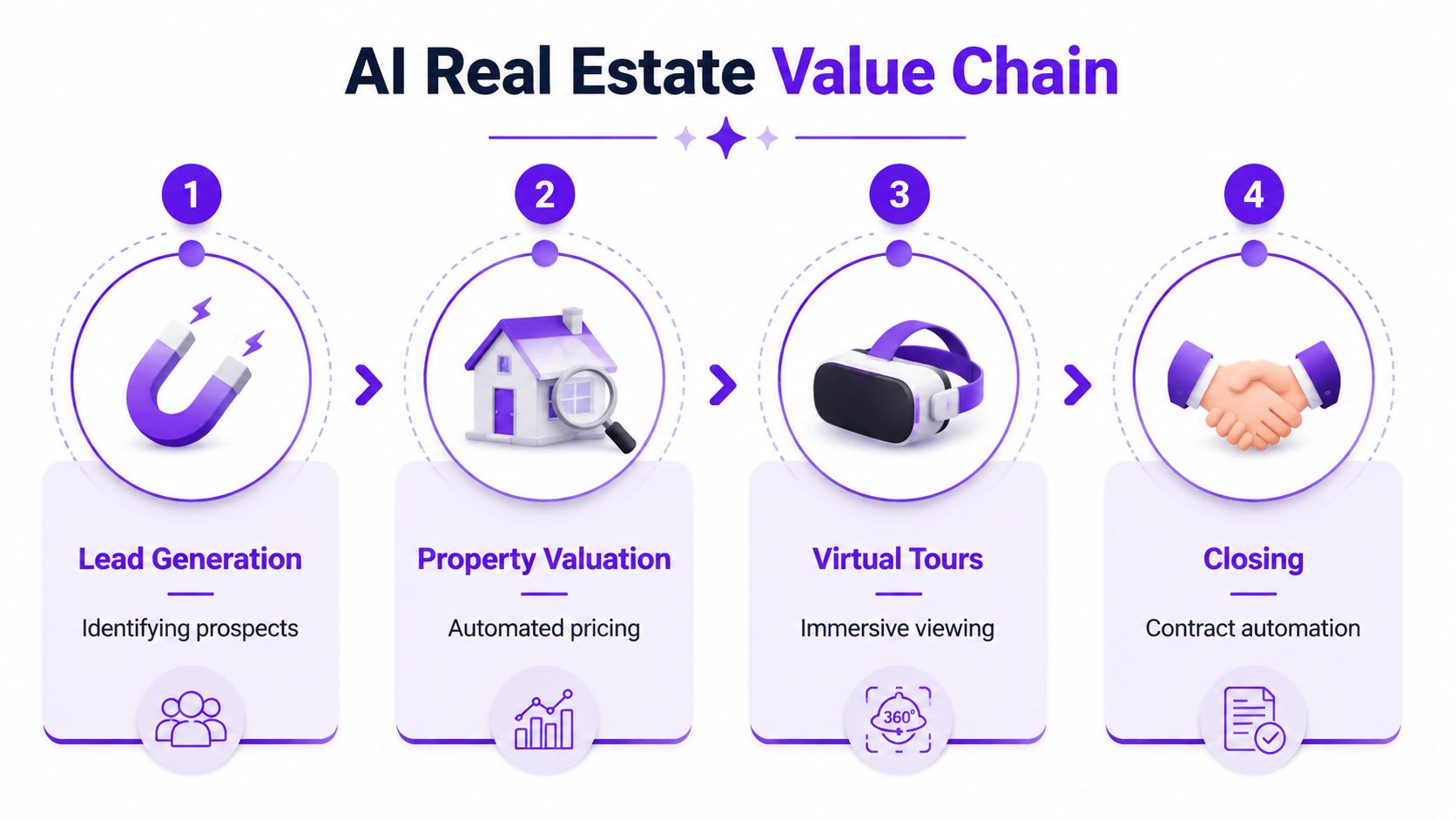
Where executives should focus first
The strongest applications usually sit in five linked stages:
Prospecting and seller discovery
Predictive analytics tools identify likely movers and help teams stop wasting effort on broad, low-yield farming.Valuation and pricing support
AVMs and market intelligence tools improve pricing discipline and listing conversations.Marketing production
AI speeds listing descriptions, ad variants, visual content, and campaign setup.Lead qualification and routing
AI screens intent, tags urgency, and routes opportunities to the right team.Transaction support
Workflow tools reduce avoidable friction in follow-up, reminders, and coordination.
Each stage feeds the next. If prospecting improves but qualification stays weak, you've only created a larger pile of unmanaged leads.
A practical value-chain view
The clearest example is predictive analytics. Tools like SmartZip and First.io analyse historical data, mortgage records, and demographic shifts to score motivated sellers, enabling agents to achieve 3x higher ROI over traditional farming methods by prioritising leads with a 25% higher conversion potential, according to this analysis of AI predictive analytics for real estate farming.
That changes how a brokerage should think about territory planning. Traditional farming casts a wide net. Predictive systems rank likelihood. One approach buys attention. The other allocates resources.
Here's the operational difference:
- Traditional prospecting: Broad outreach, uneven timing, low signal
- Predictive prospecting: Ranked households, sharper follow-up, better rep productivity
- Executive benefit: Lower wasted activity and tighter sales focus
The right AI stack doesn't add more work. It narrows attention to the opportunities most likely to convert.
Marketing fits the same logic. Once a likely seller or active buyer is identified, your team needs to produce faster than manual processes allow. That includes listing copy, nurture sequences, ad creative, and short-form video. If your content team wants a fast way to generate AI marketing videos, that can support faster campaign launch for listings and social promotion.
For outbound-heavy teams, the data layer matters just as much as the model. This breakdown of data for real estate calling is useful because calling performance depends on segmentation quality, recency, and call prioritisation. AI won't rescue poor inputs.
The strategic recommendation is straightforward. Build your AI roadmap around workflow continuity, not software categories. Prospecting, pricing, marketing, qualification, and closing should operate as one system. If the handoffs are weak, the tools won't save you.
The High-ROI Frontier of Voice AI
The market spends too much time talking about chatbots and not enough time fixing missed calls, weak after-hours follow-up, and multilingual lead handling. In many real estate businesses, especially in India, that's where the revenue leakage sits.

According to this analysis of AI gaps in real estate and Voice AI in India, 40% of leads drop off due to poor after-hours follow-up. The same source notes that platforms like DialNexa achieve 91% connect rates, can handle thousands of daily calls in regional languages, improve lead-to-booking rates from 2% to 8%, and match human qualification accuracy at 97%.
Why text-first AI misses the real bottleneck
A text chatbot is useful when a prospect wants to browse. It's far less useful when the buyer wants to talk, schedule a site visit, ask questions in a regional language, or connect outside working hours.
That's the gap many executives underestimate. Real estate demand doesn't arrive in neat office-hour windows, and it doesn't always arrive in one language. If your organisation relies on human agents to catch every inbound and outbound conversation, scale becomes fragile very quickly.
Three patterns make voice AI attractive in this market:
- After-hours demand: Prospects enquire when sales teams are offline.
- Call-heavy workflows: Discovery, qualification, reminders, and booking still happen over voice.
- Language complexity: Regional language support is operational, not cosmetic.
What voice AI changes operationally
Voice AI is valuable when it does more than answer calls. It should qualify intent, collect structured information, route high-intent leads, book site visits, and trigger follow-up without adding operational clutter.
For teams evaluating that model, this overview of an AI voice agent for real estate is relevant because it shows how voice workflows can fit discovery and booking rather than acting as a novelty layer.
A short product walkthrough helps make the use case concrete:
Here's where I'm opinionated. In high-velocity property markets, voice AI should often come before another chatbot purchase. If your team is losing enquiries because nobody responded at night, nobody called back fast enough, or nobody could handle the prospect's preferred language, text automation isn't solving the actual problem.
Buy for call completion, qualification quality, and booked visits. Don't buy for novelty.
Voice AI won't replace agents in negotiation, trust-building, or advisory work. It will replace a large volume of repetitive call handling that humans perform inconsistently under pressure. For executives, that's the point. Use AI where standardisation improves conversion and frees your team for higher-value selling.
A Strategic Framework for AI Implementation
AI projects fail when leadership starts with tools instead of bottlenecks. Start with a costly problem. Then choose the narrowest deployment that proves commercial value.

Start with one expensive bottleneck
Don't launch an enterprise AI initiative across every function. Pick one pain point that is frequent, measurable, and expensive. Good examples include poor lead response, weak qualification, inconsistent pricing support, or overloaded transaction coordination.
Use this test:
| Question | If yes | If no |
|---|---|---|
| Is the workflow high-volume? | Good AI candidate | Keep human-led |
| Is the work repetitive? | Standardise it | Avoid automation for now |
| Is the outcome measurable? | Pilot it | Redefine the use case |
| Does it require heavy judgement? | Add human review | Automate more aggressively |
A leadership team should also identify what must remain human-led. Pricing strategy, nuanced market interpretation, and compliance-sensitive communication usually need oversight even when AI supports the workflow.
Evaluate vendors like an operator, not a buyer
Vendor selection should be ruthless. Ask how the system performs, what data it uses, how outputs are reviewed, and where it fails.
That standard matters sharply in valuation. Modern ML-based AVMs can achieve median error rates as low as 2.8% by processing real-time MLS data and image recognition, while traditional appraisals can show errors exceeding 33%, according to this review of AI-powered AVMs in real estate. If a vendor claims intelligence but can't explain precision, recency, review controls, and exception handling, move on.
Ask every vendor these questions:
- Data quality: What inputs drive the output?
- Workflow fit: Does it integrate with CRM, calling, and sales processes?
- Governance: How do managers review, approve, or override outputs?
- Auditability: Can you see why the system produced a recommendation?
Treat AI procurement like operational design. You're not buying software alone. You're buying a new way of executing work.
Pilot before rollout
A strong pilot is narrow, timed, and measurable. One region, one team, one use case. Don't let a pilot become a vague learning exercise.
A practical pilot plan looks like this:
- Define baseline performance for the current manual process.
- Deploy AI in one workflow only.
- Track operational and commercial outcomes weekly.
- Review exceptions manually to identify failure patterns.
- Scale only after process adjustment, not immediately after first success.
The best AI programmes don't scale because the demo looked good. They scale because leadership proved that the tool improved a specific workflow under real operating conditions.
Building Your AI-Powered Organisation
Victory isn't about buying AI tools. It's building a real estate organisation that runs with more discipline, better prioritisation, and less manual waste.
That requires a mindset shift at the top. Executives need to stop treating AI as a marketing story and start treating it as operating infrastructure. The firms that win won't be the ones with the longest software list. They'll be the ones that redesign lead handling, pricing support, marketing execution, and service workflows around speed and consistency.
What mature adoption looks like
An AI-powered organisation usually shares a few traits:
- Leadership owns the use cases: AI isn't left to isolated team experiments.
- Managers enforce governance: Accuracy, compliance, and escalation rules are explicit.
- Teams trust the workflow: Agents know when to use AI and when to step in personally.
- Measurement stays commercial: Success is tied to conversion, throughput, and service outcomes.
This also changes staffing logic. When AI takes repetitive qualification, scheduling, and follow-up off your team's plate, managers can redeploy human effort into advisory work, site visits, negotiation, and account development. That's where your people create differentiation.
For leaders thinking beyond single-point automation, a useful next step is assessing where a broader virtual assistant for real estate model fits across prospecting, customer communication, and operational support.
Organisations don't future-proof themselves by talking about AI. They do it by standardising work, measuring outcomes, and moving faster than competitors.
The right first move is rarely a massive transformation programme. It's one well-scoped pilot owned by leadership, attached to a real business problem, with clear accountability. Start there, prove the gain, and expand from evidence.
DialNexa Labs Private Limited helps real estate developers, brokers, and property consultancies deploy human-like Voice AI for lead qualification, customer support, and presales workflows at scale. If your team wants to reduce missed enquiries, standardise follow-up, and handle property discovery or site-visit booking more efficiently, explore what DialNexa Labs Private Limited offers and assess whether a focused pilot fits your operating model.

[…] firms exploring how agents use AI in field selling and follow-up, this resource on AI for real-estate agents is useful because it ties automation to day-to-day sales execution rather than abstract […]
Excellent insights on treating AI as operating infrastructure rather than a collection of disconnected tools. The strong focus on Voice AI, lead qualification, and workflow efficiency clearly shows how real estate firms can improve conversion, productivity, and long-term competitive advantage.
This is a sharp strategic breakdown—the shift from treating AI as a convenience tool to an operating lever is exactly what separates leaders in property. The emphasis on response speed and lead triage over generic drafting mirrors what we see with high-volume inbound markets. For teams looking to operationalize this, an AI video generator that syncs audio from text or references can accelerate client-facing explainers and listing walkthroughs without adding production drag. It fits the same logic: automate the repetitive, keep humans on revenue work. Curious how others are scoring voice AI against video generation for speed-to-lead metrics.