
LiveKit vs Pipecat: The 2026 CXO Decision Guide
You're six weeks from rollout, the board wants a voice-AI launch date, and two partners are pushing different answers. One says LiveKit because the telephony and media stack is already there. The other says Pipecat because the pipeline is easier to bend around your business logic. If you're a CXO in BFSI, EdTech, real estate, healthcare, or D2C, this isn't a tooling debate. It's a decision about how much of the communication layer you want to own, and how much operational risk you're willing to carry into production.
| Criterion | LiveKit Agents | Pipecat |
|---|---|---|
| Core model | WebRTC rooms and media infrastructure | Pipeline-first orchestration |
| Best fit | Live voice, video, SIP, multi-participant sessions | Custom call logic, transport flexibility |
| Telephony | Native SIP bridging | Usually via Daily or Twilio paths |
| Recording | Built into the media stack | Usually assembled through the chosen transport |
| Latency | Slightly lower in the published test, 750–900 ms | Slightly higher in the published test, 800–950 ms |
| Community signal | Lower GitHub stars than Pipecat, higher weekly downloads | Higher GitHub stars than LiveKit Agents |
| Governance signal | HVTrust 88.8/100 | HVTrust 83.2/100 |
| Operational posture | More infrastructure out of the box | More control, more assembly work |
If your workload touches regulated calling, recordings, and auditability, this guide will save you from a bad architectural bet. If you need a practical comparison grounded in Indian deployment reality, not generic framework trivia, keep reading. If you're also evaluating the telephony layer itself, the Exotel alternatives comparison is a useful companion read.
Table of Contents
- The Decision Most CXOs Get Wrong
- How LiveKit and Pipecat Differ Under the Hood
- Features Side by Side
- Developer Experience, SDKs, and Migration
- Security, Compliance, and Data Residency for Indian Buyers
- Which One to Pick for BFSI, EdTech, Real Estate, and D2C
- Migration Paths, Pricing Models, and TCO Anchors
- Decision Checklist and the Honest Final Answer
The Decision Most CXOs Get Wrong
A BFSI head of collections is sitting on a multi-crore rollout. An EdTech VP of admissions is doing the same. Both are hearing the same pitch, one partner says LiveKit, the other says Pipecat. Many treat that as a feature shootout, then they pick whatever sounds more technical in the demo.
That's the mistake.
The choice sits two layers deeper. First, there's the architecture layer, WebRTC media platform versus transport-agnostic pipeline. Second, there's the India operations layer, PSTN and SIP support, recording controls, data residency, and auditability. If you skip the second layer, you'll end up with a stack that looks elegant in a workshop and awkward in production.
Why the wrong debate wastes budget
Indian enterprise buyers don't lose sleep over whether a framework has a prettier abstraction. They lose sleep over call recording controls, escalation paths, and who can prove what happened on a regulated call. That's why most “LiveKit vs Pipecat” articles miss the enterprise question, and why the India-specific compliance gap is still underexplained in the market, even as India's AI market is projected to reach US$17 billion by 2027 according to the cited projection in the brief (Cekura's India voice AI compliance analysis).
The right mindset is simpler. Choose the framework that matches the shape of your conversations, then test it against your telephony and governance constraints. If your workflow looks like live calling with routing, recording, and escalation, the media layer matters first. If your workflow is mostly orchestration, branching logic, and transport flexibility, the pipeline matters first.
Practical rule: if your buyer asks about SIP trunks, recording retention, and audit trails before they ask about prompts, you're already in LiveKit territory.
One more thing. In regulated Indian deployments, the framework is not the product. The call flow, storage decisions, and control surface are the product. That's why a narrow comparison of open-source features is never enough, and why the operational layer deserves as much attention as the code layer.
How LiveKit and Pipecat Differ Under the Hood
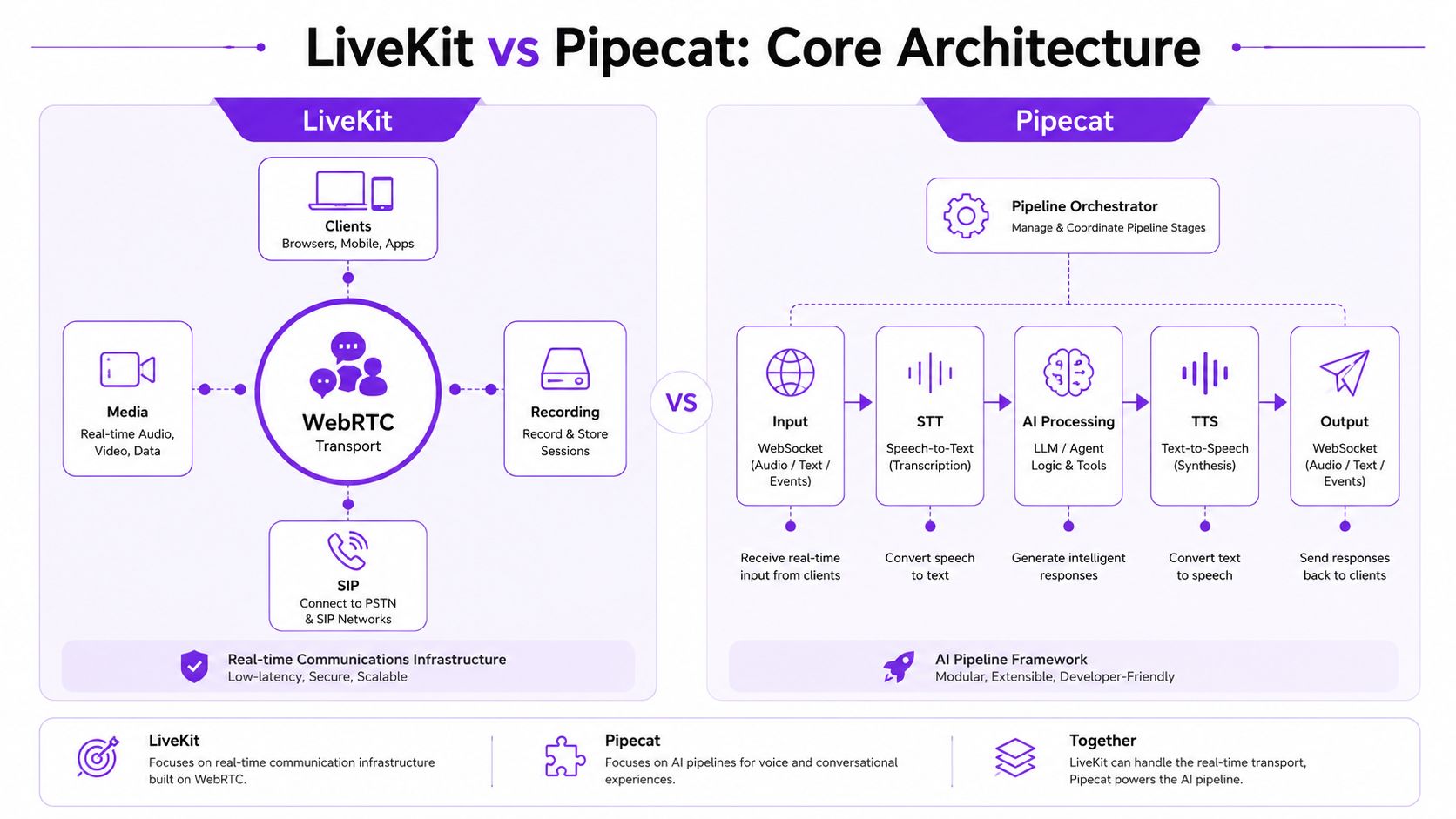
LiveKit starts from the media layer. Its centre of gravity is the WebRTC room, with native track handling, SIP support, recording, and agent state synchronisation built into the platform (LiveKit and Pipecat production voice AI comparison). Pipecat starts from the orchestration layer. It is a Python pipeline framework, built around composable processors in a directed graph, where STT, LLM, and TTS are arranged as explicit stages and the transport can vary across WebSocket, WebRTC via Daily, and Twilio media streams (Pipecat vs LiveKit voice framework decision).
The practical architecture split
A healthcare appointment bot shows the difference clearly. If you need a bot that joins a live call, handles audio cleanly, and fits into room-based collaboration with SIP-style telephony, LiveKit cuts out integration work because the media layer is already there (production voice AI comparison). That is the right choice when the main problem is connecting the call, keeping the session stable, and controlling the media path.
Pipecat is stronger when the call-flow itself is the product. A D2C brand can reuse the same logic across WhatsApp-style, web, and telephony-style paths if the deployment is assembled carefully, because Pipecat is transport-agnostic and lets you control the order of the pipeline explicitly (Pipecat vs LiveKit voice framework decision). That matters when your team needs different branching, custom hand-offs, or provider swaps without rebuilding the media stack.
For Indian CXO use cases, the split stays clean. LiveKit is the better fit when the stack needs production RTC infrastructure and native telephony primitives. Pipecat is the better fit when you want finer orchestration control and transport flexibility. If your team is still mapping SIP leg handling and escalation paths, the call-flow basics in this SIP call flow guide are the right place to anchor the architecture discussion.
A developer guide on API and microservices tutorial helps here, because the winning enterprise pattern is usually to keep intelligence and business logic behind a stable service boundary, then let the voice layer handle transport and timing.
What the latency numbers really mean
Latency gets over-analysed in these comparisons. In one benchmarked production stack, LiveKit Agents came in at 750–900 ms end-to-end and Pipecat at 800–950 ms (Forasoft comparison). Another published internal test using Deepgram Nova-2, GPT-4o, and ElevenLabs Turbo v2.5 recorded 750–900 ms for LiveKit Agents and 800–950 ms for Pipecat on Daily, a gap of roughly 50 ms in that setup (Sellerity test write-up).
That gap matters, but it does not decide the architecture on its own. Another comparison says a speech-to-speech model can answer in about 300 ms, while a typical STT + LLM + TTS cascade adds 300–800 ms of latency (Forasoft comparison). Model choice, turn detection, and transport quality usually shape the experience more than the framework name.
LiveKit tends to feel slightly snappier in the published test, but in production the orchestration design usually matters more than the last 50 ms.
Features Side by Side
What matters more than checkmarks
A CXO does not need another tick-box comparison. The core question is which platform changes the operating model for telephony, recording, compliance, and rollout speed in an Indian enterprise.
Audio and video handling. LiveKit has the stronger native RTC posture because it is built around a WebRTC SFU and room-based media handling (LiveKit and Pipecat production voice AI comparison). Pipecat can power voice flows well, but it does that through orchestration rather than by owning the media transport. If your workflow includes live participant mixing or richer room behavior, LiveKit gives you a cleaner base.
Recording. LiveKit records from inside the transport stack, so the audio path and the audit trail stay closer together. Pipecat can record too, but the recording usually sits with the transport or deployment layer you choose, which adds assembly work and more failure points. In Indian BFSI deployments, that difference shows up fast. Audit teams want a single chain from call start to stored artifact, while operations teams want fewer places where retention, redaction, or retrieval can break. A separate cloud telephony stack can still make sense, but only if you already have that operational layer under control, as explained in the cloud telephony provider guide.
For CXOs benchmarking a lighter-weight fallback path, DialNexa’s MyOperator pricing breakdown is a useful sanity check on what a pure cloud-telephony vendor charges before any voice-AI orchestration layer is added.
PSTN and SIP support. LiveKit's built-in SIP bridging is the cleaner fit for traditional calling. Pipecat works with telephony stacks through integrations, but that is still an integration path, not the native calling path. Collections, payment reminders, verification calls, and outbound support flows are easier to standardize on LiveKit because the voice stack stays closer to enterprise telephony.
SDK and platform maturity. LiveKit has the wider client and server surface, including JavaScript, Swift, Kotlin, React Native, and server SDKs, while Pipecat stays more Python-first with newer JS and TS surfaces. That matters when product, platform, and infra teams all touch the same stack. LiveKit is usually the safer choice for a multi-team environment that wants fewer translation layers between transport, media, and application code.
Security and trust. A trust-scoring source gave LiveKit Agents an HVTrust score of 88.8/100 and Pipecat 83.2/100, which gives LiveKit a modest governance edge in that source (HVTracker comparison). For Indian buyers, the more useful takeaway is operational. LiveKit's tighter media and recording surface usually makes compliance review simpler because fewer parts are split across separate vendors or custom glue. Pipecat is still viable, but the review burden shifts more onto your own deployment design.
Pricing model. Both are open source, so the bill comes from media, storage, and model usage, not framework licensing. That is why ecosystem signals still matter as a proxy for production confidence. In the same 2026 snapshot, Pipecat had 13,416 GitHub stars versus 11,356 for LiveKit Agents, while LiveKit Agents showed higher weekly demand at about 936,000 downloads/week compared with 266,000/week for Pipecat (HVTracker comparison). Stars show attention. Downloads show where production pull is stronger.
| Criterion | LiveKit Agents | Pipecat |
|---|---|---|
| Media model | WebRTC SFU and native room handling | Pipeline-oriented orchestration |
| Recording | Native and tightly coupled to media | Transport-dependent, more assembled |
| PSTN and SIP | Built-in SIP bridging | Usually via external transport stack |
| SDK maturity | Broader client and server ecosystem | Python-first, lighter surface area |
| Latency in the cited test | 750–900 ms | 800–950 ms |
| Governance signal | HVTrust 88.8/100 | HVTrust 83.2/100 |
| Community footprint | Fewer stars, higher downloads | More stars, lower weekly downloads |
| Pricing reality | Open source, infra and media costs dominate | Open source, infra and model costs dominate |
Developer Experience, SDKs, and Migration
Where teams move fastest
Your engineering director cares less about ideology and more about how quickly a team can ship, debug, and swap components. On that score, the split is clear. LiveKit brings a wider SDK family and first-party SIP/PSTN plumbing, while Pipecat gives Python teams a cleaner orchestration model with room to move between transports. The pain point is not code volume. It's how many moving parts your team has to own in month three.
Pipecat leans on Daily or Twilio more often for telephony paths, which is fine if your team is comfortable assembling the rest of the stack. LiveKit brings SIP bridging natively, which is why it usually wins when the deployment must work with enterprise telephony without extra glue. That's a big difference for Indian teams that already have call-centre dependencies and can't afford a long plumbing phase.
A concurrency reference can help here too, especially if your backend team already thinks in worker pools and throughput. The concurrency in Go resource is useful as a mental model even if your voice layer isn't written in Go, because the hard problem is still orchestration under load.
A realistic migration path
If you start on a Daily-hosted Pipecat prototype, the move to LiveKit usually happens when room semantics become unavoidable. The steps are straightforward. First, stabilise your prompts, tool calls, and turn-taking logic outside the voice layer. Second, replace the transport binding with LiveKit rooms and tracks. Third, move telephony and recording into LiveKit's media layer so audit controls sit closer to the call.
The reverse path also happens. Teams often launch on LiveKit because it's the safer operational choice, then later discover that their business logic needs more branching, custom routing, or transport variety. In that case, keep the media layer working and migrate the orchestration logic into Pipecat-style processors. The point is not to rip out your intelligence layer. The point is to isolate the wrapper that controls audio flow.
Migration rule: move the transport first if telephony is the pain point, move the pipeline first if business logic is the pain point.
The engineering verdict is blunt. LiveKit is easier for teams that want a production media stack now. Pipecat is easier for teams that want logic control and transport flexibility now. If your roadmap includes both, start where the immediate pain is highest and keep the intelligence layer independent.
Security, Compliance, and Data Residency for Indian Buyers
A compliance failure after go-live is more expensive than a slower launch. That's the core reason this section matters. Indian buyers in BFSI, healthcare, and regulated collections need answers on encryption, role-based access, recording control, audit logging, and storage location, not just uptime and latency. Under India's DPDP Act and sectoral expectations from RBI and IRDAI, voice is a high-scrutiny surface because it captures customer identity, intent, and often sensitive commercial context.
LiveKit's advantage is that it fits the media-security conversation more naturally because the platform already centres on rooms, tracks, recording, and SIP. Pipecat can be deployed securely too, but the burden of deciding where audio, transcripts, and recordings live tends to fall more heavily on your integration design. That is fine for a digital-native team. It is uncomfortable for a bank that has to answer auditors.
The India market context raises the stakes. NASSCOM projects India's AI market to reach US$17 billion by 2027 (Cekura's India voice AI compliance analysis), and voice will remain one of the most inspected surfaces in that growth curve. The question for CXOs is not whether the framework can technically be deployed. It's whether the deployment can be governed without creating a parallel compliance headache.
For most regulated Indian deployments, recording controls and data residency outweigh any feature tickbox.
That's the deciding line. If the business team needs call recordings for dispute handling, if the compliance team wants auditable retention, or if legal wants clarity on transcript storage, LiveKit usually fits the operating model more cleanly. Pipecat is the better choice only when orchestration flexibility clearly matters more than native media governance.
For teams mapping compliance to vendor selection, the India compliance mandates and voice AI landscape article is worth reading alongside this comparison. It doesn't make the decision for you, but it frames the risks the board will ask about later.
Which One to Pick for BFSI, EdTech, Real Estate, and D2C
If your workload is regulated and telephony-heavy, pick LiveKit. If your workflow is more about branching logic, multi-channel orchestration, and frequent provider swaps, pick Pipecat. That sounds simple because it is simple once you map the vertical to the call pattern.
BFSI collections and KYC
For collections, verification, and KYC support, LiveKit-first is the right default. The combination of SIP, native recording, and room-based media control fits regulator-facing telephony much better than an orchestration layer alone (LiveKit and Pipecat production voice AI comparison). Pipecat belongs here only when the journey is entirely digital and the call is not the compliance anchor.
EdTech admissions counselling
For admissions, counselling, and lead qualification, Pipecat-first usually wins. Admissions teams change scripts, personas, and routing logic all the time, and Pipecat's pipeline model handles that cleanly. Use LiveKit only when the admissions journey turns into a live video counselling room or a multi-party session where media infrastructure matters more than branching.
Real estate site-visit booking and broker qualification
For real estate, I'd choose LiveKit-first. The workflow depends on real-time voice, hand-offs to human brokers, and room-based collaboration when a lead is hot. A transport-aware media platform makes that cleaner, especially if the same session needs escalation, recording, and human takeover.
D2C COD verification and support
For D2C, Pipecat-first is the better call. Order confirmation, COD verification, and support often need transport flexibility across channels, and Pipecat is built for that kind of orchestration. You want the same business logic to survive channel changes without reworking the whole media layer.
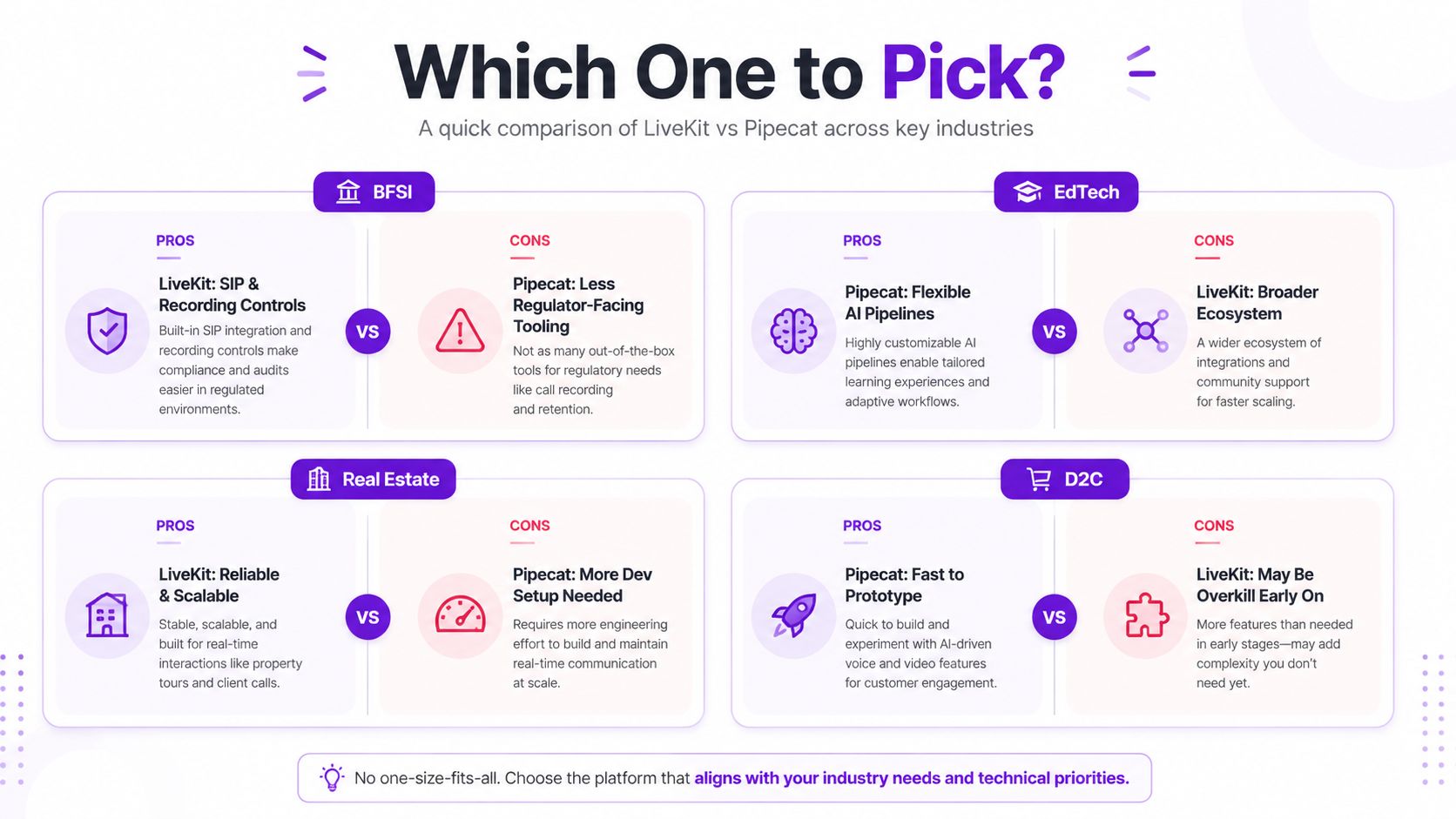
Situational rule: if the caller's journey is tied to a regulated phone interaction, start with LiveKit. If the caller's journey is tied to logic, branching, and channel flexibility, start with Pipecat.
Migration Paths, Pricing Models, and TCO Anchors
What to budget for first
There are three realistic deployment patterns. LiveKit Cloud is the simplest if you want managed rooms, tracks, and telephony-ready infrastructure. Self-hosted LiveKit on Indian regions is what you choose when control and residency matter more than convenience. Pipecat on Daily or self-hosted WebSocket transports is what you choose when pipeline flexibility is the main value.
The cost drivers are the same across all three: concurrent rooms or sessions, egress minutes, recording storage, SIP trunks, and LLM/TTS usage. That's why the open-source footprint data matters, because it tells you where the ecosystem is attracting users, but not where your monthly bill will go. In practice, media minutes and model usage dominate, not framework licensing.
For a board memo, keep the TCO anchor simple. At 1,000 concurrent sessions, the monthly cost is usually driven more by STT, LLM, and TTS than by whether you picked LiveKit or Pipecat. At 10,000 concurrent sessions, infrastructure and recording storage start to matter visibly. At 100,000 concurrent sessions, self-hosting decisions, telephony volume, and model mix become the main budget lever. Those are order-of-magnitude planning bands, not fixed quotes, and they vary with your speech stack, transport choice, and retention policy.
If you want a useful benchmark for build-cost framing, it helps to compare the platform effort against development and launch overhead too. The development package pricing reference is a handy way to remind stakeholders that software cost is not just runtime. It includes the engineering time and integration work that often gets ignored in framework debates.
Before you sign, verify five things with the vendor. Where recordings live. Who controls retention. How SIP is handled. What audit logs you can export. Which team owns failover and support. If the answer to any of those is vague, the framework isn't your biggest problem.
Decision Checklist and the Honest Final Answer
The ten-minute verdict
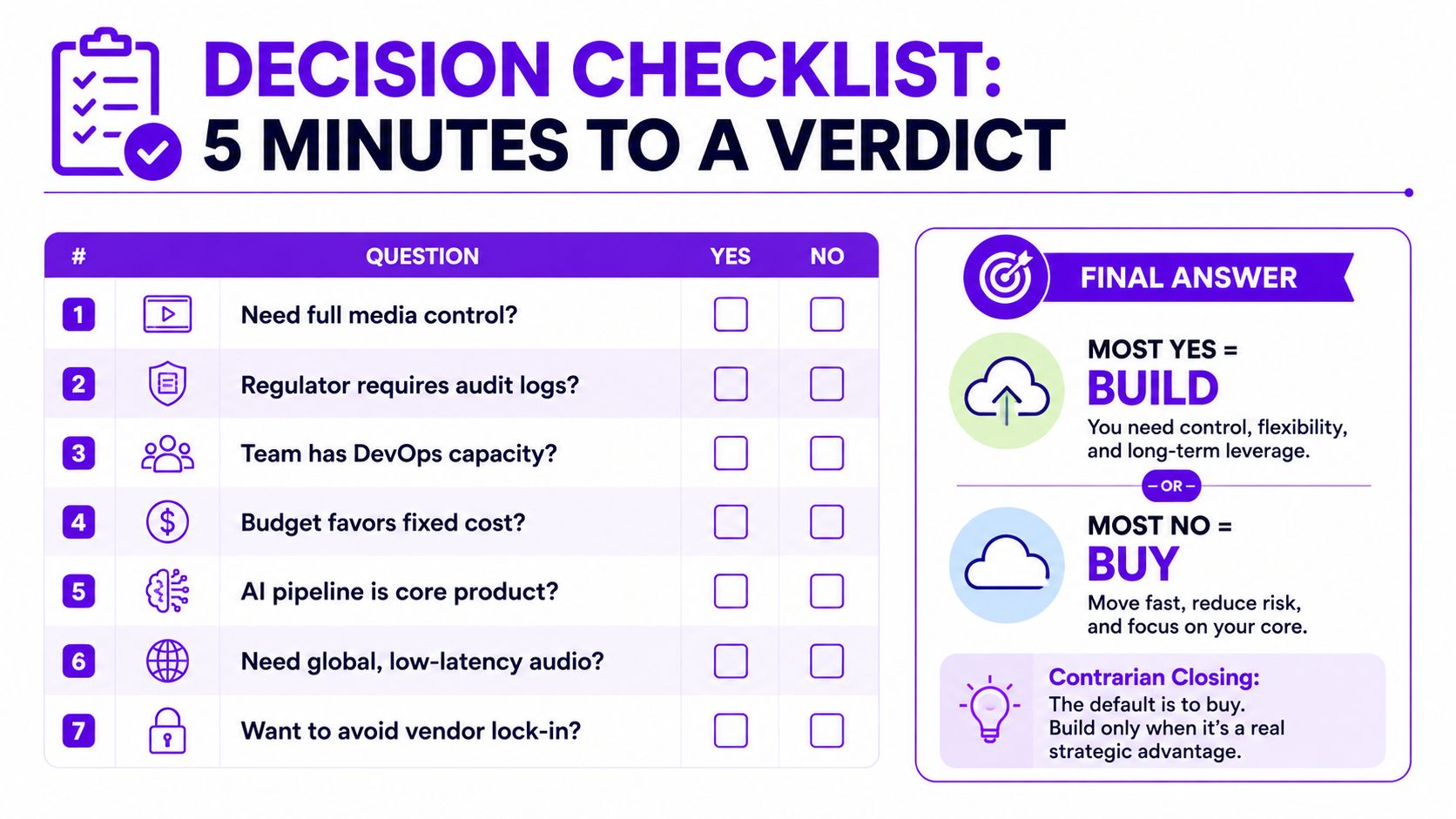
- Need full media control? Choose LiveKit.
- Regulator requires audit logs? Choose LiveKit.
- Team has DevOps capacity? Pipecat becomes more viable.
- Budget favours fixed cost? Pipecat can stay leaner operationally.
- AI pipeline is core product? Choose Pipecat.
- Need global, low-latency audio? Choose LiveKit.
- Want to avoid vendor lock-in? Either can work, but Pipecat gives more transport flexibility.
The honest answer is that neither framework should be the default if your product is just pure voice and you don't want to own orchestration at all. In those cases, a managed voice-agent platform is often the better fit. The same is true when call volume is too small to justify building and maintaining custom RTC infrastructure. Build only when the operational control matters more than the convenience.
If you want a team that thinks about voice AI the way Indian enterprises run it, not the way demos pretend it runs, DialNexa Labs Private Limited can help you map the stack, the telephony, and the workflow into something you can ship without creating a compliance mess. Visit DialNexa Labs Private Limited and put your LiveKit vs Pipecat decision against a real production architecture before you spend another cycle on abstract debate.

This is a well-structured comparison that clearly explains the practical differences between LiveKit and Pipecat. I especially liked how it connects architecture choices with real-world compliance, telephony, and industry-specific requirements.
The industry-specific recommendations make the content practical and valuable for enterprise teams evaluating voice AI solutions.
A strong and practical comparison that goes beyond feature checklists to explain the real architecture, compliance, and operational trade-offs between LiveKit and Pipecat. The industry-specific recommendations make it especially useful for CXOs and engineering teams making production voice AI decisions.
This is a well-structured comparison that makes the differences between LiveKit and Pipecat easy to understand. The CXO-focused insights provide useful context for evaluating voice AI infrastructure and making informed technology decisions.
An insightful comparison of LiveKit and Pipecat that helps business leaders understand the key differences between these technologies. This decision guide offers valuable perspectives on choosing the right platform to build scalable, efficient, and reliable real-time AI voice solutions.