
1800 Number in India: The CXO Guide to Toll-Free Voice
You're probably sitting on the same problem a lot of Indian CXOs are sitting on right now. Leads are coming in on mobile, customers want answers in Hindi, English, or a regional language, and your team is still losing high-intent callers because someone had to wait, transfer, or call back later. An 1800 number is not a vanity helpline in that setup. It's the front door to revenue, support, and regulated customer communication, and if you design it badly, it becomes an expensive noise generator.
The right way to think about it is simple. A toll-free number is only the visible layer. The voice entry point behind it is the true asset, the routing logic, the compliance controls, and the automation stack that decides whether the caller reaches sales, collections, service, or a human agent who can close the loop. In India, that distinction matters more than it does in most markets because telephony, consent, emergency access, and outbound follow-up all sit inside a tighter regulatory frame.
Table of Contents
- Why an 1800 Number Is a Strategic Voice Asset for Indian CXOs
- What an 1800 Number Actually Is and How It Works
- India-Specific Rules, Costs and Compliance Every CXO Must Know
- Setting Up, Provisioning and Porting an 1800 Number
- Choosing the Right Vendor and Pricing Model
- High-Impact Use Cases and Conversion Lift
- Wiring an 1800 Number into a Voice AI Platform
- A 90-Day Plan, ROI Framework and Common Mistakes to Avoid
Why an 1800 Number Is a Strategic Voice Asset for Indian CXOs
A sales head once tells you a lead was “lost after the first ring” because the customer didn't want to pay for the call, and the operations team tells you the issue was “closed” because someone eventually replied on WhatsApp. Both teams are partly right, and both are missing the point. If the customer journey starts with friction, the rest of the funnel inherits that friction.
The boardroom question is not whether to buy one
The key question is where a toll-free entry point earns its keep fastest. For a BFSI player, that may be collections or failed-payment support. For an EdTech brand, it may be admission counselling. For a real-estate developer, it may be site-visit booking. For healthcare, it may be appointment scheduling and follow-up. In each case, the 1800 number is not the destination, it's the switchboard.
Practical rule: If the caller is likely to ask, “Will this cost me money to call?”, you need a toll-free entry point or you're already creating drop-off.
An inbound voice channel still solves problems that web forms and chat can't finish. A parent wants to speak before paying fees. A borrower wants to negotiate after a missed EMI. A patient wants reassurance from a human, not a bot on a screen. That's why the smartest CXOs stop talking about phone numbers and start talking about caller intent, routing, and resolution.
Treat the number as a control point, not a logo asset
The number itself is only valuable if it routes differently for different journeys. Complaints should not land where admissions land. Escalations should not sit in the same queue as routine status checks. That design choice affects conversion, compliance, and brand trust all at once.
It also changes how you buy telephony. You're not just purchasing inbound access. You're purchasing a controllable front door that can be measured, governed, and extended into automation. That is the lens senior leaders need, because it lets them defend spend in terms the CFO understands, which is reduced friction, cleaner handoff, and better use of agent time.
What an 1800 Number Actually Is and How It Works
An 1800 number is a virtual routing address, not a physical line. In India, the prefix maps through the Intelligent Network to a real PSTN destination, which means the number customers dial stays stable while the backend can change. That is why a business can keep the same customer-facing number while shifting routing, balancing traffic, or moving providers.
The format is an 11-digit structure, with a 4-digit access code plus a 7-digit virtual number. This is the part many executives miss. The customer doesn't care where the call terminates, they care that it lands fast, in the right queue, and in the right language.
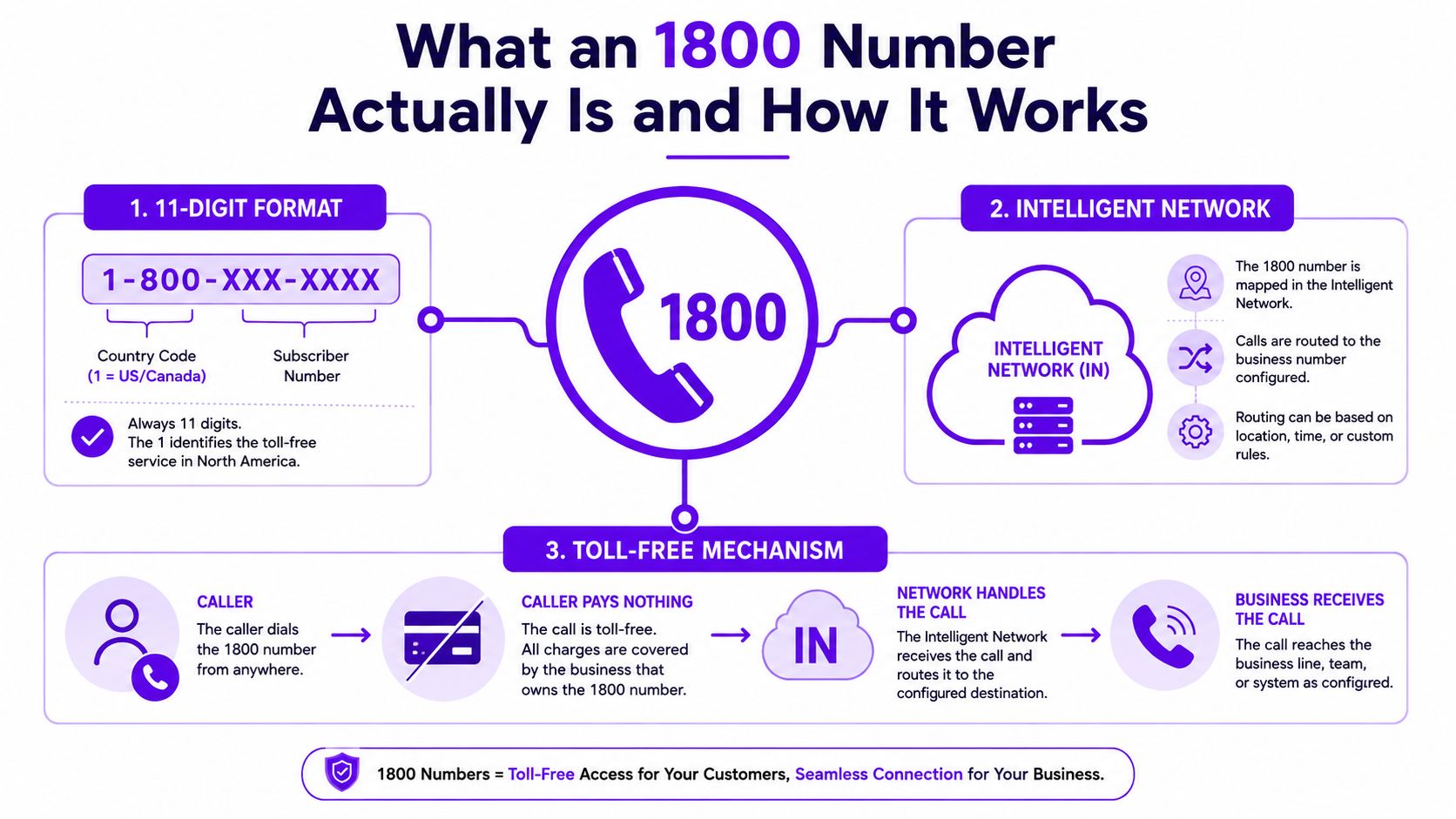
The customer sees one number, the network does the heavy lifting
That routing layer is what makes toll-free telephony useful for scale. You can point the same number to a different destination if your support centre moves. You can create branching rules for language, product line, or geography. You can also design failover so the customer doesn't hear dead air when a queue is overloaded.
This is why a toll-free number behaves more like a brand front door than a phone line. It's a forwarding address for voice. The visible number becomes the stable identity, while the routing logic behind it absorbs operational change.
The distinction from standard mobile numbers is important. A mobile number is usually a direct contact point. An 1800 number is an inbound service layer. It is built to receive and route, not to sit in someone's pocket.
An 1800 number is one type of virtual number, not the whole category. DialNexa’s virtual number India guide covers the DID, toll-free, and 140/160 series options CXOs should weigh before settling on a toll-free entry point.
If you want a technical reference point for how cloud telephony sits around this layer, the architecture overview at DialNexa's phone number provisioning guide is useful because it frames the number as part of the stack, not the stack itself.
Why this model still matters in India
The main advantage is continuity. Customers don't need to learn a new number every time your team changes vendors or restructures support. That reduces operational churn and protects brand memory. It also makes it easier to measure how different routing choices affect answer rates and resolution quality.
A good toll-free number is invisible when it works well. The customer just gets through to the right person.
The takeaway for a CXO is blunt. Buy the number if you're prepared to design the routing behind it. If you're not, you've just bought an expensive label.
India-Specific Rules, Costs and Compliance Every CXO Must Know
India's telephony reality is not a generic contact-centre playbook. The country's regulatory environment ties together inbound service numbers, outbound consent, caller identity, and emergency access, so your 1800 number can't be treated in isolation. If your telephony partner doesn't understand that, the risk lands on your team, not theirs.
TRAI requires network capability for caller line identification presentation (CLIP) and emergency dialing from fixed lines and public calling offices, and it mandates free access to national emergency numbers such as 100, 101, 102, 108, and 112. That matters because your voice stack must coexist with those rules. A bank, insurer, or hospital cannot design support flows that interfere with identity presentation or emergency-access expectations.
DND and DLT change outbound behaviour completely
India's Do Not Disturb regime is not a soft preference. It affects whether your reminders, lead follow-ups, and qualification calls get through at all. TRAI's commercial-communications framework also uses Distributed Ledger Technology registration and templates, which means the outbound side needs sender identity discipline, not just a phone number purchase.
That is where many teams get sloppy. They buy a toll-free number for inbound and then assume the outbound side will behave the same way. It won't. An EdTech counselling team, a healthcare appointment desk, or a collections team still needs approved templates, consent-aware routing, and traceable identity for follow-up.
If you want a complementary read on the compliance side of voice automation, this note on India's new compliance mandates shaping the voice AI landscape is worth keeping in your vendor pack.
Cost is not just rental, it's operational commitment
The price conversation in India usually gets oversimplified into “monthly fee” and “per-minute charges”. That misses the actual cost drivers. Shared versus dedicated numbers, porting effort, call-routing design, and compliance work all affect total cost of ownership. Porting especially tends to get treated as a clerical task, when in practice it can absorb time from operations, telecom, and compliance teams.
| Cost Component | Indicative Range | Notes |
|---|---|---|
| Number rental | Qualitative, varies by provider | Depends on shared or dedicated setup |
| Usage charges | Qualitative, varies by traffic and routing | Often driven by call volume and term |
| Porting effort | Qualitative, project-based | Can create hidden operational cost |
| IVR and routing setup | Qualitative, scope-based | Strongly affects resolution quality |
| Compliance work | Qualitative, ongoing | Includes identity, consent, and audit readiness |
For a broader vendor-market perspective, CallZent's piece on why Mexico leads in BPO services is a good reminder that service economics are now judged on efficiency, compliance, and customer experience together, not price alone.
Bottom line: In India, telephony compliance is a process problem first and a procurement problem second.
Setting Up, Provisioning and Porting an 1800 Number
The fastest way to delay a toll-free launch is to treat it like a simple SIM activation. It isn't. A clean deployment starts with entity verification, service design, and routing decisions before anyone talks about go-live. If those pieces are messy, the calendar slips.
The practical sequence is straightforward. First, confirm the legal entity and KYC documents. Second, decide whether you're buying a new number or porting an existing one. Third, map the number to the destination lines or queues. Fourth, configure the IVR, language prompts, and failover logic. Fifth, test caller ID, DTMF selection, and escalation paths before you announce the number to customers.
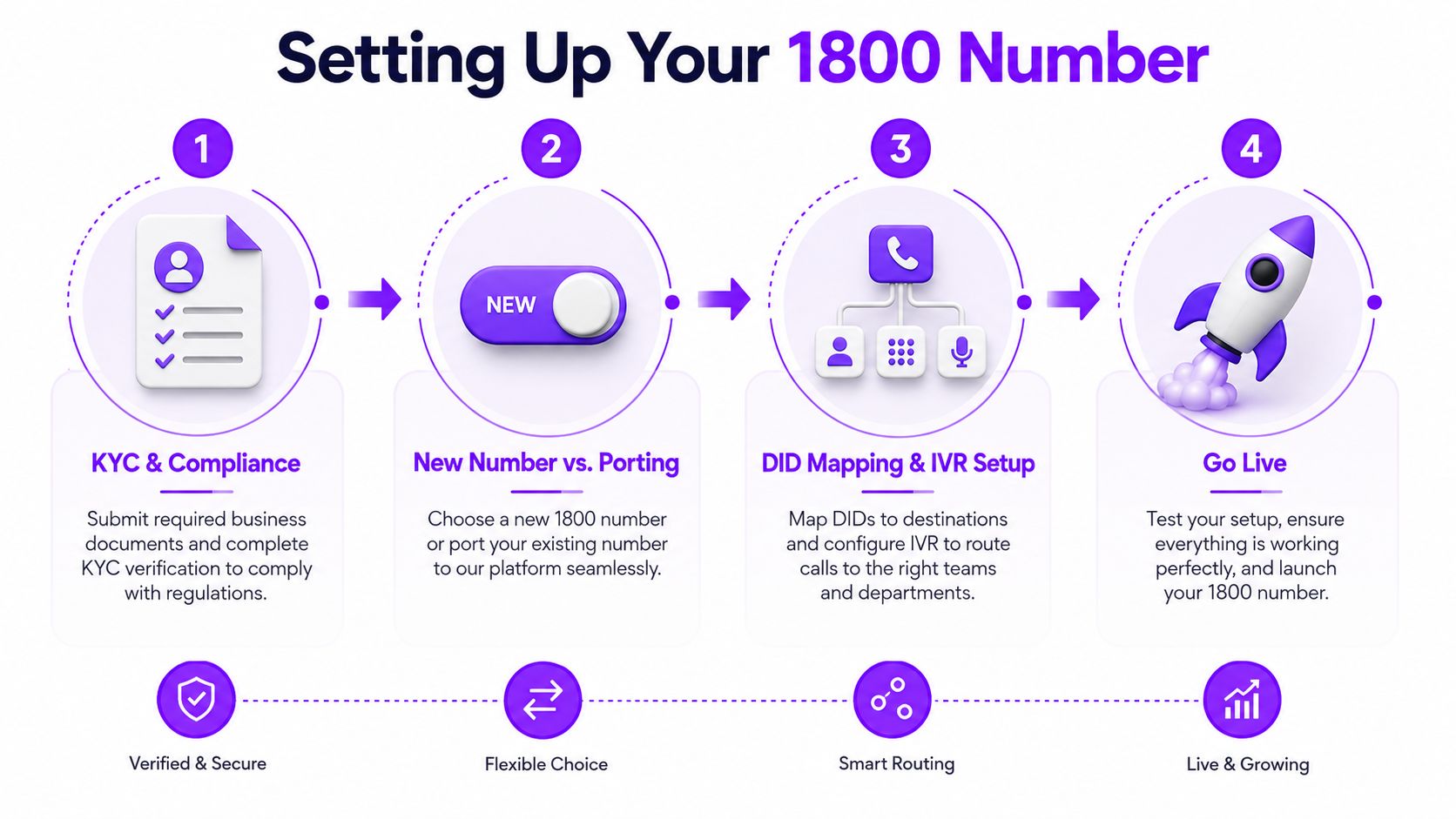
Start with KYC and routing ownership
Many projects stall due to incorrect entity documentation, missing authorisation letters, or unclear number ownership. This can delay procurement before any telecom work starts. Similar issues arise when business and operations teams disagree on who owns escalation logic.
If your stack has to support regulated workflows, the documentation step needs to be tight. DialNexa's own provisioning workflow for 1800 toll-free numbers is documented alongside its KYC requirements, which is a useful reminder that regulated-number onboarding is not an afterthought. The internal setup note at DialNexa's SIP call flow guide is also useful if you want to map voice ingress to agent groups and fallback paths.
Porting is a business decision, not a vanity decision
Porting makes sense when the current number already has customer familiarity or historic usage. Buying a new number makes sense when the old setup is messy, underperforming, or tied to a weak vendor relationship. Don't port just because it sounds cheaper on paper. Port only if the customer memory attached to the number matters enough to preserve.
Operational rule: If your current number is not recognised by customers, porting usually saves less value than leaders expect.
The most common launch delays are predictable. Teams miss DLT headers on outbound follow-ups, forget to check CLIP support, or under-specify language routing. These are not technical curiosities. They are the reasons a two-week initiative becomes a quarter-long project.
For developers and ops teams that need the platform side of the architecture, DialNexa's voice AI agents for developers is the right technical companion piece.
Choosing the Right Vendor and Pricing Model
The wrong vendor choice usually shows up later as broken routing, weak reporting, or a support team that can't explain call failures. That's why the evaluation should focus on business risk, not feature brochures. A cheaper plan that gives you poor API access or thin SLA commitments usually becomes more expensive once call volumes rise.
Compare on control, not just cost
For BFSI, I'd prioritise compliance support, traceability, and callback handling. For EdTech, I'd look hard at language support and fast routing to counsellors. For real estate and D2C, I'd care about call quality, queue management, and clean integration with sales workflows. The vendor has to fit the journey, not the other way around.
The internal question to ask is simple. Can this provider handle traffic without making my team explain every failure manually? If the answer is no, the cheapest quote is a trap.
Ask for the lines that matter in the RFP
- API depth: Can the provider expose routing, recording, and analytics cleanly?
- SLA clarity: What happens when call quality drops or queues fail?
- Language support: Can the stack handle English, Hindi, and regional routing without patchwork?
- Industry fit: Has the provider worked with regulated or high-volume inbound use cases?
- Exit flexibility: What happens if you need to move providers later?
Free inclusions are rarely free when they force your team into manual workarounds.
For a practical comparison of provider types, DialNexa's cloud telephony provider overview is a useful starting point because it frames the buying decision around capability, not logo collection.
For a line-item breakdown of one of India's most-shortlisted providers, see DialNexa's Exotel pricing guide, which covers plan tiers, per-minute rates and DLT pass-through costs.
One more thing. I'd include DialNexa Labs Private Limited as one option if you need toll-free provisioning tied to Voice AI routing, because it combines number handling with agent automation rather than treating them as separate purchases. That matters when the business wants one stack for inbound qualification and service.
High-Impact Use Cases and Conversion Lift
The strongest case for an 1800 number is not abstract brand trust. It's the point where a caller's intent is fragile and a missed connection costs money. That's true in BFSI, EdTech, real estate, healthcare, and D2C, but the mechanism differs in each one.
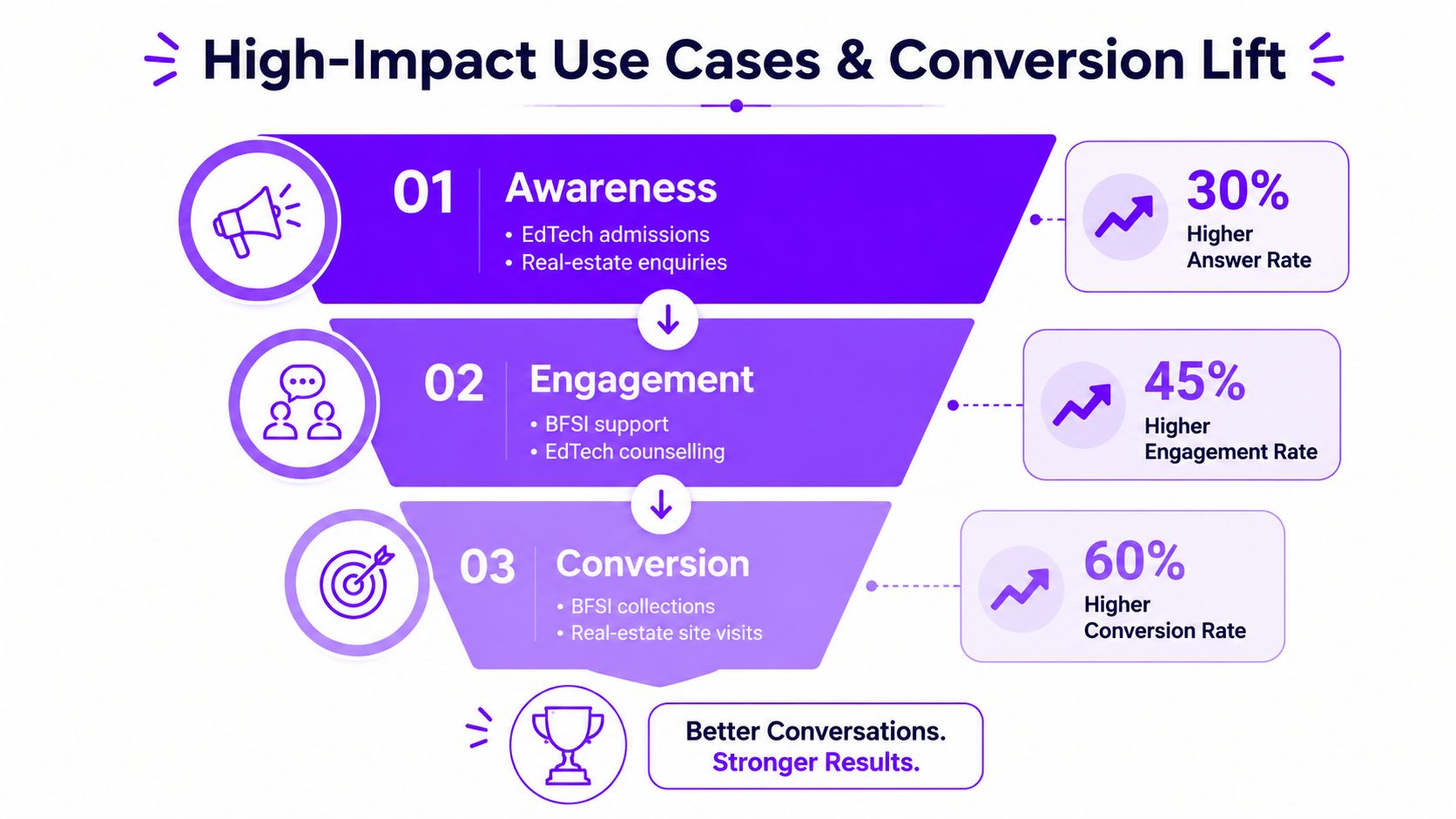
BFSI, EdTech and real estate need different routing logic
A lender handling failed autopay or document collection needs a toll-free entry point because the caller is already under friction. India's UPI scale, reported at 18.40 billion transactions in July 2026 with value of about ₹24.85 lakh crore by NPCI, shows how large the digital transaction base is. That scale creates more moments where a customer needs a human to resolve exceptions, not another app screen. The useful outcome is not just a connected call, it's a resolved payment problem that protects conversion.
In EdTech, admissions counselling works best when the number routes to the right counsellor by language, course, or geography. If the parent reaches the wrong team, the lead cools immediately. For real estate, the same logic applies to site-visit booking. The call has to reach someone who can confirm inventory, timing, and location without three transfers.
Healthcare and D2C depend on easy follow-through
Public health and digital care make the healthcare case easy to defend. India's ABDM and the government's eSanjeevani platform, which has crossed hundreds of millions of consultations in public reporting, show that remote assistance is already part of the care journey. Hospitals, clinics, and diagnostics chains can use an 1800 number for appointment scheduling, discharge follow-up, or lab-result callbacks, then hand off into digital workflows where needed.
D2C and e-commerce use the number differently. The customer may need order confirmation, COD verification, or issue resolution. If the support line is toll-free and routed well, you keep the sale from falling apart after checkout. That's especially important when the customer wants reassurance before accepting delivery.
The common thread is simple. Voice matters most when the customer is uncertain, busy, or about to abandon. That is where a well-run 1800 number pays back.
Wiring an 1800 Number into a Voice AI Platform
A modern toll-free setup should not end in a human queue. It should feed a routing layer that can classify intent, capture context, and hand off only when the machine should stop. That is why the number sits in front of the AI stack, not behind it.
The call flow should be boringly predictable
A customer dials the 1800 number. The network routes the call into your voice platform. Speech is converted through ASR, intent is interpreted through NLU, and the platform decides whether the caller can be handled by an AI agent, a human agent, or a specific branch. The system records the interaction, captures consent where needed, and stores analytics for review.
That design is valuable because it prevents the most common failure in toll-free operations. You don't want every caller dumped into a generic queue. You want the platform to decide whether this is a booking, complaint, lead qualification, collections case, or escalation.
If you want a broader primer on conversational AI for business growth, it helps to think of the voice layer as the customer's first structured conversation, not a replacement for your staff.
Use AI to route, not just to answer
The smartest use of Voice AI is selective. Let the machine handle repetitive questions, gather details, and pre-qualify. Let humans take the cases where judgment, negotiation, or empathy matter. That combination is where you get operational efficiency without making the experience feel robotic.
DialNexa's published customer outcomes are a useful benchmark here. It reports connect rates rising from 47% to 91%, lead-to-booking improving from 2% to 8%, multi-minute natural conversations, and 97% accuracy for AI-qualified leads compared with human judgment. Those figures are strong enough to justify a serious pilot, especially if your current voice process is underperforming.
Practical rule: Use the AI layer to remove waste, not to hide bad routing.
The technical companion note at DialNexa's voice AI agent documentation is useful because it shows how the platform thinking maps into implementable call flows, analytics, and handoff logic.
A 90-Day Plan, ROI Framework and Common Mistakes to Avoid
The cleanest rollout is a 90-day one. In days 1 to 30, lock requirements, KYC, compliance, and routing design. In days 31 to 60, configure the number, IVR, and language branches, then test handoffs and escalation paths. In days 61 to 90, pilot with real traffic, review call analytics, and tighten the scripts before full release.
Your ROI scorecard should stay boring and operational. Track cost per call, first-call resolution, lead-to-booking lift, collections recovery rate, and CSAT. If you can't show movement on at least two of those, the project is probably overbuilt or misrouted.
The seven mistakes I'd watch for are consistent. Picking the cheapest number, ignoring DLT, treating the 1800 line as a marketing asset, missing language coverage, under-investing in IVR design, skipping compliance audits, and failing to integrate analytics. Any one of those can turn a useful voice channel into a support liability.
If the use case needs regulated inbound handling, multilingual routing, and AI-assisted qualification, the 1800 number is still a strong choice. If the customer journey is low-friction, low-value, and mostly self-serve, force-fitting toll-free voice is a waste. The decision has to come from economics and compliance, not habit.
If you want to build an 1800 voice entry point that's designed for compliance, routing, and conversion, talk to DialNexa Labs Private Limited. They build Voice AI agents, toll-free number workflows, and routing setups for Indian teams that need inbound calls to resolve real business problems, not just ring somewhere.

This content brilliantly reframes an 1800 number as a customer-experience control point, not just a toll-free contact number.
This is a valuable and informative guide that clearly explains the role of 1800 numbers in India and how toll-free voice solutions can improve customer accessibility and business communication.
A very informative guide to understanding toll-free 1800 numbers in India and their value for businesses. It’s great to see how the right voice communication strategy can improve customer accessibility, strengthen trust, and help companies deliver a better customer experience.