
AI Call Center Automation: A CXO’s Strategic Guide
By 2026, conversational AI for customer service is projected to reduce contact centre labour costs by $80 billion globally, and in India, implementing AI agents can cut cost per call by 50% while increasing CSAT, according to Master of Code's compilation of Gartner and McKinsey findings. That combination changes the boardroom question. This isn't about whether AI belongs in the call centre. It's about whether your operating model can remain competitive without it.
For Indian enterprises, the stakes are sharper than the global headlines suggest. Cost reduction matters, but so do resilience, compliance, and conversion. A generic automation programme that works in a mature, high-bandwidth, low-regulation environment can fail in India if it can't handle low-quality audio, multilingual interactions, or DPDP-aligned data handling. The winners won't be the firms that buy the most AI. They'll be the firms that deploy AI call center automation with a disciplined commercial thesis.
Table of Contents
- The Unavoidable Shift to AI Call Centre Automation
- Inside the Machine What Powers AI Call Centre Automation
- Real-World ROI Actionable Use Cases for AI Automation
- Your Strategic Roadmap to Successful Implementation
- Measuring What Matters Redefining Call Centre KPIs
- Overcoming Real-World Hurdles Compliance and Resilience
- Beyond Automation The Future is Agentic AI
The Unavoidable Shift to AI Call Centre Automation
By 2029, agentic AI will autonomously resolve 80% of common customer service issues without human intervention, according to Gartner's customer service and support predictions. That projection matters because it changes the boardroom question. AI call centre automation is no longer a discretionary technology upgrade. It is becoming a determinant of service economics, response capacity, and operating resilience.
The financial logic is unusually strong. In many transformation programmes, companies trade short-term cost for long-term capability. Here, the same investment can improve both. Automation reduces the cost of handling repetitive demand, while better routing, faster resolution, and 24×7 availability improve customer experience. For boards, that combination deserves attention because it changes the shape of the cost curve without requiring equivalent growth in headcount.
India is moving faster than many leadership teams realise
The Indian market has already entered a reset phase. According to Reuters' reporting on India's outsourcing and call centre shift, 1.65 million workers are employed in call centres, payroll, and data handling roles, while hiring has fallen by roughly 90% as AI call centre automation and digitalisation expand. Reuters also reports that generative AI agents can reduce the human workforce needed for 10,000 monthly inquiries by up to 80%, automating the work of at least 15 agents for ₹100,000 per month, roughly the cost of three customer-care representatives.
That is not a marginal labour saving. It is a structural change in service delivery.
A competitor that automates first does more than lower cost per interaction. It can extend service hours, absorb spikes in demand without recruitment lag, and standardise quality across geographies and languages. In India, where service volumes are high and customer expectations are rising across digital-first sectors, those advantages compound quickly.
Customer expectations now support the business case
The customer side of the equation has also shifted. According to Zendesk's CX Trends research, consumers increasingly expect faster, more personalised support, and businesses are using AI to meet those expectations at scale. That matters because adoption is no longer driven only by procurement or finance teams. Customers are rewarding responsiveness, continuity, and low-friction resolution.
For management teams, the practical issue is service design. Can the current operating model deliver immediate answers for routine requests, maintain context across channels, and escalate the right cases to human agents without creating delay? If not, the gap is strategic, not technical.
A useful reference point is the broader pattern of AI in customer service benefits for support operations. The strongest deployments reduce avoidable call volume, improve consistency, and protect human agent capacity for exceptions, complaints, and revenue-linked conversations.
Delay carries a strategic risk
In India, waiting has a specific cost. Companies that postpone deployment keep a higher-cost service model in place while competitors improve throughput and responsiveness. They also lose time in building the operating discipline that responsible automation requires under local conditions.
That discipline is not abstract. It includes consent management and data handling aligned with the DPDP Act 2023, multilingual conversation design for Indian customer bases, and voice systems that continue to perform under unstable network conditions. These are execution issues with direct commercial impact. A system that works in ideal demos but fails on patchy mobile connections or weak compliance controls will not produce board-level returns.
Early movers gain more than savings. They gain process data, governance experience, and a repeatable operating model before AI call centre automation becomes standard across the sector.
Inside the Machine What Powers AI Call Centre Automation
Most executives don't need a technical lecture. They need a clean mental model of how AI call center automation works, and why each layer matters commercially.
A digital workforce, not a single bot
The simplest analogy is a digital service team.
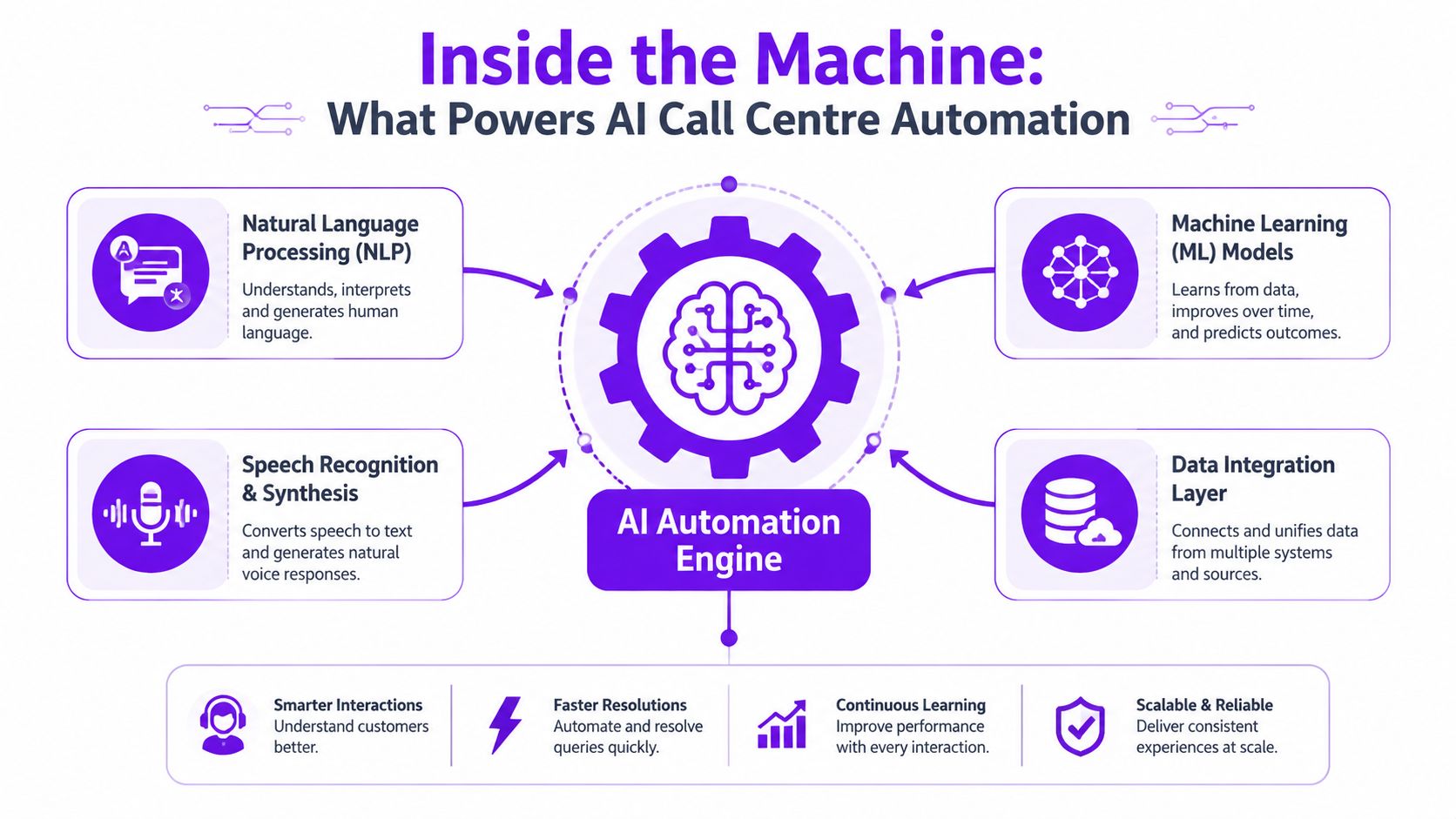
One part listens. One part understands intent. One part decides what should happen next. One part connects the conversation to your CRM, ticketing system, payment system, KYC workflow, or booking stack. When these pieces are integrated, the system can handle routine requests end to end instead of merely answering questions.
This is why the market is growing so quickly. Salesforce's India contact centre outlook projects the Indian cloud-based contact centre market to reach USD 7.9 billion by 2034, driven by autonomous AI agents powered by LLMs and NLP. The same source ties that architecture to a 30-50% drop in operational costs and 15-25% higher CSAT in sectors such as BFSI and e-commerce.
How the components create business value
Here's the operating stack in plain English.
| Component | What it does | Why a CXO should care |
|---|---|---|
| Speech recognition and synthesis | Converts spoken language into text and responds naturally by voice | Determines whether callers feel they're in a rigid IVR or a fluid conversation |
| Natural language processing | Interprets what the customer means, not just the words used | Enables intent recognition, flexible phrasing, and better routing |
| Machine learning models | Learn from patterns in outcomes and interaction histories | Improves routing, prediction, lead qualification, and prioritisation |
| Data integration layer | Connects AI to CRM, ticketing, KYC, order, and scheduling systems | Turns a conversational interface into an execution engine |
Natural language processing is the key layer because it moves the interaction from script-following to meaning detection. If your team wants a non-technical explanation of how this layer works, this practical NLP overview is a useful reference.
A voice bot without system integrations is a talking FAQ. A voice bot with orchestration and data access becomes an operating asset.
There's another point many boards miss. Performance doesn't come from one model in isolation. It comes from how the system handles the full journey: identification, intent capture, action execution, exception handling, and handoff. In Indian operations, where support often crosses voice, WhatsApp, CRM records, and human callbacks, orchestration matters as much as conversation quality.
Four executive questions that cut through vendor theatre
- Can it resolve, not just respond? A vendor should show how the agent completes tasks such as booking, KYC guidance, payment reminders, or support resolution.
- Can it hand off with context? The AI should preserve intent, customer history, and the steps already completed.
- Can it integrate cleanly? If it can't write back to core systems, the burden shifts to staff and ROI erodes.
- Can it operate in Indian conditions? Compliance, multilingual handling, and network tolerance shouldn't be afterthoughts.
The technology isn't magic. It's architecture. Boards that understand that make better investment decisions.
Real-World ROI Actionable Use Cases for AI Automation
Executives approve automation budgets for one reason: measurable financial return. In customer operations, the fastest payback usually appears in workflows with three traits. High contact volume, repetitive first-touch tasks, and visible revenue leakage between enquiry and conversion.
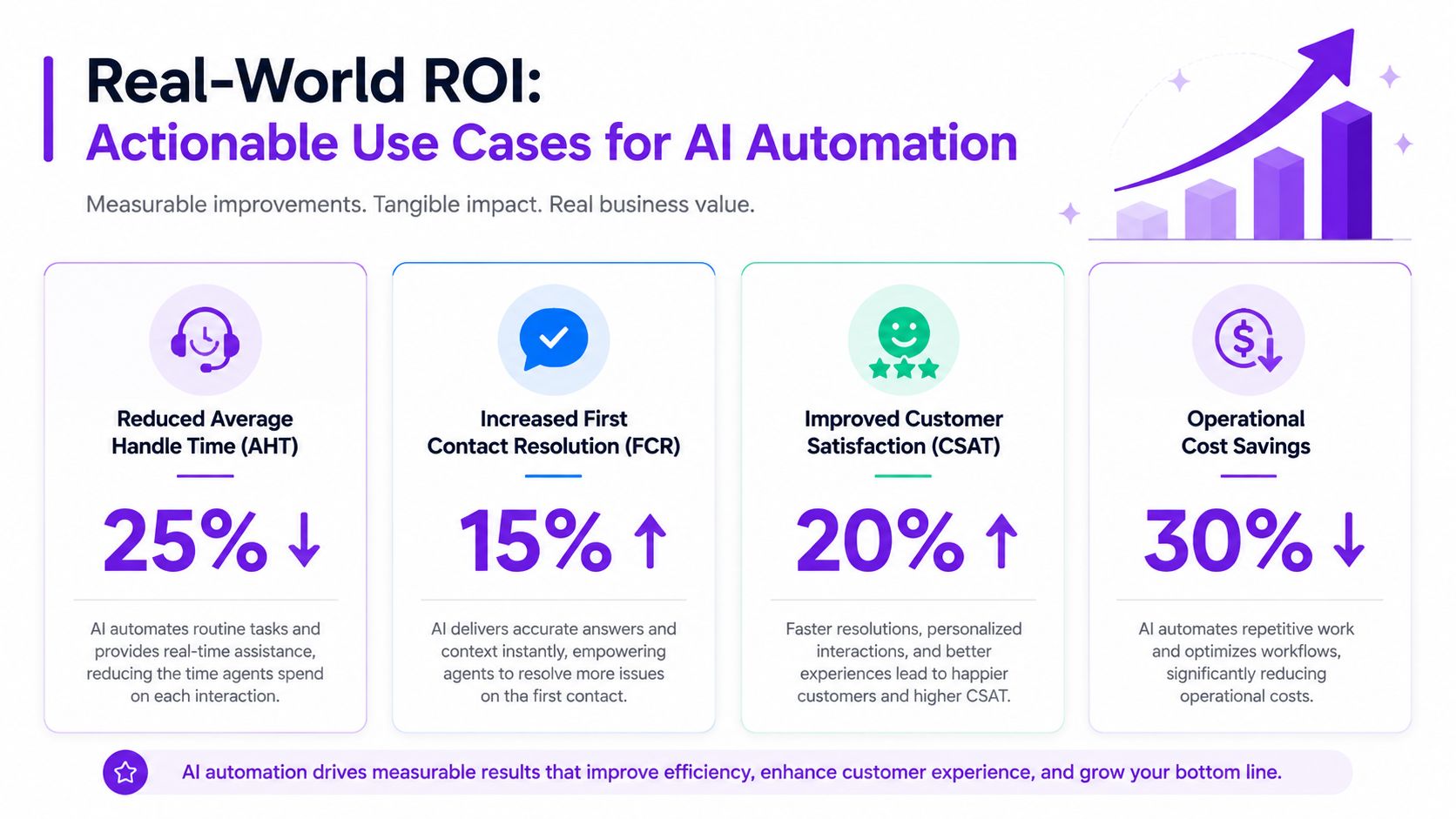
That makes presales, counselling, KYC guidance, appointment scheduling, payment reminders, and inbound triage strong candidates in the Indian market. These processes sit close to revenue, depend on response speed, and often break down during volume spikes, regional language variation, or uneven network quality. A well-scoped AI deployment improves throughput, but the larger benefit is economic discipline. It reduces the cost of handling low-complexity interactions while protecting human capacity for objections, exceptions, and closing activity.
EdTech and programme counselling
For EdTech providers, the commercial problem is rarely top-of-funnel demand alone. It is the gap between enquiry and guided progression.
A student submits a form at 9:30 p.m., misses a callback the next morning, and chooses a competitor that responds first. During admission windows, that pattern scales fast. AI voice agents help institutions respond instantly, answer standard questions on programme fit, fees, eligibility, and next steps, then route qualified prospects to counsellors with context already captured.
The ROI logic is straightforward. Speed-to-contact improves lead salvage. Standardised first-touch conversations reduce variation across counsellors. Scheduled follow-ups happen consistently, even outside office hours. For boards evaluating the category, this overview of AI agents for customer service that drive measurable business growth is useful because it frames deployment in commercial terms rather than model features.
There is also a second-order advantage. Indian EdTech demand often comes from mixed-language households and from regions where call quality is inconsistent. Systems that can confirm intent, repeat key details, and recover gracefully from dropped audio preserve more opportunities than human teams working under peak-load pressure.
Real estate and appointment conversion
Real estate teams face a different form of waste. Sales staff spend time on poorly qualified leads, duplicate follow-up, and missed scheduling windows, while serious buyers encounter delayed engagement.
AI performs well here because the early workflow is structured. Budget range, location preference, buying timeline, project type, financing status, and site-visit intent can all be captured in a consistent sequence. Human advisers then enter the conversation later, with better context and a narrower list of prospects more likely to progress.
That changes unit economics. Site visits improve in quality. Advisor time shifts from basic qualification to persuasion and closure. Management gains a cleaner view of where prospects drop out, by project, geography, campaign source, or script variant.
To improve those workflows over time, conversation analysis matters as much as call handling. The SigOS platform for customer voice shows how structured voice analysis can surface recurring objections, identify where intent weakens, and map the conversation patterns associated with better progression.
Here's the embedded example of how these workflows are increasingly being operationalised:
BFSI and compliant guidance workflows
BFSI leaders often hesitate for valid reasons. The sector operates under tighter scrutiny, customer harm risk is higher, and the DPDP Act 2023 raises the cost of weak data practices.
In fact, automation can reduce risk when the workflow is tightly scoped. The right starting point is not advisory selling or dispute resolution. It is rules-based, auditable interaction steps such as product information, document checklists, KYC guidance, payment reminders, branch appointment booking, and status updates. These journeys produce a clearer control environment because prompts, disclosures, escalation rules, and data capture points can be defined in advance and reviewed centrally.
That matters in India, where the operating environment is uneven. Customers move between voice calls, WhatsApp, branch visits, and agent callbacks. Network interruptions are common enough that retry logic, confirmation prompts, and resumable workflows affect completion rates. In regulated settings, resilience is not only an operations issue. It is part of service quality and compliance exposure.
Practical rule: Start where the process is repeatable, the disclosure language is fixed, and every handoff can be logged for audit review.
What these use cases have in common
The strongest AI automation cases share the same business pattern:
- Revenue sits close to the workflow. Faster response and better qualification protect conversion, not just service cost.
- The first interaction is structured. That makes scripting, compliance review, and performance measurement easier.
- Failure is expensive. A missed callback, an abandoned KYC step, or a delayed appointment often translates directly into lost income.
- Human talent is scarce. Automation raises the value of skilled staff by shifting them toward exceptions, negotiation, and closure.
This is why early ROI often appears in the middle of the funnel. Boards that treat AI call centre automation as a labour-saving tool alone usually understate the upside. In Indian operations, the sharper strategic benefit is better revenue capture, tighter process control, and more resilient execution under real-world conditions.
Your Strategic Roadmap to Successful Implementation
The biggest implementation mistake isn't buying the wrong model. It's launching with the wrong ambition.
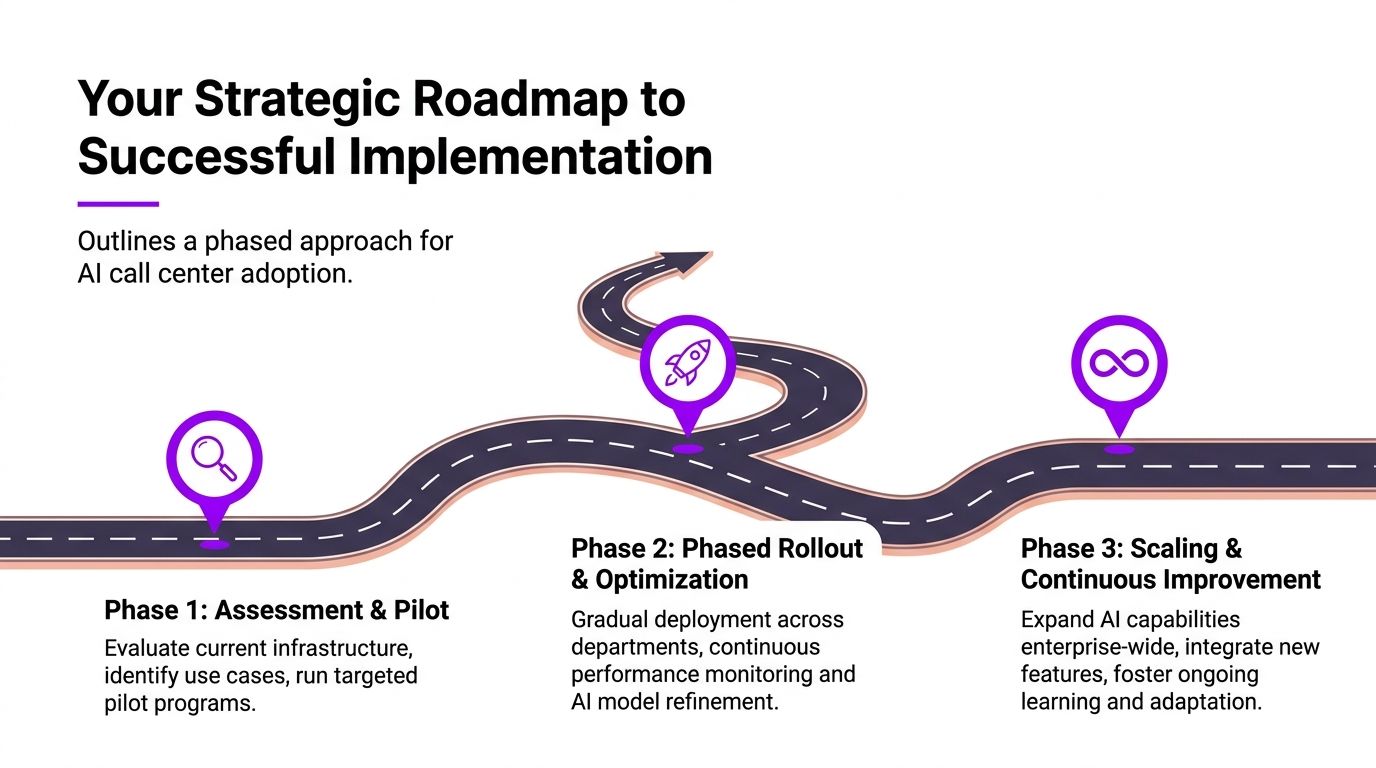
Boards often approve a broad “AI for customer service” mandate, then discover the organisation has mixed together cost takeout, experience improvement, lead conversion, compliance, and channel modernisation into one unfocused programme. A better approach is phased and financially literate.
Phase one assessment and pilot definition
Start with one business problem, not one technology category.
The right first pilot usually sits at the intersection of three factors: high volume, clear workflow boundaries, and measurable commercial value. In one company that might be admissions counselling. In another it could be KYC guidance, appointment reminders, collections follow-up, or ecommerce support triage.
Key boardroom questions at this stage:
- What is the primary objective? Cost reduction, faster response, conversion uplift, or service consistency?
- What process is repetitive enough to standardise?
- Where can we tolerate partial automation with clean escalation?
- Which systems must the AI access on day one?
A narrow pilot creates an internal benchmark. A broad launch creates confusion.
Phase two pilot execution and proof of value
Pilot design should look more like an investment case than a software rollout.
Define the workflow, the handoff logic, the approvals, the fallback path, and the exact business metrics before going live. Supervisors should review real conversations, not just dashboard summaries. Legal and compliance teams should sign off on what the AI may say, log, and escalate.
A practical pilot scorecard usually includes:
| Dimension | What to review |
|---|---|
| Operational performance | Resolution quality, transfer quality, repeat contact patterns |
| Commercial impact | Appointment completion, lead progression, qualified interaction volume |
| Experience quality | Customer feedback themes, abandonment patterns, agent acceptance |
| Control quality | Auditability, consent logging, escalation discipline |
Treat the pilot as a governance test as much as a performance test. Boards don't scale what they can't supervise.
Phase three scaling and governance
Once the pilot works, the next risk is scaling too mechanically.
A common error is copying the same flow across every function without adapting for use case, customer profile, or regulatory sensitivity. Scaling should happen by workflow family. Presales, support, collections, and compliance-heavy journeys need different controls, scripts, fallback logic, and reporting views.
The procurement lens also changes at this stage. You're no longer evaluating a demo. You're assessing an operating partner or platform against long-term fit.
The CXO vendor and feature checklist
Use this checklist in procurement reviews and steering meetings:
- Integration depth: Can the platform connect to CRM, telephony, ticketing, booking, and KYC systems without brittle custom work?
- Handoff quality: Does context move cleanly from AI to human agent?
- Governance controls: Can supervisors inspect logs, prompts, workflows, and escalation triggers?
- Compliance readiness: Does it support localised data handling, consent records, and segmented workflows for sensitive interactions?
- Resilience: Can voice performance hold up under noisy or unstable network conditions?
- Analytics quality: Can leaders track commercial outcomes, not just conversation counts?
- Scalability: Can the operating model expand from one use case to many without rebuilding the stack?
Implementation succeeds when the organisation treats AI call center automation as a managed operating capability. It fails when leaders treat it like a one-time IT deployment.
Measuring What Matters Redefining Call Centre KPIs
A call centre can improve customer economics while its legacy dashboard appears to get worse.
That is the measurement problem boards need to fix. In an AI-led operating model, average handle time often rises for human agents because AI absorbs the repetitive, low-complexity contacts first. The remaining calls are harder, more sensitive, and more commercially important. A higher human AHT in that context can reflect better routing, not weaker execution.
The board question changes from "How fast are agents closing calls?" to "How efficiently is the business resolving customer demand at the right quality level?"
Why old metrics distort investment decisions
Average handle time was designed for labour management. It is weak at measuring system performance.
If AI resolves password resets, payment reminders, policy queries, order status checks, and basic onboarding questions, the human queue becomes a concentration of exceptions. That mix shift makes AHT less useful as a benchmark for productivity, workforce planning, and vendor evaluation. It can also create the wrong managerial incentives. Teams start optimising for shorter conversations instead of higher resolution quality, stronger conversion, or lower repeat demand.
That matters in India, where language diversity, variable call quality, and regulated workflows make a short call less important than a correct outcome. In BFSI, healthcare, telecom, and public-facing services, one failed interaction can trigger repeat calls, complaints, manual review, or compliance exposure. A KPI model built around speed misses those costs.
The KPI set boards should ask for
A stronger scorecard measures outcome, cost, and control.
- Automated Resolution Rate: The share of interactions completed by AI without repeat contact, supervisor intervention, or manual correction.
- Intent Fulfilment Rate: Whether the caller successfully achieved the purpose of the interaction, such as updating details, completing a booking, opening a ticket, or receiving a compliant disclosure.
- Cost per Resolved Outcome: Total operating cost divided by successfully completed interactions, across both AI and human channels where relevant.
- Escalation Quality: Whether context, identity signals, and prior steps pass cleanly to the human agent so the customer does not need to restart.
- Repeat Contact Rate: The percentage of customers who return within a defined period for the same issue. This is one of the clearest indicators of whether automation is solving demand or merely deflecting it.
- Compliance Capture Rate: The percentage of applicable interactions where consent, disclosures, and required records are captured correctly. Under the DPDP Act 2023, this belongs on the operational dashboard, not only in legal review.
- Resilience by Network Condition: Performance segmented by poor, moderate, and strong connectivity conditions. For Indian deployments, this often explains more variance than model quality alone.
Here is a more useful board-level framing:
| Legacy metric | Why it falls short | Better board metric |
|---|---|---|
| Average Handle Time | Reflects call duration, not business value or resolution quality | Cost per resolved outcome |
| Call volume | Measures activity, not success | Intent fulfilment rate |
| Agent utilisation | Optimises staffing efficiency, not customer or commercial results | Automation coverage by workflow |
| Transfer rate | Misses whether transfers were appropriate and informed | Escalation quality |
One metric deserves special attention. Repeat contact rate.
If an AI system completes interactions quickly but customers call back because the answer was incomplete, the apparent efficiency gain is false. The business pays twice. First in the original interaction, then in the recovery effort. That hidden cost is common in deployments evaluated too heavily on containment or speed.
Boards should also ask for KPI segmentation, not blended averages. Performance should be split by workflow, language, customer type, and regulatory sensitivity. An automated renewal reminder and a KYC-related conversation do not belong in the same performance bucket. Neither do metro users on strong networks and customers in low-bandwidth conditions. Without that segmentation, weak performance in high-risk journeys can hide inside acceptable portfolio averages.
If your dashboard cannot connect automation to resolution quality, commercial outcome, and compliance accuracy, it is reporting activity rather than value.
The strategic shift is straightforward. Report how effectively the organisation resolves, converts, and contains demand at acceptable risk, not how quickly individual calls end. That is the KPI model that supports capital allocation, operating discipline, and long-term advantage.
Overcoming Real-World Hurdles Compliance and Resilience
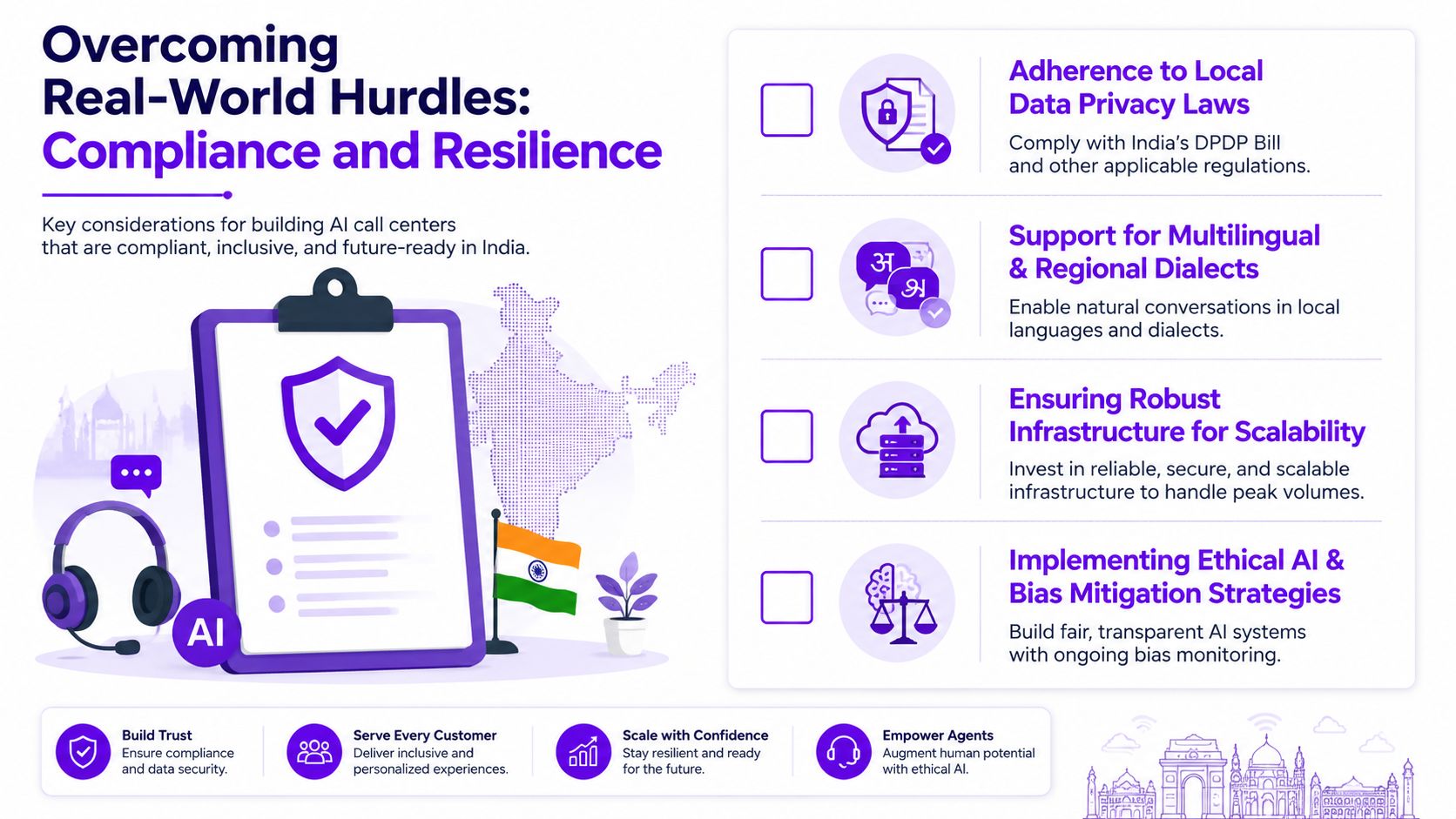
Generic global content often assumes two things that don't hold cleanly in India. First, that compliance is a universal template. Second, that network and audio quality are stable enough for voice AI to work as advertised.
Neither assumption is safe.
Compliance isn't a legal footnote
For Indian enterprises, DPDP Act readiness has to be designed into the workflow, not bolted on after procurement.
According to Retell AI's contact centre automation analysis, 79% of Indian enterprises plan to implement AI contact centres by 2026, yet only 12% have workflows compliant with India's legal frameworks such as the DPDP Act. The same source states that AI systems with localised data storage and DPDP-aligned consent logging can reduce compliance violations by 63% in sectors such as BFSI.
That gap is strategically important. It means many firms are buying AI faster than they are operationalising lawful AI.
Boards should insist on a compliance design review that answers five questions:
- Where is customer data stored?
- How is explicit consent captured and logged?
- Which interactions trigger mandatory human handoff?
- How are audit trails preserved for disputes or reviews?
- Can the organisation restrict cross-border data movement where required?
For BFSI, healthcare, and real estate, those controls shape deal risk, not just IT risk.
Resilience under Indian network conditions
A second blind spot is operational resilience in imperfect audio environments.
The NICE discussion of AI automation challenges in India-linked conditions highlights an under-addressed issue: 68% of IN-region call centres report dropped calls due to poor bandwidth or network latency, and 42% of customers abandon calls when AI fails to distinguish speech in noisy environments. The same source notes that adaptive noise suppression and fallback-to-human protocols can reduce call abandonment by 55% in IN markets, while hidden failures in non-ideal audio conditions lead to 30% lower customer satisfaction.
These aren't edge cases. They're operating realities in urban noise, patchy mobile coverage, and variable home broadband conditions.
What resilient AI call center automation looks like in practice
A resilient deployment should include:
- Adaptive audio handling: The system should manage background noise, interruptions, and inconsistent signal quality.
- Smart fallback logic: When confidence drops, the AI should transfer quickly rather than force a bad experience.
- Context preservation: The customer shouldn't lose progress because the handoff happened mid-call.
- Workflow segmentation: High-risk and sensitive interactions should have stricter thresholds for automation.
The real test of voice AI in India isn't how it performs in a demo. It's how it behaves on a noisy line, with partial context, when the customer is impatient.
Compliance and resilience belong in the same board discussion because both determine whether scale is sustainable. A system that is cheap but non-compliant, or advanced but brittle under local conditions, isn't an asset. It's an exposure.
Beyond Automation The Future is Agentic AI
The next stage isn't better menu trees or friendlier chatbots. It's agentic AI.
That term matters because it marks the shift from response generation to task completion. Traditional automation answers, routes, or summarises. Agentic AI can pursue an objective across multiple steps, maintain context, and decide the next action within defined boundaries.
From scripted handling to goal-driven execution
This is already visible in the Indian market. AI systems are increasingly being used not just to answer first-level questions, but to qualify leads, guide KYC, schedule appointments, follow up, and preserve state across longer interactions. For enterprise teams building these systems, data quality becomes an operating constraint. Resources such as a Web Scraping API for RAG are useful in the broader stack because agentic systems only perform well when the information layer behind them is current, accessible, and structured for retrieval.
The strategic implication is significant. Once AI can complete multi-step work reliably, the investment case moves beyond labour savings. The organisation starts building a scalable digital workforce for service, presales, and operational support.
What the board should do now
Boards don't need to approve a moonshot. They need to approve a disciplined first move.
The strongest path is to identify one workflow where economics, customer experience, and operational control all favour automation. Build the pilot around measurable business outcomes. Demand compliance by design. Test for resilience in real Indian conditions. Then scale only after the organisation proves it can govern the system as well as it can deploy it.
AI call center automation has stopped being a technical option. It's now a strategic lever for margin, service quality, and speed to revenue in the Indian market.
DialNexa Labs Private Limited helps organisations deploy human-like Voice AI agents for qualification, customer support, recruitment, and presales across industries such as EdTech, BFSI, real estate, hospitality, e-commerce, SaaS, and healthcare. If your team is evaluating AI call center automation for India and needs a practical path that accounts for ROI, compliance, and operational resilience, explore DialNexa Labs Private Limited.

A great overview of how AI call centre automation can improve service efficiency, reduce operational costs, and strengthen customer experience. I especially liked the focus on practical use cases and responsible implementation for Indian businesses.