

The Definitive Guide to the SIP URI Format
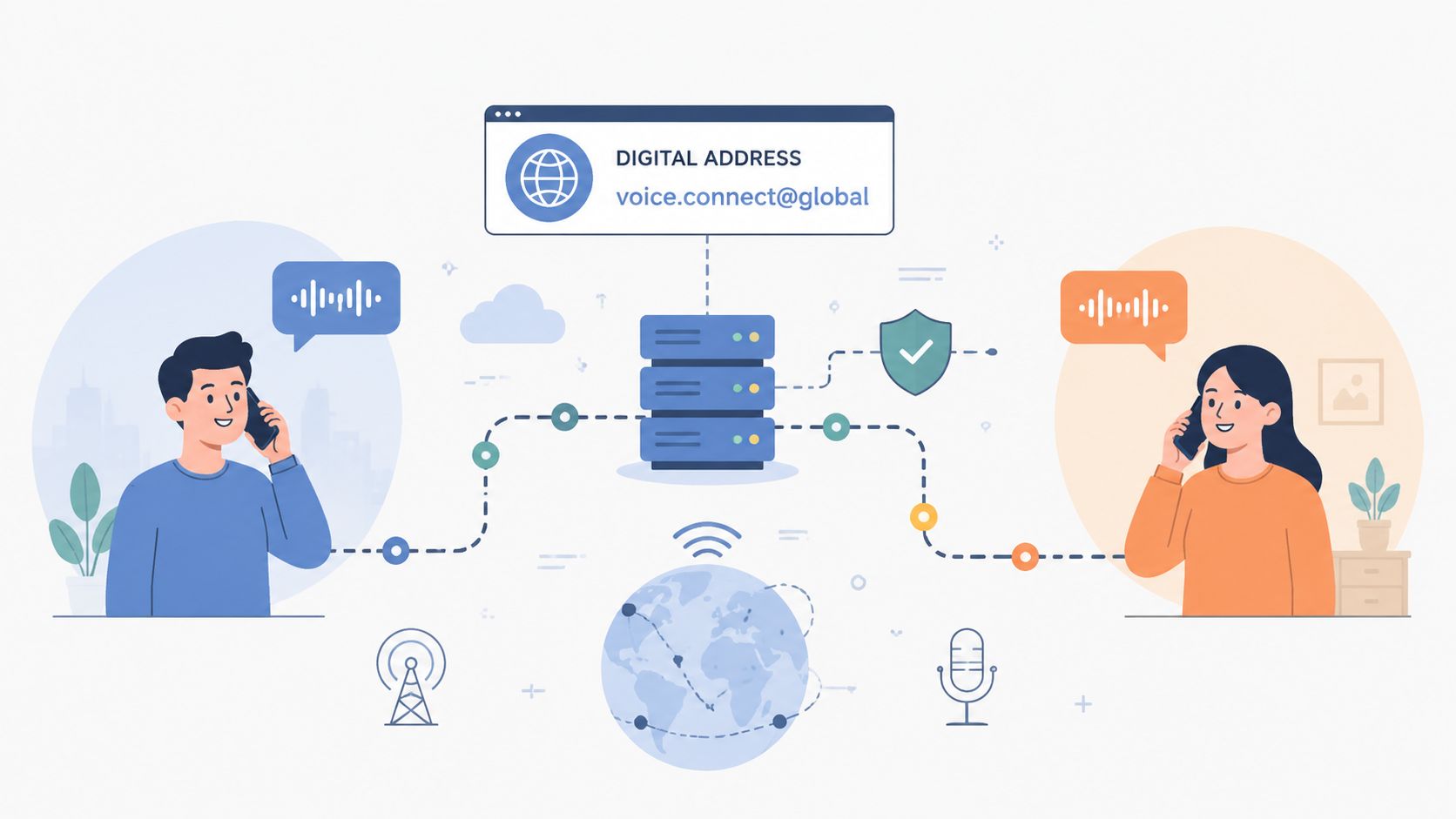
Quick answer: A SIP URI (Session Initiation Protocol Uniform Resource Identifier) is the address used to route calls, messages and video over IP. Its format is sip:user@host – for example sip:[email protected] or a phone number like sip:[email protected];user=phone. The sip: scheme signals a standard call and sips: forces TLS encryption. It works like a hybrid of a phone number and an email address for VoIP.
A SIP URI is the identifier a SIP system places in requests so proxies, registrars, and endpoints know who a session is for and where it should be sent. In plain terms, it answers two questions during call setup: which user or number is being addressed, and which domain or host is responsible for that destination.
How We Evaluated the SIP URI Format Examples and Guidance
This article is based on three sources: the syntax rules in RFC 3261, common implementation patterns described in provider and telecom documentation, and the examples that appear most often in real VoIP configurations. In our review, we prioritized examples that are both valid and likely to show up in production: user-at-domain dialing, PSTN breakout using user=phone, secure sips: routing, explicit ports, transport parameters, and header usage.
We also cross-checked the historical and structural framing against established references. SIP itself emerged in the late 1990s and was revised into the core standard used today in the SIP overview. For URI structure, we leaned on standards-oriented descriptions that explain how implementations extend sip:user@host with ports, parameters, and headers, as discussed in this IMS SIP URI reference.
One practical caveat: providers do differ. A URI can be syntactically valid and still fail if a registrar expects a domain instead of an IP, a trunk expects user=phone, or a secure endpoint requires TLS on a specific port. That is why the examples below focus on both syntax and deployment behavior.
Why The SIP URI Format Is Mission-Critical For Your Business
A SIP URI is not a marketing concept or a pricing lever. It is the address format SIP uses to identify a destination during call setup. If a SIP endpoint wants to invite another endpoint into a voice, video, or messaging session, it needs a routable identity, and that identity is usually written as a SIP URI.
The simplest form is scheme:user@host.
schemeis usuallysiporsipsuseridentifies the target user, extension, service, or phone numberhostidentifies the domain or server responsible for that target
That makes a SIP URI look a bit like an email address, but it behaves differently. An email address identifies where a message should be delivered and stored. A SIP URI identifies a target for real-time session setup. A regular phone number also behaves differently: by itself, a number does not tell a SIP network which domain, proxy, or server should handle the request.
A few examples make the distinction clearer:
sip:[email protected]points to the useralicein theexample.comSIP domain.sip:[email protected];user=phonetells the receiving system that the user part is a telephone number, not an internal username.sips:[email protected]identifies the same kind of destination, but with a secure scheme that requires protected signaling.
In our review of provider docs, the most common point of confusion was the user part. Sometimes it is a username like sales or 1001. Sometimes it is an E.164 number such as +14155550100. The meaning depends on context and parameters. Likewise, the host can be a customer domain, a carrier SBC, a PBX, or a literal IP address used for direct routing.
What the URI identifies during setup is the request target used by the SIP network to decide where the INVITE, REGISTER, or other message should go. That is why the host is mandatory: without it, there is no clear routing domain.
For a business, the relevance is straightforward: if the URI is wrong, the call does not route as intended. If it is right, features like internal dialing, SIP trunking, secure signaling, and application routing all become predictable. You can see that dependence clearly in a typical SIP call flow, where URIs appear in the request path from the first invite onward.
SIP URI vs SIP URL: What’s the Difference?
In practice, many people say “SIP URL” when they mean “SIP URI.” The more correct term in current standards usage is SIP URI.
A URI is a broad identifier format. A URL is traditionally a locator, meaning it tells you where something is and often how to retrieve it. SIP addressing is usually discussed as a URI because it identifies a logical communication target, not a web resource to fetch.
So this is standard usage:
sip:[email protected]→ SIP URIsips:[email protected]→ secure SIP URItel:+14155550100→ TEL URI, not a SIP URI
Why the distinction matters:
- A SIP URI can identify a user, service, extension, hunt group, or number in a SIP domain.
- A TEL URI only represents a telephone number.
- A SIP system may translate a TEL URI or a phone number into a SIP route, but they are not the same thing.
I’d treat “SIP URL” as understandable informal language, not the best technical label. When documentation, provisioning templates, or interop guides say SIP URI, they are usually being precise about what the field expects.
A Component-by-Component Breakdown of the SIP URI
The syntax of a SIP URI is defined in RFC 3261. The short version needed is this order of components:
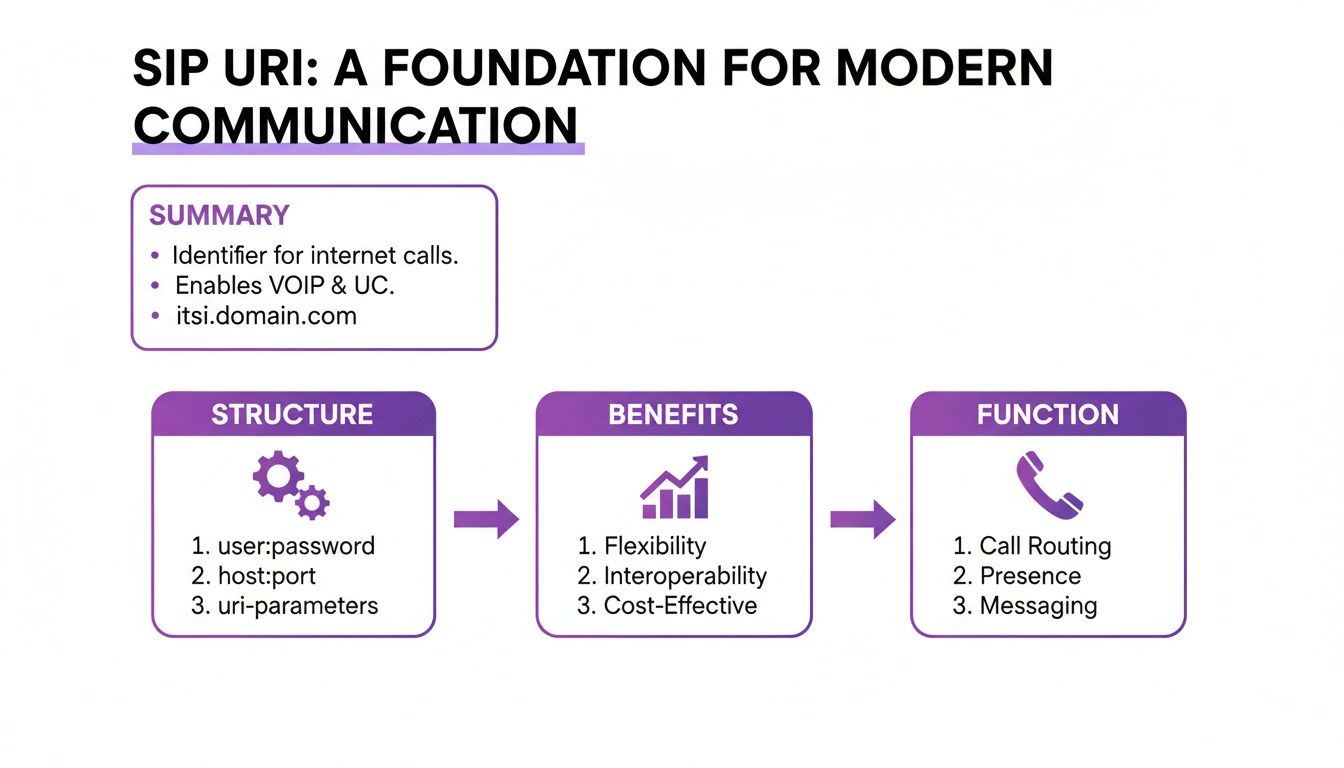
scheme:user@host:port;uri-parameters?headers
Not every part is required, but the order matters.
The Scheme: sip: vs sips:
The scheme is the first signal to the receiving software.
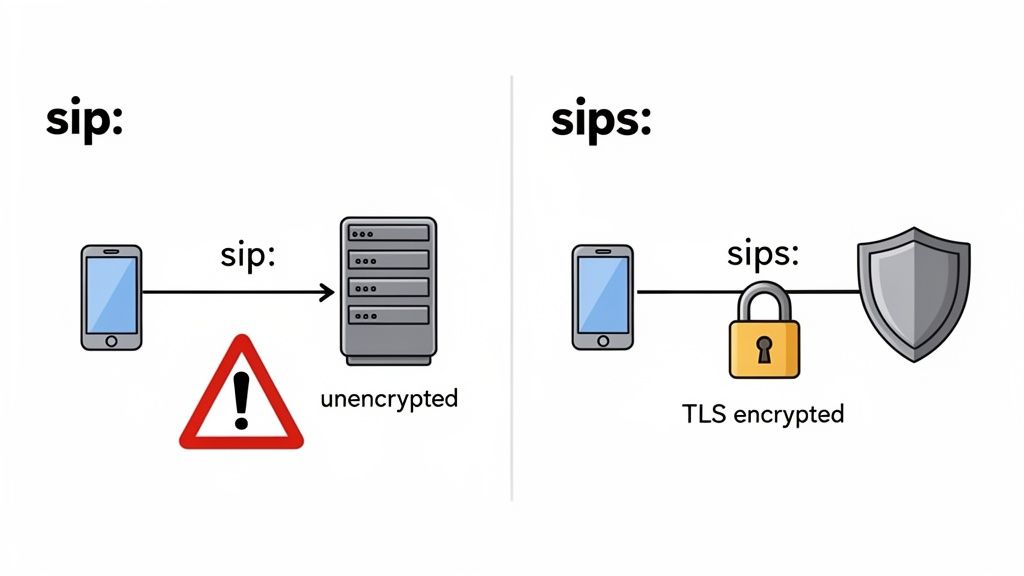
sip:means a normal SIP URIsips:means the request must be handled using secure SIP semantics with TLS protection for signaling hops as required by the standard
That scheme is not decorative. It changes transport expectations and can affect whether a proxy or SBC accepts the request at all.
The Request Target and Core Address
After the scheme comes the request target itself.
- User: the identity being addressed
- Host: the domain or host responsible for that identity
Canonical examples:
sip:[email protected]sip:[email protected]sip:[email protected];user=phone
The user part may be:
- a username:
alice - an extension:
1001 - a service label:
support - an E.164 telephone number:
+14155550100
The host part may be:
- a domain name:
example.com - a provider edge domain:
sip.provider.net - an IP address:
192.0.2.10
In our review, domains were the default in almost all production-facing examples because they allow DNS-based service discovery and easier infrastructure changes. IP literals usually appear in lab setups, direct trunk peering, firewall testing, or tightly controlled private routing.
Optional Port
A port can follow the host.
sip:[email protected]:5060sips:[email protected]:5061
If omitted, the port is inferred from transport and deployment defaults. Explicit ports are common when a provider or PBX listens on a non-default interface or when a secure listener is separated from standard SIP traffic. For a practical overview of transport and firewall behavior, a useful companion read is over at Premier Broadband.
URI Parameters
Parameters start with ; and modify how the URI should be interpreted.
Examples:
;user=phone;transport=udp;transport=tcp;transport=tls
A common production example is:
sip:[email protected];user=phone
That parameter matters because it tells the receiver to interpret the user part as a telephone number.
Optional Headers
Headers start with ? and append additional header-style information.
Example:
sip:[email protected]?Subject=Callback
Headers are less common in basic telephony setups, but they do appear in application-triggered calls and integration workflows.
Characters, Escaping, and IP Literals
RFC 3261 permits a defined set of characters in each part of the URI. Characters outside the allowed set must be percent-encoded. That is where errors often creep in: spaces, raw punctuation, or copied display names get inserted into the user part and break parsing.
A practical rule is simple: if the user value contains spaces or reserved characters, do not assume the platform will fix it for you. I see malformed user strings copied from CRMs more often than invalid ports.
IP literals are valid in the host position, such as sip:[email protected], but they are usually a deployment choice rather than a syntax preference. Use them when direct addressing is required and the provider or private network expects it; use domains when you want DNS, SRV resolution, and easier failover behavior.
How SIP URI Parameters Impact Business Operations
A SIP URI is more than just an address; its parameters are strategic commands that dictate call behavior. For executives and directors, understanding these parameters is key to unlocking security, ensuring system interoperability, and optimizing network costs. They transform a simple address into a powerful instruction.
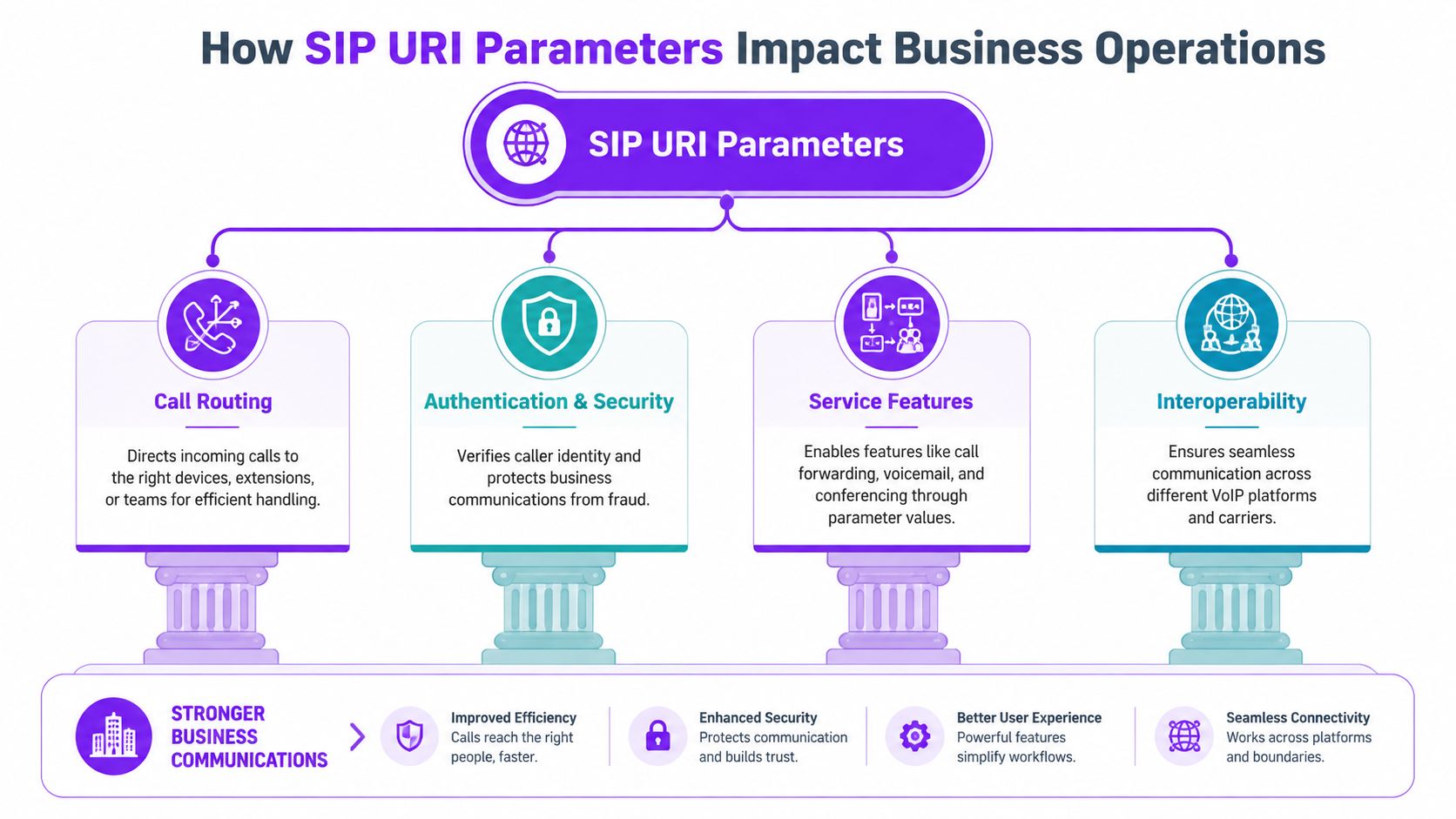
Essentially, the main URI tells the network who to call and where to find them, but the parameters tell it how to execute the connection. This distinction is what separates a reliable, enterprise-grade communication system—one achieving 99.9% call completion rates—from one that struggles.
Driving Security and Interoperability
Let's analyze two critical parameters from a business operations perspective: transport and user=phone.
First, the transport parameter dictates the network protocol. While UDP is the default, explicitly setting transport=tls forces the use of Transport Layer Security encryption.
For any organisation that deals with sensitive client information—think finance, healthcare, or legal services—enforcing TLS is non-negotiable. This single parameter ensures all call signalling is encrypted, protecting conversations from being intercepted and keeping company and customer data private. It's a foundational element of a zero-trust security model for communications.
On the other hand, the user=phone parameter is all about interoperability with the traditional telephone network (PSTN). It instructs gateways to treat the user portion of the URI as a standard phone number (in E.164 format), not an internal system username.
Example Scenario & Business Impact:
- URI:
sip:[email protected];user=phone - Business Impact: An outbound sales agent's call is initiated. This format guarantees the call is correctly routed out to a customer's mobile number on the public network. Without
user=phone, the system might futilely search for an internal user named "+919876543210," resulting in a failed call and a lost business opportunity. Precise parameter use ensures that your outbound sales and support calls connect with over 98% reliability, directly impacting revenue and customer retention.
When your teams master these parameters, you're no longer just configuring a system; you're architecting a communications framework that's secure, reliable, and built to integrate with the global economy. This level of control is fundamental for any platform that needs to scale and handle thousands of daily interactions without failure.
SIP URI Examples for Real-World Business Scenarios
Below are the examples that answer most real setup questions fastest. I prefer short, validated patterns over long business stories here because a single character is often the difference between a successful INVITE and a failed one.
1) Basic user at domain
- URI:
sip:[email protected] - What it means: Call the user
priya.sharmain the SIP domainyourcompany.in. - When you would use it: Internal dialing, softphones, PBX extensions mapped to user accounts, or direct user-to-user SIP calling.
2) Secure SIP URI
- URI:
sips:[email protected] - What it means: Reach
supportusing the secure SIP scheme, which requires protected signaling behavior. - When you would use it: Environments that enforce TLS for signaling, especially regulated or security-sensitive deployments.
3) PSTN dialing with user=phone
- URI:
sip:[email protected];user=phone - What it means: Treat
+919876543210as a telephone number and hand routing to the provider domain. - When you would use it: Outbound calls from a SIP trunk to mobile or landline numbers.
4) Dial by IP address
- URI:
sip:[email protected] - What it means: Address extension or user
1001directly at the host IP192.0.2.44. - When you would use it: Lab tests, direct private peering, SBC troubleshooting, or environments without DNS.
5) URI with an explicit port
- URI:
sip:[email protected]:5060 - What it means: Send the request to
proxy.provider.inon port5060. - When you would use it: When the provider documents a specific listener or when you want to avoid relying on defaults.
6) URI with a transport parameter
- URI:
sip:[email protected];transport=tcp - What it means: Address
agent1and signal that TCP should be used for transport. - When you would use it: Networks or providers that require TCP instead of the default behavior, or when testing interop with SBCs and firewalls.
7) URI with a header
- URI:
sip:[email protected]?Subject=New-Lead - What it means: Call
salesand attach a header value that can be consumed by the receiving application. - When you would use it: CRM-triggered call flows, click-to-call links, or custom application integrations.
Malformed example: why it fails
- URI:
sip:john [email protected] - Why it fails: The space in
john doeis not valid as written. It must be encoded or avoided, and some systems will reject it outright rather than normalize it. - Better version: use a valid identifier such as
sip:[email protected].
One pattern stood out in our review of admin guides: examples that look simple often hide provider assumptions. A URI may be perfectly valid on paper but still require a specific transport, port, or number format before a carrier will accept it. That is especially true when the public-facing entry point is a virtual number such as a Twilio phone number.
Integrating SIP URIs with Voice AI and SIP Trunking
For executives evaluating new technology, SIP URIs are the "smart addresses" that enable the full potential of services like SIP trunking and Voice AI. They provide the precise routing instructions needed for a scalable, automated, and intelligent communication ecosystem.
When a call arrives, a SIP URI tells it where to go. In a modern system, that destination is not always a person, it can be a Voice AI agent. Platforms like DialNexa use specific SIP URI formats to direct inbound calls to AI agents that can qualify leads, handle customer support, or book appointments 24/7. This immediate, intelligent routing has been proven to increase connect rates from a typical 47% to as high as 91%.
Automating Workflows with a Simple Address
Imagine a potential customer calls your main sales line. Instead of that call hitting a queue and waiting for a busy agent, a SIP URI can point it directly to an AI designed for initial engagement.
- Integration Example: A simple URI like
sip:[email protected]is configured in your phone system. It sends every new lead to an AI agent. This agent qualifies the lead based on pre-set criteria and then uses another SIP URI to transfer the high-potential lead to the most appropriate sales expert. - ROI: This automation can handle 80% of initial qualification tasks, freeing up sales teams to focus on closing deals. This directly boosts productivity and can shorten the sales cycle by 20-30%.
Business advantage comes from the integration between your SIP trunking provider and your Voice AI platform. The best VoIP solutions for businesses use that connection to help companies improve lead qualification accuracy and handle thousands of concurrent calls without increasing headcount.
By strategically pointing SIP URIs to Voice AI endpoints, businesses transform their communication infrastructure from a cost center into an automated revenue engine. A single URI can initiate a workflow that qualifies, nurtures, and converts leads, directly impacting top-line growth and operational efficiency.
For any business wanting to bring these technologies together, the SIP URI is the fundamental component that makes everything work. To see how virtual numbers serve as the public-facing entry point for these URIs, you can read our guide on the Twilio phone number. Mastering this format is the first step toward building a communication strategy that is intelligent, scalable, and profitable.
Securing Your Communications with SIPS and Best Practices
In any enterprise, security isn't just an IT concern; it's a leadership responsibility. For voice communications, protecting sensitive conversations is fundamental to managing risk and maintaining customer trust. The SIP URI format provides a simple yet powerful mechanism for enforcing security through the sip: and sips: schemes.
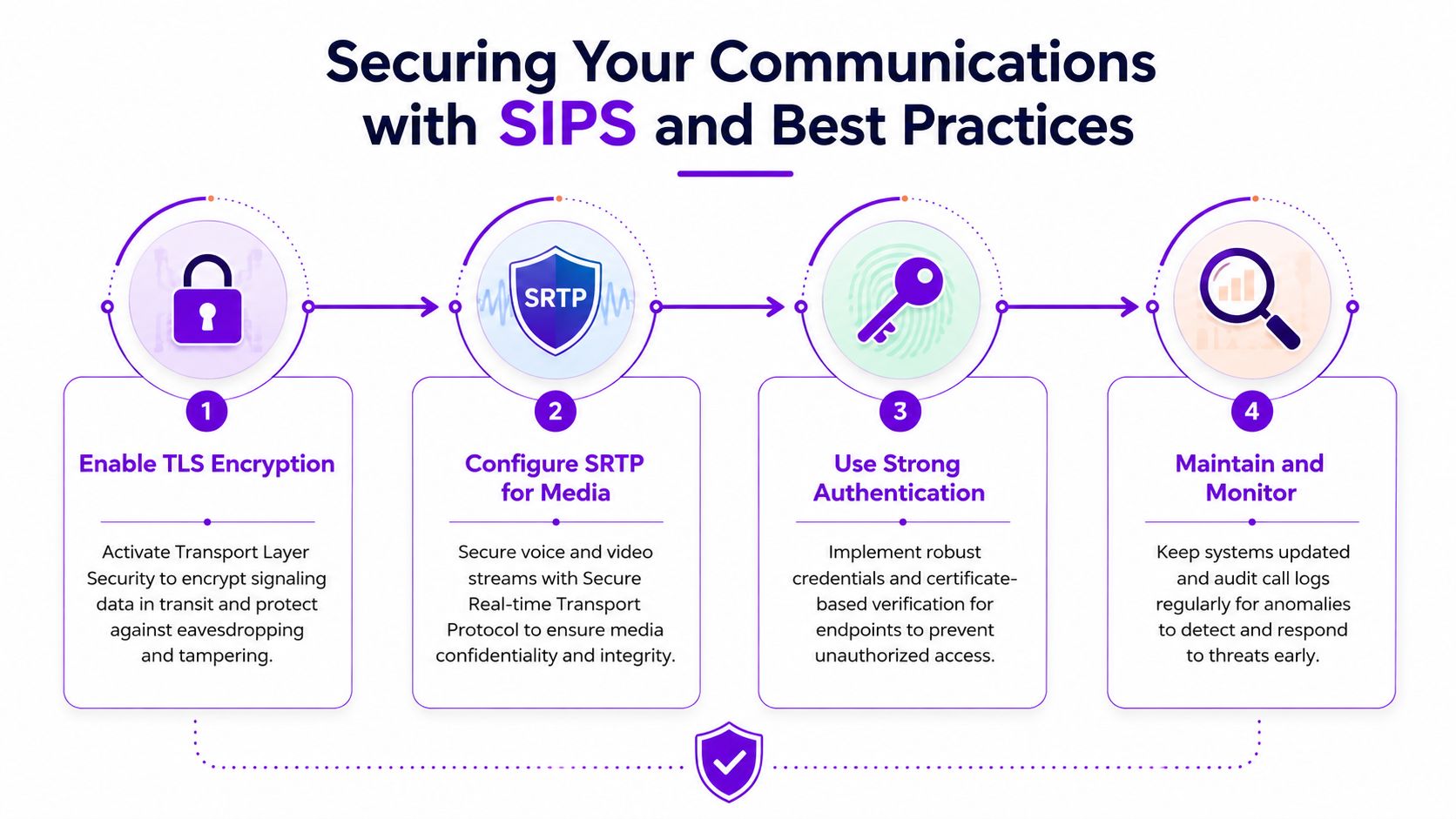
Think of it this way: a standard sip: URI is like sending a postcard. The signalling data, which sets up the call, travels in plain text, open to interception. Using the sips: prefix, however, mandates Transport Layer Security (TLS), effectively putting that postcard in a sealed, armored envelope. This encrypts the call setup, preventing attackers from eavesdropping or manipulating call data.
Enforcing Encryption with SIPS
For organisations in regulated industries like finance or healthcare, using sips: is often a baseline compliance requirement. It ensures critical details, such as caller identities and routing instructions, are shielded from unauthorized access. The difference is simple but profound:
- Unsecure (High Risk):
sip:[email protected] - Secure (Low Risk):
sips:[email protected]
By just adding one letter, the second URI instructs every system in the path to establish a secure, encrypted connection. This single change dramatically strengthens your security posture.
From a leadership perspective, mandating the use of
sips:across your communication platforms is a direct policy action that mitigates risk. It protects not only customer conversations but also valuable company data, safeguarding your organisation’s intellectual property and reputation against breaches that can cost an average of $4.45 million per incident.
However, encryption is just one piece of the puzzle. A secure scheme won't protect a poorly configured system. To secure your SIP communications, it's vital to implement network security best practices across your entire infrastructure.
Beyond encryption, executives must be aware of other financial and reputational risks. Attackers frequently hunt for misconfigured systems to commit toll fraud (making unauthorized, expensive international calls on your company's budget) or perform user enumeration to harvest valid user accounts for targeted attacks. Strong authentication policies, diligent system configuration, and regular security audits are your essential lines of defense.
Avoiding Common SIP URI Pitfalls and Validation Errors
Most SIP URI failures are boring, repeatable, and easy to miss: the host is absent, the wrong scheme is used, a carrier expects user=phone, or the endpoint and transport policy do not match. In our review of provisioning docs, those were far more common than exotic parser bugs.
Common failure patterns
-
Missing host
- Bad:
sip:alice - Why it fails: SIP routing needs a domain or host responsibility point. Without the host, proxies often cannot resolve where to send the request.
- Bad:
-
Wrong scheme for the destination
- Bad:
sip:[email protected]when the far end requiressips: - Why it fails: A secure-only edge may reject plain SIP requests or downgrade behavior may violate policy.
- Bad:
-
Omitted
user=phonefor PSTN routing- Bad:
sip:[email protected] - Why it fails: Some gateways try to interpret the user part as an internal identifier instead of a dialable public number.
- Bad:
-
Invalid characters in the user part
- Bad:
sip:john [email protected] - Why it fails: spaces and some reserved characters must be encoded or removed.
- Bad:
-
DNS mismatch or non-resolving domain
- Bad: syntactically valid URI, unreachable target domain
- Why it fails: the URI parses correctly, but the domain does not resolve to the expected SIP service or host.
-
TLS/SIPS mismatch
- Bad:
sips:[email protected]sent toward a listener that only supports plain UDP on 5060 - Why it fails: the URI demands secure handling that the destination path does not support.
- Bad:
How to verify a SIP URI
Use this order when a call will not complete:
- Check syntax first. Confirm scheme, user, host, optional port, parameters, and header separators match the expected order in RFC 3261.
- Check DNS or host reachability. If the host is a domain, verify it resolves correctly and that the target service is reachable. If it is an IP, verify direct access to the expected listener.
- Check registrar or proxy expectations. Some providers expect a customer domain, some expect their edge domain, and some require authentication tied to a specific request format.
- Check transport requirements. Confirm whether the far end expects UDP, TCP, or TLS and whether the port matches that expectation.
- Check provider-specific number handling. For PSTN breakout, verify E.164 formatting, trunk policy, and whether
user=phoneis mandatory.
For broader practical troubleshooting patterns around VoIP behavior, Cisco’s SIP documentation overview is a solid reference alongside the standard itself.
If you validate phone-number style user parts automatically, our guide on using regex for phone number can help at the input layer. Just remember that number validation alone is not SIP URI validation; the host, scheme, transport, and provider policy matter too.
Frequently Asked Questions
Got questions about the sip uri format? You're not alone. Here are some of the most common queries we see from business leaders and their teams.
Can a SIP URI Use an IP Address Instead of a Domain Name?
Yes, technically you can use an IP address like sip:[email protected].
However, from a strategic standpoint, this is highly discouraged in any enterprise environment. Using a fully qualified domain name (FQDN) like sip:[email protected] is the professional standard. Domains provide essential business agility, allowing your IT team to manage load balancing, implement disaster recovery failover routes, and change providers without disrupting service, which is impossible with a hard-coded IP address.
What Is the Difference Between a SIP URI and a TEL URI?
Think of it in terms of data richness. A SIP URI (sip:) is a complete, intelligent address for an endpoint on an IP network, containing all the details needed to route a call. A TEL URI (tel:) is a phone number, like tel:+91-80-45678900.
A TEL URI says who to call, but not how. SIP systems use TEL URIs to represent numbers on the public telephone network, leaving it to a gateway to figure out the complex routing. A SIP URI provides explicit instructions, giving you more control.
How Do Headers Work in a SIP URI?
Headers are a powerful tool for passing business intelligence with a call. By adding a ? to the end of the URI, you can add context. For example, sip:[email protected]?Subject=Urgent-Lead could automatically populate the "Subject" field in an agent's CRM pop-up, giving them instant context.
While not as common as parameters, headers are invaluable for creating custom integrations between your communication platform and other business systems like CRMs or ERPs, driving efficiency and a better customer experience.
What Does the 'user=phone' Parameter Actually Do?
The user=phone parameter is a small but critical command for global connectivity. It explicitly tells any system handling the URI that the user part is a telephone number to be dialed, not an internal username to be looked up.

This is essential for interoperability with the Public Switched Telephone Network (PSTN). When a SIP gateway sees user=phone, it knows to route the call to the traditional phone network correctly. Without it, outbound calls to customers will fail, directly impacting sales and support operations.
Ready to realise your communication strategy with intelligent automation? With DialNexa Labs Private Limited, you can deploy human-like Voice AI agents that scale your operations and turn more conversations into conversions. Explore our platform.
Written by
Aditya Kamat
Co-Founder, DialNexa
Published Apr 3, 2026
Updated Jul 25, 2026
Co-Founder of DialNexa. Expert in voice AI, conversational technology, and enterprise telephony. Building the future of AI-powered customer engagement.

[…] extensions, and address formatting are supposed to look, this plain-English explanation of SIP URI format helps clear up common input mistakes before you start […]
[…] telephony estates. Even non-engineering stakeholders benefit from understanding the logic behind a SIP URI format because identity, routing, and reputation are tightly linked in IP-based voice […]
[…] confirm the addressing format and downstream dependencies before the switch. A quick check of SIP URI formatting standards for business voice systems helps technical teams avoid preventable routing errors after the new number goes […]
It is not my first time to pay a quick visit this web site,
i am browsing this site dailly and take nice information from here every day.
[…] you've seen a technical address used for calling, that's where a SIP URI for modern voice becomes relevant. Most small businesses won't need to configure one manually, but it helps […]
[…] all need their own validation pass. Teams that rely on SIP addressing should also understand how SIP URI formats affect calling behavior before they standardise click-to-call rules across apps. The right answer is rarely “one string […]
[…] you want a quick refresher on address formatting before building dial rules, this guide to the basic format of SIP URIs is a useful […]
Excellent breakdown! This article explains how SIP URI formats are not just technical details but strategic assets that improve security, scalability, and business efficiency. The real-world examples and AI integration insights clearly show how modern communication infrastructure can become a powerful driver of growth and customer engagement.
[…] can explain routing logic, normalization, failover behavior, and structured addressing such as SIP URI format and usage, they usually have the fundamentals to adapt across […]
Thanks, Aditya Kamat, This was incredibly helpful information. I’d say this is one of the best explanations of SIP URIs I’ve come across.
I had previously looked at the Microsoft documentation here: https://learn.microsoft.com/en-us/previous-versions/office/developer/lync-2010/hh347488(v=office.14), but I couldn’t get the clarity I was looking for.
Thanks again for putting all this information together and making it available to the public. Really appreciate it.
Just want to say your article is as amazing. The clearness in your post is simply cool
and i could assume you’re an expert on this subject. Well with your permission let me to grab your RSS feed to keep up to date with forthcoming post.
Thanks a million and please keep up the gratifying work.
Oh my goodness! Amazing article dude! Many thanks, However I am encountering difficulties
with your RSS. I don’t understand the reason why I cannot subscribe to it.
Is there anyone else having similar RSS issues?
Anyone who knows the solution can you kindly respond?
Thanx!!