
Vapi Pricing 2026: A CXO’s Guide to Total Cost of Ownership
Vapi pricing starts at $0.05 per minute, but a production-ready deployment usually lands much higher, often around $0.25 to $0.33 per minute once third-party costs are included. For Indian operators, that gap is the whole story, because the headline rate is rarely the number that decides whether voice AI saves money or subtly inflates spend.
The mistake CXOs make is treating Vapi pricing like a simple software subscription. It isn't. It's a stack of orchestration, telephony, speech, model, and capacity costs, and the cheapest-looking quote can become the most expensive choice if your calls are bursty, short, or operationally sensitive. If you want a broader platform comparison mindset, a data observability platform with transparent pricing is a useful benchmark for the kind of clarity vendors should give you. For a wider implementation lens, this AI voice agent platform overview is worth keeping open while you model the stack.
Table of Contents
- Beyond the Rate Card An Executive Introduction to Vapi Pricing
- Deconstructing Vapi's Pricing Model The Five Core Components
- Scaling Costs Concurrency Limits and Volume Discounts
- ROI Modelling for Indian Enterprises Cost Scenarios and Returns
- Negotiating Your Vapi Contract Key Levers for CXOs
- Budgeting for Compliance and Implementation Hidden Overheads
- Conclusion Planning Your Voice AI Investment Strategically
Beyond the Rate Card An Executive Introduction to Vapi Pricing
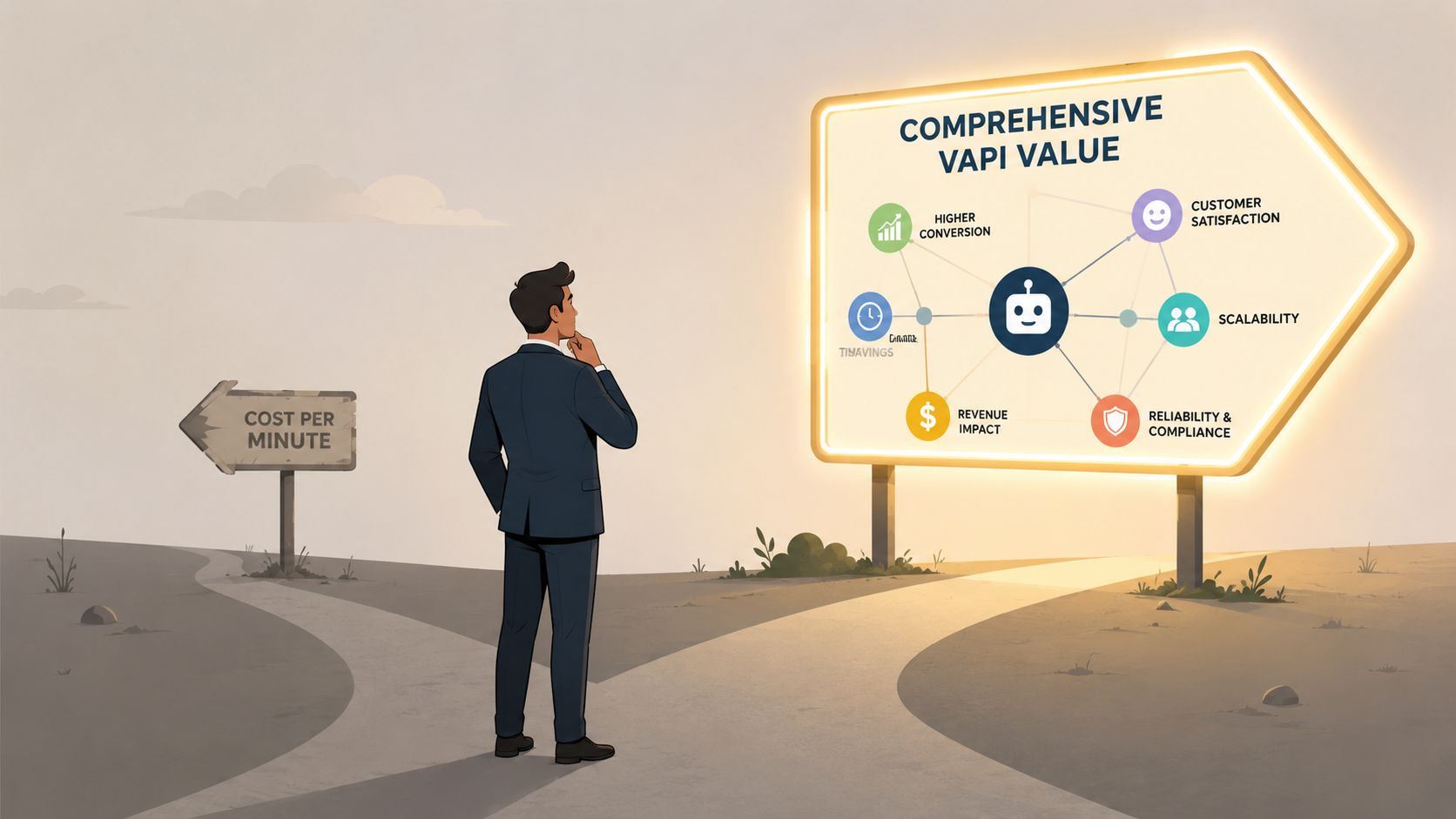
A platform that starts at $0.05 per minute sounds cheap until you price the rest of the stack. Independent pricing breakdowns put the all-in cost far higher, with added provider costs of roughly $0.20 to $0.28 per minute, which pushes typical real-world usage to about $0.25 to $0.33 per minute overall according to the pricing analysis at CheckThat's Vapi pricing breakdown. That's the number a CFO should care about, not the marketing headline.
The right question is not whether Vapi is affordable. The right question is whether it is predictable under your calling pattern. If you run admissions follow-ups, collections retries, or support queues in India, the expensive failure mode is not high average spend, it's budget drift caused by call duration, premium providers, and extra concurrency.
What the sticker price hides
The published rate covers the orchestration layer, not your whole voice operation. Once you add telephony, speech services, model usage, and capacity expansion, the bill behaves more like a utility invoice than a software licence. That's why a procurement team should evaluate total cost of ownership before it evaluates convenience.
Practical rule: If a vendor quote only shows the platform fee, assume you're seeing the smallest line item, not the real one.
For executives, this is also a vendor-design issue. A pricing model that looks tidy on a sales slide can still be operationally messy in production, especially when your call centre has morning spikes and campaign bursts. If you need a reference point for how vendors should expose cost drivers, compare it with the clarity you'd expect from a serverless GPU pricing guide, where the bill is broken into visible resource layers instead of hidden assumptions.
Why Indian buyers should be stricter
Indian businesses rarely run perfectly flat calling volume. They run peaks. They run batch campaigns. They run retries. That means the cheapest per-minute headline is often the least useful benchmark if it breaks under concurrency pressure or forces hidden upgrades later.
Use Vapi when you want modular control and are ready to manage the stack. Walk away when you need a single predictable invoice and don't have the internal team to absorb provider complexity. That's the clean executive decision.
Deconstructing Vapi's Pricing Model The Five Core Components
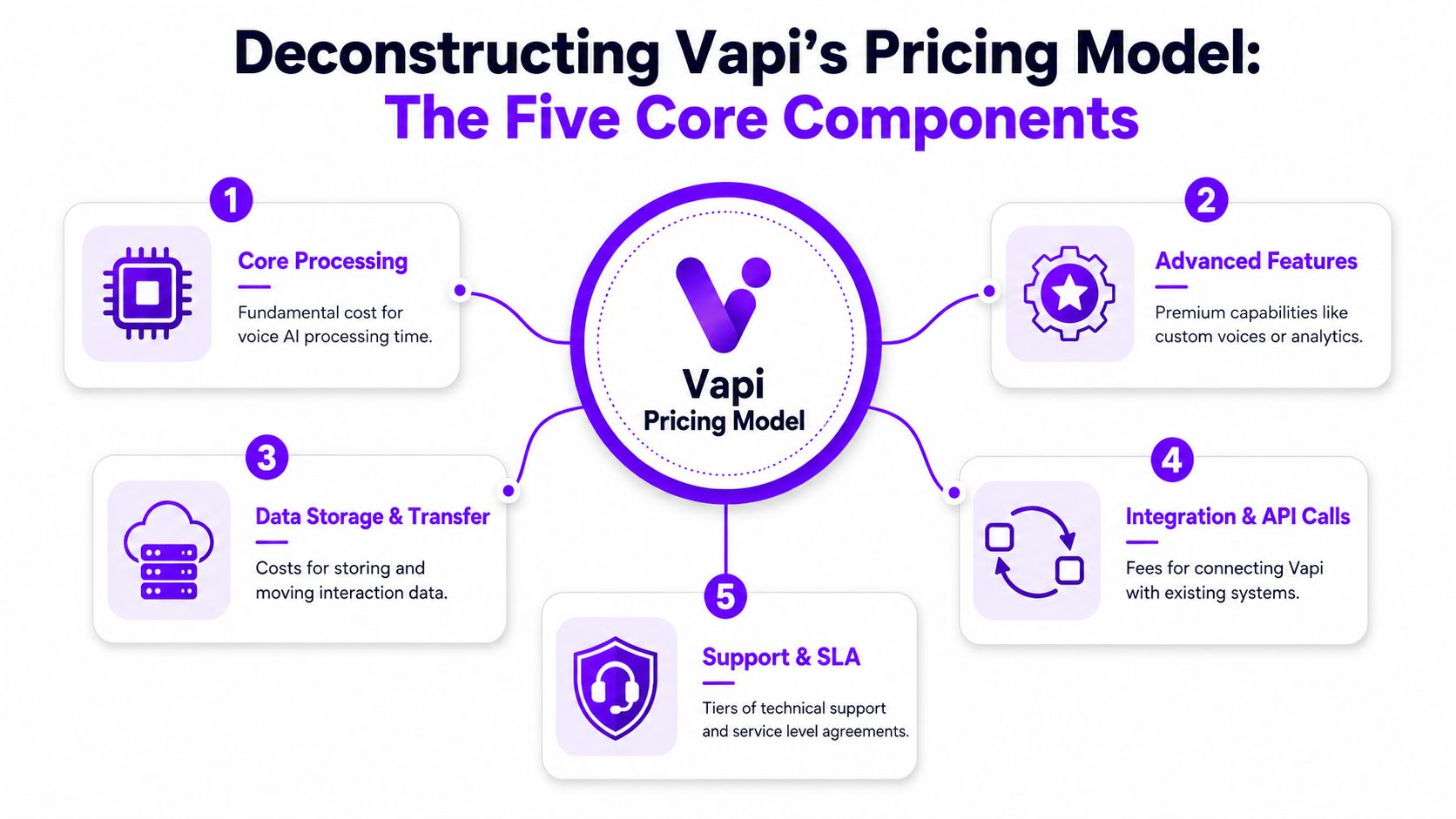
Vapi's published pricing begins with $0.05 per minute for core call orchestration on a volume-based model, and that is only the platform layer before speech, model, and telephony charges are added, according to the official Vapi pricing page. For a CXO, the headline rate is the smallest part of the bill. The actual invoice is built from several provider layers that behave differently under load.
The five layers that shape the invoice
Core processing is the orchestration layer that keeps the conversation moving. It covers routing, session handling, and the control logic that makes the voice agent operate as a live system rather than a simple demo.
Telephony is the phone transport. Vapi does not absorb that cost for you, so your calling provider still bills separately, and that separation matters when finance teams try to compare vendors on a like-for-like basis.
Speech-to-text and text-to-speech add another layer of spend. They are required for a natural conversation, and the cost shifts with voice quality, transcription volume, and the specific provider choices your team makes.
The language model layer drives the conversation logic. Prompt complexity, turn count, and response length all affect what you pay, which means the apparent per-minute rate can move quickly once the call becomes more interactive.
Extra services and add-ons are where enterprise discipline matters most. Support tiers, compliance features, and operational requirements belong in the TCO model even when they never appear in the first sales conversation.
A clean finance model separates platform cost from provider cost. If your vendor cannot help you do that, expect the month-end bill to be harder to defend internally.
How to model it without guessing
Start with the base rate, then add provider layers on top. That is the only sensible way to compare Vapi with a bundled alternative. For a clear example of infrastructure pricing discipline, review the guide to serverless GPU pricing, which shows how compute, storage, and usage are exposed as separate cost layers instead of being folded into one opaque line.
You should also model call architecture, not just minutes. A guide to concurrency in distributed systems is useful here because burst handling and simultaneous sessions are exactly where voice AI budgets break in practice.
What a CXO should ask finance
- What is platform-only spend? Separate orchestration from provider usage.
- What is provider pass-through? Ask which costs are billed externally.
- What is excluded from the headline? Telephony, premium voices, and higher-end model choices often sit outside the base rate.
- What is the escalation path? If the team grows, the cost model should stay intelligible.
If the vendor cannot answer those questions cleanly, the quote is not ready for board-level review.
Scaling Costs Concurrency Limits and Volume Discounts
A significant cost trap in Vapi is not just minutes. It's concurrency. The self-serve Build plan typically includes 10 concurrent calls, with additional capacity costing $10 per extra line per month, according to the published pricing breakdown at FrontDeskReview's Vapi pricing summary. That means a campaign can hit a capacity ceiling long before it hits a minute-based ceiling.
Why concurrency matters more in India
Indian voice operations are often bursty by design. Admissions teams call in waves, collections teams retry across time windows, and support queues can spike after a product issue or campaign launch. In that environment, throughput matters more than a neat base rate, because if you can't handle the peak, the apparent savings disappear in missed connects and delayed responses.
The billing model also matters for short calls. Vapi bills prorated to the second, not rounded to the minute, according to the official Mintlify pricing documentation. That's good for tight workflows, but it also means call-length discipline becomes a direct budget lever, especially in OTP checks, appointment confirmations, and brief disposition calls.
Operational rule: If your call centre lives in spikes, model the number of simultaneous conversations first, then model minutes second.
What the capacity bill really means
A plan with 10 concurrent lines is fine for a small pilot. It's not enough for a serious outbound campaign if your team wants reliable throughput during peak windows. Every additional line adds fixed monthly cost, so capacity planning becomes part of your vendor strategy, not an implementation afterthought.
For engineering teams that need to think about orchestration patterns, this concurrency in Go discussion is a good reminder that throughput is an architecture problem, not just a pricing problem.
What leaders should budget for
- Peak line count, not average line count. Average usage flatters the model.
- Second-level duration control. Shorter calls save real money.
- Queue tolerance. If you can't absorb spikes, you need more concurrency.
- Campaign timing. Batch calls inside the same hour cost more to support operationally than a smooth flow.
The cheapest plan on paper is the one most likely to surprise you in production.
ROI Modelling for Indian Enterprises Cost Scenarios and Returns
For Indian CXOs, Vapi only makes sense if the business case is measured against current operating cost, not against a fantasy of “AI replacing agents”. The useful comparison is a real admissions or collections workflow, where humans, dialler software, call routing, and missed connects all sit in the same model.
An admissions campaign that finance can understand
Take a 50,000-lead EdTech admissions campaign. If your team is calling at scale, the important question is not whether AI can make calls. It's whether it can handle the volume consistently while lowering waste in the process. DialNexa's own published product context shows how voice AI is used for qualification, support, recruitment, and presales across Indian verticals, which is a useful lens for thinking about outcome design rather than just cost structure.
Here's a simple boardroom-level comparison.
| Metric | Traditional Call Centre | Voice AI (Vapi Projection) | Financial Impact |
|---|---|---|---|
| Lead outreach | Manual agent-led calling | Automated voice outreach | Lower repetitive labour load |
| Coverage consistency | Varies by agent and shift | More uniform call handling | Fewer process breaks |
| Peak handling | Limited by staffing | Limited by concurrency and provider stack | Capacity planning shifts from headcount to system design |
| Cost visibility | Salary, overhead, turnover, tooling | Base rate plus provider and concurrency costs | Better visibility if modelled correctly |
| Scaling new campaigns | Hiring and training burden | Prompt and workflow changes | Faster launch cycles |
The financial question is not whether the AI line item is smaller than payroll. It usually is. The core question is whether the total system, including provider fees and concurrency, stays below the cost of your current operating model while protecting answer quality.
Where ROI comes from in practice
If a human-led model wastes time on repeated dialling, low-value conversations, and inconsistent follow-up, voice AI can compress that effort. DialNexa publishes customer-reported outcomes such as connect rates rising from 47% to 91% and lead-to-booking improving from 2% to 8%, which are useful examples of the kind of operational change CXOs should demand from any vendor conversation. Those are not Vapi numbers, but they are the right kind of business metric to benchmark.
The best ROI models don't start with the vendor's rate card. They start with the workflow you want to eliminate, shorten, or automate.
What to compare against
- Agent compensation and turnover
- Supervisor time spent on QA
- Dialler and telephony overhead
- Missed follow-ups from peak-hour congestion
- Lost opportunities from slow response times
For a related view of AI call-centre architecture, this AI call centre agent guide helps frame the difference between automation on paper and automation that absorbs operational load.
Negotiating Your Vapi Contract Key Levers for CXOs

If you negotiate only on the base per-minute rate, you've already lost money. The better negotiation starts with throughput, stability, and exit flexibility, because those three terms decide whether the platform fits your operational reality or just your procurement spreadsheet.
The contract points that matter
For bursty Indian usage patterns, predictable throughput is often more valuable than the lowest nominal per-minute price, and a key negotiation point is ensuring the plan can sustain peak concurrent demand without degrading answer rates or forcing hidden upgrades, as noted in CloudTalk's Vapi pricing analysis. That is the contract conversation CXOs should force before they sign.
Ask for volume pricing that falls as usage grows. Ask how concurrency expands. Ask what happens when a campaign runs hot for two weeks and then goes quiet. If the vendor can't answer that without hand-waving, the commercial model is weak.
What to lock down before signature
- Volume discounts: Make sure the rate improves with scale, not just the sales promise.
- SLA clarity: Get explicit uptime and support commitments, not vague service language.
- Concurrency terms: Separate minutes from simultaneous call capacity.
- Exit clauses: You need a clean path out if performance or economics change.
- Data handling rules: Security and retention should be contractual, not conversational.
For a broader market comparison, this best voice AI platform in India overview gives context on how buyers should think about platform fit before they lock into one stack.
How executives should run the negotiation
Push the vendor to explain what happens under load, not just under demo conditions. Ask for the commercial impact of premium provider choices, because those hidden components are often where costs move fastest. Then insist on written terms that align billing with the way your teams run campaigns.
Procurement rule: If the vendor won't put the operational constraints in writing, assume they'll become your problem later.
That mindset saves more money than trying to shave a fraction off the base rate.
Budgeting for Compliance and Implementation Hidden Overheads
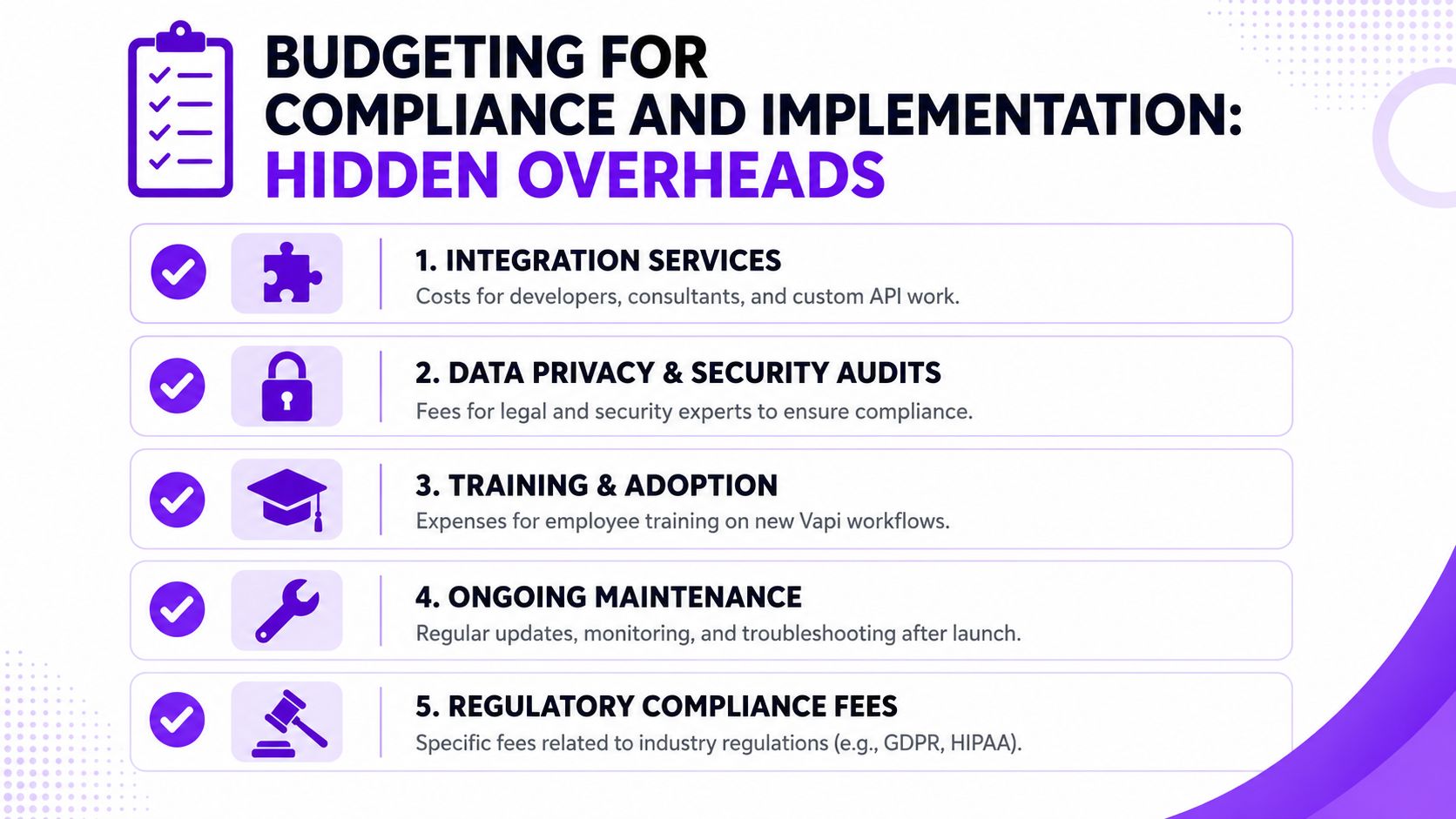
The invoice from the vendor is not your full cost. Internal implementation, compliance work, and workflow integration usually take real time from your own teams, and Indian businesses should treat that as part of TCO from day one. If you ignore it, the pilot looks cheap and the rollout becomes expensive.
The costs that never show up in a demo
Integration is the first hidden layer. Your CRM, internal dashboards, support tooling, and reporting stack all need to work with the voice system, and that usually means developer time or external consultants.
Compliance is the second layer. For regulated sectors like BFSI and healthcare, conversations around data handling, retention, and auditability become part of the deployment budget. A useful benchmark for that thinking is this financial services compliance resource, because the implementation cost is often tied to what your governance team insists on documenting.
The internal load you should budget for
- Integration services: Developers or implementation partners need time to wire the platform into existing systems.
- Privacy and security review: Legal, security, and ops teams need to sign off on the workflow.
- Training and adoption: Supervisors and agents need to understand the new process.
- Ongoing maintenance: Prompts, routing logic, and monitoring won't look after themselves.
- Regulatory checks: Sector-specific requirements can add review cycles and delays.
Why compliance changes the economics
A platform can be technically cheap and still commercially awkward if your organisation needs extra approvals, audit trails, or tighter retention rules. That's especially true in Indian BFSI, where the cost of getting governance wrong is much larger than the cost of the software itself. When the architecture has to satisfy both operations and risk teams, the hidden overhead is part of the product.
DialNexa Labs Private Limited also sits in this same space, with voice AI agents for qualification, support, recruitment, and presales, so it's a useful reference point for how implementation and operational fit affect budget planning. The lesson is simple, the lighter the internal lift, the easier it is to defend the project.
Conclusion Planning Your Voice AI Investment Strategically
Vapi can fit a serious voice AI strategy, but only if you evaluate it on total cost of ownership, not the base fee. The platform starts at $0.05 per minute, yet the deployment bill also includes telephony, models, speech services, concurrency, and compliance. For high-volume Indian call operations, those layers decide whether the project is efficient or expensive. The clean billing detail is that calls are prorated to the second, and a 37-second call is billed as 0.6167 minutes, so short-call workflows still need strict cost control.
For Indian CXOs, the decision is straightforward. If your team can manage a modular stack, Vapi remains a serious infrastructure choice. If you need a simpler operating model, tighter governance, or a voice AI system that reduces internal complexity, the headline rate should not drive the decision. The actual spend and the operational burden should.
If you're comparing pure telephony costs before adding AI, DialNexa's Exotel pricing guide shows what the Indian voice-only baseline looks like.
The next move is an internal audit. Map current call volumes, average call length, peak concurrency, telephony spend, and compliance burden, then compare those inputs against the full Vapi stack. If you want a partner that builds voice AI workflows for Indian businesses across admissions, collections, support, and lead qualification, visit DialNexa Labs Private Limited and evaluate how a production deployment should be scoped.

A clear and practical breakdown of Vapi pricing that goes beyond the headline rate to explain provider costs, concurrency, and real-world TCO. The focus on ROI modelling and peak-volume planning makes this especially valuable for Indian businesses evaluating voice AI.
This is a practical and insightful guide that breaks down Vapi pricing and total cost of ownership in a clear way. The CXO-focused perspective makes it easier to understand the key cost factors when evaluating AI voice solutions.