
Sales Qualification Process: A CXO’s Playbook for 2026
A lead contacted within 5 minutes is 21 times more likely to qualify than one contacted after 30 minutes, and 5-minute responders closed at 32%, compared with 12% for 24-hour responders, according to the Artemis GTM 2026 benchmark. For Indian CXOs, the sales qualification process is therefore not only a question of asking the right questions. It's a race to detect intent, make contact, capture decision signals, and route the prospect before another provider does.
That matters across admissions, collections, insurance renewals, real estate site visits, healthcare appointments, and e-commerce support. A practical qualification system must account for the source of the lead, the urgency implied by the channel, the complexity of the purchase, and the point at which a human seller should take over.
Table of Contents
- Why Speed-to-Lead Defines Modern Qualification
- Comparing BANT, CHAMP, and MEDDIC Frameworks
- Building Your Step-by-Step Qualification Playbook
- KPIs and Metrics That Actually Matter
- Automating Qualification with Voice AI
- The Hidden Cost of Over-Qualification
- Your 90-Day Qualification Optimization Roadmap
Why Speed-to-Lead Defines Modern Qualification
A median B2B response time of 42 hours was reported across 1,247 companies in the Artemis GTM 2026 benchmark, while only 23% of B2B companies responded within 5 minutes and just 7% consistently met that benchmark. The finding changes the operating question for revenue leaders. Instead of asking only whether an SDR can qualify a lead, ask whether the organisation can reach the lead while intent is still active.
Meta Lead Ads, IndiaMART enquiries, and WhatsApp click-to-chat conversations carry different context. A prospect who submits a Meta form for an education programme may expect an immediate call. An IndiaMART buyer may be comparing several suppliers. A WhatsApp user may already be comfortable with conversational engagement and may prefer a quick answer over a formal sales sequence. Treating these sources as identical creates avoidable leakage.
The three delays inside qualification
Detection delay begins when a lead is created but not yet visible to the right team. Broken CRM integrations, unmonitored inboxes, duplicate records, and unassigned owners all extend this interval.
Response delay covers the time between lead creation and the first human or AI interaction. Callback automation, call queues, and Voice AI can create the clearest operational advantage in this phase. A routing system can identify the source, apply the relevant script, and initiate contact without waiting for an SDR to check multiple dashboards.
Decision delay occurs after contact. A conversation may contain enough information to mark a lead as sales-qualified, nurture, or disqualified, yet the status remains unchanged because notes are incomplete or managers use different thresholds.
Practical rule: Measure each delay separately. A single “lead response time” figure hides whether the failure sits in integration, capacity, or decision governance.
The benchmark also found that leads contacted within 5 minutes were 21x more likely to qualify than those contacted at 30 minutes, while 5-minute responders closed at 32% versus 12% for 24-hour responders**.** The implication is straightforward. Every hour spent waiting can reduce the probability that the prospect enters a meaningful qualification conversation at all.
| Lead Source | Ideal Response Window | Conversion Drop After 1 Hour | Typical Manual Response Time |
|---|---|---|---|
| Meta Lead Ads | Within minutes | Qualitative decline as intent cools | Often delayed by CRM or SDR queues |
| IndiaMART enquiries | Within minutes | Qualitative decline as buyers compare suppliers | Often delayed by fragmented ownership |
| WhatsApp click-to-chat | Immediate conversational response | Qualitative decline when the chat goes unanswered | Dependent on agent availability |
The exact drop varies by sector and channel, so leadership should establish its own baseline rather than force one universal assumption. A useful starting point is the sales call pickup and response guidance, particularly for teams that manage inbound demand across several channels.
Qualification is therefore a latency-reduction system. Frameworks such as BANT and CHAMP help interpret signals, but routing, callback automation, ownership rules, and decision SLAs determine whether those signals arrive in time to matter.
Comparing BANT, CHAMP, and MEDDIC Frameworks
BANT, CHAMP, and MEDDIC answer different questions at different levels of deal complexity. BANT checks Budget, Authority, Need, and Timeline. CHAMP begins with Challenges, then tests Authority, Money, and Prioritisation. MEDDIC examines Metrics, Economic Buyer, Decision Criteria, Decision Process, Identify Pain, and Champion.
The practical mistake is choosing a framework because it's popular, then applying it to every lead. A BFSI collections workflow needs a short, repeatable gate. An EdTech counsellor may need to understand the learner's challenge and urgency before discussing money. An enterprise IT services opportunity requires deeper stakeholder and approval mapping.
A decision matrix for Indian revenue teams
| Criterion | BANT | CHAMP | MEDDIC |
|---|---|---|---|
| Time-to-qualify | Fast | Moderate | Slow |
| SDR training complexity | Low | Moderate | High |
| Inbound versus outbound suitability | Strong for inbound and transactional outbound | Strong for consultative inbound | Strongest for targeted outbound and active opportunities |
| High-volume versus low-volume fit | High-volume pipelines | Mid-volume pipelines | Low-volume, high-value pipelines |
| AI-driven scripting compatibility | High | High | Moderate, best after initial human engagement |
BANT still fits transactional BFSI collections and insurance renewals, where budget or payment capacity can be a decisive gate and the interaction must remain concise. Its simplicity also makes it easier to encode into a voice script and apply consistently across large call volumes. A published BANT implementation recommends 2–3 questions per criterion, requires all four elements before discovery is complete, and advances only deals with strong BANT scores of 3–4 out of 4 to proposal, as described in this BANT qualification framework.
CHAMP is more suitable for EdTech admissions and SaaS demos. The prospect may have a real problem but no formally allocated budget. Asking about the challenge first creates a more natural conversation and helps the seller determine whether the issue is sufficiently important to prioritise.
MEDDIC belongs later in the motion. For named-account enterprise deals above ₹50L ACV in manufacturing and IT services, the seller must understand the economic buyer, approval process, evaluation criteria, and internal champion. Applying that depth to every inbound lead would slow response and burden SDRs with information they can't use at the first touch.
For a broader explanation of how qualification fits into the funnel, Lead Printer's guide to B2B lead qualification offers useful context. Indian SMBs should generally default to a CHAMP hybrid for speed, with a short authority and urgency check added to the opening. Reserve MEDDIC for named-account enterprise motions, where the likely deal value justifies deeper research and human discovery. Teams documenting these handoffs can also use a sales process flowchart to make stage ownership visible.
Building Your Step-by-Step Qualification Playbook
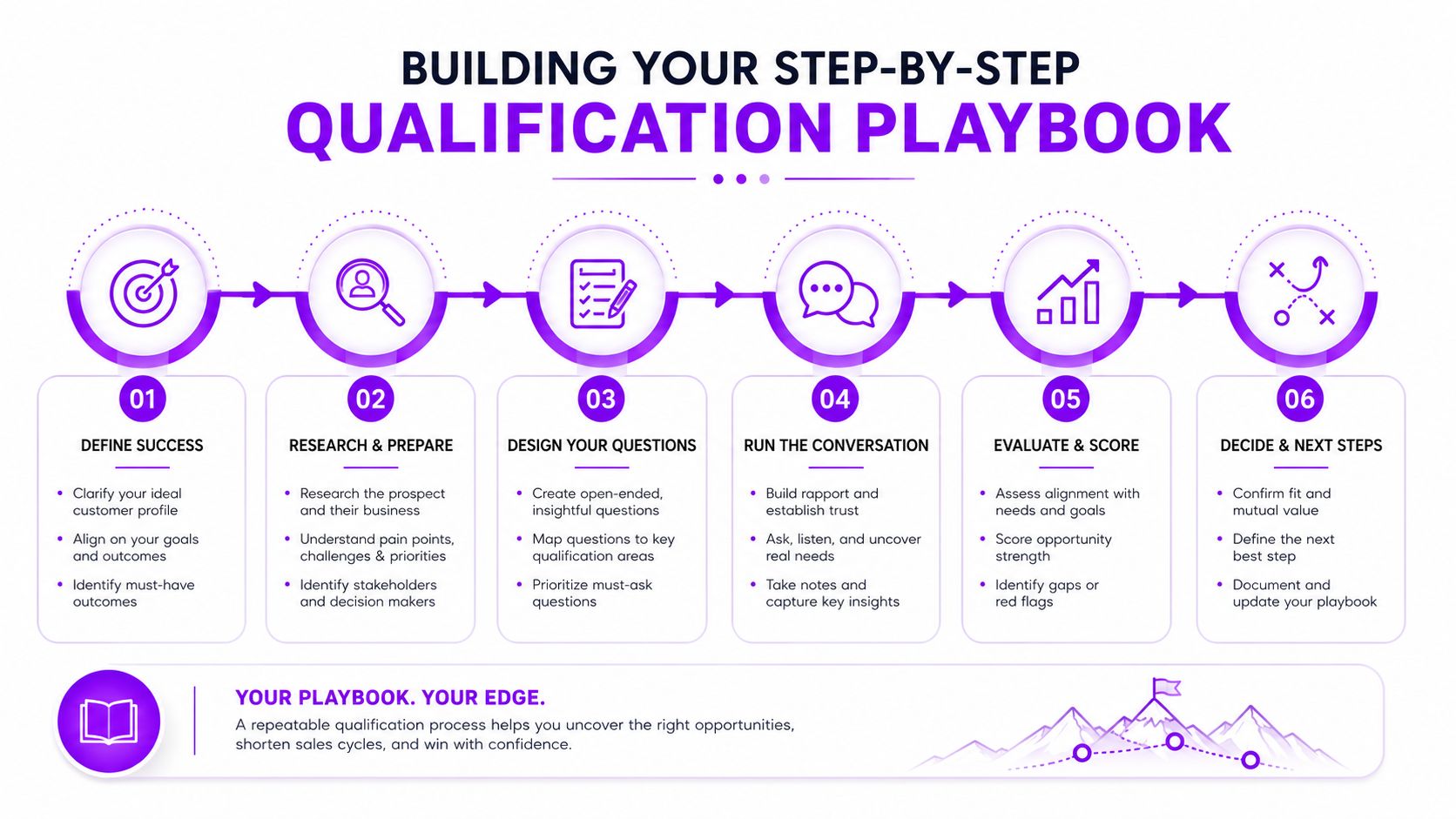
A workable sales qualification process needs five operating stages, not a collection of disconnected questions. The sequence below gives RevOps, marketing, SDR leadership, and sales management a shared design that can be implemented in one sprint and refined through conversion data.
Capture and enrich before calling
Stage 1, Lead Capture and Enrichment: connect Meta Lead Ads, IndiaMART, WhatsApp, website forms, and telephony to the CRM. Append company, city, role, source, product interest, campaign, and previous interaction data. The source tag must remain visible because the same question doesn't carry equal meaning across channels.
A WhatsApp enquiry for a site visit should trigger a location and timing check. An IndiaMART enquiry may require product specification and purchase quantity context. An admissions form may need programme, intake, and counselling preference fields.
Use a permission-based first touch
Stage 2, First-Touch Script: give SDRs and Voice AI a short opening that establishes context without sounding like a survey.
“Hello, this is [Name] from [Company]. You recently enquired about [product or programme] through [channel]. I'm calling to understand what you're looking for and connect you with the right person. May I ask one quick question about the challenge you're trying to solve?”
If the prospect agrees, continue with: “What prompted you to enquire today, and what would make this conversation useful for you?” The script creates context, asks one challenge-based question, and secures permission to qualify. Teams can adapt the wording using this inbound sales script resource.
Stage 3, Qualification Gate: ask exactly four questions, mapped to CHAMP:
Challenge: What problem are you trying to solve now?
Pass when the prospect describes a specific, relevant problem. Fail when there's no current need.Authority: Who else will be involved in deciding or approving this?
Pass when the contact is the decision-maker or can identify the buying group. Fail when there's no path to the relevant stakeholder.Money: Has a budget or funding route been identified?
Pass when the prospect confirms an available budget, expected range, or credible funding path. Fail when the purchase has no financial route.Prioritisation: When do you need a solution or next step?
Pass when the prospect gives a defined urgency or event. Fail when the need is indefinite.
Score each answer from 0 to 25. A 70–100 score qualifies for an AE, 40–69 enters nurture, and below 40 receives a disqualification reason code. This rubric is an operating convention, not a universal benchmark. Review it against closed-won and closed-lost outcomes.
Route, hand off, and follow up
Stage 4, Routing Logic: if the score is ≥70, route the lead to an AE calendar link within 5 minutes. If the score is 40–69, place the prospect into a nurture sequence matched to the stated challenge. If the score is <40, disqualify with a documented reason such as no need, no authority path, no funding route, or no urgency.
Stage 5, Handoff and SLA: the MQL-to-SQL packet should include CRM fields, source channel, score, call recording link, summary, stated challenge, decision participants, timeline, and next action. Set a 2-hour AE acknowledgement SLA so a qualified lead doesn't wait after the AI or SDR has created intent.
For prospects who don't answer the first call, use a concise WhatsApp follow-up:
“Hi [Name], this is [Name] from [Company]. You enquired about [product or programme]. I tried calling to understand your requirement. Reply with your preferred callback time, or send your main question here and I'll route it to the right person.”
Teams evaluating automation patterns can also consult Outsoci's guide to qualifying leads automatically. A simple downloadable scorecard should contain: lead ID, source, timestamp, owner, challenge, authority, money, prioritisation, score, disposition, reason code, recording link, next action, and SLA status.
KPIs and Metrics That Actually Matter
Lead volume is a marketing output. It doesn't tell a sales director whether the qualification system is protecting capacity or wasting it. The operating dashboard should show MQL-to-SQL conversion, qualification latency, cost-per-SQL, and movement through the qualification stage.
For India-first SaaS, one benchmark places MQL-to-SQL conversion at 18–25%, while broader cross-industry averages can be as low as 13%, according to India-first GTM benchmarks. Another commonly cited B2B benchmark set lists average lead-to-MQL conversion at 31%, MQL-to-SQL conversion at 13%, and a speed-to-lead target of 1 hour, with properly qualified leads converting at about 40%, as outlined by Landbase's lead qualification statistics.
Read the dashboard diagnostically
| KPI | B2B SaaS Benchmark | EdTech Benchmark | Real Estate Benchmark | Diagnostic Signal |
|---|---|---|---|---|
| MQL-to-SQL conversion | 18–25% | Use an internal baseline | Use an internal baseline | Low performance suggests weak source filters or scoring |
| Average qualification latency | 1-hour speed-to-lead target | Measure by campaign and intake | Measure by property and location | Delay indicates capacity or routing failure |
| Cost-per-SQL | Track from paid and organic sources | Track by programme | Track by project and city | Rising cost suggests low-intent leads consume follow-up |
| Pipeline velocity | Track stage movement weekly | Track enquiry to counselling | Track enquiry to site visit | Slow movement points to handoff or next-step friction |
The EdTech and real estate columns should be populated with internal baselines unless the organisation has a validated sector benchmark. Avoid inventing a target merely to make a dashboard look complete.
Cost-per-SQL matters because qualified B2B leads from paid advertising in India typically cost ₹600 to ₹2,500, depending on sector, city, deal size, and sales-cycle length, according to Indian B2B lead-generation benchmarks. If low-intent enquiries remain in the SDR queue, the business pays for calls that should have been nurtured or rejected.
A weekly RevOps review should show lead volume by source, median detection delay, median first-touch delay, MQL-to-SQL conversion, score distribution, cost-per-SQL, AE acknowledgement compliance, and SQL-to-opportunity progression. If MQL-to-SQL falls below the relevant benchmark, audit source quality and thresholds. If latency is high, fix capacity and routing before rewriting the script. Sales leaders tracking these measures can use this sales KPI reference to organise the review.
Automating Qualification with Voice AI
Voice AI addresses the part of the sales qualification process that manual teams struggle to scale, the first response. It can call a lead from a Meta Lead Ad, IndiaMART enquiry, or website form within minutes, capture answers in real time, and pass the record to a human seller when the buying signal meets the agreed threshold.
The value isn't that an AI agent asks more questions. The value is consistency. Every lead receives the correct source-aware opening, the same core qualification gate, and a recorded disposition that can be compared across campaigns, cities, and teams.
A useful deployment begins with three layers:
- Signal capture: ask about product interest, urgency, location, income band where relevant, preferred callback time, and decision-maker status.
- Real-time scoring: map responses to the selected framework and write structured fields back to the CRM.
- Human escalation: transfer or route the conversation when the lead meets the AE threshold, requests a human, raises a compliance concern, or asks a question outside the approved knowledge base.
For Indian language preferences, conversation design requires more than translation. The system should recognise common code-switching between English and an Indian language, preserve product names, handle regional pronunciations, and offer a callback option rather than forcing a long conversation. BFSI workflows also need approved disclosures and escalation paths for sensitive interactions.
Integration requirements include CRM synchronisation, telephony infrastructure, WhatsApp Business API access where follow-up is part of the workflow, campaign and source fields, recording permissions, and a clear human handoff policy. Without these controls, Voice AI becomes another disconnected channel instead of a qualification layer.
DialNexa Labs Private Limited provides human-like Voice AI agents for qualification, support, recruitment, and presales, with custom agents, CRM-connected post-call fields, routing, reminders, and follow-ups. Its AI agents for lead generation can be evaluated as one implementation option alongside other telephony and conversational platforms.
The right operating model is hybrid. AI handles speed, repetition, structured capture, and first-level screening. Human agents handle negotiation, complex discovery, sensitive objections, enterprise stakeholder mapping, and conversations where trust or judgement matters more than throughput.
The Hidden Cost of Over-Qualification
More questions don't automatically create better pipeline. They often create a slower qualification gate that measures form completion rather than buying intent.
Qualification should answer a narrow question: is this prospect ready and suitable for the next commercial step? Discovery answers a broader question: what does the prospect need, how will the solution work, and which stakeholders must be involved? Combining both into the first call burdens the SDR and asks the prospect to do too much before trust has formed.
A full MEDDIC conversation can be valuable for an enterprise opportunity, but it's poorly suited to an early-stage inbound lead. An SDR who must capture every metric, economic buyer, decision criterion, decision process, pain point, and champion signal before routing may leave the prospect waiting while a competitor responds.
The qualification gate should detect enough signal to route intelligently. Discovery should create enough understanding to sell responsibly.
A practical question filter
Rank questions using historical conversion data. Keep the questions that distinguish closed-won from closed-lost outcomes, then automate those that are objective, repeatable, and safe to ask without human judgement.
Automate first:
- Product or programme interest
- Location and serviceability
- Urgency or preferred timeline
- Basic eligibility or budget route
- Callback preference
- Whether another decision-maker must join
Reserve for human discovery:
- Business impact and cost of inaction
- Sensitive financial context
- Complex objections
- Competitive positioning
- Procurement, legal, or technical approval
- Negotiation and commercial trade-offs
The system should test each question against a simple decision tree. Does the answer change routing? If yes, retain it. Can the answer be captured reliably through a short, approved interaction? If yes, automate it. Does the answer require interpretation, empathy, or commercial judgement? If yes, reserve it for a human.
Teams should also re-score historical conversion data every quarter because market conditions and ICP fit change. A threshold that worked for one campaign can over-qualify a later audience, while a generous threshold can flood AEs with leads that lack urgency. The fix isn't a longer script. It's a smaller set of better-ranked questions tied to live routing.
Lead nurturing should begin when the prospect has a relevant problem but isn't ready for an AE. A structured lead nurturing automation workflow preserves the signal without forcing premature sales contact.
Your 90-Day Qualification Optimization Roadmap
The first 30 days belong to measurement. RevOps should audit detection, response, and decision latency across Meta Lead Ads, IndiaMART, and WhatsApp. The SDR Manager should sample calls, compare scores with dispositions, and document where leads wait. The Sales Director should approve the qualification definition and the handoff SLA.
Days 31–60 should focus on a Voice AI pilot on the highest-volume, lowest-conversion channel. Start with one use case, one framework hybrid, a controlled script, and explicit escalation rules. The pilot should be judged on response consistency, qualification latency, score quality, AE acknowledgement, and downstream opportunity movement.
Days 61–90 are for optimisation. Tighten thresholds using conversion outcomes, remove low-value questions, improve handoff fields, and expand to a secondary channel only if the first deployment produces reliable data.
Use a weekly decision cadence:
- Week 1–4: RevOps owns the latency audit and source mapping.
- Week 5–8: SDR leadership owns script adoption and escalation quality.
- Week 9–12: Sales leadership decides whether conversion and handoff evidence justify expansion.
A pilot should scale when it improves speed without lowering downstream quality. It should be iterated when routing is fast but scores are unreliable, or when qualified leads still wait for human acknowledgement. Use real-time monitoring for sales operations to keep those decisions visible.
Qualification latency belongs in the CXO revenue review, not only in an SDR productivity report. It determines whether paid demand becomes a conversation, whether a conversation becomes an SQL, and whether the organisation gets the first credible chance to win.
DialNexa Labs Private Limited offers Voice AI agents that handle first-response calls, qualification questions, CRM field capture, routing, reminders, and follow-ups across Indian revenue workflows. Visit DialNexa Labs Private Limited to assess a channel-specific pilot and turn qualification latency into a measurable revenue operating metric.

This playbook provides a clear look at the sales qualification process and highlights key considerations for CXOs in 2026. The practical focus on identifying qualified opportunities and improving sales efficiency makes it a valuable resource for modern sales teams.
This is a practical guide to lead qualification, especially the way it connects response time, qualification frameworks, and clear routing processes. The channel-specific examples and measurable KPIs make the approach easy for revenue teams to understand and apply.
A practical and insightful guide showing how faster lead response, the right qualification framework, and automated routing can improve sales conversions. The industry-specific examples, step-by-step playbook, and measurable KPIs make this article especially valuable for Indian B2B revenue teams.