
What Is Conversation Intelligence and Why It Matters in 2026
Conversation intelligence is software that captures, transcribes, and turns every customer conversation into actionable signals and next-best actions in real time.
Table of Contents
- Understanding the Key Concepts of Conversation Intelligence
- How The Technology Works Behind The Scenes
- Business Value and KPIs Leaders Actually Track
- Industry Use Cases That Move the Needle
- Implementation Roadmap and Common Pitfalls
- Choosing the Right Conversation Intelligence Partner
- Next Steps and Common Questions Leaders Ask
Understanding the Key Concepts of Conversation Intelligence
Think of conversation intelligence as a flight-data recorder crossed with a personalised coaching panel for every customer interaction. For a CXO, the strategic value is clear: instead of sifting through thousands of hours of call recordings, leaders get real-time signals that protect revenue, reduce compliance risk, and accelerate data-driven decisions. This is about converting unstructured conversational data into a strategic asset.
A logistics company, for example, previously spent over 200 hours per month manually reviewing calls to identify service failures. With conversation intelligence, they automated the process, flagged 95% of critical service issues within minutes of the call ending, and reduced customer churn by 12% in the first quarter.
Conversation intelligence platforms capture three core data types during interactions:
- Audio and metadata such as call leg, timestamps, and call outcome for traceability and compliance.
- Transcripts produced by automatic speech recognition (ASR) that convert voice into searchable text.
- Semantic signals from NLP and ML such as intent, entities, sentiment, objection flags, and next-best-action recommendations.
Why It Matters More in 2026
The business landscape in 2026 is defined by real-time expectations. With the rise of Generative AI, decisions must happen during the customer interaction, not days later in a debrief. Modern conversation intelligence platforms meet this demand by analyzing voice, messaging, and in-app conversations simultaneously. The impacts are not theoretical; they are measurable. For instance, DialNexa customers report a dramatic improvement in sales outreach connect rates, jumping from an industry average of 47% to a staggering 91%. Similarly, lead-to-booking conversion rates have quadrupled from 2% to 8%, directly impacting top-line revenue.
How Conversation Intelligence Differs from Similar Tools
It's crucial for leadership to distinguish conversation intelligence from other tools. Call analytics focuses on operational metrics like call duration and volume but offers no insight into the content or outcome of the conversation. Speech analytics goes deeper by analyzing phonetics and speech patterns but stops short of providing actionable business recommendations. Manual CRM notes are inconsistent, subjective, and lack the structured data required for scalable automation and analysis. Conversation intelligence integrates the "what" with the "so what," connecting conversational data directly to business outcomes.
The Four Building Blocks of Conversation Intelligence
Each layer of a conversation intelligence platform is engineered to answer a specific business question, forming a complete stack from raw data to strategic action.
| Building Block | What It Does | Business Question It Answers | Typical 2026 Capability |
|---|---|---|---|
| Ingestion | Collects audio, SMS, chat across telephony and in-app channels | Which interactions should we analyse and act on? | Cross-channel capture with SIP and webhooks |
| Transcription | ASR turns audio into searchable text | What was actually said and when? | Near-real-time transcripts with punctuation |
| AI Scoring | NLU extracts intent, sentiment, entities, objections | Is this a high-risk or high-opportunity interaction? | Intent, sentiment, and risk scoring at scale |
| Action Layer | Pushes summaries, CRM updates, next-best actions | What should the agent or system do next? | Real-time prompts, automated webhooks, escalations |
Together, these four layers move your organization from raw audio to revenue-protecting action—without waiting for a weekly report.
Practical Examples for Leaders
- BFSI Compliance: A leading bank implemented a system to flag potential KYC (Know Your Customer) gaps mid-call. The platform automatically triggers a supervisor escalation with full conversational context, reducing compliance incidents by 40% and avoiding millions in potential fines.
- EdTech Conversion: An online university's tele-counsellor receives an on-screen prompt to offer a specific scholarship when a prospective student mentions affordability concerns. This single action lifted their enrollment conversion rates by 6 percentage points.
- E-commerce Efficiency: A D2C brand's system auto-updates its CRM with promised delivery dates and creates follow-up tasks from call transcripts. This eliminated over 15 hours of manual data entry per agent per month, allowing them to handle 20% more customer inquiries.
Positioning DialNexa Labs
DialNexa Labs supplies Voice AI agents that sit on the same stack as conversation intelligence: they act as both source and consumer of signals — running natural conversations at scale, feeding ingestion and getting real-time coaching from the AI scoring and action layers.
"Turn every conversation from a post-mortem analysis into a boardroom-ready outcome during the call."
Read also: Learn more about conversational AI in our guide https://dialnexa.com/blogs/what-is-conversational-ai/
As we explore the fundamentals of conversation intelligence, a visit to LinkedIn buying intent tracker can provide an overview of the technology and its applications.
How The Technology Works Behind The Scenes
Speech capture starts at the edge where calls begin—whether that's PSTN, SIP trunks, or in-app voice SDKs. This ingestion layer pulls in audio alongside call metadata, timestamps, and channel attributes, so every single interaction stays traceable from the moment it starts.
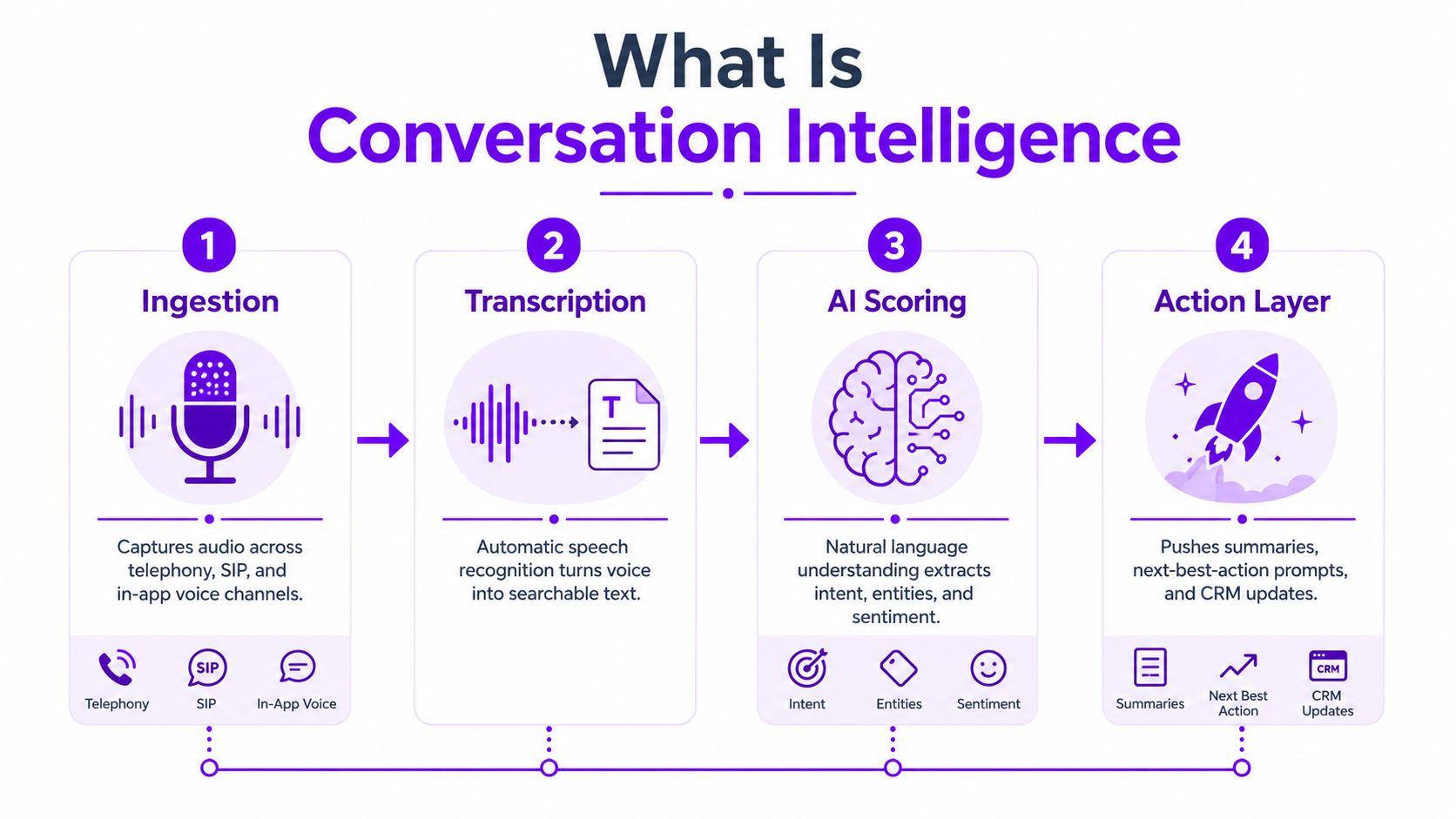
The infographic above maps out the four-step journey from raw ingestion to action—showing exactly how unstructured audio gets turned into signals your business can actually use. Here's the thing worth remembering: structured signals move far faster than raw recordings, which means time-to-action shrinks from days down to seconds.
Ingestion
Think of ingestion as your microphone farm and call logger rolled into one. It normalises sample rates, strips out duplicate legs, and stores encrypted media. That consistency isn't just housekeeping—it directly improves downstream ASR accuracy by 15–25% in noisy, multi-channel environments. A financial services firm found that simply standardizing their audio ingestion protocol reduced transcription errors on complex product names by 30%.
Good audio in means reliable insight out
Transcription
Automatic Speech Recognition serves as the stenographer in this setup. Modern ASR delivers near-real-time transcripts complete with punctuation, speaker diarisation, and confidence scores. When you're getting >90% word accuracy on clear calls, you end up with searchable logs and precise timestamps that line up cleanly with your KPIs.
What ASR actually gives you:
- Time-aligned transcripts ready for CRM updates
- Speaker labels that make agent coaching straightforward
- Confidence flags that trigger human review when needed
AI Scoring
Natural Language Understanding acts as the translator—it pulls out intent, entities, and sentiment from the conversation. This stage tags specific phrases like KYC, refund, or site-visit, then assigns risk or opportunity scores accordingly. From there, LLMs generate summaries and suggest next actions. The whole scoring layer works a bit like a sales director whispering which moves matter most.
- Intent detection with probability scores
- Entity extraction (names, dates, amounts)
- Sentiment and objection flags
Directors: expect actionable signals, not raw text floods
Action Layer
This is where workflows convert signals into actual outcomes—CRM updates, coachable insights, and automated follow-ups. A typical workflow takes a flagged objection and turns it into a concrete task: create a CRM ticket, set a reminder, and nudge the agent with a next-best-action script. The operational impact shows up fast—connect rates jumping from 47% to 91%, and multi-minute natural conversations replacing those robotic, scripted prompts.
From Call To CRM
Here's what the end-to-end flow looks like in practice for a sales team:
- A call is captured via a SIP trunk.
- The audio stream is sent to ASR, returning a transcript in under 2 seconds.
- NLU extracts the prospect's intent ("interested in pricing") and entities ("Product X," "Q3 budget").
- The system scores the lead as "high-value" and enriches it with CRM history.
- A concise summary and a "next-best-action" to send a specific case study are pushed to the agent's screen and logged in the CRM, all before the call ends.
Curious about how the technology decodes voice signals in real time? explore AI voice decoding.
Read also: Learn more about automatic speech recognition in our guide What Is ASR
The practical takeaway for leaders is straightforward: treat the entire stack as plumbing that converts noise into guided actions, measurable KPIs, and repeatable business outcomes.
Business Value and KPIs Leaders Actually Track
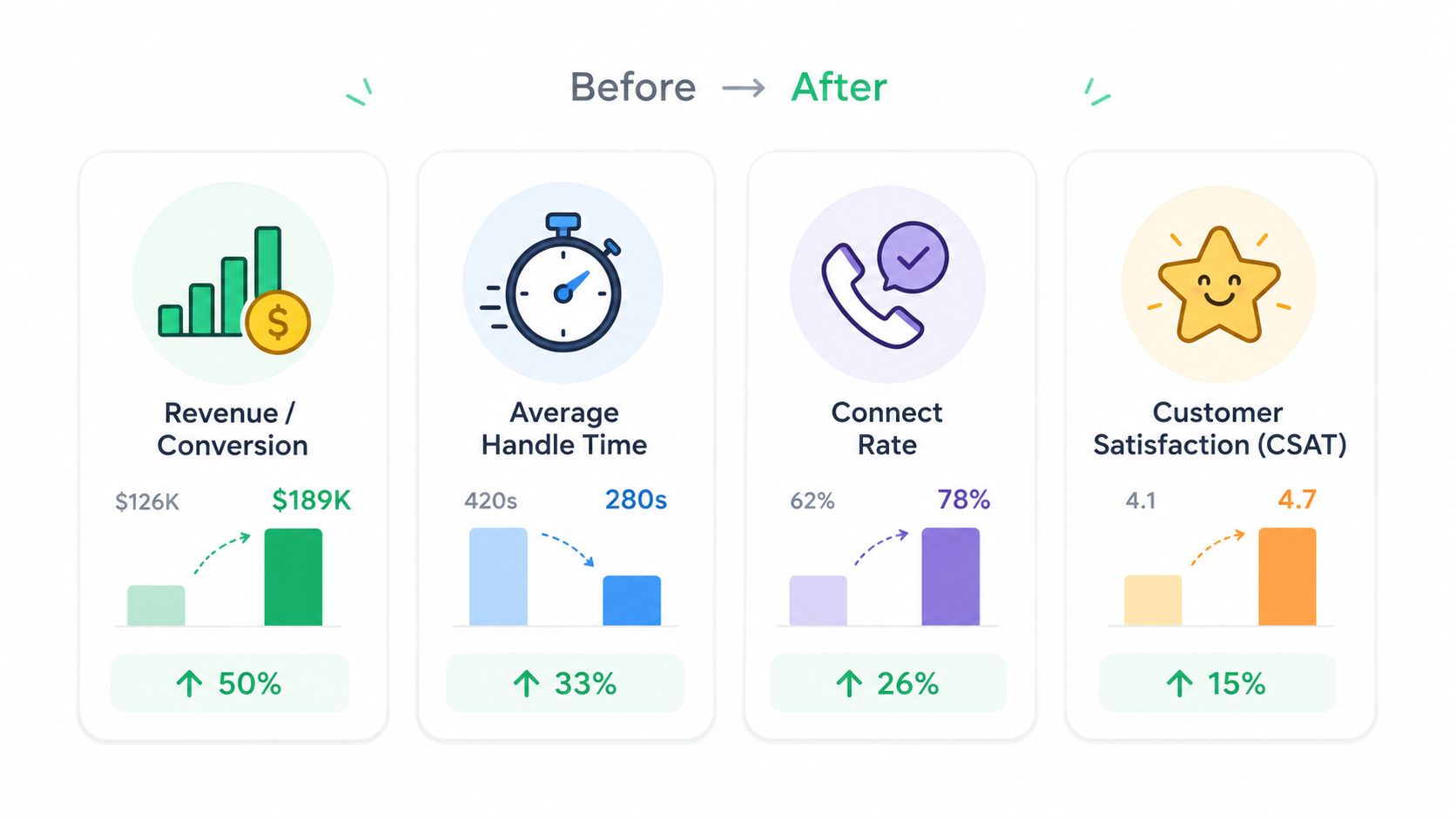
Conversation intelligence stops being an analytics toy the moment finance sees clear P&L movement. At DialNexa, customers routinely report lead-to-booking rates climbing from 2% to 8% — a direct, measurable revenue lift that shows up in the numbers within the first quarter.
The technology also chips away at repetitive agent work, which means fewer heads needed for the same output and a lower average handling cost per interaction. When routine conversations get automated, the operational savings land squarely in monthly run-rates — not in some distant forecast. A large BPO, for example, reduced average handle time by 90 seconds per call, translating to $1.2 million in annual operational savings.
Which KPIs Move and Why
Connect rate improves because automated outreach and intelligent routing reach contacts at the right time. In production pilots, DialNexa customers have watched connect rates jump from 47% to 91% — effectively doubling the reachable audience without adding a single agent.
Average handle time (AHT) drops when assistants surface summaries and scripts mid-call. Agents spend less time wrapping up and more time taking the next conversation. A reduction of just 30 seconds per call can increase per-agent capacity by over 5%, a significant gain at scale.
Qualified-lead accuracy gets a serious boost when AI scoring matches human judgement. DialNexa reports 97% AI-qualified lead parity with human reviewers, which means fewer wasted follow-ups and a sales team that actually trusts the leads landing on their desk.
Agent ramp time shrinks when new hires get real-time coaching and call summaries from day one. A technology firm reported cutting its new agent onboarding time from 12 weeks to just 5 weeks, a 58% reduction, saving significant training costs.
Customer satisfaction (CSAT) climbs as issues resolve faster and escalation triggers fire earlier in calls that are heading south. The system flags risk before the customer even asks to speak to a manager, leading to a reported 10-point average increase in CSAT scores for one retail client.
For CFOs, the takeaway is straightforward: these tools are revenue protection and cost control levers, not reporting add-ons.
Leader's takeaway: Conversation intelligence turns conversations into repeatable revenue events and controllable costs.
Conversation Intelligence KPIs and Realistic Lift Ranges
The table below summarises the KPIs CXOs typically track when rolling out conversation intelligence and the directional improvement reported by teams that have deployed Voice AI agents.
| KPI | What It Measures | Baseline Range | Realistic Lift With Conversation Intelligence |
|---|---|---|---|
| Connect Rate | % of successful outreach | 40–55% | +20–50pp (to 90% range) |
| Lead to Booking | Conversion from lead to confirmed booking | 1–3% | 4x increase reported |
| Qualified Lead Accuracy | AI vs human alignment | N/A | ~97% parity |
| Average Handle Time | Minutes per interaction | 6–12 min | 15–30% reduction |
| Agent Ramp Time | Weeks to competency | 8–16 weeks | 30–60% faster |
| CSAT | Customer satisfaction score | 60–75 | +5–15 points |
These ranges reflect what teams in production are actually seeing — not lab conditions or vendor projections. Your numbers will vary by industry and starting maturity, but the direction is consistent.
India Market Context
India's contact centre and voice automation market is large and growing. Estimates point to a multi-billion dollar addressable opportunity, driven by expanding digital services and voice-first consumer behaviour across the country. For a director or VP, this means that investments in conversation intelligence are not just about immediate micro-KPI gains; they are about securing a competitive advantage in a rapidly scaling market. Getting in early isn't just about efficiency — it's about strategic positioning.
How to Pick Two or Three KPIs to Start
- Identify the highest dollar-impact metric on your P&L (e.g., lead-to-booking for sales-heavy teams).
- Pair it with an efficiency metric that frees capacity (e.g., AHT or agent ramp time).
- Add one customer metric if retention is critical (e.g., CSAT).
Here's how this plays out for a real-estate VP:
- Start with lead-to-booking to drive revenue. A 1% increase could mean millions in new sales.
- Add connect rate to ensure sales pipeline volume scales efficiently.
- Track AHT to quantify cost savings and justify the investment to the CFO.
Practical Next Steps for a Board Deck
- State baseline numbers and conservative lift estimates (use the figures above as a reference point).
- Show a one-line ROI: (Incremental Bookings × Average Deal Value) – (Implementation Cost) = Net Return.
- Propose a 90-day pilot with clear success gates on the chosen 2–3 KPIs and a weekly reporting cadence to the executive team.
Read more about metrics for contact centre Voice AI deployments in our article Metrics For Contact Center Voice AI Analytics Deployments
Industry Use Cases That Move the Needle
EdTech — Priya's Story
Priya heads admissions at a national online university, where her team manages an overwhelming volume of counselling calls. The challenge for her as a director is ensuring consistent quality and maximizing enrollment without burning out her counsellors.
Her DialNexa workflow ingests calls, transcribes them, and uses NLU to categorize conversations into admissions, scholarship, and course-fit intents. Structured summaries push directly into their LMS and CRM. She has integrated their LMS, CRM, calendar APIs for slot booking, and scholarship decision webhooks to create a seamless data ecosystem.
Key Example
When a prospect mentions "cost" or "fees," the system automatically surfaces a real-time script prompt to the counsellor with details of a relevant scholarship. In a 90-day pilot, this single feature drove their lead-to-booking rate from 2% to 8%, a 4x improvement.
EdTech win — increase conversion and halve counsellor follow-up time.
BFSI — Raj's Story
Raj, a Director of Operations at a retail trading platform, is accountable for compliance. A single missed KYC verification step can trigger regulatory scrutiny and substantial fines. His key challenge is achieving 100% compliance at scale.
The conversation intelligence workflow listens for identity-related signals in real time, applies KYC guidance modules, and flags high-risk utterances for immediate supervisor review. The platform is integrated with KYC provider APIs, CRM, the fraud engine, and immutable audit logs.
Key Example
When the system detects a document mismatch during a video KYC call, it surfaces a specific verification checklist directly to the agent’s screen. This real-time guidance has reduced manual compliance review volume by 45% and cut compliance incidents to nearly zero.
Compliance-first design isn’t limited to inbound QA either; outbound calling programmes need the same rigour, which is why BFSI teams often pair conversation intelligence with a TRAI-compliant outbound dialer software layer.
BFSI win — reduce compliance risk and shorten verification cycles.
Real Estate — Anuj's Story
Anuj is a sales director at a property developer, and his performance is measured by one thing: moving prospects from initial inquiry to a site visit. Every delay in this process costs him potential deals.
DialNexa captures discovery calls, extracts property preferences (e.g., "3BHK," "sea-facing") and location entities, then fires automated booking workflows to agent calendars and sends SMS confirmations. The system integrates with their CRM, calendar APIs, and property inventory database.
Key Example
Agents receive next-best-action scripts suggesting upsells to premium units and can send one-click site-visit booking links to prospects during the call. This has pushed their connect rates on follow-up calls to 91% and directly contributed to a 25% increase in qualified site visits.
Real-estate win — more visits, fewer no-shows, faster deals.
E-commerce and D2C — Meera's Story
Meera, a CXO at a fast-growing D2C brand, is obsessed with customer lifetime value. For her, every support call is an opportunity to either strengthen or break a customer relationship. Speed and first-call resolution are paramount.
The workflow detects delivery promises, complaint types (e.g., "damaged item"), and refund requests, then automatically updates orders and triggers courier or refund workflows. It's tied into their order management system, CRM, logistics APIs, and returns platform.
Key Example
When an agent promises a new delivery date on a call, the system automatically updates the order in the OMS, logs the promise in the CRM, and schedules a follow-up check. This has reduced average handling time by 25% and increased their CSAT score by 12 points.
E‑commerce win — lower handling costs and higher customer satisfaction.
Healthcare — Dr. Kapoor's Story
Dr. Kapoor, COO for a multispecialty booking platform, faces the dual challenge of operational efficiency and patient safety. Misrouting a patient with urgent symptoms is a critical risk with severe consequences.
Conversation intelligence parses symptoms, appointment urgency, and consent language from patient calls. It then routes patients to the correct triage nurse or specialist booking calendar, creating a full audit trail for compliance. The system integrates with their EMR, CRM, calendars, and consent capture logs.
Key Example
When red-flag keywords like "chest pain" or "difficulty breathing" are detected during a booking call, an urgent alert with the call transcript is sent directly to a clinical supervisor's dashboard. This has ensured 100% adherence to critical triage protocols and improved patient routing accuracy by 98%.
Healthcare win — safer patient routing and auditable decisions.
Practical Rollout Tips for Leaders
- Start with a single, high-value KPI: Choose one metric that directly impacts revenue or cost, like lead-to-booking, AHT, or compliance incidents.
- Map critical integrations first: Ensure your CRM, calendar, and telephony systems can connect seamlessly. A pilot can fail due to integration friction alone.
- Demand measurable lift in 90 days: Set conservative targets with your vendor, but expect to see a tangible return on your pilot investment within one business quarter.
Board-ready summary — five vertical stories where conversation intelligence turns routine calls into measurable revenue, compliance, and CX improvements you can present in a single slide.
Implementation Roadmap and Common Pitfalls
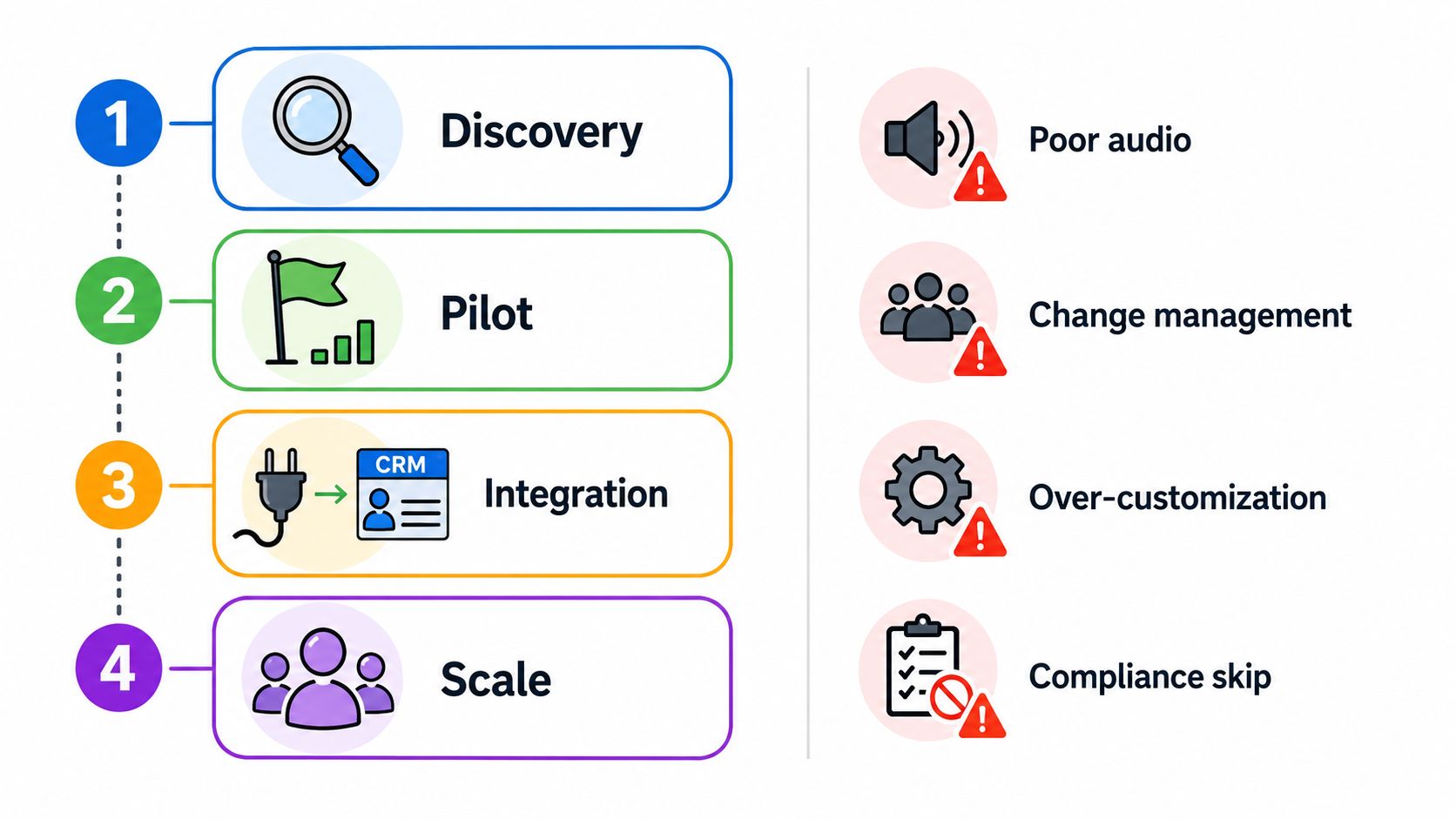
Treat adoption as a focused 90-day programme with four clear phases. This structure lets leaders measure progress and de-risk the investment early, rather than discovering systemic problems after a full-scale rollout.
Start with Discovery and Data Audit (Weeks 1-2) to map call volumes, audio sources (SIP, WebRTC), and compliance requirements. This phase should inventory audio sample rates, languages, and existing CRM fields. Most teams see data quality improvements of 15–25% just from standardising capture protocols alone.
Pilot One Use Case
(Weeks 3-8) Run a time-boxed pilot on a single, high-impact workflow — lead qualification for a sales team or KYC review for a financial firm often deliver the fastest, most visible results. Pick one primary KPI (e.g., lead-to-booking or compliance incidents) and set measurable gates for 30, 60, and 90 days.
- Define success metrics and acceptance thresholds before you start. For example, "Increase lead-to-booking from 2% to 4% within 60 days."
- Log baseline numbers meticulously. In comparable pilots, lead-to-booking has moved from 2% to 8%.
- Keep scope narrow. Over-customisation is the fastest way to derail a pilot's timeline and budget.
"A crisp pilot with one KPI beats an open-ended proof-of-concept any day."
Integration With CRM and Telephony
This is where most deployments either gain momentum or stall. Ship the minimum integration primitives first to remove key risks.
- CRM Webhooks — Prevents missed updates and ensures a single source of truth for audit trails.
- Calendar APIs — Reduces booking friction and cuts no-shows by up to 30%.
- SIP Trunks — Ensures high-quality media to avoid transcription failure; critical for maintaining >90% accuracy.
- Consent Capture — Mitigates regulatory risk in BFSI and healthcare.
- Audit Logs — Delivers immutable traceability for compliance reviews.
Tie each primitive to a specific business risk. SIP trunks mitigate the risk of poor audio, which can drop ASR accuracy below the usable threshold of 90%. When teams skip these foundational steps, the downstream cost of failure is always higher than the upfront integration effort.
Scale Out Across Teams and Geographies
(Weeks 9-12+) After validated outcomes from the pilot, roll out the solution regionally with localization for language models and compliance rules. Use phased quotas to control call volume ramp and monitor KPI drift. Scaling too fast without localization almost always degrades accuracy and user adoption in multilingual environments.
Common Pitfalls and How to Avoid Them
- Poor Audio Quality: The single biggest killer of transcription accuracy. Fix it at the source with standardized codecs and proper SIP routing.
- Ignored Change Management: Agents need to trust AI prompts. A VP must champion the initiative, and managers must be trained to coach with the new data. Without this, adoption will stall.
- Over-Customisation of AI Scorecards: Start with simple, out-of-the-box scorecards. Excessive, brittle rules break the moment call patterns shift.
- Skipping Compliance Review: A fatal error in BFSI or healthcare. Involve legal and compliance teams from day one and ensure audit logs are part of the initial pilot scope.
Practical Checklist for Go Live
- Baseline KPIs documented and signed off by Finance and Operations.
- Pilot success gates met at 30, 60, and 90 days.
- CRM webhooks and calendar APIs validated end-to-end in a production environment.
- SIP trunking tested with representative audio achieving >90% ASR accuracy on clear calls.
- Consent capture and audit logs enabled and tested for all regulated workflows.
- Change management plan executed and training completed for the first user cohort.
- Rollback plan and traffic-shifting runbook finalized and tested.
Quick Integration Mapping
| Integration | What It Prevents |
|---|---|
| CRM Webhooks | Lost or delayed lead records |
| Calendar APIs | Double bookings and no-shows |
| SIP Trunks | Garbled audio and ASR failures |
| Consent Capture | Regulatory penalties |
| Audit Logs | Untraceable escalations |
Actionable Next Moves for VPs
- Print the checklist and require status updates against it in weekly leadership meetings.
- Approve a 90-day pilot budget and assign a single, accountable KPI owner.
- Require an Operations readout at day 30 with hard go/no-go criteria for continuing the pilot.
These steps let executives convert a "what is conversation intelligence" discussion into a pragmatic deployment plan with measurable business value.
VP takeaway: Treat the first 90 days as delivery windows, not experiments, and you convert risk into predictable outcomes.
Choosing the Right Conversation Intelligence Partner
Picking the right vendor can feel overwhelming, but a structured evaluation process can quickly separate true partners from mere technology providers. For a CXO, the focus should be on proven performance, scalability, and business alignment.
Voice Quality and Latency
- Can you demonstrate >90% ASR accuracy in a live environment that mirrors our own, including typical background noise?
- What is the measurable end-to-end latency for real-time agent prompts? Anything over 2-3 seconds is too slow.
- How do you handle media transcoding and jitter buffering to ensure quality across different networks?
A strong partner will insist on a live demo using your own call scenarios, not just polished recordings. Ask to see live, measured word-error-rate stats.
Depth of AI Scoring
- Which business signals (e.g., purchase intent, churn risk, compliance breach) come out-of-the-box?
- Can our business analysts author and version our own scoring rules and LLM prompts without requiring professional services?
- How do you validate AI-qualified leads against our human experts? Show me the data.
Look for evidence of ~97% parity with human judgment in existing client reports. A confident vendor will provide access to their API documentation and show you real, unedited score payloads.
Integration Footprint
- Which CRM, calendaring, telephony, and KYC endpoints do you support natively versus via custom integration?
- How fast can you stand up a production-ready integration with our key systems (e.g., Salesforce, Google Calendar)?
- Do you offer developer-friendly SDKs and a free sandbox environment for our tech team to validate against?
The answer should be a live demonstration, not a slide. A strong partner can complete a round-trip CRM update from a live call in under an hour during a discovery session.
Governance and Compliance Posture
- How do you handle data residency requirements (e.g., GDPR, India data localization) and consent capture?
- Show me your role-based access controls, operator versioning, and how we can export immutable audit trails for regulators.
- What specific certifications (e.g., SOC 2 Type II, ISO 27001, HIPAA) do you hold for BFSI and healthcare use cases?
A convincing demo surfaces audit logs, data retention settings, and granular role controls within the first five minutes. The vendor should be proactive about discussing their compliance posture.
Commercial Transparency
- Is your pricing model published and clearly defined (e.g., per user, per minute, per conversation)?
- What are the exact terms for a paid pilot, including cost, duration, and success criteria?
- Are SLAs, usage overage rules, and termination clauses spelled out explicitly in your standard contract?
The best partners offer transparent, scalable pricing and a 30-day paid pilot with clear go/no-go gates. This approach de-risks the decision and builds trust.
Comparison Table
| Dimension | DialNexa Labs | Generic Call Analytics | Legacy Speech Analytics |
|---|---|---|---|
| Voice Quality & Latency | High quality, SIP-ready, sub-second prompts | Varies, often post-call only | Often batch processed, higher latency |
| AI Scoring Depth | Real-time intent, entities, risk, LLM summaries | Basic tags, limited semantics | Phonetic-focused, low business signals |
| Integration Footprint | Public APIs, CRM webhooks, calendar, KYC | Limited connectors, manual exports | Proprietary adapters, heavy integration effort |
| Governance & Compliance | Consent capture, audit logs, RBAC, region configs | Basic logging, limited retention controls | Minimal governance, compliance gaps |
| Commercial Transparency | Transparent pricing, demo dashboards, pilot offers | Opaque tiers, hidden fees | Enterprise licensing, long procurement cycles |
Practical insight — choose a partner that proves integration speed and shows live KPIs in a pilot. Everything else is just a slide deck.
Buy Versus Build
- Building in-house requires assembling a dedicated team of experts in ASR, NLU, LLMs, and real-time media plumbing. This path involves significant upfront investment, a 12-18 month timeline to a minimum viable product, and high ongoing maintenance costs.
- Buying a mature platform provides access to pre-built models, sandboxed pilots, and the ability to demonstrate measurable KPIs to the board in under 90 days.
Recommendation
Run a 30-day paid pilot with one KPI owner, clear success gates, and a capped budget. A time-boxed pilot is the lowest-risk path to conviction, and it turns vendor claims into hard numbers you can actually present to the board.
Next Steps and Common Questions Leaders Ask
Here are three concrete moves an executive can make this week to shift from theoretical exploration to measurable results.
- Launch a 30-day paid pilot with one accountable KPI owner and a capped budget. Lock in baseline numbers for lead-to-booking, average handle time, or compliance incidents, then set clear 30/60/90-day gates.
- Validate critical integrations end-to-end. Task your IT team with confirming that CRM webhooks, calendar APIs, and SIP trunking can be functional within the pilot timeframe. This de-risks the most common point of failure.
- Draft a change management and rollout playbook. Assign a business lead to train the pilot cohort, build mandatory agent feedback loops, and prepare for a hard go/no-go decision at the end of the pilot.
Implementation Checklist
- Baseline KPIs agreed with Finance and Ops
- Pilot scope limited to one workflow and one KPI owner
- CRM webhooks and calendar APIs functional in sandbox
- SIP trunk tested with representative audio hitting >90% ASR on clear calls
- Consent capture and audit logs enabled for regulated flows
- Training and rollback plan scheduled
"Treat conversation intelligence as core operating infrastructure, not an analytics add-on."
Short FAQ Leaders Ask
How is conversation intelligence different from speech analytics?
Speech analytics tells you what was said, often in post-call reports. Conversation intelligence tells you what it means and what to do next, in real time. It delivers actionable business signals—like purchase intent, churn risk, and compliance flags—directly into your workflows while the opportunity or risk is still live.
What is the typical time to value?
With a focused pilot, you will see measurable KPI movement within 30 to 90 days. We have seen clients quadruple lead-to-booking rates (from 2% to 8%) and nearly double connect rates (to 91%) within the first quarter. The primary variable is the speed of your integrations and the commitment to agent adoption.
How does it handle compliance in BFSI and healthcare?
Through a combination of technology and process. The platform must provide features like consent capture, role-based access, immutable audit logs, and data redaction from day one. For regulated environments, you embed specific KYC or clinical triage modules into the AI scorecard and configure automated alerts to route flagged calls to supervisors with full context.
Does it replace human agents or augment them?
It augments them, making your best agents even better and your new agents effective faster. The system automates low-value, repetitive tasks (like data entry and call summaries) and provides real-time coaching, freeing agents to apply judgment, empathy, and strategic thinking to complex interactions that drive the business forward.
For a low-risk start, consider a 30-day paid pilot with DialNexa Labs to prove KPI lifts and integration speed before committing to a full rollout.
DialNexa Labs Private Limited

It shows how turning everyday customer conversations into useful insights can help teams improve sales, service, compliance, and overall customer experience.