
A CXO’s Guide to Deploying AI Agents for Lead Generation
TL;DR
- AI agents for lead generation are a strategic deployment, not just software, they qualify and engage prospects autonomously, with BFSI deployments seeing connect rates jump from 47% to 91% and real estate lead-to-booking conversion rising from 2% to 8%.
- India’s AI adoption is accelerating fast: 90% of Indian businesses already use AI in some form, and the Reserve Bank of India projects generative AI could add $438 billion to India’s GDP by 2030.
- The winning model is augmentation, not replacement; AI handles high-volume, repetitive top-of-funnel work while human reps focus on objections, nurturing, and closing.
- Most deployments show initial ROI within the first quarter, with a typical pilot launching in 2–4 weeks and full rollout following in another 4–8 weeks.
Key Stats at a Glance
| Metric | Value |
| Indian businesses using AI in some form (2024) | 90% |
| BFSI connect rate improvement | 47% → 91% |
| Real estate lead-to-booking conversion | 2% → 8% |
| DialNexa connect rate | 91% |
| DialNexa lead qualification accuracy vs. human judgement | 97% |
| Indian companies with fully optimized AI use (2024) | 30% (vs. 26% global average) |
| Connect rate benchmark for “well-configured AI” | 90%+ |
| Typical pilot launch timeline | 2–4 weeks |
| Full rollout timeline after pilot | Additional 4–8 weeks |
When we talk about AI agents for lead generation, we’re not discussing just another piece of software. We’re talking about a strategic deployment of intelligent, automated systems designed to find, qualify, and engage with potential customers on your behalf, often without any human sitting in the driver’s seat.
These agents can execute massive outreach campaigns, conduct surprisingly natural conversations to determine who is a genuine prospect, and then seamlessly pass high-intent leads straight into your CRM.
The real strategic value?
It frees up your top sales talent to stop chasing dead ends and focus their energy on high-intent, conversion-ready prospects. This is less about simple automation and more about architecting an intelligent, scalable engine for revenue growth.
The Strategic Shift to AI in Lead Generation
In today’s hyper-competitive market, staying ahead requires fundamental operational shifts, not just incremental tweaks. The entire paradigm of lead generation has evolved. It’s no longer about sheer volume, making more calls or sending more emails, it’s about intelligent, high-precision execution. Legacy methods like manual cold calling and generic email blasts are becoming obsolete, particularly in fast-paced sectors like EdTech, real estate, and financial services where speed and scale are paramount.
Frankly, these legacy approaches are riddled with inefficiency. Sales representatives burn out on repetitive, low-yield tasks, driving up operational costs and staff turnover. Worse still, connect rates are often abysmal, and the leads that do trickle through are of inconsistent quality at best.
Why are old lead generation models failing?
The fundamental problem is that outdated tactics are misaligned with modern buyer expectations. Today’s decision-makers and consumers demand instant, personalized, and relevant interactions. A manual approach simply cannot deliver that experience at scale. This is where AI agents for lead generation introduce a necessary evolution.
Consider these agents not as a replacement for your team, but as a force multiplier. They can execute top-of-the-funnel work with relentless precision, 24/7. Imagine an AI agent that makes thousands of initial calls a day, politely filters out anyone not interested, and delivers a clean, pre-qualified list of prospects to your closers.
This isn’t a future concept; it’s a practical, deployable tool for forward-thinking businesses right now. Learn more about how you can elevate customer experience and boost business growth with this approach.
The Tangible Business Case for AI
The argument for AI becomes undeniable when you examine the data. In 2024, India has emerged as a leader in AI adoption, with a staggering 90% of businesses now leveraging AI in some facet of their operations.
Let’s look at some practical examples:
- For a leading BFSI firm, deploying AI-powered voice agents nearly doubled their connect rates, elevating them from a typical 47% to an exceptional 91%.
- In the competitive real estate market, an AI agent was tasked with handling initial discovery calls and automatically booking site visits. This strategic move boosted their lead-to-booking conversions from a meager 2% to a robust 8%.
The Reserve Bank of India even projects that generative AI will contribute up to $438 billion to the country’s GDP by 2030, largely driven by these kinds of efficiency gains.
The real strategic value here is turning high-volume, low-conversion drudgery into a predictable revenue pipeline. AI agents don’t just cut costs; they build a scalable foundation for growth by making sure every potential lead is contacted instantly and intelligently. For a deeper look at the specific tools making this possible, it’s worth exploring the landscape of AI lead generators.
Laying the Groundwork for Your AI Agent
Before diving into the technology, a successful AI agent for lead generation strategy begins with a solid business plan. For any executive, the objective isn’t just to implement AI; it’s to build a predictable, powerful engine for growth. This requires defining specific, measurable outcomes.
Forget vague goals like “get more leads.” Instead, think in terms of concrete business impact. Are you aiming to achieve a 30% increase in qualified sales appointments this quarter? Or is the primary goal operational efficiency, such as slashing your cost-per-qualified-lead by 50% in the next six months? Having a clear, measurable target like this acts as your North Star, ensuring every subsequent decision serves a tangible business purpose.
Where can AI make the biggest difference in lead generation?
With your objectives defined, the next step is tactical. Identify the precise workflows where an AI agent will deliver the highest return. Not all tasks are created equal. You are looking for high-volume, repetitive jobs that currently consume the valuable time of your skilled personnel.
Consider these high-impact opportunities:
- Frontline Lead Qualification: Let the AI manage the initial touchpoint. It can sift through thousands of new inquiries, filter out unqualified prospects, and pass only genuinely interested parties to your sales team.
- KYC and Onboarding: For a financial services company, an AI agent can patiently guide new customers through the Know Your Customer (KYC) process, reducing friction and minimizing drop-off rates.
- Event and Webinar Follow-Up: The moment a webinar concludes, an AI agent can initiate calls to every attendee, booking demos while their interest is at its peak.
- Appointment and Demo Scheduling: Eliminate the time-consuming email back-and-forth. An AI agent can manage the entire scheduling process for site visits or product demos, freeing up calendars and reducing administrative overhead.
This diagram brings to life how an AI agent shifts the entire lead generation process from a manual, linear effort to a streamlined, scalable growth machine.
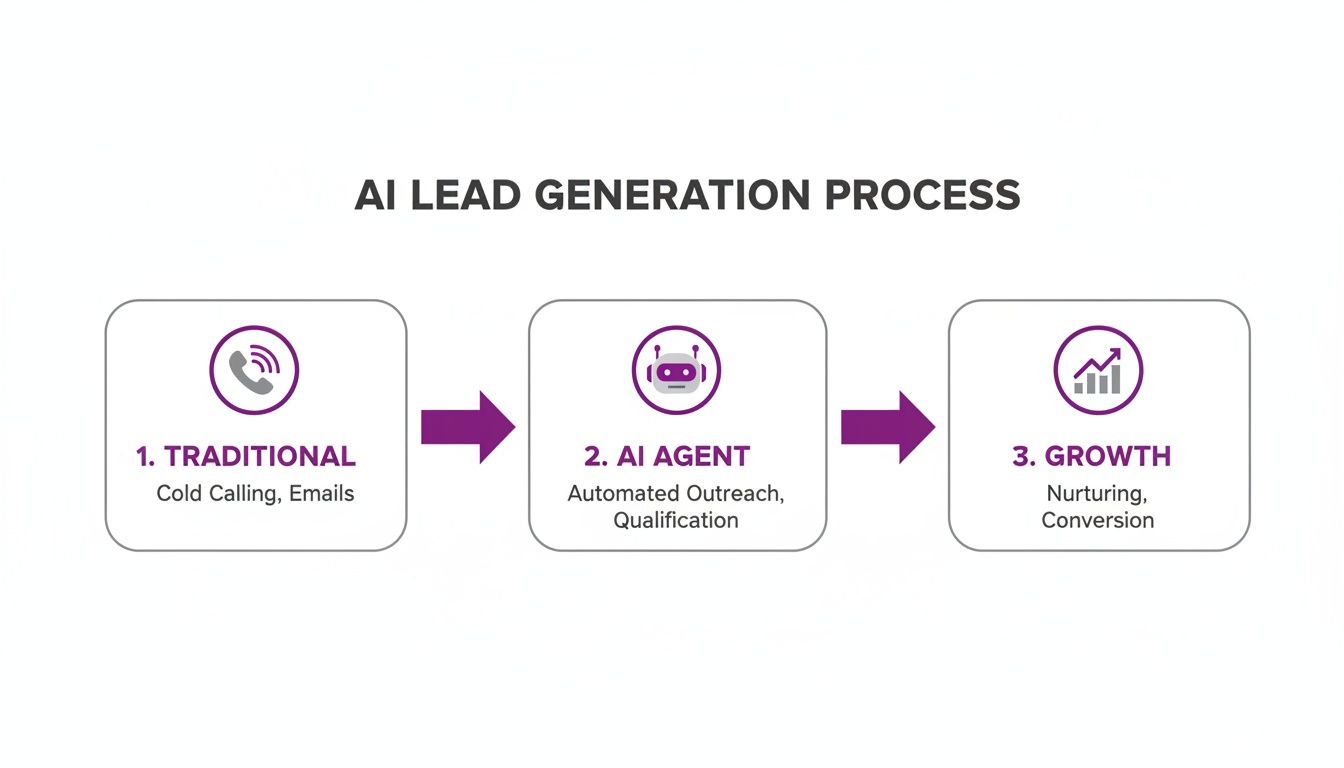
What we’re seeing here is a fundamental operational shift. You transition from a linear, person-by-person outreach model to an intelligent, automated system that qualifies leads at scale and directly fuels your expansion.
Giving Your AI Agent a Voice and a Personality
Once you’ve defined what the agent will do, the next critical decision is how it will do it. This is where you move beyond process flows and begin crafting the conversational experience. A superior AI agent doesn’t sound like a machine reading a script; it should feel like a natural, professional extension of your brand.
This is about crafting the right agent persona. You must tailor its personality, tone, and language to align with your audience’s expectations and needs.
Here’s how that might look in practice across different sectors:
| Industry | Agent Persona | Key Trait | Primary Goal |
|---|---|---|---|
| EdTech | Empathetic Counsellor | Supportive & Patient | Guide prospective students through course options and answer admission queries. |
| BFSI | Professional Advisor | Trustworthy & Clear | Assist with account opening, explain financial products, and ensure compliance. |
| Real Estate | Efficient Coordinator | Proactive & Organised | Qualify buyer interest, provide property details, and book site visits seamlessly. |
| E-commerce | Helpful Assistant | Friendly & Responsive | Confirm orders, handle shipping queries, and assist with returns or exchanges. |
The objective is to make the interaction feel valuable and human, not automated. When you build a persona that reflects your brand’s voice, you begin building trust from the very first interaction, which is absolutely crucial for generating high-quality leads.
Of course, the dialogue itself must be equally intelligent. It’s not a rigid, one-way script. It’s a dynamic conversation map designed to handle questions, navigate objections, and gently guide the prospect toward the desired outcome.
Let’s look at two practical examples.
Dialogue Snippet: Real Estate
- Scenario: A prospect has inquired online about a premium apartment.
- AI Agent: “Good morning! I see you’re interested in our 3BHK sea-facing apartments at The Crest. To provide the most relevant information, could you tell me if you are looking for an investment or for personal use? This will help me share the details that matter most to you.”
Dialogue Snippet: E-commerce
- Scenario: Confirming a high-value Cash on Delivery order to reduce returns.
- AI Agent: “Hi, this is a confirmation call from AuraStyle for your recent order of the ‘Classic Leather Jacket.’ To confirm your order and ensure a speedy delivery, could you please verify your pin code is 400051?”
Notice the difference? The real estate agent is consultative and qualifying. For a real-estate-specific rollout playbook and conversion benchmarks, see this AI for real estate leads guide. The e-commerce agent is efficient, friendly, and direct. This level of detail is what distinguishes a clunky chatbot from a truly effective lead generation AI.
Weaving Your AI Agent into Your Tech Stack
An AI agent for lead generation should not be a siloed tool; it must be the central hub of your growth engine. For any business leader, the real strategic victory isn’t just automating calls. It’s about creating a seamless, intelligent flow of data across your entire technology ecosystem. This is the difference between a simple dialler and a self-optimising revenue machine.
The goal is to integrate your AI agent directly with your Customer Relationship Management (CRM) and marketing automation platforms. When this is executed correctly, every piece of data—from call outcomes to specific customer objections—is instantly captured, analysed, and acted upon. You’re building a unified system where all your technology works in concert.
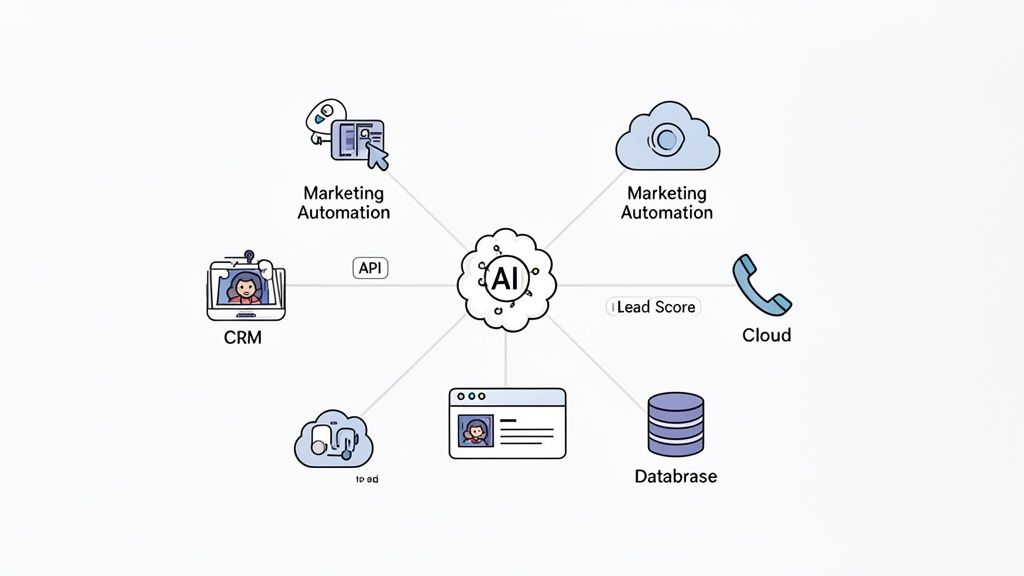
This connected ecosystem finally delivers that elusive 360-degree view of every prospect. You can trace the entire customer journey, from the initial AI-powered touchpoint to the final deal closure, all within the systems your teams use every day.
How do you build a connected ecosystem with API-driven integration?
So, how do you build this connected ecosystem? The key lies in API-driven integration. Modern AI platforms are designed to communicate with other software through Application Programming Interfaces (APIs). Think of APIs as secure bridges that allow your AI agent, CRM, and marketing tools to exchange information automatically.
This real-time data exchange unlocks powerful, automated workflows that directly impact efficiency and revenue. For example:
- A lead flagged as “high-intent” by the AI agent can be instantly routed to your top sales representative in the CRM, eliminating manual assignment delays.
- The moment a prospect mentions a specific competitor on an AI call, your marketing platform can automatically trigger a competitive battlecard email to your sales team.
- Call dispositions and AI-generated summaries are logged directly into the contact’s record, providing your human team with complete context for a warm, intelligent follow-up.
This isn’t just about saving a few minutes. It’s about acting on buying signals with speed and precision. While getting started with new tech can feel intimidating, there are practical guides that walk you through the basics of integrating an AI agent for customer service, and the core principles are exactly the same for lead generation.
How does cloud deployment help AI lead generation agents scale?
For any Director or CXO, scalability is non-negotiable. You need a solution that can grow with your business without demanding significant upfront capital expenditure on hardware or infrastructure. This is where cloud-based deployment becomes a strategic advantage.
By hosting your AI agent in the cloud, you gain the ability to handle massive call volumes—from a few hundred to tens of thousands per day—without performance degradation. The Indian AI data management market’s explosive growth, from USD 1,015.1 million in 2023 to a projected USD 4,663.9 million by 2030, is a testament to the sheer scale enabled by cloud technology. In 2023, cloud deployment was the largest and fastest-growing segment, allowing businesses to roll out AI agents rapidly through simple API integrations and intuitive dashboards. You can dig deeper into these market growth findings to see how this impacts sales and marketing.
The real strategic advantage of the cloud is agility. You can deploy, test, and scale your AI lead generation efforts at speed, reacting to market changes without being shackled by physical infrastructure.
This approach dramatically lowers the barrier to entry and reduces the total cost of ownership, putting sophisticated AI within reach for businesses of all sizes.
Critical CRM Integration Points for AI Agents
To truly maximize the value of your AI agent, several key data points must be synced with your CRM. This creates a closed-loop system where frontline intelligence directly informs high-level strategy. This table highlights the essential data sync points between your AI agent and CRM to ensure a seamless lead management workflow and data-driven optimisation.
| Integration Point | Data Synced from AI Agent to CRM | Strategic Benefit for CXOs |
|---|---|---|
| Lead Status | Updates lead status (e.g., Qualified, Not Interested, Call Back). | Provides a real-time view of pipeline health and ensures accurate sales forecasting. |
| Call Disposition | Logs detailed call outcomes (e.g., Booked Appointment, Wrong Number). | Offers clear data for auditing, compliance, and measuring campaign effectiveness. |
| Interaction Summary | Attaches a summary or full transcript of the conversation. | Equips human agents with full context, enabling smarter, more effective follow-up conversations. |
| Lead Score | Assigns a score based on intent signals identified during the call. | Automates lead prioritisation, ensuring sales teams focus their energy on the most promising opportunities. |
By focusing on these vital integration points, you create a powerful feedback loop. Your AI agent doesn’t just generate leads; it enriches your central database with priceless intelligence, making your entire sales and marketing operation smarter over time.
Measuring Success with KPIs That Matter
Bringing an AI agent for lead generation into your workflow is a strategic investment, not a technological experiment. To validate its value and continuously refine your strategy, you must measure what truly impacts the business. For any leader, that means looking beyond vanity metrics and focusing on Key Performance Indicators (KPIs) tied directly to revenue, efficiency, and growth.
The objective is to build a clear, data-driven narrative that proves the value of your AI initiative. Are you reducing customer acquisition costs? Are you increasing the volume of qualified opportunities for your sales team? These are the questions that arise in the boardroom, and the right KPIs provide the answers.
Which core KPIs should you track for AI lead generation?
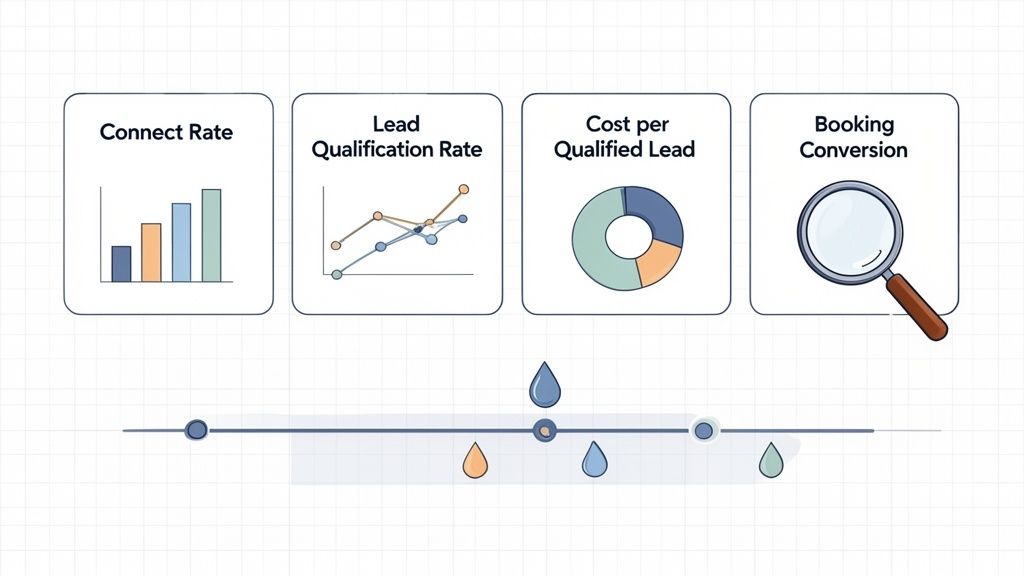
To gain a comprehensive understanding of your AI agent’s performance, start with a core set of operational and financial KPIs. These metrics provide a high-level view of both efficiency and effectiveness, painting a clear picture of your return on investment.
- Connect Rate: This is the foundational metric. It is the percentage of calls where your AI agent successfully reaches a live person. A high connect rate—often exceeding 90% with a well-configured AI—is the first indicator of effective outreach.
- Lead Qualification Rate: Of all connected calls, what percentage result in a genuinely qualified lead? This KPI is a direct measure of your agent’s ability to discern real prospects from the noise.
- Cost Per Qualified Lead (CPQL): This is a critical metric for financial oversight. It is calculated by dividing the total campaign cost by the number of qualified leads generated. A consistently declining CPQL indicates increasing operational efficiency and a strengthening ROI.
- Booking Conversion Rate: For most businesses, the ultimate goal is a booked demo or appointment. This KPI tracks the percentage of qualified leads that schedule a meeting, directly linking your AI’s activity to a growing sales pipeline.
We’ve actually put together a more detailed guide on this topic. You can read more about how to measure the success of your outbound campaigns with our AI voice agent here.
Uncovering Deeper Insights with Advanced Analytics
While core KPIs are essential, advanced analytics help you understand the why behind the numbers. This is where you can begin to fine-tune your agent’s performance for optimal results. Modern AI platforms offer sophisticated analytics that provide a granular view of every interaction.
The real power of AI isn’t just in making calls; it’s in learning from them. By analysing conversational data, you can turn every interaction into a valuable data point that makes your entire lead generation process smarter.
For instance, sentiment analysis can interpret the emotional tone of a conversation. It helps you determine if your agent’s persona is resonating with your audience. Does it sound helpful and professional, or does it come across as robotic? This insight is invaluable for refining scripts and agent personalities.
Another powerful tool is objection handling analysis. By tagging and categorizing objections—such as “not interested,” “bad timing,” or “too expensive”—you can identify trends. For example, if you notice that 20% of your calls terminate immediately after the pricing discussion, it’s a clear signal to A/B test a different approach to that part of the conversation.
A Framework for Continuous Optimisation
Measuring success is not a one-time activity; it’s a continuous cycle of testing, learning, and improvement. The most effective approach is to establish realistic benchmarks and then systematically test variables to surpass them. This is where A/B testing becomes an indispensable part of your strategy.
Consider implementing these practical A/B tests:
- Opening Lines: Test two different opening statements. Does one result in a longer average conversation duration or a higher qualification rate?
- Agent Personas: Run a formal, professional voice persona against a more casual, friendly one. Which persona achieves a higher booking rate with your specific target audience?
- Call-to-Action: Compare a direct CTA like, “Would you like to book a demo now?” against a softer approach, such as “Would you be open to a brief 15-minute call next week?” Analyze which one secures more commitments.
By systematically testing elements like these and closely monitoring your KPIs, you create a powerful feedback loop. This data-driven approach ensures your AI agents for lead generation don’t just perform well—they continuously evolve into a smarter, more effective, and indispensable component of your revenue engine.
Navigating Compliance in Regulated Industries
When deploying AI agents for lead generation in highly regulated sectors like finance or healthcare, adherence to compliance is non-negotiable. The stakes are incredibly high. While innovation is the objective, it cannot come at the expense of regulatory compliance and the trust you have built with your customers. The strategic challenge is to embed strict regulatory adherence into the very fabric of your AI strategy. It’s about building a system that’s not just intelligent and efficient, but also ethical, transparent, and completely secure.
This requires a “compliance-by-design” approach from day one. Every interaction must be engineered with regulations in mind. For instance, in banking and financial services (BFSI), every conversation must align with Know Your Customer (KYC) norms. In healthcare, the priority is the uncompromising protection of sensitive patient data.
Building Trust Through Transparency and Security
A foundational principle is absolute transparency. Customers must be informed that they are interacting with an AI. Obtaining their explicit consent to proceed is not just best practice—it’s a legal requirement in many jurisdictions. A simple, upfront disclosure from your AI agent is a powerful first step in establishing trust.
For agents operating in healthcare, a deep understanding of data protection laws is critical. It’s vital to ensure your AI platform is architected to meet these rigorous standards, similar to platforms that achieve HIPAA compliance for secure data handling. Adherence protects your organization from significant financial penalties and reputational damage.
Another critical component is the creation of a robust audit trail. Every conversation must be logged and assigned a reliable call disposition. These records serve as your proof of compliance during an audit and are invaluable for internal quality assurance. They create a clear, verifiable history demonstrating that all protocols were followed.
The goal is to create an AI lead generation engine that is “compliant-by-design.” This isn’t about ticking boxes after the fact; it’s a proactive approach that makes regulatory requirements a core part of your deployment, protecting both your customers and your business.
Practical Compliance in Action
The adoption of AI in India’s regulated sectors underscores this point. By 2024, an impressive 30% of Indian companies had fully optimized their use of AI, surpassing the global average of 26%. The industries leading this charge—fintech, software, and banking—are core sectors for us at DialNexa. In these fields, our AI agents have significantly reduced operational costs while boosting conversions, achieving 91% connect rates and matching human accuracy in lead qualification at 97%. This demonstrates that top-tier performance and airtight compliance can and must coexist.
So, how do you put this into practice?
- Scripted Disclosures: Embed clear, compliant disclosures directly into your agent’s scripts. A BFSI agent, for example, could initiate a call with, “Hello, you’re speaking with an AI assistant from ABC Bank. This call will be recorded for quality and training purposes. To continue, please say ‘yes’.”
- Data Masking: Program your AI to automatically mask or redact sensitive data like Aadhaar numbers, PAN details, or personal health information from all transcripts and recordings.
- Regular Audits: Do not adopt a “set it and forget it” mindset. Conduct frequent internal audits of your AI agent’s interactions to ensure consistent adherence to evolving regulations and your own internal policies.
By embedding these safeguards, you can confidently leverage the power of AI agents for lead generation without jeopardizing the trust you’ve worked so hard to build.
Leaders’ Top Questions About AI Agents: FAQs
Adopting any new technology, especially one as transformative as AI, naturally raises important questions. As a leader, your focus is rightly on the return on investment, the impact on your team, and the protection of your brand’s reputation. Let’s address the most common questions we hear from executives considering AI agents for lead generation.
1. How Quickly Can We Expect to See an ROI?
The timeline for return on investment varies, but clients often experience initial returns within the first quarter. The most immediate benefits are typically a reduction in operational costs and a significant increase in connection rates. It’s not uncommon to see connect rates jump from a baseline of 47% to over 91% almost immediately.
The more strategic ROI, such as an increase in lead-to-booking conversions, generally materializes within three to six months as the system is optimized. For example, we’ve enabled real estate clients to increase their conversion rates from 2% to 8%. The key is to track both cost savings and revenue gains from day one to quantify the full business impact.
2. Will AI Agents Make Our Human Sales Team Redundant?
Absolutely not. This is a common misconception. The correct paradigm is augmentation, not replacement. The strategic purpose is to delegate the high-volume, repetitive tasks at the top of the funnel—initial outreach, basic qualification, and appointment scheduling—to the AI. These are precisely the activities that lead to burnout among skilled sales representatives.
By automating this work, your highly trained SDRs are liberated to focus on high-value activities: handling complex objections, nurturing high-intent leads, and closing deals. It’s about elevating your sales team, making them more strategic and, ultimately, more productive.
3. How Do We Make Sure the AI Agent Sounds Like Us?
This is a critical, non-negotiable requirement. Modern AI platforms are designed for deep customization to ensure your brand voice is preserved. The process begins by selecting a voice persona that accurately reflects your brand’s tone—whether that is formal and authoritative or warm and supportive.
From there, we collaborate to build dialogue scripts, leveraging insights from your best human sales conversations. We incorporate your unique value proposition and brand-specific terminology. This is an iterative process; we continuously monitor and A/B test the scripts to ensure every call not only feels natural but also perfectly represents your brand.
4. What Does the Implementation Process Actually Look Like?
We can typically launch a pilot program in as little as two to four weeks. This initial phase is focused on establishing clear objectives, designing the initial scripts, integrating with your lead sources, and training the AI on your specific use cases.
Once the pilot demonstrates success, a full-scale rollout usually takes an additional four to eight weeks. We employ this phased approach deliberately—it allows for rigorous testing and refinement, ensuring the AI performs optimally before it is deployed across the entire organization. This minimizes risk and accelerates the time-to-value.
Ready to see what intelligent automation can do for your lead generation? At DialNexa, we build custom AI agents that deliver real, measurable results. Find out how our solutions can help you scale outreach and supercharge your sales team by visiting https://dialnexa.com.

[…] concrete expectation, reducing the chance they will call a competitor. The information gathered by AI agents for lead generation can be pushed directly into a CRM for seamless […]
[…] organisations evaluating upstream funnel automation before full workflow redesign, this playbook on AI agents for lead generation in sales teams is useful because it focuses on qualification logic, routing, and outreach […]
[…] and keeping humans in control when needed. That's the same operational challenge you see in DialNexa Labs AI for sales, where the value comes from tying AI behavior to real revenue workflows rather than treating it […]
[…] novelty feature. If your team is evaluating that category specifically, DialNexa's write-up on AI agents for lead generation shows how teams frame qualification and follow-up around actual commercial […]
Excellent insights on how AI agents are transforming lead generation from a volume game into a precision-driven growth strategy. The focus on measurable KPIs, seamless integration, and compliance makes this a practical roadmap for modern businesses aiming to scale intelligently.