
After Hours Virtual Receptionist: How AI Can Handle Calls 24/7
Most businesses stop answering the phone at 7 pm, but their customers keep calling. A parent asks about course fees after dinner, a policyholder calls about a claim on Sunday, or a buyer rings about a flat at 10 pm. Without an after hours virtual receptionist, these calls end in voicemail or a missed-call alert nobody checks until morning.
That wait is expensive. A 2011 Harvard Business Review study of 1.25 million sales leads found that firms contacting a lead within an hour were nearly seven times as likely to qualify it, and more than 60 times as likely as firms that waited a day or longer.
An after hours virtual receptionist closes that gap by answering every call the moment it comes in. This guide explains how AI handles those calls, what it can and cannot do, and what to check before you choose a platform.
TL;DR
- An after hours virtual receptionist is an AI voice agent that answers calls when your team is offline, handles routine requests, and hands the rest to staff the next morning.
- It can book appointments into a live calendar, qualify leads with your questions, answer FAQs, and schedule follow-up calls or WhatsApp messages.
- AI answers many calls at the same time, so a 9 pm spike after a campaign does not turn into busy tones or long queues.
- For Indian callers, real Hindi, Hinglish and regional language handling matters more than the number of languages listed on a feature page.
- A traditional after hours phone answering service mostly takes messages, while AI can complete the task during the call itself.
- Complex, sensitive or emergency calls still need a clear, fast route to a human.
What Is an After Hours Virtual Receptionist?
An after hours virtual receptionist is software that answers your business line outside working hours and handles calls the way a front-desk executive would. Older versions were simple: a recorded greeting, an IVR menu and a voicemail box. Modern versions use voice AI, so callers speak normally and the system understands what they want.
In practice, it works as an inbound answering service that sits on top of your existing number. Calls after a set time, or calls your team cannot pick up, route to the AI agent. During the day, the same setup works as an AI phone receptionist for overflow calls your team cannot reach in time.
Why Do After Hours Calls Need Real Answers?
Calls that come in after closing time are often high-intent. The caller chose to phone instead of filling a form, which usually means they want an answer now. If nobody picks up, many simply call the next business on their list.
Here is who typically calls once the office closes:
- Working professionals: They look into courses, loans and insurance in the evening, once their own workday is over.
- Patients: They call clinics to book or move a consultation after they get home.
- Property buyers: They follow up on weekend site visits or on ads they saw over the weekend.
- Existing customers: They call about payments, orders or policy questions that came up during the day.
Inbound calls also tend to work well with AI. DialNexa’s voice AI report, based on more than one million AI-assisted business calls in India, found that inbound conversations reached about 89% goal completion. Only 0.01% of those calls ended because the caller hung up first.
How Does an After Hours Virtual Receptionist Handle a Call?
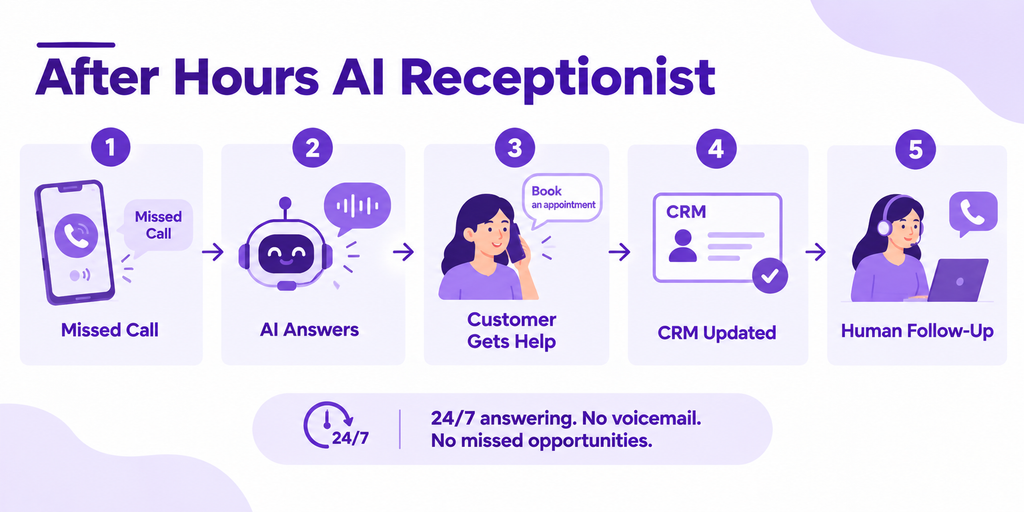
Each call follows a short, predictable sequence. Here is what happens from the first ring to the morning handover:
- Answers on the first ring: The AI picks up with a greeting in your business name. There is no hold music and no menu to press through.
- Understands the request: Speech recognition and a language model work out what the caller needs, even when they explain it in their own words.
- Takes action: It checks your calendar, CRM or knowledge base, then books, answers, qualifies or records the request.
- Confirms the outcome: The caller hears a short summary and can receive a WhatsApp or SMS confirmation.
- Hands over: Your team starts the day with transcripts, outcomes and a list of callers who asked for a person.
Take a dental clinic in Pune that closes at 8 pm. A patient calls at 10:30 pm with a toothache and asks for the earliest slot. The AI books 9:30 am, sends a WhatsApp confirmation, and flags the call as urgent, so the front desk knows who is first before the clinic opens.
What Can It Handle While Your Team Is Offline?
Most after hours calls fall into a few repeatable types. These are the ones AI handles well, along with one it should always pass on.
Appointment Booking
With calendar access, the AI can book, reschedule or cancel appointments in real time. It reads open slots, confirms the time with the caller and blocks it, so two people never get the same slot. Pairing bookings with appointment reminders also cuts next-day no-shows.
Lead Qualification
For sales teams, an inbound call at 9 pm is a warm lead that cools by morning. The AI asks your qualification questions, such as budget, timeline, location or course interest, and scores the lead in your CRM. As a result, reps start the day with qualified conversations instead of a list of missed calls.
FAQs and Basic Support
Questions about fees, timings, order status, documents or eligibility rarely need a person. An automated answering service built on voice AI pulls answers from your knowledge base and replies in a normal, conversational tone. However, if the answer is not in its knowledge base, it should say so and log the question instead of guessing.
Automated Follow-Ups
Some calls cannot be closed at night. In those cases, the AI sets up the next step: a callback at a time the caller picks, a WhatsApp message with a brochure or payment link, or a reminder call the next day. These follow-ups run on rules you set, so no lead depends on someone remembering to call back.
Escalation to a Human
Not every call should stay with AI. Callers who are upset, ask for a manager or describe an emergency should reach a person quickly. Good setups route these calls to an on-call number through a warm call transfer, passing along a short summary so the caller does not repeat their story.
How Does AI Handle Concurrent Calls and Sudden Spikes?
A human receptionist takes one call at a time. An AI receptionist can take many at once, limited mainly by your plan and telephony setup. This matters most when calls arrive in bursts instead of a steady stream.
Consider an EdTech company that runs a Sunday evening webinar. When it ends at 8 pm, 300 attendees call the number on screen within twenty minutes. A small night team would leave most of them waiting. By contrast, an AI-powered inbound answering service picks up every call, qualifies each caller and books counselling slots across the next two days.
That said, concurrency is not unlimited by default. Ask any vendor how many simultaneous calls your plan supports, what happens when you go past that limit, and whether response speed drops at peak load.
Can It Handle Multilingual Workflows for Indian Callers?
Callers in India rarely stick to one language. Someone may start in Hindi, switch to English for a price question, and return to Hindi to confirm the slot. An AI receptionist that only works in pure English or pure Hindi will lose these callers halfway through.
At night this matters even more, because there is no bilingual staff member to step in. Before you go live, test the system with the way your customers actually speak:
- Hinglish: Hindi and English mixed in the same sentence, including product names and numbers.
- Regional languages: Tamil, Telugu, Kannada, Marathi, Gujarati or Malayalam, depending on where your callers are.
- Language switching: Whether the agent follows the caller when they change language mid-call.
- Names and addresses: Whether Indian names, localities and PIN codes are captured correctly.
Teams that already run multilingual call centers can reuse their existing scripts and language routing rules as a starting point.
AI Receptionist vs After Hours Phone Answering Service
A traditional after hours phone answering service uses human operators, usually in a shared call centre, who take messages and pass them on. The table below compares that model with an AI receptionist and a basic IVR with voicemail.
| Factor | AI Receptionist | Human Answering Service | IVR + Voicemail |
|---|---|---|---|
| Availability | 24/7, including holidays | 24/7, often at a higher night rate | 24/7 |
| Calls at once | Many in parallel | Limited by operators on shift | Many, but no conversation |
| What happens on the call | Books, qualifies, answers, follows up | Takes a message, sometimes books | Caller presses keys or leaves voicemail |
| Languages | Hindi, Hinglish, regional (varies by vendor) | Depends on operators on shift | Pre-recorded prompts only |
| CRM updates | Automatic, with transcript | Manual entry or email summary | Voicemail file only |
| Sensitive calls | Hands off to a human | Handled by a person | Not handled |
| Cost model | Usage-based, per minute | Per call or monthly retainer | Low fixed cost |
The biggest difference is what happens during the call. A human answering service mostly records a message, so your team still calls back in the morning. An AI receptionist finishes the task on the spot, which suits high-volume, repeatable calls. On the other hand, people still handle emotional calls better, and a basic IVR system stays the cheapest option when callers only need routing.
How to Choose an AI Platform for After Hours Calls
Many AI platforms for call automation look alike in a demo. The differences show up at 11 pm on a busy Sunday. Ask these questions before you sign:
- Does inbound voice AI performance in production match the demo, especially response speed under load?
- Can it read and write to our calendar, CRM and WhatsApp during the call, or only after it ends?
- How well does it handle Hinglish and the regional languages our customers use?
- What is the handoff path for urgent or sensitive calls at night?
- How is pricing structured, and what happens to cost when call volume spikes?
Also watch for these warning signs during evaluation:
- Scripted demos only: The vendor shows clean, English-only calls and avoids live testing with your call types.
- No pilot recordings: You cannot review real transcripts or recordings from a trial.
- Vague limits: Answers on concurrency, uptime or latency stay general instead of specific.
- No consent process: There is no clear approach to call recording consent and data handling.
Finally, be clear about limits. An after hours virtual receptionist should not give medical, legal or financial advice, and it cannot replace judgment on complex complaints. Whether you call it an automated answering service or an AI agent, keep those calls on a human path and let AI handle the repeatable work around them.
Conclusion
After hours calls are often high-intent, and voicemail loses most of them. An after hours virtual receptionist answers every call, books and qualifies on the spot, and gives your team a clean summary each morning.
The setups that work best keep AI on repeatable tasks and give sensitive calls a quick route to a person. Test it with your real call types, in the languages your customers speak, before rolling it out across every line.
At DialNexa, we build AI voice agents that answer inbound calls around the clock, speak Indian languages, update your CRM and hand off to your team when a call needs a person. Explore DialNexa to see how it can cover your night and weekend calls.
FAQs
1. Can an AI receptionist answer calls 24/7?
Yes. An AI receptionist runs on cloud telephony, so it answers calls at any hour, including weekends and public holidays. There are no breaks or shift changes. Most businesses route calls to it after closing time, or whenever their team is busy, while keeping their existing phone number.
2. Can it book appointments after business hours?
Yes, as long as it is connected to your calendar or booking system. The AI checks open slots, offers options to the caller, confirms the chosen time and blocks it right away. It can also send a WhatsApp or SMS confirmation and a reminder before the appointment.
3. Can it qualify leads and schedule follow-ups?
It can. The AI asks the qualification questions you define, such as budget, timeline or course interest, and records the answers in your CRM. It then books a callback with a sales rep or schedules a follow-up call or message, so leads who call at night are not left waiting.
4. What happens when a caller needs a human?
The AI recognises requests for a person, signs of frustration or urgent issues, and transfers the call to an on-call number you choose. It passes along a short summary, so the caller does not repeat themselves. If nobody is available, it books a priority callback for the morning.
5. Can it answer calls in Hindi or regional languages?
Many voice AI platforms support Hindi, Hinglish and regional languages such as Tamil, Telugu, Kannada and Marathi. Quality varies a lot by vendor and by language pair, though. Test the system with real mixed-language conversations, including names, numbers and addresses, before you rely on it for after hours calls.
6. How is an AI receptionist different from a traditional answering service?
A traditional answering service uses human operators who mostly take messages for your team to act on later. An AI receptionist completes the task during the call, such as booking slots, qualifying leads or answering questions. It also handles many calls at once and updates your CRM automatically.

Leave a Reply