
AI Phone Receptionist Guide for Indian CXOs in 2026
Only 37.8% of incoming calls to small businesses are answered by a live person, and a small business can lose about $126,000 per year from missed calls, according to the compiled industry data often cited in this market from GetNextPhone. For an Indian CXO, that is not a software curiosity. It is a revenue leak in the middle of phone-led workflows that still drive real estate site visits, healthcare bookings, BFSI support, and education admissions.
India's buyers already behave like digital-first customers in one important way. UPI processed 18.3 billion transactions in May 2024 worth ₹24.8 trillion in the referenced industry guide, which means people expect fast follow-up after they raise intent. If your team misses the call, delays the callback, or hands the caller to a dead end, you lose the conversion window. That is why an AI phone receptionist belongs in front-desk strategy, not in an IT sandbox.
Table of Contents
- The Missed-Call Problem Every Indian CXO Should See
- What an AI Phone Receptionist Is
- How Six Indian Industries Are Using AI Phone Receptionists
- Building the Business Case With Real Numbers
- The Compliance and Language Reality Most Vendors Avoid
- Rolling Out an AI Receptionist Without Breaking Operations
- A Buyer's Checklist for Shortlisting Vendors
- What to Do This Quarter and Common Questions Answered
The Missed-Call Problem Every Indian CXO Should See
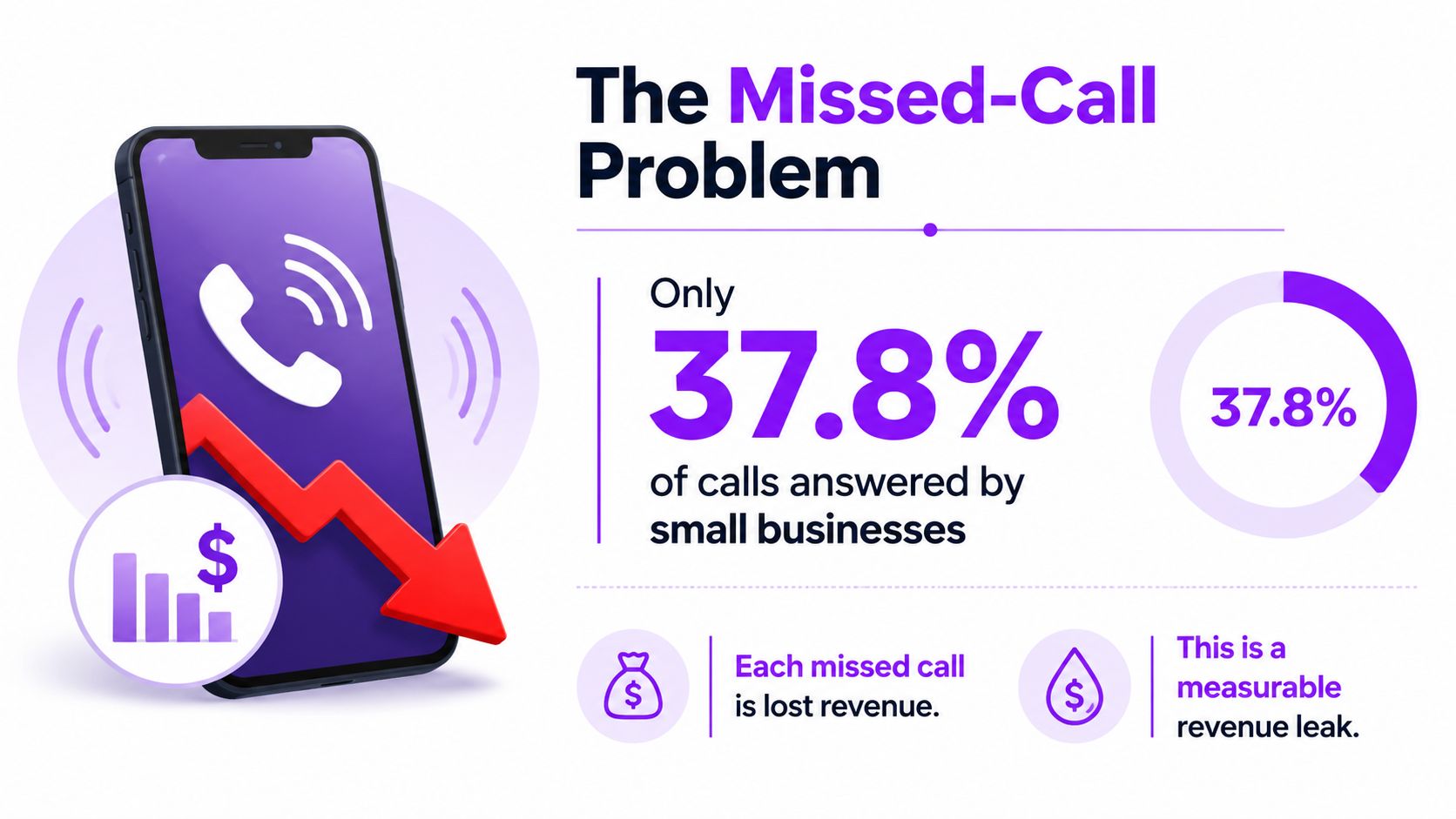
The hard truth is simple. If a call rings and nobody answers, the buyer often moves on. Independent UK research often cited in this market shows that only 37.8% of incoming calls to small businesses are answered live, and after-hours traffic is even worse, with small businesses missing 35 to 45% of calls and 80% never following up GetNextPhone. That is the exact problem an AI phone receptionist is built to solve.
Where the leakage shows up
In India, the pain is sharpest where the phone is still the first real sales event. A buyer calls a broker about a flat. A parent rings an admissions counsellor. A patient tries to book an appointment. A trader needs support and does not want to sit on hold. In all of those cases, the call itself is the conversion moment, not a side channel.
Practical rule: if the first call is missed, the next conversation usually happens with a competitor.
That is why the economics matter. The same compiled data pegs the annual loss from missed calls at about $126,000 per year for a small business GetNextPhone. You do not need to believe every business loses that exact amount to see the pattern. Even a modest leak becomes serious once it repeats across branches, shifts, weekends, and holidays.
| Sector | Primary Phone Use Case | Cost of a Missed Call |
|---|---|---|
| Real Estate | Site visit booking, property enquiry | Lost site-visit intent |
| Healthcare | Appointment booking, patient callbacks | Lost booking and delayed care access |
| BFSI | Support intake, KYC guidance | Lost lead or unresolved service issue |
| Education | Admission counselling, programme enquiry | Lost application or callback opportunity |
A useful way to think about this is control, not automation. The business does not need another tool that answers for the sake of answering. It needs a front desk that captures intent, records the caller's details, and gets the right human involved before the lead cools.
What an AI Phone Receptionist Is
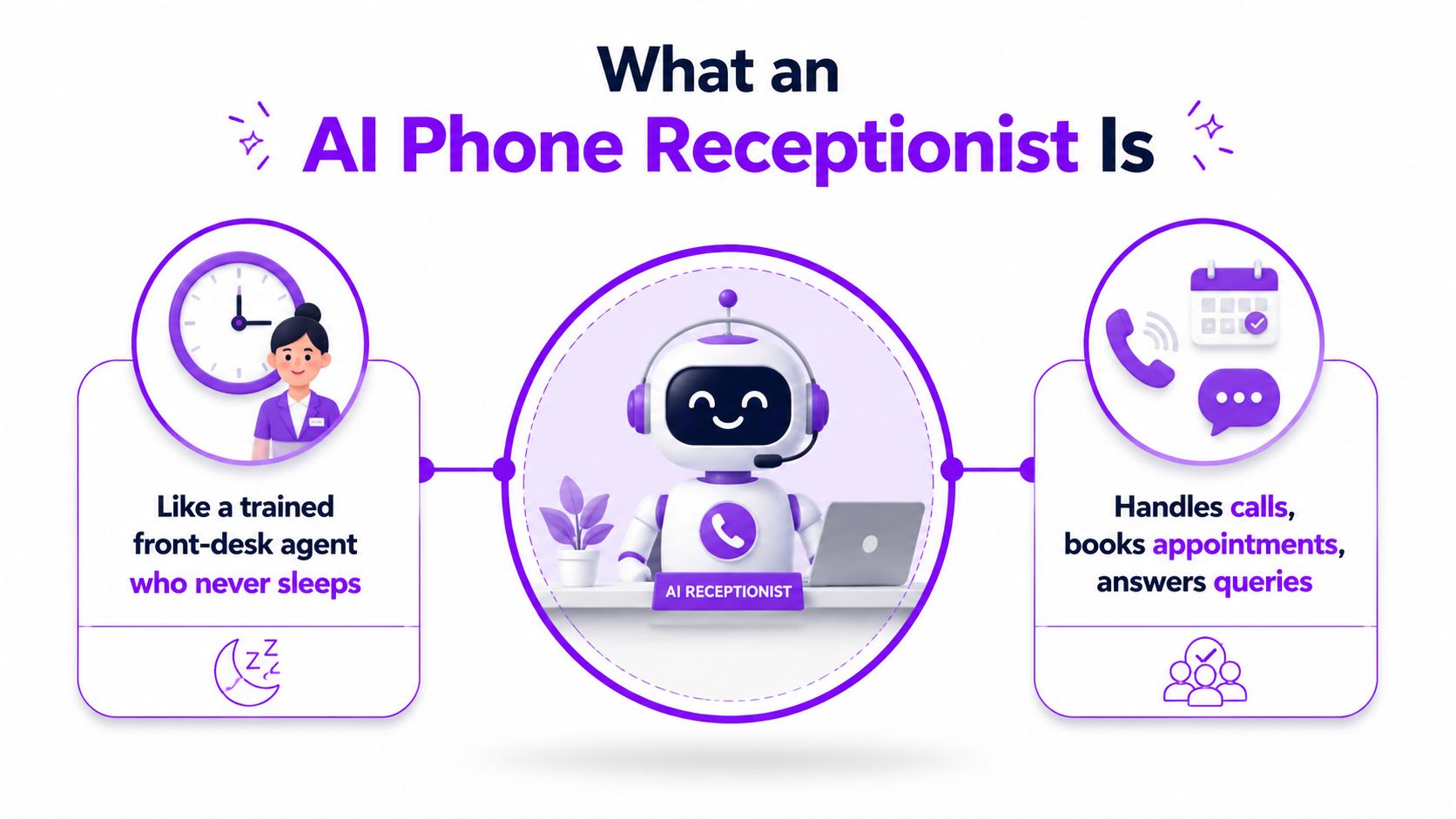
An AI phone receptionist functions as a trained front-desk agent that operates continuously. It answers calls, identifies why the caller rang, captures the right details, and either resolves the request or routes it to a person. The point is consistency. A machine can do this across every shift and branch without the gaps that hit a human desk.
The five layers underneath the voice
A real system is not one model. It is a pipeline. Carrier telephony, usually SIP or cloud telephony, carries the call. Streaming speech-to-text converts the caller's words. Intent extraction figures out what the person wants. Response generation decides what to say next. Text-to-speech speaks back.
The carrier layer itself carries real cost. DialNexa's Exotel pricing guide shows how per-minute voice and DLT charges from a telephony vendor like Exotel stack on top of the AI receptionist layer.
Latency is what makes or breaks the experience. Practical systems target under 500 ms end-to-end response time, with 350 to 700 ms treated as the workable window for natural turn-taking VoiceCharm. Once the delay becomes obvious, callers interrupt, prompts repeat, and the call needs human rescue. That is a service failure, not a small technical flaw.
Why it is not just another IVR menu
A normal IVR says, “Press 1 for Sales.” An AI receptionist listens to the words a caller uses. That matters because buyers do not speak in menu logic. They say, “I want a demo tomorrow,” or “I need to reschedule my slot,” or “Can someone call me back after lunch?”
Before you buy, judge the product by behaviour under load. A vendor directory such as compare top AI voice agents helps you see whether a tool handles real conversations or only scripted routing. That is a better filter than glossy claims.
The operational question is simple. Can the system hold context, answer naturally, and escalate cleanly when confidence drops? If it cannot, it is not a receptionist. It is a fancier phone menu.
For teams mapping a rollout, the auto attendant system guide at DialNexa is a useful reference because it sits close to the line between legacy routing and modern voice handling. It helps frame the role as a front desk layer, not a human replacement.
An AI phone receptionist should also sit inside a tighter operating model. It captures intent, records consent where needed, and sends high-risk calls to a human fast. That matters in India, where multilingual handling is not optional and where the DPDP Act 2023 puts pressure on how caller data is collected, stored, and handed off.
How Six Indian Industries Are Using AI Phone Receptionists
India's phone channel is still enormous. The country had 1.18 billion wireless subscribers and 1.09 billion broadband subscribers as of March 2024 Telecom Authority reporting cited in Ainora's summary. That means the voice channel remains reachable across urban, semi-urban, and mobile-first buyers. If you run a customer-facing business, you cannot assume the lead will first fill out a web form.
What changes by industry
In EdTech, the call is usually an admission enquiry. The receptionist has one job, identify the programme, the timeline, and whether the caller is serious enough to book a counsellor slot. In real estate, the call is often a site-visit request. The system should capture budget, locality, and urgency, then hand off fast if the lead is qualified.
In BFSI, the AI should not pretend to be a compliance officer. It should answer the basic service query, gather identity details where allowed, and route anything sensitive to the right human desk. In e-commerce and D2C, the use case is order confirmation and callback handling, especially when a customer needs reassurance before delivery.
For SaaS, the obvious use case is demo scheduling. The caller usually wants to know whether the tool fits their stack, and the receptionist should book the right salesperson without a chain of back-and-forth emails. In healthcare, the priority is appointment booking and reminder handling, with a fast handoff if the caller's issue sounds urgent.
Call handling should follow the business risk, not the caller's volume.
A senior team should ask a blunt question in every case. What is the first qualifying question, and what is the exact handoff trigger? If that answer is fuzzy, the deployment will drift into generic call answering, which is useful but not enough.
For a broader view of communication stack choices, Canadian SMB communication solutions gives a useful contrast, even though the market is different. The lesson translates cleanly. Better phone handling is not a “nice to have” when the phone drives revenue.
Building the Business Case With Real Numbers
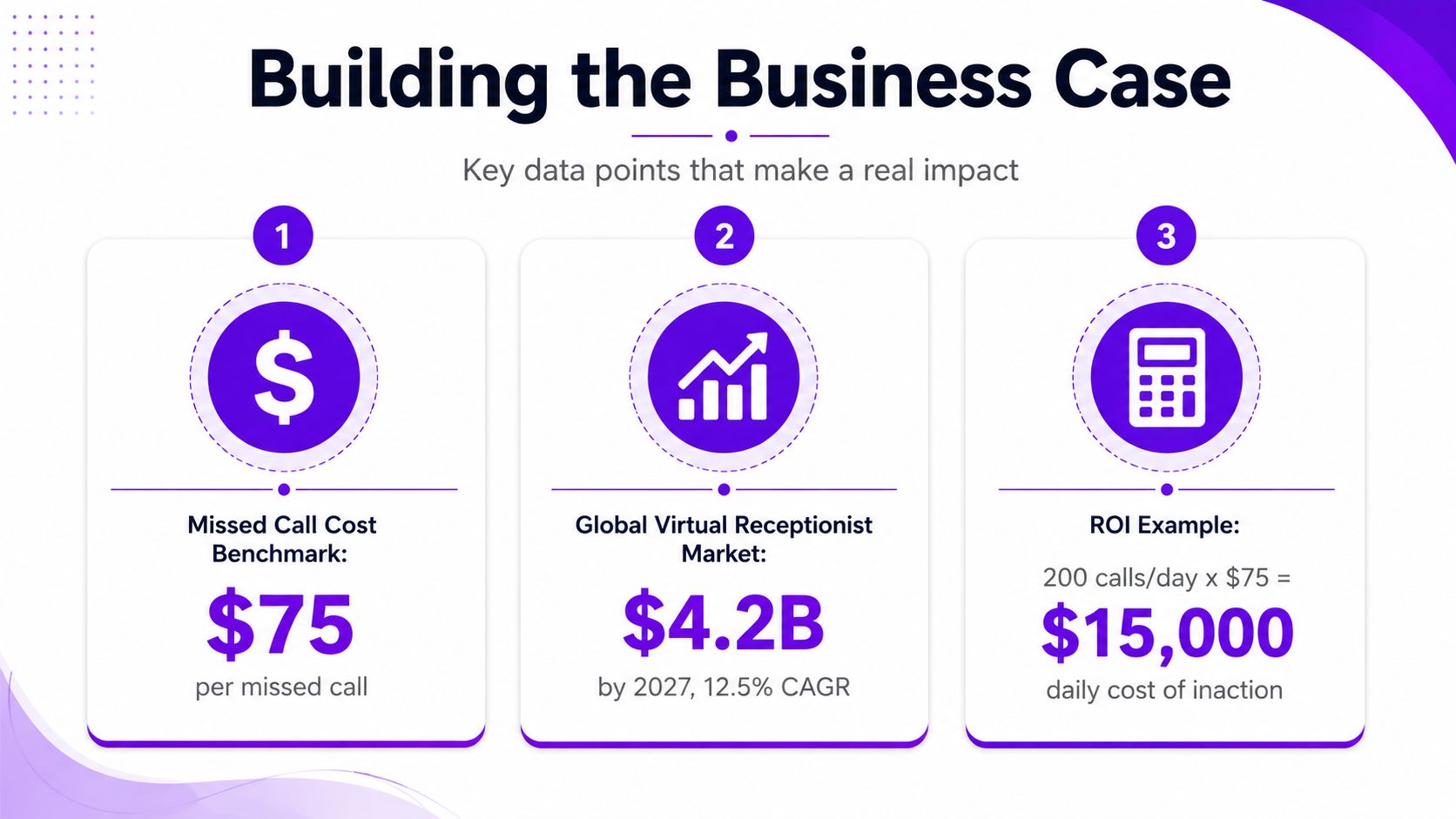
The market case is already clear. Analysts at Business Research Insights estimated the virtual receptionist market at $3.85 billion in 2024 and projected it to reach $9 billion by 2033 at a 9.8% CAGR. That does not mean every buyer should sign a contract tomorrow. It does mean automated call handling has moved from a novelty to part of standard infrastructure.
How to model it without fantasy math
Start with missed calls. Put a value on each qualified call, then compare that with the cost of a no-answer or slow-answer outcome. A marketplace benchmark in the brief uses $75 per missed call for ROI modelling, which is a clean way to measure the cost of inaction. Then build from volume, not optimism.
| Input | Conservative | Optimistic |
|---|---|---|
| Missed calls per day | 20 | 50 |
| Value per missed call | $75 | $75 |
| Daily cost of inaction | $1,500 | $3,750 |
Vendor-reported lift also matters. Customers cited by DialNexa report connect rates rising from 47% to 91%, lead-to-booking improving from 2% to 8%, and AI-qualified leads matching human judgment with 97% accuracy. Treat those as pilot benchmarks, not universal outcomes. They are still useful because they show what a good deployment can look like.
A real estate desk, an admissions team, or a clinic group should use the same method. Estimate the calls handled today, the share that go unanswered or are mishandled, and the downstream conversion value. Then compare that with the cost of a receptionist layer that works after hours, on weekends, and during peak load.
Decision rule: if a missed call can produce a lost booking, answer rate is a revenue metric, not an admin metric.
Labor costs strengthen the case. India's statutory minimum wage framework varies by state and skill level, so staffing a uniform 24/7 desk across branches is structurally messy and expensive GetNextPhone. An AI voice layer does not remove people from the workflow. It reduces the pressure to staff every slot at the same level.
For a practical implementation lens on call handling economics, the AI call centre agent guide at DialNexa is worth reading before procurement. It helps buyers separate automation value from vanity metrics.
The Compliance and Language Reality Most Vendors Avoid
The strongest India case for an AI phone receptionist is not “it works 24/7.” It is “it works within the rules and knows when to get out of the way.” India's Digital Personal Data Protection Act, 2023 creates stricter obligations around consent, purpose limitation, and safeguards for personal data, and RBI-regulated or healthcare-adjacent workflows often need stronger audit trails and human override than generic demos discuss DiabolAI.
What buyers should insist on
If the vendor cannot explain consent capture, retention, and escalation logs, walk away. The system should document what the caller agreed to, what was collected, and who saw the record next. That is not paperwork. That is the difference between a usable front desk and a compliance headache.
The product story shifts here. The winning design in India is not replacement. It is a compliant front-desk layer that captures intent, documents consent, and routes high-risk calls quickly. That is a much better fit for BFSI, healthcare, recruitment, and any workflow where a bad qualifier can create legal or service risk.
The language problem is just as important. Most vendor demos overfocus on polished English. India's reality is Hinglish, code-switching, accent variation, and noisy mobile lines. The better system is the one that uses language detection, short confirmation prompts, and quick human handoff when confidence drops.
For policy context on the voice stack, India's voice AI ecosystem policy overview is a useful companion read. It helps buyers see why multilingual handling is becoming infrastructure, not a feature.
If a tool only sounds good in demo conditions, it is not ready for Indian callers.
The practical takeaway is direct. Buy auditability before buying flair. Buy multilingual fallback before buying a flashy voice. Buy escalation controls before buying a promise of “full automation.”
Rolling Out an AI Receptionist Without Breaking Operations
Start with the queue that hurts most. If your admissions line, site-visit desk, or support callback line is bleeding leads, that is where the pilot belongs. India has about 63 million MSMEs in 2023, and even a 10% slice missing just 5 calls per day translates to roughly 31.5 million missed calls daily before larger enterprises are counted CallFlow Labs. The point is scale. The problem is not rare.
What the rollout should look like
Choose the deployment style based on control. An API-first setup fits teams with a strong tech stack and clear CRM ownership. A persona-first setup fits operations teams that want ready-made call flows for admissions, site visits, KYC guidance, or demo booking. Either way, the business should define the scripts, the fallback logic, and the human override.
Integrations are where many pilots fail. The receptionist must sync into your CRM and calendar, and it must know when a caller should be pushed to a live person. If the vendor leaves a fallback number unstaffed, the handoff collapses. If the script is trained on outdated offer details, the caller gets bad information and the whole pilot loses credibility.
You can use caller routing to your AI agent as a useful reference when thinking about call forwarding logic and control points. The routing design matters because a clean handoff is part of the product, not a bolt-on.
The cleanest rollout is staged. One queue first. One persona first. One metric set first. Then broaden once the team trusts the call summaries, the consent handling, and the escalation quality.
A Buyer's Checklist for Shortlisting Vendors
Use the demo to pressure-test behaviour, not branding. Ask the vendor to show real call handling, then compare what happens when the caller changes language, changes intent, or asks for a human. DialNexa customers report connect rates rising from 47% to 91%, lead-to-booking improving from 2% to 8%, and AI-qualified leads matching human judgment with 97% accuracy DialNexa. Those numbers are useful because they give you something concrete to benchmark against.
What to check in the room
- Voice quality and pace: Ask whether the voice still sounds natural when the call gets noisy. A good demo should not collapse the moment the caller interrupts.
- Multilingual and code-switch handling: Ask for Hinglish, accented speech, and quick fallback logic. If the vendor handwaves this, it is not ready for India.
- Latency under load: Ask for response timing in real conversation, not a scripted playback. If the reply lags, turn-taking breaks.
- Consent and audit logs: Ask how recordings, redaction, and retention are handled. If the vendor has no clear answer, that is a red flag.
- Escalation controls: Ask who gets the handoff, when the human is alerted, and what summary they receive.
- Analytics and API access: Ask whether you can see call outcomes, qualification tags, and booking data without manual exports.
The pilot should run for two weeks on a live but contained queue. Do not distort normal operations just to make the dashboard look pretty. Measure answer rate, qualification accuracy, and the quality of the handoff, then compare against the manual baseline.
If the vendor cannot prove reliability on the calls that matter most, stop there. A front desk is only as good as its worst escalation.
What to Do This Quarter and Common Questions Answered
Pick the highest-volume call flow, run a two-week pilot, and measure answer rate, qualification accuracy, and cost per lead. If the pilot improves handling without damaging compliance or caller experience, expand to the next persona. That is the right pace for a buyer who wants evidence, not slides.
How is this different from IVR? IVR routes by keypad choice. An AI receptionist understands spoken intent and can handle a fuller conversation.
Can it record calls and capture consent under DPDP? Yes, if the vendor supports consent prompts, retention controls, and audit logs. If it does not, do not deploy it in regulated workflows.
Can it work alongside human agents? Yes, and that is the right model for India. The AI should handle first response, qualification, and routing, while humans take edge cases and high-risk conversations.
How does pricing usually scale? It usually scales with usage, call volume, or the level of workflow support. For a CXO, the comparison is not monthly fee versus salary. It is cost versus missed revenue.
DialNexa Labs Private Limited builds human-like Voice AI agents for qualification, customer support, recruitment, and presales, including AI receptionist-style call handling for Indian workflows. If you want a compliant front-desk layer that can capture intent, route risky calls, and fit EdTech, BFSI, real estate, healthcare, e-commerce, or SaaS operations, visit DialNexa Labs Private Limited and review how its voice agents are deployed.

This is a well-structured and practical guide that clearly explains how AI phone receptionists can improve call handling across different industries.