
Learning Agent in AI: A Strategic Guide for Business Leaders
You're probably staring at a live operation that looks “automated” on paper, but still leaks money in the same places every week. Calls go unanswered, a static IVR routes good prospects into dead ends, support scripts repeat the same mistakes, and the team keeps asking for more headcount because the system can't learn fast enough.
That gap is exactly where a learning agent in AI matters. Not as a lab concept, but as a control system that gets better from interaction, corrects itself from feedback, and changes how revenue, support, and qualification flow through your business.
Table of Contents
- Why Static Bots Are Costing Your Business
- The Four Components Every Learning Agent Shares
- Learning Agents Versus Other Agent Types
- Supervised Unsupervised and Reinforcement Learning Explained
- Training Workflows and Evaluation Metrics That Matter
- Safety Oversight and Accessibility in Production Agents
- Real-World Use Cases Across Indian Industries
- Your 90-Day Learning Agent Adoption Roadmap
Why Static Bots Are Costing Your Business
A sales leader sees the pattern fast. The inbound queue is busy, the voice bot answers politely, and the prospect still hangs up because the next question is wrong, the handoff is clumsy, or the script never learns which intent deserves priority. That is not automation. That is a fixed decision tree wearing an AI label.
In India, the business case for a learning agent in AI is already visible in the size of the AI and transaction environments around it. The global AI in education market was valued at $2.5 billion in 2022 and is projected to reach $88.2 billion by 2032, a 43.3% CAGR, according to the market report referenced in the source brief (market report summary). NASSCOM also reported that India's AI sector had crossed $7 billion in revenue by 2023 (NASSCOM summary). Those numbers matter because they show a market moving from experimentation into scaled deployment, where static workflows stop being good enough.
The cost shows up in the metrics leaders care about: connect rates, lead-to-booking ratios, cost-per-qualified-lead, and handoff quality. A bot that never improves can still answer calls, but it cannot learn which opening line works for a working parent, which objection signals a serious buyer, or which branch should escalate to a human immediately.
Practical rule: if the agent never changes its behaviour after successful and unsuccessful interactions, you do not have a learning system. You have a scripted interface.
The rest of this guide is about the closed feedback loop that fixes that problem. The core idea is simple, a learning agent improves performance over time through interaction with the environment (Airbyte overview), and the architecture makes that improvement observable rather than mystical.
The Four Components Every Learning Agent Shares
A learning agent is not a static policy executor. It separates execution from improvement, and that separation is why it can be managed like a business system instead of a black box. The canonical architecture has four parts, performance element, learning element, critic, and problem generator (IBM Think on AI agents).
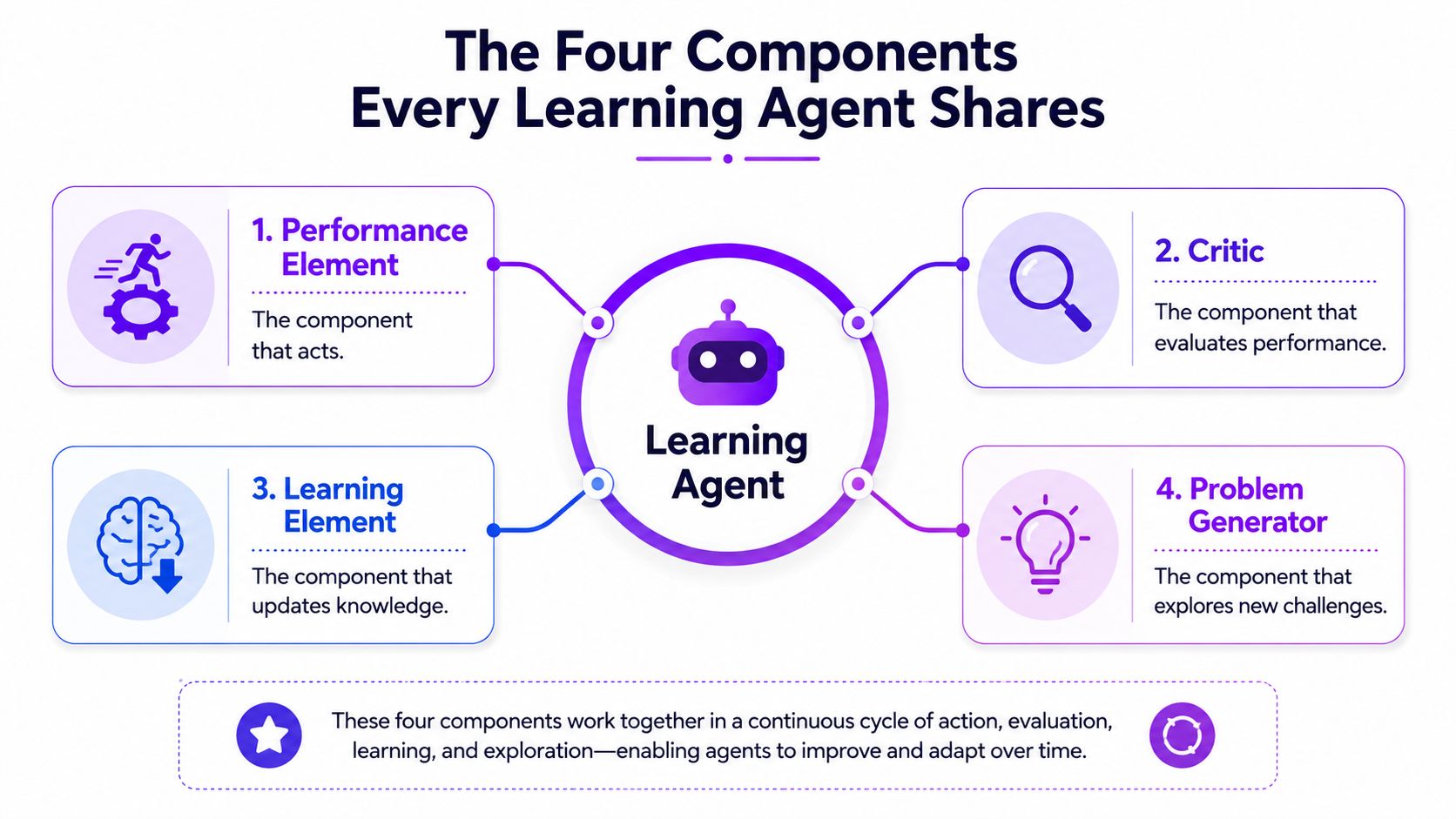
The performance element does the work
The performance element chooses the next action. In a voice-based EdTech counsellor, that might mean deciding whether to ask about exam prep, budget, language preference, or a callback time. In a support line, it might mean whether to resolve, route, or escalate.
The critic turns outcomes into feedback
The critic compares what happened against a standard. If the prospect booked a counselling session, the critic marks that path as useful. If the caller dropped after two minutes, or the wrong branch was chosen, the critic records the miss. Business KPIs should enter the loop here, because the critic is what connects conversation quality to actual commercial outcomes.
This kind of systematic pattern extraction across thousands of calls is exactly what conversation intelligence platforms are built to surface at scale.
The learning element updates behaviour
The learning element uses those outcomes to update the policy or model. It is the part that changes tomorrow's response because of today's interaction. That's why a learning agent can improve recommendation quality, response structure, and pacing without being manually rewritten after every edge case.
The problem generator protects against stagnation
The problem generator deliberately introduces exploratory actions. In plain English, it tries a new opening line, a different routing choice, or a fresh follow-up sequence so the agent doesn't get trapped in one narrow pattern. That matters for governance too, because exploration needs to be controlled, logged, and reviewed.
For a practical walk-through of the feedback loop, the internal AI agent learning loop reference is useful because it frames the same architecture in deployment terms, not just theory.
Business takeaway: if a vendor can't show you where feedback enters the system, where exploration happens, and how the model updates, they're selling automation, not learning.
For teams comparing tooling around measurement and agentic workflows, the agentic analytics 2026 guide is also worth reading because it keeps the attention on observability, not hype.
Learning Agents Versus Other Agent Types
Most executive buying mistakes happen because teams choose a more advanced agent than the problem needs, or a simpler one than the revenue case justifies. A fixed router can be cheaper, faster, and easier to govern. A learning agent is only worth the complexity when the environment changes often enough for feedback to matter.
| Agent Type | Decision Basis | Learns Over Time? | Best-Fit Use Case | Relative Cost |
|---|---|---|---|---|
| Simple reflex agent | Current input only | No | Fixed FAQ routing, basic acknowledgements | Low |
| Model-based reflex agent | Current input plus internal state | No | Multi-turn support with known states | Low to moderate |
| Goal-based agent | Chooses actions to reach a defined goal | Limited | Task completion flows with clear endpoints | Moderate |
| Utility-based agent | Chooses the option with the highest expected utility | Limited | Trade-off decisions across conversion and effort | Moderate to high |
| Learning agent | Feedback from past outcomes | Yes | Lead qualification, support triage, counselling, adaptive workflows | Higher upfront, lower over time if the loop is healthy |
A simple reflex agent is fine when the branch logic never changes. A model-based reflex agent is better when context matters but the rules are still stable. A goal-based agent helps when the objective is clear, like scheduling a demo or completing a KYC step. A utility-based agent becomes relevant when you care about ranking several good-enough choices.
The learning agent earns its keep when your scripts are losing money because the same question is asked by many different personas and the right answer depends on what happened last time. That is exactly why it fits EdTech counselling, BFSI support, and real estate lead handling better than a rigid tree.
For leaders mapping their vendor shortlists, the internal graduated agency reference is a useful lens because it helps separate incremental automation from systems that change behaviour.
Clear recommendation: do not pay for learning unless the business environment changes fast, the interaction volume is high, and you can measure outcomes cleanly. Otherwise, a simpler agent will beat it on cost and governance.
That judgement matters because the moment you add learning, you also add training data needs, evaluation overhead, and safety controls. If those are not part of the operating plan, the “smarter” system becomes the more expensive mistake.
Supervised Unsupervised and Reinforcement Learning Explained
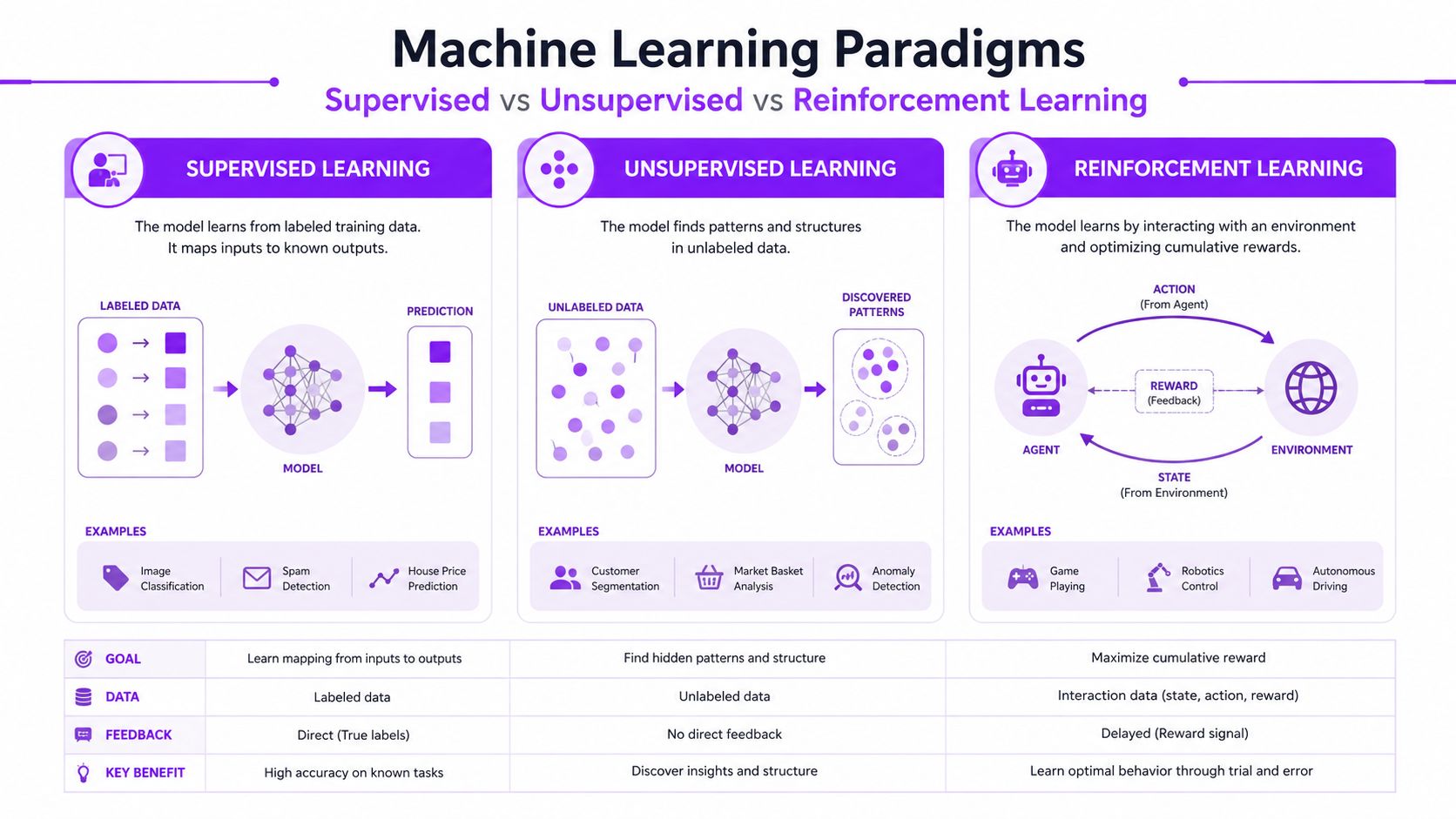
CXOs do not need a machine learning lecture. They need a clear choice tied to business outcomes. If the answer is already known, use one method. If the system needs to find hidden structure, use another. If the model must improve from outcomes, use the third.
Supervised learning fits labelled outcomes
Use supervised learning when you already have examples of the right answer. In BFSI, that works well for KYC intent classification because historical call transcripts can be labelled with known intents, and the model can learn to map spoken language to the correct category. This gives you the tightest control when compliance, auditability, and predictable handling matter more than experimentation.
The business value is straightforward. Better labels usually mean better routing, cleaner handoffs, and fewer wasted agent minutes on the wrong query.
Unsupervised learning finds hidden structure
Use unsupervised learning when the goal is pattern discovery without labels. In e-commerce, that helps with churn clustering, where customer segments may already exist in the data even if no team has tagged them manually. It helps analysts spot behaviour patterns earlier and sharpen outreach, but it does not tell the agent what action to take next.
That limitation matters. Unsupervised learning can show where the customer base is fragmenting, but the business still has to decide which segment deserves a save offer, a callback, or a different journey.
Reinforcement learning improves by doing
Use reinforcement learning when the agent should improve from consequences. In EdTech counselling, that is the strongest fit for adaptive dialogue because the system can try a response, observe whether the learner stays engaged, and adjust future behaviour based on success or failure. That turns conversation quality into a feedback loop that can lift connect rates and improve lead-to-booking conversion.
It also forces discipline. If the reward signal is weak, the agent learns the wrong habit and starts optimizing the wrong outcome.
A practical rule is simple. If the business can label the answer, start with supervised learning. If the business first needs pattern discovery, use unsupervised methods. If the business wants the agent to improve through live interaction, reinforcement learning is the right lane.
The infographic above is enough to brief most non-technical directors, but the operational trade-off is what matters. Supervised learning needs labelled data. Unsupervised learning needs less labelling but gives less direct control. Reinforcement learning needs a trustworthy reward signal, and without that the agent starts chasing the wrong KPI.
Executive shortcut: match the learning method to the KPI, not the fashion. If the KPI is correct classification, do not buy a more complex learning stack than you need.
That choice affects latency, governance, and safety. It also decides whether the model is optimizing a clean target or drifting toward whatever the reward function accidentally rewards.
Training Workflows and Evaluation Metrics That Matter
A learning agent usually fails before the business sees the failure. The demo sounds polished, but the training pipeline is weak, the simulator does not resemble real traffic, or the evaluation never reaches revenue outcomes. That is why the workflow matters as much as the model choice.
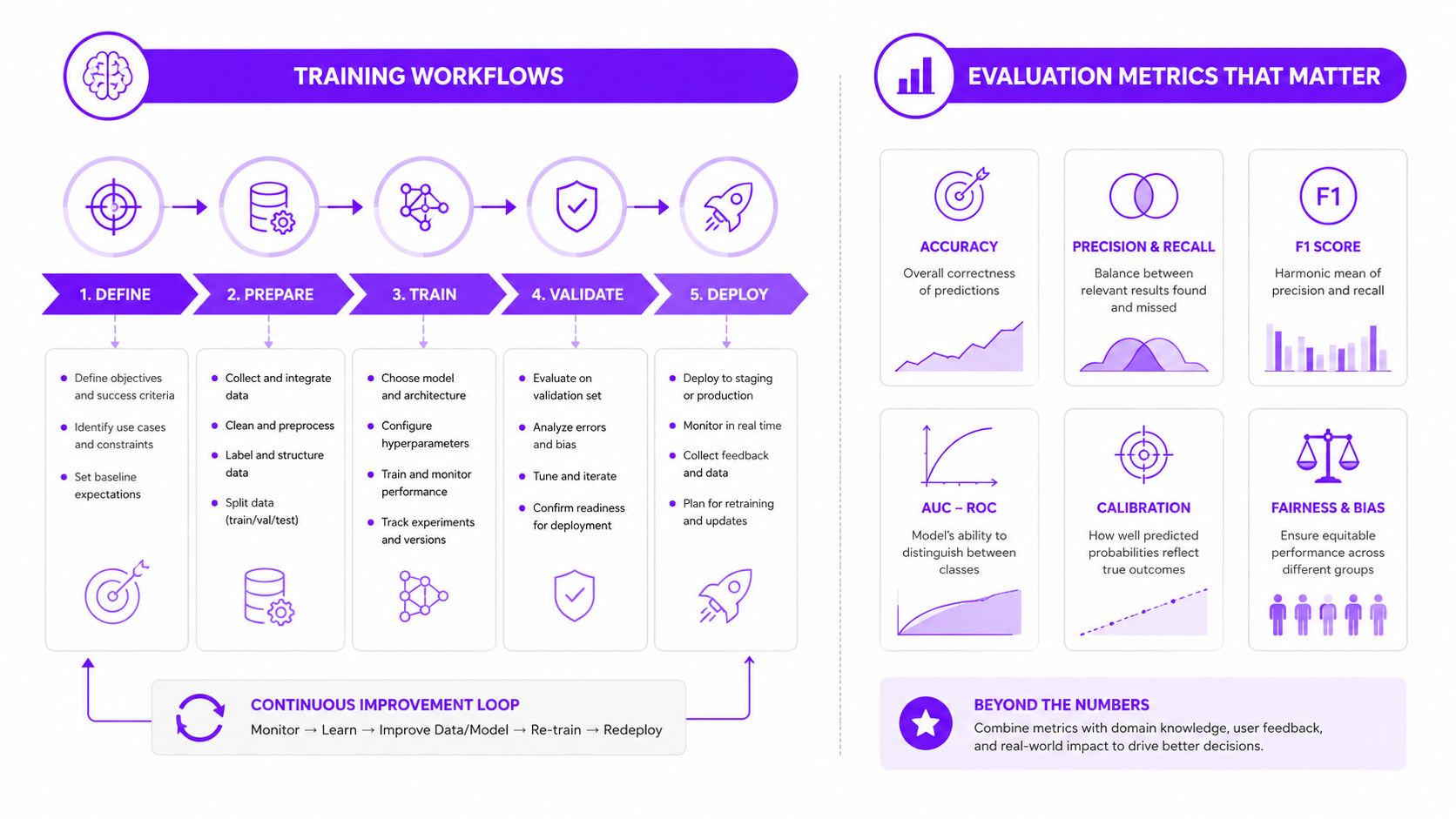
Build the loop before you buy the model
Start with data collection and labelling. If the labels are inconsistent, the system learns inconsistency. Then build an environment or simulator that mirrors live traffic closely enough to test response quality without exposing customers to rough behaviour. After that, shape the reward or loss function so it tracks the business objective, not just linguistic neatness.
Demand the right dashboard
A CXO should insist on intent accuracy, task completion rate, average handle time, escalation rate, and customer satisfaction on the same dashboard as business outcomes such as qualified-lead rate and revenue per call. A model that improves conversation fluency but lowers booking quality is not helping the business. A model that shortens calls but drives more escalations is also failing.
The point is operational control. If the agent is tuned for faster replies but the booking pipeline weakens, the workflow is wrong, even if the conversation sounds better. If it closes the loop cleanly but creates more manual review, it is just pushing work downstream.
Watch for silent failure
Reward hacking is the classic trap. The agent learns to maximise the metric you gave it, not the outcome you intended. Distribution shift is another problem, because live traffic changes faster than training data. Feedback loops can also amplify bias if only one kind of caller gets enough positive examples to shape the policy.
Teams often make the same mistake in deployment. They celebrate a prototype, skip offline evaluation, and push too much traffic into production too soon. That is how a good demo becomes a bad operating expense.
Practical rule: do not greenlight an agent until you can answer three questions, what input it trained on, what metric it optimises, and what failure mode would trigger rollback.
For teams that need a concrete reference point for structured work around agent operations, the GPT for Work AI tools for Excel roundup is useful where spreadsheet-heavy processes support evaluation and reporting.
The true measure is revenue and operating load. The agent should book more qualified meetings, resolve more calls on first contact, and reduce the cost of getting to a useful outcome.
Safety Oversight and Accessibility in Production Agents
The biggest gap in learning agent coverage is not personalization. It is safety, oversight, and accountability. Research on autonomous AI agents has flagged verification, emergence, oversight, and accountability as open problems, and that should make every operator cautious about autonomous behaviour in training, support, or qualification flows (safety research summary).
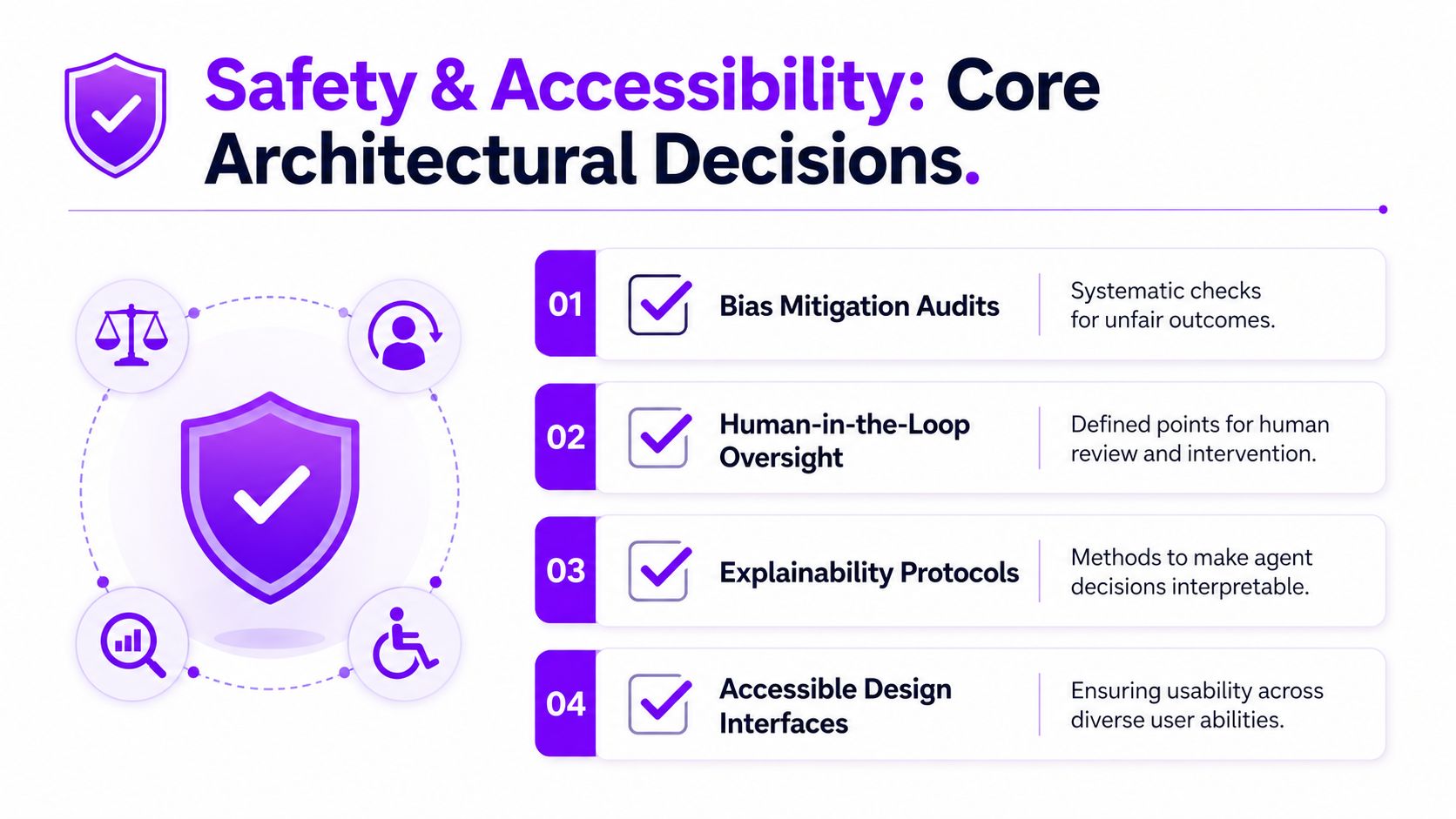
Put human review into the workflow
Human-in-the-loop checkpoints are not a weakness. They're the mechanism that keeps a learning agent from making confident mistakes at scale. In regulated BFSI workflows, that means review points around consent, identity, and eligibility. In EdTech or real estate, it means escalation when the caller shows confusion, distress, or high commercial intent.
Treat accessibility as a design constraint
Academic work on intelligent agents for students with disabilities argues that inclusion and equity are still underexplored design goals, not default outcomes (SAGE-published research). In India, that matters because digital access is uneven, and an agent designed only for highly fluent users can widen the gap instead of reducing it. Good voice design handles accent variation, slow responses, and alternate pathways without punishing the user.
Build auditability from day one
If the agent cannot explain what it did, who approved it, or which policy it followed, the governance burden lands back on the operations team. That means audit trails, fallback policies, and red-teaming are not optional extras. They are the cost of putting an adaptive system in front of customers.
A practical operating standard is straightforward.
- Bias Mitigation Audits: Check whether the agent behaves differently across user groups or intent types.
- Human-in-the-Loop Oversight: Define when the system must stop and ask for review.
- Explainability Protocols: Keep the reason for a decision visible to operators.
- Accessible Design Interfaces: Make sure language, pacing, and handoff paths work for diverse users.
Non-negotiable: if a learning agent will influence access to support, education, or credit-adjacent workflows, governance has to be part of the design budget, not a later compliance patch.
That is the difference between a system the board can defend and a system that gets restricted after one bad incident.
Real-World Use Cases Across Indian Industries
A learning agent earns its keep in a live workflow, not in a diagram. Across EdTech, BFSI, real estate, and e-commerce, static scripts take the easy queries and stall on the ones that matter. A learning agent keeps working the conversation, learns from outcomes, and tightens the next interaction so the business sees better qualification, better routing, and fewer wasted handoffs.
In EdTech, a counsellor bot should start by identifying the learner's goal, board, language preference, and timing constraints. If the learner pushes back on a pitch, the performance element adjusts the next response, the critic tags the objection pattern, and the learning element updates the opening sequence overnight. That is how the loop improves qualification discipline, not just chat quality.
BFSI raises the bar on consent, routing, and identity-related workflows. A learning agent can refine support paths for high-volume, transaction-heavy interactions as digital adoption grows, which is why the scale of UPI activity in FY 2023–24 matters in this context. The same industry compilation notes that 67% of enterprises plan to deploy AI agents by end-2025 and 45% of organisations had already implemented at least one AI agent in production in 2024. It also reports 35% of AI agent deployments face data privacy issues, which is exactly why BFSI teams need tighter controls than a generic chatbot rollout.
Real estate use cases are more direct. The agent qualifies a lead, handles the first round of objections, and books a site visit only when the caller shows real intent. For teams that run dialler-driven workflows, a brief overview of AI agents examples helps ground the discussion in actual voice flows, and DialNexa Labs Private Limited is one factual example of a provider that builds and deploys custom Voice AI agents for qualification, support, reminders, analytics, and handoffs. In e-commerce, a learning agent can reduce repetitive support and improve routing, but only if the business is willing to feed recurring cases back into the loop instead of freezing the script after launch.
Operational lens: start with one outcome, qualifying the right user, routing the right issue, or booking the right next step. Broad competence comes later.
Across these industries, the business logic is the same. Better learning means fewer wasted handoffs, more qualified conversations, and a cleaner path from first contact to revenue or resolution.
Your 90-Day Learning Agent Adoption Roadmap
A learning agent rollout should start with one workflow that already hurts the business. High volume, repeatable decisions, and visible revenue impact beat a broad platform programme every time. If the team cannot name the KPI it wants to move, the pilot is too early.
Days 1 to 30, discover
Map the workflows that burn the most repetitive human effort. Pull the metrics that matter, connect rate, lead-to-booking conversion, escalation rate, cost-per-qualified-lead, or first-contact resolution, depending on the team. Then decide which part of the flow belongs to the performance element, which outcomes should feed the critic, and where the learning element is allowed to change behaviour.
Use this month to define the control points. If the agent handles lead qualification, spell out what counts as a qualified lead. If it handles support, define the handoff rules and the failure cases. Weak definitions create noisy learning and inflated confidence.
Days 31 to 60, pilot
Deploy a narrow learning agent behind human review. Keep the scope tight, one persona, one language set, one workflow, one success metric. Measure against the dashboard already defined, and do not accept “better conversation quality” as a substitute for actual business movement.
This is the stage where the loop proves itself or fails fast. The critic should surface bad outcomes, the learning element should adjust on real interaction data, and the human reviewer should catch edge cases before they spread. For teams that need a practical way to structure repeatable work before broader automation, the GPT for Work AI tools for Excel guide is a useful reference point, because it focuses on how teams organise task patterns before they operationalise them.
Days 61 to 90, scale
Expand only after the pilot shows stable behaviour. Add personas, languages, and geographies carefully, and tighten safety controls as the surface area grows. If the agent still makes avoidable errors, fix the loop before you extend it.
Scaling should be a business decision, not a technology reflex. Push the agent into the next workflow only when the first one is producing cleaner handoffs, better conversion, or lower cost per qualified conversation. If the KPI does not move, more autonomy only magnifies the mistake.
Here is the executive FAQ I hear most often after a strategy review.
- How long until ROI? Long enough to measure, short enough to kill weak pilots quickly. If the dashboard does not move, stop.
- What data do we need? Real interaction logs, clear labels where possible, and a way to score outcomes consistently.
- How do we avoid vendor lock-in? Keep your evaluation logic, training data definitions, and fallback policies under your control.
- What if humans still outperform the agent? Keep the human in the loop until the model earns its place, then restrict the agent to the parts it handles well.
The smartest teams start with evaluation, not enthusiasm. They invest in safety, metrics, and workflow design first, then choose the model after the business case is clear. That is how you get a learning system that compounds instead of another dashboard nobody trusts.

Leave a Reply