
The Power of Now: Real Time Monitoring for Decisive Business Agility
Real-time monitoring is the practice of collecting and analysing data the second it's created, giving you a live, up-to-the-minute view of your business operations. For a C-suite executive, this is more than a tech upgrade; it’s a fundamental shift in business strategy. It empowers your organisation to react to opportunities and threats as they unfold, not after the P&L report reveals their impact.
Why Real-Time Monitoring Is Your New Competitive Edge
As a business leader, you depend on data to make crucial decisions. The problem is, traditional reporting often feels like you're driving by looking only in the rearview mirror. Monthly summaries and quarterly reports show you where you've been, but they don't offer much insight into the road ahead. This reactive approach can leave your company exposed to unexpected operational failures and cause you to miss out on golden revenue opportunities.
Now, picture yourself in the driver's seat with a live GPS and a full dashboard. You see your current speed, engine status, and get alerts about traffic jams ahead, allowing you to change course before you're stuck. That’s the strategic advantage of real-time monitoring. It transforms your leadership style from reactive problem-solving to proactive, data-driven strategy execution.
From Hindsight to Foresight
When you have a live pulse on your operations, you’re no longer making decisions based on old, stale information. Instead, you can act on insights the moment they matter most. This capability creates a powerful ripple effect across your entire organisation, directly impacting the bottom line.
- Seize Fleeting Opportunities: Imagine a Director of E-commerce notices a real-time surge in website traffic for a specific product following a celebrity mention. A real-time monitoring system alerts them instantly. They can immediately amplify marketing spend for that product and adjust inventory levels, capturing maximum revenue from the trend before it fades.
- Mitigate Risks Before They Escalate: For a VP of Operations at a logistics firm, a sudden spike in "late delivery" mentions during customer calls triggers an immediate alert. This isn't a line item in a weekly report; it's a live fire. The team can instantly investigate the flagged distribution center, identify the bottleneck—perhaps a broken conveyor belt—and reroute shipments, preventing a widespread service failure.
- Enhance Customer Loyalty and Reduce Churn: A Director of Customer Success sees an alert that a high-value enterprise client has repeatedly called support with increasing frustration in their voice, as detected by sentiment analysis. Instead of waiting for an angry email, the director can proactively reach out to the client, armed with the full context, to resolve the issue and salvage the relationship. You can read more about how AI is transforming customer interactions in real time in our detailed article.
“Managing a business with yesterday's data is like trying to win a race by looking at last year's finish line. Real-time monitoring gives leaders the live telemetry needed to navigate today's market and anticipate tomorrow's turns.”
Ultimately, embedding real-time monitoring builds a culture of agility and precision. It empowers every department—from sales and support to operations and compliance—to make smarter, faster decisions that have a direct impact on revenue, customer satisfaction, and operational excellence. It’s not just about seeing data; it’s about acting on it now.
Understanding Your Business's Digital Nervous System
Think of real-time monitoring not as a complex IT project, but as your company’s digital nervous system. It's constantly sensing what’s happening across your entire operation, processing it in the blink of an eye, and delivering crucial insights to you—the brain of the business—so you can make smart, decisive moves. It’s a living network architected for immediate action.
Just like our own nervous system, this digital version has distinct parts working in concert, each with a critical job. You don't need to be a technologist to grasp the concept. The key is understanding how raw data is transformed into a clear signal for growth or a warning of impending risk. Once you see that flow, you can ask the right strategic questions and ensure your technology investments are directly serving your business objectives.
This flowchart perfectly illustrates the shift from looking in the rearview mirror (analysing past data) to acting on what's happening right now.
While historical data has its place for strategic planning, the real competitive advantage lies in processing live information to guide your next operational move.
The Three Core Components
Your digital nervous system works in a continuous, three-step loop. Each stage is essential for transforming a flood of raw events into intelligence that your teams can act upon.
-
Data Ingestion (The Senses): This is where the process begins. The system gathers raw data from all of your business touchpoints—your company's eyes and ears. Every word on a customer call, every click in your app, every transaction processed is a piece of sensory input fed into the system in real time.
-
Stream Processing (The Brain): As soon as data arrives, it hits the processing engine—the brain of the operation. It doesn't wait to process information in batches overnight. Instead, it analyses, correlates, and enriches data streams as they happen. This is where a customer’s frustrated tone is instantly flagged as "negative sentiment," or a specific sequence of website clicks is identified as "high purchase intent."
-
Visualisation & Alerting (The Reflexes): This is the final, crucial step where processed insights are delivered to your teams, triggering the system’s reflex action. Key metrics update on live dashboards, and critical events trigger automated alerts sent directly to the right person. For example, a sudden drop in lead qualification rates might flash an alert on the VP of Sales' dashboard. For leaders, maintaining a complete operational picture is vital. You can learn more about how to monitor and control AI workloads with Control Center to stay on top of everything.
For a leadership team, grasping this flow is everything. It’s not about knowing the code; it’s understanding that when a customer mentions an urgent need on a call, your system can sense it, understand its strategic importance, and alert an account manager to follow up—all in a matter of seconds.
This architecture is what separates market leaders from the laggards, enabling a business to react with both speed and precision. The table below breaks down these layers and the technologies that power them.
Key Components of a Real Time Monitoring Architecture
This table offers a simplified look at the technological layers that make up a real-time monitoring system, connecting each component to its business function.
| Component Layer | Business Function | Example Technologies |
|---|---|---|
| Data Ingestion | Collecting raw event data from all sources like customer calls, app logs, and transactions. | Kafka, Amazon Kinesis, Webhooks |
| Stream Processing | Analysing and enriching data streams in real time to identify patterns and insights. | Apache Flink, Spark Streaming |
| Visualisation & Alerting | Presenting actionable insights on dashboards and sending automated alerts for critical events. | Grafana, Kibana, Custom Dashboards |
By framing your real-time monitoring setup as a digital nervous system, you can have far more productive conversations with your technical teams. You focus on the business outcome—the "why"—while they execute on the technical implementation—the "how." This shared understanding ensures every investment in technology serves a clear, strategic purpose and helps build a smarter, more responsive organisation.
Moving from Data Overload to Actionable Insights
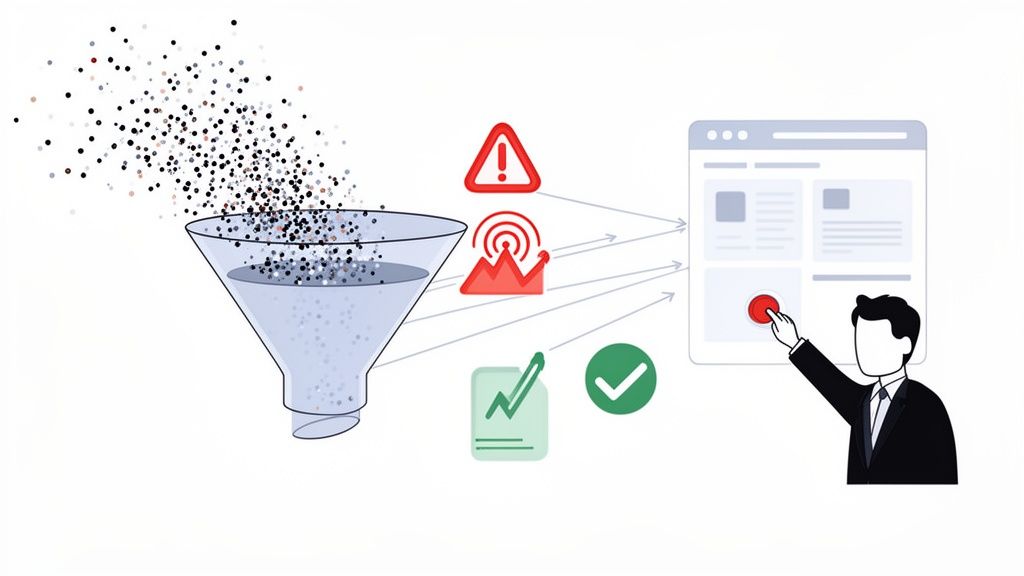
Any decent monitoring system can generate a mountain of data. But for a C-suite leader, raw data is a cost center; actionable insight is a profit driver. The magic happens when you transform that flood of information into sharp, strategic signals for your teams. The goal of real-time monitoring isn't just to collect data; it's to get immediate answers to the critical questions that impact revenue, cost, and risk.
This is where you shift from getting bogged down in data to pinpointing the metrics that truly matter. It’s about configuring your system to be a vigilant co-pilot, not just a noisy backseat driver. Your VPs and Directors receive precise alerts that demand attention, rather than drowning in endless, unactionable logs.
Identifying Metrics That Drive Performance
Every department is driven by a unique set of KPIs. A well-designed real-time system tracks these moment-by-moment, giving you a live pulse on performance across the entire organisation. This means VPs and directors can see exactly how their teams are tracking against strategic goals, right now.
Consider the distinct needs across your executive team:
- For the VP of Sales: The focus is on pipeline velocity and revenue. Live metrics like call-to-demo conversion rates, lead qualification accuracy, and agent talk time provide instant feedback on sales script effectiveness and team performance.
- For the Director of Customer Support: The priorities are customer satisfaction and operational efficiency. Monitoring live agent sentiment scores, first-call resolution rates, and call handling times helps identify coaching opportunities before they impact churn.
- For the Head of Operations: Stability and performance are paramount. Tracking API latency, system uptime, and transaction success rates ensures the technological backbone of the business remains robust and reliable.
This focused approach ensures every leader receives insights directly tied to their strategic objectives, cutting through the operational noise. It’s particularly vital in fast-growing digital economies. For example, India's Digital India initiative has expanded the active internet user base to 806 million. This presents a massive opportunity for businesses reliant on live customer interaction, making real-time monitoring essential for e-commerce and EdTech companies aiming to manage and convert leads at scale. You can find more insights on India's digital growth on Statista.com.
Crafting Intelligent Alerts That Prompt Action
The line between an effective monitoring strategy and a failed one is often defined by the quality of its alerts. A constant barrage of notifications creates "alert fatigue," causing teams to ignore important signals. The art is in building intelligent alerts that trigger only when a meaningful deviation from the norm occurs—one that requires a specific, immediate business response.
An alert should be more than a notification; it should be a catalyst for a business decision. The goal isn't to report that something happened, but to signal that something needs to happen now.
Here’s a practical example for a VP of Sales. Let’s say your sales team uses a Voice AI to qualify inbound leads, and your normal qualification rate is a healthy 85%.
Suddenly, an alert fires: “AI Lead Qualification Rate dropped to 60% in the last hour.”
That’s not just a data point; it’s a fire alarm for the revenue pipeline. The sales director can act instantly. Is a new marketing campaign sending low-quality leads? Did a recent script update to the Voice AI degrade its performance? Receiving that alert in real time means the issue can be diagnosed and fixed in minutes, preventing the loss of significant revenue that would only be discovered in next week’s report. The insights from this kind of monitoring are a key theme in the 2024 State of AI in the Speech Technology Industry, where live analytics are delivering real results.
By focusing on high-impact metrics and designing alerts that compel intervention, you transform your monitoring system from a passive observer into an active participant in your company’s success. It provides leaders with the confidence that they aren’t just watching their business run—they’re actively steering it towards its goals.
Real-Time Monitoring in Action Across Industries
Theory is one thing, but seeing real-time monitoring deliver tangible results is what truly matters to a business leader. This is where abstract ideas like data streams and alerts translate directly into measurable gains in revenue, efficiency, and risk reduction. The real power of monitoring lies in its ability to solve specific, high-stakes problems, turning split-second insights into a decisive competitive edge.
For VPs and Directors, this isn't about the technology itself; it's about the outcomes. It’s about how a single, timely piece of information can completely change the trajectory of a customer interaction, a sales cycle, or a compliance check. While every industry faces unique challenges, the solution often boils down to the same core principle: seeing and acting on events as they happen.
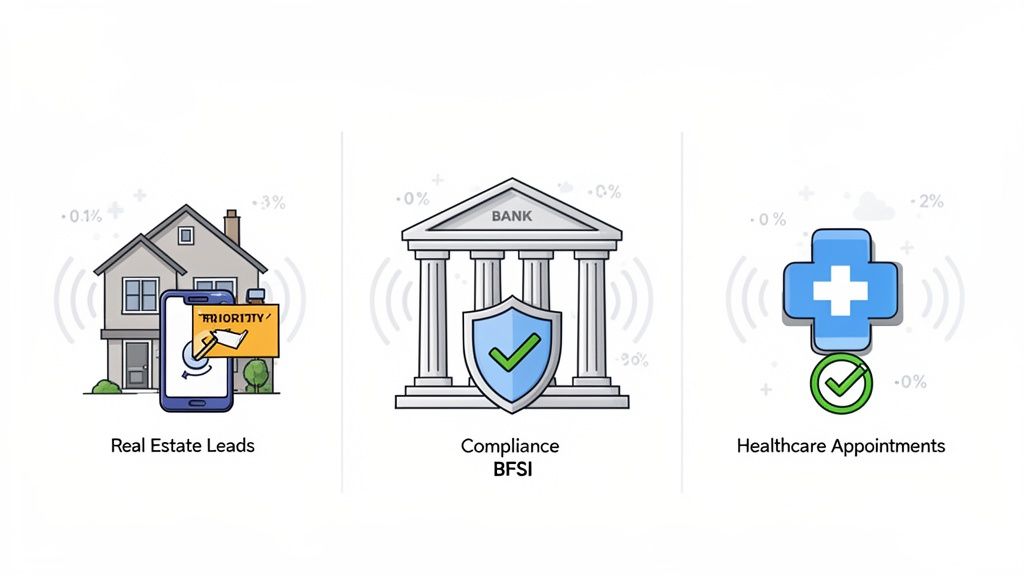
Let's dive into some compelling, real-world scenarios where this capability isn't just an improvement, but a complete game-changer.
Real Estate: Capturing High-Intent Leads Instantly
In the hyper-competitive world of real estate, speed to lead is everything. A prospective homebuyer’s initial interest is fleeting; a delayed follow-up is a lost opportunity. The core challenge for any VP of Sales is ensuring that the most motivated buyers are identified and engaged before a competitor does.
Picture this: a potential buyer calls an automated line, powered by a Voice AI, to inquire about a new property listing. The conversation is standard until the caller says, "This is exactly the neighbourhood I've been looking for, and I'm pre-approved for a loan."
A traditional system would simply log this call for an agent to review later—perhaps hours or even a day later. By then, that red-hot lead could be gone. With real-time monitoring, the system instantly analyses the sentiment and keywords, flagging the call with a ‘High-Value Lead’ alert.
This alert is immediately routed to the top-performing sales agent for priority follow-up within minutes. The result? The brokerage sees its site visit bookings jump from a modest 2% to an impressive 8%. This isn't an incremental improvement; it's a direct and significant boost to the sales pipeline, all driven by acting on a key insight at the perfect moment.
BFSI: Ensuring Flawless Regulatory Compliance
For any Director of Compliance in the Banking, Financial Services, and Insurance (BFSI) sector, regulatory adherence is non-negotiable. During sensitive processes like Know Your Customer (KYC) verification or when discussing investment products, agents must adhere to strict scripts to avoid massive fines and reputational damage. The challenge is ensuring 100% compliance on every single call.
Here, real-time monitoring acts as a vigilant, ever-present compliance officer. As a customer service agent guides a client through the KYC process over the phone, a monitoring system analyses the conversation live.
If the agent forgets to mention a mandatory disclosure, the system provides an instant, private on-screen prompt: "Reminder: Mention the data privacy clause now." This immediate correction keeps the call compliant without disrupting the customer experience. For a CXO, this isn't just about preventing a fine; it's about demonstrating a rock-solid commitment to governance and protecting the brand's integrity.
Healthcare: From Appointment Booking to Proactive Patient Care
The healthcare industry is rapidly adopting new technologies to improve patient outcomes and operational efficiency. For a healthcare executive, the goal isn't just to fill appointment slots but to ensure patients receive continuous, proactive care. This is where connecting different monitoring systems creates immense value.
Consider a Voice AI successfully booking an appointment for a patient. That’s a great first step, but the system's role doesn't have to end there. By integrating with broader health monitoring platforms, it becomes far more powerful.
This integration is particularly crucial given the growth in remote health management. In India's remote health monitoring sector, the market, recently valued at USD 255.1 million, is projected to soar to USD 1,368.6 million by 2034, driven by the need for preventive care in underserved areas. Imagine a Voice AI not just booking appointments but also integrating with these systems for proactive check-ins, such as, "Your vitals show elevated blood pressure; let's schedule a consultation now." You can find more details in this analysis of the future of India's remote health monitoring market.
This evolution from reactive scheduling to proactive intervention demonstrates how real-time monitoring transforms patient care, reduces costly no-shows, and ultimately leads to better health outcomes, aligning with the strategic goals of any healthcare leader.
Real Time Monitoring Impact Across Key Sectors
To put it all together, let’s look at a side-by-side comparison of how real-time monitoring addresses specific pain points and delivers concrete results across these industries.
| Industry | Business Challenge | Real Time Monitoring Solution | Measurable Outcome |
|---|---|---|---|
| Real Estate | High lead decay rate; losing motivated buyers to competitors due to slow follow-up. | Instantly analyse inbound calls for keywords and sentiment (e.g., "pre-approved loan") to flag high-intent leads. | Increase in site visit bookings from 2% to 8%; accelerated sales cycle. |
| BFSI | Risk of massive fines and brand damage from non-compliance with strict regulatory scripts. | Live call analysis with on-screen prompts for agents to correct script deviations in real time. | Maintained 100% compliance on mandatory disclosures; significant reduction in regulatory risk. |
| Healthcare | Reactive patient care; missed opportunities for early intervention and high appointment no-show rates. | Integrate Voice AI booking systems with remote health data for proactive patient outreach. | Improved patient outcomes; shift from reactive to preventive care model; reduced no-shows. |
As the table shows, the application might change, but the core benefit remains the same: immediate insight that drives immediate, valuable action.
Putting Your Real-Time Monitoring Strategy into Action
Implementing real-time monitoring is more than a technology procurement; it's a strategic initiative that requires a clear, executive-led plan. For any leader, the success of such a project hinges not on the software alone, but on a solid playbook that aligns with core business goals and prepares the organisation for a new way of operating. Without that top-down direction, even the most advanced tools will fail to deliver value.
The journey doesn't start with vendor demos. It starts with a simple but powerful question: "What critical business problem are we trying to solve right now?" The answer to that question becomes the North Star for your entire implementation.
Start with Clear Business Objectives
Before evaluating any platform, define what a "win" looks like in concrete business terms. Are you aiming to increase lead conversion, reduce customer churn, or achieve 100% regulatory compliance? Vague goals like "improving efficiency" are a recipe for a project that lacks focus and sponsorship.
You must be specific and tie your objectives to key performance indicators (KPIs) you can measure.
Here’s what that looks like in practice:
- Objective: Increase site visit bookings from inbound calls.
- KPI: Boost the lead-to-booking rate from 2% to 8% within one quarter.
- Objective: Reduce agent response time for high-value customers.
- KPI: Lower the average time it takes to resolve their issues by 30%.
This level of focus ensures your monitoring efforts are directly linked to tangible business results. This principle applies at a macro level, too. In India’s booming economy, for instance, real-time tracking of economic indices gives a live pulse on the nation's financial health. With recent reports showing real GDP surging by 8.2% year-over-year, fuelled by a 9.2% growth in services, business leaders can act with confidence. An EdTech company can monitor enrolment calls as the education sector expands, while a real estate developer can track site-visit bookings as construction takes off.
Launch a Pilot Project to Prove Value
Instead of attempting a massive, company-wide rollout, start small. Select one high-impact, low-complexity pilot project that can deliver a quick, undeniable win. This approach minimises risk, builds momentum, and creates internal champions for the technology.
A perfect pilot could be monitoring a single sales team's calls to improve lead qualification accuracy. When you can present a measurable jump in qualified leads to the board in just a few weeks, you’ve built a powerful business case for expansion.
Foster Cross-Departmental Collaboration
Real-time monitoring is not an IT project; it's a business transformation tool. For it to succeed, your technical and business units must work in lockstep. IT handles the 'how'—ensuring data integrity, security, and system reliability. But business leaders must own the 'why'—defining the critical metrics, setting alert thresholds, and determining the strategic actions to be taken based on the insights.
"True operational agility is born when the IT department and the business units stop working in silos. Real-time insights are the common language that bridges that gap, turning data into a shared asset for driving growth."
Establish regular reviews between these teams. Get them in a room to review dashboards, refine alerts, and ensure the monitoring strategy remains aligned with evolving business priorities. As you build out your strategy, exploring the available AI monitoring tools can give you a significant advantage.
Drive the Cultural Shift Through Training
The final and most critical piece is culture. Your teams must learn to trust the data and act on real-time insights. This requires a shift away from relying on intuition or historical reports and toward embracing immediate, data-driven decisions.
Invest in training that goes beyond dashboard tutorials. The focus should be on interpretation and action. Run workshops where teams role-play scenarios based on live alerts. For example, "A high-value customer's sentiment just dropped to negative on a support call; what is your immediate next step?" This hands-on training builds the operational muscle memory needed to convert real-time data into decisive, value-creating actions.
Common Questions from the C-Suite
When evaluating any new strategic initiative, the right questions must be asked. Integrating real-time monitoring is a significant decision, and as a leader, you need answers that cut straight to business value, not technical jargon. Here are the most common concerns from an executive perspective.
Isn't This Just Another Name for Business Intelligence?
Not at all. Think of traditional Business Intelligence (BI) as reviewing last quarter's financial report. It’s invaluable for identifying long-term trends and formulating strategy, but it’s fundamentally backward-looking.
Real-time monitoring, in contrast, is like having a live video feed from your factory floor or call center. It tells you what’s happening right now. This empowers your teams to resolve a customer's issue mid-conversation, optimize operations on the fly, and seize market opportunities the moment they arise. BI helps you plan the war; real-time monitoring helps you win the battle.
What's the Real ROI Here?
The return on investment is tangible and typically manifests in three key areas. When implemented correctly, you are turning live operational data into a direct source of profit.
- Smarter Operations: Drive immediate cost savings by automating tasks, preventing costly errors before they occur, and allocating resources with precision to where they are needed most at that exact moment.
- More Revenue: This is about capitalizing on opportunities you were previously missing. Think higher conversion rates from sales calls because you identified a high-intent lead in seconds, or spotting the perfect moment to upsell during a customer interaction.
- Happier Customers: Proactive service and lightning-fast issue resolution lead directly to reduced churn, improved customer loyalty, and a higher lifetime value.
A great real-world example is a real estate firm we worked with. By using real-time analysis to flag high-intent leads during calls, they boosted their site-visit bookings from 2% to 8%. That’s a direct line from insight to revenue.
Will This Bog Down My IT Team for Months?
It absolutely shouldn't. The era of massive, multi-year IT overhauls is over. Modern platforms are designed for rapid, focused implementation.
The most effective approach is to start small. Select one high-impact business area—like monitoring sales calls to improve lead qualification—and prove the value there first. This strategy delivers a quick win with minimal disruption. Many of the best-in-class tools are cloud-based and integrate seamlessly with your existing technology stack, allowing you to bypass the pain of legacy enterprise software projects.
Ready to turn your customer conversations into tangible results? With DialNexa, you can launch intelligent Voice AI agents that qualify leads, support customers, and shorten your sales cycle. See what our real-time insights can do for your bottom line. Discover DialNexa today.

[…] now look beyond cameras alone and focus on operational visibility, similar to how broader real-time monitoring models are used to spot issues early instead of reacting after the damage is […]
Excellent article that clearly demonstrates how real-time monitoring transforms organizations from reactive decision-making to proactive, data-driven leadership. The industry examples and business-focused use cases make a compelling case for turning live insights into measurable growth, efficiency, and customer loyalty.
[…] readers comparing broader operational models, real-time monitoring for business agility offers a helpful explanation of why live system visibility improves responsiveness across […]
[…] the few signals that predict business outcomes. That is why leadership teams are reassessing how real-time monitoring in operations should feed board reporting. The highest-value use case is not visibility for its own sake. It is […]