
Cash Management Services CMS: A 2026 CXO Strategy Guide
India's cash management services CMS market is still tied to a massive cash economy, and CMS Info Systems says it handles close to 40% of India's ₹31 trillion in cash in circulation. That alone should end the lazy assumption that UPI has made CMS irrelevant.
The central question is more useful, and more uncomfortable for finance teams. In a hybrid economy, cash management services CMS is no longer a back-office utility, it's the control layer that decides how cleanly your organisation can move between physical cash, bank accounts, and digital rails without losing visibility, control, or working capital.
Table of Contents
- Why CMS Still Matters in a UPI-First India
- What Cash Management Services Actually Do
- The Six Building Blocks of a Modern CMS Stack
- How BFSI, E-Commerce, Real Estate, and EdTech Use CMS Differently
- Integration Choices That Decide Whether CMS Works
- KPIs and Compliance a Board Will Actually Ask About
- How to Choose a CMS Provider Without Getting Sold To
Why CMS Still Matters in a UPI-First India
UPI has changed how Indians pay, but it hasn't removed the need to move, secure, reconcile, and optimise cash. The RBI reported currency in circulation at roughly ₹35.2 lakh crore as of end-March 2024, while UPI crossed 131 billion transactions in FY2023-24, which tells you the operating reality is hybrid, not binary. India's corporates are not choosing between cash and digital, they're managing both at once, every day. CMS's 2024 annual report on the hybrid payments reality
That's why the smartest way to think about cash management services CMS is orchestration. A retail chain may collect cash at store level, receive digital payments through UPI, settle vendor invoices through bank rails, and still need a single treasury view that ties all of it together. Jumpstart Partners on cash forecasting is useful here because it reinforces the discipline of knowing what's coming in, what's going out, and when, before the bank balance surprises you.
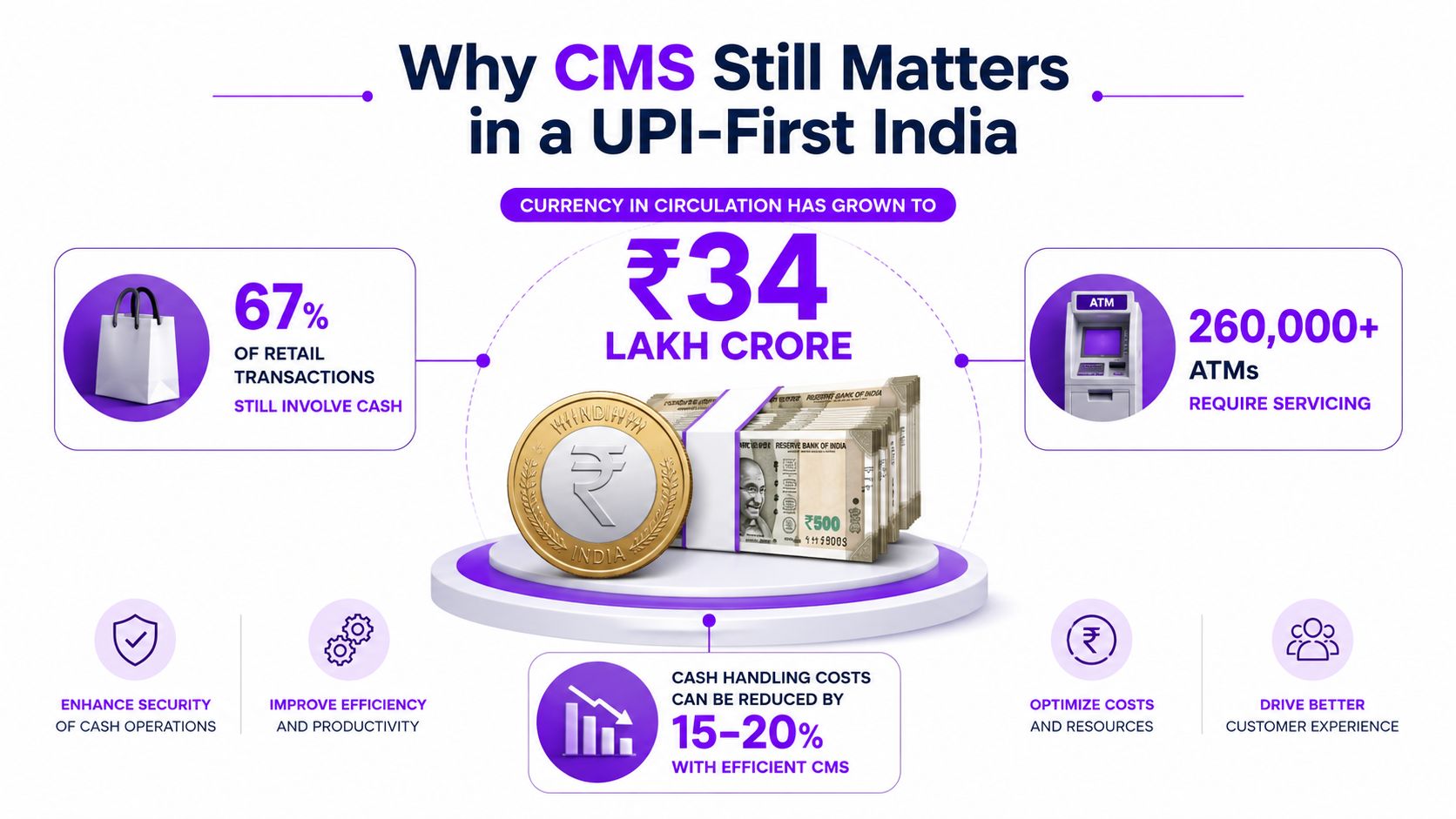
What the market numbers really say
CMS Info Systems said it handled about 12.7 trillion rupees of cash in FY23, across 16,000+ pin codes and 4,000+ cash vans, which is a logistics footprint, not a clerical function. Its cash management revenue rose from ₹11,108.07 million in FY22 to ₹13,262.80 million in FY23, a 19.4% increase, while consolidated revenue from operations grew from ₹15,896.7 million to ₹19,147.3 million in the same period. The company also reported a 14% revenue CAGR from FY19 to FY23. CMS Info Systems investment case
That matters because scale changes the strategic case. When a provider is moving that much value across a geographically wide network, CMS stops looking like cost centre plumbing and starts looking like a core infrastructure layer.
Practical rule: If cash is still moving through branches, service points, ATMs, or field collections, CMS isn't optional. It's how you stop the physical side of the business from leaking time and money.
The board-level question
Don't ask whether your business is “digital enough” to skip CMS. Ask whether your current cash operating model creates too much float, too many exceptions, or too much blind spot between collection and reconciliation. If the answer is yes, CMS still pays its way, even in a UPI-first market. The primary benefit isn't just fewer trips to the bank, it's cleaner liquidity control and less manual chaos in treasury.
What Cash Management Services Actually Do
CMS is the operating layer that moves cash from collection points to where finance can use it, and records every handoff on the way. Branches, stores, counters, ATMs, and collection centres feed into that layer. Banks, treasury teams, and payment rails then move the money, control it, and settle it. If the process is poorly designed, cash piles up in the wrong place, payments slow down, and treasury loses sight of what is available.
That is why CMS is not a single product. It covers collections, secure transport, vaulting, concentration, disbursement, reconciliation, and reporting. Anyone selling it as a narrow banking add-on is missing the point.
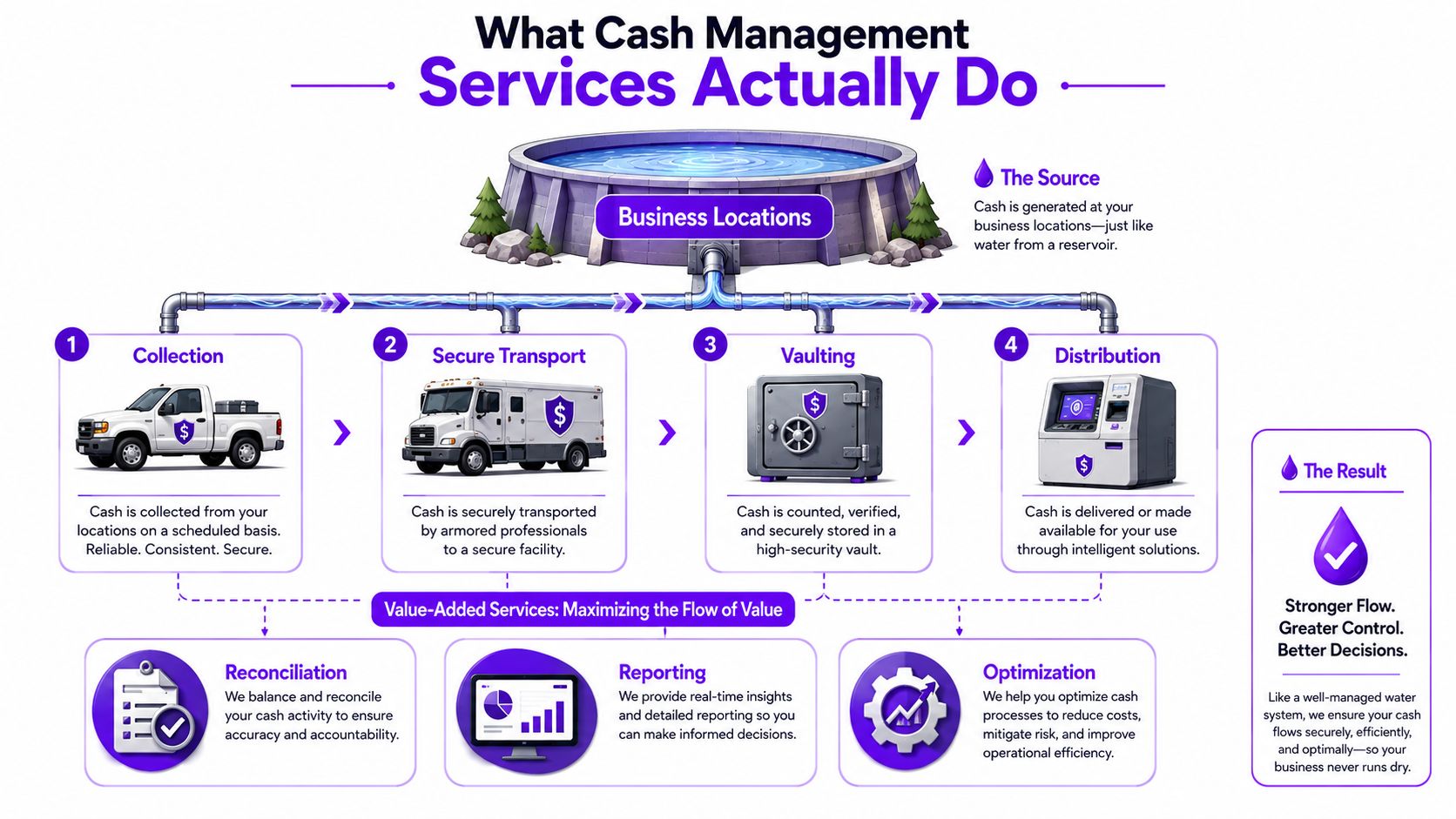
The operating flow from field to finance
The flow begins with collection. Cash or cash-linked receipts are picked up from retail points, branches, or ATMs, then moved into secure transport and vaulting, where the provider counts, verifies, stores, and prepares the funds for the next movement or settlement. Indian CMS offerings reflect that reality with role-based approvals, encryption, and ERP/API integration, because traceability matters as much as physical movement. Indian CMS workflow and controls
The final stage is distribution. That covers disbursement to the people or systems that need funds next, whether that means payroll, vendor payouts, branch replenishment, or central treasury funding. CMS is not about handling cash for its own sake, it is about making money usable without manual rework.
The six things a treasury team should care about
A CXO should judge CMS by how much friction it removes in six places. Collections cut down cash sitting idle at the edge of the business. Disbursements reduce payment bottlenecks. Concentration pulls scattered balances into one control point. Liquidity visibility shows what is real, not what a spreadsheet claims is real. Forecasting shows what tomorrow is likely to require. Payments let finance execute without a pile of email approvals and manual file handling.
A CMS platform should be judged by how much manual chasing it removes from finance, not by how impressive its dashboard looks in a demo.
For a simple internal explanation, use this line: CMS collects cash, moves it safely, records it properly, and puts it where treasury can use it. That is the business case in one sentence.
The practical definition is clearer when you examine collection mechanics in a broader process, so this collection process guide is worth reading alongside your own operating model.
The Six Building Blocks of a Modern CMS Stack
Collections and secure transport
The first test of a modern CMS stack is whether it can handle India's last mile without losing control of the cash. CMS Info Systems' annual report points to 97% district coverage and says 64% of CMS ATM cash management points are in semi-urban and rural India, which tells you the operating model has to work far beyond metro headquarters. A treasury team that ignores geography is designing for a market it does not serve. CMS Info Systems annual report benchmark
For retail chains, fuel stations, clinics, or branch-heavy businesses, the collection block should answer one question, how fast does money leave the point of sale and reach controlled custody? If the answer is slow, you are carrying avoidable risk and avoidable float. In a cash-heavy business, that delay is not an operational detail, it is working capital leakage.
Disbursements and concentration
Disbursement is where CMS becomes a control system for working capital. Indian CMS architectures commonly support NEFT, RTGS, NACH, and bulk payments, so scheduled payouts do not have to sit in a manual queue. Concentration then pulls cash from many entities or locations into a central account, giving treasury one place to decide what to pay, what to hold, and what to deploy.
That concentration layer matters because it turns a scattered collection business into a finance structure that can be governed. If your company has multiple branches or collection points, the issue is not just whether money arrives. It is whether it arrives in a form treasury can act on without waiting for manual confirmations.
Liquidity, forecasting, and payments
Liquidity visibility is the layer most firms think they already have, until they compare actual balances with what their ERP claims is available. CMS platforms create a real-time or near-real-time position so finance knows what is available now. Forecasting then projects likely inflows and outflows, which shifts treasury from reacting to planning.
Payments is the execution layer. In India, CMS implementations are typically built around APIs, host-to-host connectivity, SFTP, and file uploads so daily deposit MIS, clearing batches, and auto-reconciliation can run with fewer manual exceptions. That architecture matters because transaction data can flow directly into treasury systems without rekeying. India CMS architecture and automation
| CMS block | What it does | Why it matters in India |
|---|---|---|
| Collections | Brings cash in from branches, stores, or ATMs | Works across large, dispersed networks |
| Secure transport | Moves funds under controlled custody | Reduces loss and exception risk |
| Vaulting | Verifies and stores cash before settlement | Supports auditable handling |
| Concentration | Pools balances centrally | Improves treasury control |
| Forecasting | Estimates inflows and outflows | Helps manage working capital |
| Payments | Executes disbursements through banking rails | Cuts manual processing risk |
Operational takeaway: If you cannot tie these six blocks to a named owner in finance or operations, the CMS programme is already under-controlled.
The reason the market keeps expanding beyond ATM-heavy use cases is that CMS is no longer only about currency. Market research on sector demand points to growth in account reconciliation, emerging receivables, coin and currency, and DDA, which shows demand for control and automation rather than pure cash handling. India sector context on product-line growth
How BFSI, E-Commerce, Real Estate, and EdTech Use CMS Differently
BFSI uses CMS for control, uptime, and network reliability. CMS Info Systems is described as the largest ATM cash management company in India, and one source says it is also among the largest globally by number of ATM points. For a bank with a dispersed ATM estate, that scale matters because replenishment failures directly affect withdrawals and branch workload. CMS ATM cash management scale
E-commerce cares about speed and settlement. A marketplace or D2C business with cash-on-delivery flows needs pickup, reconciliation, and refund disbursement to run cleanly, otherwise the finance team ends up reconciling exceptions instead of managing cash. The same CMS backbone can also handle seller payouts when operations are structured well.
Real estate is different again. The money is often linked to site visits, booking tokens, stage-wise collections, and vendor payments across project sites. A developer doesn't need a generic “cash service”, it needs discipline around who receives funds, when they hit treasury, and how fast they move into contractor or land-related payments.
EdTech has its own pattern. Fee collection may happen at partner centres or through counsellors, but the messy part is usually not collection alone. Refunds, commission payouts, and batch settlement of instalments can turn into a reconciliation headache if the banking stack isn't disciplined.
A good CMS design follows the cash behaviour of the business. It doesn't force one vertical's pattern onto another.
The common thread is that each of these sectors runs a hybrid flow. Cash still matters in some nodes, while digital rails dominate others. CMS creates value where those flows meet, especially when finance teams need one view of settlement, exception handling, and liquidity.
For BFSI teams looking at operational support around customer onboarding and service workflows, the same discipline applies to compliance-heavy interactions, which is why automated KYC verification in financial services often sits alongside treasury process redesign in the same transformation programme.
The same discipline applies to the SMS and voice alerts CMS platforms send for collections and disbursement confirmations. Those messages cannot legally reach customers without prior TRAI DLT registration of the entity, sender header, and message template.
Integration Choices That Decide Whether CMS Works
The biggest CMS failures are not about cash handling. They come from poor integration choices. If the CMS platform sits outside the ERP and banking stack, finance teams end up copying data, chasing files, and clearing mismatches by hand. That is not a system, it is an expensive detour.
For Indian businesses, CMS should sit between cash and digital operations. It has to handle branch collections, dealer remittances, field collections, refunds, and bank settlements in one control layer. In a UPI-first market, that still matters when cash remains part of the operating model, especially for businesses that need one view of receipts, exceptions, and liquidity across channels.
API first or file based
The cleanest setups use APIs because they reduce latency and remove rekeying. Where the bank and treasury stack already support direct data exchange, API-led integration gives the best shot at a live cash view and cleaner exception handling. Host-to-host connectivity is also strong when transaction volume is high and you want stable, structured flows tied to banking rails.
SFTP and file uploads still have a role, especially in more legacy-heavy estates. They are slower, but they can be practical when multiple banks or older ERPs need scheduled exchanges rather than live orchestration. The wrong move is not using files, it is pretending files are real-time.
Where control has to sit
Indian bank CMS offerings explicitly include role-based approvals, encryption, and ERP/API integration because traceability is essential. If your treasury workflow cannot show who approved what, when the bank received it, and how the exception was handled, the process will fail audit scrutiny sooner or later. The same control logic sits behind Indian bank control requirements.
For high-volume NEFT, RTGS, NACH, and bulk payments, I would push hard for the shortest possible path between treasury approval and bank execution. That usually means direct or near-direct integration, not a maze of intermediary spreadsheets. If your team is still exporting, editing, and re-uploading files, the control problem is bigger than the software problem.
Practical rule: Choose the simplest integration that gives you an auditable, near-live treasury view. Anything else is just automation theatre.
One more point. Reconciliation automation should sit on top of the integration layer, not below it. Once cash movement and bank data are structured, the system should match entries automatically and surface only the exceptions that need human review. That is how finance gets out of the file-chasing loop.
If your technology team also owns customer identity or document workflow, the same integration mindset applies to compliance-heavy processes more broadly, which is why automated KYC verification is relevant reading for the wider operating model.
KPIs and Compliance a Board Will Actually Ask About
The board does not want a CMS walkthrough. It wants three numbers, then it wants to know whether control design is strong enough to trust those numbers. Those three numbers are cash-conversion cycle, same-day reconciliation rate, and forecast accuracy over a 13-week horizon. If you cannot discuss them cleanly, the CMS programme is being run as a treasury initiative in name only.
The board conversation
Cash concentration should be tracked by how quickly balances get centralised and put to use. Reconciliation should be tracked by how much of the day's activity clears without manual intervention. Forecasting should be tracked by how close the 13-week view is to actuals, because a forecast that misses consistently is just a polished spreadsheet.
Compliance needs the same level of discipline. Use a platform that creates traceable audit trails and records who touched what, when, and why. If your provider cannot show that on demand, it will struggle under internal audit or statutory review. For a broader automation lens, DigiParser compliance automation is a useful example of how firms are thinking about structured workflows and auditability in document-heavy processes.
CMS KPIs a CXO Should Track
| KPI | What it measures | Benchmark range | Board question it answers |
|---|---|---|---|
| Cash-conversion cycle | How long cash is tied up in operations | Use your internal baseline, then push it lower quarter by quarter | Are we freeing cash or trapping it? |
| Same-day reconciliation rate | How much activity is matched without manual work | Target a level high enough to keep exceptions manageable, not cosmetic | Can finance trust today's numbers? |
| 13-week forecast accuracy | How closely forecasted cash matches actual cash | Measure against actual outcomes and review by business unit | Can treasury plan funding and deployment with confidence? |
The point of the table is not to pretend there is one universal benchmark. It is to stop teams from hiding behind vendor language and force a real operating discussion. If a provider cannot help you improve all three, it is not a strategic CMS platform, it is a utility.
For governance, keep the policy stack simple. Know who can approve, who can release, who can reconcile, and who can audit. Then make sure the CMS platform enforces that separation instead of relying on process memory.
If your finance organisation also struggles with control across banking or client-facing workflows, the same discipline applies to compliance-heavy operations. That makes financial services compliance automation a relevant adjacent read.
How to Choose a CMS Provider Without Getting Sold To
Start with four criteria and ignore the feature parade. Geographic coverage, technology stack, compliance posture, and total cost of ownership are the only filters that matter at the first pass. If a vendor cannot hold up on those four, the demo is selling theatre.
What to ask in the first meeting
Geographic coverage matters because India does not run as one operating cluster. A provider needs enough reach to serve metro, semi-urban, and rural demand without forcing your teams to work around gaps. Technology stack matters because you need clear support for APIs, H2H, SFTP, and the approval model your teams use. Compliance posture matters because role-based access, audit trails, and clean exception handling are the price of entry. As noted earlier, CMS scale and coverage should be judged against the geography your business really serves, not the one in a sales deck.
The first question is simple. Can the provider support the way your cash moves today, and the way it will move when digital and physical channels sit in the same operating flow? If the answer is vague, move on.
Total cost of ownership is where many deals get misread. A low monthly fee can hide manual reconciliation, exception handling, and poor coverage. A higher-priced provider can still be cheaper overall if it reduces operational drag and protects working capital. For a practical buyer checklist, choosing a cash management company is useful, but your own operating data should make the final call.
When in-house still beats outsourcing
Do not outsource everything just because a provider has a larger fleet. If you have tight local routes, limited cash volumes, or a very specific operating rhythm, keeping part of the process in-house can be the cleaner choice. Outsource the parts that are hard to standardise, such as secure transport, vaulting, and large-scale reconciliation. Keep strategic control where treasury needs it, especially over visibility and approvals.
The right model is usually hybrid. CMS should sit between your cash-heavy branches and your digital treasury controls, not replace every local judgment call. In a business with uneven cash density, that hybrid layer gives you better control than either full outsourcing or full internal ownership.
My view is direct. The best CMS provider in a hybrid Indian economy is the one that makes cash and digital flows behave like one controlled system. Bigger is not automatically better, and fragmented is almost always worse.

This is a clear and insightful overview of how modern cash management keeps both physical and digital payments under control. The practical focus on reconciliation, liquidity, integration, and compliance makes the CMS discussion highly useful for businesses.