
Outbound Dialer Software: A CXO’s Guide to Compliant Scale
India identified 4,168 crore spam calls in 2025, while its community blocked 1,189 crore of them, according to Truecaller's India 2025 report. That changes the buying question for outbound dialer software. Indian enterprises don't need a tool that merely dials faster. They need a communication platform that can prove why a call was made, use the correct number series, scrub suppression lists, respect calling windows, and prevent automated traffic from creating silent or abandoned calls.
For a CXO, the commercial risk is operational as much as regulatory. A dialer that improves agent activity but mishandles DLT registration, consent, or pacing can expose a campaign to complaints, blocking, and reputational damage. The right architecture treats compliance as part of campaign performance, not as a filter added after the sales workflow is complete.
Table of Contents
- Why Outbound Dialer Software Matters for Indian Enterprises
- How Preview Power and Predictive Dialing Modes Work
- Navigating TRAI Compliance and DND Regulations
- Key Features to Evaluate in Outbound Dialer Software
- Industry Use Cases and Real-World Outcomes
- Measuring ROI and Tracking the Right Metrics
- Implementation Roadmap and Vendor Selection Checklist
Why Outbound Dialer Software Matters for Indian Enterprises
Outbound dialer software automates the mechanical work between a lead entering your system and an employee or Voice AI agent speaking with that lead. It can select the next eligible contact, place the call, connect a live interaction to the right resource, record the disposition, and send the outcome back to a CRM. In India, those functions must operate inside TRAI's commercial communications framework.

The distinction matters because consumer filtering is already aggressive. Truecaller's reported 4,168 crore identified spam calls and 1,189 crore blocked calls in India during 2025 show why an unknown or poorly presented number can fail before an agent gets an opportunity to explain the purpose of the call. The dialer therefore influences deliverability through identity, timing, list quality, retry logic, and the relevance of the conversation.
The platform sits above the phone line
A modern stack usually connects four operational layers:
- Lead and consent data: The system identifies the customer, campaign purpose, consent status, suppression status, and previous outcomes.
- Dialling orchestration: The platform chooses preview, power, or predictive behaviour and controls how quickly the next call is attempted.
- Conversation handling: A human agent or Voice AI agent manages qualification, support, reminders, follow-ups, or escalation.
- Governance and analytics: Managers review recordings, dispositions, complaint signals, abandoned-call risk, and campaign performance.
BFSI teams may use it for collections, service calls, and EMI reminders. EdTech teams may prioritise prompt counselling for fresh enquiries. Real estate teams can route high-intent prospects to booking specialists, while healthcare operations can separate appointment confirmations from promotional outreach. D2C teams often need a short, controlled verification conversation rather than a broad sales pitch.
Executive view: Dialling speed is only one input. In India, compliant identity, consent provenance, suppression hygiene, and agent availability determine whether scale produces conversations or complaints.
Outbound dialer software also belongs in the wider discipline of outbound lead generation. Teams building that discipline can use Visbanking's lead generation guide to think through list creation, qualification, and follow-up before selecting the telephony layer. The practical lesson is straightforward: a dialer can execute a poor list efficiently, but it can't repair weak targeting or undocumented permission.
For Indian enterprises, the buying brief should start with the campaign types, number-series requirements, DLT workflow, CRM events, escalation paths, and suppression process. Teams budgeting the surrounding telephony stack can also review this IVR system cost guide for pricing models and TCO benchmarks. Only after those controls are clear should leadership compare automation depth, analytics, or agent productivity.
How Preview Power and Predictive Dialing Modes Work
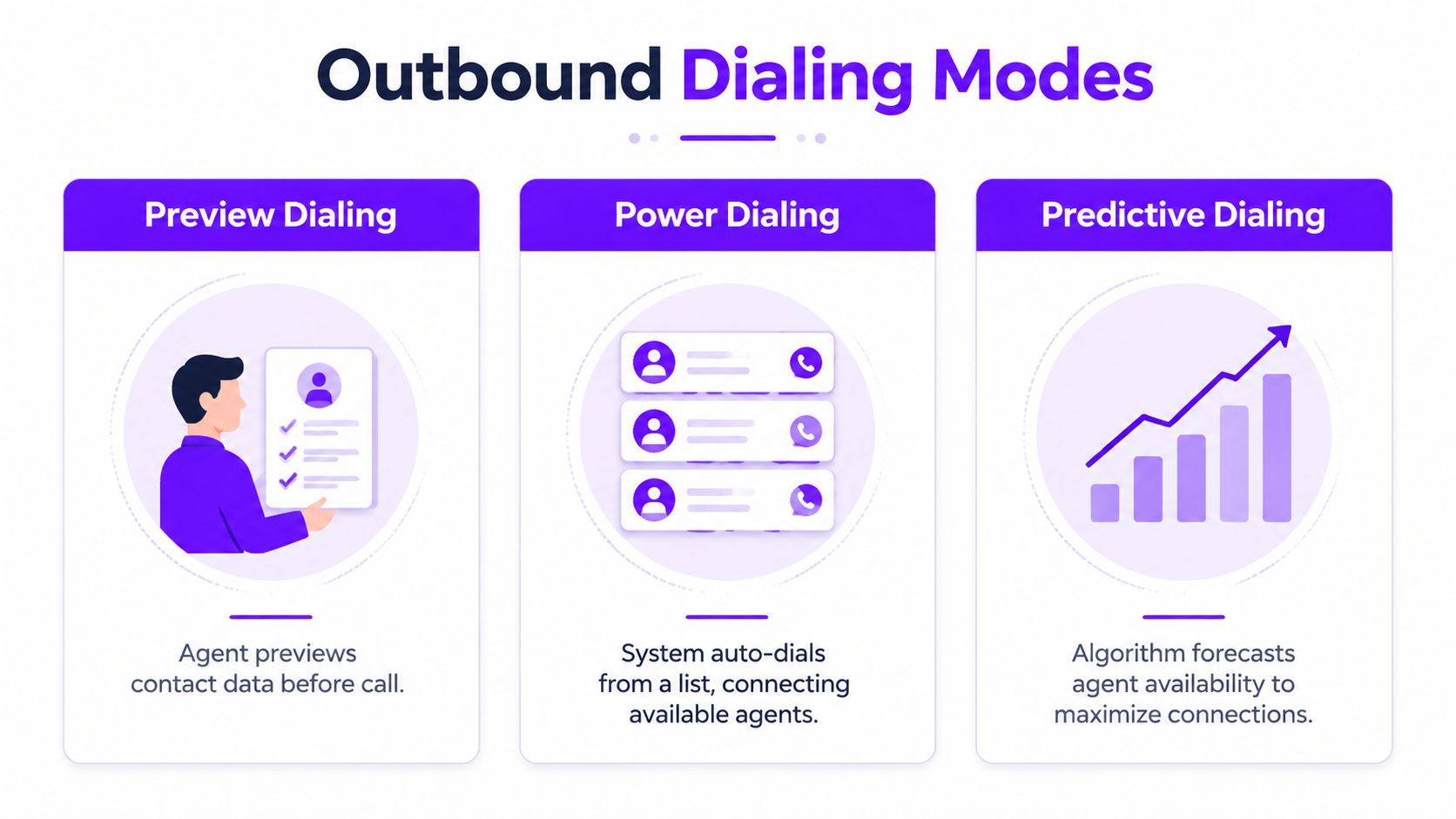
The three common modes solve different operational problems. Preview dialing gives the agent context before the call. Power dialing keeps available agents moving through a controlled queue. Predictive dialing anticipates agent availability and places calls ahead of time, which can increase utilisation but demands tighter pacing controls.
Preview mode for high-context conversations
Preview is appropriate when each contact needs research or careful handling. An EdTech counselling squad might show the course enquiry, preferred language, prior conversation, location, and consent record before an advisor presses call. A relationship manager handling a sensitive BFSI service issue may need to review account context and the previous disposition rather than receive an unexpected connection.
Preview improves control because the agent decides when to proceed. The trade-off is lower automation and more time between attempts. It works best when conversation quality, customer context, or regulatory sensitivity matters more than maximum queue velocity.
Power mode for steady throughput
Power, or progressive, dialing calls the next eligible contact when an agent becomes available. The system doesn't need to dial multiple contacts speculatively, so the workflow is easier to explain and supervise. A D2C team confirming COD orders can use power mode to move through a verified list while keeping one live agent attached to each active attempt.
This mode offers a practical middle ground. It removes manual number entry and reduces idle time without creating the same abandoned-call exposure associated with aggressive predictive logic. Managers still need controls for calling windows, retry limits, list suppression, and disposition-specific follow-ups.
Predictive mode for staffed, high-volume teams
Predictive dialing uses forecasting to estimate when agents will finish calls and become available. A 50-agent collections operation may use it to keep the floor active across a large eligible queue, but only if the platform can detect answer outcomes, predict agent availability, and slow down when live capacity falls.
TRAI explicitly warns that a sender registered for commercial communication must not use an autodialer that causes silent or abandoned calls, as set out in the TRAI regulation on unsolicited commercial communication. Predictive mode therefore needs live-agent capacity forecasting, conservative pacing, answer-machine handling, and immediate rate limiting. The platform must never treat an unanswered or humanless connection as a harmless efficiency event.
A useful procurement test is to ask the vendor to demonstrate how the system behaves when answer rates change, agents become unavailable, or a campaign approaches its compliance threshold. For broader platform evaluation, teams can also compare call tracking platforms for HVAC to understand how call attribution and conversation analytics differ from outbound dialling.
Teams considering how an automated queue behaves in practice can review auto-dialer call workflows before running a pilot. Choose the least aggressive mode that meets the campaign's service level. Add predictive behaviour only when governance, staffing, and monitoring are mature enough to control its downside.
Navigating TRAI Compliance and DND Regulations
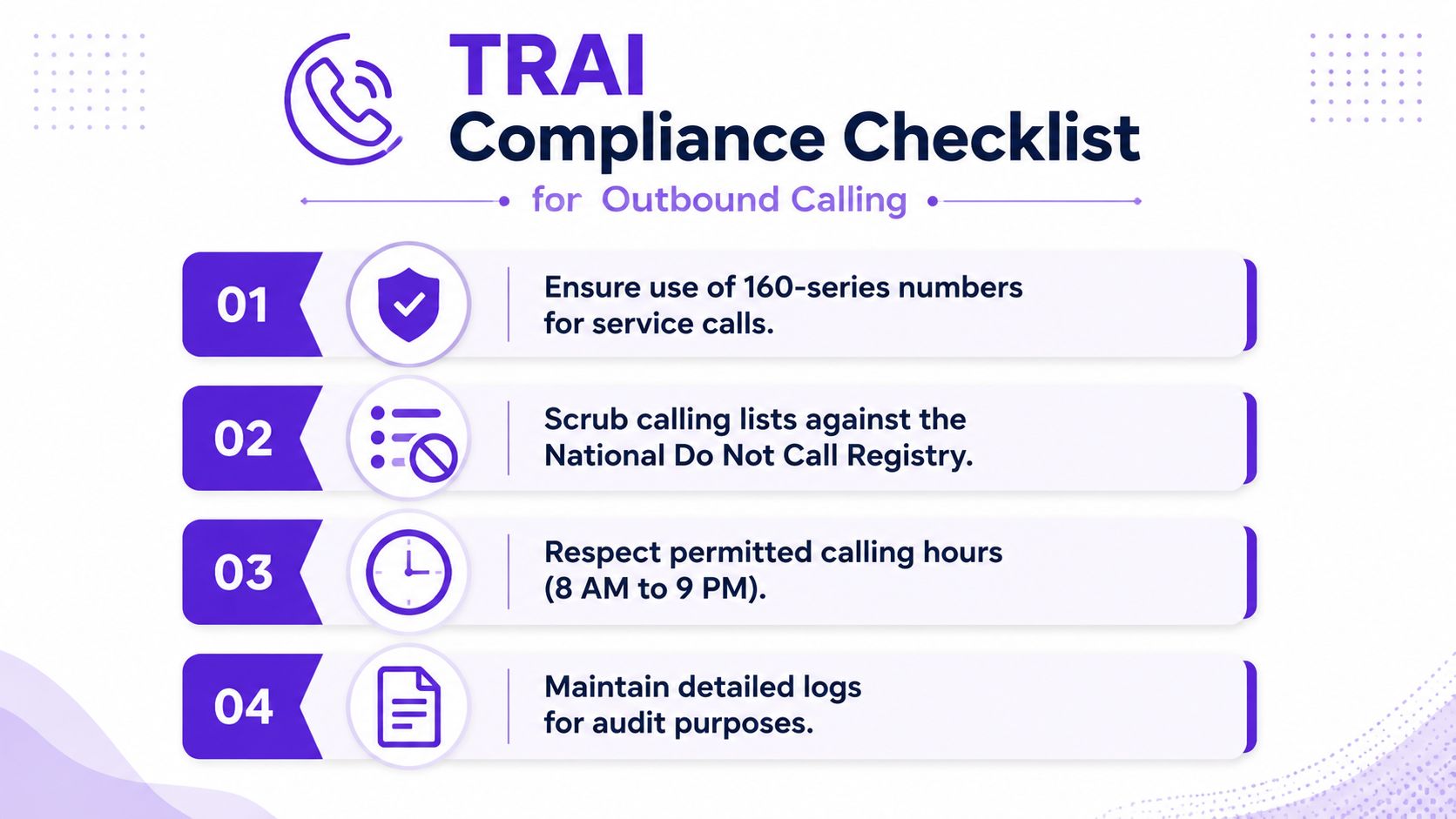
India's commercial calling rules turn number selection and data hygiene into core product requirements. Promotional outbound calls are expected to use the 140-series, while service and transactional calls use the 160-series, according to India-focused compliance guidance from Tabbly's TRAI and DLT guide. Regular 10-digit mobile numbers are heavily restricted or blocked for commercial auto-dialled and AI calls, so a vendor that can't clearly explain number-series handling isn't ready for enterprise deployment.
The implementation burden increased in 2024. Access providers were directed to complete end-to-end implementation of the 140xxx numbering series on the DLT platform, including migration of existing telemarketers and call scrubbing, by 30 September 2024, as described in the same compliance reference. Buyers should ask whether the dialer connects to this operating model or exports a list and leaves the risk with the customer.
Controls that must exist before launch
Commercial outbound calls should be scheduled only between 9:00 AM and 9:00 PM IST, including weekends, according to Kedeyo's guidance on cold calling in India. A compliant platform should enforce the window automatically rather than rely on a supervisor remembering to stop a campaign.
The procurement checklist should include:
- DLT registration: Principal entities, telemarketers, headers, and templates must be represented in the required registration process before traffic is sent.
- Series-aware routing: Promotional, service, and transactional campaigns should not share one undifferentiated outbound identity.
- NCPR and DND scrubbing: Lists must be checked against customer preferences before the campaign attempts a call.
- Consent metadata: The platform should retain the source, purpose, date, and campaign relationship for each consent record.
- Time-zone scheduling: Calling rules should apply at campaign and contact level, with no manual workaround for an ineligible attempt.
- Abandoned-call protection: Predictive campaigns need pacing logic that reacts to live agent capacity and answer outcomes.
- Audit records: Managers should be able to retrieve campaign, number, template, consent, disposition, and retry history.
The compliance window is becoming less forgiving. TRAI's February 2025 changes reduced the consumer complaint window to 7 days, reduced provider action time against unregistered senders to 5 days, and escalated repeat violations to one-year blacklisting, according to TRAI's February 2025 press release. PIB reported 7,31,120 notices issued to unregistered telemarketers in 2025 and 31.09 lakh UCC complaints overall in the same verified data reference. Those figures make complaint response, list suppression, and traceability board-level concerns rather than back-office administration.
A real estate business can apply the same discipline to broker and buyer outreach. RealEstateCRM's compliance software guide for real estate agents offers useful context on organising compliance workflows, while Indian dialer buyers should also review TRAI DLT registration requirements before committing to a vendor.
Key Features to Evaluate in Outbound Dialer Software
Feature lists often hide the most important question: can the platform control the entire campaign, from eligibility to outcome? A dialer with a polished interface but shallow CRM synchronisation, weak suppression logic, or limited pacing controls creates manual work exactly where errors are expensive.
A practical priority matrix
| Feature | BFSI | EdTech | Real Estate | Healthcare | D2C |
|---|---|---|---|---|---|
| Consent and suppression controls | Critical | Critical | High | Critical | High |
| Number-series and campaign identity | Critical | High | High | Critical | High |
| Intelligent routing | Critical | High | Critical | Critical | High |
| Preview calling | High | Critical | High | Critical | Medium |
| Power calling | High | High | High | Medium | Critical |
| Predictive calling | Controlled use | Selective use | Selective use | Limited use | Controlled use |
| CRM and case-history integration | Critical | High | High | Critical | High |
| Voice AI qualification | High | Critical | High | Selective use | High |
| Recording and quality assurance | Critical | High | High | Critical | High |
| Real-time reporting | Critical | Critical | High | Critical | Critical |
Intelligent routing should consider more than agent availability. It may need language, geography, product, customer value, delinquency stage, lead score, or escalation status. A BFSI collections queue could route a sensitive case to a senior agent, while an EdTech enquiry can move to a counsellor familiar with the programme. The intelligent call routing framework provides a useful way to map those rules before a vendor demonstration.
Where AI adds value
Voice AI agents can handle qualification, presales, reminders, support, and handoffs when the conversation is structured and escalation rules are explicit. They're most useful when they capture intent, ask the next relevant question, update the CRM, and transfer exceptions to a person. They're less useful when a vendor treats a generic script as a substitute for policy, customer context, or consent controls.
CRM integration should be two-way and event-based. A completed call should update the contact, disposition, retry eligibility, next action, and recording reference without forcing agents to copy notes across systems. Reporting should show campaign-level pacing, live agent availability, answer outcomes, conversion movement, suppression events, and complaints, not only total dials.
Answer-machine detection and abandoned-call prevention deserve special attention. The dialer must distinguish a live person, voicemail, busy signal, invalid number, and no answer, then apply a different follow-up rule to each. That classification is both a productivity feature and a safeguard against non-human connect logic outrunning the live team.
Industry Use Cases and Real-World Outcomes
The strongest deployment plans begin with a narrow workflow, not a general promise to “automate calling”. Each industry has a different definition of a successful conversation, and each needs a different balance between preparation, throughput, escalation, and compliance.
BFSI collections and reminders
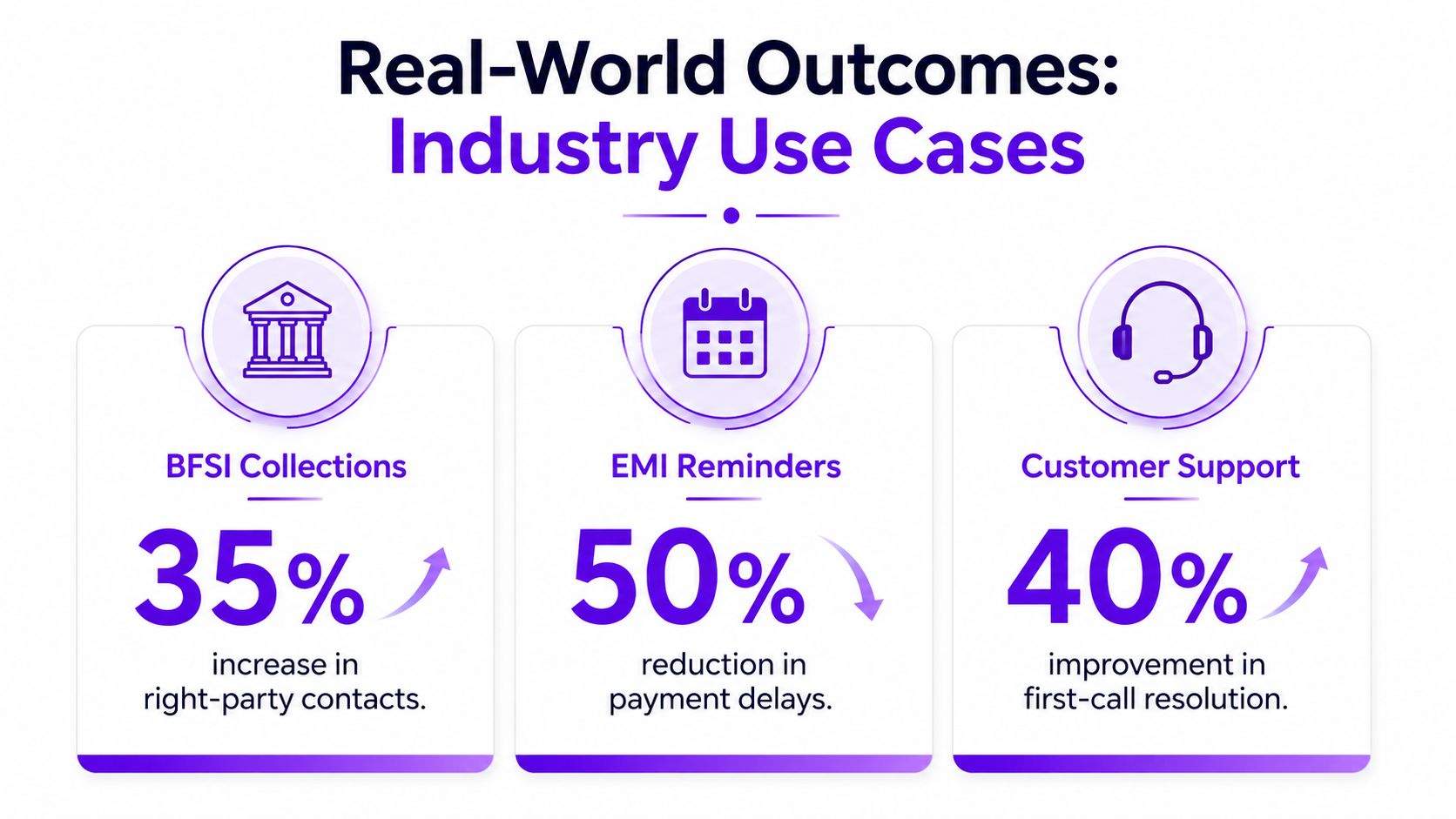
A collections operation can segment accounts by consent status, product, payment stage, and previous contact outcome. Preview mode suits complex or sensitive accounts because the agent can review context before speaking. Power mode works for structured EMI reminders, while predictive mode should be restricted to campaigns with sufficient live-agent capacity and strict abandoned-call controls.
The result to track isn't just dials. Measure right-party contact, promise-to-pay capture, payment link delivery, escalation quality, and suppression accuracy. A missed compliance event can outweigh a short-term increase in agent occupancy.
EdTech admissions counselling
An EdTech team can route fresh enquiries to available counsellors, use Voice AI to confirm course interest and preferred timing, and escalate qualified prospects for human counselling. Preview mode helps advisors personalise high-intent calls, while power mode keeps follow-up queues organised.
Customers report connect rates rising from 47% to 91%, alongside multi-minute natural conversations, according to the verified customer outcomes provided for this article. They also report lead-to-booking improving from 2% to 8%, with AI-qualified leads matching human judgement with 97% accuracy. These are reported outcomes, not universal benchmarks, so leaders should validate them against their own list quality, offer, consent base, and agent process.
Real estate, healthcare, and D2C workflows
A real estate campaign can qualify budget, location, property preference, and purchase timeline before booking a site visit. Healthcare teams need stricter routing for appointment confirmation, rescheduling, reminders, and human escalation. D2C operations can use power mode for COD verification, then trigger a fulfilment or exception workflow based on the customer's response.
The common design principle is disposition-led automation. “Interested”, “call later”, “wrong number”, “do not call”, “appointment booked”, and “needs human help” should each produce a different next action. A generic retry sequence wastes contact attempts and can create avoidable complaints.
Operational lesson: The dialer should decide what happens next only after the campaign has defined what each outcome means.
Leadership teams should pilot one measurable workflow per business unit. Compare the new process with the existing one using the same lead definition and reporting period. Don't attribute improvement to the dialer until you've separated list quality, offer changes, agent training, calling time, and routing logic.
Measuring ROI and Tracking the Right Metrics
ROI analysis becomes credible when the dashboard connects activity to commercial outcomes and compliance exposure. Total dials are useful for capacity planning, but they don't show whether the team reached eligible customers, held useful conversations, or created revenue.
The operating dashboard
Track connect rate as live conversations divided by eligible call attempts. Customers have reported a rise from 47% to 91% in this measure, but that outcome should be treated as a customer-reported result rather than a promise, as supplied in the verified data for this article.
Measure talk-time utilisation by comparing agent time in productive conversations with logged-in availability. A high number can still signal poor pacing if agents receive irrelevant contacts or rushed handoffs. Pair it with conversation outcomes, quality scores, and customer complaints.
Cost per qualified lead should include telephony, platform fees, AI usage where applicable, agent time, list acquisition, and follow-up effort. If Voice AI qualifies a lead before human transfer, compare the full cost of that path with the human-only process, not merely the cost of a call minute.
Metrics that protect the business
Monitor lead-to-booking velocity, conversion by disposition, retry success, suppression events, consent completeness, abandoned-call incidents, and complaint rate. A campaign that produces more bookings but also creates a compliance incident isn't a successful scale model.
For EdTech or real estate, the supplied customer outcomes include lead-to-booking movement from 2% to 8% and AI qualification matching human judgement with 97% accuracy. Use these reported outcomes as hypotheses for pilot design, then establish a baseline before launch and review performance by source, language, campaign, and agent or Voice AI persona.
The dashboard should give a CXO three views:
- Commercial view: Qualified conversations, bookings, collections outcomes, conversion velocity, and cost per outcome.
- Operational view: Queue health, agent capacity, talk-time, retry status, and routing performance.
- Risk view: Consent gaps, DND or NCPR suppression, number-series use, abandoned calls, complaints, and audit completeness.
A contact-centre KPI framework can help analytics teams structure these views. Review them together, because revenue and compliance are connected in Indian outbound operations.
Implementation Roadmap and Vendor Selection Checklist
A controlled rollout is more valuable than a rushed launch. Indian enterprises should treat deployment as a sequence of operational decisions, with compliance and data readiness confirmed before call volume increases.
A phased path to production
Discovery and audit: Document campaign types, number series, consent sources, DLT status, NCPR or DND suppression, CRM fields, escalation rules, and existing complaint handling. Separate promotional traffic from service and transactional workflows.
Pilot design: Select one campaign with a clear audience, disposition model, retry policy, and success measure. Start with preview or power mode unless predictive controls have been tested against actual agent capacity.
Integration and training: Connect the CRM, lead source, recording workflow, reporting layer, and handoff queue. Train agents on dispositions, consent-sensitive conversations, escalation, and the difference between service and promotional calls.
Staged rollout: Expand by campaign or team, not by switching every queue on at once. Review deliverability, connect rate, conversation quality, suppression events, abandoned calls, and complaints before increasing automation.
Vendor questions that deserve written answers
- DLT maturity: Can the vendor explain registration, headers, templates, number series, and scrubbing responsibilities?
- Compliance automation: Does the system enforce the 9:00 AM to 9:00 PM IST window, consent rules, suppression refreshes, and abandoned-call protection?
- Data handling: Where does the platform store recordings, transcripts, customer data, and audit logs?
- Integration depth: Are CRM updates two-way, real-time, and supported by documented APIs?
- Operational support: Who responds when a campaign is blocked, a route fails, or a compliance event needs investigation?
- Campaign control: Can teams change pacing, retry logic, routing, and eligibility without engineering intervention?
Reviewing cloud telephony provider selection criteria can help structure the shortlist. Avoid vendors that promise unrestricted volume, treat DND as a simple upload, or can't show how their predictive mode prevents silent and abandoned calls.
DialNexa Labs Private Limited offers configurable Voice AI agents and outbound call workflows for qualification, presales, reminders, support, recruitment, and human handoffs across Indian enterprise use cases. Visit DialNexa Labs Private Limited to evaluate a compliant, measurable outbound operation built around your campaign rules, CRM processes, and customer experience goals.

This is an insightful guide that clearly explains how outbound dialers can improve calling efficiency, lead management, and customer engagement. The strong focus on TRAI compliance, CRM integration, and measurable ROI makes it highly practical for Indian businesses.
This is an informative guide to scaling outbound calling while keeping customer experience and compliance in focus. The practical insights are especially useful for CXOs looking to improve calling efficiency and operational performance.
The comparison of dialing modes, industry use cases, ROI metrics, and vendor selection criteria makes the article especially useful for businesses planning outbound calling operations in India.
This is a detailed and practical guide that clearly explains outbound dialer modes, compliance requirements, AI capabilities, and CRM integration. The industry-specific examples and procurement checklist make it easier for businesses to understand how to choose and implement dialer software effectively.