
Auto Dialer Software: A CXO’s Guide for Indian Markets 2026
$3.8 billion in 2025, projected to reach $9.7 billion by 2034 at an 11.0% CAGR. That number from Dataintelo's auto dialer software market outlook changes the boardroom conversation. Auto dialer software is no longer a call-centre utility. It's a capital allocation decision tied to productivity, customer access, and operating advantage.
For Indian enterprises, the strategic risk isn't whether to automate outbound calling. It's whether leadership buys a system built for generic global assumptions instead of India's mix of compliance rules, telecom behaviour, and high-volume voice-led sales motions. In sectors such as EdTech, real estate, BFSI, healthcare, and SaaS presales, that distinction determines whether the platform becomes a revenue multiplier or a compliance liability.
Table of Contents
- Why Auto Dialer Software is a Strategic Asset Not Just a Tool
- Choosing Your Dialing Engine A Guide to Dialer Types
- Core Features That Drive Business Outcomes
- Measuring ROI Real-World Examples from Indian Enterprises
- Navigating Indias Complex Compliance Landscape
- Your Strategic Implementation and Rollout Checklist
Why Auto Dialer Software is a Strategic Asset Not Just a Tool
The market growth cited earlier reflects a boardroom shift. Leadership teams are funding auto dialer software because outbound calling still shapes revenue in India, and manual processes waste too much paid agent time to ignore.
That waste rarely appears in a single line item. It shows up as lower agent utilisation, uneven follow-up discipline, higher cost per qualified lead, and slower response times on high-intent enquiries. For a CFO, that means more payroll tied to non-selling activity. For a CRO or Head of Customer Success, it means missed conversations in categories where voice remains the fastest path to qualification, collections, counselling, and appointment conversion.
Auto dialer software changes the operating model. It replaces manual number entry and idle ring time with controlled call flows, standardised outreach logic, and cleaner management visibility. The strategic gain is not just efficiency. It is predictability. Teams can forecast output more accurately, enforce contact policies more consistently, and identify whether performance issues sit with lead quality, agent behaviour, timing, or call routing.
In India, that distinction matters more than many global guides acknowledge. Connect quality varies by telecom conditions, customer acquisition often depends on rapid callback windows, and compliance failures can create commercial risk alongside regulatory exposure. A dialer chosen only on headline automation features can depress contact rates or create avoidable legal and brand problems. A dialer chosen with Indian operating conditions in mind can protect margin while improving conversion quality.
That is why this category belongs in strategic planning, not only in IT procurement.
A weak buying decision can lock the business into the wrong economics for years. High-volume dialling without CRM context can increase talk time while reducing conversion. Poor pacing controls can produce agent idle gaps or abandoned calls. Limited auditability can turn consent management into a manual exception process, which raises both operational cost and risk.
Leadership teams assessing outreach transformation often start by examining how teams optimize sales call productivity. That is a reasonable starting point. The stronger question for Indian enterprises is broader: which dialling approach improves revenue throughput, holds up under local compliance requirements, and performs reliably across real-world network conditions.
For a side-by-side look at TRAI-compliant number series, calling-window enforcement, and vendor evaluation criteria, DialNexa’s outbound dialer software guide walks through the same buying checklist in more depth.
Choosing Your Dialing Engine A Guide to Dialer Types
Not all auto dialer software serves the same business objective. The dialling engine determines agent rhythm, customer experience, list coverage, and compliance exposure. For a COO or VP Sales, that means dialer type affects both operating cost and commercial outcome.
How each dialer changes operating economics
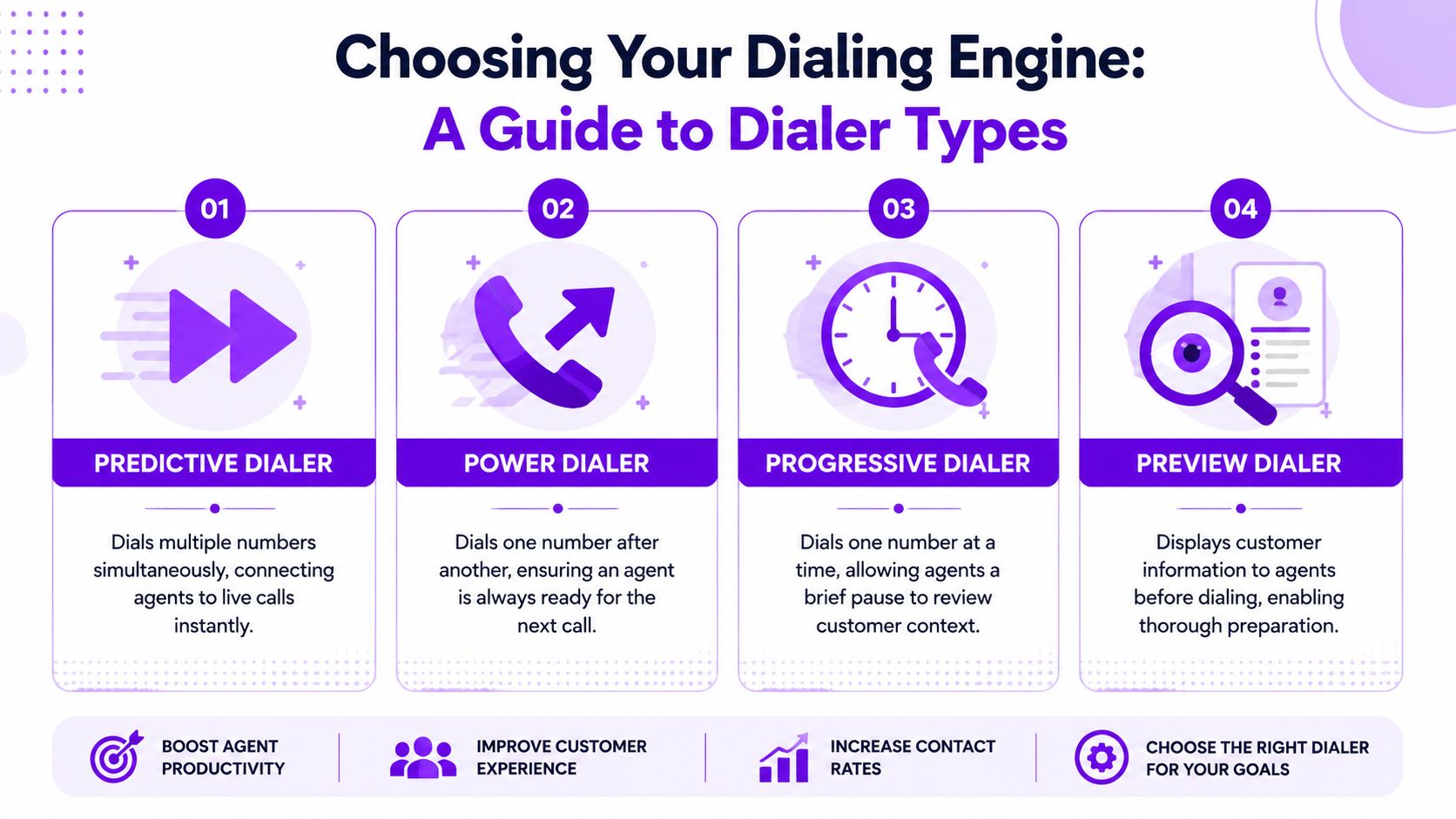
A predictive dialer places multiple calls simultaneously and routes answered calls to available agents. This suits teams that care most about coverage. Think broad consumer campaigns, reminder campaigns, or large outbound databases where each call has relatively low strategic value.
A power dialer moves through numbers one after another, usually ensuring an agent is ready before the next call. It's a better fit when the business wants speed without the chaos of over-aggressive pacing. Many inside sales teams prefer this model because it improves throughput while preserving agent readiness.
A progressive dialer dials one number at a time with a brief pause for the agent to review context. That small pause matters. In EdTech counselling, for instance, an advisor may need to see programme interest, geography, and prior interaction before speaking. Progressive dialling balances efficiency with context.
A preview dialer gives the agent customer details before the call is placed. This is the right choice when preparation materially affects conversion. High-value B2B outreach, premium real estate conversations, and relationship-driven financial services often benefit from preview workflows.
| Auto Dialer Types Strategic Comparison | Dialing Mechanism | Best For (Use Case) | Key CXO Consideration |
|---|---|---|---|
| Predictive Dialer | Dials multiple numbers simultaneously | High-volume outreach and broad campaign coverage | Maximises reach, but customer experience and compliance controls must be watched closely |
| Power Dialer | Dials the next number when an agent is available | Sales teams that need steady pace and live agent readiness | Strong balance of productivity and control |
| Progressive Dialer | Dials one contact at a time with a short review gap | EdTech counselling, service callbacks, structured follow-ups | Better context can improve conversation quality |
| Preview Dialer | Shows record first, then agent initiates the call | Complex B2B, premium real estate, consultative sales | Best when each lead carries high potential value |
Which model fits which business motion
The most common executive mistake is buying for headline volume instead of revenue design. A real estate developer selling premium inventory doesn't need the same engine as a collections team. A SaaS company scheduling demos doesn't need the same flow as an appointment reminder desk.
Here's the simpler way to decide:
- Choose predictive when list size matters more than pre-call preparation.
- Choose power when the team needs momentum and every live connection should have an available agent.
- Choose progressive when agents need a short context window but leadership still wants scale.
- Choose preview when call quality and preparation outweigh sheer call count.
A dialer is an operating policy encoded in software. Once deployed, it shapes how every rep spends the day.
For teams comparing these models in more depth, this guide to automated calling systems is useful because it frames automation choices in practical workflow terms rather than vendor jargon.
Core Features That Drive Business Outcomes
Most vendor checklists overstate features and understate consequences. CXOs should reverse that. The question isn't whether a platform offers dashboards, routing, recording, or integrations. The question is what each feature does to cost, conversion, governance, and scalability.
Features that matter to revenue operations
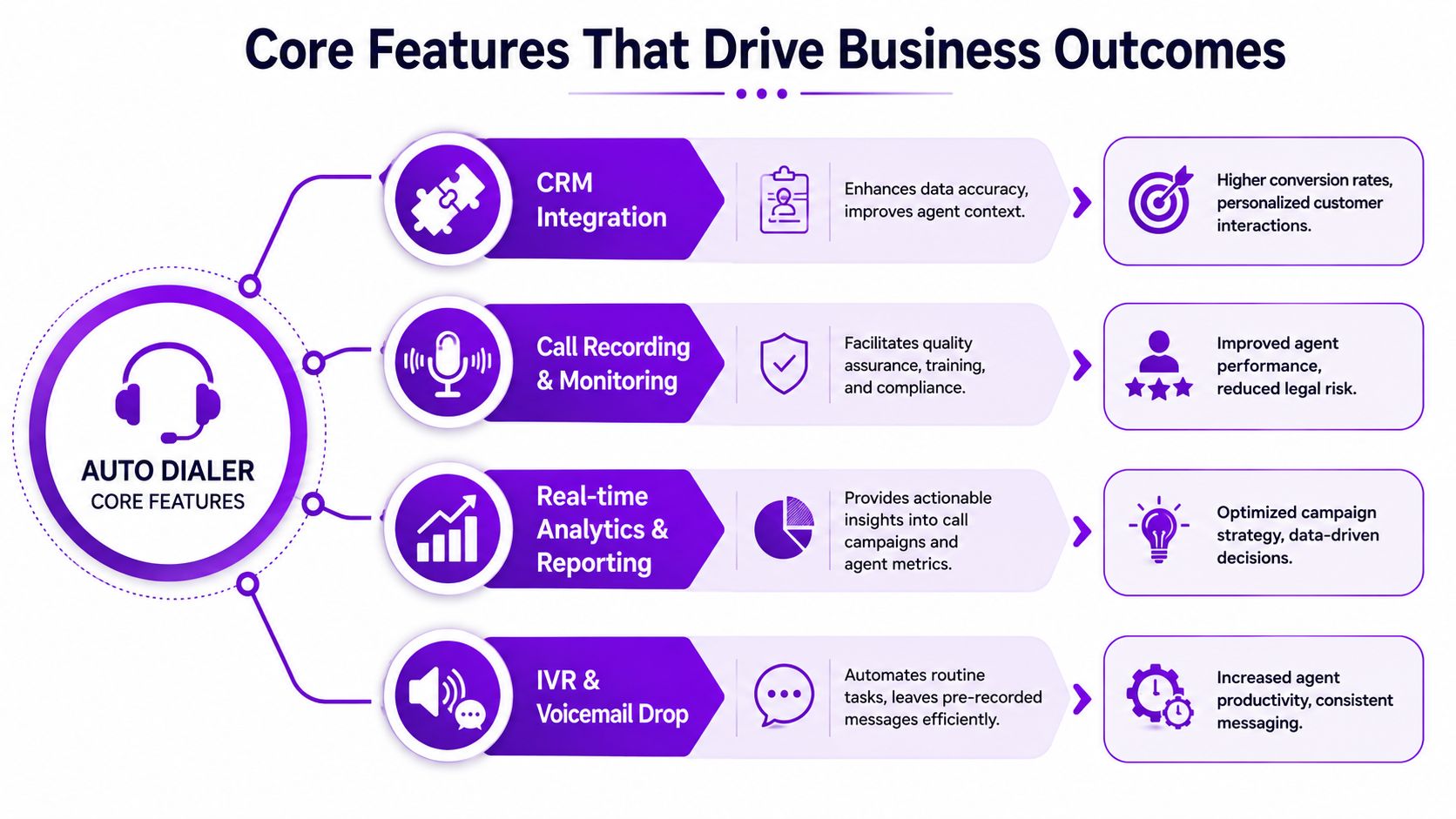
CRM integration is the first absolute necessity. When the dialer and CRM share records cleanly, teams get a single source of truth for lead status, call outcomes, and next actions. Without that, agents work from partial context, managers reconcile data manually, and leadership loses confidence in pipeline reporting.
Call routing and assignment logic matter because they determine whether the right conversation happens at the right time. A counselling lead should reach a counsellor. A KYC follow-up should reach a trained support queue. Routing based on campaign, skill, or customer profile improves resource allocation without increasing headcount.
Call recording and monitoring serve two separate executive priorities. The first is quality management. Leaders can identify whether scripts, objections, and follow-up motions are being executed consistently. The second is compliance discipline, especially when businesses need auditable evidence of what agents said and when they said it.
Where automation starts to change the cost structure
Real-time analytics and reporting turn auto dialer software from a task tool into a control system. With the right reporting, leaders can see connection patterns, campaign productivity, queue performance, and agent output in one place. That helps commercial teams reallocate effort quickly instead of waiting for month-end review cycles.
IVR input and voicemail drop reduce repetitive handling. If a contact only needs a standard prompt, acknowledgement, or routing path, automation can absorb that work. Human agents then spend more time on conversations that need judgement.
AI-driven voice capability is where the model changes more materially. For many organisations, the first gain from AI isn't replacing sales or service teams. It's filtering low-value repetition out of their day. Qualification calls, basic support interactions, reminders, and follow-ups can be handled in a more standardised way, leaving high-cost staff free for nuanced conversations.
- For sales leaders: Better context and routing improve conversation quality.
- For COOs: Automation reduces wasted labour on repetitive call steps.
- For compliance teams: Recording and structured workflows improve oversight.
- For boards: Reporting creates visibility into whether outbound operations are producing productive growth or just activity.
Practical rule: If a feature doesn't improve revenue visibility, reduce operating friction, or lower compliance risk, it's probably not a buying criterion.
Measuring ROI Real-World Examples from Indian Enterprises
The headline productivity case is already strong. Auto dialer software can increase call volume by up to 300%, allowing agents to conduct 3x more conversations per day compared with manual dialling, and in India cloud telephony-powered auto dialers average an 85% connection rate, according to Nextiva's review of auto dialer software. The executive question is how that productivity converts into operating advantage by sector.

More conversations per day don't automatically create more revenue. They do, however, expand the number of opportunities a well-run team can qualify, schedule, recover, or convert. That changes the economics of lead response time and follow-up discipline.
EdTech and counselling operations
EdTech teams often win or lose at the follow-up stage. A prospective student fills a form, compares several institutions, then waits for a call that may come late or with little context. Auto dialer software fixes the operational side of that problem by helping counselling teams contact more leads while keeping scripts and disposition tracking consistent.
In practical terms, that means an admissions function can work through a large intake list faster without asking every counsellor to spend the day manually dialling. When integrated with CRM data, progressive dialling is often the better design because the counsellor sees course interest and previous touchpoints before the conversation starts.
A related strategic shift is the move towards voice-led automation in Indian support and sales operations. This perspective on how India's centres are embracing Voice AI is relevant because it shows why many organisations now treat calling efficiency and qualification automation as one transformation programme rather than two separate projects.
Real estate and site-visit generation
Real estate teams have a different problem. Lead lists move quickly, intent decays fast, and site visits depend on timely qualification. Here, a power or preview dialer usually makes more sense than a pure predictive approach, because agents often need to know project, budget band, and location before they call.
The return comes from tighter pipeline progression. Teams can qualify interest faster, route hot prospects to the right sales staff, and maintain follow-up discipline without creating admin burden. Even when the first call doesn't convert, the organisation preserves context for the second and third touch, which is where many deals are recovered.
This overview gives a useful visual explanation of how outbound calling performance can be analysed in practice:
BFSI and structured outreach
BFSI operations need a more controlled posture. Outreach may involve service updates, KYC-related communication, product follow-ups, or customer support callbacks. Here the benefit of auto dialer software isn't just higher volume. It's repeatability, auditability, and rule-based execution.
That means leadership can set clear campaign parameters, script logic, and assignment rules instead of relying on inconsistent manual workflows. For regulated businesses, this is often the hidden ROI driver. Fewer process deviations can matter as much as faster throughput.
Productivity only becomes ROI when the organisation can turn more connections into cleaner pipeline movement, faster service resolution, or lower operating cost per productive conversation.
Navigating Indias Complex Compliance Landscape
India is where global buying guides often fail senior decision-makers. They summarise outbound calling rules at a high level, but they rarely explain the operational controls required to protect telemarketing access, preserve answer rates, and avoid avoidable regulatory exposure.
For Indian enterprises, compliance is not a legal footnote. It is a throughput constraint, a brand risk, and a board-level governance issue. A dialer that increases connection attempts but cannot enforce local rules can reduce ROI faster than it improves agent productivity.
The rules leadership teams should treat as system requirements
The first control is calling-hour enforcement. TRAI places clear limits on when commercial outbound calls may be placed, and those limits need to be enforced by the platform itself, not left to agent discretion or shift-level supervision. If a vendor cannot prove account-level time-window controls for India, the shortlist should tighten immediately.
The second control is DND screening. In practice, this determines whether campaign scale is an asset or a liability. A manual process may be tolerable at low volume. It breaks down once campaigns expand across cities, products, and partner teams. At that point, list hygiene affects both compliance and unit economics, because every blocked or inappropriate call consumes agent time, depresses contact quality, and increases complaint risk.
DLT readiness is the third control, especially for businesses that combine voice outreach with SMS reminders, authentication, or follow-up workflows. Leadership teams should treat DLT alignment as part of channel orchestration, not as a separate telecom task. If the voice workflow succeeds but the follow-up message flow is delayed, rejected, or misconfigured, conversion drops and the operating model fragments.
That is why India-specific buying criteria need to go beyond "supports outbound calling."
Why consent design affects commercial performance
Indian outbound performance is shaped by trust signals as much as dialer speed. Customers are less likely to engage when the call appears disconnected from prior consent, approved messaging, or a recognisable business identity. The commercial effect is straightforward. Lower trust reduces answer quality, stretches conversion cycles, and raises cost per productive conversation.
This is one of the main gaps in international software reviews. They assess dialing modes, CRM integrations, and reporting depth, but they often miss how compliance controls influence pickup rates and downstream revenue in India. In this market, governance and conversion quality are linked.
For firms also evaluating call recording practices across regions, Noota's guide on recording is a useful companion read because recording policy often intersects with disclosure, training, and audit processes.
Executive teams should test four areas before signing:
- Calling-window enforcement: The platform should apply India time restrictions automatically at campaign or account level.
- DND controls: Contact screening should happen before launch, with evidence available for audit and dispute resolution.
- DLT alignment: Messaging workflows should map cleanly to registered entities, approved headers, and template logic.
- Supervisor visibility: Operations leaders should be able to review campaign activity, exceptions, and agent conduct without spreadsheet reconstruction.
Leaders planning broader voice automation should also review India's voice bot regulations and compliance trends in AI. The regulatory questions become harder once automation expands beyond agent-assisted dialing.
Compliance should be built into workflow design, vendor selection, and reporting controls before the first campaign goes live.
Your Strategic Implementation and Rollout Checklist
Buying the right platform is only half the decision. The commercial return comes from implementation discipline. Most failed deployments don't collapse because the software cannot dial. They fail because the business never aligned objectives, data, workflows, and accountability.
Buying checklist for executive teams
Start with fit, not features. A CXO team should ask whether the dialer type matches the company's sales motion, service model, and compliance exposure. A fast-moving consumer campaign and a high-value consultative motion shouldn't share the same assumptions.
Then test operational compatibility:
- CRM alignment: Can the software write call outcomes, notes, and status updates back to the system of record cleanly?
- India readiness: Does it support DND scrubbing, time-window enforcement, and DLT-linked workflow requirements?
- Control visibility: Can leaders see campaign output, agent activity, and queue performance without relying on spreadsheet reconciliation?
- Workflow flexibility: Does it handle routing, IVR paths, and different dialling modes without forcing separate tools?
A strong buying decision usually comes from a narrow scorecard. If the platform passes operational, compliance, and data-governance tests, then compare usability and commercial terms.
Rollout checklist for operations leaders
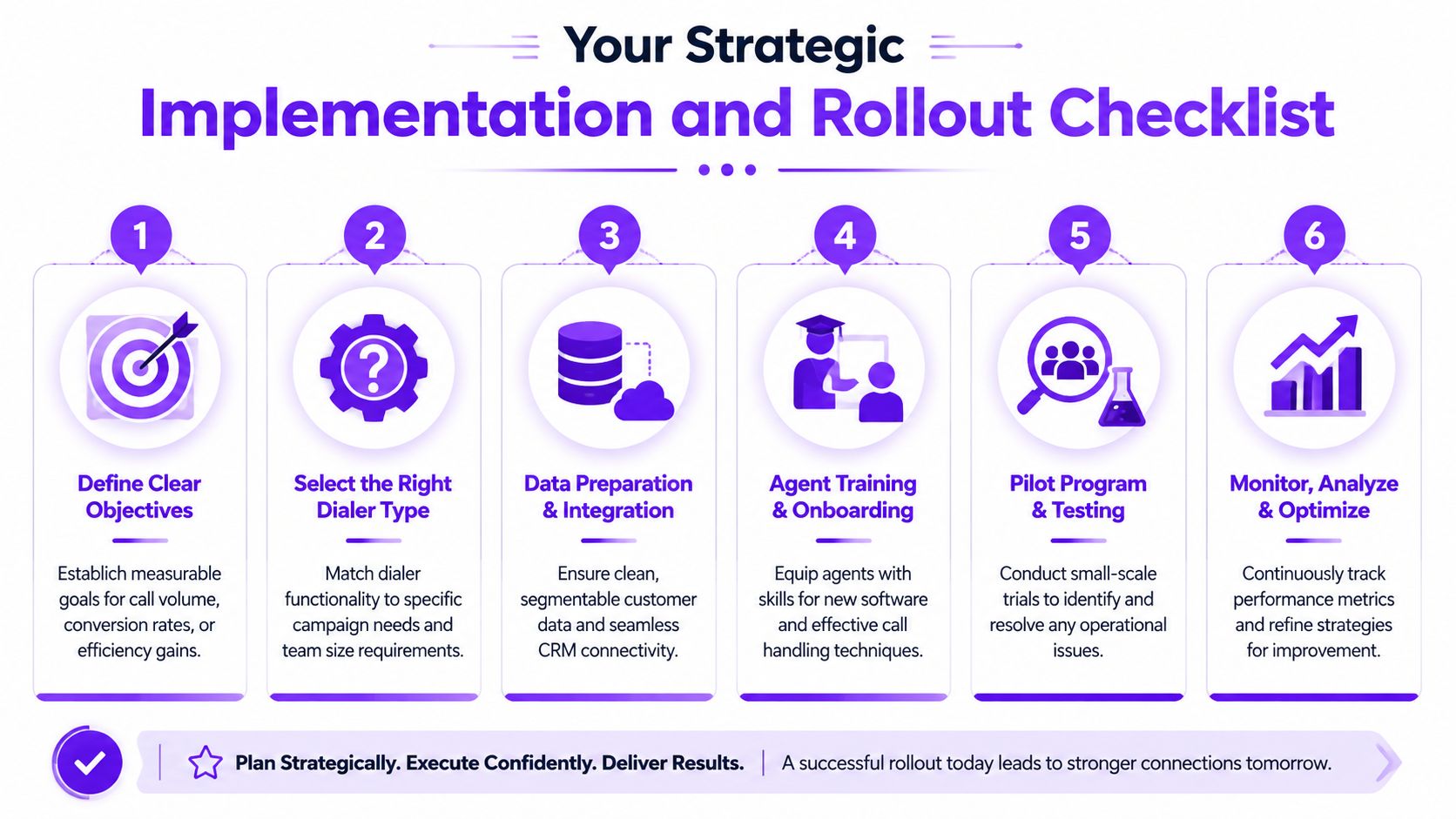
Deployment should start with one well-defined campaign, not a company-wide switch. That pilot should have a clear business purpose such as admissions follow-up, site-visit booking, KYC callback management, or demo scheduling. If the use case is vague, the rollout usually becomes a software training exercise rather than an operational upgrade.
Next, clean the data. Bad list hygiene, duplicate records, and weak disposition rules can make a good platform look ineffective. Agents should know exactly how to code outcomes, when to reschedule, and how to trigger follow-up actions.
Then focus on execution:
- Define measurable objectives. Choose the business outcome first. That might be better lead coverage, faster callbacks, or more scheduled appointments.
- Map scripts to call intent. Counselling, collections, reminders, and premium sales all need different openings and call logic.
- Train managers, not just agents. Supervisors need to understand pacing, reporting, QA review, and escalation rules.
- Run a controlled pilot. Compare output quality and workflow friction before broader deployment.
- Review call data weekly. Look for routing gaps, script weakness, and avoidable agent idle time.
- Refine before scaling. A disciplined pilot teaches more than a rushed launch across multiple teams.
Good implementations don't begin with “turn it on”. They begin with “what operating problem are we fixing, and how will we know it worked?”
For boards and leadership teams, the final takeaway is straightforward. Auto dialer software should be approved like any other revenue-adjacent operating system. It needs a clear use case, local compliance fit, workflow integration, and a management cadence for optimisation. Without those, automation only speeds up inconsistency.
If your organisation is exploring compliant, scalable voice automation for qualification, customer support, recruitment, or presales, DialNexa Labs Private Limited helps teams deploy human-like Voice AI agents designed for Indian workflows. The platform is built for sectors such as EdTech, BFSI, real estate, healthcare, e-commerce, and SaaS, giving leadership teams a practical path from repetitive calling to structured, conversion-ready conversations at scale.

[…] This is also where AI voice agents change the economics. Legacy dialers improved call volume. AI-enabled outbound programs can screen intent, handle basic qualification, collect structured responses, and pass only qualified or sensitive conversations to human agents. That shifts the management question from "How many calls did we place?" to "Which conversations required skilled human time, and which could be resolved earlier in the workflow?" Teams comparing options often start with dial speed, then realise the bigger decision is how much of the conversation stack should be automated. A practical reference point is this guide to auto dialer software and calling workflows. […]
A well-structured look at how auto dialer software can improve productivity, lead conversion, and operational control across Indian businesses. The focus on choosing the right dialer type, ROI, CRM integration, and compliance makes this highly practical for decision-makers.
This is a well-structured guide that clearly explains how auto dialer software can improve productivity, conversion, compliance, and operational control. The comparison of different dialer types and their practical business use cases makes the content especially helpful for CXOs evaluating the right solution.
This is a great breakdown of how auto dialer software can improve productivity, lead follow-ups, and operational efficiency. I especially liked the focus on choosing the right dialer based on business needs and compliance.
A strong and practical overview of how auto dialer software can improve productivity, follow-up consistency, and revenue operations. I especially liked the focus on choosing the right dialer type and balancing efficiency with compliance for Indian businesses.