

Auto Dialer Calls: A CXO’s Guide to Scaling Outreach
Your revenue team is probably doing one of two bad things right now. Either agents are wasting prime selling hours on manual dialling, voicemail dead ends, and duplicate follow-ups, or your automation is running faster than your compliance controls can keep up. Both scenarios cost money. One leaks productivity slowly. The other creates legal and brand risk at scale.
Senior leaders usually spot the symptom first. Pipeline coverage looks thin despite a full team. Contact rates feel inconsistent across regions. Collections, counselling, booking, or follow-up campaigns generate activity but not enough qualified conversations. The fix isn't “buy a dialer”. The fix is to treat auto dialer calls as an operating model decision tied to revenue, labour efficiency, and risk control.
Table of Contents
- Beyond Manual Dials The Strategic Case for Auto Dialer Calls
- How an Auto Dialer Works A Primer for Leaders
- Choosing Your Engine The Four Types of Auto Dialers
- Auto Dialers in Action Strategic Use Cases for Indian Industries
- Navigating Compliance in India and the US TRAI and TCPA
- KPIs That Matter Measuring Auto Dialer Performance for ROI
- The Next Leap DialNexa's Human-Like Voice AI
Beyond Manual Dials The Strategic Case for Auto Dialer Calls
A Sales VP in an EdTech firm doesn't complain that agents can't dial fast enough. They complain that fresh leads go cold before anyone speaks to them. A collections head in BFSI doesn't complain about keyboards. They complain that agents spend too much time on unreachable records and too little time on borrowers who might pay. That's the core problem. Manual outreach turns skilled staff into switchboard operators.
Auto dialer calls fix that only when leadership frames the investment correctly. This isn't a telephony purchase. It's a throughput decision. You are reallocating labour from low-value call handling mechanics to revenue-bearing conversations, service resolution, and relationship management.
Practical rule: If your agents are paid for judgement, persuasion, empathy, or compliance-sensitive handling, they shouldn't spend their day punching numbers.
The strongest operations teams also understand that the dialer sits inside a broader contact centre architecture. Queueing, routing, reporting, and CRM sync matter as much as the dial mode itself. If your leadership team is reviewing options, this round-up of expert advice on contact centre systems is worth reading because it puts the phone system in its proper operational context rather than treating it as a standalone gadget.
Executive value comes from three places:
- Revenue lift: More live conversations per agent means more opportunities to qualify, book, recover, or close.
- Cost control: Automation removes repetitive pre-call work that doesn't need human judgement.
- Governance: The right dial strategy can reduce risky calling behaviour instead of amplifying it.
The mistake is buying for volume alone. Boards should ask a harder question. Which calling model gives our teams more high-quality conversations without creating avoidable compliance exposure?
How an Auto Dialer Works A Primer for Leaders
An auto dialer is best understood as an assembly line for conversations. Your CRM or lead list supplies the numbers. The platform places outbound calls automatically. It identifies what happened on each attempt, such as a live answer, no answer, voicemail, busy signal, or failed connection. It then routes live calls to an available agent or applies the next rule in the workflow.
The assembly line for conversations
In a manual workflow, an agent does five jobs before their core work even begins. They open the lead record, find the number, dial it, wait through ringing, and log the outcome. Only after that can they have the conversation they were hired to have.
With auto dialer calls, software takes over most of that pre-conversation labour.
- List ingestion: The system pulls contacts from your CRM, campaign file, or workflow queue.
- Dial execution: It places calls automatically based on the selected dial mode.
- Outcome detection: It records whether the call reached a person, machine, voicemail, or failed state.
- Routing: If the call connects, it passes the live contact to an available agent or to the next automation layer.
- Disposition logging: The result is written back into your records for follow-up logic and audit trails.
That's why platform design matters. You're not just buying outbound calling. You're buying workflow compression.
A useful reference point is this guide to an automated calling system, which explains how automation shifts teams from repetitive dial tasks to structured outreach operations.
What leadership should care about
Leaders don't need to master every technical setting, but they do need to understand the commercial effect of each moving part.
| Operating layer | What the system does | What it changes for the business |
|---|---|---|
| Contact source | Pulls from lists, queues, or CRM workflows | Determines list quality and targeting discipline |
| Dial logic | Controls call pacing and timing | Shapes agent productivity and customer experience |
| Detection | Interprets answer states and call outcomes | Affects wasted effort and workflow accuracy |
| Routing | Connects answered calls to available agents | Drives speed-to-conversation |
| Logging | Captures outcomes and timestamps | Supports optimisation and compliance evidence |
Leaders should care less about whether a vendor says “AI-powered” and more about whether the platform reliably converts call attempts into useful conversations.
Small efficiencies compound into significant gains. If every agent skips the dead time between call attempts, the organisation gains more talk time, better data capture, and cleaner follow-up sequencing without increasing headcount.
Choosing Your Engine The Four Types of Auto Dialers
Selecting the wrong dialer type creates friction immediately. You'll either throttle good agents with clumsy pacing or push customers into dead air and abandoned calls. The right choice depends on the value of each lead, the complexity of each conversation, and the level of compliance control you need.
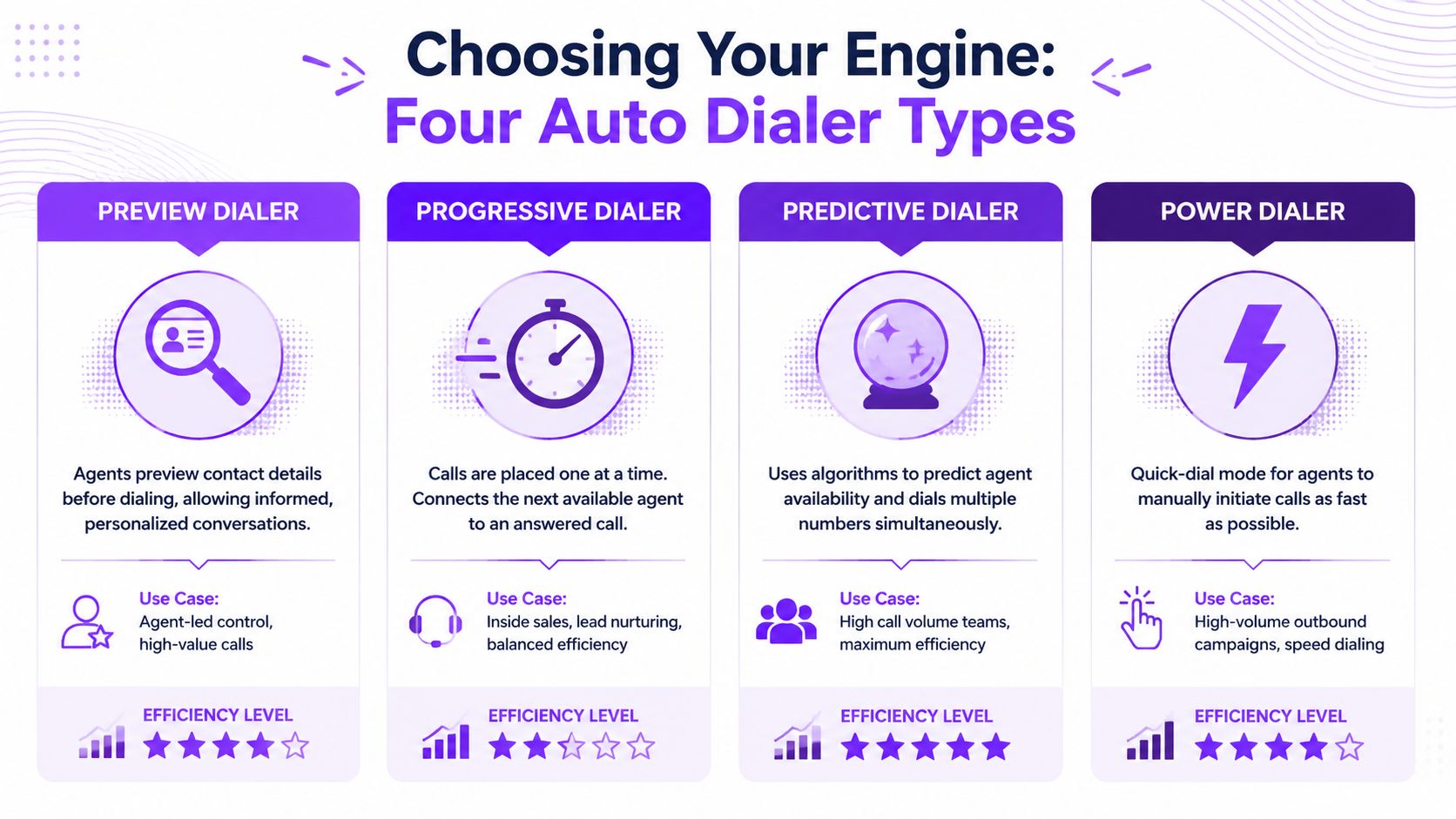
Preview dialer
A preview dialer shows the agent the customer record before the call begins. The rep decides when to launch the call. This is the right model when context matters more than speed.
Use it for high-consideration sales, premium real estate, complex financial products, alumni fundraising, or any workflow where the caller needs to review history, source, notes, and objections before speaking.
The trade-off is obvious. You get stronger conversations, but lower throughput.
Progressive dialer
A progressive dialer waits until an agent is available, then places the next call automatically. It balances efficiency with control and is often the safest mainstream option for businesses that want automation without the aggressiveness of predictive pacing.
This works well for BFSI reminders, programme counselling, reactivation campaigns, and service follow-ups where every answered call needs a human present immediately.
Its strategic advantage is discipline. It reduces the chance of awkward pauses after answer and gives operations teams more predictable staffing logic.
Predictive dialer
A predictive dialer places calls ahead of agent availability based on expected answer rates. The system tries to maximise agent talk time by assuming some calls won't connect and some agents will finish in time for the next answered call.
This is the classic volume engine. It fits top-of-funnel outreach, broad lead pools, and standardised scripts.
It also carries the sharpest operational trade-off:
- Higher efficiency potential: Agents can spend more time in active conversation.
- Greater pacing sensitivity: If answer rates jump unexpectedly, some contacts may experience silence or abandonment.
- Stricter oversight requirement: Bad tuning can damage both compliance posture and brand perception.
Power dialer
A power dialer typically dials one contact after another for a specific agent, as soon as that agent is ready. It keeps the rep in rhythm without the aggressive concurrency of predictive systems.
For inside sales teams, broker desks, and follow-up specialists, this is often the most practical compromise. The agent stays productive, every connected call has a ready human, and the workflow remains simple to manage.
Choose dialers based on lead economics. If each lead is expensive or strategically important, favour control. If the list is broad and the conversation is standardised, favour measured automation.
A board-level summary looks like this:
| Dialer type | Best for | Main strength | Main risk |
|---|---|---|---|
| Preview | High-value and context-heavy calls | Better preparation | Lower volume |
| Progressive | Balanced outreach programmes | Controlled efficiency | Less aggressive throughput |
| Predictive | Large-scale outbound campaigns | Maximum conversation density | Abandonment and CX risk |
| Power | Agent-owned sales sequences | Consistent pace | Limited scaling versus predictive |
Auto Dialers in Action Strategic Use Cases for Indian Industries
A board approves an auto dialer rollout. Lead volume rises. Agent utilisation looks better for two weeks. Then conversion stalls, complaints increase, and compliance questions reach legal. The problem is rarely the dialer itself. The problem is using the same calling model across industries with very different revenue economics, customer expectations, and regulatory exposure.
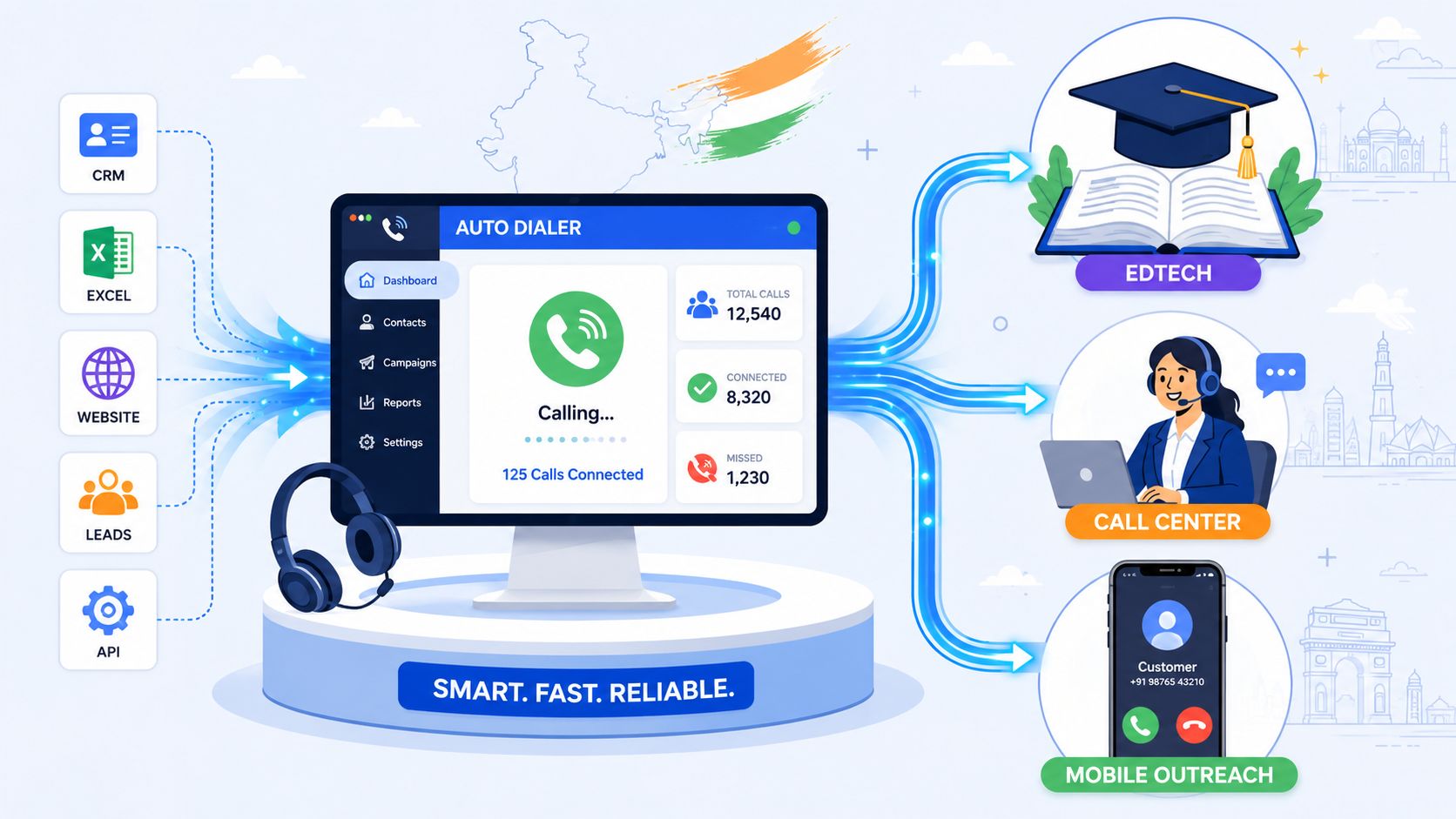
In India, volume-first outbound strategy fails fast. Telecom controls, consent enforcement, variable answer behaviour, and retry limits all reduce the value of brute-force dialling. Executives should treat auto dialer calls as a capacity allocation system. Put scarce call attempts into segments with the highest revenue probability, the lowest compliance risk, or the strongest recovery value.
EdTech should optimise for speed-to-lead and counsellor utilisation
EdTech economics are simple. The first qualified conversation carries far more value than the fifth generic follow-up. If a prospect requests course details, scholarship information, or counselling support, the dialer should push that lead to the front of the queue immediately.
A progressive or power dialer usually fits best because it protects the handoff between inquiry and counsellor. Every live answer reaches a prepared human, which improves contact quality and reduces wasted media spend on leads that go cold while waiting.
Use automation in layers. Fresh form fills, callback requests, and re-engagement leads should run on different rules, with different retry windows and different agent skill mapping. For outreach teams that need reminder campaigns or early-stage qualification before a counsellor steps in, a structured bulk voice call workflow helps separate low-value repetition from high-value conversations.
BFSI should prioritise auditability over raw dial volume
In BFSI, a fast dialer with weak controls is a liability. Payment reminders, renewal prompts, policy servicing, collections support, and KYC follow-ups all need clean records, consistent dispositions, and disciplined retry logic.
That is why controlled pacing wins. Progressive workflows usually outperform aggressive predictive setups in regulated financial outreach because they reduce abandoned calls, keep agent availability aligned with live connects, and produce better logs for compliance review. The outcome that matters is not more attempts. It is more valid conversations with documentation that stands up to internal audit and customer disputes.
This also improves cost efficiency. Fewer failed handoffs mean less agent idle time, fewer repeat contacts caused by poor dispositioning, and lower rework for operations teams.
Real estate should favour context-rich outreach over campaign scale
Real estate buyers do not behave like commodity leads. One prospect wants a brochure. Another wants financing details. Another is ready to book a site visit this week. Treating all three the same destroys conversion efficiency.
Preview and power dialers are usually the better choice here because agents need context before the call starts. Project type, budget band, geography, source campaign, and prior engagement should be visible before the first sentence. That preparation raises appointment quality and lowers the chance that expensive leads are wasted on generic scripts. Building that context starts with disciplined real estate calling data practices, since preview and power dialers are only as useful as the lead fields they can display.
Local execution also matters. Answer rates, ring duration, and carrier behaviour vary across Indian networks, so teams should test pacing, retry timing, and call windows on live campaign data instead of relying on default vendor settings. If a provider cannot explain how its system handles Indian traffic conditions and consent-sensitive outreach, it is not ready for revenue-critical use.
Choose the use case before you choose the dialer mode. Revenue teams should buy higher connect quality, lower handling cost, and stronger compliance control, not just more calls per day.
Navigating Compliance in India and the US TRAI and TCPA
A board approves an outbound automation rollout. Call volume rises in week one. By week six, legal is reviewing consent records, operations is explaining abandoned calls, and finance is recalculating the business case because avoidable compliance failures are eroding margin. That is how poorly governed auto dialer calls destroy ROI.
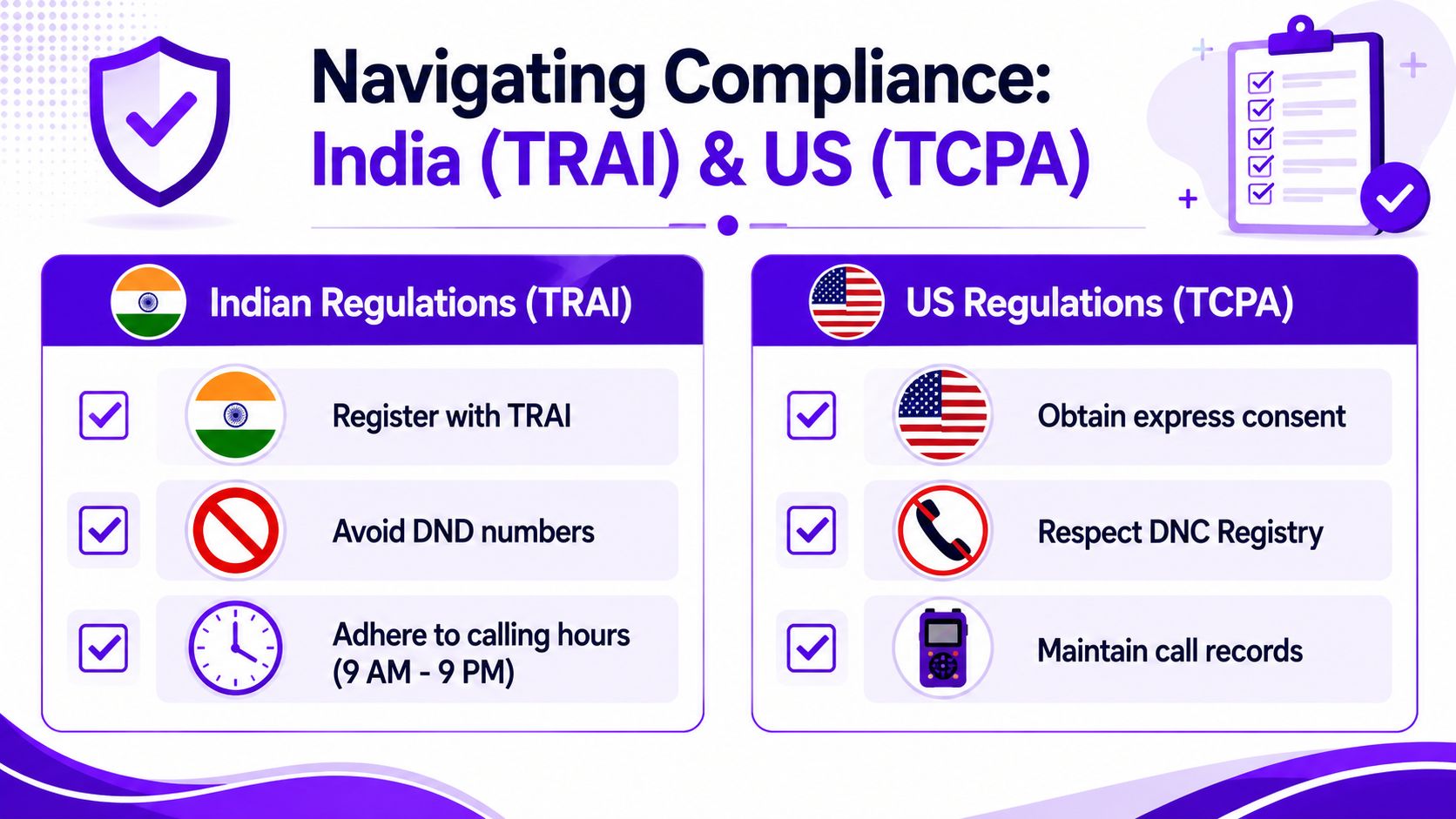
India demands operational control, not just technical setup
In India, compliance starts with campaign design. Pacing, consent status, list classification, retry logic, and call timing all affect whether an outbound program stays productive without creating regulatory exposure. Teams that treat these settings as routine vendor configuration make expensive mistakes.
TRAI's historical cap on abandoned calls matters because it forces discipline into dialer strategy. If your pacing logic outruns agent availability, the problem is not only customer irritation. It is a direct operating risk that can trigger complaints, waste lead inventory, and weaken brand trust.
For a deeper breakdown of how pacing, number-series routing, and calling-window enforcement should work together, see this outbound dialer software compliance guide.
Classification risk is just as serious. Educational institutions, real estate firms, lenders, and other high-volume outreach teams often struggle to separate promotional calls from service or transactional communication. That confusion leads to poor suppression logic and weak consent handling. The result is predictable. More disputes, more escalations, and more friction with DND-sensitive audiences. For a useful breakdown of how these rules are tightening around automated outreach and AI calling, see this analysis of India's voice bot regulations and compliance trends in AI.
Board recommendations:
- Require campaign-level compliance rules before launch: Define consent basis, call purpose, retry limits, and approved time windows for every campaign.
- Audit abandonment and disposition trails weekly: Timestamped logs for answered, abandoned, failed, callback, and suppressed calls should be reviewable by operations and compliance.
- Use India-specific tuning: Carrier behaviour, answer patterns, and network congestion differ by region and operator. Default settings are not an acceptable operating model.
A dialer should reduce labour cost per conversation while keeping complaint risk contained. If it cannot do both, it is not ready for scaled deployment.
In the US, consent records and system architecture drive legal exposure
US compliance turns on two executive questions. What exactly does the platform do, and can you prove the customer agreed to the contact?
The legal definition of an autodialer narrowed after Facebook v. Duguid. The U.S. Supreme Court held that equipment must use a random or sequential number generator to fall within the TCPA's autodialer definition, which materially changes platform risk analysis for systems calling from stored lists, as explained in this review of the TCPA autodialer rule.
That ruling did not remove consent obligations for telemarketing. The FCC states that telemarketing calls using an autodialer or an artificial or prerecorded voice to wireless numbers require prior express written consent, and TCPA violations can carry penalties of $500 per violation or up to $1,500 for willful or knowing violations, according to the FCC's Telephone Consumer Protection Act overview.
This is a governance issue before it becomes a legal one. If your organisation cannot produce consent records, suppression history, opt-out handling, and call-routing logic on demand, your compliance posture is weak regardless of how efficient the dialer appears on a vendor demo.
One practical standard works across both markets. Build the operating model so legal review, auditability, and performance reporting are part of the workflow from day one. The same discipline used in measuring outreach efficiency, similar to how field-service firms track key performance indicators for contractors, should apply to consent quality, suppression accuracy, abandonment control, and complaint volume.
KPIs That Matter Measuring Auto Dialer Performance for ROI
A board approves an auto dialer program. Six months later, call volume is up, payroll is unchanged, complaints are creeping higher, and no one can prove whether revenue improved. That is a reporting failure, not a dialing failure.
Executives should judge auto dialer calls on three outcomes. Revenue produced per reachable lead. Labour cost removed from low-value manual work. Compliance risk contained at the campaign level. Total calls placed belongs on an operations report, not in the ROI case.
Stop reporting vanity metrics
Use a KPI stack that shows cause and effect. If connect rate falls, the problem usually sits in list quality, call timing, caller ID reputation, or carrier routing. If agent utilisation rises while conversion quality drops, the dialer is pushing more low-intent conversations into expensive human time. If abandonment rises, pacing is misaligned with staffing and supervision.
Abandonment deserves board visibility because it affects both risk and efficiency. As noted earlier, Indian operations must keep pace settings within TRAI expectations. The smart operating choice is simple. Set campaign rules so compliance limits are built into pacing, then judge the dialer on how much live talk time and qualified pipeline it creates inside those limits.
Track a short list of metrics that management can act on:
- Connect rate: Measures whether data quality, call timing, and network configuration are producing live answers.
- Agent utilisation rate: Shows whether paid agent hours are going to conversations instead of idle time.
- Qualified conversion rate: Ties answered calls to sales-ready leads, appointments, collections promises, or other commercial outcomes.
- Cost per qualified lead or cost per acquisition: Shows whether automation is improving unit economics.
- Abandonment rate: Flags pacing problems early and gives compliance teams a direct control metric.
- Revenue per completed conversation: Tells finance whether better connect mechanics are translating into commercial return.
Build an executive dashboard that changes behaviour
A useful dashboard should force operating decisions. Which lead sources deserve more budget. Which campaigns need tighter pacing. Which shifts, geographies, or agent pods convert best. Which lists should be suppressed because they create complaint risk without enough revenue upside.
That same discipline appears in adjacent operating environments. Teams using structured scorecards, such as these key performance indicators for contractors, make better decisions because they separate workload from business outcome. Outbound calling should be managed the same way.
Report fewer numbers. Demand tighter accountability.
Every campaign owner should explain the link between list source, dial mode, answer rate, qualified outcome rate, cost per outcome, and complaint or abandonment levels. If they cannot explain that chain, they are managing activity, not ROI. That is the difference between a dialer that lowers cost and one that scales waste.
The Next Leap DialNexa's Human-Like Voice AI
A board approves an auto dialer rollout to cut calling costs. Three months later, the team is still paying for idle agent time, uneven lead qualification, and inconsistent first-call handling. The problem is not call volume. The problem is that traditional dialers stop at connection, while revenue and compliance exposure are decided in the conversation that follows.
Why Voice AI changes the economics
Human-like Voice AI changes the operating model. It answers immediately, follows a defined conversation path, captures intent and key details, and sends only qualified or exception cases to human teams. That cuts wasted labour at the top of the funnel and gives trained agents more time for objection handling, complex service issues, and conversion work.
This matters most in high-volume environments where first-touch calls are repetitive but still commercially important. Banks, insurers, healthcare networks, recruiters, and large sales teams do not need more dialing capacity alone. They need a lower cost per productive conversation and tighter control over what happens on every answered call.
The conversion case is straightforward. Better response speed, tighter script adherence, and consistent qualification improve the odds that a live contact turns into a booked meeting, verified lead, payment commitment, or support resolution. The process also becomes easier to audit, which matters when leadership is trying to balance growth against TRAI and TCPA exposure.
The strongest programmes are built around customer effort, not novelty. If you are assessing conversational automation, this perspective on reducing lead friction is useful because it ties AI performance to conversion bottlenecks instead of feature checklists.
DialNexa presents its Voice AI as a way to improve connect quality, qualification consistency, and downstream booking performance. The strategic point is sound. Once AI can manage the first conversation well, an auto dialer stops being just a throughput tool and becomes a margin tool.
A product demo shows the shift more clearly than any feature list.
DialNexa Labs Private Limited helps teams deploy human-like Voice AI agents for qualification, customer support, recruitment, presales, reminders, and follow-ups at scale. If your organisation wants more from auto dialer calls than faster dialling, DialNexa can help you improve reach, consistency, and operational efficiency without adding avoidable complexity.

Excellent insights on how auto dialers should be viewed as a strategic business decision rather than just a technology purchase. The focus on ROI, compliance, and industry-specific implementation makes this a highly valuable resource for modern revenue teams.
This is a clear and practical breakdown of how auto dialers can improve agent productivity, lead response, and compliance. The industry-specific examples make it especially useful for understanding the right dialer strategy.
A valuable overview of how auto dialers can improve productivity, conversation quality, and operational efficiency when aligned with the right business use case. The focus on dialer selection, industry-specific strategies, CRM integration, and compliance makes this especially practical for leadership teams.