
10 Conversational AI Examples: Drive ROI in 2026
By 2025, 95% of customer interactions are projected to be powered by AI chatbots, and these systems are expected to handle 85% of interactions without human intervention, according to Superhuman's chatbot market analysis. That matters because conversational AI examples are no longer side projects for support teams. They're becoming the operating layer for sales, service, onboarding, and retention.
For executives, the strategic question isn't whether conversational AI is real. It's where it produces the fastest operational payoff without creating compliance, brand, or customer-experience risk. The strongest deployments share a pattern. They automate high-volume conversations first, connect the agent to business systems second, and keep humans focused on exceptions, not repetition.
This guide focuses on 10 conversational AI examples that matter in practice. Each one pairs a realistic business scenario with a sample dialogue snippet, the clearest available performance evidence, and adaptation tips that leadership teams can use to design their own rollout. The examples span real estate, education, banking, e-commerce, software, hiring, healthcare, hospitality, and cross-functional operations.
Underneath every one of these examples sits the same underlying voice assistant architecture, the layered pipeline of speech recognition, dialogue management, and response generation that determines how naturally the agent handles a real conversation.
If email overload is part of the same automation agenda, it's also worth looking at how teams build AI email agents alongside voice and chat workflows.
Table of Contents
- 1. Real Estate Lead Qualification and Site-Visit Booking at Scale
- 2. EdTech Student Enrollment and Program Counseling Automation
- 3. BFSI Customer Support and KYC Verification Automation
- 4. E-Commerce Customer Support and Returns Processing
- 5. Software and SaaS Presales Demo Scheduling and Product Qualification
- 6. Recruitment and Candidate Screening Automation
- 7. Healthcare Patient Appointment Booking and Pre-Visit Triage
- 8. Hospitality Reservation and Guest Services Automation
- 9. Cross-Industry Use Cases and ROI Summary
- 10. Implementation Checklist and Best Practices
- Top 10 Conversational AI Use Cases Comparison
- Turning Insights into Action
1. Real Estate Lead Qualification and Site-Visit Booking at Scale
Real estate is one of the clearest conversational AI examples because speed and persistence directly affect revenue. When buyers enquire after hours, a voice agent can capture budget, location, property type, financing intent, and visit availability before a human broker even logs in.
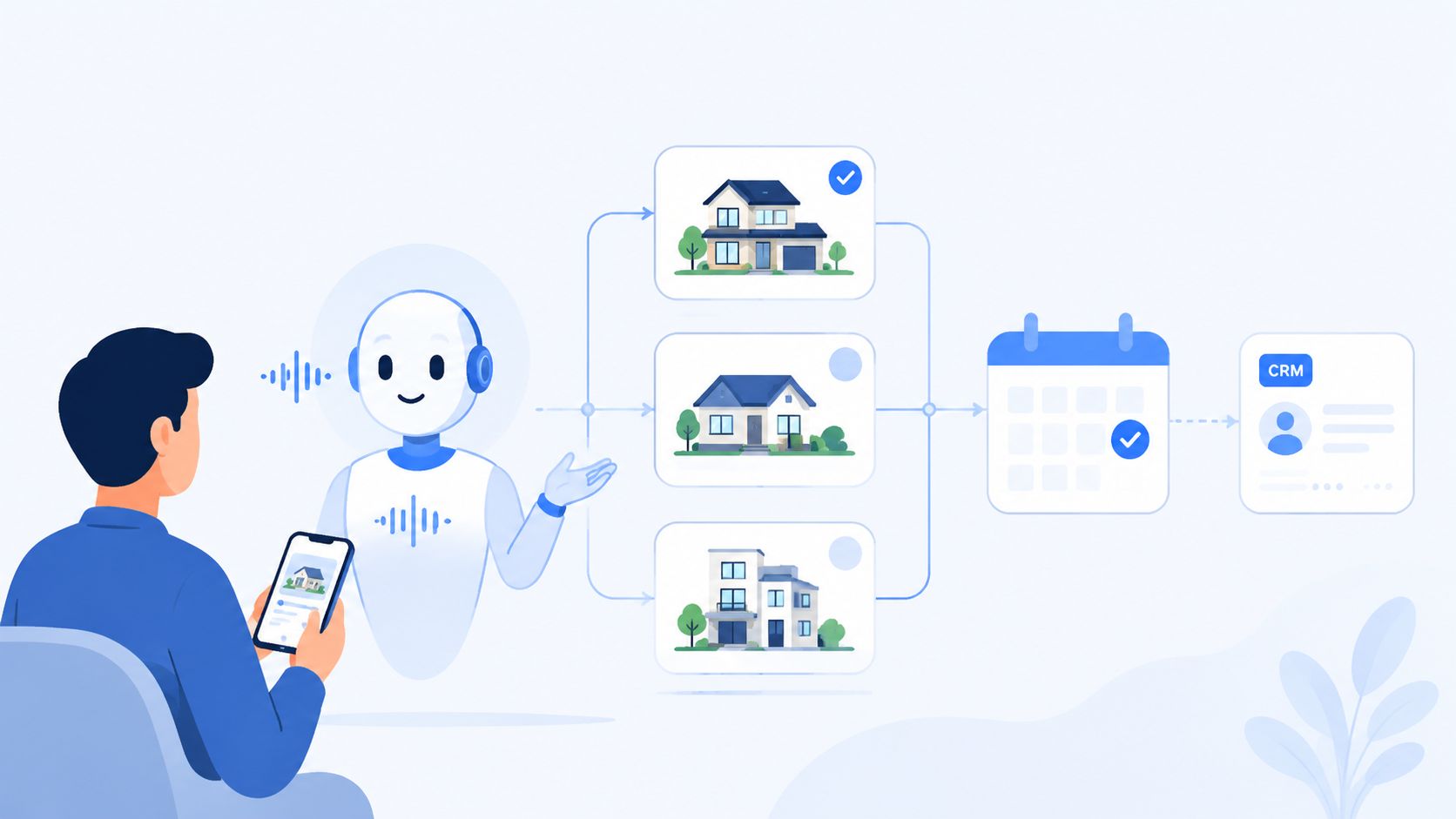
In Indian deployments, conversational AI for property discovery and site-visit booking has reached a 91% connect rate, cut routine qualification costs by 60% to 70%, and improved lead-to-booking from 2% to 8% in multilingual voice workflows, according to Voice.ai coverage cited by DialNexa. For CXOs, that combination matters more than novelty. It means the same system can expand top-of-funnel coverage while reducing labour intensity in the middle of the funnel.
What high-performing property workflows look like
A practical dialogue often starts:
Prospect: “I'm looking for a 2BHK near Whitefield under my budget.”
Agent: “I can help with that. Are you buying for self-use or investment, and when would you like to visit shortlisted properties?”
That exchange does three jobs at once. It qualifies intent, narrows inventory, and moves the conversation towards a calendar event.
Another striking benchmark comes from HOABL. Its conversational AI agent Priya sold 1,419 homes valued at ₹640 crore with zero sales teams, no site visits, and minimal human involvement, based on the founder's public presentation. That result isn't a universal template, but it shows what happens when the agent isn't limited to FAQ handling.
A useful implementation reference for teams evaluating this model is this guide to an AI voice agent for real estate.
For a product walkthrough, this short demo is useful:
Adaptation tips for operators
- Map inventory first: Load live property status, budget bands, micro-market names, and site-visit slots into the agent before launch.
- Qualify in tiers: Start with budget, location, property type, and purchase timeline. Add financing and family-size questions later.
- Close the loop fast: Schedule an automatic follow-up within 24 hours if the prospect doesn't confirm the visit.
2. EdTech Student Enrollment and Program Counseling Automation
Education leaders don't need a generic chatbot. They need an agent that can hold a credible advisory conversation, screen seriousness, answer programme-fit questions, and route strong prospects to counsellors while preserving context.
The strongest EdTech conversational AI examples work because they mirror an admissions conversation instead of a support script. The agent asks where the learner is in their career, what outcome they want, whether they need flexibility, and what constraints could block enrolment. That's very different from “press 1 for fees”.
A counselling flow that scales without sounding robotic
A realistic exchange might sound like this:
Student: “I work full-time and want to move into analytics.”
Agent: “Got it. Are you looking for a short certificate to build job-ready skills, or a longer programme that supports a formal career transition?”
That wording matters. It frames programme selection around outcomes, not catalogue browsing.
For executive teams, the operational upside is consistency. Every prospect gets the same baseline discovery. Counsellors then spend their time on motivated applicants with a recorded summary of goals, objections, financing concerns, and preferred callback windows.
Strong enrolment agents don't replace admissions staff. They remove repetitive intake so staff can focus on conversion and trust-building.
How education leaders should adapt it
- Build decision paths around intent: Separate career-switchers, upskillers, degree-seekers, and employer-sponsored learners.
- Train for objections: Tuition, time commitment, academic readiness, and job outcomes need clear, approved responses.
- Route with context: Pass transcript summaries and fit signals to advisors so the student never has to repeat themselves.
EdTech operators should also tune scripts around seasonality. Enquiry behaviour changes sharply during intake windows, scholarship pushes, and exam-result periods. If your voice agent sounds identical year-round, it will miss the emotional context of the buying decision.
3. BFSI Customer Support and KYC Verification Automation
Banking and insurance leaders have less margin for error than most sectors. That's why the best BFSI conversational AI examples combine natural dialogue with rigid workflow control, especially in KYC, onboarding, eligibility screening, and complex service queries.
In the BFSI sector, banks using conversational AI for complex enquiries reduced average handling time by 40%, achieved 98% brand-aligned accuracy, and reported a 5× increase in review coverage, according to Nurix's BFSI analysis. Those outcomes are strategically important because they connect customer experience, compliance discipline, and operational efficiency in one motion.
Where financial institutions are getting measurable gains
A strong voice flow can verify identity with biometric voice samples, run OCR on government IDs, and screen product eligibility using income and creditworthiness signals during the same interaction, as described in the same Nurix analysis. That turns a call into an onboarding workflow, not just a conversation log.
A simple script could begin like this:
Customer: “I want to open an account, but I'm not sure what documents I need.”
Agent: “I can guide you. I'll first confirm your identity requirements, then check which account types fit your profile.”
That sequence lowers friction because the customer hears a process, not a policy recital.
For teams exploring adjacent banking applications, this overview of chatbots in banking is a useful operational reference.
What to implement first
- Separate compliance paths: Standard, enhanced, and high-risk verification should use distinct conversation logic.
- Log every step: Auditability isn't optional in KYC, disputes, or onboarding exceptions.
- Escalate edge cases early: Unusual customer profiles, document mismatches, or sanction-screening flags should move quickly to human review.
4. E-Commerce Customer Support and Returns Processing
Returns are where many retail support teams bleed time. Customers want speed, policy clarity, and a resolution that doesn't require repeating order details across channels. That makes returns one of the most commercially useful conversational AI examples in e-commerce.
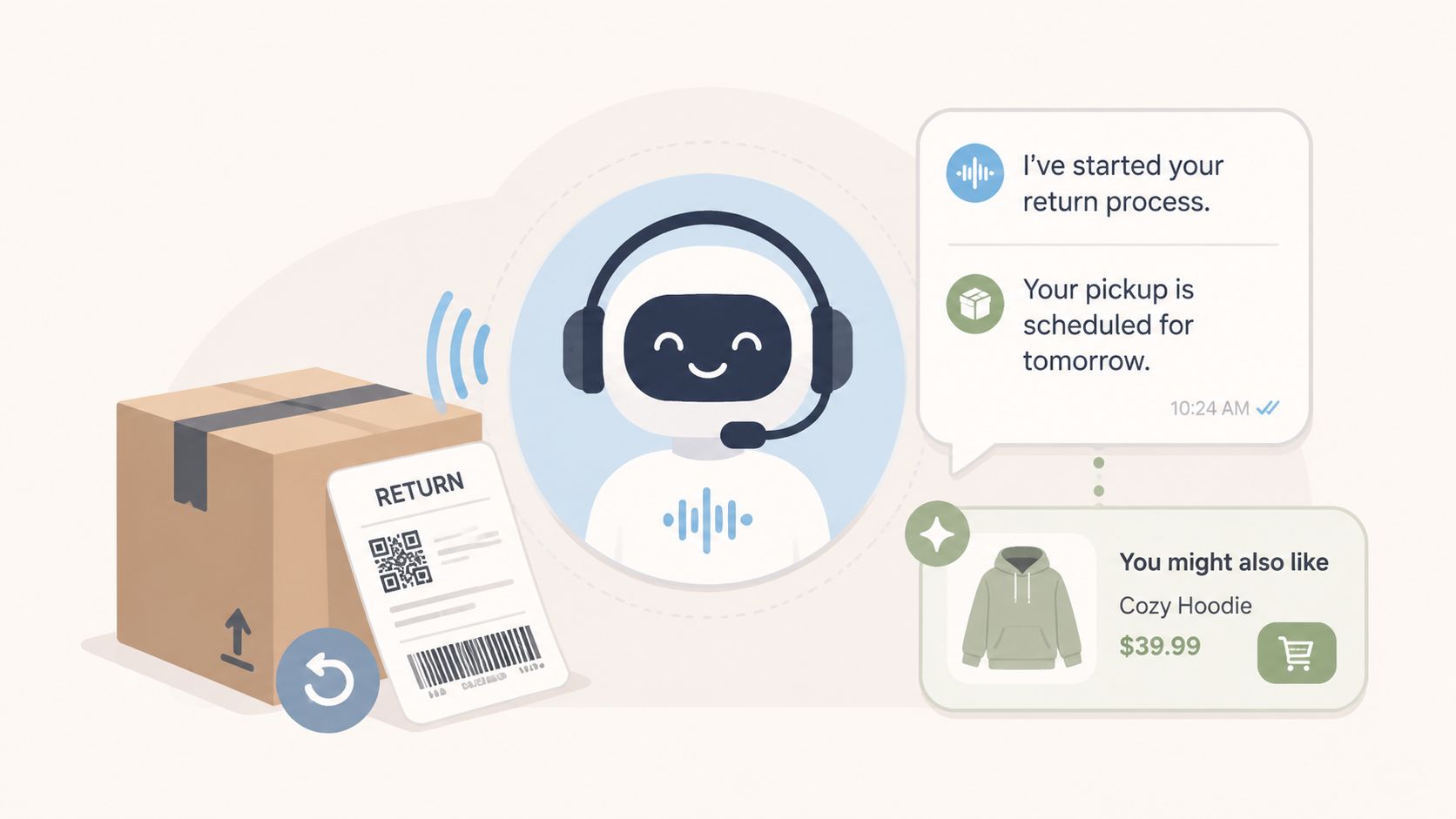
The strategic value goes beyond deflection. A well-designed agent can identify the customer, pull the order, check eligibility, issue the next step, and protect margin by offering exchanges or store credit where appropriate. That shortens handle time while preserving goodwill.
Why returns are the fastest path to value
A typical interaction might be:
Customer: “My order arrived, but the size doesn't fit.”
Agent: “I've found your order. This item is eligible for return. Would you prefer an exchange, a refund, or help finding the right size first?”
That last clause matters. It turns a cost centre moment into a retention opportunity.
The strongest operating model also connects support data back to merchandising. If the same conversation appears repeatedly around fit, colour mismatch, or damaged packaging, product and fulfilment teams should see it quickly. Conversational AI becomes a feedback sensor, not just a service layer.
A practical design pattern
- Start with high-frequency intents: Returns, refund status, shipping updates, and damaged-item claims usually deliver the fastest payback.
- Connect the core systems: The agent needs order management, inventory status, refund rules, and notification triggers.
- Detect frustration early: Escalation logic should recognise repeated questions, negative sentiment, or policy disputes before the interaction deteriorates.
For retail leaders, the executive lesson is simple. If the agent can't take action inside your commerce stack, it won't produce meaningful value. It will only talk about work that humans still have to do.
5. Software and SaaS Presales Demo Scheduling and Product Qualification
Software companies often waste expensive sales capacity on weak-fit demos. Presales agents fix that by qualifying intent before an account executive or solutions engineer joins the conversation.
This is one of the most effective conversational AI examples for revenue teams because the workflow is structured. Buyers usually reveal company size, use case, timeline, incumbent tools, and urgency within the first few exchanges. When the agent captures that cleanly, calendars fill with better opportunities, not just more meetings.
What a strong presales agent sounds like
A realistic exchange:
Buyer: “We're exploring tools for customer support automation.”
Agent: “Understood. Are you replacing an existing platform, or evaluating this for the first time, and how large is the support team you need to support?”
That question qualifies maturity and complexity in one step.
The best SaaS teams use this approach to route prospects differently by segment. Enterprise buyers need integration and security discovery. SMB buyers usually care more about speed, pricing fit, and immediate use cases. One generic flow won't serve both well.
Operating principle: Qualification should reduce seller effort, not create another conversational layer that buyers have to fight through.
Execution guidance for revenue leaders
- Segment the path: Build separate qualification flows for enterprise, mid-market, and SMB.
- Capture objections before the demo: Pricing sensitivity, migration concerns, and missing-feature questions should be logged in advance.
- Protect intent windows: Offer scheduling while interest is highest, ideally during the same interaction.
For CXOs, the hidden gain is forecast quality. Once demo booking is standardised, leadership gets cleaner data on which channels, buyer profiles, and use cases convert into serious pipeline.
6. Recruitment and Candidate Screening Automation
Hiring teams rarely struggle with finding conversations. They struggle with managing volume without slowing down or introducing inconsistency. That's why screening is one of the most practical conversational AI examples for internal operations.
A voice agent can conduct first-round screening, confirm work eligibility, gather notice-period details, test basic role fit, and schedule interviews. Recruiters then review structured outputs instead of chasing every inbound applicant manually.
Where screening agents fit best
A simple screening sequence might sound like this:
Agent: “Thanks for applying. Before we schedule the next step, can I confirm your current role, total experience, and whether you're open to a hybrid work model?”
Candidate: “I'm a customer support executive with three years' experience and yes, hybrid works.”
That's enough to determine whether the candidate should move forward, be parked, or be redirected.
The best early deployments focus on repeatable roles where baseline criteria are clear. Customer support, inside sales, operations, and back-office hiring tend to fit this model better than highly specialised executive searches.
A helpful reference for this use case is this guide on how AI voice agents can streamline HR job interviews and improve candidate selection.
How hiring teams can adapt the model
- Start with standardised hiring: Use roles with clear knockout questions and high applicant volume.
- Separate score types: Keep role-fit, logistics, and communication quality as distinct signals.
- Be transparent with candidates: Tell them what the conversation is for and what happens next.
The executive benefit isn't just lower recruiter workload. It's a more consistent top-of-funnel hiring process, which improves fairness and speed at the same time when deployed carefully.
7. Healthcare Patient Appointment Booking and Pre-Visit Triage
Healthcare has some of the clearest service opportunities for conversational AI, but it also has the highest stakes. Booking and triage flows need to be fast, understandable, and designed for patients who may already be stressed, confused, or underserved.
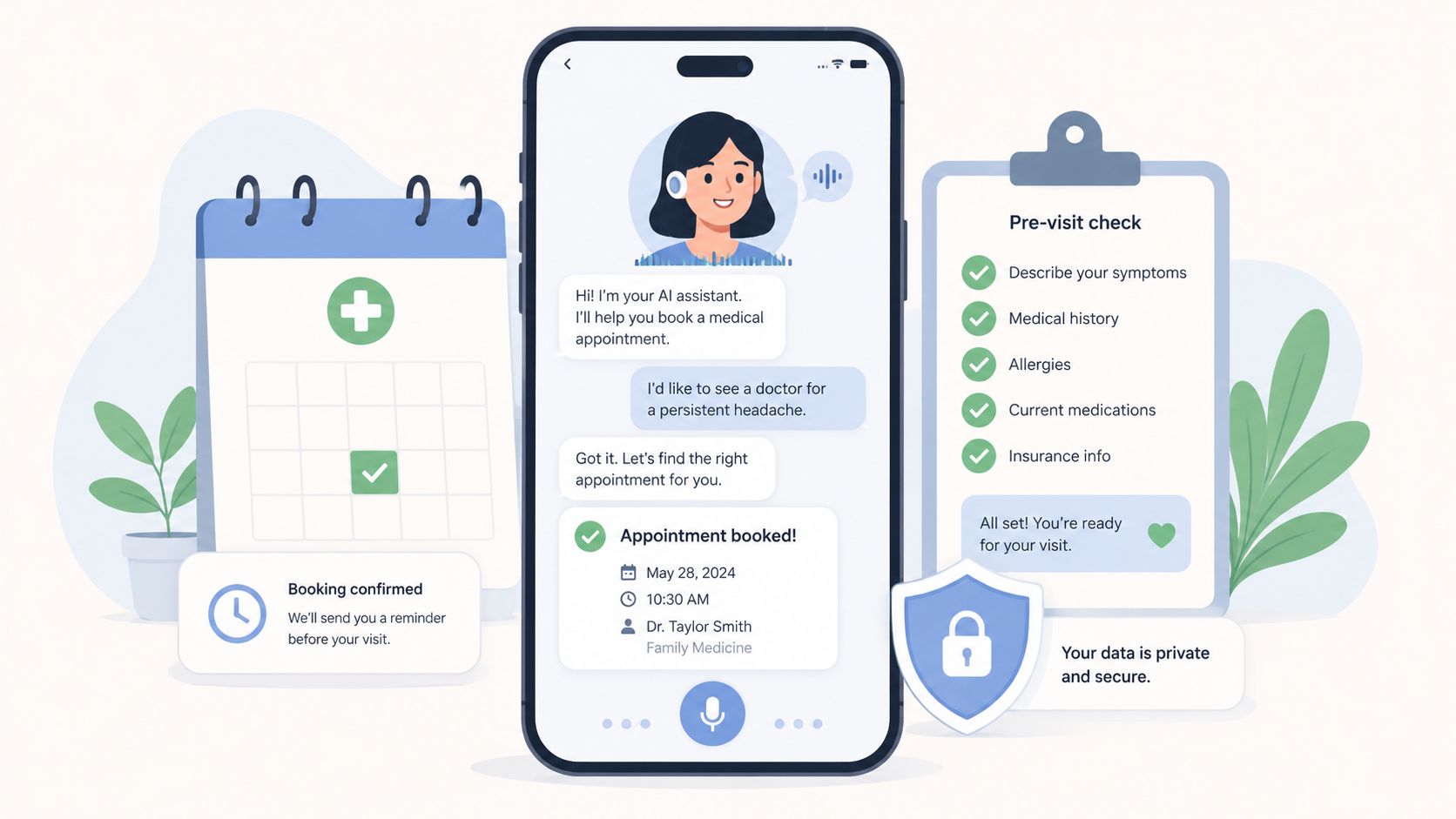
Twilio notes a critical gap in many healthcare examples. Its analysis highlights that 40% of minoritised populations face delayed care because of systemic barriers, and it argues that conversational AI should be intentionally designed to reduce disparities in underserved communities through equity-focused needs assessment and community-informed design, as explained in Twilio's healthcare use-case discussion. That's a strategic point, not a design footnote.
The healthcare lesson most vendors miss
A booking conversation might start like this:
Patient: “I need to see someone about recurring chest discomfort.”
Agent: “I can help with next steps. If this feels severe or urgent, seek emergency care immediately. Otherwise, I can ask a few questions to route you appropriately.”
That response does two jobs. It supports triage and sets a safety boundary.
The same Twilio analysis also notes that 75% of current vendor case studies fail to mention how models were validated with underserved user groups. For healthcare executives, that should influence procurement and governance. A polished demo isn't enough if the model hasn't been tested for accessibility across language, disability, and community context.
Operational guidance for care delivery teams
- Align scripts with clinical intake: Triage prompts should mirror approved care pathways.
- Design for accessibility: Language choice, pacing, and channel flexibility matter as much as the model itself.
- Escalate safely: Complex symptoms, medication risks, or urgent indicators must route cleanly to clinicians.
Healthcare organisations that are also modernising hiring workflows may find adjacent value in this guide to AI hiring tools, especially when staffing and patient access challenges overlap.
8. Hospitality Reservation and Guest Services Automation
Hospitality teams don't just manage bookings. They manage expectations, preferences, changes, and moments that shape reviews. That makes conversational AI especially useful when it's connected to reservation systems and service workflows, not isolated as a marketing widget.
A strong reservation agent can take a booking, capture arrival time, note dietary or accessibility needs, and coordinate upgrades or special requests. In hotels, restaurants, and venues, the value comes from consistency. Every guest gets the same baseline attentiveness, even during peak hours.
A reservation flow that improves service consistency
A realistic interaction might sound like this:
Guest: “I need a room for two nights and I'll arrive late.”
Agent: “I can arrange that. Do you also want me to note a late check-in and any room preferences before I confirm availability?”
That's effective because it bundles booking and service preparation in one exchange.
For operators, conversational AI outperforms basic booking forms. The agent can ask follow-up questions naturally and store usable operational context. Front-desk teams, restaurant hosts, and concierge staff then begin with a clearer picture of what the guest needs.
The best hospitality agents don't just fill slots. They reduce service variability before the guest arrives.
How operators should tailor deployment
- Build preference memory: Repeat guests expect the system to remember room type, seating preferences, or loyalty status.
- Prioritise service categories: Separate urgent requests from routine requests and pre-arrival planning.
- Connect local knowledge carefully: Recommendations should be curated and on-brand, not improvised.
In hospitality, the ROI often shows up in smoother operations first. Revenue gains follow when service reliability improves and staff spend less time on repetitive reservation logistics.
9. Cross-Industry Use Cases and ROI Summary
The broad market data now confirms that conversational AI has moved beyond experimentation. Grand View Research estimates the global conversational AI market at $14.3 billion in 2025 and projects it will reach $78.9 billion by 2033, with a 23.8% CAGR from 2026 onward, while also noting that conversational AI in contact centres is projected to save $80 billion in labour expenses by the end of 2026 and that 92% of companies have already implemented AI-powered solutions, including conversational tools like chatbots and sentiment analysis, in its conversational AI market report. For executives, that combination signals two things. Adoption is broad, and the strongest financial case still centres on operations.
The macro picture executives should care about
Across sectors, the repeatable use cases look remarkably similar:
- Qualification: Leads, applicants, patients, and prospects are filtered before humans engage.
- Scheduling: Site visits, demos, interviews, appointments, and reservations move faster.
- Verification: Identity, eligibility, and compliance checks become more consistent.
- Support: Routine service interactions are resolved without queue build-up.
- Triage: Urgent or high-value cases are prioritised earlier.
The business model is the same even when the industry changes. Use AI for structured, high-volume dialogue. Keep people for exceptions, trust-building, and judgment.
What these conversational AI examples have in common
The most effective deployments share four traits. They're connected to source systems, they have clear escalation rules, they measure business outcomes instead of only containment, and they treat script design as an operating discipline.
For teams extending this strategy into messaging, one adjacent play is to build AI agents for WhatsApp where customers already expect rapid, conversational responses.
10. Implementation Checklist and Best Practices
Most failed deployments don't fail because the model can't talk. They fail because the business never defined the workflow clearly enough. Executives should treat rollout as an operating change with technical components, not a software experiment.
A rollout sequence that reduces risk
Start narrow. Pick one workflow with high volume, stable rules, and measurable outcomes. Real estate qualification, returns processing, appointment booking, and candidate screening usually fit that pattern better than highly ambiguous service cases.
Then map the workflow in order. What data does the agent need, which systems must it read or write to, where are the escalation points, and what language is approved for edge cases? If those answers aren't explicit, the launch will drift.
- Scope one journey: Avoid bundling support, sales, and onboarding into the first release.
- Map data dependencies: Inventory, calendars, CRM fields, policy rules, and identity checks must be accessible.
- Define handoffs: Humans need transcript summaries, next actions, and customer context at the moment of transfer.
The metrics that actually matter
The most useful metrics depend on the workflow. Revenue teams should watch qualification quality, speed-to-contact, appointment conversion, and show rates. Service teams should watch resolution quality, escalation accuracy, and repeat-contact reduction. Compliance-heavy teams should watch exception handling, auditability, and policy adherence.
A mid-sized real estate firm in Pune increased site-visit conversions by 32% within 90 days after integrating conversational AI into WhatsApp follow-ups, according to a public LinkedIn case shared by Ashwinder R Singh. The lesson isn't that every team will match that result. It's that disciplined follow-up design often matters as much as the model itself.
Top 10 Conversational AI Use Cases Comparison
| Use case | Implementation Complexity 🔄 | Resource requirements 💡 | Expected outcomes ⭐📊 | Key advantages ⚡ | Ideal use cases |
|---|---|---|---|---|---|
| Real Estate Lead Qualification and Site-Visit Booking at Scale | Medium–High, CRM, inventory & regional compliance setup | Property inventory mapping, CRM/calendar integration, tuning data | Moderate conversion lift (2–8%), CPA ↓35–40%, connect rate ↑47–91% | 24/7 high-volume qualification, structured data capture, reduced agent hours | Large developers, brokerages, high-inquiry listings |
| EdTech Student Enrollment and Program Counseling Automation | Medium, curriculum mapping and prerequisite logic | SIS integration, multilingual content, program documentation | Enrollment ↑3.2–9.8%, time-to-enroll ↓ (14→5 days), cost-per-enrollment ↓~42% | Personalized counseling, warm handoffs, extended hours for prospects | Online programs, bootcamps, continuing education providers |
| BFSI Customer Support and KYC Verification Automation | High, strict regulatory and security requirements | Compliance experts, PCI/HIPAA-grade infra, sanctions DB integration | KYC completion ↑82–96%, onboarding time ↓ (8→2 days), regulatory accuracy ~99.7% | Immutable audit trail, 24/7 secure verification, reduced compliance workload | Banks, fintechs, trading platforms, digital lenders |
| E‑Commerce Customer Support and Returns Processing | Low–Medium, OMS/logistics integration and SKU KB upkeep | Order/fulfillment integration, product knowledge base, fraud rules | First-contact resolution ≈78%, handling time ↓64%, cost/contact ↓~68% | Fast returns/refunds, high-volume handling, upsell opportunities | Fashion, electronics, D2C brands, marketplaces |
| Software & SaaS Presales Demo Scheduling and Qualification | Medium–High, product/competitive mapping & multi‑tier flows | CRM/calendar, demo content, sales handoff protocols | Demo show rate ↑ (41→88%), demo→proposal ↑, sales cycle ↓31% | Filters unqualified leads, richer prospect context, higher show rates | B2B SaaS, enterprise sales with demo workflows |
| Recruitment and Candidate Screening Automation | Medium, role-specific assessments and ATS integration | ATS, screening scripts, privacy & data retention controls | Time-to-hire ↓ (38→18 days), cost-per-hire ↓41%, candidate match ≈94% | Scales first‑round screening, consistent evaluation, reduced bias | High-volume hiring (contact centers, data entry, tech roles) |
| Healthcare Patient Appointment Booking & Pre‑Visit Triage | High, HIPAA, clinical protocols, EHR integration | EHR/practice management integration, clinical triage design | No-show ↓ (23→8%), booking time ↓ (5min→45s), pre-visit completion ~91% | Improves clinical readiness, triage for urgency, 24/7 booking | Clinics, telehealth platforms, multi‑specialty hospitals |
| Hospitality Reservation and Guest Services Automation | Medium, PMS & dynamic pricing integration | Property management integration, guest preference DB, upsell content | Reservation conversion ↑22–47%, average booking value +18%, front‑desk workload ↓44% | 24/7 reservations, personalization, instant service requests | Hotels, restaurants, resorts, event venues |
| Cross‑Industry Use Cases and ROI Summary | Varies, depends on chosen workflow & compliance needs | Core integrations (CRM/ERP/EHR/ATS), scripted flows, analytics | Conversion lifts ~2–156%, cost reductions 35–68%, capacity 200–600+ interactions/day | Reusable patterns: scheduling, verification, triage; fast scaling | Organizations starting pilots on rule‑based high‑volume processes |
| Implementation Checklist and Best Practices | N/A, prescriptive steps to reduce complexity | Stakeholders, data mapping, compliance sign‑off, pilot resources | Faster, lower‑risk rollouts; measurable conversion & compliance metrics | Clear escalation paths, monitoring, A/B testing, iterative tuning | Any org planning voice AI pilots and phased rollouts |
Turning Insights into Action
The most valuable conversational AI examples aren't the flashiest ones. They're the ones that remove delay from a business process that already matters. Property teams need to qualify and schedule faster. Admissions teams need to counsel at scale without losing context. Banks need better verification and lower handling time. Retail teams need to resolve returns without turning every enquiry into a queue. Hiring teams need structured screening. Care teams need booking and triage flows that are accessible and safe.
That's the common thread across the examples above. Conversational AI creates value when it sits inside a real workflow with a clear business owner, a connected system stack, and measurable outcomes. If the agent can't read the right data, trigger the next action, or escalate intelligently, it won't produce executive-grade results. It will merely automate a conversation about work that still happens somewhere else.
The right starting point is usually narrower than leadership expects. Choose a high-volume journey with repeatable logic and real operational pain. Define the script structure, data fields, escalation thresholds, and success metrics before the pilot starts. Then test aggressively. A/B testing opening language, routing criteria, callback timing, and follow-up prompts often reveals that performance changes come from operational design choices, not just from model quality.
This also changes governance. Customer experience, operations, compliance, and technology leaders need shared ownership. The script is a policy surface. The handoff flow is a service design decision. The analytics layer is an operating dashboard. Teams that separate those responsibilities too sharply tend to create brittle deployments that sound good in demos and underperform in production.
A strong pilot should answer a short list of executive questions. Did the system reduce manual workload in a measurable way? Did it maintain quality standards? Did it improve conversion, access, or resolution speed in the target workflow? Did it hand off exceptions cleanly? If the answer is yes, expand horizontally into adjacent journeys that use the same underlying assets, such as identity checks, scheduling logic, CRM updates, or multilingual support.
For organisations evaluating platforms, DialNexa Labs Private Limited is one relevant option in this category. The company focuses on voice AI agents for qualification, support, recruitment, and presales workflows across sectors including EdTech, BFSI, real estate, hospitality, e-commerce, and software.
The strategic opportunity for 2026 isn't just to deploy conversational AI. It's to institutionalise it where conversations already determine revenue, service quality, and operating cost. Start with one workflow that matters, instrument it properly, and scale from evidence, not enthusiasm.
If you want to turn these conversational AI examples into a working rollout, DialNexa Labs Private Limited offers voice AI agents for qualification, customer support, recruitment, presales, and sector-specific workflows. Teams can use it to design and deploy custom call flows, connect operational systems, and pilot automation in real estate, BFSI, EdTech, software, hospitality, e-commerce, and healthcare-facing booking environments.

A great overview of how conversational AI can deliver real business value across real estate, EdTech, BFSI, e-commerce, and SaaS. The practical workflows and focus on qualification, automation, and better customer experiences make the examples highly useful.
This is a great overview of how conversational AI can deliver practical value across real estate, EdTech, BFSI, e-commerce, and SaaS. The realistic workflow examples and focus on qualification, automation, personalization, and measurable outcomes make the content especially useful for business leaders.
A great overview of how conversational AI can move beyond simple automation and become part of real business workflows. The focus on context, intelligent handoffs, and measurable outcomes makes these use cases especially valuable for growing organisations.