
Intelligent Call Routing: A CXO Guide to Peak Performance
India crossed 1.2 billion telephone subscribers in 2024 and had more than 1.15 billion wireless subscribers, while mobile broadband alone exceeded 930 million connections according to 8×8's overview of intelligent call routing. For a CXO, that statistic changes the conversation. Call routing isn't a telephony setting. It's a capital-allocation decision inside one of the world's largest customer-interaction environments.
At this scale, a small improvement in how calls are matched, prioritised, and resolved doesn't stay small for long. It compounds across service, sales, collections, admissions, onboarding, and retention. Intelligent call routing matters because it determines whether customers reach someone who can help on the first attempt, or whether the business pays for avoidable transfers, repeat calls, lost opportunities, and lower agent productivity.
A common oversight is where the value comes from. The headline benefit isn't that routing becomes “smarter”. The primary gain is that the organisation starts allocating scarce human expertise with more precision. That improves efficiency, protects revenue, and creates a service experience that slower competitors struggle to match.
Table of Contents
- The High Cost of Unintelligent Call Handling
- Beyond First In First Out What Is Intelligent Call Routing
- The Evolution of Routing Logic From Rules to AI
- The Technology Stack That Powers Smart Routing
- Measuring What Matters KPIs and True ROI
- Intelligent Routing in Action Strategic Industry Use Cases
- Your Implementation Blueprint and Best Practices
The High Cost of Unintelligent Call Handling
India had about 1.3 million contact-centre jobs in 2023, making it one of the world's largest customer-interaction labour markets, according to Bland's analysis of intelligent call routing. That fact matters because routing failures inside a market this large aren't isolated service errors. They become structural operating costs.
A basic queue treats every incoming call as roughly equal and every available agent as roughly interchangeable. Most executive teams know that isn't true. A billing issue, a loan query, a student admission call, and a high-intent property enquiry don't carry the same urgency or commercial value. Yet many organisations still let those calls enter rigid paths shaped by department charts rather than business outcomes.
The financial drag shows up in three places:
- Revenue leakage: Sales or renewal calls lose momentum when a prospect lands with the wrong team and has to repeat context.
- Labour inefficiency: Skilled agents spend time on calls they shouldn't be handling, while better-suited agents sit underused or overloaded unevenly.
- Customer friction: Every transfer raises effort. High-effort journeys weaken trust, particularly in categories where the caller needs certainty, speed, or compliant advice.
Unintelligent routing doesn't just create longer queues. It misallocates your most expensive asset in the contact centre, agent time.
Structured call tracking software closes that gap by turning every routed call into a searchable, auditable record instead of an anecdote.
The issue becomes sharper in India because customer interaction is often multilingual and intent shifts quickly. A caller may begin in English, move to a regional language, and raise a query that requires product expertise or regulatory authority. A simple first-in, first-out model can't interpret that complexity. It can only move calls forward.
Why scale changes the economics
Large enterprises often chase savings through hiring, scheduling, and channel deflection. Those matter. But routing has a different profile. It affects almost every call without requiring more demand to justify the investment.
When the organisation handles high call volumes across product lines, geographies, and customer segments, even modest reductions in transfers and repeat explanations translate into measurable operational relief. The true value lies in the competitive advantage the organisation gains, one that's hard to copy quickly: faster connection between customer intent and agent capability.
That's why intelligent call routing belongs in the same strategic conversation as pricing discipline, conversion operations, and customer retention. It's not back-office plumbing. It's a system for deciding how the business responds when the customer raises a hand.
Beyond First In First Out What Is Intelligent Call Routing
A standard call queue works like a fixed traffic signal. Calls move in preset order, with limited awareness of who the caller is or what outcome is needed. Intelligent call routing works more like a live traffic management system. It uses available signals to choose the best path, not merely the next open lane.
In practical terms, intelligent call routing uses caller information and operational context to decide where a call should go before an agent answers. That can include the caller's number, account history, menu selections, previous interactions, likely intent, language preference, and real-time availability of agents with the right skills.
For leaders who want a clearer baseline, DialNexa's explainer on what call routing is is useful because it separates basic distribution logic from more context-aware approaches.
What makes it “intelligent”
The difference isn't automation alone. Most contact centres already automate some distribution. The difference is decision quality.
An intelligent router asks questions such as:
- Who is calling? Existing customer, prospect, VIP account, applicant, patient, or partner.
- Why are they likely calling? Support issue, complaint, upgrade request, compliance question, counselling enquiry, booking request.
- Who is best placed to resolve it? Not just any free agent, but the one with the highest likelihood of resolving the issue cleanly.
- What should happen if the ideal agent isn't available? Queue, callback, next-best specialist, or escalation path.
Why that matters commercially
A traditional ACD model is built for distribution efficiency. Intelligent call routing is built for resolution efficiency.
That distinction changes how a business performs. Distribution efficiency optimises movement. Resolution efficiency optimises outcomes. CXOs should care about the latter because it influences cost per interaction, service quality, lead progression, and agent productivity all at once.
Practical rule: If your routing logic only asks “who is free?”, you're operating a staffing system. If it asks “who is most likely to resolve or convert this call?”, you're building an operating advantage.
For sales and service teams, that means routing starts before the conversation reaches a human. The system can pre-sort intent, attach context, and deliver the call with enough information for the agent to begin productively. Customers experience that as speed and relevance. Finance sees it as fewer wasted interactions and better use of specialised talent.
The Evolution of Routing Logic From Rules to AI
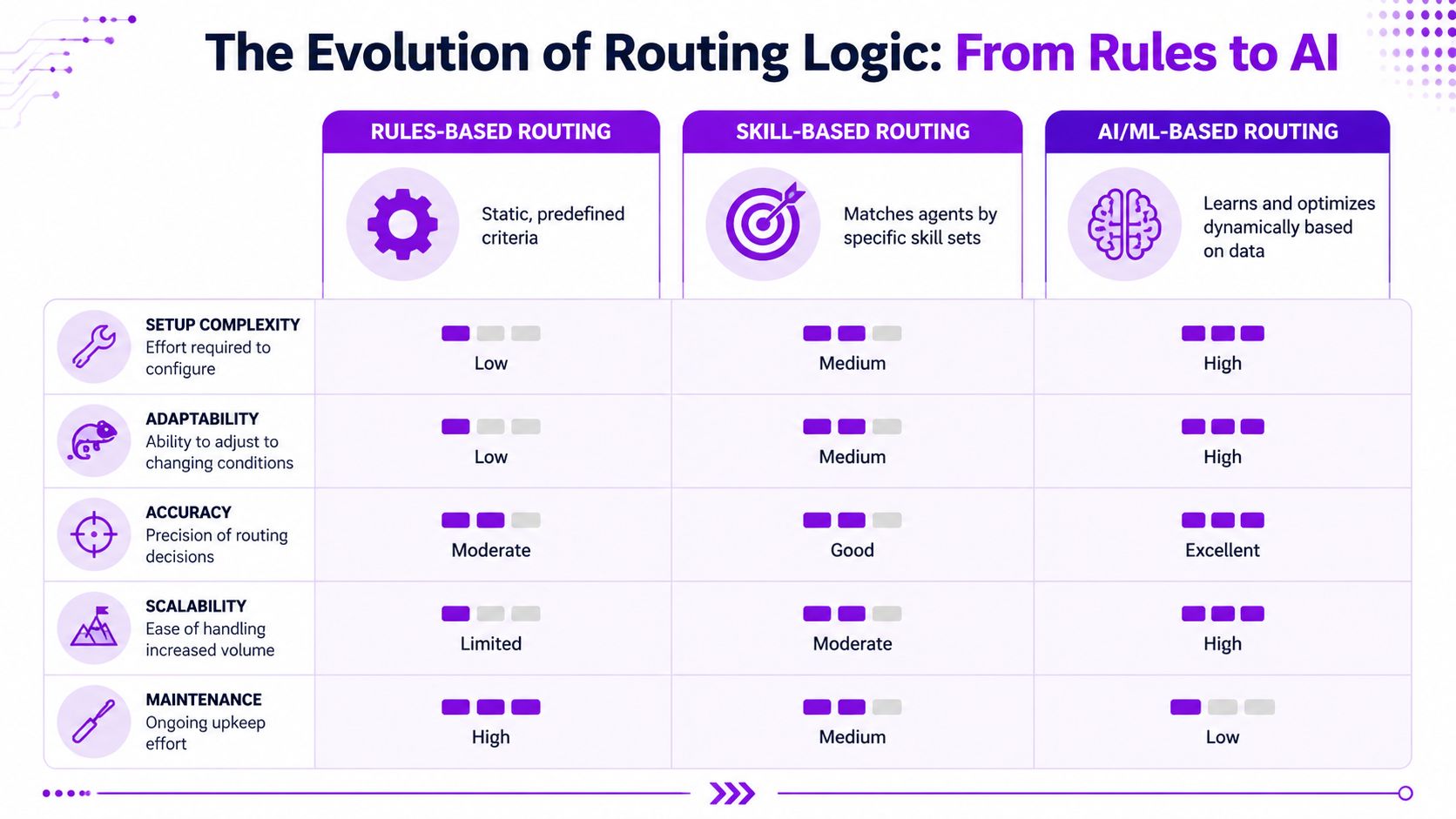
The phrase “intelligent routing” covers very different levels of maturity. Some systems rely on fixed instructions. Others route by skills. More advanced systems use predictive logic to evaluate intent, availability, and likely outcomes in real time. These approaches don't just differ technically. They produce different operating models.
Three models with very different economics
Rules-based routing is the oldest model. It follows static instructions such as time of day, department selected, or geography. This can work in stable environments with limited complexity. The weakness is rigidity. As call types multiply, exceptions pile up and rules become harder to maintain.
Skill-based routing is a material step forward. For India-specific performance design, the most actionable benchmark is to route by skill-based matching and language coverage because systems can analyse agent expertise, certification level, and language fluency to improve the probability of first-contact resolution, as outlined in Zendesk's guidance on intelligent call routing. This is particularly valuable in multilingual consumer and BFSI workflows where the wrong match creates both customer frustration and compliance exposure.
AI or ML-driven routing adds prediction. Instead of relying only on declared rules or static skill tags, the system uses patterns from caller signals and operating data to estimate the best next action. It can weigh intent confidence, queue depth, recent interactions, and fallback paths more dynamically. Teams exploring this operating model often also review AI call centre software to understand how routing, automation, and agent-assist functions fit together.
Comparison of call routing approaches
| Approach | Core Logic | Best For | CX Impact | Scalability |
|---|---|---|---|---|
| Rules-based Routing | Static predefined rules | Simpler operations with limited call types | Predictable but often blunt | Limited as complexity grows |
| Skill-based Routing | Matches calls to agent capabilities | Multilingual, specialised, or regulated environments | Better first-time matching and fewer transfers | Moderate to strong |
| AI or ML-based Routing | Uses multiple signals and predictive decisioning | High-volume, high-variation operations | More adaptive and context-aware | High when supported by clean data |
What a CXO should choose
The right answer depends less on what sounds advanced and more on where the business loses money today.
If the operation is relatively simple, rules-based routing may be enough for now. If the business handles diverse intents, multiple languages, or certified workflows, skill-based routing often delivers the clearest near-term value. If the enterprise is already integrating customer data, agent-state data, and voice or NLP inputs, AI-driven routing can improve allocation decisions at a level static systems can't match consistently.
To support that evaluation, it helps to review platforms that combine call routing and analytics features so the team can see not just where calls go, but how routing choices affect service performance over time.
The strategic mistake is to buy AI first and governance second. Advanced routing only creates an edge when the operating model, data quality, and escalation logic are mature enough to support it.
The Technology Stack That Powers Smart Routing
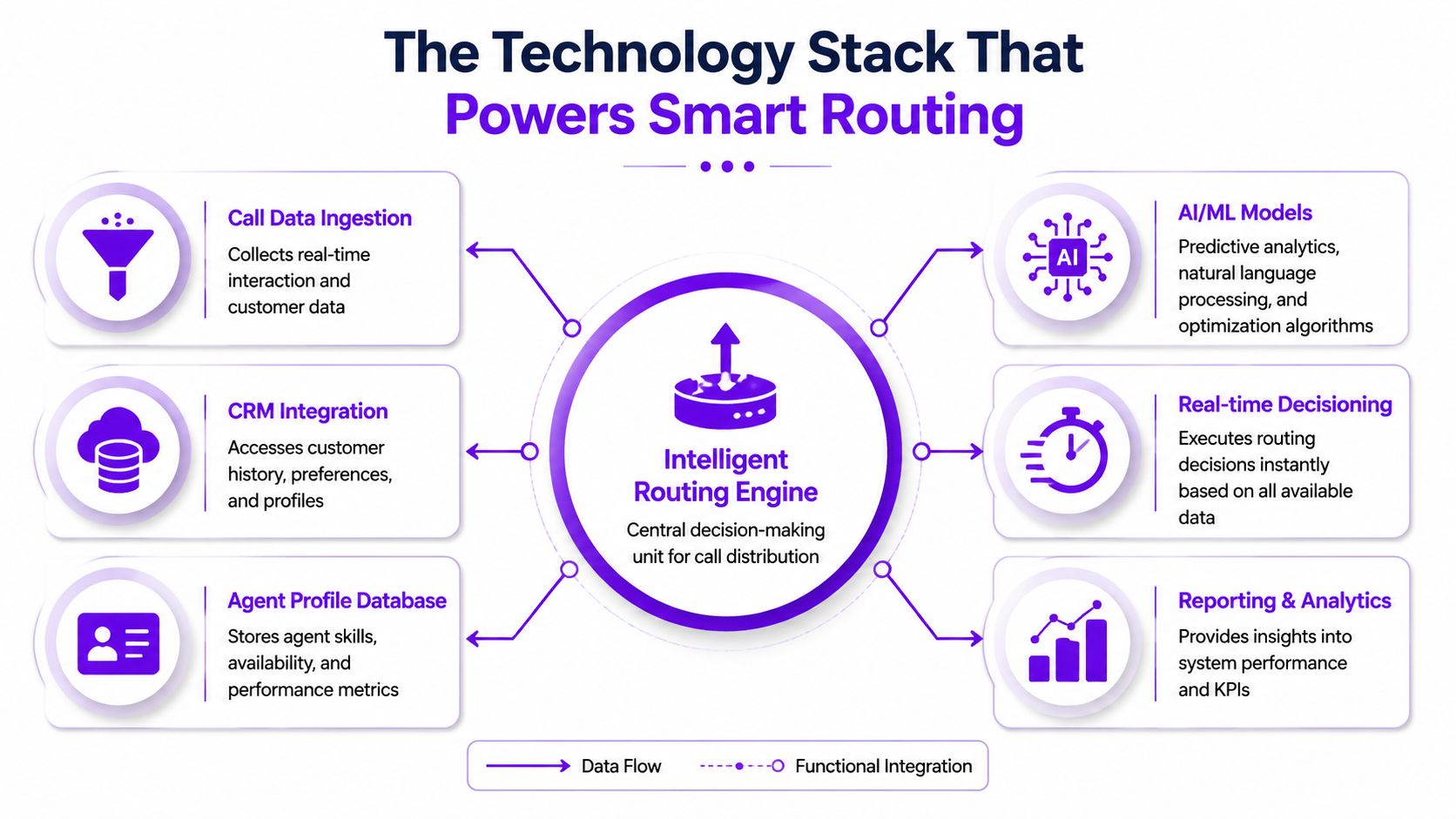
Routing decisions are only as good as the context available in the first few seconds of the call. In practice, that means the stack matters less as a collection of tools and more as a decision system that can turn customer, intent, and workforce signals into a financially better outcome before queue time grows.
The four inputs that make routing decisions useful
A well-integrated stack combines IVR, ANI or CLI lookup, CRM context, and real-time agent-state data to make routing decisions in milliseconds, as described in Whippy's explanation of intelligent call routing. The strategic value is straightforward. Better inputs produce better matches, and better matches improve resolution economics.
- IVR or Voice AI: This identifies intent early and captures only the information needed to route well. The business effect is lower misrouting and less paid agent time spent on triage.
- ANI or CLI lookup: Caller identity connects the interaction to account history, segment, geography, or service tier. That allows the system to prioritise high-value or at-risk customers before a poor experience affects retention or conversion.
- CRM context: CRM data adds commercial memory. The router can distinguish a new prospect from an existing customer, a dormant account, or a caller with an open case, then route based on revenue potential, churn risk, or service obligations.
- Real-time agent-state data: This shows who is available, what each agent is qualified to handle, and where capacity is tightening. That improves utilisation and helps the operation avoid the common trade-off between speed and quality.
Why architecture matters commercially
The financial impact comes from the interaction between these systems, not from any single component. A contact centre that captures intent but cannot access CRM history will still route many callers generically. A contact centre with customer data but no live agent-state feed will often send the right customer to the wrong queue at the wrong moment. Integration quality determines whether routing logic reduces avoidable labour cost or rearranges waiting time.
This is also where many investment cases fail. Enterprises often buy AI features before they fix data flow, taxonomy design, and operational governance. The result is a technically capable routing layer sitting on incomplete or stale inputs. For a CXO, that is not an innovation problem. It is a capital efficiency problem.
A stronger design uses routing as an operating margin tool. Voice workflow software such as DialNexa can support that model by handling pre-qualification or structured intake before handoff, then passing captured intent into the broader call flow. If you are aligning routing improvements with broader contact centre KPI benchmarks, this intake layer helps connect front-end call handling to measurable outcomes such as transfer rate, handle time, and resolution quality.
The same logic applies to analytics. Routing improves faster when teams can trace which signals predict better outcomes by segment, queue, or call reason. That is why disciplines such as marketing data analytics matter beyond marketing. They help operations leaders identify which customer attributes, intent patterns, and staffing conditions should influence routing policy because they correlate with revenue protection, lower service cost, or stronger conversion.
One test separates tactical tooling from strategic infrastructure. Ask whether the routing engine can combine customer context, intent signals, and live workforce data in real time, then learn from the outcome. If the answer is yes, routing becomes a source of competitive advantage. If the answer is no, the organisation still has a queue, just with better branding.
Measuring What Matters KPIs and True ROI
The board doesn't fund routing because a system diagram looks cleaner. It funds routing when the operating metrics move in ways that affect revenue, service cost, and customer retention.
Early in the review process, many teams focus on volume metrics because they're easy to extract. That's a mistake. “Calls handled” rarely tells you whether the system is allocating expertise well. Intelligent call routing should be judged on whether it improves the economics of each interaction.
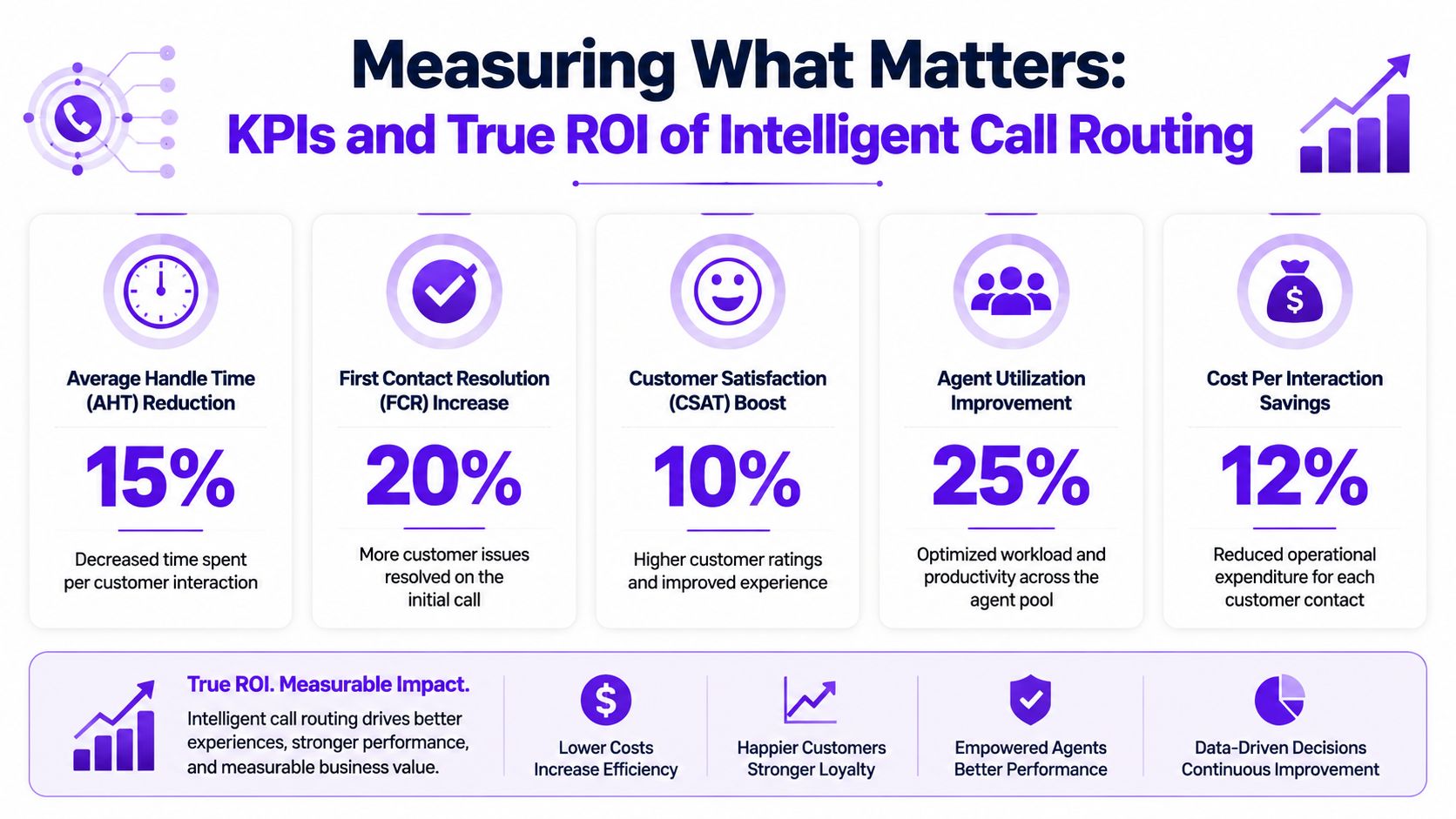
A visual summary helps frame the common KPI categories, even though any executive evaluation should verify metrics against the organisation's own baseline and reporting design.
The KPI set that belongs in the board pack
Start with a narrower set of measures that reveal whether routing is changing outcomes:
- First Contact Resolution: A strong proxy for whether calls are reaching the right person with the right context.
- Transfer rate: High transfers usually indicate weak matching logic or poor skill mapping.
- Average handle time: Useful only when interpreted alongside resolution quality. A shorter call isn't helpful if it creates a repeat contact.
- Call abandonment: A direct signal of queue friction and delay.
- Agent utilisation: Reveals whether specialist capacity is being used intentionally or distorted by blunt queue rules.
- Lead qualification accuracy: Especially relevant in sales, admissions, and real estate workflows where pre-routing intent quality affects conversion.
- Conversion progression: For revenue teams, the right question isn't “Did we answer?” but “Did the call move the customer to the next commercial milestone?”
To make those KPI relationships more actionable, leaders often pair contact-centre metrics with broader marketing data analytics so they can trace how routing quality affects campaign conversion, source quality, and downstream revenue performance.
A more detailed framework for executive reporting sits well alongside contact centre KPI benchmarks and definitions, particularly when finance and operations need a common language.
How to think about ROI without vanity metrics
DialNexa's published company information provides one of the clearer examples of how call-handling intelligence can affect commercial outcomes in adjacent voice workflows. The company states that customers report connect rates rising from 47% to 91%, lead-to-booking improving from 2% to 8%, and AI-qualified leads matching human judgment with 97% accuracy. Those figures are part of the publisher background supplied for this article, not third-party benchmark data.
That matters because it reframes ROI. The return from better routing isn't limited to lower service cost. It can also show up as:
- Better contact quality at the top of funnel
- Higher conversion efficiency in human follow-up
- Lower waste in specialist team capacity
- More consistent handling of routine interactions
This video offers a useful reference point for thinking about how teams operationalise those gains in practice.
When executives evaluate intelligent call routing, the strongest business case usually combines service efficiency with conversion quality. Cost savings alone can undervalue the decision.
The mistake is to seek a single ROI number too early. Intelligent call routing usually affects several linked metrics at once. The better approach is to track how routing quality changes the customer journey from first contact to resolved case or qualified opportunity.
Intelligent Routing in Action Strategic Industry Use Cases
The strongest use cases appear where the cost of a bad match is high. That may mean lost revenue, regulatory risk, or a poor customer experience that damages trust.
EdTech admissions
An admissions operation often receives a mix of enquiries. Some callers want fee details. Others need programme counselling, eligibility guidance, or help deciding between courses. A generic queue treats those intents as equivalent.
Intelligent call routing changes the flow. A voice front end captures the learner's interest area, study level, and urgency, then routes the call to a counsellor aligned to that programme or region. If the caller is returning after an earlier conversation, CRM context can help continue the discussion instead of restarting it.
The commercial gain is straightforward. Counsellors spend more time in relevant conversations and less time re-triaging basic intent. Prospective students experience continuity, which matters in categories where decisions are emotional as well as financial.
BFSI service and compliance
In BFSI, the cost of a bad transfer is higher than inconvenience. Some calls need trained agents with specific authority, product familiarity, or compliance handling. A language mismatch or poor handoff can increase risk as well as delay.
Skill-based routing is especially valuable here because the system can route by expertise, certification, language fluency, and availability. A customer with a trading-platform issue, KYC question, or sensitive account request shouldn't land in a generic pool and then be forwarded manually.
The strategic advantage in BFSI isn't just faster service. It's controlled allocation of regulated expertise.
That reduces friction for the customer, but it also protects internal workflows. Supervisors spend less time firefighting escalations that should have been prevented at the routing stage.
Real estate conversion operations
Real estate teams often lose momentum between initial interest and site-visit booking. Incoming calls vary widely. Some are early-stage browsers. Others are high-intent buyers asking about unit type, budget band, possession timeline, or location.
Intelligent routing improves this by separating discovery from closing. A voice workflow can pre-qualify the caller, capture budget and project preference, then route them to the sales representative or project team best positioned to continue the conversation. If the preferred rep is unavailable, the system can apply a next-best fallback rather than forcing the caller through a dead end.
The business effect is not abstract. Sales teams protect their strongest human effort for the most relevant conversations. Customers move faster from enquiry to decision stage. Leadership gets cleaner operational visibility into which call types deserve specialist coverage.
Across all three industries, the pattern is the same. Intelligent call routing creates value when it allocates limited expertise with intent, not when it merely accelerates call movement.
Your Implementation Blueprint and Best Practices
Most routing projects fail for predictable reasons. Teams overcomplicate the logic, underestimate data quality issues, or launch without clear commercial priorities. Intelligent call routing works best when the rollout sequence is disciplined.
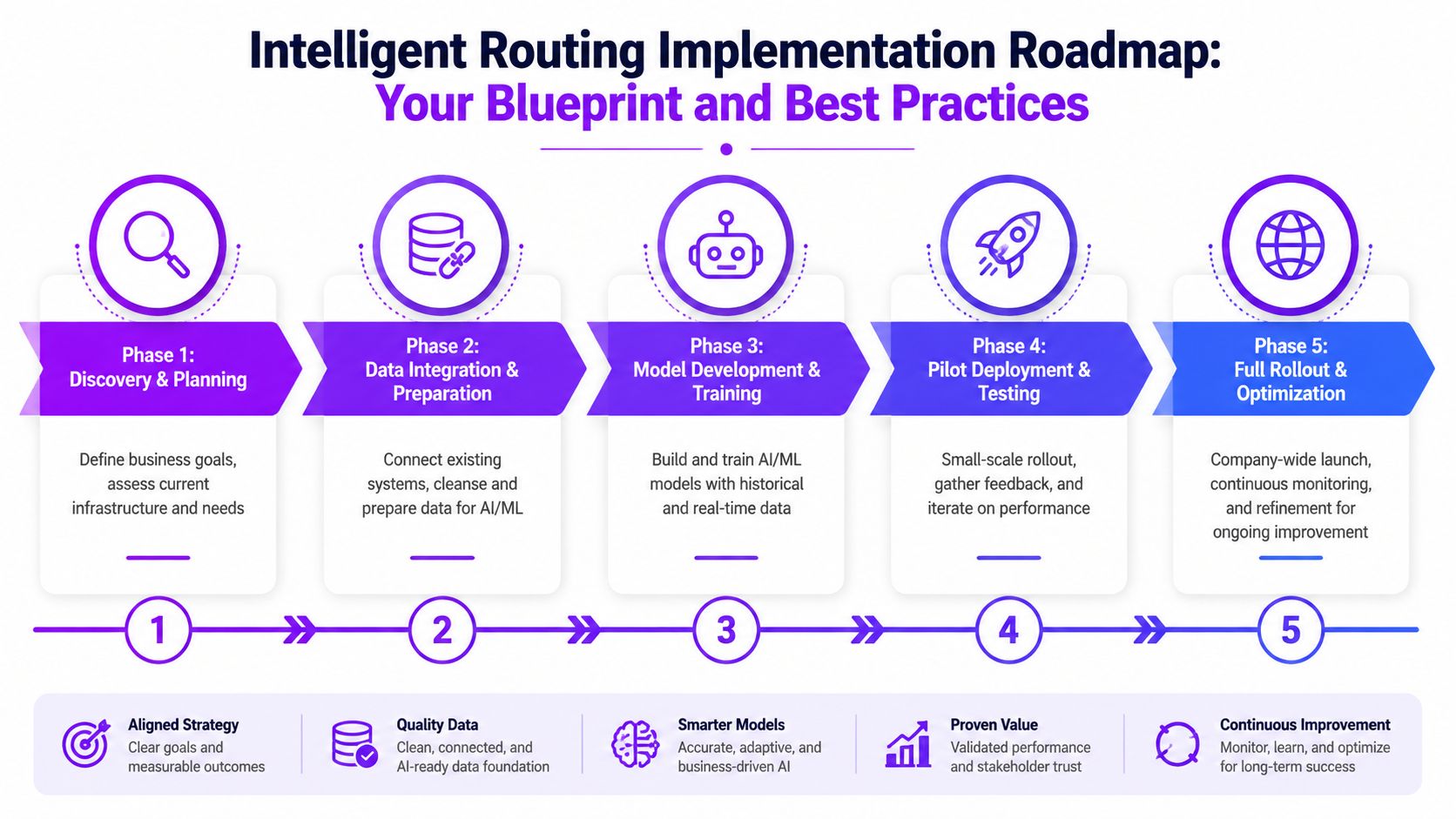
A practical rollout sequence
Start with the loss point
Don't begin with features. Identify where routing failures hurt most. It may be repeat calls in service, misrouted high-value enquiries in sales, or overloaded specialists in compliance.Map the data you trust
Routing quality depends on usable inputs. Audit IVR data, caller ID reliability, CRM freshness, and agent skill profiles before designing complex decision trees.Define a small number of routing priorities
Examples include language fit, issue type, customer tier, or certification requirement. Fewer well-governed rules usually outperform large brittle rule sets.Pilot on one workflow first
Choose a contained environment such as admissions counselling, premium support, or inbound property enquiries. A focused pilot exposes operational gaps without destabilising the full centre.Review routing and workforce design together
Better routing can expose scheduling weaknesses. Teams refining staffing logic often compare how to choose the best scheduling solution because routing performance and workforce allocation are tightly connected.
Guardrails for imperfect data
A major challenge is preventing bad routing decisions when data is incomplete or stale. Best practices emphasise fallback logic, capacity caps, and manual overrides, and warn that overloaded or overcomplicated rules can increase errors, according to Landis Technologies' guidance on routing strategies.
That guidance has direct executive implications:
- Build fallback paths: If caller ID is missing or CRM data is outdated, send the call to a generalist queue designed for live triage rather than forcing a false precision match.
- Set capacity caps: Don't let the system keep selecting the same high-performing specialists until queue quality collapses elsewhere.
- Allow manual intervention: Supervisors need a way to override routing when patterns change faster than the rules.
- Keep governance simple: Complexity often looks impressive in workshops and fails in production.
Good routing systems assume some data will be wrong. Great routing systems stay reliable when it is.
The strongest implementation mindset is iterative. Route, measure, inspect failure modes, and refine. That's how intelligent call routing becomes an operating capability rather than a one-time deployment.
If your team is evaluating how voice AI, qualification workflows, and intelligent call routing fit into a modern customer operation, DialNexa Labs Private Limited is one option to review. The company provides Voice AI agents for support, qualification, recruitment, and presales workflows, which makes it relevant for organisations that want to connect better call handling with clearer commercial outcomes.

This is an excellent analysis of how intelligent call routing shifts the focus from queue management to outcome management. The article clearly shows that matching customer intent with the right expertise improves conversion rates, operational efficiency, and overall customer experience.
This is a strong and practical breakdown of how intelligent call routing can improve both customer experience and operational efficiency. The focus on AI-driven, skill-based routing makes the business value especially clear.