
TRAI DLT Registration: A Step-by-Step CXO Guide for India
You're probably here because a campaign looked ready, the creatives were approved, the team was aligned, and then delivery started slipping for reasons nobody on the business side expected. That's the hard truth with TRAI DLT registration in India, it isn't a back-office checkbox, it's a gatekeeper for whether your commercial voice and SMS traffic reaches customers.
For CXOs, the right way to think about DLT is simple. If your brand sends OTPs, payment reminders, admissions nudges, order updates, collections calls, or promotional outreach, the messaging stack has to be mapped into the DLT ecosystem before delivery can happen, because TRAI made registration a core compliance control under TCCCPR, 2018, published on July 19, 2018 and brought into force on February 28, 2019 (TRAI regulation PDF).
Table of Contents
- Why TRAI DLT Registration Matters for Every Commercial Outreach
- The Three Layers of DLT Registration and Who Owns Each Role
- Preparing Documents and Choosing the Right DLT Portal
- Registering Headers and Content Templates the Right Way
- Linking Telemarketers, Aggregators, and Voice AI Vendors
- Common DLT Errors, Approval Delays, and How to Fix Them
- CXO Checklist for Sustainable DLT Compliance in 2026
Why TRAI DLT Registration Matters for Every Commercial Outreach
A campaign goes live. The creative is approved, the dialler is warmed up, and the OTP flow is supposed to be invisible to the customer. Then the delivery team realises the sender ID was never registered on the DLT platform used by the terminating operator, so messages start bouncing and the business side hears about it only after customers complain.
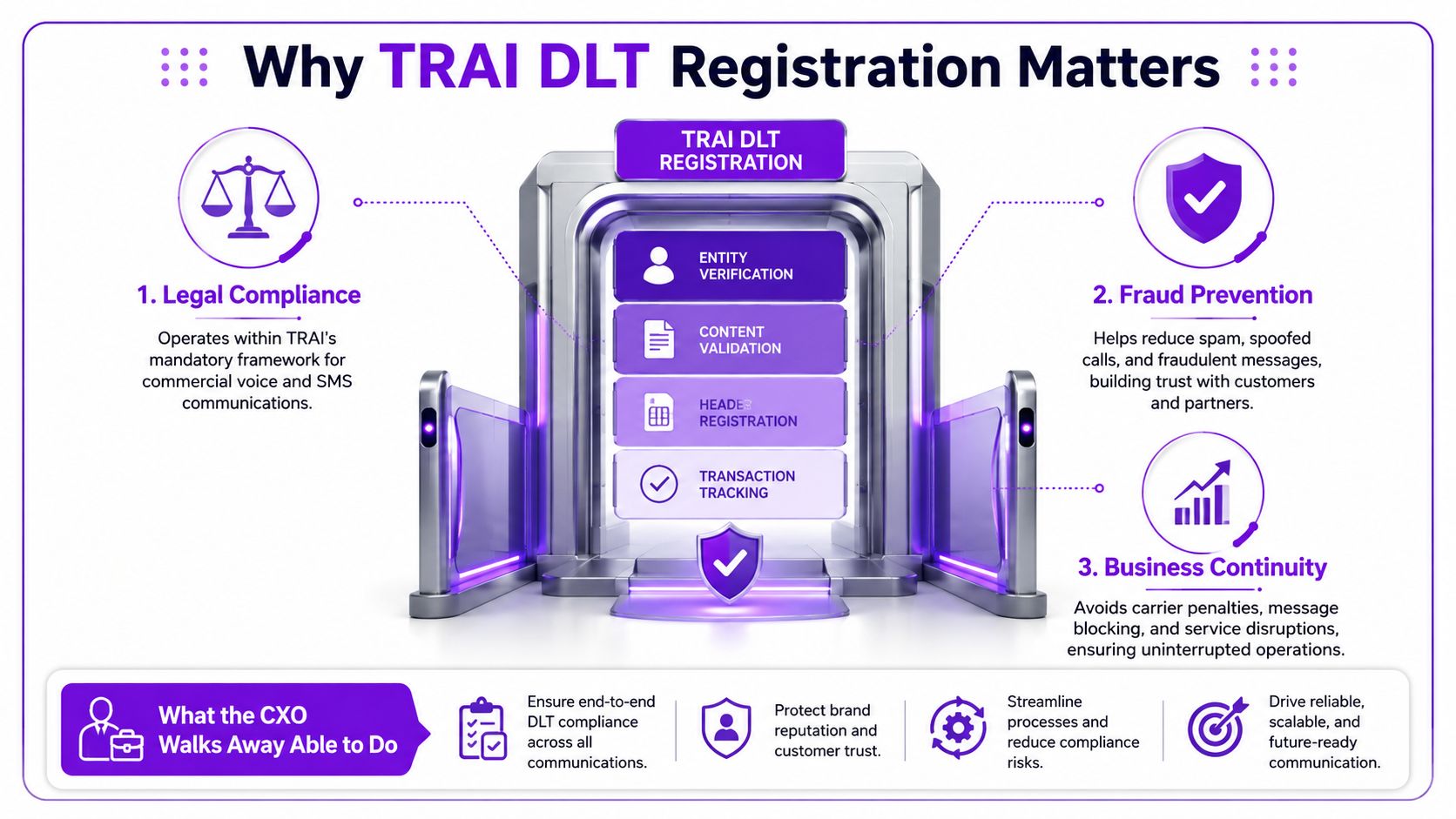
That's why TRAI DLT registration matters. It is the mandatory control layer for commercial voice and SMS in India, and it sits in front of transactional, promotional, and service traffic alike. TRAI's own framework uses permissioned DLT networks to record and verify entity registration, consumer consent, and message content, which makes registration a hard requirement, not an administrative extra (TRAI regulation PDF).
What breaks when you skip it
Non-registration isn't a minor gap, it's a hard stop on commercial outreach. TRAI-backed guidance states that every business or legal entity not registered on DLT under TCCCPR-2018 cannot send commercial communications through telecom services, which is exactly why banks, insurers, e-commerce firms, and service businesses must register before they can start sending at scale (Airtel DLT directive PDF).
The market context explains why TRAI took that posture. Reporting tied to TRAI has cited about 1.2 billion mobile subscribers, around 230 million DND subscribers, nearly 30 billion messages per month, more than 10 lakh SMS senders, more than 10 lakh SMS headers, about 22,000 registered telemarketers before DLT, and roughly 1.2 million SMS disconnections linked to illegal telemarketing (SMSCountry DLT registration guide). That volume is exactly why India needed a permissioned gate instead of voluntary discipline.
Practical rule: if your campaign depends on a sender ID, a template, or a vendor route, assume it will fail unless the DLT record is complete and current.
What a CXO should walk away with
The output isn't just “registered or not registered.” The useful outcome is a working compliance chain, entity registration, header approval, template whitelisting, vendor linkages, and a cadence that operations can own without escalation every time a route changes.
If you're mapping a new outbound workflow, start with the compliance path first and the campaign build second. The commercial launch can't outrun the registry. For teams building voice-first customer contact, the operational playbook around compliant outbound routing is worth reading too, especially if you're aligning calling strategy with registration workflow, as covered in DialNexa's guide to call handling and outreach design.
The Three Layers of DLT Registration and Who Owns Each Role
The common mistake is treating DLT as one form. It isn't. It's a layered control system, and each layer belongs to a different owner inside the business and vendor chain.
How the architecture actually works
The public guidance breaks the process into entity registration, header registration, and content template registration (SMS DLT registration guide). Entity registration is the foundation. That's where the principal brand proves who it is, typically with PAN, GST, and signatory details. Only after that approval can the company build headers and templates on top of it.
| Layer | Owned by | What it controls | Typical internal owner |
|---|---|---|---|
| Entity Registration | Principal Entity | Legal identity, business proofs, signatory approval | Brand or Compliance Lead |
| Header Registration | Entity and Telemarketer | Sender ID or caller ID structure | SMS or Voice Vendor |
| Content Template Registration | Entity and Telemarketer | Exact message content and use case | Compliance Lead and Campaign Owner |
That hierarchy matters because rookie teams often try to register a header before the entity is approved. That stalls onboarding and pushes the whole programme back. The brand owner needs to treat entity approval as the dependency that enables everything else.
Who owns what in practice
The Brand owns the entity record. The Compliance Lead should control document quality and template language. The SMS or Voice Vendor typically handles the operational submission work. The Aggregator Account Manager then maps the approved assets into the delivery chain so the traffic can move.
The fastest onboarding teams don't let the campaign manager “own” DLT alone. They assign one person to approvals, one to document control, and one to vendor coordination. That avoids the classic situation where a live campaign is waiting on someone's email inbox.
A useful way to read the system is this. Entity approval proves legitimacy. Header approval proves the sender identity. Template approval proves the exact message is acceptable. If any one of those breaks, delivery becomes unstable.
The additional point CXOs should care about is that TRAI's DLT ecosystem now assigns explicit functional roles for Header Registration, Consent Registration, and Content Template Registration, which means the platform is not just a directory, it's an enforcement layer for preferences, complaints, and content control (TRAI DLT UCC framework PDF). For leadership teams, that means compliance ownership has to sit close to operations, not buried three layers deep.
For practical vendor planning, the delivery stack matters as much as the registration stack. If you're comparing how cloud telephony and messaging partners connect into regulated calling workflows, DialNexa's cloud telephony overview is a relevant companion read.
Preparing Documents and Choosing the Right DLT Portal
A DLT filing slows down for one reason more than any other, sloppy documents. Teams assume the portal will forgive small errors, then lose days to repeated rejections across inboxes and support tickets.
The document stack you need
Keep the core papers ready before anyone opens the portal:
- PAN of the entity, matched exactly to the legal name on the application.
- GST certificate, where applicable.
- Certificate of Incorporation or partnership deed, based on the business structure.
- Board resolution or proprietor authorisation for the signatory.
- Authorised signatory PAN and Aadhaar.
- A working email and mobile number for OTPs and approval notices.
The failure points are usually simple. Aadhaar not linked to the PAN used on the form creates avoidable friction. A signatory email already tied to another entity confuses verification. PAN mismatches are worse, because they can trigger rejection without a clear explanation and leave teams guessing about portal delays.
For businesses that run identity-heavy workflows, the same discipline applies beyond DLT. KYC cleanup has to happen before submission, not after the first rejection. Automated KYC verification matters here because poor document hygiene slows both approval and launch.
Portal choice is operational, not cosmetic
There are six live DLT platforms that matter in practice, Jio, Airtel, Vi, BSNL, Tata, and Videocon. The choice is about approval speed, interface friction, and how much follow-up work the portal creates later.
| DLT Platform | Typical Entity Approval Time | Template Approval SLA | Best For |
|---|---|---|---|
| Jio | Not publicly standardised | Not publicly standardised | Teams comfortable with structured workflows |
| Airtel | Not publicly standardised | Not publicly standardised | Teams with tighter consent and voice workflows |
| Vi | Not publicly standardised | Not publicly standardised | Brands needing broad commercial messaging support |
| BSNL | Not publicly standardised | Not publicly standardised | Organisations using public-sector aligned telecom flows |
| Tata | Not publicly standardised | Not publicly standardised | Enterprises needing connectivity partner flexibility |
| Videocon | Not publicly standardised | Not publicly standardised | Teams comparing portal frictions before rollout |
Portal experience is not uniform, and pretending otherwise wastes time. Headers and templates registered on one platform do not automatically mirror everywhere. Brands either repeat the registrations or work through the common DLT view, so one campaign can go live on one route and stall on another.
For CXOs, the critical issue is launch speed and deliverability. DLT is a recurring compliance workflow tied to vendor changes, routing changes, and message control. A partner switch can create fresh approval work even if the campaign text stays the same.
Teams that operate across markets usually see the same lesson elsewhere. The mechanics behind how to register for 10dlc make the point clearly, sender identity and message intent must be registered before traffic moves.
Registering Headers and Content Templates the Right Way
Header registration is where most campaigns either become disciplined or turn messy. If the sender identity is wrong, the rest of the work is wasted.
Reserve the header with intent
For SMS, the header should be a six-character alpha sender ID that signals the business use case cleanly, things like BRANDP or BANKOT, not vague strings no customer would recognise. For voice, the structure is different, and the platform-specific mechanics matter. The principle stays the same, though, the sender identity has to match the commercial purpose and the registered entity.
The next step is category selection. Use the correct content template category, whether that's Service, Promotional, Transactional, OTP, or a platform-specific Header Bidding Scrub where applicable. The header belongs to the entity record, and the template must be attached to the right header before it can be used.
Match the SMS copy exactly
Template registration is not a loose approval of “similar wording.” It's the exact text the network will validate. That means the live SMS body must match the approved template wording, including approved variables such as {{name}} and {{otp}}. If your campaign copy drifts even slightly, the message can be filtered or rejected.
A BFSI lender usually needs several OTP-related templates, login, transaction, mandate, statement, KYC, and welcome. An EdTech company usually needs a different set, such as webinar invites, fee reminders, and lead follow-up messages. Same system, different discipline.
Practical rule: write the template once, get it approved once, then reuse the exact approved text across every campaign variant that needs the same route.
The technical handoff matters too. The PE-ID and Template-ID have to be passed to the telemarketer or aggregator before traffic starts. Without that handoff, the vendor can't legally push the message through the DLT ecosystem.
For voice-heavy teams, the operational equivalent is equally strict. If you're building bulk voice outreach around compliant messaging and call flows, DialNexa's bulk voice calls resource is worth reviewing alongside the registration work.
What the sharing model really means
Template IDs are shared across DLT platforms in principle, but campaign teams shouldn't assume that means “register once, forget it.” The common-view model reduces duplication, yet each platform still has its own operational path, so the workload remains real. The win is consistency, not zero effort.
| Header Type | Content Template Category | Allowed Use Cases | Example Industries |
|---|---|---|---|
| Alpha Header | Transactional, OTP, Service | Alerts, verification, account updates | BFSI, healthcare, logistics |
| Alpha Header | Promotional | Offers, campaigns, reminders | Retail, EdTech, real estate |
| Voice Sender Structure | Service and transactional calling | Support calls, reminders, confirmations | BFSI, telecom, healthcare |
Linking Telemarketers, Aggregators, and Voice AI Vendors
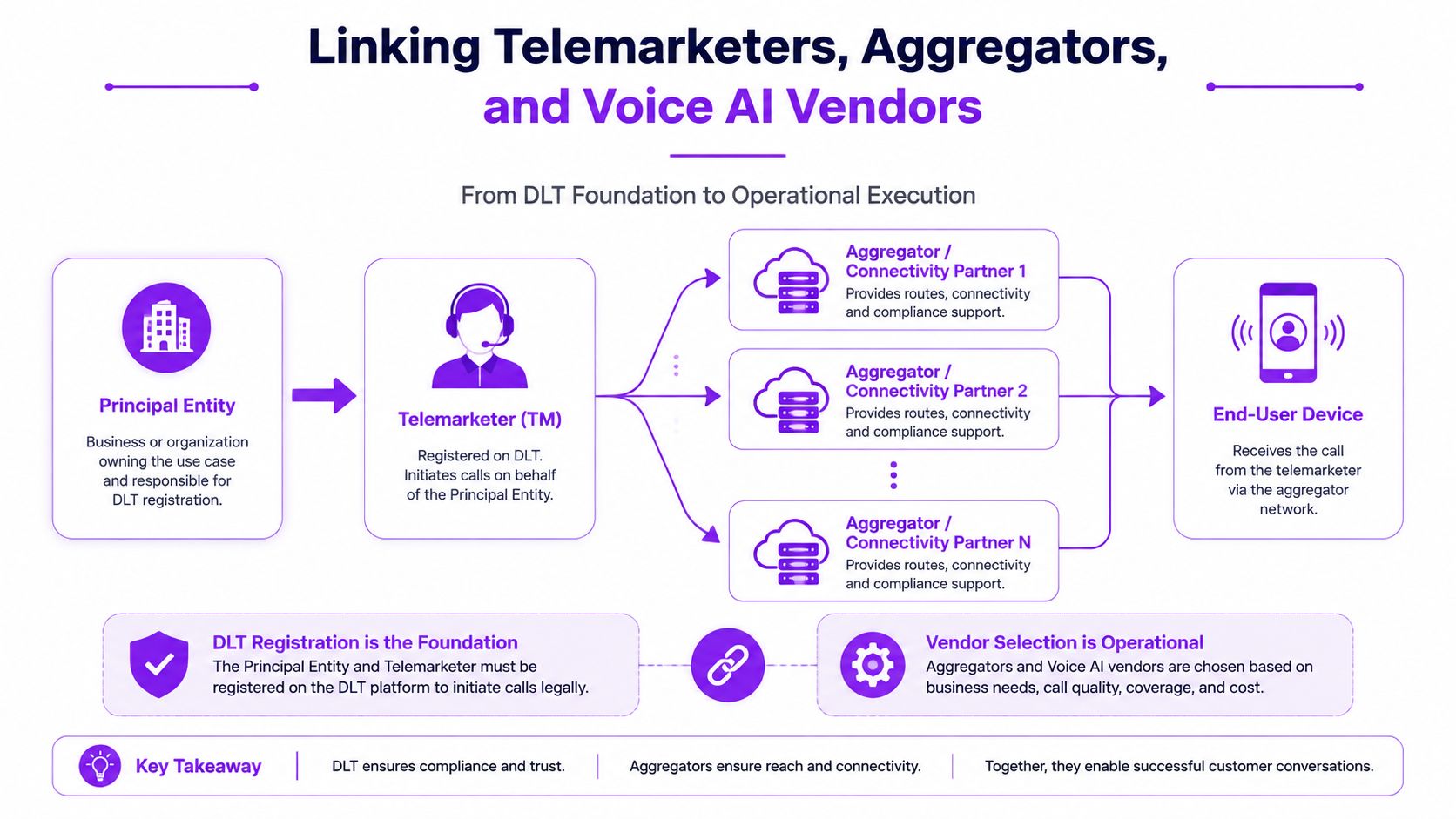
A launch stalls fast when the DLT chain is loose. The principal entity, the telemarketer, and the aggregator all need to line up before traffic starts, or approved assets will fail in the path between registration and delivery.
The delivery chain has to be explicit
The principal entity connects to its telemarketer. That telemarketer connects to one or more aggregators, also called connectivity partners. The approved header and template combination has to be linked to the telemarketer, and the telemarketer has to be mapped under every aggregator the brand uses for SMS, voice, or WhatsApp API delivery.
Portal behaviour differs in ways that matter operationally. Jio DLT typically requires TM addition through the entity record. VIL ties headers to specific content templates per TM. Airtel uses a different consent workflow. The rule stays the same, the delivery chain has to match the vendor chain, not the procurement slide deck.
Voice AI vendors need the same discipline
A voice AI provider requires the same onboarding discipline as any other vendor. The bot provider has to be registered as a telemarketer, with the relevant PE-ID, headers, and templates checked for AI-voice disclosure expectations before it sends anything for the brand. If the bot changes, the mapping changes with it.
Teams often overestimate routing flexibility. More registered entities can improve segmentation and fallback routing, but every added link creates more onboarding work, more documents, and more places for traceability to break. CXOs should treat that trade-off as a launch decision, because it affects speed to market and message deliverability.
Vendor substitution is a compliance change, not just a commercial one. If you switch the vendor mid-campaign, you need a re-map, not a fresh contract and a shrug.
The practical benchmark for vendor selection is traceability. For teams comparing providers, Top 12 Voice AI Companies in India gives a useful market map, while enterprise AI voice security is worth reading for the control layer around compliant calling. If routing changes, the DLT records have to change too, and the approval trail has to stay clean.
Common DLT Errors, Approval Delays, and How to Fix Them
Most approval delays aren't mysterious. They come from the same small set of mistakes, repeated by teams that assume the portal will be forgiving. It won't.
The failure patterns that cost time
Header rejection is common when the same six-character code was already reserved on a sister portal by a partner. The fix is simple, search all relevant DLTs before you book the header, because the system won't protect you from internal duplication.
Entity rejection usually comes from mismatched PAN, GST, or company-type classification. Don't raise a fresh ticket and hope it disappears. Correct the upload, validate the document set, and resubmit cleanly.
Template rejection is often self-inflicted. Promotional traffic that uses words like “free”, “guaranteed”, “win”, or “cashback” tends to trip compliance review, and AI voice templates without explicit opt-in disclosure lines also get blocked. Consent registration gaps are another recurring failure, especially when user consents are uploaded but not mapped to the template ID, which causes the traffic to be treated as unsolicited.
Timelines and fees are not uniform
The operational reality is uneven. Header approval is usually 2 to 7 days, template approval is 3 to 14 days, and entity approval can take up to 7 days, with BSNL Header Bidding often the slowest path. Fee structures also vary by portal, entity registration is free, but per-header registration and template processing fees can range from ₹500 to ₹2,500 on certain DLTs (Infobip DLT registration documentation).
| Error Type | Typical Cause | Approval Timeline | Fastest Fix |
|---|---|---|---|
| Header rejection | Name already reserved elsewhere | 2 to 7 days | Search all portals before booking |
| Entity rejection | PAN, GST, or entity mismatch | Up to 7 days | Correct the upload and resubmit |
| Template rejection | Soft-fail promo language or missing disclosure | 3 to 14 days | Rewrite to match compliant intent |
| Consent gap | Consent not mapped to template ID | Variable | Relink consent to the approved template |
Escalation is a process, not a panic button
Use the escalation path in order, support ticket, then portal SPOC, then the DCC grievance portal. That sequence keeps the issue traceable and avoids random follow-ups that nobody owns.
Operational advice: if a template is rejected twice, stop rewriting it in marketing language. Put compliance in the room and strip the copy back to what the portal will actually approve.
One more thing leadership teams miss. If the template ownership can't be traced back to a signatory during audit, the problem is bigger than a delay. It becomes a governance failure, and that's exactly the kind of thing that interrupts launch plans.
CXO Checklist for Sustainable DLT Compliance in 2026
The right DLT model isn't “register once and forget.” It's a recurring workflow that stays inside the business cadence, especially when vendors, routes, and campaign themes change.
What has to stay on the calendar
Use a quarterly header-template audit cadence. Every approved header and template should be checked against live campaigns, vendor mappings, and current copy. If marketing has moved on but DLT hasn't, delivery will eventually break.
Keep consent artefact retention for at least 6 months. That matters when a complaint lands and the team has to prove which consent supported which message. Make that the compliance team's job, not the vendor's memory.
Set a vendor-switch trigger flow for telemarketer or aggregator re-linking. If procurement changes a route, compliance has to re-map the chain before traffic moves. No exceptions.
What changes before every launch
Before every festive or high-volume campaign, run a content scrub. This is especially important for promotional sends, where language drift is the easiest way to trigger rejection.
If you use AI voice, pre-register the bot template with explicit disclosure language. Don't wait until the first live call to discover the wording doesn't pass review. Teams that plan AI calling should also review their vendor controls, and DialNexa's enterprise AI voice security resource is a useful benchmark for how tightly that layer should be managed.
What keeps governance from collapsing
Maintain a single source of truth for entity IDs across all DLT portals. Then add a 48-hour breach response protocol for failed consent audits, so a compliance miss doesn't sit unresolved until the next sprint.
The KPIs should be boring and strict, template-to-campaign latency, delivery rate above 90%, and zero PEER review penalties. If your team can't see those three measures, it doesn't have a compliance system, it has a filing cabinet.
For a practical rollout, assign one owner, one reviewer, and one frequency for each control. Keep the owner in ops, the reviewer in compliance, and the frequency on a calendar no one can ignore. That's how you stop DLT work from landing on a single exhausted manager every time product wants a faster launch.
DialNexa Labs Private Limited helps Indian teams build compliant, human-like voice AI agents for qualification, support, and outbound workflows, which makes DLT discipline easier to operationalise inside real campaigns. If you're tightening your calling stack and want a partner that understands both outreach design and regulated delivery, visit DialNexa Labs Private Limited to explore how their voice AI workflows fit into a compliant launch process.

This is a clear and practical guide that makes TRAI DLT registration easier to understand for businesses handling SMS and voice communication. The detailed focus on compliance, sender IDs, templates, vendor linking, and operational ownership makes it especially valuable for Indian enterprises.
This is a practical guide for CXOs navigating TRAI DLT registration in India. The step-by-step approach makes the process easier to understand and highlights important considerations for compliant business communication.
The step-by-step approach and focus on common onboarding issues make the article especially useful for businesses planning compliant voice and SMS communication in India.