
Virtual Number India: A CXO’s Guide to Compliance and Scale
Your sales team has a familiar problem. The business is expanding across cities, call volumes are rising, and customer-facing teams still depend on personal mobiles, disconnected landlines, or numbers that cannot support proper routing and reporting. Then an OTP fails, a customer calls back a promotional number, or operations discovers that an existing mobile line can't be moved into a cloud telephony platform.
That's the reality behind virtual number India deployments. A virtual number can give BFSI, EdTech, real estate, healthcare, and D2C teams structured call routing, tracking, IVR, and continuity, but it isn't an unrestricted mobile line. SMS and OTP support, number portability, DLT registration, and the 140 and 160 numbering series can determine whether a rollout works in production.
Table of Contents
- What a Virtual Number Actually Means in India
- Types of Virtual Numbers and Their Strategic Use Cases
- Navigating TRAI Compliance and DLT Registration
- Procurement Models and the Portability Constraint
- Pairing Virtual Numbers with Voice AI for Automation
- Common Pitfalls and How to Avoid Them
- Building Your Compliant Virtual Number Strategy
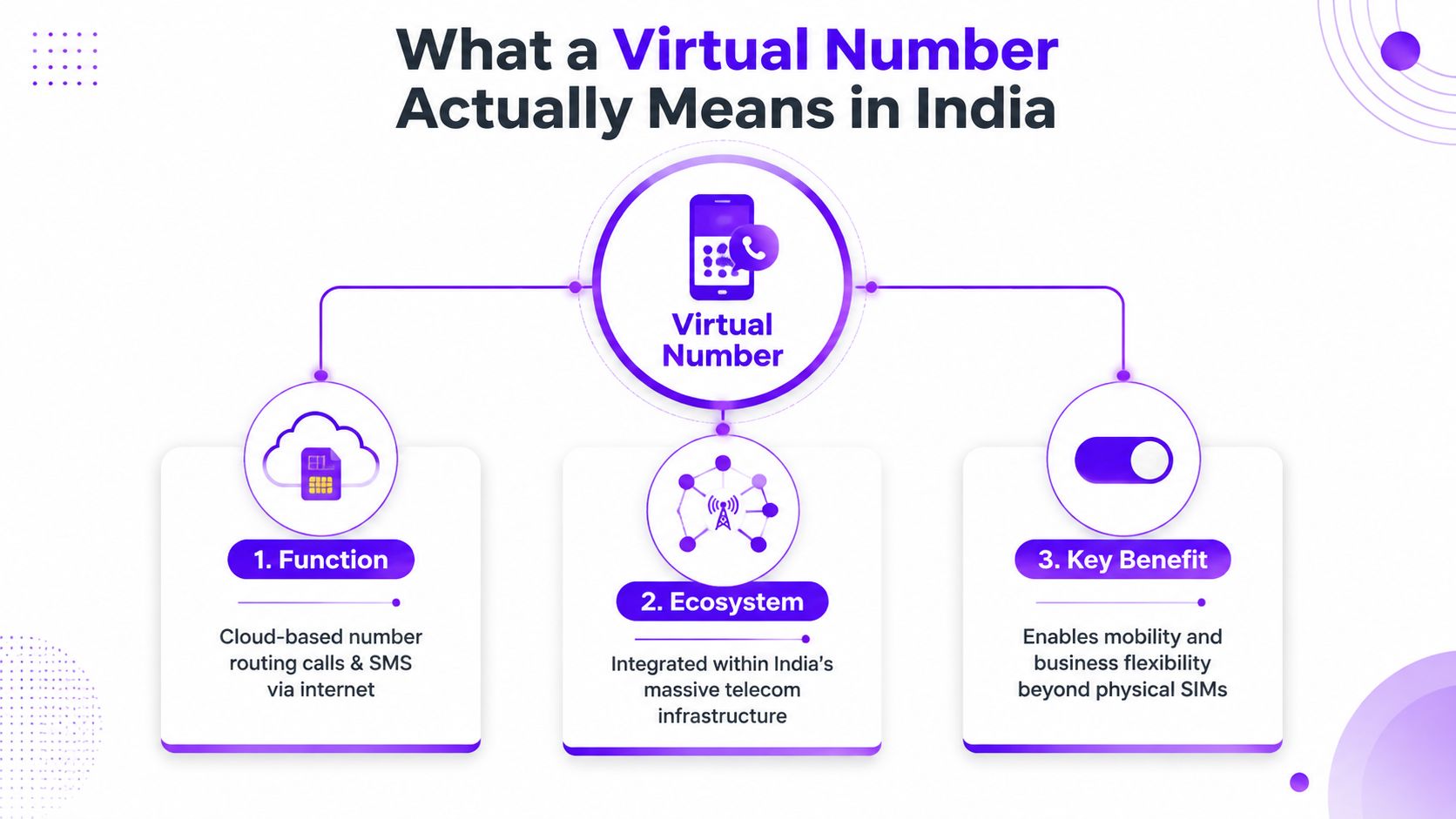
What a Virtual Number Actually Means in India
A real estate company may begin with a few sales executives calling leads from their own mobiles. As the team expands, management needs to know which campaign generated each enquiry, route missed calls to the right centre, and ensure that customers don't lose access when an employee leaves. A virtual number addresses those operational needs by placing the business identity above the individual handset.
At a technical level, a virtual number is a telephone number managed through a cloud telephony system. Calls can be routed to agents, IVR menus, queues, SIP endpoints, or automated voice systems without tying the customer-facing identity to one physical SIM. That makes it useful for lead attribution, regional routing, callback handling, and centralised supervision.
The Indian operating context
India's number environment is exceptionally broad. TRAI's June 2025 telecom performance data recorded 1,218.36 million total telephone subscribers, including 1,163.03 million wireless subscribers and 54.46 million wireline subscribers. The same release recorded 1,082.67 million active wireless users on peak VLR day.
Those figures matter to a CXO because a virtual number doesn't operate in isolation. It depends on licensed telecom infrastructure, operator interconnection, numbering policy, and compliance processes. India also recorded 13.58 million mobile number portability requests in June 2025, with cumulative requests reaching 1,118.94 million since implementation, according to the same TRAI release. The scale and movement of the subscriber base explain why businesses value routing and contact continuity, but they also show why number services remain policy-sensitive.
A physical mobile line belongs to a subscriber and is designed for ordinary mobile use. A virtual number is a business communication asset that can be allocated to a workflow, campaign, geography, or service queue. It can support inbound and outbound calling, but voice availability doesn't automatically mean SMS, OTP, or unrestricted promotional calling is available.
Practical rule: Treat the number, the voice workflow, the messaging identity, and the compliance registration as separate operating assets.
India's regulatory foundation has also evolved. TRAI issued recommendations on internet telephony on 24 October 2017, while the Telecommunications Act, 2023 received Presidential assent on 24 December 2023 and entered into force in stages in June and July 2024. For buyers comparing cloud telephony providers, the central question isn't whether a vendor can give you a number. It's whether the vendor can support the specific voice, routing, messaging, and compliance model your business needs.
Types of Virtual Numbers and Their Strategic Use Cases
Number selection should follow the workflow, not the vendor's catalogue. A toll-free line for collections, a regional DID for admissions, and an IVR number for appointment booking solve different problems. The same company may need more than one number pool, especially when promotional calling and service communication require different treatment.
| Number Type | Best For | Industry Example | Compliance Note |
|---|---|---|---|
| DID or local number | Regional presence and inbound routing | An EdTech team assigns city-focused numbers to admissions counsellors | Confirm allocation, calling purpose, and approved use with the provider |
| Toll-free number | Customer support and higher-friction inbound conversations | A BFSI support or collections desk uses a central access number | Review usage rules, call recording, consent, and escalation processes |
| IVR-enabled number | Structured self-service and department routing | A real estate business routes site-visit requests to regional teams | Menus don't replace compliance for outbound commercial calls |
| Virtual mobile number | Controlled business calling and campaign workflows | A D2C brand uses a managed line for order confirmation or COD verification | Don't assume SMS, OTP, or ordinary mobile portability is available |
DID and local numbers
DID or local numbers are useful when geography influences trust or routing. An EdTech organisation can direct a learner from one region to a relevant counselling team, while a healthcare network can route calls to the correct clinic group. The business gains central oversight without publishing an employee's personal number.
Toll-free and IVR
Toll-free numbers fit support-heavy models where the customer should have a clear, central entry point. BFSI teams may use them for support, collections, or escalation, while D2C brands can use them for order issues. IVR adds structure by separating sales, support, payment queries, and service requests before an agent answers. For a breakdown of subscription, per-minute, and setup pricing benchmarks when budgeting an IVR-enabled number pool, see this IVR system cost guide.
For teams building verification journeys, a separate reference on cost-effective phone verification can help frame the difference between verifying a phone identity and providing a dependable India-specific messaging channel. Those are related, but they're not interchangeable.
The 140 and 160 distinction
The number series is a strategic decision, not a formatting detail. TRAI's 2024 direction on DLT-based voice solutions requires access providers to implement a DLT-based voice solution for the 140-level numbering series within 60 days, submit an implementation plan for the 160-level numbering series within 30 days, and complete implementation within 90 days.
Operationally, that points businesses towards 140 for promotional voice calls and 1600 for service and transactional calls, subject to the applicable rules and provider implementation. A sales campaign, a payment reminder, a policy service call, and a callback after a customer action shouldn't be placed in one undifferentiated number strategy. CXOs evaluating an 1800 number should ask how the proposed number fits the intended customer-contact category.
Navigating TRAI Compliance and DLT Registration
A virtual number rollout becomes risky when procurement happens before compliance design. The team buys numbers, uploads a contact list, starts calling, and only later discovers that promotional communication, customer preferences, sender identity, and message templates require separate controls.
TRAI's Telecom Commercial Communications Customer Preference Regulations, or TCCCPR, provide the key framework for commercial calling and messaging. Public guidance from AVOXI on India virtual phone numbers states that businesses making promotional outbound calls must register as telemarketers, scrub lists against the National Customer Preference Register, and use the designated 140 number series for outbound commercial calls.
A workable compliance sequence
Classify the communication. Separate promotional calls, service calls, transactional notifications, support callbacks, collections activity, and OTP journeys. Each category can involve different numbering and consent expectations.
Register the business identity. For SMS and commercial messaging, DLT registration requires the business to establish its entity details and communication identity before sending at scale. Vyora's explanation of DLT registration in India identifies entity details, sender IDs, and message templates as core parts of the registration stack.
Set up telemarketer relationships where required. Promotional outbound calling shouldn't run through an ordinary mobile-style identity. Confirm how the provider handles telemarketer registration, number-series assignment, list scrubbing, and records.
Submit headers and templates. A message can fail operationally even when the call platform works if the sender ID or template hasn't been approved. Marketing, compliance, and operations should own this process together.
Maintain consent and audit records. Store the basis for contact, the purpose of the interaction, customer preferences, and the relevant number pool. A compliance review is much easier when each campaign can be traced to a defined workflow.
The legal context is broader than DLT. The Telecommunications Act, 2023 replaced the Indian Telegraph Act of 1885 and reshaped the legal foundation for voice services. That doesn't turn every vendor feature into a compliance guarantee. It means procurement teams need current contractual, operational, and escalation documentation.
Compliance decision: Don't approve a number because it can place a call. Approve it only after the business knows which customer-contact purpose it will serve.
For an implementation team, TRAI and DLT registration guidance is useful as a working reference, but legal and telecom compliance ownership should remain with the organisation and its authorised providers.
Procurement Models and the Portability Constraint
A BFSI, EdTech, or D2C team can spend weeks planning a cloud calling rollout, then discover that its most recognisable mobile number cannot move into the new system. That portability constraint changes procurement from a simple vendor choice into a customer-identity decision.
Frejun's guidance on number porting for virtual numbers in India states that Indian mobile numbers cannot be ported into virtual telephony services. This differs from ordinary mobile number portability, which TRAI treats as a formal regulatory area and continues to update, including the Telecommunication Mobile Number Portability (Ninth Amendment) Regulations, 2024, listed on its mobile number portability portal.
What the constraint changes
A bank, NBFC, or D2C company may have legacy numbers printed on invoices, stored in customer phones, and associated with years of service history. If those numbers cannot become virtual identities, the organisation must retain them for a defined purpose, announce a new business number, or run a controlled transition. Moving an employee's personal mobile into customer operations is not an acceptable replacement for a governed business number pool.
The operating design normally separates:
- Inbound numbers: Published for support, enquiries, callbacks, or regional access.
- Outbound numbers: Assigned according to promotional, service, or transactional purpose.
- Automation numbers: Connected to IVR, APIs, SIP paths, or Voice AI workflows.
- Messaging identities: Registered separately for compliant SMS communication.
This separation matters because Indian SMS and OTP use cases do not automatically follow voice calling rules. A virtual number may support calls while remaining unsuitable for OTP delivery or application-to-person messaging. DLT registration, approved headers and templates, and the applicable 140 or 160 series requirements can force a new sender strategy rather than a direct cloud migration.
Pay-per-use versus subscription
Pay-per-use suits seasonal campaigns, variable demand, and teams validating call volumes. Subscription arrangements support steadier budgeting when usage and support requirements are predictable. Pricing depends on the provider, number type, minutes, recording, APIs, support, and compliance services. Assess the quote as a total operating cost, not only as a rental charge.
| Procurement model | Strength | Trade-off | Suitable scenario |
|---|---|---|---|
| Pay-per-use | Cost follows call activity | Monthly spend varies | Seasonal admissions or campaign-led outreach |
| Subscription | Easier budget planning | Commitments may exceed usage | Stable support or service operations |
| Hybrid | Separates core access from variable automation | Requires stronger governance | Large teams with permanent support and campaign peaks |
Evaluate SIP trunking, APIs, call recording, webhooks, CRM integration, and number-health monitoring together. Ask whether the platform identifies active or default numbers, supports inbound and outbound testing, assigns live call ownership, and documents provider escalation. Teams assessing phone-number integrations should also confirm how failed calls, number changes, audit records, and messaging restrictions are handled.
Procurement decision: approve a number only after its customer-contact purpose, portability limits, SMS or OTP suitability, and compliance owner are documented.
Pairing Virtual Numbers with Voice AI for Automation
A virtual number becomes strategically valuable when it connects a customer to a repeatable operating process. A real estate Voice AI agent can qualify location, budget, and property preference before offering a site visit. An EdTech agent can handle programme questions and route high-intent learners. A BFSI workflow can guide customers through support or KYC steps while escalating sensitive cases to a human team.
The number provides the access layer. The AI platform supplies conversation logic, qualification, routing, reminders, and follow-up. Together, they let operations leaders define a consistent customer journey rather than leaving every call to individual agent behaviour.
DialNexa's publisher information reports customer outcomes including connect rates rising from 47% to 91%, lead-to-booking improving from 2% to 8%, and AI-qualified leads matching human judgement with 97% accuracy. Those figures are reported by the publisher, so they should be treated as customer-reported outcomes rather than a guaranteed result for every deployment.
Design the call path before the prompt
Start with the event that triggers the call. A new lead may need qualification, a missed call may need an immediate callback, and a completed transaction may need service confirmation. Each event should have an approved number, a defined purpose, a clear handoff rule, and a record in the CRM.
A well-structured design typically includes:
- Routing logic: Send regional, product, or language-specific calls to the right queue.
- Qualification fields: Capture only the information the next team needs.
- Escalation rules: Transfer complaints, vulnerable-customer situations, or complex queries to trained staff.
- Follow-up controls: Schedule reminders based on customer intent and consent, not indiscriminate retries.
- Audit visibility: Preserve call outcomes, ownership, disposition, and recording access according to internal policy.
The human-like conversation matters because customers often ask follow-up questions rather than answering a fixed script. DialNexa's platform is described as supporting qualification, customer support, recruitment, and presales workflows, with ready-made personas for real estate discovery, trading-platform support, KYC guidance, and programme counselling. Its stated design supports operation at thousands of calls per day with consistent messaging, reminders, and follow-ups.
Architecture principle: Voice AI should automate a controlled business process, not create an uncontrolled calling layer.
Security and access management also deserve attention. Teams connecting telephony APIs, CRM systems, and agent infrastructure can use this practical guide for agent infrastructure teams to think through service-account ownership, permissions, and operational separation.
The following video provides additional context on AI voice-agent workflows and deployment considerations.
For organisations planning an AI voice agent platform, the number strategy should be approved alongside the conversation design. Otherwise, the AI may be ready while the assigned number is unsuitable for the intended customer-contact purpose.
Common Pitfalls and How to Avoid Them
A virtual number may handle voice reliably while failing at SMS, OTP, or two-factor authentication. Treating it like a mobile SIM creates a hidden dependency, particularly for Indian BFSI, EdTech, and D2C workflows. SMS isn't supported on virtual numbers on at least one established provider's India offering, so confirm the provider's actual capabilities before designing the customer journey.
The SMS and OTP trap
A typical workflow starts with an automated call, sends an OTP by SMS, and verifies the response through the same number. If the virtual number cannot receive SMS, voice remains available but verification stops.
Ask the provider these questions before procurement:
- Can the number receive inbound SMS in India?
- Can it receive OTPs from the intended senders?
- Is two-way messaging available, or only outbound messaging?
- Is the number eligible for verified-number workflows?
- Which DLT registrations, headers, and templates are required?
- What happens when a customer replies?
Messaging must be planned as a separate workstream. Businesses sending OTPs, alerts, or promotional messages at scale must register entity details, sender IDs, and approved templates on the DLT before sending. A voice number alone does not provide that messaging identity.
Other deployment failures
A virtual number is not an unrestricted mobile line. Commercial calling remains subject to telecom compliance, customer preferences, and number-series rules, including the distinct treatment of 140 and 160 series use cases. Using one number for promotions, service calls, callbacks, and support can confuse customers and weaken audit trails.
Portability creates another constraint. Existing customer-facing mobile numbers generally cannot be converted into virtual telephony identities. Migration therefore requires new number allocation, customer communication, CRM changes, and parallel handling where necessary.
Finally, call volume is an incomplete success measure. Track answer quality, routing accuracy, compliant dispositions, escalation rates, callback completion, and whether customers reach the correct team without repeating their context. These checks expose failures that raw call counts hide.
Building Your Compliant Virtual Number Strategy
CXOs should approve virtual numbers through a decision matrix, not a generic cloud-telephony checklist. Map each workflow to its purpose, audience, direction, number series, messaging need, consent basis, escalation path, and reporting requirement. Then separate the number pools for inbound support, outbound promotion, service communication, automation, and messaging.
A practical vendor review should test four capabilities:
- Compliance readiness: TCCCPR processes, DLT support, consent records, and number-series guidance.
- Telephony control: IVR, routing, recording, SIP or API connectivity, and live number monitoring.
- Workflow fit: CRM events, callbacks, ownership, escalation, and audit reporting.
- Automation depth: Voice AI integration, approved scripts, human handoffs, reminders, and outcome capture.
Run a controlled pilot with one defined workflow, such as EdTech counselling, D2C COD verification, real estate site-visit booking, or BFSI support. Validate voice, SMS, OTP, portability assumptions, compliance documentation, and reporting before expanding across teams.
DialNexa Labs Private Limited offers Voice AI agents for qualification, customer support, recruitment, and presales, with configurable workflows and telephony integrations designed for these operational use cases.
DialNexa Labs Private Limited can help your team design compliant Voice AI workflows around the right virtual-number structure, from qualification and support to follow-ups and booking. Visit DialNexa Labs Private Limited to review the platform and plan an India-ready deployment.

This is a clear and practical guide that explains how virtual numbers can improve business communication, routing, and customer management. The focus on compliance, portability, and Voice AI integration makes it especially valuable for Indian businesses.
This article provides valuable insights into using virtual numbers in India while balancing compliance, scalability, and business communication needs. A practical guide for CXOs looking to build efficient and reliable communication systems.
This is a useful guide for understanding how virtual numbers can support business communication in India. The focus on compliance, scalability, and practical business needs makes the article valuable for CXOs.
This guide gives a clear and practical explanation of how virtual numbers support business communication, routing, compliance, and Voice AI automation. The real-world examples across real estate, BFSI, EdTech, and D2C make the operational and procurement considerations easy to understand.