
Compliance Monitoring Explained: A Practical CXO Guide
The most dangerous compliance failure in India isn't always a missing policy. It's the absence of evidence showing what happened between policy approval and the regulator's question.
The Comptroller and Auditor General's Union Government Report No. 36 of 2025 examined financial transactions under 56 grants across 29 ministries and five constitutional bodies or secretariats, covering gross expenditure of ₹16,26,975.07 crore in 2023-24. Its 16 illustrative compliance-audit cases across seven ministries or departments and one central public sector enterprise show the scale at which weak controls, procedural gaps and revenue leakage can matter. The CAG report makes the point clearly: compliance is not merely a filing calendar. It is an evidence problem.
For Indian CXOs, the practical shift is straightforward. Stop asking whether a control existed at quarter-end. Start asking whether your organisation can prove, with timestamped and retrievable records, that it detected, escalated and corrected a breach when it occurred. That is the role of modern compliance monitoring, particularly in voice-heavy operations where every call, consent event, escalation and configuration change can become part of the audit record.
Table of Contents
- Why Compliance Monitoring Is No Longer a Quarterly Checklist
- What Compliance Monitoring Really Means for a Modern Enterprise
- The Indian Regulatory Landscape Every CXO Must Monitor
- Sampling Versus Continuous Monitoring and When to Use Each
- Building Your Compliance Monitoring Framework in Five Steps
- Putting It to Work With Voice AI Across BFSI EdTech and Real Estate
- Common Pitfalls and Best Practices for Evidence-Ready Monitoring
- Turning Compliance Monitoring Into a Strategic Advantage
Why Compliance Monitoring Is No Longer a Quarterly Checklist
Quarterly compliance reviews feel orderly because they fit the reporting cycle. They also create dangerous blind spots. A team can review a sample of calls, reconcile a set of transactions and sign a management certificate while an operational breach continues across customer-facing workflows.
The CAG defines a compliance audit as an examination of transactions involving expenditure, receipts, assets and liabilities to determine whether constitutional provisions, applicable laws, rules, regulations, orders and instructions were followed. Its 2025 Union Government report shows that this examination operates at national fiscal scale, not as a narrow back-office exercise. The report's cases demonstrate why point-in-time assurance can identify failures after value has already leaked or procedural damage has already occurred.
The control gap between policy and proof
A policy tells an employee what should happen. Monitoring captures what happened. An audit then tests whether the evidence is reliable enough to support an assurance conclusion.
That middle layer matters in collections, customer support, onboarding, sales and incident response. If an agent skips identity verification, a customer withdraws consent, a supervisor changes a workflow or a security event remains unreported, a policy document won't reconstruct the event. A properly designed monitoring system can.
CXOs who retain the checklist model face four predictable consequences:
- Regulatory censure: A regulator can challenge the absence of contemporaneous evidence even when policies are formally approved.
- Board exposure: Directors may face difficult questions about oversight when management cannot show how controls operated in practice.
- Customer churn: A privacy or conduct failure can damage trust long after the technical issue is closed.
- Capital inefficiency: Late remediation consumes legal, technology and operational resources that early detection would have protected.
The enforcement direction is visible beyond public spending. A 2025 analysis citing Ministry of Corporate Affairs disclosures reported penalties against companies for Companies Act violations, with penalties rising from ₹22.27 crore in 2019-20 to ₹107.30 crore in 2024-25, while recoveries rose from ₹3.19 crore to ₹24.51 crore. The Ministry of Corporate Affairs analysis illustrates a more enforcement-oriented environment.
Board question: If a regulator asked for the evidence behind yesterday's customer interactions, could your team produce it without reconstructing the answer from spreadsheets, inboxes and individual laptops?
What Compliance Monitoring Really Means for a Modern Enterprise
Compliance monitoring is the systematic, ongoing collection and review of operational evidence to confirm that business activity aligns with applicable law, regulation and internal policy. The evidence may include call recordings, consent receipts, transaction logs, access trails, disclosure records, incident tickets, approval histories and retention events.
A useful analogy is a health check-up versus a fitness band. A compliance audit is the periodic health check-up. Compliance monitoring is the fitness band that records activity continuously and surfaces warning signs while someone can still act.
That definition creates three important boundaries.
Monitoring is not an audit
A compliance audit is generally retrospective and periodic. It may be performed by an independent internal audit function, an external auditor or a public audit institution. The auditor tests evidence and reaches an assurance conclusion.
Monitoring runs during operations. It identifies a missing disclosure on a call, an unusual access event or an overdue escalation before an audit team arrives. Monitoring supports an audit, but it doesn't replace independent assurance.
Monitoring is not enterprise risk management
Enterprise risk management weighs risk against return across the organisation. It helps leadership decide which risks deserve investment, tolerance or transfer. Compliance monitoring is narrower and more operational. It tests whether a specific obligation or control was followed.
Nor is monitoring the same as regulatory reporting. Reporting is an output sent to a regulator, exchange, board or committee. Monitoring is the upstream sensing layer that makes the report accurate and defensible.
For teams handling sensitive customer information, a specialist resource such as FigTrig's privacy page for underwriting teams can help clarify how privacy considerations fit into an operational workflow. The technology choice still has to meet your own regulatory, contractual and evidentiary requirements.
Evidence must survive scrutiny
In India's regulated finance environment, RBI requirements for applications that access or affect critical or sensitive information call for audit and system logging capabilities. The logs must support audits, forensic evidence, dispute resolution and non-repudiation. The RBI-focused observability guidance explains the practical implication: event capture alone isn't enough. Logs need attribution, time ordering and sufficient context to reconstruct user actions and system state.
For a voice workflow, that means preserving who handled the interaction, what the system presented, what the customer said, which rule fired, who accessed the recording and whether anyone exported or altered the evidence. A timestamped, immutable and retrievable record is the difference between a dashboard and a defensible control.
The Indian Regulatory Landscape Every CXO Must Monitor
Indian CXOs don't need a generic global compliance catalogue. They need a regulator-by-regulator evidence map that connects obligations to systems, owners and response windows.
RBI-regulated organisations should treat interaction evidence as a control asset. Customer communications, access events, configuration changes, recording access and exports need a traceable history. In a collections operation, for example, a supervisor should be able to identify the agent, call time, consent or disclosure event, escalation path and corrective action without searching across disconnected systems.
SEBI creates a particularly unforgiving incident-response workflow. Under its cybersecurity framework, regulated entities must report cyber-attacks, threats, incidents and breaches to SEBI, stock exchanges or depositories within 6 hours of noticing or detecting the event, and share the information through the SEBI Incident Reporting Portal within 24 hours. Stock brokers and depository participants have the additional six-hour reporting requirement to exchanges or depositories. SEBI's consolidated cybersecurity and cyber resilience material.pdf) should be translated into automated escalation timers, not stored as a PDF in a compliance folder.
The DPDP direction adds a privacy evidence layer. Guidance on the 2025 rules describes a minimum one-year retention period for logs and associated traffic data used to detect, investigate and remediate unauthorised access, with sectoral rules potentially requiring longer periods. The PIB's note on the DPDP Rules, 2025 states that the highest penalty can reach ₹250 crore for failure to maintain reasonable security safeguards. Breach-notification failures and violations concerning children can each attract penalties of up to ₹200 crore, while another violation may attract up to ₹50 crore. The PIB note on DPDP penalties makes the board-level relevance unmistakable.
MCA enforcement reinforces the need to monitor filings, approvals, disclosures and supporting evidence continuously. Use the TRAI DLT registration guidance as a practical reminder that customer communications and consent workflows can also intersect with operational compliance.
Indian Regulatory Monitoring Obligations at a Glance
| Regulator | Key Obligation | Evidence Required | Penalty Exposure |
|---|---|---|---|
| RBI | Maintain audit and system logging for applications affecting critical or sensitive information | Attributed, time-ordered logs, call records, access history, configuration changes and export trails | Exposure depends on the applicable RBI direction and supervisory action |
| SEBI | Report detected cyber events within prescribed windows and monitor them through closure | Detection time, classification, escalation, notification, remediation and closure records | Regulatory and enforcement exposure for missed reporting or weak cyber controls |
| DPDP framework | Retain relevant security logs for at least one year where the rule applies, subject to longer sectoral requirements | Consent, access, breach, deletion, retention and investigation records | Up to ₹250 crore for specified security-safeguard failures, with other listed penalties up to ₹200 crore or ₹50 crore |
| MCA and Companies Act | Monitor filings, disclosures, approvals and statutory adherence | Board records, filing evidence, approval trails and correction history | Monetary penalties and enforcement action for violations |
Sampling Versus Continuous Monitoring and When to Use Each
Sampling isn't automatically bad. It becomes dangerous when leadership mistakes limited review for complete assurance.
A mid-sized Indian enterprise may sample selected calls, transactions or disclosures where the process is stable, low volume and low consequence. That approach can help a team identify recurring coaching issues without instrumenting every event. It won't reliably detect a fast-moving breach across a high-volume collections queue or a customer-data workflow.
Continuous monitoring takes the opposite position. It records and evaluates every relevant interaction or event, then routes exceptions to an owner. Tooling and storage require more design, but the organisation gains lower detection latency and a stronger evidentiary record.
| Dimension | Sampling-Based Monitoring | Continuous Monitoring |
|---|---|---|
| Setup cost | Lower initial configuration | Higher integration and control-design effort |
| Ongoing cost | Review effort remains manual | Platform, storage and alert-management costs continue |
| Coverage | Partial, selected activity | Broad or complete coverage of defined workflows |
| Detection latency | Usually tied to the review cycle | Near real time or event driven |
| Audit defensibility | Depends heavily on sample design and documentation | Stronger when logs are attributable, immutable and retrievable |
| Ideal use case | Stable back-office processes with lower risk | Customer-facing voice, personal-data and regulated financial workflows |
The right decision isn't “automation everywhere”. It is risk-based instrumentation. Sample routine reconciliations and mature administrative processes. Continuously monitor customer-facing voice workflows, consent capture, access to recordings, incident escalation and regulated disclosures.
The distinction between real-time and near-real-time matters in any workflow where a delay changes the outcome. Artul.ai's explanation of how analysis latency affects trading strategies offers useful context for thinking about latency as a control design decision rather than a technical detail.
For a more operational view of event-driven oversight, see DialNexa's real-time monitoring approach. The rule is simple: sample what is stable, continuously instrument what can harm customers, breach privacy or trigger regulator action.
Building Your Compliance Monitoring Framework in Five Steps
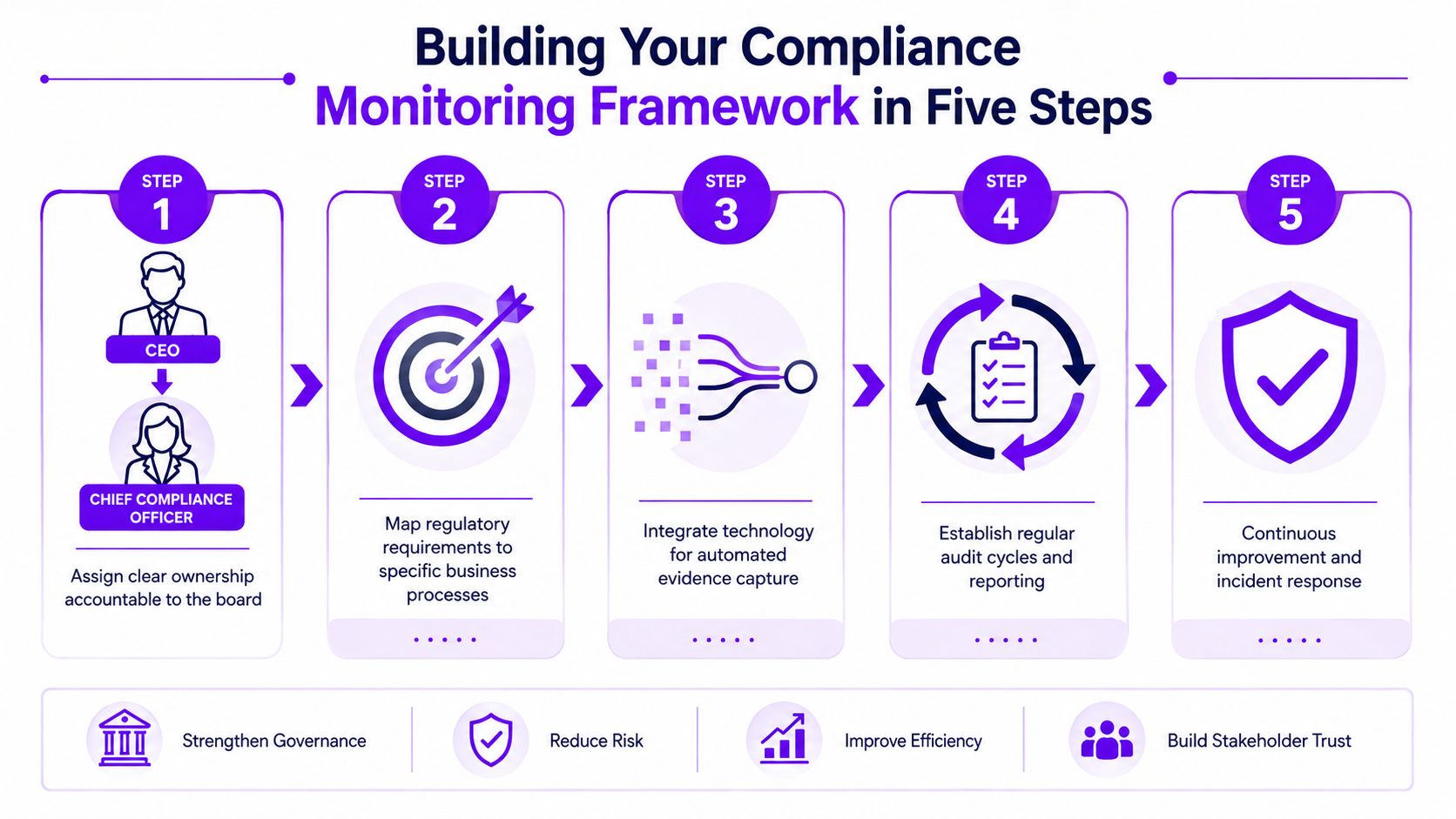
A credible framework starts with accountability, not software. Technology can collect evidence, but leadership must decide which obligations matter, who owns them and what happens when a control fails.
1. Put one executive in charge
Assign a Chief Compliance Officer or equivalent control owner accountable to the board. Don't bury ownership three layers under finance and then expect operations to treat alerts as urgent. Each obligation needs a named process owner, escalation owner and evidence owner.
2. Map obligations to data sources
Create a control matrix that links every obligation to the system that can prove compliance. For a DPDP-sensitive voice workflow, map the requirement to call recordings, consent receipts, identity checks, access logs, deletion events and retention exceptions.
The 2025 rules guidance describes a one-year minimum retention baseline for relevant logs and associated traffic data. That should influence architecture from the start. Separate operational data from audit evidence, apply immutable or tamper-resistant storage, control access by role and support legal holds.
3. Measure control performance, not activity
A dashboard filled with call counts isn't a compliance dashboard. Track indicators such as:
- Disclosure completeness: Whether required language appeared in the relevant interaction.
- Consent capture: Whether consent was explicit, attributable and linked to the purpose.
- Grievance turnaround: Whether complaints moved through the required workflow within the internal or regulatory target.
- Incident-to-report latency: How long detection, escalation and notification took, measured in hours where the rule demands it.
- Evidence retrieval: Whether an authorised reviewer can produce the required record without manual reconstruction.
4. Integrate voice, chat and transactions
Avoid stitching together exports from a call platform, CRM, ticketing tool and shared drive after an incident. Choose tooling that connects these sources, preserves event context and routes exceptions automatically. DialNexa's call-tracking software is one example of the type of workflow layer teams can evaluate when voice evidence needs to connect with operational records.
5. Review continuously at two levels
Frontline managers need live alerts and queues that tell them what to fix now. Executives need a monthly view of trends, unresolved exceptions, repeat failures, evidence integrity and remediation ageing. The audit committee should receive a concise account of material breaches, overdue actions and the organisation's ability to retrieve supporting evidence.
Implementation rule: Don't buy a dashboard until you can name the obligation, event, owner, escalation path and retention policy behind every metric.
Putting It to Work With Voice AI Across BFSI EdTech and Real Estate
Voice AI becomes relevant to compliance monitoring when it does more than transcribe calls. The platform needs to evaluate the interaction against defined rules, preserve evidence and route exceptions to people who can act.
BFSI collections
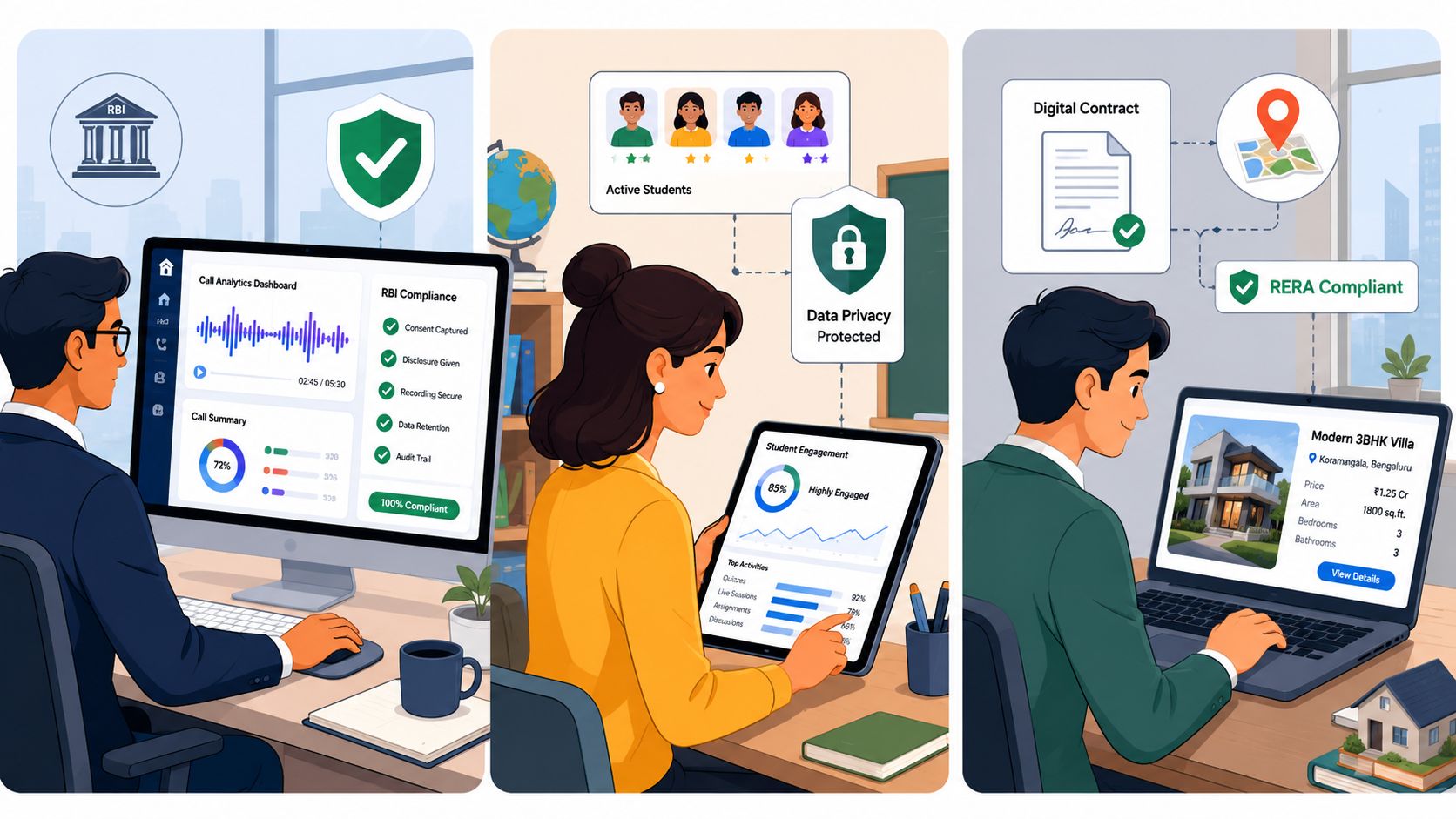
A collections manager can configure a workflow to check identity-verification steps, required disclosure language and respectful conduct. The system reviews each outbound interaction, records the relevant evidence and sends a live alert when an agent departs from the approved script.
The dashboard should show the affected call, agent, rule triggered, transcript segment, recording-access history and assigned reviewer. A second rule can automatically flag the interaction for legal or compliance review when the customer disputes the debt, alleges misconduct or requests escalation.
This doesn't remove human judgement. It moves human judgement to the exceptions that need it, instead of asking supervisors to search manually through routine calls.
EdTech admissions
An admissions workflow involving a minor needs an explicit consent trail. The voice agent can ask the required question, capture the response, associate it with the inquiry and stop the workflow when the answer is ambiguous.
The evidence view should preserve the language used, the timestamp, the consent status, the purpose presented and any later withdrawal or deletion request. Independent guidance on the DPDP Act notes that personal data should be erased once its purpose is no longer being served or consent is withdrawn, unless a legal retention exception applies. This guidance on DPDP and voice-recording audit trails is useful when designing stale-record and exception workflows.
Real estate site visits
A real estate agent can promise more than approved marketing material allows. A monitored voice workflow can check whether project disclosures were made, record which agent made each statement and alert the manager when a claim diverges from approved content.
The manager's dashboard should separate compliant bookings, incomplete disclosures, disputed statements and calls awaiting review. For teams evaluating this operating model, DialNexa's AI voice agent for real estate provides a relevant product context for site-visit and qualification workflows.
Common Pitfalls and Best Practices for Evidence-Ready Monitoring
Most monitoring failures aren't caused by a lack of ambition. They come from weak operational design.
The first failure is quarterly sampling across a process that changes every day. Sampling can miss a conduct issue in collections, an incomplete consent event or an access anomaly that matters immediately. Use continuous checks for regulated customer interactions and reserve sampling for processes where the risk and change rate justify it.
The second is fragmented evidence. Recordings sit in one tool, consent data in another, approvals in email and incident tickets in a service desk. When a regulator asks a question, the compliance team becomes an investigator. Centralise evidence references, preserve event relationships and restrict deletion through policy rather than convenience.
The controls that prevent avoidable failure
- Automated consent capture: Store the consent response, purpose, timestamp, identity context and withdrawal status together.
- Tamper-resistant retention: Preserve audit evidence separately from operational data, with role-based access and controlled deletion.
- Escalation timers: Start the clock when an event is detected, not when someone notices an inbox message.
- Rehearsed incident playbooks: Test who classifies, who approves, who reports and who preserves evidence.
- Evidence reviews: Review exceptions regularly, close remediation actions with proof and investigate repeat triggers.
- Readable dashboards: Put urgent exceptions in front of the people responsible for action. A dashboard nobody opens during an incident is decorative software.
SEBI's reporting framework requires a six-hour window for prescribed initial incident reporting and continued monitoring through closure. That means the control cycle includes detection, classification, escalation, notification, containment, investigation, remediation and closure evidence. A missed handoff can break the chain even when the technology detects the event.
The DPDP penalty structure raises the stakes for security safeguards, breach notifications and child-data obligations. In voice operations, that translates into practical controls for recordings, transcripts, consent, access and retention. Teams that need a concrete inspection-readiness reference can also review this guide to SOP evidence for inspections.
The final control is ownership. DialNexa's automated KYC verification workflow illustrates the kind of status, document and exception tracking that can support evidence-ready operations when configured against the organisation's actual obligations.
Evidence-ready principle: A regulator shouldn't have to trust your description of the control. Your systems should show what happened, who acted, when they acted and how the issue was closed.
Turning Compliance Monitoring Into a Strategic Advantage
Compliance monitoring belongs on the board agenda because it affects more than regulatory correspondence. It determines whether an organisation can launch products, scale customer operations and defend its reputation without increasing control risk at the same pace.
An evidence-ready programme lowers the cost of audits because teams can retrieve records instead of reconstructing them. It helps product and operations leaders identify unsafe workflow changes before those changes spread. It also gives the board a clearer view of whether management's stated control environment matches day-to-day behaviour.
The strategic advantage comes from treating evidence as an operational asset. A call recording isn't just a training file. It can prove disclosure, consent, identity verification, conduct, escalation and remediation. An access log isn't merely a security artefact. It can show whether the organisation detected an unusual event, contained it and preserved the trail needed for investigation.
This mindset is particularly important as India's privacy and digital-governance requirements move from policy into operational enforcement. Implementation timing remains evolving, including staged activation of some DPDP obligations, so organisations should avoid waiting for every detail to settle before building the evidence layer. They should design workflows that can adapt, preserve records and enforce purpose-based retention.
DialNexa Labs Private Limited can be evaluated as a practical voice workflow option for teams that need structured interaction data, live alerts and dashboards across customer conversations. The key decision isn't whether to replace every human reviewer. It's whether the organisation can turn high-volume voice activity into attributable, searchable evidence that supports timely intervention.
A mature compliance monitoring programme does three things consistently: it detects exceptions early, routes them to accountable owners and preserves proof of resolution. That is more valuable than another quarter-end certification because it gives leaders operational control before a regulator, customer or board committee demands an explanation.
DialNexa Labs Private Limited offers Voice AI agents, workflow integrations and dashboards for customer support, qualification, recruitment, presales and regulated interaction monitoring. Visit DialNexa Labs Private Limited to assess how your team can instrument voice workflows, automate evidence capture and build an auditable compliance monitoring process.

This guide offers a clear and practical explanation of compliance monitoring, with a useful focus on what CXOs need to understand. The emphasis on structured oversight and customer experience makes it a valuable resource for leaders managing compliance and business operations.
This is a thoughtful and practical explanation of why continuous compliance monitoring is becoming essential for modern enterprises, especially in regulated workflows.
This is a clear and practical explanation of why modern compliance monitoring needs continuous evidence, not just periodic checklists. The examples around voice workflows, audit trails, and regulatory requirements make the topic especially useful for businesses.
A practical and insightful guide explaining how Indian businesses can strengthen compliance monitoring through continuous oversight, clear accountability, and reliable audit trails. The regulator-specific examples and actionable five-step framework make this article especially valuable for organizations managing sensitive customer data and voice AI workflows.
A valuable and practical guide explaining how continuous compliance monitoring strengthens governance, reduces risk, and improves audit readiness. The five-step framework and India-specific regulatory examples make it especially useful for CXOs building stronger, evidence-based compliance processes.