
Call Tracking Software: A CXO’s Guide to ROI and Compliance
Call tracking software is still often bought as a marketing toy. That's the wrong frame in India, especially if you run BFSI, healthcare, collections, real estate, or any operation where the phone is part of the revenue path and the compliance path at the same time.
Treat it as an operational control layer. If your calls aren't captured, routed, logged, and analysed with discipline, your forecasting, QA, and audit readiness are already weaker than you think.
Table of Contents
- Why Call Tracking Is Now an Operational Necessity
- How Modern Call Tracking and Voice AI Work Together
- Navigating India's Compliance and Data Privacy Requirements
- The Economics of Adoption and ROI Measurement
- Strategic Use Cases for Regulated Industries
- Implementation Checklist and Vendor Selection Criteria
- Future-Proofing Your Communication Stack
Why Call Tracking Is Now an Operational Necessity
The old advice says call tracking exists to tell marketing which campaign drove a lead. That's too small. In India, the phone is still where serious intent shows up, where objections get resolved, and where your team either saves a deal or loses it to silence, delay, or sloppy follow-up.
The market itself still looks early-stage, not mature. One India web-technology snapshot says call tracking software is used on only 0.3% of Indian websites in 2026, and Google Ads Call Tracking holds 95.9% of the measured market, with Clixtell at 2.3% and CallRail at 1.8% (callhistorychecker.com). That concentration tells you the category is still narrow, and most buyers are using it for basic ad attribution rather than deeper operational control.
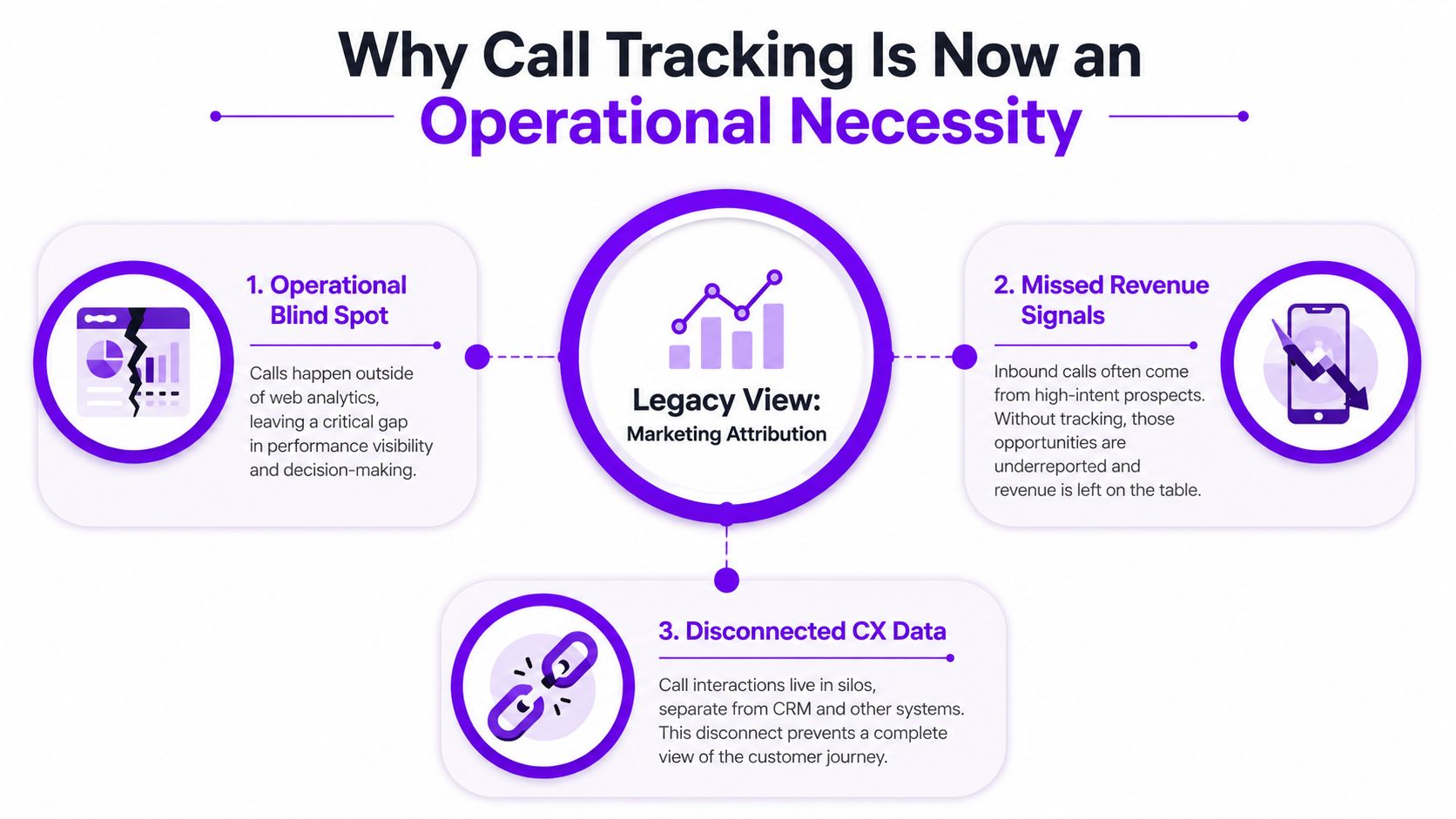
The real problem is invisible work
When inbound calls aren't structured, leaders make decisions from partial data. Sales hears anecdotes, operations sees queue pressure, and compliance only notices issues after a review. That creates blind spots in workforce planning, quality assurance, and revenue forecasting.
Practical rule: if your business handles meaningful phone traffic, every important call should leave a trace you can search, audit, and act on.
That's also why the operational case is stronger than the marketing case. Untracked calls make CAC calculations fuzzy, hide missed opportunities, and distort channel performance. If a caller never gets logged correctly, the business still paid for the ad, the agent time, and the missed chance, just without the evidence trail.
If you're building the stack properly, start with a basic discipline like what call logging should capture, then move from storage to analysis. The difference between a call log and a usable operational layer is whether the data changes routing, coaching, and follow-up.
The leadership test is simple
If your team handles more than routine inbound volume and you still rely on manual note-taking, you're making strategic calls from incomplete information. The issue is not whether phones still matter. The issue is whether your organisation is using voice data as an asset or treating it like noise.
How Modern Call Tracking and Voice AI Work Together
Modern call tracking software is not a reporting add-on. It is the operational layer that links campaign source to call outcome, then feeds transcription, intent detection, and summaries into the stack while the lead is still hot.
The mechanics are straightforward. Dynamic Number Insertion, or DNI, swaps the phone number on a webpage or landing page based on the visitor's source, keyword, or session. When the call comes in, the system routes it to the right queue or agent, records metadata, and pushes the result into your CRM or analytics stack.
Teams should insist on this sequence.
- Assign the number dynamically. Use DNI so a campaign or session gets a unique tracking number.
- Route the call cleanly. Connect that number to your PBX, cloud telephony, or contact centre platform.
- Capture conversation intelligence. Transcribe the call, detect sentiment, tag intent, and summarise next actions.
- Sync downstream systems. Push source data, call notes, and outcomes into CRM and reporting tools.
A useful external primer on AI tool evaluation is compare AI content tools, because the same discipline applies here, you want system fit, not feature noise.
Voice AI turns unstructured conversation into structured operational data. One call can produce caller ID, duration, source, disposition, sentiment, objections, competitor mentions, and follow-up status without a manager listening back manually.
Good call tracking should reduce human guesswork, not just automate screenshots for a dashboard.
Rule-based scoring only tells you a call was long or short, answered or missed. AI-driven analysis shows why a caller hesitated, where the script broke, and whether the lead deserved priority. If your team processes thousands of calls a month, that is the baseline, not an upgrade.
For teams already comparing broader voice workflows, conversation intelligence basics is the right companion concept. Call tracking is the capture layer, Voice AI is the interpretation layer, and together they create a system that supports sales, service, and compliance without extra manual work.
Navigating India's Compliance and Data Privacy Requirements
India is where generic call tracking advice breaks down fast. A platform that works for lightweight marketing attribution can become a liability once you apply TRAI traceability, recording consent, retention controls, and DPDP duties to the same workflow.
The telecom foundation comes first. India's operator apps and portals already make call-history access feel normal through interfaces such as MyJio, Airtel Thanks, Vi, and BSNL, with some services offering downloadable history for 60 or 90 days and others noting access to several months of records. That expectation has shaped how users think about call metadata, but normal access is not the same as open-ended access.
TRAI's DLT framework requires access providers to use distributed ledger technology for recording consumer preferences, consent verification, complaint handling, and intelligence (TRAI privacy policy). For businesses, the message is simple. Your voice workflows need recorded-consent logic, traceability, and auditable handling from day one.
What the compliance stack should actually do
TRAI's 2025 UCC-detection regulation goes further on operations. Access providers must keep strict access controls, maintain access logs, retain activity logs and system trails online for a minimum of two years, and prevent download, sharing, or reuse of UCC-detect data outside the permitted purpose (TRAI regulation PDF). That does not work with loose call notes sitting in a CRM.
The DLT setup also matters for registration and traceability. If your team is still treating DLT as a back-office telecom task, start with this TRAI DLT registration guide, because the routing rules and consent chain affect how every call workflow should be designed.
DPDP-era guidance adds another layer. India-focused compliance writing stresses purpose limitation, consent management, deletion after purpose is met, and India-only residency controls for call data, while also separating TRAI consent for commercial calling from DPDP consent for processing transcripts, recordings, sentiment tags, and CRM entries (ClearTouch). Buyers miss this split constantly, and vendors often gloss over it. Teams mapping the surrounding telephony spend can also review this IVR system cost guide for pricing models and TCO benchmarks.
Practical rule: if a vendor cannot explain consent, retention, and access logging in plain English, they are not ready for India's regulated voice workflows.
For recorded calls, public India compliance guidance commonly calls for a pre-call recording announcement, with one guide stating it should play within the first 15 seconds and specify the purpose of recording (FreJun compliance guide). That affects call flow design, IVR scripting, and QA checks.
| Regulation | Scope | Key Requirement | Enforcement Status |
|---|---|---|---|
| TRAI DLT framework | Telecom consent and traceability | Consent verification, complaint handling, recorded traceability | Active framework |
| TRAI 2025 UCC regulation | Access-provider UCC detection and logs | Access controls, access logs, activity logs, two-year online retention | Active regulation |
| DPDP-era guidance | Personal data processing in voice workflows | Purpose limitation, consent management, deletion after purpose, India residency controls | Operational guidance shaping current deployments |
Regulated buyers should ask one question first. Can the tracking architecture survive consent review, retention review, and audit review without manual cleanup?
The Economics of Adoption and ROI Measurement
Many teams still evaluate call tracking primarily through campaign-attribution dashboards. That misses the value. The economics are about recovering missed calls, improving qualification, and cutting the cost of bad process, not just tying a phone lead to an ad set.
Public pricing gives a practical starting point. Capterra India lists a call-tracking category with a starting price of $15.00 and a usage-based pricing model with a free trial (Capterra India). A public India-focused listing also shows plans at ₹1,349/user/month and ₹1,699/user/month, with monthly, quarterly, or annual billing and extra India virtual numbers priced at ₹600 for three numbers per month (FreJun pricing page). Those are entry points, not full enterprise TCO.
ROI measurement should start with revenue leakage, not vanity attribution. Count how many calls would have been lost, how many were handled faster, and how much manual work disappeared from ops, QA, and reporting. A useful model includes licensing, telephony, integrations, storage, and the time your team spends on setup and governance. For a cleaner framework, use MarTech Do's ROI measurement guide alongside an internal performance view like performance reporting for call operations.
Sample ROI framework for mid-market BFSI
| Metric | Baseline | Post-Implementation | Annualised Revenue Impact |
|---|---|---|---|
| Missed call recovery | Untracked callbacks | Structured follow-up workflow | Revenue recapture from otherwise lost high-intent calls |
| Lead attribution quality | Partial campaign visibility | Better source identification | Less budget wasted on weak channels |
| Agent productivity | Manual call notes and summaries | Automated transcription and call summaries | More time spent on live selling and servicing |
| Lead-to-close speed | Slower handoffs between teams | Cleaner routing and qualification | Faster movement through the funnel |
Compliance risk belongs in the ROI model too. A weak audit trail, poor retention discipline, or mishandled consent workflow creates operational cost, not just legal exposure. In regulated calls, the cost of fixing a broken process later is usually higher than setting up the stack correctly now.
Don't buy call tracking to prove marketing spend. Buy it to reduce the number of revenue decisions made from incomplete call data.
For operational leaders, the case is straightforward. If voice drives conversion, service, or collections, the business should treat call metadata, transcripts, and outcomes as part of the revenue system, not a side report.
Strategic Use Cases for Regulated Industries
Generic demos fail fast in regulated operations. A home loan aggregator, a test-prep business, and a property developer all need different routing logic, consent handling, and audit trails.
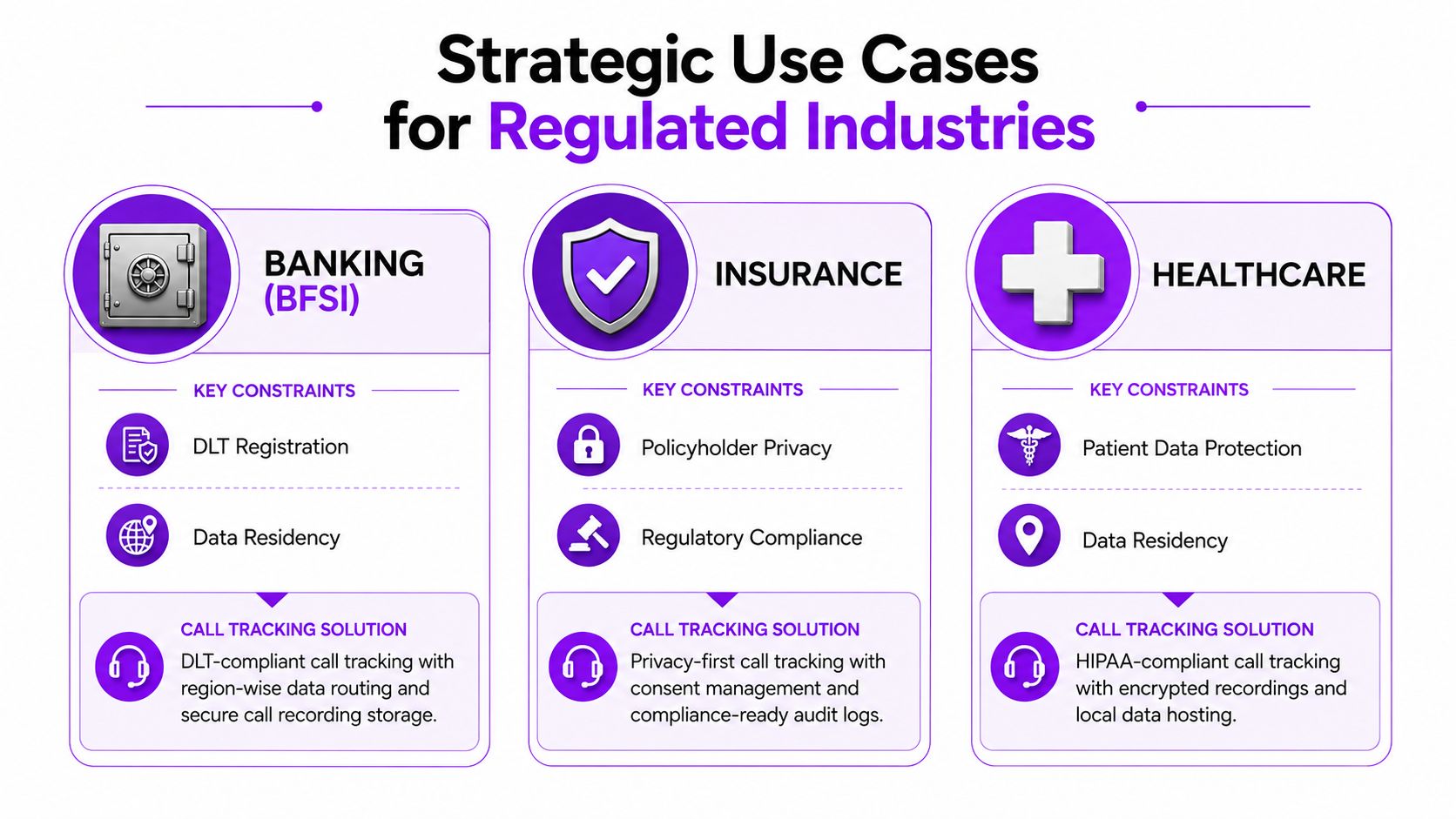
BFSI teams handling home loan enquiries need more than campaign attribution. They need DNI across partner websites, recording discipline, and PII masking before transcription so agents and managers can review calls without exposing unnecessary personal data. That gives operations cleaner qualification and fewer manual handoffs, while also tightening control over what Voice AI can process.
EdTech has a different problem set. A test-prep company may run regional language campaigns, receive calls from parents and students, and use Voice AI to detect course intent before routing to the right counsellor. Consent handling matters here, especially when the conversation involves minors or a parent speaking on their behalf. The call log must support qualification, not just prove that a phone rang.
Real estate is more local and more physical. A developer can assign unique toll-free numbers to hoarding campaigns by site or project, then use call logs to connect marketing spend to walk-in conversions and site-visit bookings. If a dispute arises, the business needs a record that holds up in internal review, which means the call data has to be structured for retrieval, not buried in a generic notes field.
Outbound-heavy teams should treat cold calling optimization for outbound sales as part of the same operating model. Outbound discipline and inbound tracking need the same dashboard, the same QA rules, and the same handoff logic. If they run separately, operations is managing two versions of performance.
The stack matters as much as the use case. CRM sync, dialer integration, and call review need to work together, because a campaign source that never reaches the sales record is useless to the business.
| Industry | Main Constraint | Operational Need | Call Tracking Priority |
|---|---|---|---|
| BFSI | Consent, retention, PII masking | Route, record, and audit with control | Compliance-safe qualification |
| EdTech | Parent and minor handling | Intent detection and proper routing | Consent-aware counselling |
| Real Estate | Location-level lead handling | Campaign-to-site attribution | Dispute-ready call logs |
Implementation Checklist and Vendor Selection Criteria
Implementation fails when teams buy software before they clean up the process. Start with the telephony map, then the consent model, then the integrations. If you reverse that order, you'll spend weeks untangling blocked numbers, broken webhooks, and reporting gaps.
A sensible rollout has three phases. First, audit existing PBX, cloud telephony, number pools, and call flows. Second, handle DLT registration, template approval, and routing logic. Third, connect CRM, marketing automation, and dashboards, then train agents and supervisors on what the new data means.
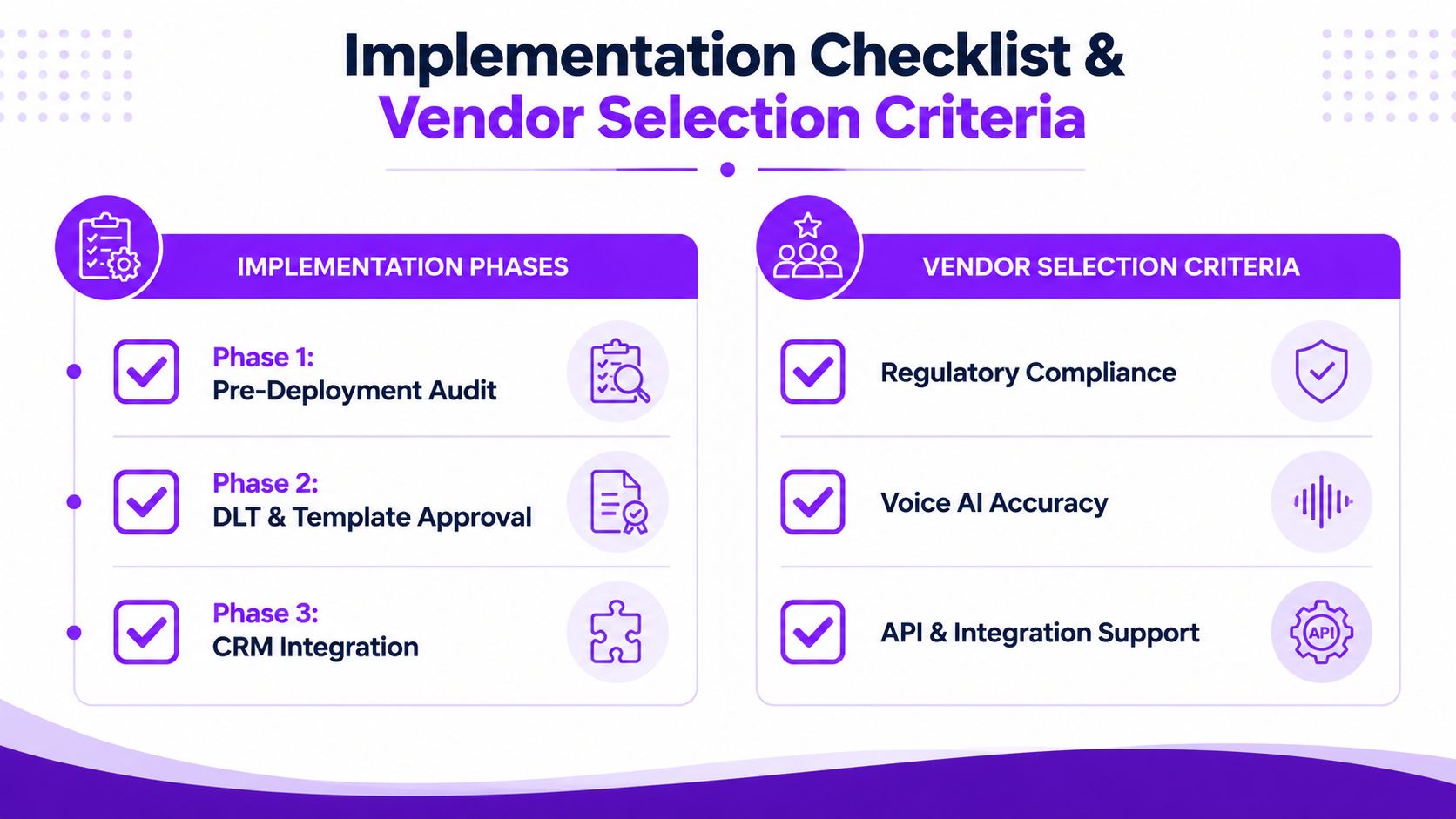
For vendor selection, ask hard questions, not brochure questions. Does the vendor support TRAI-compliant DLT scrubbing natively? Where do recordings live, and can they keep call data inside Indian data centres? How do they handle consent revocation? What happens when a webhook fails during peak call volume? Can they show audit artefacts, not just feature slides?
Cloud telephony provider selection should also be judged on whether the platform can survive real operating pressure, not just demo-day polish.
The questions CXOs should ask
- Regulatory fit: Can the platform explain TRAI, DLT, and consent handling without hand-waving?
- Data residency: Do recordings, transcripts, and metadata stay where your policy requires?
- Access control: Are roles, logs, and permissions strict enough for regulated operations?
- Voice AI quality: Does transcription and summarisation hold up in real Indian call conditions?
- Integration depth: Will CRM and telephony sync reliably without custom engineering for every change?
- Retention controls: Can the system enforce deletion and access windows cleanly?
- Operational visibility: Do managers get usable dashboards, or just raw exports?
- Support maturity: Can the vendor handle escalation when call flow logic breaks?
- Audit readiness: Can they produce logs, trails, and configuration history on demand?
- Scalability: Will number pools and routing still work when volume rises?
- Security evidence: Can they share credible assurance material such as SOC 2 Type II or CERT-In aligned reporting?
- Consent workflows: Can revocation and suppression be handled cleanly across systems?
One practical option in this space is DialNexa Labs Private Limited, which provides Voice AI agents with call history, transcripts, summaries, extracted fields, and call-detail views for operational review. That kind of design matters because the system has to support both qualification and auditability.
Future-Proofing Your Communication Stack
The next version of this category won't be about tracking calls better. It will be about making the phone channel behave like a structured data source that powers routing, coaching, and automated resolution. Basic attribution will stay useful, but it won't be enough for teams that want speed and governance together.
The right roadmap is phased. Start with compliance-ready call tracking. Add transcription, summaries, and conversation intelligence. Then move toward predictive lead scoring and autonomous voice handling for repetitive tier-one interactions. Vendors with open APIs, solid security posture, and a product roadmap aligned with India's compliance reality will age far better than point tools.
If your stack still treats voice as a disconnected channel, you're leaving too much value in the gap between marketing, sales, and compliance. Audit the stack, remove the silos, and decide where call data should flow next.
DialNexa Labs Private Limited helps teams turn voice into a usable operational system, not just a log of missed opportunities. If you want call tracking software that also supports qualification, summaries, routing, and compliance-aware workflows, visit DialNexa Labs Private Limited and review how their Voice AI stack fits your operating model.

This is a valuable and practical guide that clearly shows how call tracking can improve revenue, follow-up, and operational decision-making. The focus on Voice AI, compliance, and measurable ROI makes the content especially useful for modern Indian businesses.
This article offers valuable insights into how call tracking software can support ROI measurement while addressing important compliance considerations. A practical and informative guide for CXOs looking to make smarter decisions around customer experience and business performance.
This is an informative guide to understanding how call tracking software can improve ROI while maintaining compliance. The practical insights are especially useful for CXOs looking to make smarter decisions about call analytics and performance.
The focus on Voice AI, CRM integration, call intelligence, and India-specific compliance considerations makes the article especially valuable for businesses managing high-volume phone interactions.
The industry-specific examples and implementation checklist make it especially useful for businesses looking to build a more structured and measurable communication workflow.
A valuable and insightful article explaining how call tracking and Voice AI can improve lead attribution, agent productivity, and revenue performance. The practical implementation steps, ROI framework, and focus on TRAI compliance and data privacy make it especially useful for businesses managing high-volume customer calls.