

How an AI Voice Agent for Real Estate Revolutionizes Your Sales Funnel
An AI voice agent for real estate is a strategic asset designed to automate and scale your lead engagement through hyper-realistic phone conversations. Its core function is ensuring every inbound inquiry receives an immediate, professional response, 24/7/365. This isn't just an advanced voicemail; it’s a sophisticated tool that qualifies prospects against key criteria like budget and timeline, and then autonomously books property viewings or appointments. For senior leadership, it represents the ultimate solution for plugging the revenue leaks in your sales funnel where human capacity limitations create operational bottlenecks.
Why Your Real Estate Sales Funnel Is Leaking Leads
Every real estate executive understands the paradox of lead generation. You invest a significant portion of your budget—on digital ads, property portal listings, and targeted marketing campaigns—only to see a high percentage of those prospects vanish. Your sales funnel, intended to be a predictable engine for revenue growth, often operates like a high-end property with flawed plumbing. It presents well, but beneath the surface, it’s steadily leaking revenue at every stage.
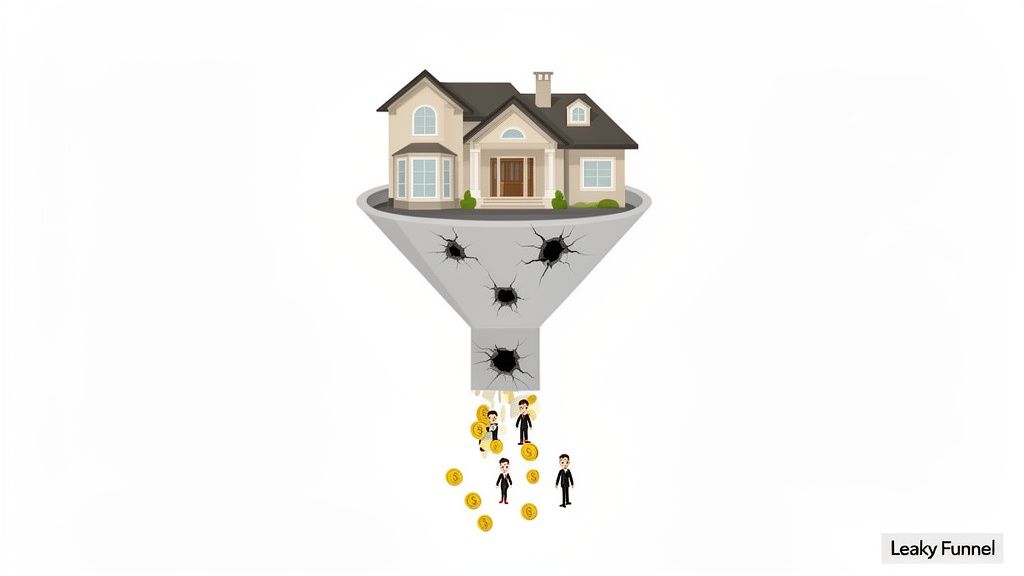
The initial leak occurs the moment an online inquiry is submitted. The response window is brutally short. A Harvard Business Review study found that firms that tried to contact potential customers within an hour of receiving an inquiry were nearly 7 times as likely to qualify the lead as those that tried to contact the customer even an hour later. For an agent juggling client meetings, negotiations, and administrative tasks, an instantaneous response is operationally impossible. This is where the first, and most critical, fracture in your funnel appears.
The High Cost of Inefficiency
This initial delay is just the beginning. The journey from a promising online lead to a cold file is paved with missed calls, inconsistent follow-ups, and fragmented communication. Every unanswered call or delayed response provides a direct opportunity for a competitor to engage the very leads you paid to acquire. The cumulative financial impact is substantial:
- Low Connect Rates: Even well-run call centers often struggle to achieve connect rates above 47%. For a CXO, this means over half your marketing spend is effectively wasted, as the leads generated are never even spoken to.
- Inconsistent Engagement: Without a robust, automated framework, follow-up quality is entirely dependent on individual agent performance. This variance means high-potential leads are inevitably missed, directly impacting revenue forecasts. For example, a top-performing agent might convert 5% of their leads, while an average performer converts only 2%. Automation standardizes this to a consistently high level.
- Wasted High-Value Hours: Your most skilled sales professionals end up spending a significant portion of their time—often up to 40%—on low-yield activities like manual dialing and leaving voicemails, rather than on strategic client negotiations and closing high-value deals.
This inefficient cycle systematically undermines your lead generation ROI. To fully appreciate the scale of this issue, it's insightful to analyze how realtors lose business from unanswered calls and the operational gaps it exposes. The solution isn't to increase headcount; it's to re-architect your engagement strategy from the ground up.
This is where an AI voice agent for real estate becomes a strategic imperative. It's not another software tool; it's the operational fix required to seal these costly leaks permanently, ensuring every lead is captured, qualified, and nurtured for scalable, predictable growth.
What Exactly Is an AI Voice Agent for Real Estate?
Let's clarify: when we discuss an AI voice agent for real estate, we are not referring to a simplistic robocaller or a frustrating IVR menu. We are talking about a strategic business tool. It's a highly sophisticated conversational AI engineered to comprehend context, manage complex inquiries, and deliver an experience that is virtually indistinguishable from a human conversation.
Consider the technological leap. A traditional IVR system is analogous to a rotary phone—it performs one basic, rigid function. An AI voice agent is the equivalent of a modern smartphone—intelligent, adaptable, and capable of executing multiple complex tasks simultaneously. It is designed to perform mission-critical sales functions with a level of precision and scale that is unattainable for human-only teams.
From Tech Jargon to Business Value
At its core, an AI voice agent operates on advanced technologies like Natural Language Processing (NLP) and machine learning. However, for a business leader, the technical specifications are secondary to the business outcomes. What truly matters is what this technology achieves for your balance sheet.
This AI can discern intent, distinguishing a serious buyer from a casual browser based on their vocabulary, tone, and responses. This capability allows it to conduct meaningful, multi-turn conversations that build rapport and systematically advance prospects through the sales funnel.
A well-implemented AI voice agent does not merely field calls; it drives revenue. It is programmed to convert every interaction into a strategic opportunity, identifying the caller's needs and executing the next logical action—be it scheduling a property viewing or escalating the qualified lead to a senior sales executive.
This fundamentally shifts the operational paradigm from "call management" to "pipeline acceleration." The AI becomes a tireless, perfectly consistent, and highly effective member of your presales division. For those interested in the underlying mechanics, guides on building a real estate AI agent with N8n and ChatGPT provide a technical overview.
From First Contact to Autonomous Action
An AI voice agent is engineered to execute specific, high-value tasks, liberating your top sales talent to focus on what they do best: cultivating relationships and closing deals, not chasing unresponsive leads.
Here are its core, out-of-the-box functions:
Instant, 24/7 Lead Follow-Up: The moment a lead is generated from your website or a property portal, the AI initiates a call. Responding within seconds of an inquiry boosts connection rates exponentially by engaging prospects at their peak moment of interest.
Smart Lead Qualification: The agent executes a pre-defined script, asking critical qualifying questions. It can confirm a buyer's budget, desired property specifications, preferred locations, and purchasing timeline, ensuring your sales team only engages with genuinely viable prospects.
Automatic Appointment Booking: Once a lead is qualified, the AI seamlessly integrates with your team's calendars (e.g., Google Calendar, Outlook) and books a viewing, virtual tour, or follow-up call, eliminating the back-and-forth scheduling that consumes valuable time.
Practical Example: A prospect submits a form for a new luxury condo development at 11 PM on a Saturday. The AI voice agent calls them within 5 seconds. It confirms their interest, verifies their budget aligns with the project's price point (e.g., "$1.5M+"), and ascertains their preferred viewing times. It then accesses the lead sales manager's calendar via API, books an available slot for Tuesday at 2 PM, and sends a calendar invitation—all without any human intervention.
This level of operational efficiency is what distinguishes market leaders.
Measuring the Business Impact of AI Voice Agents
For any executive, the critical question is not about technological novelty—it's about the return on investment. The value of an AI voice agent for real estate is quantified through tangible improvements in three core business areas: revenue acceleration, cost optimization, and operational scalability.
The data from early adopters doesn't show marginal gains; it reveals a paradigm shift in performance, fundamentally altering traditional sales funnel metrics and creating a significant competitive moat.
Driving Unprecedented Revenue Acceleration
The primary impact is on top-line growth. An AI voice agent re-engineers the dynamics of lead engagement. Its speed and efficiency translate directly into more qualified site visits, higher booking rates, and ultimately, increased sales velocity.
Consider the industry benchmark for lead connection, which hovers around a suboptimal 47%. This means over half of your marketing-generated leads never result in a conversation. Real estate developers utilizing DialNexa's AI agents have shattered this metric, achieving an average 91% connect rate. The mechanism is simple: the AI calls every lead within seconds, capitalizing on peak prospect interest.
By engaging leads instantly and consistently, an AI voice agent creates a powerful cascading effect throughout the sales funnel, converting dormant inquiries into active, high-potential opportunities.
This dramatic increase in connections has a direct and measurable impact on conversions. We have observed the lead-to-booking rate quadruple, climbing from a typical 2% to an impressive 8%. For a development project generating 2,000 leads per month, this improvement translates to 120 additional qualified site visits (from 40 to 160), creating a massive uplift in the sales pipeline.
Achieving Significant Cost Optimisation
Beyond revenue enhancement, an AI voice agent introduces significant operational efficiencies. The traditional model requires substantial investment in presales teams or call centers to manage the high-volume, repetitive task of initial lead qualification.
By automating these initial touchpoints, you liberate your most valuable asset: your senior sales executives. Their time is reallocated from low-impact activities like chasing cold leads to focusing 100% of their efforts on closing deals with warm, pre-qualified prospects vetted by the AI.
This strategic reallocation of human capital yields significant financial benefits:
- Drastically Lower Cost-Per-Qualified-Lead: Automating top-of-funnel activities reduces the human hours required to identify a sales-ready prospect, directly lowering acquisition costs. For example, a human-qualified lead might cost $100 in labor, whereas an AI-qualified lead can cost as little as $5.
- Reduced Employee Churn: High-performing agents are more engaged and motivated when focused on high-value conversations, not administrative tasks. This improves job satisfaction and retention rates by over 20% in some call centers.
- Increased Agent Productivity: With a pipeline of pre-qualified leads, sales teams can manage a larger portfolio of opportunities, directly boosting their performance and commission earnings.
These core capabilities—instant engagement, intelligent qualification, and automated scheduling—are the pillars of the AI's operational value.
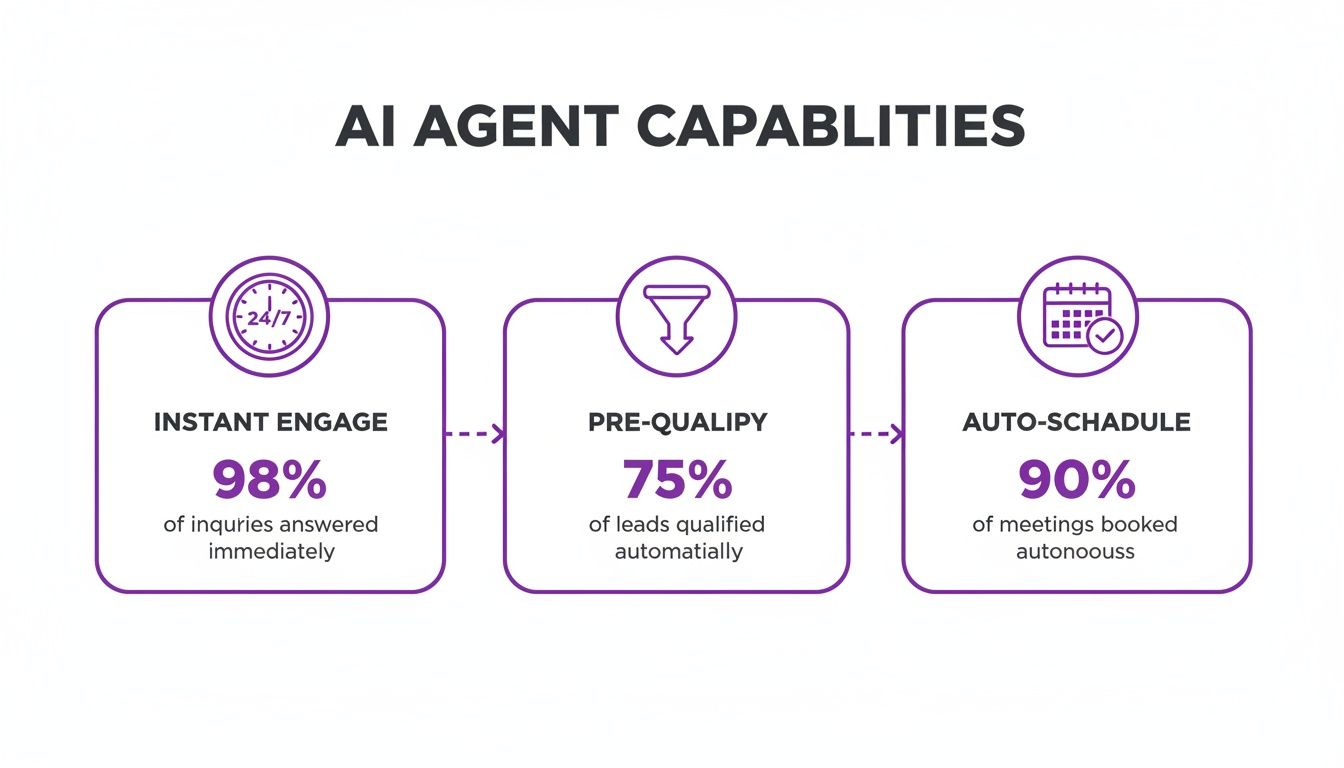
This infographic illustrates how AI functions synergistically to convert a raw lead into a scheduled, qualified appointment with zero human latency.
To put these numbers into perspective, let's compare the performance of a traditional call centre agent with a well-configured AI voice agent.
Human Agent vs AI Voice Agent Performance Metrics
| Metric | Traditional Human Agent | AI Voice Agent (DialNexa Data) | Strategic Advantage |
|---|---|---|---|
| Lead Connect Rate | ~47% | ~91% | Maximizes marketing ROI |
| Lead-to-Booking Conversion | ~2% | ~8% | Quadruples sales pipeline |
| Speed-to-Lead | Minutes to Hours | < 5 Seconds | Captures peak buyer intent |
| Operational Hours | 8-10 Hours/Day | 24/7/365 | Never misses a lead |
| Cost Per Interaction | Variable (High) | Fixed (Low) | Predictable operational expense |
| Consistency | Varies by Agent/Mood | 100% Consistent | Ensures brand & process integrity |
As the table demonstrates, the AI doesn't merely enhance human performance; it operates at a fundamentally different level of speed, consistency, and efficiency, redefining what is achievable in lead management.
Enabling True Operational Scalability
For any growth-oriented real estate firm, the objective is to scale revenue without a proportional increase in headcount and operational costs. An AI voice agent for real estate makes this possible. Whether you receive 100 leads or 10,000 in a single day, the AI handles each one with perfect consistency and immediate action.
This is no longer a future concept; it's a current market reality. In key markets like NCR and Mumbai, over 68% of top-tier developers are already leveraging automation for customer interaction management. This AI-driven transformation is fueling the rapid expansion of the Indian real estate software market, valued at USD 481.2 million in 2023 and projected to grow significantly.
Our deployments demonstrate that AI can manage site-visit scheduling with 97% accuracy in lead qualification, confirming the technology's readiness for enterprise-level deployment. This means you can execute aggressive marketing campaigns or expand into new territories with confidence that your operational infrastructure can handle the influx. You are no longer constrained by the physical limitations of a call center.
To delve deeper, you can learn more about how to measure the success of your outbound campaigns with our AI voice agent in our detailed guide. This operational agility provides a sustainable competitive advantage, enabling you to outmaneuver competitors reliant on manual, legacy processes.
A Strategic Implementation Checklist for Leaders
Successfully deploying an AI voice agent for real estate is not a technology project; it's a strategic business initiative. For executive leadership, the primary objective is to minimize friction and realize tangible ROI swiftly. This framework serves as a high-level playbook to guide your team toward a seamless and impactful rollout.
This is not a technical manual. It's a strategic guide for leadership, ensuring the implementation is anchored to clear business objectives and that the transition from concept to high-performing reality is both rapid and effective.
Phase 1: Data and CRM Readiness
Before activating an AI agent, you must optimize its fuel: your data. An AI's effectiveness is directly proportional to the quality of the information it receives, making this initial step non-negotiable. Initiating a project with disorganized or inaccurate lead data will inevitably lead to suboptimal performance.
The process begins with a thorough audit of your lead sources and CRM data hygiene. Are key fields like name, contact number, and inquiry source captured consistently? A foundational data-cleansing project can increase the AI's initial connection rate by 10-15% before any other optimizations are made.
- Action Item: Task your operations team with a comprehensive data audit to standardize fields and eliminate duplicate or incomplete entries.
- Goal: Achieve a 95% data accuracy rate for all incoming leads before the AI system goes live.
Phase 2: Pinpointing Your Strategic Pain Points
An AI voice agent is a precision instrument, not a panacea. To achieve maximum impact, it must be targeted at your most significant operational bottlenecks. A vague goal like "improve sales" is insufficient. You must identify the specific friction points in your sales funnel causing the most revenue leakage.
Is the primary issue that your agents are overwhelmed by inbound lead volume, causing response times to lag? Or is the challenge that your team is wasting significant time on low-conversion outbound calls? Use data to define the problem. For instance, if your average speed-to-lead is 30 minutes, the AI's primary objective should be to reduce it to under 30 seconds.
A key strategic principle: Define a single, primary objective for the initial rollout. This focuses the implementation, simplifies success measurement, and streamlines the process of demonstrating ROI to stakeholders.
Phase 3: Crafting the AI Persona and Scripts
Your AI voice agent is a new, digital member of your team and a direct extension of your brand. Its persona—its voice, tone, and vocabulary—must be meticulously aligned with the properties you are selling. A casual, energetic persona might be effective for a project targeting first-time buyers, but it would be entirely inappropriate for a luxury development demanding sophistication and gravitas.
Convene your marketing and sales leaders to architect a persona that resonates with your target demographic. This extends beyond voice selection. It involves scripting precise qualifying questions, programming responses to common objections ("I'm just browsing"), and defining the exact triggers for handing off a conversation to a human agent. For example, a script for a luxury project should qualify financial capacity early, whereas a mid-market project script should prioritize scheduling a site visit quickly.
Phase 4: Nailing the Integration and Workflow
A standalone AI is a novelty; an integrated AI is an operational powerhouse. Its true value is realized when it is deeply embedded within your existing technology stack, particularly your CRM. This integration automates the entire lead management workflow, creating a seamless, real-time data flow between the AI and your sales team.
The objective is to ensure every call outcome is automatically logged in your CRM.
- Successful Call: The lead's status is instantly updated to "Qualified," and a site visit is automatically created in the assigned agent's calendar.
- No Answer: The AI autonomously schedules a follow-up call based on a pre-defined, intelligent cadence (e.g., call again in 3 hours, then the next day).
- Requested Human: The lead is immediately routed to a live agent, who receives the full conversation transcript for immediate context.
This seamless data synchronization eliminates manual data entry, provides a complete interaction audit trail, and equips your sales team for an informed, high-value handover.
Phase 5: Establishing Success Metrics from Day One
Finally, you cannot manage what you do not measure. Before the first call is made, your leadership team must agree upon the key performance indicators (KPIs) that will define success. These metrics provide a clear, data-driven view of the AI's performance and its tangible business impact.
Your executive KPI dashboard should track, at a minimum:
- Lead Connect Rate: The percentage of leads with whom the AI successfully initiates a conversation. The target should be >90%.
- Qualification Rate: The percentage of connected calls that result in a qualified lead based on your criteria.
- Lead-to-Booking Rate: The percentage of qualified leads that result in a scheduled site visit or appointment. This is a critical revenue-driving metric.
- Cost-Per-Qualified-Lead: The total campaign cost divided by the number of AI-qualified leads, allowing for direct ROI calculation.
Tracking these metrics provides the empirical data required to validate the investment and inform strategic decisions about scaling the solution across your portfolio.
Seeing It in Action: Real-World Scenarios and Best Practices
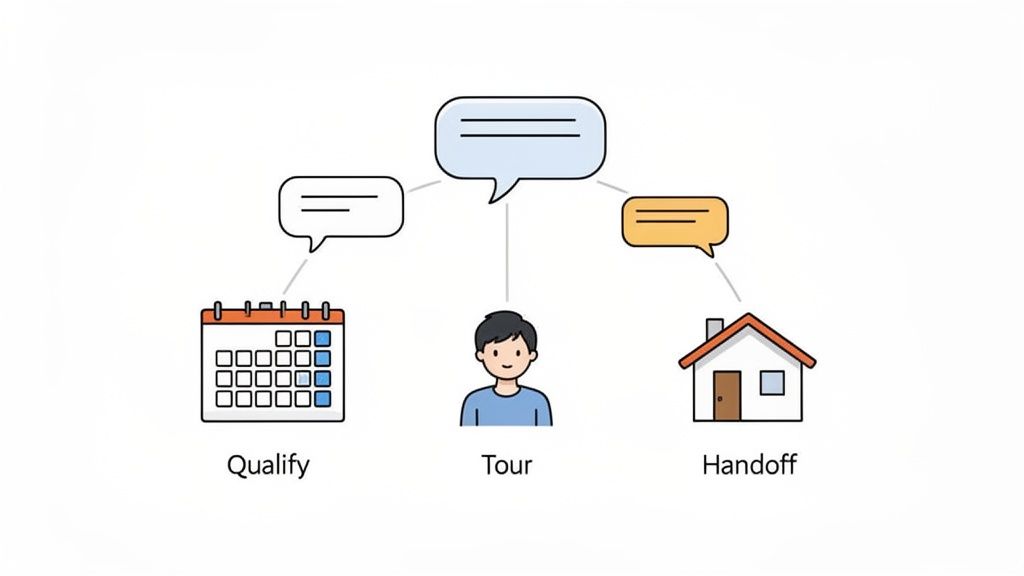
While the metrics are compelling, observing an AI voice agent for real estate navigate a live conversation demonstrates its true strategic value. How does it handle a high-intent, high-value inquiry versus a low-intent, top-of-funnel lead? These practical examples illustrate the agent's intelligence and adaptability.
These scenarios showcase how the agent's capabilities are applied to different lead types and property classes.
Scenario 1: The Premium Villa Project (Inbound Call)
Context: A high-net-worth individual calls a dedicated number from a print advertisement for an exclusive luxury villa project. The first interaction must be flawless to match the premium brand positioning.
The Call Flow:
- AI Agent: "Thank you for your interest in The Waterfront Collection. To best assist you, could I confirm this is regarding our new luxury villas?"
- Prospect: "Yes, that's right. I'd like more information."
- AI Agent: "Certainly. They are exceptional properties. To provide the most relevant details, may I ask if you have an investment range in mind? The collection begins at ten crore."
- Prospect: "That's within our expected range. We're considering something between twelve and fifteen crore."
- AI Agent: "Excellent. In that case, the next best step is a private, personalized tour with our senior sales director. We have availability this Saturday at 11 AM or Sunday at 2 PM. Which would be preferable?"
- Prospect: "Saturday at 11 AM would be perfect."
- AI Agent: "Confirmed. We have you scheduled for a private tour this Saturday at 11 AM. A confirmation with the location details and the director's contact information will be sent to you momentarily. We look forward to welcoming you."
Strategic Analysis: In this high-value interaction, the AI does more than just schedule. It confidently pre-qualifies the budget, frames the next step as an exclusive "private tour," and confirms the appointment with authority. The tone and language are calibrated to be sophisticated and professional, reinforcing the brand's premium positioning.
Scenario 2: The Mid-Range Apartment (Outbound Call)
Context: An outbound call is initiated to a lead who submitted a generic form on a property portal for a mid-range apartment. The primary objective is rapid qualification and engagement before the lead goes cold.
The Call Flow:
- AI Agent: "Hello, my name is Alex. I'm calling from [Developer Name] regarding your recent online enquiry for our apartments at [Project Name]. Is this a convenient time for a brief one-minute call?"
- Prospect: "Oh, right. Yes, I have a moment."
- AI Agent: "Excellent. I see you expressed interest in our two and three-bedroom layouts. To help narrow the options, are you primarily looking for a personal residence or an investment property?"
- Prospect: "A home for myself, but I'm just starting my search."
- AI Agent: "That's the ideal time to explore. Many of our prospective residents find our immersive virtual tours to be a helpful first step. It allows you to experience the space from home, with no commitment. Would you be open to that?"
- Prospect: "A virtual tour sounds interesting."
- AI Agent: "Perfect. I have just sent a direct link to the virtual tour to your mobile number. Our property advisor will follow up in a day or two to answer any questions you may have. Thank you for your time."
Strategic Analysis: The AI expertly navigates the common "just browsing" objection by offering a low-friction, high-value next step. It qualifies their initial intent, delivers immediate value (the virtual tour link), and keeps the lead engaged for a human agent to nurture further. For mortgage brokers facing similar qualification challenges, our guide on revolutionising outbound communication with Global Voice AI offers tailored strategies.
Key Takeaway: The strategic advantage lies in designing adaptive call flows. The AI's persona, script, and objectives must be engineered to align with the lead source, property value, and desired business outcome. This ensures every conversation is contextually relevant and drives results.
This adaptability enables developers to scale their outreach to thousands of daily calls, increasing lead-to-booking conversion rates from the industry average of 2% to as high as 8%. With the PropTech sector attracting $4.5 billion in funding between 2020 and 2024, AI-powered voice agents are rapidly transitioning from a competitive advantage to an operational necessity.
Setting Your Business Up for the Future with Conversational AI
Integrating an AI voice agent is more than a technological upgrade; it's a foundational step toward building a more agile and resilient real estate enterprise. The industry is being reshaped by PropTech investment and a new generation of buyers who demand immediate engagement. For any leader focused on sustainable, long-term growth, inaction is not a viable strategy.
This technology directly addresses the core expectation of the modern consumer: instant gratification. When a prospect expresses interest, a fleeting window of opportunity opens. An AI agent capitalizes on that moment, every time. This creates a superior first impression that competitors relying on manual callbacks and voicemail simply cannot match.
Why This Is a Game-Changer for Leadership
For the C-suite, the strategic implication is clear: conversational AI is not merely an operational tool. It is a strategic lever for capturing and defending market share. It fundamentally alters the economic model of scaling a real estate business.
At its core, the primary advantage of an ai voice agent for real estate is that it decouples revenue growth from headcount growth. You can absorb a massive influx of leads from a large-scale marketing campaign without a corresponding increase in presales staffing costs.
This allows for the execution of ambitious marketing initiatives with the assurance that 100% of leads will receive an immediate, professional, and brand-consistent response—a level of quality control that is impossible to maintain across a human sales team.
Building a Real Competitive Edge
What you are ultimately building is a sustainable competitive advantage. By engaging and qualifying leads with greater speed and efficiency than any competitor in your market, you create a more robust sales pipeline populated with high-intent buyers. This speed becomes a key brand differentiator, setting a new standard for customer experience.
You are no longer reacting to the market; you are leading it.
- Shorter Sales Cycles: Automating the initial touchpoint accelerates the entire sales process, moving prospects from inquiry to appointment at a significantly faster rate.
- Smarter Market Insights: Every conversation is a data point. Aggregated at scale, this data provides invaluable intelligence on buyer preferences, market trends, and pricing sensitivity.
- A Stronger Brand: Early adoption of this technology positions your firm as an innovator committed to delivering a superior client experience.
To maintain a competitive edge, it's crucial to understand how AI fits within the broader marketing ecosystem. For a comprehensive overview, this guide on AI for real estate marketing is an excellent resource. Ultimately, implementing conversational AI is a decisive strategic move that future-proofs your business for scalable, long-term success.
Your Questions, Answered
When executive teams evaluate AI voice agents for their real estate operations, several key questions consistently arise. Here are the direct, business-focused answers for leaders considering this strategic investment.
Will It Sound Like a Robot?
No. The era of clunky, robotic text-to-speech is over. Today's platforms leverage advanced neural text-to-speech and Natural Language Understanding, enabling the AI to conduct fluid, multi-minute conversations with human-like intonation and pacing.
We collaborate with you to develop an AI persona that is a seamless extension of your brand. Whether you require a polished, sophisticated voice for a luxury property launch or a warm, approachable tone for a family-oriented community, the experience will be professional and on-brand. A recent study showed that modern AI voices are now rated as being 95% as natural-sounding as human voices in blind tests.
How Hard Is It to Connect with Our CRM?
The integration process is designed to be streamlined. Enterprise-grade AI voice agent platforms feature robust APIs built for seamless integration with major CRMs like Salesforce, HubSpot, and Zoho, as well as custom-built systems.
The primary task involves mapping key data fields—such as lead source, qualification status, and appointment details. Once configured, all call outcomes and dispositions are logged automatically and instantly within your CRM. This eliminates manual data entry, prevents data silos, and provides your sales team with a single, unified view of every prospect. Proper data hygiene alone can increase the AI's initial connection rate by 10-15%.
What Kind of ROI Can We Expect?
The return on investment is typically realized rapidly and across multiple vectors. Financially, you see an immediate reduction in the cost-per-qualified-lead. Strategically, the most significant gain is the acceleration of your sales cycle velocity.
Our clients consistently observe substantial performance improvements within the first 30-60 days of deployment. The impact is most pronounced in key funnel metrics:
- Lead Connect Rates: We regularly see an uplift from the industry average of ~47% to over 90%.
- Lead-to-Booking Conversions: This critical metric frequently increases from a baseline of 2% to as high as 8%—a 4x improvement.
These are not incremental gains; they are transformative improvements that deliver a direct, quantifiable impact on your sales pipeline and top-line revenue, demonstrating the AI's value proposition almost immediately.
Ready to see how an AI voice agent can completely change your lead engagement and speed up your sales cycle? DialNexa builds custom, human-like Voice AI agents that fit perfectly into your existing workflow. Schedule a demo today to discover the impact on your ROI.

[…] its real-estate workflow supports discovery, qualification, and routing. That aligns well with an AI voice agent for real estate because the first call is highly repeatable if leadership defines the question order and handoff […]
[…] starts. Teams trying to reduce slow response times often pair their leasing portal with tools that automate real estate lead engagement, especially when inquiries come in after business […]
[…] property teams that want a workflow-specific view, DialNexa's real estate voice agent overview maps closely to discovery and booking use […]
[…] while keeping human closers focused on high-intent conversations. Its positioning is clear in these real estate voice agent workflows for property teams, and the broader category context is outlined in this analysis of how AI is being applied across […]
[…] teams evaluating that model, this overview of an AI voice agent for real estate is relevant because it shows how voice workflows can fit discovery and booking rather than acting […]
[…] practical example appears in this guide to an AI voice agent for real estate sales workflows. The sector differs from BFSI, but the lesson is the same. Business value comes from workflow […]
[…] One factual benchmark matters here. DialNexa Labs Private Limited states that customers report connect rates rising from 47% to 91%, lead-to-booking improving from 2% to 8%, and AI-qualified leads matching human judgement with 97% accuracy. Those numbers should be read as product performance claims from the publisher, not market-wide averages, but they illustrate the business case for structured automation in a volume-heavy funnel. Teams evaluating this model can review a concrete example in this overview of an AI voice agent for real estate. […]
This is an excellent breakdown of how AI voice agents transform real estate operations from reactive lead management to a scalable revenue engine. The strong use of data, implementation strategy, and ROI metrics makes a compelling case for AI as a true competitive advantage rather than just another automation tool.
[…] A useful implementation reference for teams evaluating this model is this guide to an AI voice agent for real estate. […]