

AI for Real Estate Leads: The 2026 CXO Playbook
India's corporate real estate sector moved from under 5% AI adoption in 2023 to 91% in 2025, according to coverage citing the JLL Global Technology Survey 2025. That shift changes the executive question. AI for real estate leads is no longer a speculative chatbot project. It's an operating decision about which buyer segments need immediate contact, which require deeper discovery, and which should stay in automated nurture.
The strongest Indian benchmark makes the commercial case clearly. Portal and paid-channel leads typically convert at 8% to 15% without AI follow-up, compared with 20% to 35% when AI qualification and automated follow-up are used, while response time can move from four to six hours to under 60 seconds after deployment, according to India-focused real estate lead-management benchmarks. Those figures don't justify buying an undifferentiated AI platform. They justify redesigning the lead journey around speed, price band, channel, and qualification depth.
Table of Contents
- 2026 AI Adoption and Conversion Benchmarks for Indian Real Estate
- What AI for Real Estate Leads Actually Does
- Core Approaches Inside an AI Lead Stack
- Mapping AI Across the Real Estate Lead Journey
- Example Flows for Indian Residential Projects
- KPIs, ROI and What to Measure
- Implementation Checklist and Integration Best Practices
- Your 30-60-90 Day AI Rollout Plan
2026 AI Adoption and Conversion Benchmarks for Indian Real Estate
The 91% adoption figure sets the operating context for Indian real estate CXOs. Corporate real estate decision-makers moved from under 5% AI adoption in 2023 to 91% in 2025, according to coverage of the JLL Global Technology Survey 2025. AI now belongs in lead routing, qualification, follow-up, and decision support, not only content production.
Early-mover coverage also promotes a 3x increase in qualified buyers, but that figure is not part of the verified India conversion benchmark. Do not use it as a forecast. The defensible operating case is narrower: AI improves execution when it reduces response time, asks consistent questions, and gives the right sales representative complete buyer context.
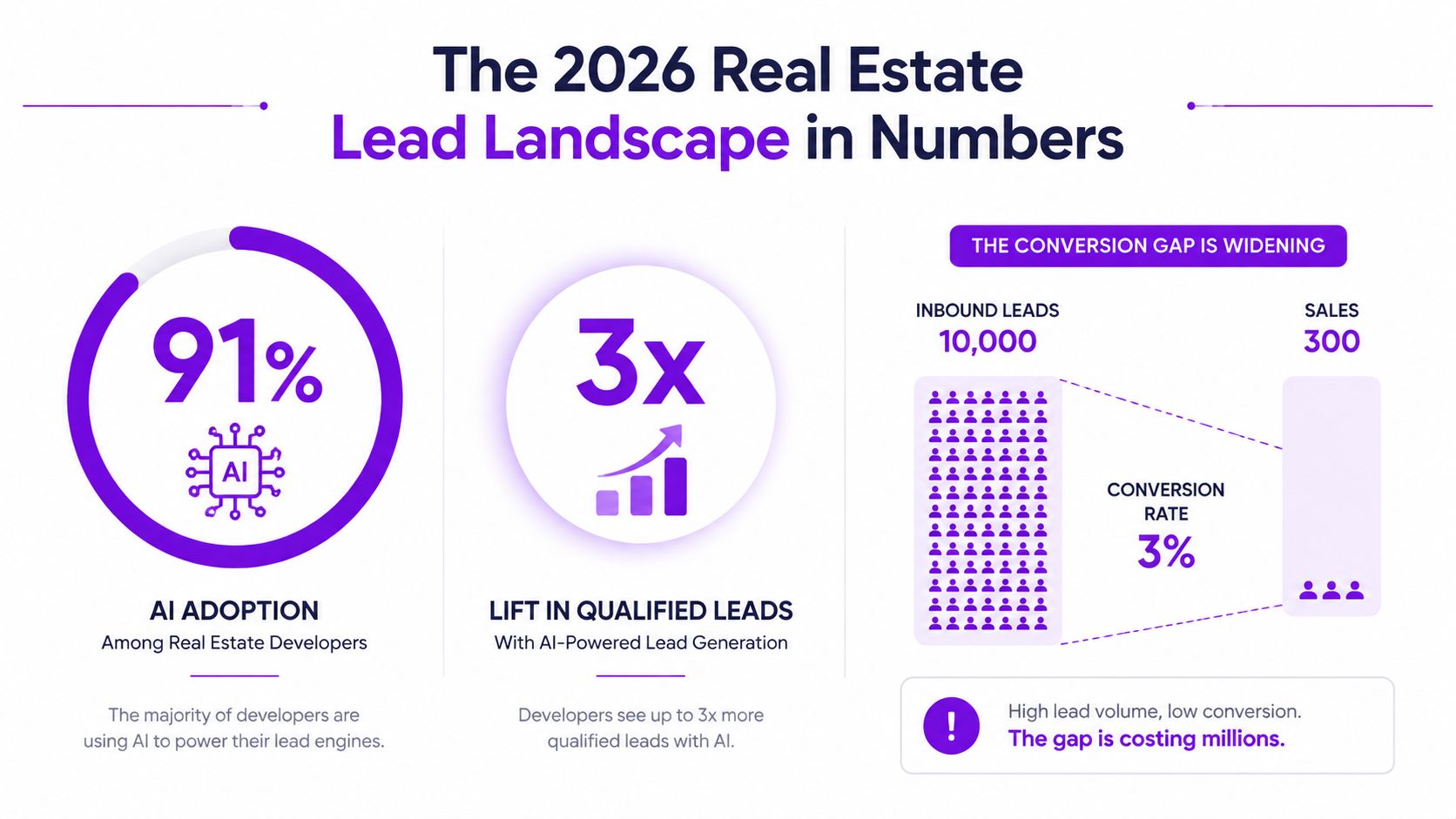
The conversion gap is operational
Indian developers often respond in four to six hours without AI, while AI-supported workflows can respond in under 60 seconds, according to the India real estate lead-management benchmark. A separate India-focused benchmark reports that contacting a lead within 5 minutes makes qualification roughly 21x more likely than waiting beyond 30 minutes. Calls within 1 minute can produce 391% more conversions than calls made after 1 hour, according to Vyora's analysis of AI calling for Indian real estate.
Set the first-touch SLA before purchasing advanced scoring. A model cannot recover intent after a slow sales response has allowed it to decay.
Configure AI by project economics
Use different operating designs for different projects.
- Affordable projects need low-cost automated capture, qualification, and appointment handling. A large human SDR layer can become inefficient quickly.
- Mid-market projects need volume control. AI should process portal, broker, Meta, Google Search, and YouTube enquiries, then reserve relationship-manager time for qualified buyers.
- Premium projects need deeper discovery. Capture budget, location, configuration, financing readiness, decision participants, and timing before routing the lead to a senior RM.
Budget band alone does not determine the workflow. ANAROCK data reported by ET Realty shows the average lead-to-buy cycle reached 26 days in 2025, down from 32 days in 2024. Homes priced above ₹3 crore moved from 17 days to 27 days, while the ₹2 crore to ₹3 crore band converted in 15 days.
Route the ₹2 crore to ₹3 crore buyer for speed and clear qualification. Give ultra-premium prospects a longer nurture path with richer context for the senior RM. For stack design and deployment considerations, review this AI in the real estate industry guide.
What AI for Real Estate Leads Actually Does
AI for real estate leads is software that captures enquiries, qualifies buyers, nurtures undecided prospects, and books site visits with limited human intervention. It doesn't replace the RM. It removes repetitive first-touch work and gives the RM a better-organised conversation to continue.
A useful system performs four jobs:
- Capture demand from website forms, WhatsApp, property portals, click-to-chat campaigns, and Meta ads.
- Qualify intent through guided questions about budget, location, BHK or configuration, possession timeline, and financing.
- Nurture selectively with personalised reminders, inventory updates, answers to objections, and follow-up cadences.
- Book the next action, usually a site visit, video consultation, callback, or senior-RM handoff.
An India real estate lead-flow guide from Caller Digital describes a workflow in which an AI voice agent calls a new portal or advertising lead within 90 seconds, asks about budget, BHK, possession date, and financing, and routes serious buyers to a human site-visit specialist. That is the correct mental model. The product isn't a chatbot sitting on a landing page. It's a coordinated revenue workflow.
Procure the stack in layers
Treat each layer as a separate vendor and architecture decision.
- Data layer: stores buyer history, project inventory, unit availability, source, previous conversations, and booked actions. If the data layer is incomplete, the agent will offer unavailable inventory or repeat questions.
- Intelligence layer: scores intent and recommends routing based on explicit answers and behavioural signals. It should distinguish a browsing portal lead from a buyer who has supplied a budget and requested a specific visit slot.
- Interaction layer: handles voice, WhatsApp, web chat, SMS, and email. Voice suits urgent qualification and missed-call recovery. Chat suits self-service and low-friction capture.
- Orchestration layer: writes structured outcomes into Salesforce, HubSpot, Zoho, or an in-house CRM, creates tasks, reserves calendars, and triggers reminders.
Define the human boundary
The AI should stop when the buyer asks for negotiation, legal clarification, a complex financing explanation, a complaint resolution, or a senior-level discussion. The handoff record should include the conversation summary, qualification answers, source, preferred project, objections, and requested next step.
DialNexa's AI voice agent for real estate is one example of a voice-led layer designed around qualification and site-visit booking. The important procurement question isn't whether the voice sounds natural. It's whether the system produces a clean, actionable record inside the sales process.
Core Approaches Inside an AI Lead Stack
Three approaches matter in a modern lead stack: voice AI, conversational agents, and predictive scoring. They solve different bottlenecks, so buying one and expecting it to replace the others is poor operating design.
| Approach | Cost per Lead | Qualification Depth | Best Use Case |
|---|---|---|---|
| Voice AI | Higher than chat because it supports live conversations | Deep, especially for budget, timeline, financing, and visit intent | Immediate outbound qualification, inbound calls, and missed-call recovery |
| Conversational agents | Lower marginal cost and easier to scale | Moderate, strongest for structured top-of-funnel questions | Website, WhatsApp, portal follow-up, and after-hours capture |
| Predictive scoring | Depends on data and model integration rather than conversation volume | Indirect, because it prioritises rather than interviews | Ranking call lists and routing sales capacity |
Voice AI
Voice is the right tool when the lead needs a conversation now. It can ask follow-up questions, detect hesitation, handle inbound calls after hours, and recover missed calls. The trade-off is operational: telephony quality, language tuning, consent, escalation logic, and concurrency all matter.
An India-focused voice-AI benchmark says a human representative may spend 8 to 12 minutes collecting budget, location, BHK, timeline, and financing information, while a voice AI agent can complete that checklist in 4 to 5 minutes around the clock, according to Tenori Labs. Use voice when qualification depth directly affects RM allocation.
Conversational agents
Chatbots and WhatsApp agents are better for broad capture. They can answer project FAQs, collect preferences, share approved collateral, and keep a prospect engaged when a phone call would feel intrusive. Their weakness is shallow intent. A buyer who clicks through a few menu options isn't necessarily ready for a senior RM.
Predictive scoring
Scoring works after the data foundation exists. It ranks leads using budget, location, timeline, source, repeat engagement, and prior outcomes. It doesn't replace conversation. It tells the team which conversation should happen first.
For outbound planning and list discipline, PropLab's outbound lead generation guide provides useful context on structuring outreach rather than treating every contact as equally valuable.
My recommendation by project band
- Affordable: conversational agent first, with automated booking and selective voice escalation.
- Mid-market: voice AI plus WhatsApp, then scoring once outcome data is reliable.
- Premium: voice AI for discovery, scoring for prioritisation, and senior-human handoff after deeper qualification.
DialNexa's AI agents for lead generation are relevant when the requirement spans multiple channels and CRM actions rather than a standalone chatbot.
Mapping AI Across the Real Estate Lead Journey
The lead journey has four operational stages: capture, qualification, nurture, and conversion. Each stage needs a different AI capability and a clear ownership rule. A web form, a portal enquiry, and a missed inbound call shouldn't enter the same automation path.
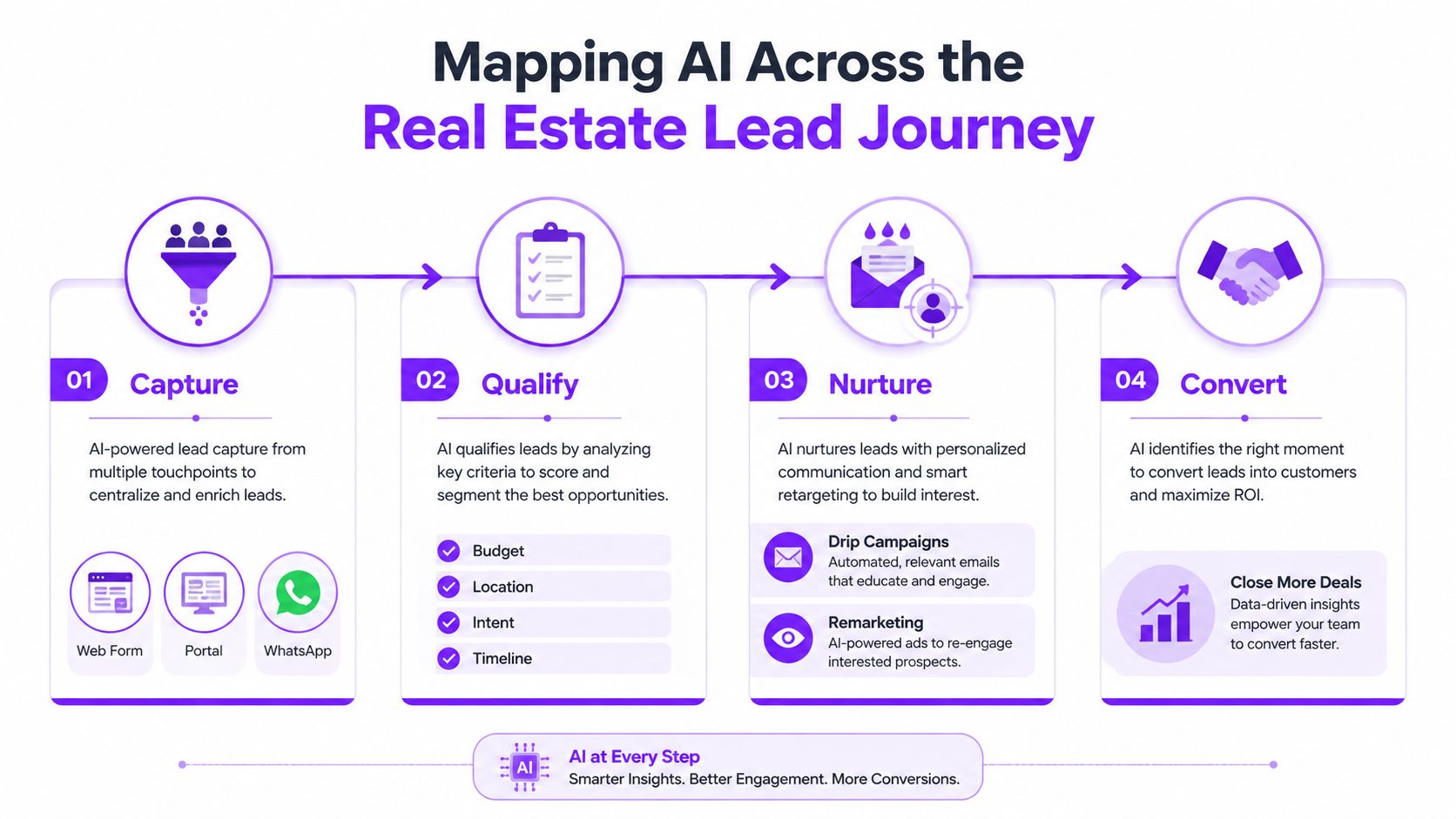
Capture
Capture starts with identity and context. Preserve the source UID, campaign, project, property type, consent status, and timestamp. A portal lead should carry the listing or project context that generated the enquiry. A Google Search lead may need more discovery because the initial intent signal is less specific.
An India-focused benchmark explicitly frames conversion around contact rate, qualification rate, and site-visit conversion across channels including 99acres, MagicBricks, Housing.com, Meta, Google Search, and YouTube, as described in Zappio's 2026 benchmark article. Track those stages separately. A high contact rate with weak qualification is not success.
Qualify
Use conversational agents for simple structured questions and voice AI when answers need probing. The minimum useful record covers budget, location, BHK or configuration, purchase timeline, financing readiness, and preferred visit timing.
A portal lead that says “show me two-bedroom homes near Pune” should not be treated like a buyer who confirms budget, possession preference, and weekend availability. The routing engine should distinguish both.
Nurture
Nurture is not a generic drip campaign. It should respond to the missing decision variable. Send inventory or floor-plan information when configuration is unclear. Offer financing guidance when readiness is uncertain. Offer a video consultation or alternate slot after a missed appointment.
For data collection, deduplication, and conversation history, DialNexa's real estate calling data guide offers a useful implementation lens.
Convert and hand off
Booking requires more than placing a calendar event. The system should confirm the slot, send location details, remind the buyer, allow rescheduling, and notify the assigned RM. The handoff contract must state exactly when AI stops and what context travels with the lead.
For teams researching external property data workflows, Scrapeway's Zillow scraping benchmarks provide relevant technical context, although Indian developers should validate data rights, source quality, and local compliance before using comparable approaches.
The video below illustrates the broader workflow logic.
Example Flows for Indian Residential Projects
A good deployment starts with routing rules, not a personality prompt. The following flows show how the same AI capability should behave differently across buyer type, price band, and urgency.
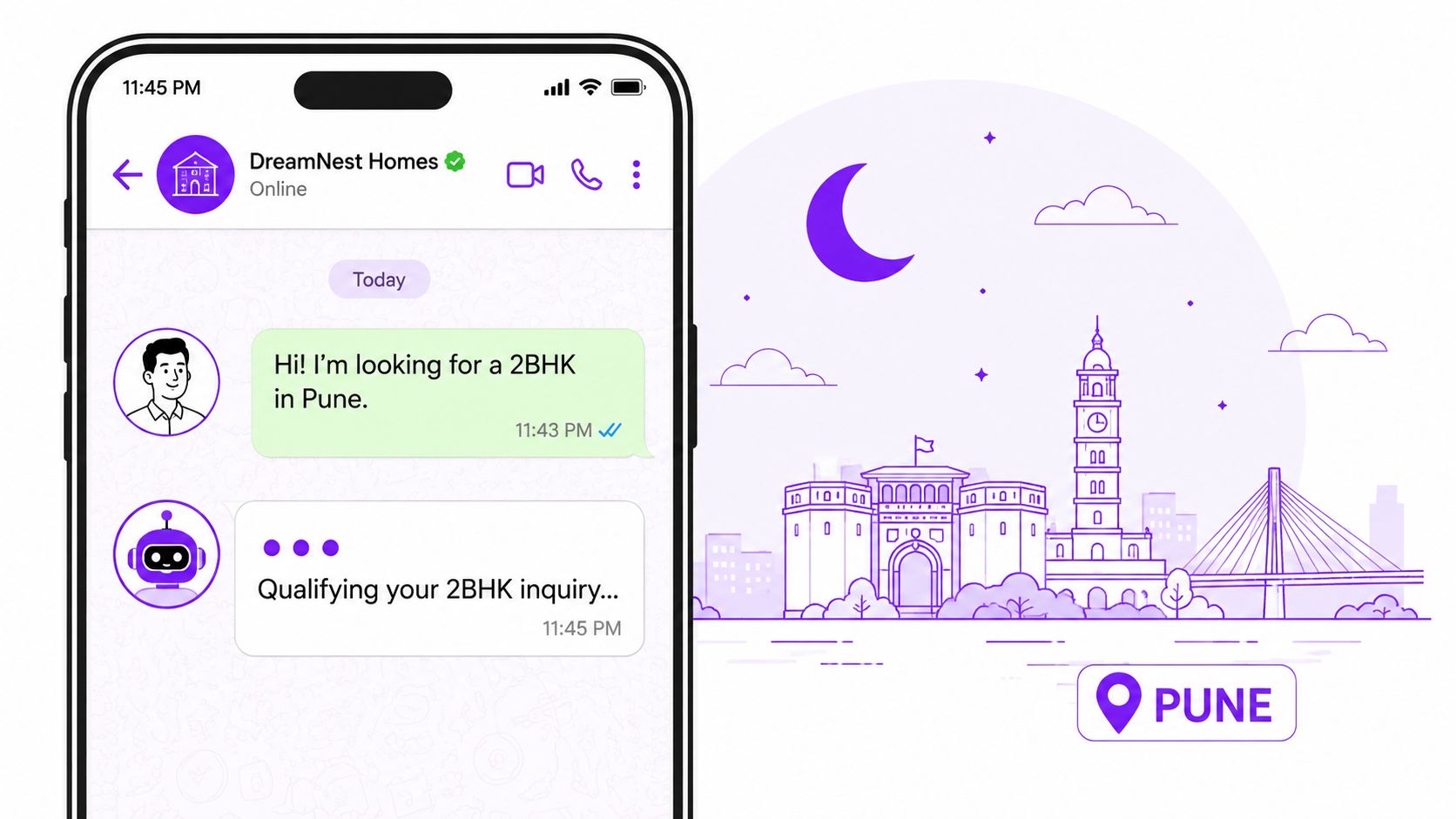
Flow A for a mid-budget Pune 2BHK
A portal lead arrives at 9 PM. The WhatsApp agent sends:
Opening: “Thanks for enquiring about 2BHK homes in Pune. Are you looking for self-use or investment?”
The next beats are direct:
- “Which Pune location works best for you?”
- “What budget range should we work within?”
- “When are you looking to move?”
- “Would you prefer a weekday or weekend visit?”
The agent qualifies the lead within four messages, then offers approved project details and asks for a preferred callback window. A voice AI agent calls the next morning to confirm intent and lock the site visit. The CRM receives the chat, answers, source, timestamp, and booking outcome.
Routing rule: if budget and location match available inventory, create a visit task. If either is missing, place the lead into a short clarification sequence. If the buyer requests negotiation or a detailed loan discussion, hand off to an RM.
Flow B for a premium Gurugram 4BHK
A high-intent form fill triggers an immediate voice callback. The opening should be concise:
“You requested information about the 4BHK residences in Gurugram. May I confirm your preferred configuration, budget range, and expected purchase timeline?”
The agent then asks whether the buyer is the final decision-maker, whether financing is required, and whether a private presentation or site visit is preferred.
Routing rule: a buyer who confirms fit and requests a meeting goes directly to a senior RM. A buyer who is interested but undecided enters a personalised nurture path. If no visit is booked after 7 days, the system pauses the standard sequence and creates a review task rather than continuing repetitive messages.
Flow C for an NRI buyer
Start on WhatsApp in English, preserve IST calendar awareness, and offer a video site visit when travel isn't immediate. The script should confirm country, preferred communication window, property use, budget, financing expectations, and whether a family member in India will attend a physical visit.
Fallback logic: if voice contact fails, send a concise WhatsApp summary and a video-booking link. If the buyer replies outside the preferred window, don't trigger a call immediately. Route the conversation to an RM when the prospect asks about documentation, remittance, taxation, or legal ownership.
The human takes over when the decision becomes advisory rather than administrative. AI should prepare the RM, not attempt to impersonate one.
KPIs, ROI and What to Measure
A CXO dashboard should show whether AI improves commercial throughput, not whether it generates conversations. Start with the funnel in order: lead connect rate, qualification rate, site-visit booking, completed visit, booking, cost per visit, and RM productivity.
The public Indian benchmarks support measuring speed and conversion together. Portal and paid-channel leads convert at 8% to 15% without AI follow-up and 20% to 35% with AI qualification and automated follow-up, according to Clarivis Intelligence's India benchmark. Response time should sit beside conversion because the same benchmark reports movement from four to six hours to under 60 seconds.
| KPI | Affordable, below ₹60L | Mid, ₹60L to ₹1.5Cr | Premium, above ₹1.5Cr |
|---|---|---|---|
| Connect rate | Track by source and time of day | Track first-touch SLA and repeat attempts | Track decision-maker contact |
| Qualification rate | Focus on budget and configuration completeness | Add timeline and financing readiness | Add decision participants and advisory needs |
| Lead to site visit | Measure booking and attendance separately | Prioritise speed and slot availability | Measure quality of the visit request |
| Lead to booking | Segment by campaign and project | Compare AI-routed and human-routed cohorts | Include senior-RM handoff quality |
| Cost per visit | Include media and automation cost | Include recovered pipeline | Include RM and high-touch presentation cost |
| RM productivity | Visits per RM and follow-up backlog | Qualified conversations per RM | Senior meetings per RM and conversion quality |
Use the right denominator
Don't report one blended conversion number across price bands. ANAROCK reporting shows the lead-to-buy cycle reached 26 days in 2025, but the ultra-premium segment above ₹3 crore took 27 days, compared with 15 days for ₹2 crore to ₹3 crore homes, according to ET Realty's coverage. Compare like with like, or you'll reward the wrong routing behaviour.
Monday-morning view: Show new leads, median first response, contact rate, qualified leads, booked visits, attended visits, bookings, cost per attended visit, and unresolved handoffs by project and source.
A useful dashboard should also expose failure states: duplicate leads, missing consent, unavailable inventory, failed calls, reschedules, and leads waiting for human action. DialNexa's sales KPI guide provides a practical reference for organising the measurement layer.
Don't accept an ROI model that begins with vague productivity savings. Start with recovered visits, improved qualification, shorter cycle length, and reduced wasted RM time. Tie every improvement to a project, channel, and budget band.
Implementation Checklist and Integration Best Practices
Sequence the implementation correctly. Connect the CRM first, then map source identifiers, then enforce the data contract that determines where every AI output lands. If the CRM receives only a transcript without structured fields, the sales team still has to do the manual work.
CRM and data plumbing
- CRM integration: Connect Salesforce, HubSpot, Zoho, or the in-house CRM before launching live traffic.
- Source identity: Map portal, campaign, ad-set, project, and lead-source UIDs so attribution survives every handoff.
- Field contracts: Define controlled fields for budget, location, configuration, timeline, financing, intent, next action, and owner.
- Data readiness: Use at least 90 days of historical lead records with outcome labels before training or tuning a scoring model.
- Identity hygiene: Deduplicate phone and email keys, and preserve consent flags at the lead level.
Compliance and telephony
India's DPDP requirements make consent a design input, not a legal review at the end. Store recording consent, disclose the purpose of the call, define retention, and redact personally identifiable information before model training. Confirm data residency and vendor access controls with procurement and legal teams.
Voice infrastructure needs practical fallbacks:
- DTMF fallback: Let callers use keypad input when speech recognition fails.
- IVR handoff: Transfer to a human queue with the conversation summary attached.
- Language selection: Validate Hindi, English, Hinglish, Tamil, and Telugu performance against real recordings.
- Concurrency planning: Match capacity to peak traffic, not average daily volume.
- Disclosure controls: Align call-purpose messaging with applicable TRAI and internal compliance requirements.
Pilot design
Run a controlled pilot on one project and one budget band. Compare AI-assisted handling with a human baseline, keep the qualification questions fixed during the test, and define success thresholds before launch.
A proper pilot includes:
- One project with stable inventory.
- A controlled lead source.
- Predefined routing rules.
- A human comparison group.
- Daily review of failed calls and bad qualifications.
- A kill switch if qualification quality drops or compliance exceptions appear.
Don't scale because the agent handles many calls. Scale only when the CRM records are complete, the handoff is accepted by RMs, and the project-level economics improve.
Your 30-60-90 Day AI Rollout Plan
A board-ready rollout needs three phases, each with a different decision.
Days 1 to 30 focus on the foundation
Audit every lead source and establish the baseline for response time, contact rate, qualification rate, site-visit booking, attendance, booking, and cost per visit. Choose one high-volume project, freeze the qualification criteria, connect the CRM and call infrastructure, and document the human handoff.
Don't start with every project or every language. Start with a workflow where the team can inspect outcomes daily.
Days 31 to 60 run the controlled pilot
Use voice AI for inbound calls and follow-up, a conversational agent on the website and WhatsApp, and predictive scoring for form leads. The proposed pilot thresholds are connect rate above 80%, qualification lift of 20% to 30%, site-visit bookings up 15%, and cost per visit down 25%. These are rollout targets, not verified industry outcomes, so test them against your own baseline rather than presenting them as market benchmarks.
Review performance by source and price band. A system that improves affordable-project response but produces poor premium handoffs needs separate routing, not a blended success label.
Days 61 to 90 scale deliberately
Expand to two additional projects only after the pilot passes its quality and compliance gates. Add outbound re-engagement for stalled leads, send AI summaries into sales huddles, and formalise the rule that RMs handle AI-flagged hot leads while lower-intent prospects remain in controlled nurture.
Three strategic decisions should survive the 90-day review:
- Treat AI as an operating-model change, not a marketing plug-in.
- Measure cost per attended visit and booking quality, not chatbot volume.
- Lock the review cadence before increasing spend, so every new project inherits proven routing and handoff rules.
DialNexa Labs Private Limited offers configurable Voice AI agents for real estate qualification, follow-up, CRM updates, and site-visit booking across structured workflows. Visit DialNexa Labs Private Limited to evaluate a project-level pilot, define the handoff rules, and build a measurable rollout around your lead sources and budget bands.

This is an insightful guide to using AI for real estate lead generation and customer experience in 2026. The CXO-focused strategies provide practical ideas for improving lead management, engagement, and sales efficiency.
This is a detailed and practical guide that clearly explains how AI can improve real estate lead capture, qualification, nurturing, and sales handoffs.
The project-wise approach and focus on response time, CRM integration, and human-AI collaboration make the article especially useful for real estate teams.
The project-wise examples and KPI-focused approach make the strategies easy for real estate teams to understand and apply.
A comprehensive guide explaining how AI can improve real estate lead qualification, follow-ups, and site-visit conversions through faster responses and smarter routing. The practical strategies for affordable, mid-market, and premium projects make this article especially valuable for real estate businesses looking to improve sales efficiency.