
What Is Call Routing? A CXO’s Guide to Driving Revenue
Indian enterprises do not lose revenue only when the phone stops ringing. They lose it when high-intent callers reach the wrong queue, repeat information, wait too long, or drop before qualification begins. For CXOs, call routing is therefore not a telephony feature. It is a control system for conversion, staffing efficiency, and customer experience.
Call routing is the logic that decides where an incoming call should go. In well-run operations, that logic uses more than agent availability. It uses caller intent, geography, language, campaign source, business hours, and historical context to send each conversation to the resource most likely to produce the right commercial outcome. That resource can be a live agent, a specialist desk, or an AI layer that screens and prioritises calls before a human joins. Accurate call logging for customer interactions makes that routing logic more effective because teams can route with context instead of starting every conversation from zero.
The strategic implication is straightforward. Routing affects more than average handling time. It shapes connect rates, lead quality, first-call resolution, compliance exposure, and cost per acquisition.
Pairing routing logic with a dedicated call tracking software layer closes the loop, giving leaders campaign-to-outcome visibility on top of the routing decision itself.
That is especially relevant in India, where enterprises often handle multiple languages, regional demand swings, uneven agent coverage, and sector-specific regulatory requirements inside the same contact flow. Generic routing setups treat all inbound demand as queue volume to be distributed. High-performing teams treat routing as a decision layer tied to measurable KPIs. The next step is not only to send calls faster. It is to combine AI-based qualification with routing rules so the business can prioritise serious buyers, reduce wasted agent time, and improve revenue yield from every inbound call.
Table of Contents
- Why Misrouted Calls Are Costing You More Than You Think
- The Core Call Routing Methods Decoded for Leaders
- How a Call Travels Through a Modern Routing System
- The Strategic Benefits and KPIs Your Board Cares About
- The Next Frontier Integrating Voice AI with Call Routing
- Call Routing in Action Industry-Specific Blueprints
- A CXOs Checklist for a Successful Implementation
- Frequently Asked Questions for Decision-Makers
Why Misrouted Calls Are Costing You More Than You Think
Misrouted calls reduce revenue before a salesperson speaks. The loss starts with paid acquisition, then spreads into lower contact rates, longer handle times, weaker lead qualification, and avoidable drop-offs.
For Indian enterprises, that cost is often misread as a marketing or staffing problem. It is frequently a routing problem. A prospect who calls after a high-intent search, performance ad, or field campaign is signalling willingness to engage now. If that caller reaches a generic queue, repeats the same context twice, or gets transferred across teams, the business has already introduced friction at the point of highest intent.
The operational waste is measurable even without a separate line item in the P&L. Sales teams spend time on poorly matched conversations. Senior agents get pulled into basic enquiries. Regional or language-specific demand is sent to agents who cannot resolve it quickly. Each of those failures pushes up cost per qualified conversation and pushes down the return on acquisition spend.
The more important point is strategic. Routing does not just decide who answers. It determines whether your business can convert demand efficiently.
A common pattern looks routine on the surface. A homebuyer from Pune calls a real estate firm after seeing a digital ad for a specific project. The call lands in a national queue, reaches an agent unfamiliar with the inventory, then moves to another team for language or city alignment. By then, response speed has fallen, buyer confidence has weakened, and the probability of conversion is lower. The lead did not deteriorate on its own. The system degraded it.
This is why mature teams treat routing and qualification as connected disciplines. Static routing rules can sort calls by time, region, or department. Higher-performing operations go further and use early signals such as campaign source, caller history, language preference, and stated intent to decide whether the call should reach sales, support, collections, or a specialist closer. In high-volume Indian markets, that distinction matters because lead quality varies sharply across channels, cities, and time bands.
Call records then become more than an audit trail. They show where commercial value is being lost. Teams that pair routing logic with structured call logging for operational accountability can identify patterns such as repeat transfers, low-intent traffic hitting premium sales queues, or high-value enquiries reaching underqualified agents first.
For a CXO, the conclusion is straightforward. Misrouting is not a telephony inconvenience. It is a hidden tax on media spend, agent productivity, and conversion performance. The companies that address it well use routing as a control system for revenue quality, especially when AI-based qualification is added before the call reaches an agent.
The Core Call Routing Methods Decoded for Leaders
Call routing determines whether inbound demand reaches the team most likely to convert it, resolve it, or waste it. For leadership teams, the question is not which routing method sounds more advanced. The question is which logic improves revenue per call, lowers avoidable transfers, and keeps agent time focused on the highest-value conversations.
Routing as a Decision Engine
Automatic Call Distributor (ACD) handles the first level of queue control. It receives incoming calls and distributes them using predefined rules such as department, campaign, priority tier, or service line. In practice, ACD sets the floor for operational discipline. Without it, expensive sales and support capacity gets pooled too broadly, which raises wait times and lowers first-contact efficiency.
Interactive Voice Response (IVR) captures intent before an agent joins the call. That input can come from keypad selections or spoken responses, and it gives the routing layer an early signal about why the caller is reaching out. Teams reviewing menu design, self-service, or intent capture can use this guide to IVR software and design as a reference point. For Indian enterprises handling multiple languages, uneven lead quality, and high call volumes from paid campaigns, IVR works best when it does more than route. It should help qualify.
Skills-based routing assigns calls to agents with the relevant capability, such as product expertise, regulatory training, language fluency, or closing ability. NICE has reported that businesses using skills-based and equitable distribution routing have seen agent utilisation rise by as much as 25%, according to its analysis of call routing strategy. The commercial implication is straightforward. If a high-intent insurance prospect reaches a licensed closer on the first attempt, the business protects both conversion probability and handling cost.
Time-based routing changes call paths based on business hours, staffing windows, or expected demand spikes. This method matters in India because purchase intent often peaks outside standard office hours, especially for consumer services, education enquiries, and regional campaigns. A time rule can direct evening sales calls to an active inside-sales pod instead of sending them into a general queue built for daytime support.
Geographic routing directs callers to teams aligned with local language, city context, or regional operating norms. For national businesses, this is less about caller proximity and more about relevance. A caller from Coimbatore, Jaipur, or Guwahati may respond better to an agent who understands local terminology, service availability, and buying patterns.
Least-cost or least-occupied logic focuses on throughput and cost control. It routes calls to the most economical available path or the next qualified agent with spare capacity. Used in isolation, this method can improve queue speed while weakening outcomes on sales or complex service calls. Used selectively, it helps operations leaders protect utilisation in high-volume environments where the value of each call is relatively uniform.
Call Routing Methods at a Glance
| Routing Method | Primary Function | Best For (Business Scenario) |
|---|---|---|
| ACD | Places inbound calls into structured queues | Multi-department service and sales operations |
| IVR | Collects caller intent before routing | Businesses needing basic self-service and pre-qualification |
| Skills-based routing | Matches callers to agents with relevant expertise | BFSI, technical support, admissions, high-value sales |
| Time-based routing | Redirects calls based on time windows or shift coverage | After-hours enquiries, distributed teams, evening lead capture |
| Geographic routing | Sends calls to regionally relevant teams | Multi-city operations, language-led support, local sales |
| Least-cost or least-occupied logic | Uses efficiency rules to assign the next destination | High-volume operations focused on throughput and utilisation |
The stronger operating model combines these methods instead of choosing one. A paid-search lead might first pass through IVR for language and intent, then be prioritised by campaign value, then routed by skill to the agent with the highest close rate for that product and region. That is the shift from telephony administration to commercial orchestration.
If your routing logic only asks “who is free?”, you are managing capacity. If it asks “who is most likely to resolve or convert this call?”, you are managing performance.
How a Call Travels Through a Modern Routing System
A modern routing stack doesn’t need to be technically intimidating. Leadership teams only need to understand the handful of components that affect customer experience, integration risk, and decision quality.
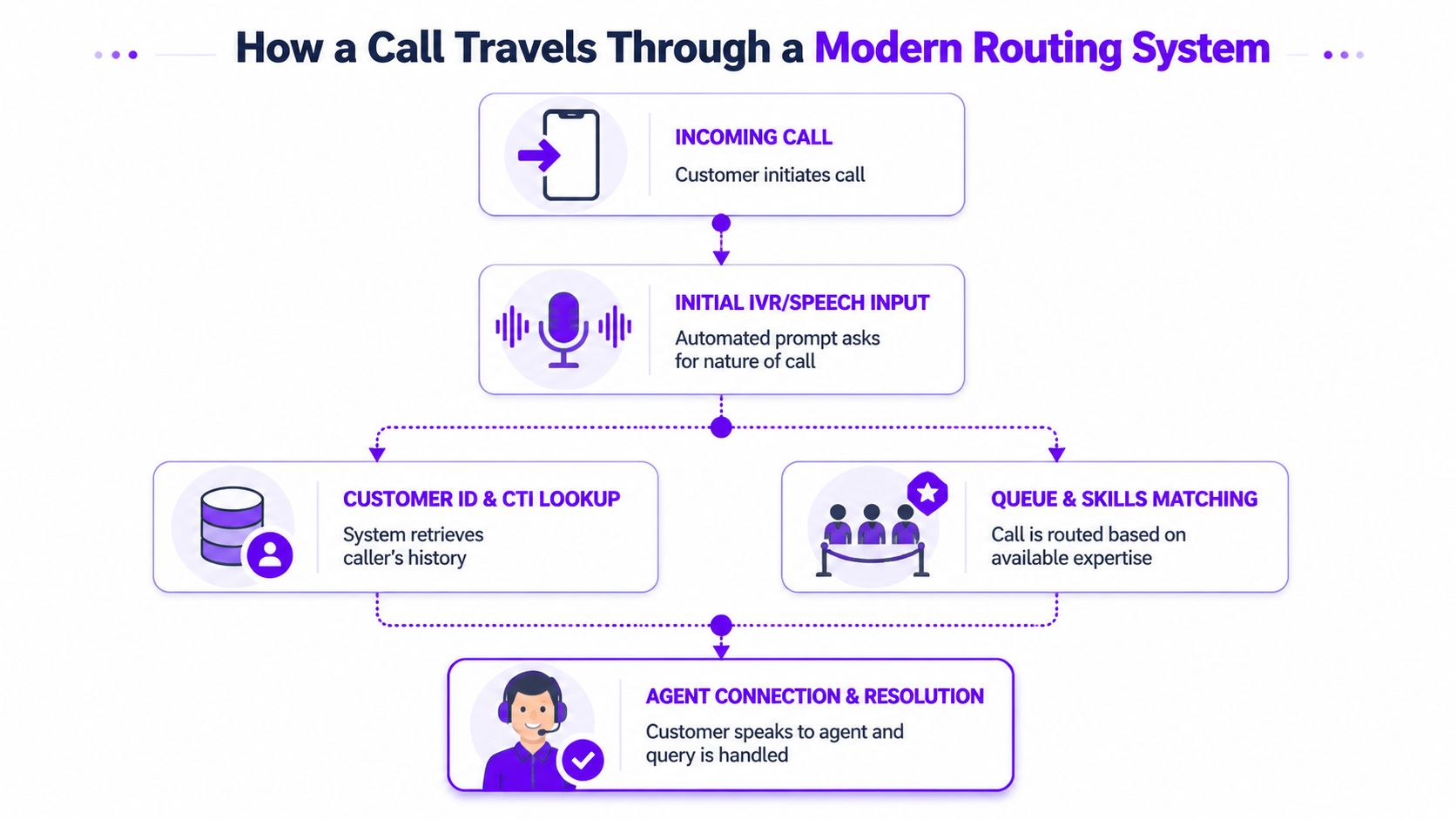
The journey in plain English
A customer places a call. The telephony layer receives it and passes it into the routing environment. If your technology team uses SIP infrastructure, this SIP call flow explainer is a helpful reference for how signalling and call movement work behind the scenes.
Engineers configuring that signalling layer also need a consistent addressing scheme, and reviewing the SIP URI format is a useful reference for how endpoints, extensions, and domains are represented before a call ever reaches the routing engine.
The system then collects early context. That may come from IVR input, speech recognition, caller ID, dialled number, or CRM lookup. If the number is recognised, the platform can identify whether the caller is an existing customer, an open lead, or a priority account.
Next comes the actual decision. The routing engine evaluates rules such as intent, queue state, agent skills, language needs, operating hours, and escalation policies. In stronger environments, API triggers also pull real-time CRM or workflow data before assigning the call.
The final stage is connection and resolution. The call is delivered to a human agent, a specialist queue, or an automated workflow. The best systems also pass the context forward so the recipient doesn’t start blind.
What leaders should ask their teams
- What data is available at call entry? If routing starts with almost no context, your system will make shallow decisions.
- Which systems influence routing? CRM, ticketing, lead scoring, and compliance layers should shape assignment logic where relevant.
- How is fallback handled? When the preferred agent or queue isn’t available, the next step should protect experience, not just clear traffic.
A useful test is simple. Ask your team to explain how a premium customer, a first-time lead, and a compliance-sensitive caller each move through the system. If the answer sounds identical, the routing design is too blunt.
The Strategic Benefits and KPIs Your Board Cares About
Indian businesses lose money on call handling in ways standard dashboards often hide. The board sees staffing cost, conversion rate, retention, and service quality. Call routing influences all four.

The KPI chain that matters
Routing quality determines whether the business resolves demand at the first useful point of contact or pays for the same issue multiple times. A misrouted customer call can trigger a transfer, a repeat explanation, a longer handle time, and often a second inbound contact. A misrouted sales enquiry can waste the highest-intent moment in the funnel. In both cases, the cost is larger than telephony. It affects labour efficiency, customer confidence, and revenue timing.
For service leaders, the first metric to watch is First Call Resolution. Higher FCR usually means the routing logic is matching customer intent, language, account priority, and issue complexity to the right queue or specialist. That has a second-order effect on CSAT, because customers judge the experience by how quickly the business understands and resolves the problem, not by how advanced the routing engine sounds on paper.
For commercial teams, routing should be read as a conversion control. If high-intent callers wait too long, reach a general queue, or land with agents who lack product or regional context, lead quality deteriorates before the sales conversation even starts. In India, where enterprises often manage multiple languages, city-level teams, and varied serviceability rules, this is a board issue rather than a contact-centre detail. Better routing can improve connect rates, reduce lead leakage, and direct premium opportunities to the teams most likely to close them.
What boards should measure
A useful board view tracks operational and commercial outcomes together:
- First Call Resolution: Shows whether calls are reaching people who can act, not just answer.
- CSAT or post-call sentiment: Indicates whether customers experienced continuity or had to restart the conversation.
- Transfer rate: Highlights avoidable friction and weak decision logic at entry.
- Average handling time: Falls when callers arrive with the right agent and enough context.
- Conversion rate on inbound leads: Reveals whether sales calls are being assigned by fit, urgency, and buying stage.
- Cost per resolved case or qualified lead: Connects routing design directly to ROI.
- Agent productivity by queue: Shows whether specialists are spending time on high-value interactions or cleaning up poor distribution.
The more strategic question is not whether routing reduces queue chaos. It is whether routing improves the economics of customer demand.
That is where the India-specific opportunity becomes clearer. Enterprises that combine qualification signals with routing logic can move beyond department-based assignment. A caller can be prioritised based on language, serviceability, prior purchase history, open tickets, or likely revenue value. Once AI-driven qualification is added, the routing layer can sort not just by intent, but by lead quality and expected next best action. That creates a cleaner path to measurable outcomes such as higher connect rates, stronger lead-to-meeting ratios, and lower handling waste.
Boards should review routing as a profit and productivity system. The right design reduces repeat work, protects conversion, and improves the return on every inbound call.
The Next Frontier Integrating Voice AI with Call Routing
Indian contact centres already know that basic IVR can sort demand. The constraint is precision. Once call volumes rise, language preferences vary by region, and lead values differ sharply by product line, menu-based routing starts sending too many calls to the wrong queue, too early, and with too little context.
Why AI changes the routing input
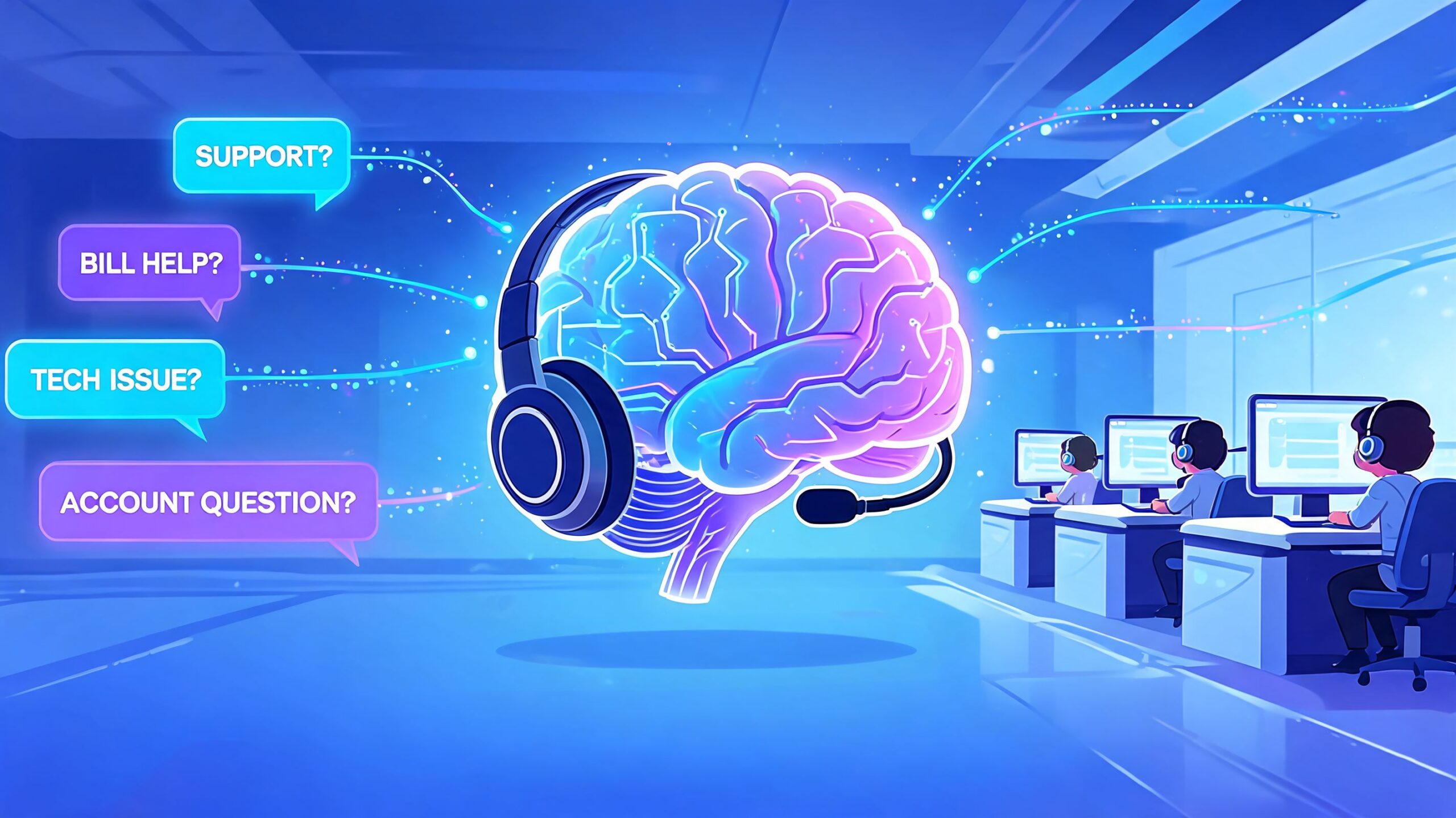
Voice AI expands the quality of data available before a handoff. Instead of relying on keypad choices or a single intent label, the system can capture spoken intent, urgency, serviceability, language, prior interaction signals, and buying readiness inside the first exchange. That gives routing logic a stronger basis for decision-making.
The commercial impact is straightforward. Better qualification at the front of the call reduces low-value transfers, protects specialist capacity, and raises the odds that a high-intent caller reaches the right team on the first attempt. For Indian enterprises managing multilingual demand and uneven agent availability across cities, that shift matters because routing errors are not just service failures. They are conversion leaks.
At that point, call routing stops being a telephony feature and starts acting as an allocation engine for revenue and operating cost.
Legacy IVR depends on callers to self-classify. Voice AI can classify intent and quality through the conversation itself, then pass that output into routing rules.
What an AI-first routing flow looks like
An AI-first model usually follows four steps:
- The AI agent answers first. It captures intent in natural language rather than forcing the caller through a rigid menu.
- Qualification happens inside the conversation. The system collects signals such as need, urgency, fit, language, and likely next action.
- Routing rules use that output. High-value or high-complexity calls go to the right specialist, while low-complexity requests can stay automated.
- Context moves with the call. The next agent receives the summary and does not need to restart discovery.
The strategic advantage is not automation alone. It is selective automation. A business can reserve expensive human attention for cases that need judgment, compliance handling, or closing skill, while AI handles early-stage qualification and repetitive query capture. That improves two board-level metrics at once: labour efficiency and conversion quality.
For CXOs evaluating architecture, the key design question is interoperability. Routing logic often needs to pull signals from CRM records, ad-source data, serviceability checks, fraud controls, and AI models at the same time. Systems that support APIs, orchestration, and model flexibility are easier to adapt as workflows change.
Here’s a short visual explainer on how AI voice flows are evolving in practice:
One practical option in this category is DialNexa Labs Private Limited, which provides Voice AI agents for qualification, support, recruitment, and presales workflows. In routing terms, that means the AI conversation becomes a live input to assignment logic instead of sitting as a separate layer beside it.
For Indian enterprises, the non-obvious upside is sharper prioritisation. If the AI layer can identify language, geography, eligibility, and purchase intent before transfer, the business can route not only by function but by probable value. That is how routing begins to improve connect rates, lead quality, and agent utilisation in measurable terms.
Call Routing in Action Industry-Specific Blueprints
Generic routing advice usually breaks down at the industry level. The right design depends on what a missed call costs and what kind of expertise the next interaction requires.
Real estate
A real estate enquiry rarely arrives at a convenient time. Many prospects call after work, when project interest is high but team coverage is thin. In Indian real estate, time-based routing for post-6 PM enquiries has lifted lead-to-booking conversion from 2% to over 8% by reducing lead drop-off outside standard hours, according to Netcarrier’s call routing analysis.
The blueprint is straightforward. Evening calls should not hit the same logic as mid-day traffic. Route after-hours enquiries to extended-hour teams, regional agents, or an AI qualifier that captures project interest and booking readiness before handing off.
BFSI
In BFSI, the routing objective isn’t only speed. It’s controlled handling. Calls involving KYC, investment queries, or regulated communication need tighter assignment rules than a normal sales queue.
The strongest design here combines identity signals, compliance checks, and skills-based routing. Sensitive calls should reach certified or policy-approved teams first, while lower-risk interactions can be distributed more broadly. For executives, the benefit is risk containment alongside efficiency.
EdTech
EdTech buyers don’t all need the same counsellor. A prospect interested in a technical programme, executive education, or admissions finance may need different expertise. Sending every inbound call to a general counselling pool creates avoidable drop-offs and weakens follow-up quality.
A better model routes by intent and fit. If an AI or IVR layer identifies programme interest, language preference, or application stage, the call can move directly to the most relevant admissions specialist.
Three sector patterns stand out:
- Real estate needs time sensitivity: routing must capture intent when prospects are available, not when your office is.
- BFSI needs control: routing must enforce who can handle what.
- EdTech needs match quality: routing must connect the student to the counsellor most likely to move the decision forward.
A CXOs Checklist for a Successful Implementation
Poor implementation turns routing into a cost multiplier. Strong implementation turns the same infrastructure into a yield engine for revenue, service capacity, and compliance.
Leadership should treat routing design as an operating model decision, not a telephony configuration task. The first question is commercial. Which outcome matters most over the next two quarters: higher qualified connect rates, better first-call resolution, lower transfer volume, faster response for high-value accounts, or tighter control over regulated interactions? A routing programme without one primary KPI usually produces local improvements that do not change board-level numbers.
Execution gets sharper when the current call flow is documented with evidence. Map where calls wait, bounce, repeat context, or reach the wrong queue. Then quantify the business effect by call type. A transferred new lead has a different cost than a delayed service request or a compliance-sensitive interaction that reaches an unauthorised team. That distinction matters because it determines where routing logic will create the highest return first.
A practical CXO checklist looks like this:
- Define one primary KPI and two guardrails: Set a main target such as qualified conversion rate or first-contact resolution. Add guardrails such as compliance adherence, abandonment rate, or average speed to answer so one gain does not create a new problem elsewhere.
- Segment demand by value, risk, and intent: Separate high-intent prospects, existing customers, repeat callers, regulated cases, and routine requests. Routing should reflect commercial priority and handling complexity, not just queue balancing.
- Use qualification data before handoff: If AI or IVR can capture language, location, product interest, urgency, or buying stage, feed those signals into the routing decision. For Indian enterprises, this is often the difference between a generic call centre and a conversion-focused inbound engine.
- Plan system dependencies at the start: CRM, helpdesk, lead scoring, and policy controls should inform routing rules early in the design. Retrofitting them later usually creates exceptions, manual workarounds, and weaker reporting.
- Choose architecture that can adapt: If your roadmap includes AI-led screening, multilingual voice flows, or model orchestration across vendors, assess integration flexibility upfront. Technical teams comparing future-ready options may use this reference on an OpenAI-compatible endpoint for open models during architecture review.
- Set a review cadence tied to business cycles: Update routing rules when campaigns shift, hiring changes capacity, new products launch, or regional demand patterns move. Static logic decays quickly in high-growth environments.
One mistake appears repeatedly in enterprise rollouts. Teams automate the current process before testing whether the decision rules are commercially sound. That locks inefficiency into scale.
The better sequence is diagnose, prioritise, integrate, then automate. For CXOs, that approach produces a clearer ROI case because each routing rule can be tied to a measurable business result: fewer wasted leads, better agent utilisation, stronger compliance control, and higher value per inbound call.
Frequently Asked Questions for Decision-Makers
A routing system affects revenue quality as much as call handling speed. For Indian enterprises dealing with uneven lead quality, multilingual demand, and regional capacity constraints, the board-level question is straightforward: will better routing increase conversion, reduce wasted agent time, and improve control over the customer journey?
| Question | Answer |
|---|---|
| What is call routing in practical terms? | It is the decision layer that assigns each incoming call to the right destination based on business rules and live context. In higher-performing setups, those rules use intent, agent skill, queue conditions, language, geography, CRM history, and AI-based qualification signals. |
| Is call routing only for large contact centres? | No. Mid-sized sales teams, distributed service operations, hospitals, financial services firms, and education providers can all gain if calls are currently delayed, transferred, or handled by the wrong team. The economic case comes from better match quality and lower leakage across the funnel. |
| Can it work with our existing CRM and support stack? | In many cases, yes. The harder question is governance. Leaders need to decide which systems should shape routing decisions, which data fields are reliable enough to act on in real time, and where manual overrides are still required. |
| How should we think about ROI? | Start with the metrics already reported to leadership: connect rate, conversion rate, first-call resolution, average handling time, agent occupancy, and cost per qualified lead. Routing improves the return on existing spend by sending the right demand to the right resource earlier in the interaction. |
| How long does implementation take? | Timing depends on how many workflows, departments, and systems are involved. A focused rollout for one call type can move quickly. A cross-functional deployment with multilingual IVR, CRM logic, compliance checks, and AI qualification needs tighter design and testing discipline. |
| Should we deploy AI from day one? | Only if the underlying routing logic is clear and the operating data is usable. AI adds the most value when it classifies intent, filters low-value calls, captures structured inputs, and improves queue assignment. It performs poorly when teams use it to compensate for weak process design. |
| What should the board ask before approving budget? | Ask which KPI should move first, how success will be measured within the first quarter, what data will drive decisions, how exceptions will be handled, and who owns optimisation after go-live. Those answers determine whether routing becomes a measurable operating asset or another underused workflow tool. |
DialNexa Labs Private Limited is one option to evaluate for AI-driven call handling and routing design. The sensible next step is to map your highest-value call paths, identify where qualification breaks down, and test whether AI-informed routing can improve conversion, service quality, or compliance outcomes before scaling across the business.

[…] that treat extension handling as part of a broader call routing workflow and routing logic usually get cleaner handoffs and fewer manual interventions. That matters in any environment where […]
[…] churn risk, payment behaviour, product demand, and service friction. With the right workflows and call routing logic built around customer intent and priority, that data can improve both unit economics and customer […]
[…] leaders who want a clearer baseline, DialNexa's explainer on what call routing is is useful because it separates basic distribution logic from more context-aware […]
[…] That framing helps boards ask better questions. Not “Do we have call forwarding?” but “How does our routing design handle intent, urgency, availability, and escalation?” Teams that want a practical framework for that broader question can review this explanation of what call routing means in a business system. […]