
Call Center Outbound Script: Boost CX & Conversions
Contact rates are only the start of the problem. The larger board-level issue is conversion efficiency after the call connects. A weak call center outbound script raises cost-per-acquisition, floods the pipeline with poorly qualified leads, creates uneven compliance risk, and makes scale harder across teams, vendors, regions, and languages.
Senior operators should treat the script as a managed revenue asset with version control, testing discipline, and clear performance ownership. That matters even more now because the same script logic often needs to work for human agents and automated calling flows. If the structure is unclear, both agent performance and Voice AI performance deteriorate.
The companies that improve outbound results do not stop at better wording. They define qualification paths, objection handling rules, consent language, escalation points, and outcome codes that can be measured. That is how teams improve answer-to-qualified-lead rates, reduce wasted follow-up, and protect market coverage without creating compliance debt.
This article examines the subject from that operating lens. It covers script structure, conversion-focused components, objection handling in the Indian context, sector templates for EdTech, BFSI, and real estate, KPI design, and how to prepare scripts for AI-assisted outreach. Teams trying to improve answer rates should also review these practical strategies to get more prospects to pick up the call, because list quality, timing, and script design work together.
The same shift is happening in sales enablement more broadly. Bounti insights on future sales point to a model where AI supports execution, but performance still depends on the quality of the underlying sales logic. Outbound scripts sit at the center of that logic.
Table of Contents
- Why Your Outbound Script Is a Strategic Asset Not a Document
- The Anatomy of a High-Performing Outbound Script
- Designing Compelling Script Components That Convert
- Mastering Objection Handling and Indian Compliance
- Outbound Script Templates for EdTech BFSI and Real Estate
- Measuring Script Performance with the Right KPIs
- Future-Proofing Your Outreach with Voice AI
Why Your Outbound Script Is a Strategic Asset Not a Document
Boards do not have a script problem. They have a unit economics problem.
When outbound acquisition costs rise, lead quality slips, or new segments fail to respond, the cause is often hidden inside the script logic. The opener shapes answer rates and early drop-off. The qualification path decides whether agents spend time on accounts with real buying potential. The compliance language affects trust, call duration, and whether the next step feels safe enough to accept. A script influences revenue efficiency long before it affects closing technique.
This matters even more in outbound programs that run across mixed channels, regional markets, and agent skill levels. What looks like a document on the floor is usually an operating model in written form. It defines who gets priority, which value proposition appears first, what disqualifies a lead, when consent or disclosure must be stated, and how a conversation moves from contact to commitment. If those choices are weak, the team pays for them in higher CAC and lower contact productivity.
A simple example makes the point. Two teams call the same lead pool. Team A uses a generic opener, asks broad discovery questions, and lets weak-fit prospects book follow-ups. Team B uses a tighter script that identifies the use case early, screens out poor fit within the first minute, and routes qualified interest to the right next step. Team B may book fewer raw meetings, but its cost per qualified opportunity is usually better because agent time is not being spent on low-probability pipeline.
That is why serious operators manage scripts the way they manage routing rules, lead scoring, and QA frameworks. They version them. They test them by segment. They map each script block to a business outcome.
The strategic shift is clear. A good script is written for people and machines at the same time. Human agents need judgment room. Voice AI needs modular prompts, clear branch logic, and approved language that can be measured consistently. The same core asset should support both, with compliance and performance controls built in from the start. Teams thinking through that transition can review Bounti insights on future sales.
Leadership teams should expect every call center outbound script to answer five commercial questions:
- Which audience is this built for
- What business problem earns attention in the first few seconds
- How do we separate fit from curiosity fast
- What next step creates pipeline without adding false positives
- Which disclosures and guardrails protect trust at scale
Answer those well and the script becomes a reusable asset across campaigns, languages, and channels. Miss them and the business keeps funding avoidable inefficiency.
Pick-up strategy sits inside this discussion too. The work starts before the first sentence is delivered, which is why this guide on getting more prospects to pick up the call is relevant at leadership level. Answer rates, script design, and qualification discipline belong to the same commercial system.
The Anatomy of a High-Performing Outbound Script
Most outbound scripts fail because they are written as prose. High-performing scripts are built more like process design. They move from contact to context, then to qualification, then to commitment.
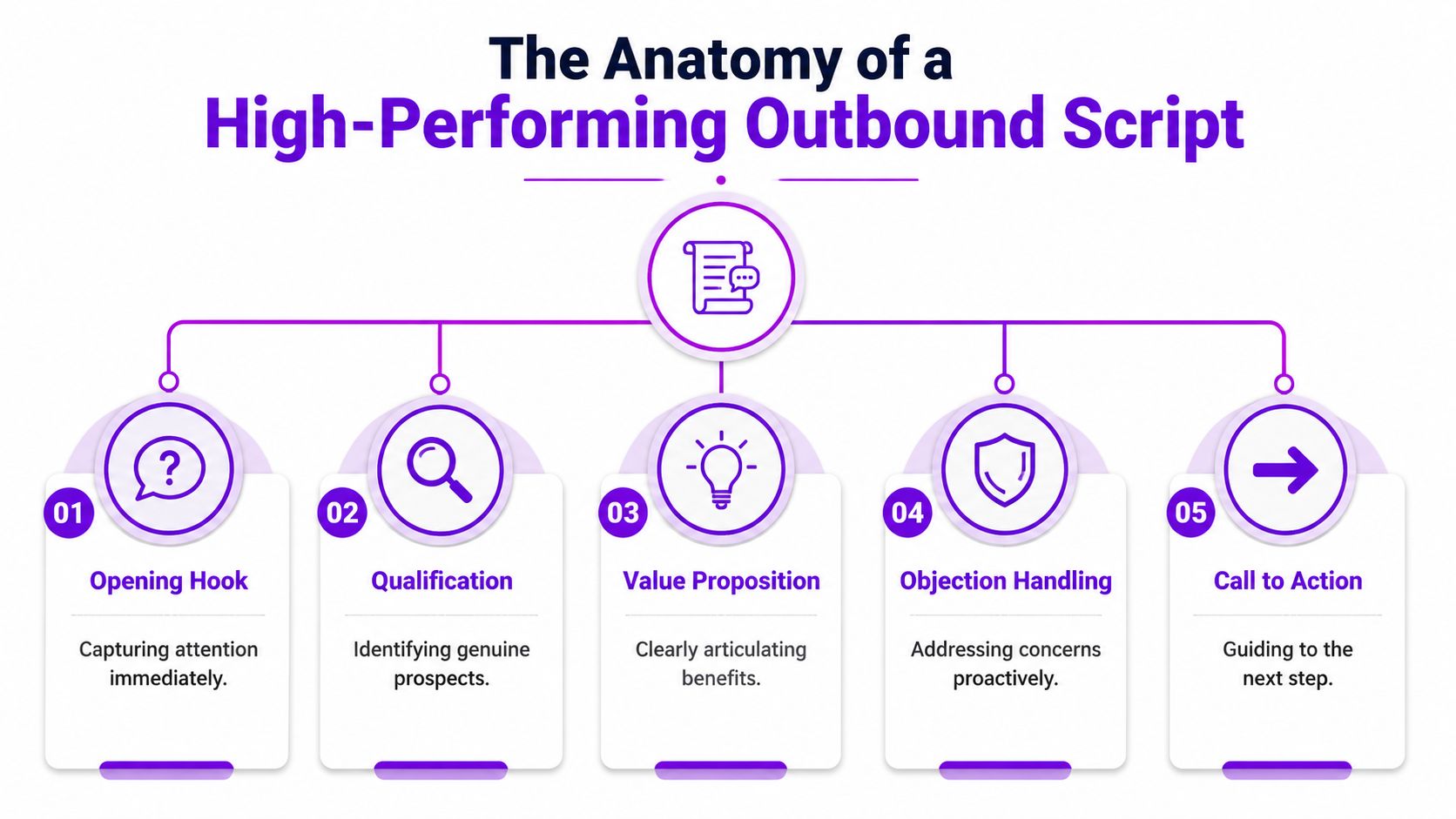
A useful way to evaluate any call center outbound script is to inspect five structural components. If one is weak, the whole call suffers.
The opener and the value proposition
The opener has one job. Earn the next few seconds. It should identify the caller, signal relevance, and reduce the instinct to disconnect. It should not begin with a generic permission request that sounds like every sales call.
The value proposition comes immediately after. During this, many teams over-explain the company and under-explain the problem they solve. Prospects don't need your company summary. They need a reason to continue listening.
Use this test. If the first two lines of the script could belong to any competitor, they are too weak.
Qualification and objection handling
Qualification is where revenue discipline begins. Good scripts do not interrogate. They uncover whether the account has a use case, a timeline, and enough intent to justify the next step.
Objection handling belongs in the architecture, not as an afterthought. If common concerns appear repeatedly, the script should anticipate them with framing language before the objection fully forms. That reduces friction and keeps agents from improvising poorly.
A few design principles work well:
- Make qualification progressive: Start broad, then narrow into specifics only if interest exists.
- Use conversational branching: Different answers should trigger different follow-up paths.
- Pre-empt predictable concerns: Trust, price, relevance, timing, and legitimacy should all have prepared responses.
The call to action and the close
The call to action must define one next step. Too many outbound scripts ask for too much. A site visit, a demo, a document share, a KYC completion step, or a counselling callback can each work. Asking for all of them in one call usually does not.
The close should remove ambiguity. The prospect must leave knowing what happens next, who owns it, and when it will happen.
A strong close sounds operational, not theatrical. It confirms the next action and protects momentum.
If you want a deeper operational lens on structure, this resource on call center script best practices is useful because it treats scripts as controlled workflows rather than just agent prompts.
The simplest board-level test is this: can your script be understood as a repeatable pipeline stage? If yes, it is well designed. If no, your team is still relying on individual agent talent to carry structural weaknesses.
Designing Compelling Script Components That Convert
The architecture matters, but the wording decides whether the call moves forward. Small language choices create large behavioural differences. Busy prospects react to friction, vagueness, and overfamiliarity within seconds.
The easiest way to improve a script is to compare weak language against language that carries a clear commercial purpose.
Openers that earn the next few seconds
A poor opener sounds safe to the agent and expensive to the business. It asks for time before earning attention. It hides the reason for the call. It often triggers the exact response you wanted to avoid.
Here's a practical comparison table your managers can use in workshops.
| Weak Language (To Avoid) | Strong Language (To Use) | Why It Works |
|---|---|---|
| Are you free to talk? | Hi, this is Ravi calling from [Company]. I'm reaching out because your team enquired about [topic/product]. Have I caught you at a bad moment, or can I take 20 seconds to explain why I called? | Gives identity, context, and a low-friction choice. |
| I just wanted to introduce our company. | We help teams dealing with [specific problem]. I wanted to check whether that's currently a priority for you. | Leads with relevance rather than company biography. |
| Is this a good time for a sales call? | I'll keep this brief. The reason for my call is [specific trigger]. If it's not relevant, we can stop there. | Lowers resistance by showing control and respect. |
| We offer many solutions for your business. | From what we see, companies in your position usually focus on one of two things: [outcome A] or [outcome B]. Which one matters more right now? | Creates a guided choice and starts qualification early. |
| Can I tell you about our services? | Before I suggest anything, may I ask one quick question about your current process? | Makes the call feel consultative, not generic. |
An opener works when it does three things quickly: identifies the caller, proves relevance, and establishes a compact reason to continue.
Don't optimise for sounding polished. Optimise for sounding relevant.
Qualification that feels useful
Qualification scripts often collapse because managers write them like forms. Prospects hear a checklist and disengage. Better scripts sequence questions in a way that helps the prospect think.
For example, an EdTech team should not open qualification with, “What is your budget for this programme?” That question arrives too early and too bluntly. A better progression looks like this:
- Context first: “Are you looking for a programme for immediate enrolment or exploring options for a later intake?”
- Fit second: “Which area are you comparing right now?”
- Constraint third: “What usually decides the shortlist for you, schedule, outcome, location, or fees?”
That sequence is easier to answer because it mirrors decision-making.
A BFSI prospecting script needs even tighter judgement. Instead of asking broad product-interest questions, start with customer status, product relevance, and willingness to proceed under a secure and clearly identified interaction. A trust-led structure outperforms a pitch-led structure in sensitive categories.
Closings that create movement
Many outbound calls fail at the close because the script ends with soft language such as “let me know” or “we'll follow up sometime”. That is not a close. It is a leak in the pipeline.
Use closing language that creates a specific operational handoff:
- For demo booking: “I can arrange a short product walkthrough with our specialist. Would tomorrow afternoon or the next working day suit you better?”
- For counselling: “I'll schedule a counsellor callback and note your preferred course interest so you don't need to repeat everything.”
- For site visits: “I can lock a visit slot and send the exact location details once we confirm your preferred day.”
Strong scripts outperform charismatic agents. Good closings reduce dependence on improvisation.
A practical review exercise works well with sales and ops leaders in the same room. Take ten recorded calls. Strip out the company names. Read only the opener, one qualification segment, and the close. If you cannot immediately identify why a customer would progress, the wording is still too generic.
Mastering Objection Handling and Indian Compliance
Outbound leaders in India face a dual burden. They need scripts that can recover from objections and they need language that doesn't damage trust or increase complaint exposure.

Generic outbound advice usually treats objections as persuasion puzzles. In practice, objections are often signs that the call entered too fast, framed value too vaguely, or failed to establish legitimacy.
Objections are diagnosis signals
The three objections that appear most often are some version of “not interested”, “send me details”, and “we already use someone”.
Each needs a different response.
- Not interested: Don't challenge it immediately. Clarify whether it means bad timing, low relevance, or mistrust. “Understood. So I don't waste your time, is that because this isn't a priority, or because the context isn't clear yet?”
- Send me details: Don't celebrate too early. This can be genuine or dismissive. “Happy to. To make that useful, what should I include so it's relevant to your role?”
- We already use someone: Don't attack the incumbent. “That's helpful. Many businesses do. We're usually brought in when they want a second option around [specific concern]. Is that worth a quick comparison or not at the moment?”
That last phrase matters. “Or not at the moment” lowers pressure and often gets a cleaner answer.
A scripted objection response should reopen the conversation, not win an argument.
Compliance language that builds trust
India-specific outbound scripting needs more than rapport. It needs compliance-aware design. A major gap in most script advice is the practical question of what can be said, how often, and under what consent context. As noted in Convoso's discussion of outbound script best practices, TRAI's Commercial Communications rules and DLT-based registration are meant to curb spam and regulate promotional messaging. That means Indian outbound scripts need to balance persuasion with verifiable consent, caller identification, and complaint-risk reduction.
For boards and compliance heads, this translates into script requirements such as:
- Clear caller identification: The prospect should know who is calling and why.
- Consent-aware progression: If the interaction depends on prior enquiry, interest, or permission, the script should reference that context clearly.
- Reduced ambiguity: Don't use wording that sounds deceptive, disguised, or over-familiar.
- Complaint-risk control: If a prospect declines, the script should guide the agent toward a clean and respectful exit.
A trust-led opener in a sensitive category might sound like this:
“Good afternoon, this is Neha calling from [Company] regarding your recent enquiry about [product/service]. Before we continue, I want to confirm I'm speaking with the right person and that you're comfortable proceeding.”
That line does more than sound polite. It protects the organisation. BFSI, education, and real estate teams benefit from this approach because customers are already alert to spam and fraud signals.
Compliance also changes repetition strategy. If your campaign requires multiple attempts, the wording should vary by attempt and preserve context. Repeating the same hard-sell line across attempts is one of the fastest ways to sound like nuisance traffic.
Outbound Script Templates for EdTech BFSI and Real Estate
Vertical-specific scripting matters because the buyer's risk lens changes by category. The same opener will not work equally well for a parent evaluating a course, a customer discussing a financial product, and a prospect considering a property visit.
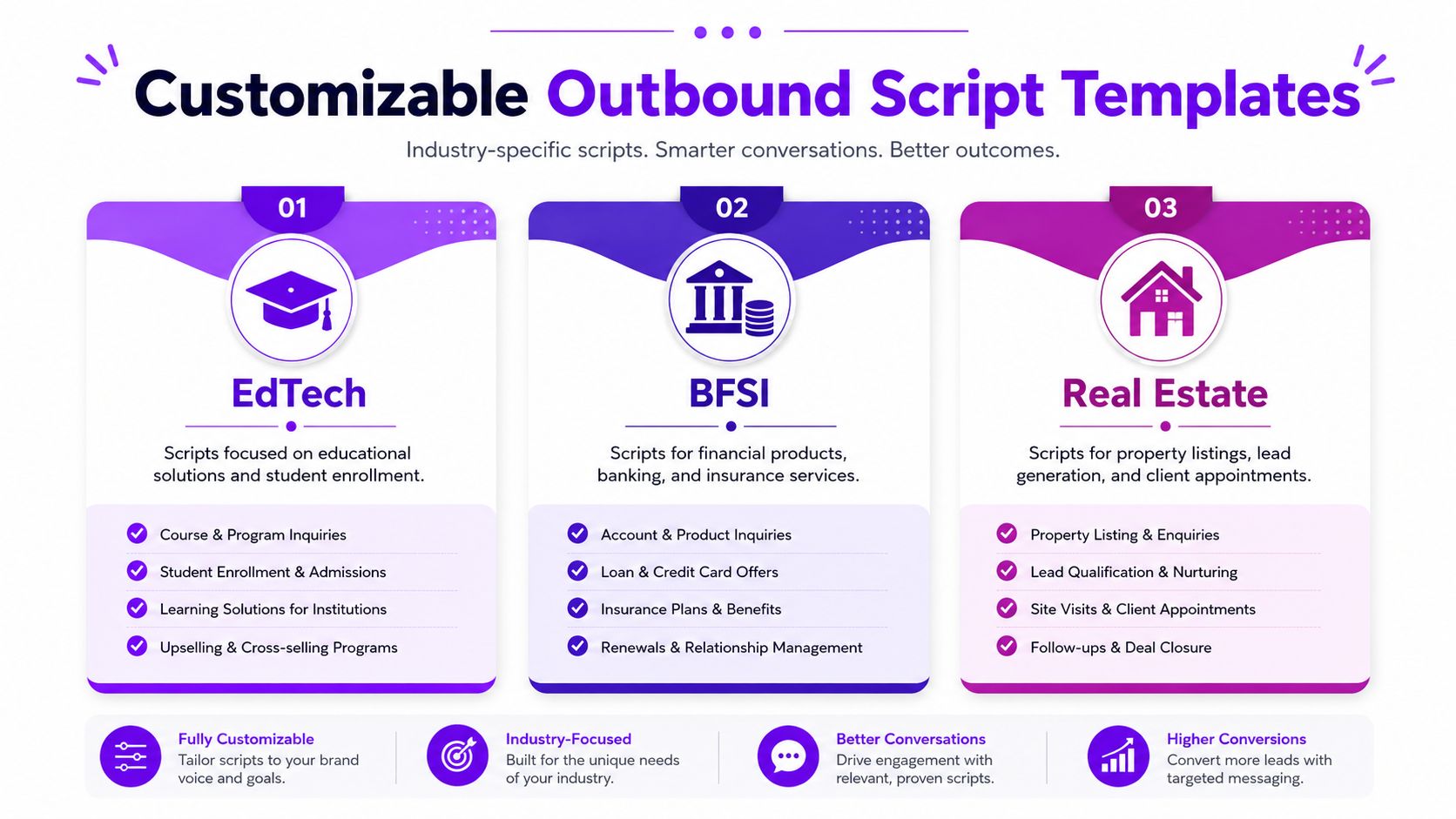
EdTech template
EdTech scripts work best when they sound like guided counselling rather than admission pressure.
Sample opener
“Hi, this is Asha calling from [Institution]. I'm reaching out regarding your interest in [programme area]. I won't take long. I just wanted to understand what kind of course outcome you're looking for so we can guide you properly.”
Why it works
It places the prospect in a decision process, not a sales trap.
Qualification prompts
- Stage: “Are you looking for the next intake or planning further ahead?”
- Motivation: “Is your focus career switch, upskilling, or formal certification?”
- Constraint: “What usually decides the final choice for you, learning format, faculty, timing, or fee structure?”
Close
“The best next step is a counselling call suited to your requirements. I can arrange that and share the programme options that match what you've said.”
For teams that coach agents through pricing resistance, this guide for agents on price objections is a useful companion because it keeps the conversation anchored in value and fit.
A short walkthrough can also help teams visualise how script flow changes by industry.
BFSI template
BFSI scripts need precision and trust. They should establish identity, relevance, and procedural safety before exploring need.
Sample opener
“Hello, this is Karan calling from [Company] in relation to your interaction concerning [service/product]. I'd like to first confirm that this is a convenient time for a brief discussion, and I'll keep it limited to the purpose of your request.”
Why it works
The tone is controlled. It signals legitimacy.
Qualification prompts
- Need state: “Are you evaluating this for immediate action or just comparing options?”
- Current arrangement: “Are you already using a similar product or service today?”
- Next-step readiness: “Would it help if I explained the process briefly before we discuss suitability?”
Close
“If you'd like to proceed, the next step is [application/KYC/callback] and I'll note your preference so the next interaction stays focused.”
Real Estate template
Real estate outreach succeeds when it narrows attention quickly and secures a concrete visit or discussion.
Sample opener
“Hi, this is Priya calling from [Developer/Consultancy] regarding your interest in properties in [location]. I'm calling to understand whether you're actively evaluating options now or still shortlisting areas.”
Why it works
It separates active buyers from casual browsers without sounding dismissive.
Qualification prompts
- Buying stage: “Are you looking for self-use or investment?”
- Decision filter: “What matters more at this point, location, possession timeline, or budget alignment?”
- Actionability: “Would a site visit help, or are you first looking for a sharper shortlist?”
Close
“I can arrange either a site visit or a focused callback with the project advisor, depending on what's more useful for you.”
These templates should be treated as modular building blocks, not final scripts. The board-level benefit is consistency. The floor-level benefit is that agents know what good sounds like before the call starts.
Measuring Script Performance with the Right KPIs
A script isn't good because agents like it. It's good when it improves measurable outcomes. That distinction matters because many outbound teams still judge performance by dials made, talk time, or activity volume. Those metrics describe effort. They do not tell leadership whether the script is doing its job.
Track outcomes not effort
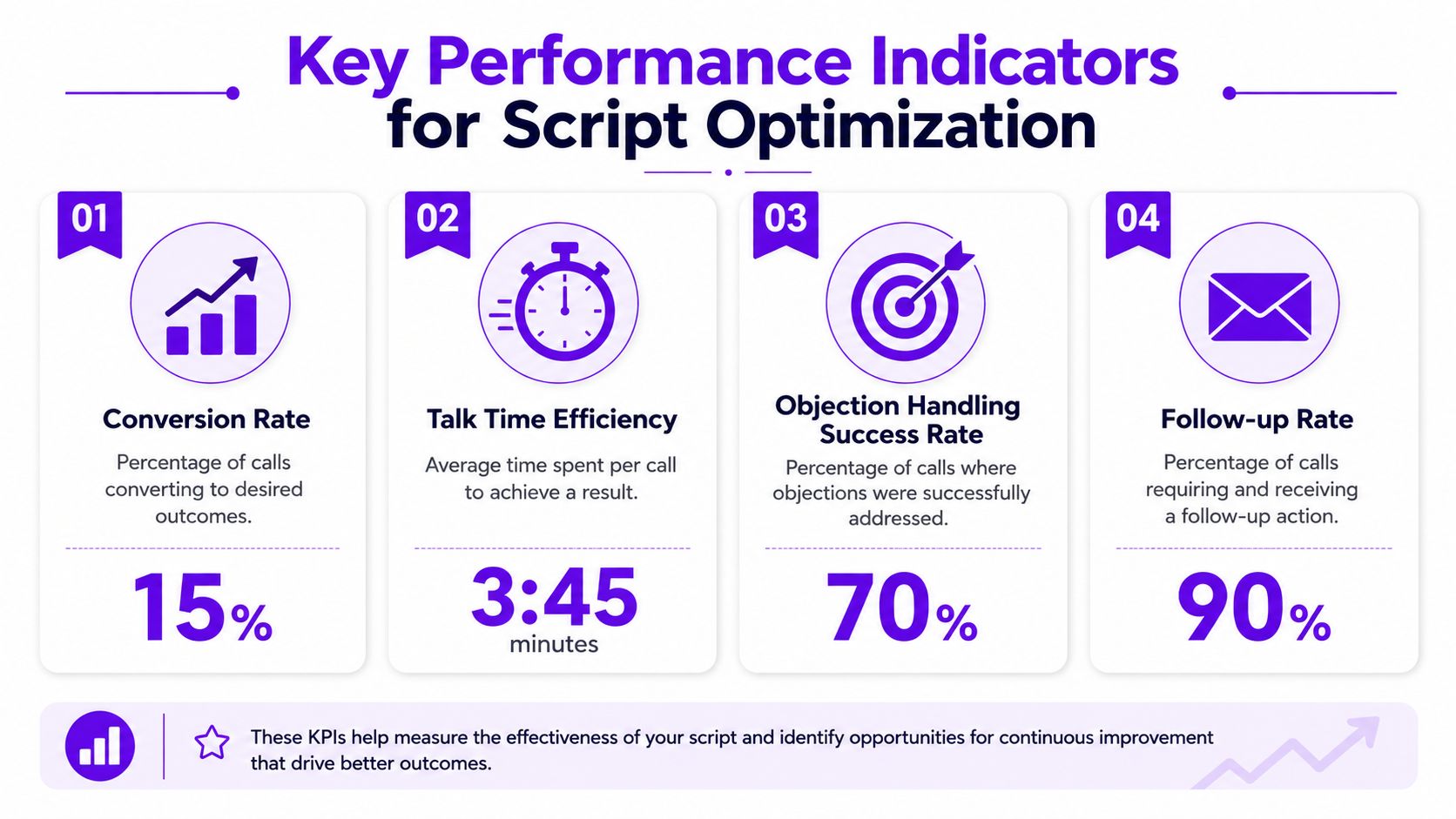
For India-focused outbound teams, quality is measured more effectively through conversion rate, first-call close, and answer success rate, not call volume alone, as outlined in CloudTalk's outbound KPI guidance. That guidance also identifies average handle time, calls per agent, and call connection rate as core metrics. The strategic implication is straightforward. A well-built script must get answered, keep the interaction efficient, and secure a clear next step such as qualification, booking, or consent.
That sequence matters at board level because every extra transfer, repeat call, or vague follow-up raises operating cost.
A practical scorecard for script review should include:
- Conversion rate: Are connected calls turning into the defined desired outcome?
- First-call close: Does the script create enough clarity and trust to move the prospect forward on the first attempt?
- Answer success rate: Are opening lines and timing strong enough to support live engagement?
- Average handle time: Are agents reaching the point efficiently, without sounding rushed?
- Call connection rate: Is the campaign structure supporting the script, or forcing it into poor conditions?
The script should be reviewed like any other revenue asset. If it cannot improve a KPI, it is just wording.
How to test scripts without creating noise
A/B testing scripts sounds simple but often fails because teams change too many variables at once. If you alter the opener, the value proposition, and the CTA together, you won't know what produced the change.
A cleaner testing discipline looks like this:
- Choose one script element only
Test the opener or the CTA, not both. - Keep the audience similar
Compare like-for-like lead segments. - Hold the operational context steady
Same call windows, same routing logic, same training baseline. - Measure the downstream effect
A better opener that creates poor-quality appointments is not an improvement. - Retire weak language quickly
Don't keep legacy wording alive because one team is used to it.
Script ownership often needs to move higher in the organisation. The best operator to manage script testing is usually not a single team lead. It is a cross-functional owner who can see acquisition cost, qualification quality, and sales handoff performance together.
Future-Proofing Your Outreach with Voice AI
Boards are funding Voice AI for a simple reason. Outbound growth gets expensive fast when each added call attempt produces more activity than qualified pipeline. At that point, the script stops being a coaching aid and becomes an operating asset that affects acquisition cost, lead quality, compliance exposure, and market reach.
That standard changes how scripts should be built.
A future-ready call center outbound script has to perform in two environments at once. Human agents need room for judgment. Voice AI needs clear logic, controlled branching, and language that can be audited. If the script is vague, agents may compensate in the moment. Automation will repeat the same flaw at scale across every campaign, list, and region.
The practical answer is modular design.
Write modularly, not as a monologue
Linear scripts were built for one representative carrying the full conversation from start to finish. Voice AI works better with decision-based modules that can be measured, approved, and revised centrally without rewriting the whole flow.
An AI-ready script usually includes:
- Identity module: Clear introduction, brand disclosure, and purpose of call
- Context module: Why the lead is being contacted now, based on source, product interest, or trigger event
- Qualification module: Short branching paths for intent, eligibility, budget, geography, or timing
- Consent and compliance module: Required disclosures, call permissions, and opt-out handling
- Escalation module: Rules for transferring high-intent or high-risk conversations to a human agent
- Follow-up module: Next action for no-answer, callback requests, partial qualification, or document collection
This structure matters beyond scripting hygiene. It gives leadership a cleaner way to manage changes across channels. If legal updates one disclosure, operations should not have to retrain every team from scratch. If conversion drops in one segment, the qualification branch should be isolated and tested without disturbing the rest of the script.
Platforms such as the Double My Leads AI assistant show where the category is headed. Teams are moving from static call sheets to governed conversation flows that can run repetitive outreach while preserving audit trails, routing rules, and handoff discipline.
Design for governance, not only conversation
Voice AI increases coverage. It also increases the cost of script errors.
A weak phrase used by 20 agents creates inconsistency. The same phrase deployed through automation can affect thousands of calls before anyone catches the issue. From a CXO perspective, governance has to cover four controls at minimum:
- Compliance control: Required statements, consent logic, DNC treatment, and clear handoff conditions
- Performance control: Which modules improve contact rate, qualification rate, and booked-meeting quality
- Brand control: Consistent tone across human and AI channels
- Change control: Versioning, approval workflows, and rollback if a new script underperforms
That is how script design starts to look like infrastructure. One governed framework can support agents, voice bots, and blended teams without creating separate standards that drift over time.
Human teams still own the expensive moments
Automation works best in repetitive, rules-based stages of the funnel. Human agents should handle the parts of the conversation where judgment changes revenue outcomes or risk.
That usually includes:
- complex objections
- sensitive trust-building conversations
- exception handling
- negotiation
- late-stage conversion support
This division of labour improves unit economics. Automation handles speed, frequency, and coverage. Human teams handle ambiguity, persuasion, and recovery when a prospect does not fit the expected path.
DialNexa Labs Private Limited offers Voice AI agents for outbound calling, lead qualification, follow-ups, and presales workflows. Used well, these systems make script quality more visible because scale exposes ambiguity, weak transitions, and compliance gaps much faster.
The board-level takeaway is straightforward. Treat the outbound script as a managed asset with owners, metrics, controls, and version history. Build it once so people can execute it with judgment and AI can execute it with discipline. That is how outreach scales without giving up control of cost-per-acquisition, lead quality, or compliance.

This is an excellent perspective on why outbound scripts should be treated as strategic business assets rather than simple call documents. The focus on compliance, measurable KPIs, and AI-ready design offers valuable insights for building scalable and high-performing outreach operations.
“Excellent insights on building high-performing outbound scripts that improve efficiency, compliance, and conversions. A practical and valuable guide for sales and call center leaders looking to drive better business results.”