
What Is Call Logging and How It Drives Business Growth
At its core, call logging is the automatic process of capturing detailed information about every phone call that flows in and out of your business. But for leaders, it's much more than a simple record. Think of it as the central nervous system for your entire voice communication network, gathering the raw data you need to drive sales, sharpen customer support, and streamline your operations.
Understanding Call Logging Beyond The Basics
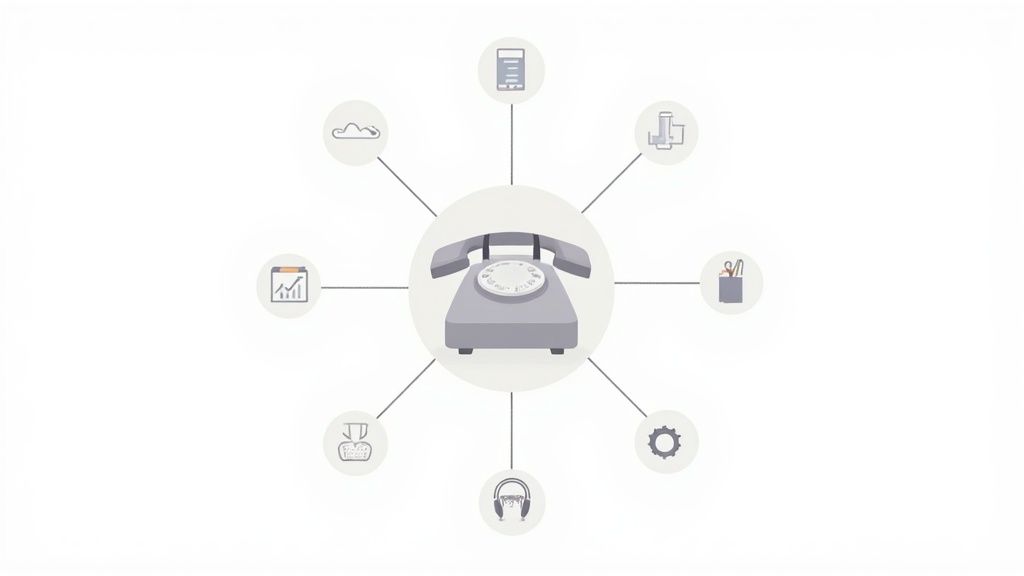
It’s easy to dismiss call logging as a purely technical function—a digital filing cabinet for phone calls. That view, however, completely misses the strategic goldmine hidden within the data.
Instead of a simple list, picture it as the flight data recorder for your company's voice strategy. It meticulously documents every crucial interaction, bringing to light patterns and insights that would otherwise stay completely hidden.
For a Director of Sales, this means identifying that the top-performing sales reps average 15 follow-up calls to close enterprise deals, while underperformers give up after five. A VP of Operations can study call volume trends to perfect staffing schedules, ensuring call centres are fully staffed for the post-lunch rush but not over-resourced during quiet morning hours, directly optimising payroll costs. It’s the very foundation of voice-based business intelligence.
Turning Data Into Decisions
The real magic happens when call logging turns raw numbers into clear, actionable insights. It’s the first step to truly understanding your customers, measuring team performance with real data, and making informed decisions that actually fuel growth.
Without this data, you’re flying blind. You're left to guide multi-million-pound strategies with gut feelings and anecdotal evidence. With it, you can answer critical business questions with confidence:
- Which marketing campaigns are actually making the phone ring? A property developer assigns a unique number to its billboard campaign. Call logs show 300 calls to that number, resulting in 50 qualified leads. This provides a clear, quantifiable ROI that a CXO can use to justify future marketing spend.
- Are my support agents solving problems on the first try? A SaaS company's support director analyses call logs and sees that calls regarding 'integration issues' are 20 minutes longer and have a high repeat-caller rate. This insight triggers a project to improve the software's API documentation, reducing support costs and improving customer satisfaction.
- How fast are we really getting back to new sales leads? A B2B firm's timestamps reveal an average 4-hour delay between a web form lead and the first sales call. By implementing an alert system to cut this to under 15 minutes, the company can measurably increase its lead conversion rates.
For today's executive, call logging isn't just about compliance or record-keeping. It's about unlocking a new level of operational visibility. It provides the empirical evidence needed to validate strategies, identify performance gaps, and pinpoint opportunities for significant improvement across the organisation.
Modern platforms are pushing this even further by connecting call log data with other business systems. When you combine these logs with AI, for example, you can automate deep analysis and spot trends you'd never find manually. You can learn more about the expanding role of AI for call centres in our detailed guide and see how it all starts with this fundamental data.
For a deeper look at the platforms that turn raw call logs into a full operational control layer, see DialNexa’s call tracking software guide, which covers India-specific compliance and ROI measurement.
Ultimately, the question isn't just "What is call logging?" but "What can we achieve with it?" The answer, quite simply, is strategic clarity.
The Anatomy of a High-Impact Call Log
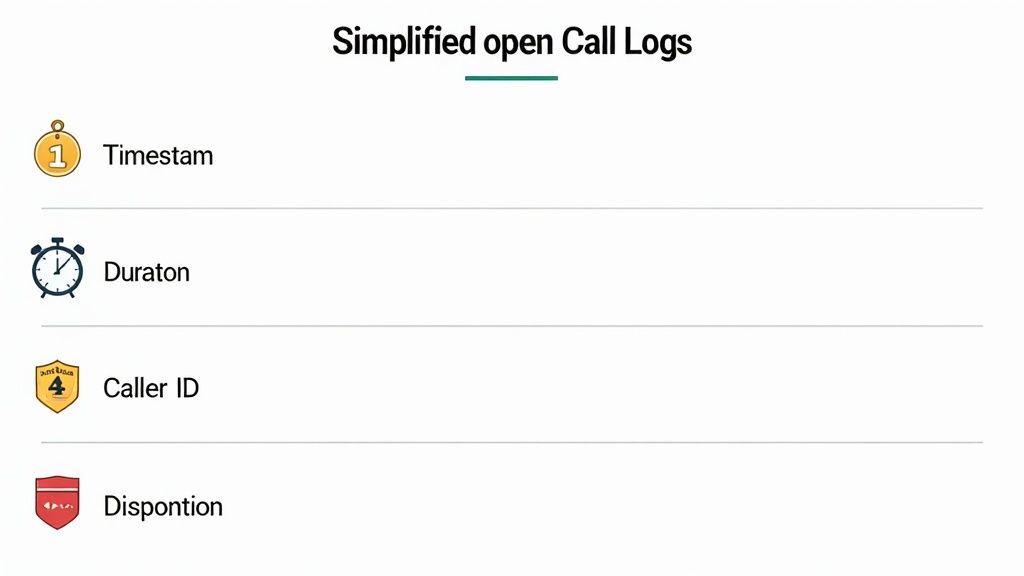
At first glance, a call log can look like a simple list of numbers and times. But for anyone serious about business performance, it’s actually a detailed blueprint of every front-line interaction. Each entry is packed with metadata that, when you piece it all together, tells the complete story of your customer and team communications.
To really get what call logging is all about, you have to look past the surface. It’s about understanding how these individual data points connect to create a powerful, strategic asset for your business. Let’s break down the key components that make a call log so incredibly useful.
Core Data and Its Strategic Value
The basic elements of any call log give you the who, when, and how long of every conversation. This might sound simple, but this core metadata is the starting point for uncovering some serious operational insights.
- Timestamp: This isn't just about when a call happened. For a sales leader, analysing timestamps reveals that connection rates with C-level executives are 40% higher between 8-9 AM. This data is used to refocus outbound campaigns for maximum impact.
- Caller ID/Contact Information: More than just a name or number, this links the call directly to a customer's record in your CRM. A support agent for a high-value client instantly sees their entire purchase and support history, allowing for a personalised, high-touch service from the first second.
- Call Duration: This metric is a surprisingly powerful indicator of both efficiency and complexity. An operations director notices that inbound support calls handled by new hires are consistently 50% longer. This triggers a review of the onboarding program, leading to targeted training that brings new agents up to speed faster.
These fundamental details set the stage, but the real strategic gold is found in the outcome-focused data that modern systems are built to capture.
A high-impact call log doesn’t just record activity; it records outcomes. By connecting actions to results, it transforms from a passive record into an active tool for strategic analysis and performance improvement.
Unlocking Deeper Insights with Disposition Codes
Arguably the most valuable piece of information in a modern call log is the call disposition code. Think of it as a short, standardised label that an agent applies at the end of a call to categorise what happened.
For a customer success director, consistently seeing dispositions like ‘Technical Issue’ or ‘Billing Enquiry’ can act as an early warning system, flagging emerging problems long before they escalate. It provides a real-time pulse check on customer sentiment and product health.
Let's look at a practical example. Imagine a sales manager trying to figure out which of two sales scripts is more effective. By digging into the call logs, they can directly compare two key data points:
- Call Duration: How long are agents spending on calls using Script A versus Script B?
- Disposition Code: What was the outcome—'Sale Complete,' 'Follow-up Required,' or 'Not Interested'?
By correlating shorter call durations with a higher number of 'Sale Complete' dispositions, the manager has hard evidence showing which script is more efficient and actually closes more deals. This is exactly how granular data from call logging informs high-level strategy, turning simple records into a genuine competitive advantage.
How Call Logging Fuels Every Business Department
Most people hear "call logging" and immediately picture a customer support centre. But thinking of it just as a support tool is a huge mistake. For any leader who’s serious about growth, call logs are a goldmine of objective data that can sharpen performance in every corner of the business, from the sales floor to HR.
When you start digging into this data, it stops being a simple record of who called whom. It becomes the single source of truth for how your teams are really doing. It answers the tough questions that keep VPs and Directors up at night, replacing gut feelings with cold, hard facts that lead to smarter strategies.
Driving Sales Velocity and Effectiveness
For any VP of Sales, it’s all about speed and results. Call logs give you a direct window into the daily habits that are either speeding up or slowing down your sales cycle. You can see in an instant how fast your team is pouncing on hot new leads—a critical factor that has a massive impact on whether you win the deal.
Let's say your team is testing two different sales scripts. By tagging calls with disposition codes like ‘Demo Booked’ or ‘Not a Fit,’ you can see which script is actually getting results. It's not just about what works, but what works efficiently. By comparing call durations against outcomes, you can pinpoint the script that not only closes more but also frees up your reps' time. This data-first approach takes the guesswork out of sales coaching and gets everyone focused on what’s proven to work.
Call logging transforms sales management from an art into a science. It provides the empirical data needed to refine sales processes, coach representatives with precision, and ultimately, drive predictable revenue growth.
Optimising Operations and Staffing
If you're an Operations Director, your world revolves around maximising efficiency and keeping a lid on costs. Call logging data is one of the most powerful tools you have to strike that balance, especially when managing teams that talk to customers all day. By spotting trends in call volumes—by the hour, day, or even season—you can build staffing schedules based on actual demand.
For example, a logistics company director might notice a 30% spike in "Where is my order?" calls every Monday. This insight leads to proactively sending automated delivery updates over the weekend, which reduces Monday call volume by 20% and frees up agents for more complex issues. This is a massive challenge for businesses handling huge call volumes. Take the Indian telecommunications market, for example. Managing a network with roughly 1.207 billion subscribers requires an incredible amount of precision. The sheer volume of call data generated needs to be analysed just to maintain service quality and keep operations running smoothly. You can explore more data about India's telecom subscriber base from TRAI.
Empowering HR with Performance Insights
Even the Human Resources team can get immense value from call data. When it's time for performance reviews or awards, HR leaders can use call logs to see who is truly excelling. Instead of relying on anecdotal feedback, they can look at concrete metrics like average call handling time, first-call resolution rates, or the number of qualified leads generated.
This data offers a fair, unbiased way to spot your top performers. On the flip side, it also shines a light on who might need a bit more support by flagging agents with consistently long call times or frequent escalations. For instance, an HR Director might notice that three agents from a recent hiring cohort have call durations 40% longer than average. This allows for proactive, targeted coaching to be deployed to that specific group, improving performance and reducing employee turnover. Industries like real estate depend on this kind of insight to figure out why agents might be losing out on business, a problem we cover in our guide on how realtors can use AI to solve missed calls.
From Call Logs to Actionable Business Intelligence
Having raw data is one thing, but turning it into smart, automated insights is what gives you a real competitive edge. The leap from basic call logging to AI-powered business intelligence isn't just an upgrade; it's a fundamental shift in how you think about your customer conversations. It’s the difference between knowing what happened on a call and truly understanding why it happened, often as it's unfolding.
Modern platforms make this happen by enriching call logs with Voice AI. This isn't just about storing call details anymore. Voice AI actively listens, transcribes, and analyses every conversation that comes through your system. It automatically flags customer sentiment, picks up on specific keywords, and figures out intent, effectively turning messy audio into clean, searchable data you can actually use.
This diagram shows how insights from your calls can ripple out from a central hub to power various parts of your business.
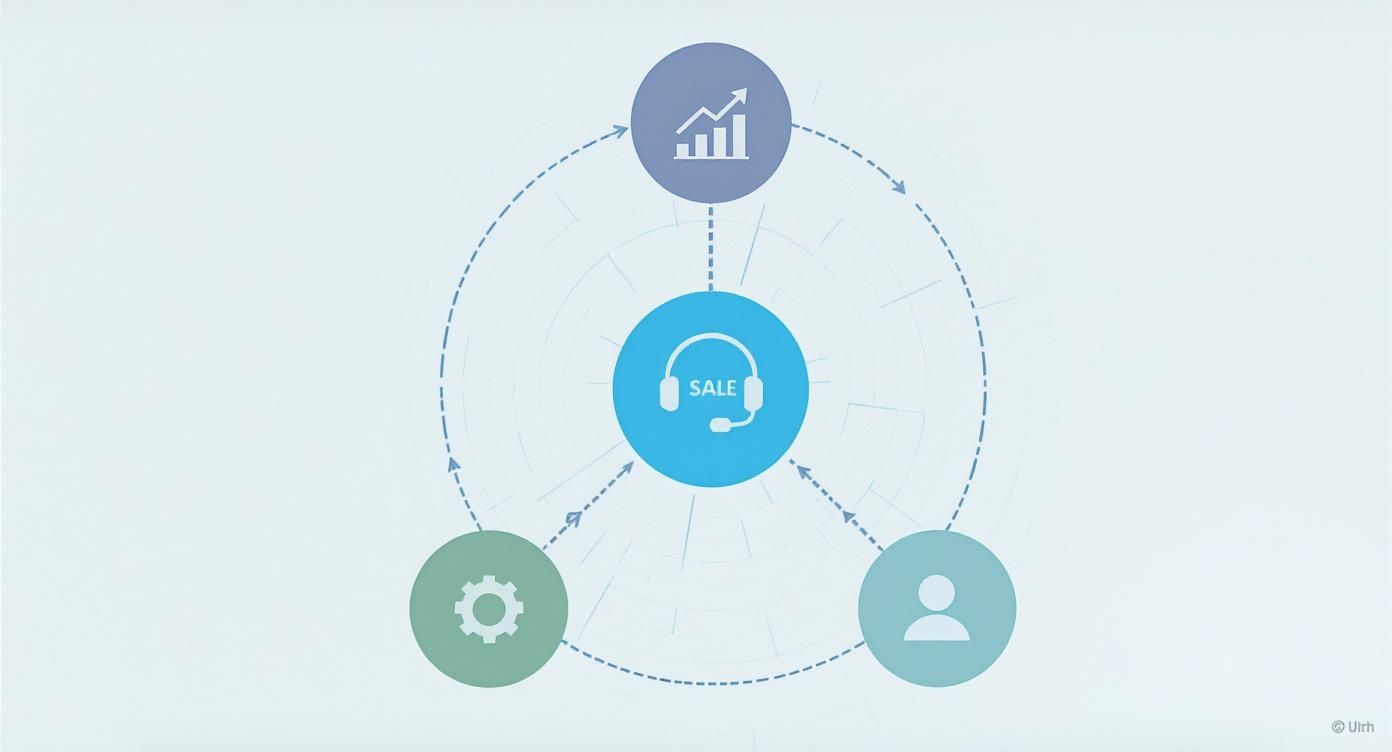
As you can see, call logging becomes the nerve centre, feeding critical data directly into your sales strategies, operational improvements, and even your HR training programmes.
From Reactive to Proactive Strategy
Think about it this way: what if your system could automatically flag every call where a competitor is mentioned? A VP of Sales at a software company could receive a daily digest of all calls where "Competitor X" was discussed. This allows them to instantly gauge market positioning and refine sales scripts to address specific competitive threats—a level of agility that’s impossible with manual call reviews.
Or here's another powerful example: spotting customers who are about to leave. AI can pick up on subtle cues in a customer's voice—like growing frustration or a sense of giving up—and trigger an alert. Your customer success team can then step in before it's too late, completely changing the customer relationship game.
The growth in this area is massive. In India alone, the call centre AI market was valued at USD 103.8 million and is expected to grow at a compound rate of about 28%, hitting USD 452.5 million by 2030. This boom is fuelling the kind of real-time analysis that was once just a pipe dream.
For a CXO, this isn't merely an upgrade to an existing tool. It's a strategic shift from reactive problem-solving to proactive opportunity seizure, turning a compliance function into an engine for growth.
Uncovering Deeper Conversational Insights
The table below highlights the strategic jump from simply recording calls to truly understanding them with AI.
Traditional Logging vs AI-Powered Intelligence
| Capability | Traditional Call Logging | AI-Powered Call Logging |
|---|---|---|
| Data Type | Basic metadata (time, duration, numbers) | Rich, transcribed conversational data |
| Analysis | Manual, sample-based, and after the fact | Automated, real-time, and comprehensive |
| Insights | Identifies call volume and duration trends | Uncovers customer sentiment, intent, and churn risk |
| Agent Coaching | Relies on managers listening to a few random calls | Provides data-driven feedback on every interaction |
| Strategic Value | Serves as a simple record-keeping system | Becomes a core source of business intelligence |
This transition is about moving beyond just scratching the surface. AI-driven analysis gives you a much richer, more colourful picture of your communications. It’s not just about what was said, but also how it was said. For instance, advanced speech analytics can measure the amount of silence on a call. Long pauses could mean a customer is confused or an agent is scrambling for an answer.
This kind of granular detail opens up brand new coaching opportunities and helps you pinpoint exactly where your internal processes need a tune-up. You can learn more about how speech analytics provides insights that go beyond voice in our dedicated article.
To really get the most out of your call data, it helps to follow established business intelligence best practices. When you do, you stop treating your voice data as a simple archive and start using it as a powerful tool for continuous improvement and a serious strategic advantage.
Managing Compliance and Security Risks
For any senior leader, managing risk is always top of mind. While call logging unlocks a goldmine of business intelligence, it also brings a serious responsibility: protecting sensitive data. A breach isn’t just a technical problem; it’s a direct hit to your company's reputation and bottom line. Navigating this landscape means knowing the rules of the road and having the right security in place.
Regulations like GDPR in Europe and industry-specific rules in finance or healthcare aren't just guidelines—they're legal mandates with hefty penalties. In finance, for instance, regulations often require all trade-related calls to be recorded and stored to prevent market abuse. Getting this wrong can lead to fines stretching into the millions.
The telecom industry faces similar pressures, where precise call logging is a regulatory must-have. To give you a sense of the scale, in India, about 14.14 million subscribers requested to switch mobile carriers in just one month. This constant churn highlights why systems must log data perfectly for both regulatory oversight and to maintain network integrity.
Building a Secure and Compliant Foundation
The only way to manage these risks effectively is to establish a robust Logging and Monitoring Policy. This isn’t a job you can simply hand off to the IT department; it’s a strategic decision that needs executive buy-in. Your legal and tech teams need to be in lockstep, creating a framework that protects both your customers and your business.
A strong compliance strategy for call logging isn't about restriction; it's about enablement. By building a secure foundation, you give your teams the confidence to use call data to its full potential without exposing the business to unnecessary risk.
Start by asking the right questions. Your leadership team should be able to get clear answers from your technical and legal experts on the following points.
Crucial Questions for Your IT and Legal Teams
- Data Encryption: How are we encrypting our call data? Is it protected both while it's moving across our network (in transit) and when it’s sitting on our servers (at rest)?
- Access Control: Who can actually access these call logs? More importantly, how do we track and audit that access to make sure no one is looking at things they shouldn't?
- Retention Policies: What are our rules for keeping data? We need to hold onto logs long enough to meet compliance requirements, but not so long that we create unnecessary risk.
- Redaction Capability: Can our system automatically find and remove sensitive information, like credit card numbers, from recordings and transcripts?
Tackling these questions head-on ensures your call logging strategy is not just a tool for growth but a cornerstone of trust and security.
Questions We Hear From Business Leaders
As a leader, you’re not just asking "what is call logging?" You're asking, "What can it do for my business?" You need to know the strategic impact, the financial upside, and how it will slot into the way you already work. This section answers the tough, practical questions we hear from executives every day.
We've stripped out the technical jargon to give you the clear, straightforward information you need to make a smart decision.
How Does Call Logging Actually Connect to Our CRM?
You'll be glad to hear that modern call logging systems are built to play nicely with others. They use APIs—think of them as secure data bridges—to connect directly with major CRMs like Salesforce, Zoho, or HubSpot. This creates a seamless, two-way flow of information.
This isn't some clunky, manual setup. Once connected, the system automatically pushes call data—like duration, time, and agent notes—straight into the right customer record in your CRM.
Here’s what that looks like in practice: A sales manager can pull up a lead’s profile in their CRM and see a full history of every single phone call, complete with recordings and outcomes. Your team gets a 360-degree view of the customer’s journey without ever having to switch screens. That means smarter, more relevant conversations.
This kind of integration transforms your CRM from a static contact list into a living, breathing record of customer conversations. It kills manual data entry, slashes human error, and makes sure your single source of truth is always telling the whole story.
What’s the Real ROI on a System Like This?
The return on investment you get from a call logging platform isn’t just one number; it’s a ripple effect of benefits that spread across your entire company. The value shows up in direct cost savings, huge boosts in efficiency, and tangible revenue growth.
- Sales Performance: A financial services company used call log analysis to discover that their top reps spent 60% of their call time listening. This insight led to a company-wide training program on active listening, which increased their lead conversion rate by 15% within one quarter.
- Customer Support Efficiency: A retail chain identified that 25% of support calls were related to a confusing checkout process on their website. Fixing the issue based on this data reduced call volume, saving thousands in operational costs per month.
- Operational Savings: By looking at call volume patterns, you can get smarter about staffing. You can stop overpaying for agents during quiet spells and make sure you’re never caught short during a rush.
While the exact numbers change from business to business, many companies see a significant return within the first year, driven by all these improvements working together.
How Can We Make Sure Our Team Actually Uses These Tools?
Getting your team on board comes down to one thing: showing them what’s in it for them. If they see the tool as a ‘big brother’ system designed to watch their every move, they’ll fight it. But if they see it as a tool to help them crush their targets and make their jobs easier, they’ll be all for it.
The trick is to position it as a tool for improvement, not for surveillance.
Think about it like this: Show your salespeople how the system can automatically flag their most successful calls, allowing them to create a personal "greatest hits" playlist to refine their technique. For support agents, demonstrate how AI can transcribe their calls and auto-fill CRM notes, saving them 10 minutes of administrative work after every complex interaction.
A good rollout has to include solid training that focuses on these personal wins. It’s also crucial to weave the toolset directly into their daily workflow so it feels like a natural part of their day, not another annoying task.
Ready to turn your call data into your biggest strategic advantage? At DialNexa, we build Voice AI solutions that combine powerful call logging with real, actionable intelligence. We help you boost efficiency, drive revenue, and find the hidden gems in every conversation. Explore how DialNexa can elevate your business operations today.

[…] is creating calls that never convert. If you need baseline context before vendor selection, this guide to what call logging means in business operations helps clarify the underlying data […]
[…] compare systems. A background voice recorder should be assessed alongside adjacent controls such as call logging infrastructure for business communication workflows, retention policy, access governance, transcription accuracy, and retrieval speed. Storage alone […]
[…] a specialist desk, or an AI layer that screens and prioritises calls before a human joins. Accurate call logging for customer interactions makes that routing logic more effective because teams can route with context instead of starting […]
Excellent breakdown of how call logging evolves from simple record-keeping into a powerful source of business intelligence and strategic decision-making. The practical examples clearly show why data-driven visibility is essential for improving customer experience, operational efficiency, and long-term growth.