

Call Divert Meaning: Boost Business Growth in 2026
When connect rates move from 47% to 91% and lead-to-booking conversion rises from 2% to 8% after call diversion is combined with better routing and scheduling, the phrase “call divert meaning” stops sounding like telecom jargon and starts looking like a board-level growth lever (documented business results).
This is a reframing. Call divert isn't just a convenience feature for people stepping away from their desk. It's a control mechanism for revenue capture, service continuity, and operating discipline. In sectors like EdTech, real estate, BFSI, healthcare platforms, and software sales, inbound calls often arrive at the exact moment a buyer is ready to act. If the communication stack fails then, marketing spend has already been wasted.
Leaders usually examine acquisition costs, funnel conversion, and agent productivity. Fewer scrutinise the routing layer between an incoming enquiry and a live conversation. They should. A weak routing design sends high-intent callers to voicemail, dead ends, or unavailable staff. A strong one keeps the enquiry alive, protects response speed, and turns fragmented telephony settings into a managed customer experience system.
Table of Contents
- Beyond Missed Calls The Strategic Importance of Call Divert
- What Is Call Divert and How Does It Work
- The Four Types of Call Divert Your Strategy Depends On
- Implementing Call Divert From Basic Codes to Business Systems
- Divert vs Forwarding vs Transfer Clarifying the Jargon
- The Future of Call Management Voice AI and Intelligent Routing
Beyond Missed Calls The Strategic Importance of Call Divert
Call divert affects revenue quality long before it appears in an IT review. In high-intent categories such as EdTech admissions, real estate enquiries, lending support, and post-sales service, the cost of a failed first connection is rarely limited to one missed conversation. It shows up as lower media efficiency, slower response cycles, weaker conversion from existing demand, and avoidable pressure to hire ahead of proven need.
That is why boards should treat call divert as part of commercial design.
The strategic question is simple. When the intended recipient cannot answer, what happens to demand in that exact moment? If the answer is voicemail, manual callback, or silent call loss, the business has built waste into its acquisition funnel. If the answer is intelligent redirection to the next best endpoint, the business protects intent while it is still active.
This matters more in the Indian market, where network variability, uneven handset availability, field-based work, and multilingual customer journeys create more failure points than a single-office calling model assumes. A property broker at a site visit, an admissions counsellor moving between student calls, or a collections agent working across patchy coverage zones will not be available every time a valuable call lands. The routing layer has to absorb that operational reality.
Revenue protection starts before the conversation begins
For leadership teams, call divert is less about telephony convenience and more about preserving expensive demand. Marketing has already paid to generate the enquiry. Sales has already invested in brand trust, lead qualification, or local presence. A missed connection at that stage reduces the return on every upstream investment.
Three business effects follow when call divert is configured well:
- Revenue leakage falls: High-intent callers reach an available person instead of dropping out at the first unavailable line.
- Staffing productivity improves: Teams handle more live opportunities without adding headcount to cover predictable gaps in availability.
- Customer experience becomes more consistent: The caller experiences continuity, even when internal teams are distributed, mobile, or busy.
The strongest operators use call divert to compress response delay, not just to avoid missed calls.
The executive implication is broader than telephony
For a CFO, this is acquisition efficiency. For a COO, it is continuity under real operating constraints. For a Chief Revenue Officer, it is a control point between lead generation and conversion. For a customer experience leader, it is one of the few mechanisms that can improve responsiveness without requiring the customer to change behavior.
That framing matters because many firms still evaluate call divert as a feature, not a system policy. The difference is significant. A feature reroutes a ring. A policy defines how the organisation protects inbound value when people are unavailable, networks are inconsistent, or queues spike without warning.
In sectors where one call can represent a course enrolment, a property visit, a loan application, or a renewal risk, that distinction has direct commercial weight.
What Is Call Divert and How Does It Work
Call divert means an incoming call is automatically redirected to another destination instead of ringing only the original line. That destination might be a mobile, a colleague's extension, a support desk, an answering service, or another predefined endpoint.
A useful analogy is a digital receptionist. The caller asks for one person, but the system already knows the next best destination if that person is unavailable. The caller doesn't need to know the internal logic. The business does.
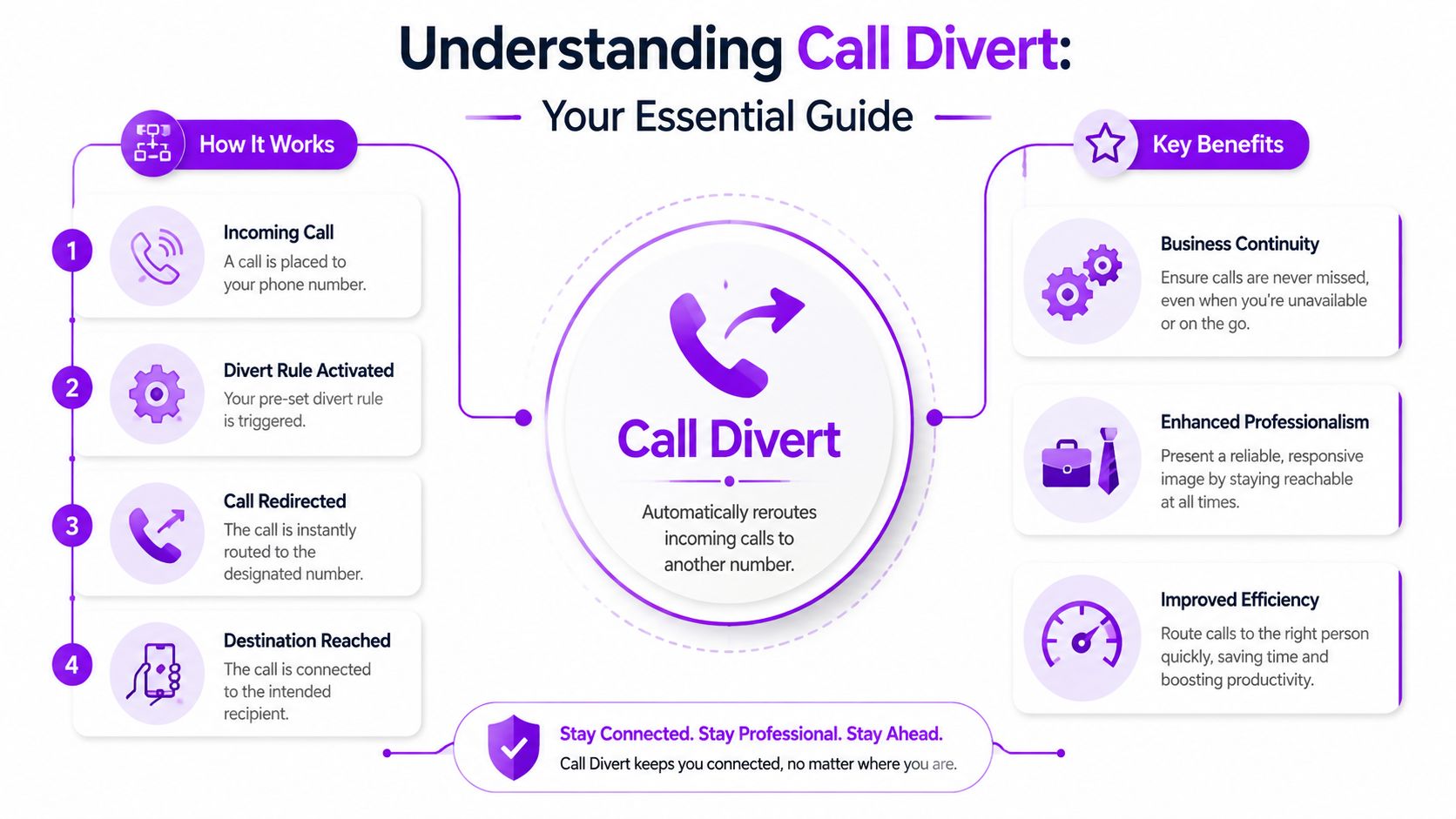
A practical definition leaders can use
In plain business language, call divert is an automated rule that keeps inbound demand moving. It prevents a call from ending at the first unavailable point of contact.
That matters because the mechanism is pre-programmed. It doesn't rely on the employee noticing a missed call and reacting later. It acts in real time, which is why it can support continuity at scale.
A few practical examples make the call divert meaning clearer:
- EdTech admissions: If a counsellor is on another call, the enquiry can move to the next qualified adviser.
- Real estate sales: If a broker steps into a site visit, fresh buyer calls can route to a colleague after a set number of rings.
- Healthcare bookings: If the front desk is overloaded, appointment requests can move to a backup line instead of dropping.
Call divert is most valuable when the caller never experiences the internal gap you were trying to fix.
What happens inside the network
The deeper telecom answer is more important than many executives realise. Call divert, formally called MMTel Communications Diversion or CDIV, is a network-level service. The routing logic sits in subscriber-specific rules stored in the Home Subscriber Server, not merely on the handset itself. The result is that the original phone can be bypassed entirely under the right conditions. Technically, diversion can trigger when a subscriber sends a “302 Moved Temporarily” SIP response or when conditional rules are met (technical explanation of CDIV and SIP behaviour).
That redirection still has to resolve to a valid destination, and teams reviewing how those addresses are structured can use this guide to SIP URI format to understand how a diverted call is addressed once it leaves the original endpoint.
That network-level design explains why call divert scales well. It also explains why businesses use it as a foundation for more advanced workflows. The same source notes that diverting unreadable calls to a secondary line or AI agent has produced connect rate improvements from 47% to 91% in real-world qualification workflows.
For leadership teams, the key point is simple. This is not an improvised workaround. It's a formal communications control built into telephony infrastructure. Once you understand that, it becomes easier to evaluate call divert not as a handset feature, but as a policy engine for accessibility, service resilience, and commercial responsiveness.
The Four Types of Call Divert Your Strategy Depends On
Different divert types solve different management problems. Treating them as interchangeable leads to weak customer journeys and poor staffing logic.
The standard business framework starts with two categories. Unconditional forwarding sends every call to a predetermined number. Conditional forwarding activates only under triggers such as busy, unavailable, or no answer. A practical example is a real estate broker who forwards caller enquiries to a colleague during lunch, after a set number of rings, so no client is lost while personal boundaries remain intact (business explanation of unconditional and conditional forwarding).
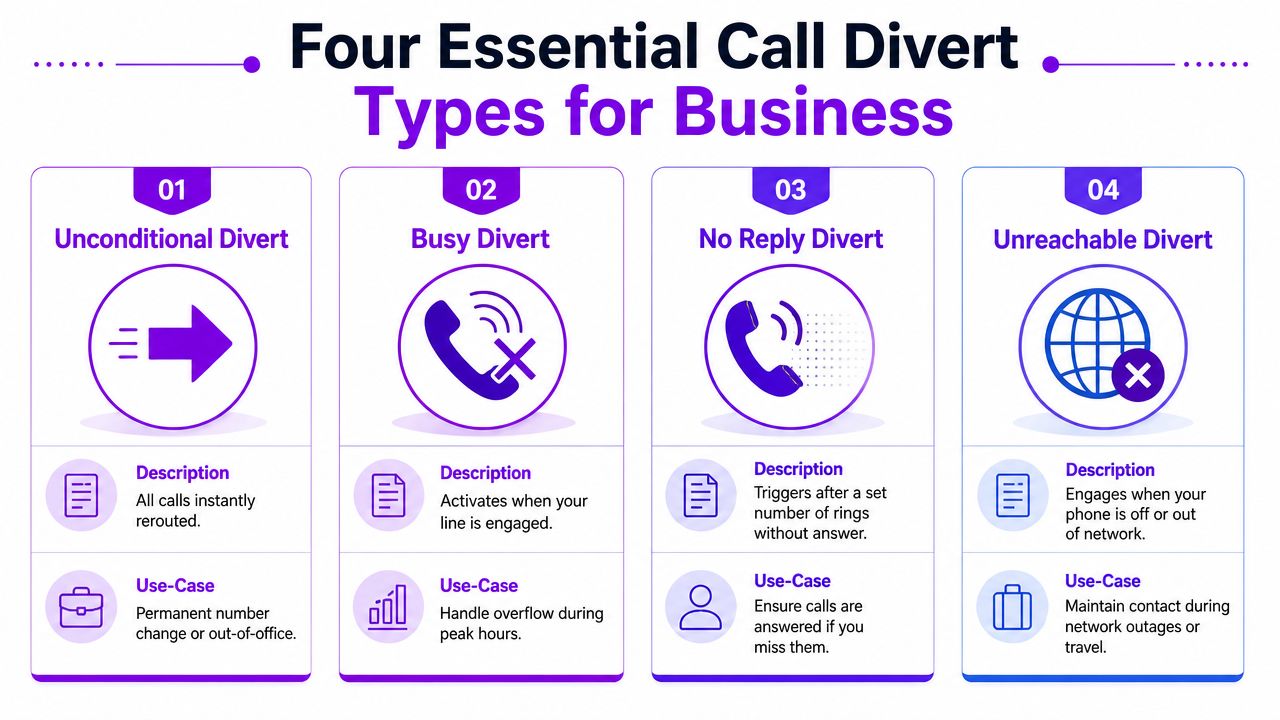
Unconditional divert
This is the bluntest instrument and sometimes the right one. Every incoming call goes elsewhere, regardless of whether the primary user is free.
Use it when the business wants certainty over flexibility. A developer's sales office during renovation, a founder travelling internationally, or a temporary branch closure are all straightforward examples.
Executive use case: A Regional Sales Director in real estate moves all calls from a project-specific number to a central response team during a launch weekend. That keeps campaign traffic consolidated and avoids missed enquiries caused by fragmented staffing.
Busy divert
Busy divert activates when the line is already engaged. This is one of the most commercially important settings for high-intent sales environments.
If your best closer, counsellor, or support specialist is on a call, the next customer shouldn't hear silence or hit voicemail. The system should immediately push that interaction to another capable endpoint.
Where it works best
- Real estate teams: Peak ad-response windows often produce multiple simultaneous buyer calls.
- BFSI support desks: Customers calling about onboarding or KYC often need immediate handling.
- Admissions teams: Counsellors can't abandon an active conversation just because a new lead arrives.
A VP of Revenue should see busy divert as overflow management, not as a backup feature.
Before the next example, this walkthrough is useful for teams that want to see the concepts in action.
No reply divert
No reply divert waits for a defined ringing period, then redirects the call. It's often the best balance between personal ownership and service continuity.
This option suits businesses where the first-choice agent should get a chance to answer, but the organisation won't tolerate dead air beyond a short threshold. It's common in account management, consultative sales, and support structures with named ownership.
Boardroom implication: No reply rules are where customer experience policy becomes operational. You're deciding how long the brand may wait before the system intervenes.
For a COO, this is useful in service teams with coverage obligations. If the first owner doesn't answer after the permitted ring window, the call can move to another pod, a team lead, or a central desk.
Unreachable divert
Unreachable divert triggers when the device is off, out of network, or otherwise not reachable. This is the least understood setting and, in some markets, the riskiest if deployed casually.
Its strategic value is obvious. Field teams travel. Mobile networks fluctuate. Executives fly, drive, and move between weak-coverage areas. Without unreachable rules, those moments become customer-facing failures.
A concise comparison helps:
| Divert type | Trigger | Best strategic use |
|---|---|---|
| Unconditional | Every call | Planned handover or temporary number replacement |
| Busy | Line engaged | Overflow protection in high-volume periods |
| No reply | Not answered after set rings | SLA protection with primary-owner priority |
| Unreachable | Device off or out of network | Continuity for mobile teams and unstable coverage |
The smartest deployments don't choose one. They combine all four around actual business conditions. That's how call divert evolves from a telecom setting into a deliberate operating model.
Implementing Call Divert From Basic Codes to Business Systems
Enterprise teams usually start with handset codes because they are fast to deploy and familiar to staff. That approach works for personal availability. It breaks down when inbound voice is tied to revenue targets, service-level commitments, and brand reputation.
Carrier-based divert is a tactical control. Business telephony is an operating system.
A broker attending site visits can redirect calls to another mobile number. An admissions counsellor can switch calls before a campus event. Those actions solve a momentary coverage problem. They do not create accountable routing across a sales floor, a counselling desk, or a support function where missed calls carry measurable commercial cost.
Carrier codes provide access. They do not provide governance.
The gap appears once call handling moves from an individual habit to a managed process.
- User-level logic: Basic codes reflect one person's status, not queue conditions, team capacity, or lead priority.
- Manual risk: Staff must remember to activate, reverse, and test settings. Failure rates rise during travel, shift changes, and peak campaigns.
- Limited policy design: Ring-time rules, overflow paths, business-hour treatment, and VIP handling are difficult to control consistently through carrier settings.
- Poor reporting: Operations leaders cannot easily audit who redirected calls, where those calls went, or whether the routing improved answer rates.
For smaller firms evaluating alternatives, Cloudvara's small business PBX insights outline how central administration, time-based routing, and shared call flows replace improvised number-to-number diversion.
Menu design also affects implementation quality. Teams mapping inbound journeys should understand how DTMF works in business telephony because keypad input still routes a meaningful share of callers before an agent, counsellor, or broker is involved.
Indian operating conditions make centralised routing more valuable
India adds two constraints that executives should treat seriously. Mobile coverage can fluctuate across cities, highways, and buildings. Business communication also remains heavily mobile-first, especially for distributed sales teams and owner-led firms.
That combination changes the economics of call divert. A simple redirect from one handset to another may preserve reachability in a stable network. In a mobile-dependent environment, it can also pass failure from one endpoint to the next. For EdTech admissions teams and Real Estate brokers, that matters because many high-intent enquiries happen outside a desk-based setup and require immediate connection to the right person, not a voicemail recovery attempt hours later.
The strategic question is not whether divert is available. It is where routing intelligence sits.
If routing lives at the carrier or handset level, the business gets convenience but little control. If routing lives in a cloud PBX or contact platform, leadership can set fallback paths by campaign, geography, business hours, and team ownership. That improves three board-level outcomes at once: lower call loss, better agent utilisation, and stronger conversion from expensive inbound demand.
This distinction becomes sharper at scale. A five-member team can sometimes manage with ad hoc divert rules. A multi-city EdTech sales team running paid lead generation, or a Real Estate network balancing listing enquiries across agents, needs central logic, auditability, and failover by design. At that point, call divert stops being a phone setting and becomes part of revenue operations.
Divert vs Forwarding vs Transfer Clarifying the Jargon
Telecom language creates confusion because the terms overlap in everyday use. For leadership teams, the distinction matters because each term implies a different control point and a different operating model.
In most business discussions, call divert and call forwarding mean the same thing: redirecting an incoming call to another destination so the caller doesn't land in voicemail and the company maintains availability. The terms are used interchangeably, and major carriers support them universally through their own activation codes (reference on call forwarding and call diversion terminology).
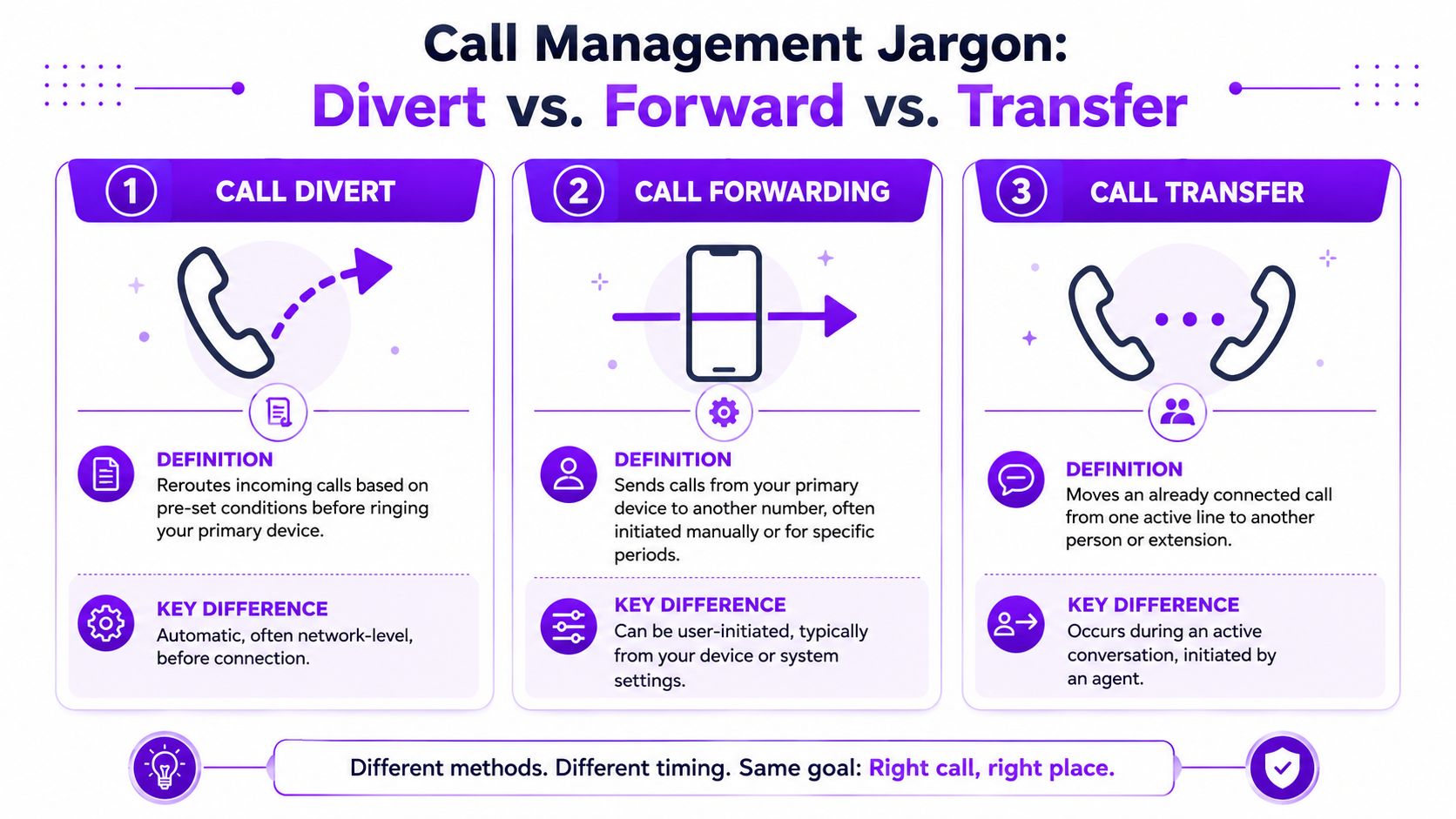
Where leaders get tripped up
The difference is usually between divert/forwarding and transfer.
| Term | When it happens | Who controls it | Strategic use |
|---|---|---|---|
| Call divert | Before the call is answered | Pre-set system rule | Protect availability |
| Call forwarding | Commonly used as another term for divert | User or system setting | Redirect inbound calls |
| Call transfer | During an active conversation | Agent or receptionist | Move a live caller to the right person |
A simple example helps. If an admissions counsellor doesn't answer and the system sends the call to a backup adviser, that's diverting or forwarding. If the counsellor answers first and then moves the caller to finance, that's a transfer.
This distinction sharpens executive decision-making. A company with too many transfers may have discovery happening too late. A company with poor divert logic may be losing callers before any conversation starts.
Smart call handling starts before the first hello. Transfer quality matters, but pre-answer routing determines whether the conversation happens at all.
The more useful strategic term
The better umbrella term is call routing. Routing includes divert rules, forwarding logic, IVR decisions, business hours, queues, and transfers as part of one orchestrated system.
That framing helps boards ask better questions. Not “Do we have call forwarding?” but “How does our routing design handle intent, urgency, availability, and escalation?” Teams that want a practical framework for that broader question can review this explanation of what call routing means in a business system.
Once leaders shift to routing language, the telecom debate becomes much more useful. They stop arguing over features and start governing outcomes.
The Future of Call Management Voice AI and Intelligent Routing
The future of call management doesn't replace call divert. It builds on it. The same logic that once said “if unavailable, send the call elsewhere” now supports systems that decide whether a caller should reach sales, support, compliance, a booking flow, or an automated voice agent.
That evolution matters because modern businesses don't just need answered calls. They need the right conversation to happen with the right level of effort at the right time.
From fixed rules to adaptive response design
Advanced conditional forwarding already shows the direction of travel. Time-based rules can activate during specific hours or days, enabling after-hours coverage. One practical example is forwarding calls to a central support line from 6 PM to 8 AM to maintain service continuity. Another is a trading platform forwarding KYC guidance calls to an answering service after hours to preserve compliance and trust (after-hours forwarding examples and time-based rule design).
That's still rules-based telephony. The next step is intelligence layered on top of those rules. Instead of merely deciding where a call goes, the system can help decide what should happen next: answer a routine question, collect context, qualify intent, schedule an appointment, or escalate to a human specialist.
For leaders studying that evolution, a useful companion read is this deep dive into speech AI, which explains why high-quality voice understanding matters once routing expands into automation, transcription, and conversation workflows.
What this means for executive teams
For a board, the implication is straightforward. Telephony is no longer separate from revenue operations. It's part of the same decision system as CRM, staffing, customer experience, and automation.
The organisations that lead here won't be the ones with the most complex phone menus. They'll be the ones that use intelligent routing to protect responsiveness, standardise communication quality, and extend skilled coverage beyond human scheduling constraints. A useful next step for operators evaluating that shift is this overview of intelligent call routing in modern communication stacks.
The enduring call divert meaning, then, is bigger than redirection. It's the first layer of a broader capability: making sure demand reaches a viable endpoint, then converting that endpoint into a productive outcome.
DialNexa Labs Private Limited helps businesses turn call routing into a scalable operating advantage with human-like Voice AI for qualification, customer support, presales, recruitment, and follow-up workflows. If your team wants fewer missed opportunities, more consistent conversations, and a communication stack built for high-volume environments, explore DialNexa Labs Private Limited.

This is a clear and insightful guide to how call divert can protect revenue, improve customer responsiveness, and support business continuity. The practical breakdown of divert types and the focus on real-world Indian business scenarios make the topic especially valuable for leadership teams.
A valuable overview of how senior VoIP roles require not only technical expertise but also strong business, communication, and decision-making skills. The comparison between full-time and freelance career paths is especially practical for engineers planning their next step.
A clear and practical explanation of how call divert can protect valuable leads while improving response time and customer continuity. I especially liked the focus on different divert types and how they can support real-world business operations.