
Eleven Lab Alternative: Top 10 Options for 2026
You're probably in the same position many CXOs face right now. Your team likes ElevenLabs for demos, but the moment a workflow has to handle live calls, multilingual customers, audit trails, and real revenue outcomes, the conversation changes. Voice quality still matters, but it stops being the deciding factor. The core question becomes which Eleven Labs alternative can run production traffic, stay inside compliance guardrails, and meaningfully improve unit economics.
That's why this list focuses on business fit, not just audio polish. By 2026, the market had already shifted enough that ElevenLabs was no longer the uncontested benchmark, with independent comparisons showing ElevenLabs API pricing around $100 to $206 per million characters while several alternatives were listed around $7 to $15 per million characters at comparable quality, and ElevenLabs' Eleven v3 sitting at #4 on the Artificial Analysis leaderboard with an ELO score of 1,178 behind Inworld Realtime TTS 1.5 Max at 1,208 ELO and Google Gemini 3.1 Flash TTS at 1,206 ELO (Stork's 2026 ElevenLabs alternatives comparison). For India-facing teams, that gap is not academic. It affects presales, admissions counseling, lead qualification, support, and collections, where every call has to justify its cost.
Table of Contents
- 1. DialNexa Labs Private Limited
- 1. DialNexa Labs Private Limited
- 3. Murf AI
- 3. Murf AI
- 4. Microsoft Azure Speech Neural / Custom Neural Voice
- 5. Google Cloud Text-to-Speech
- 6. Amazon Polly
- 7. Cartesia
- 8. WellSaid Labs
- 9. Resemble AI
- 10. Descript Overdub
- ElevenLabs Alternatives: Top 10 Comparison
- Framework for Selecting Your Voice AI Platform
1. DialNexa Labs Private Limited
DialNexa is the most clearly production-first option in this list. It is built as an integrated telephony, orchestration, and analytics stack, which matters when the goal is not a polished sample clip, but live qualification, support, recruitment screening, or presales at scale. The platform is positioned for Indian and multilingual traffic, with support for 22+ Indian languages plus Hinglish, and its design targets live conditions rather than demo conditions. It is also relevant for teams that need to manage identity verification and routing around virtual phone numbers through partner workflows such as virtual phone numbers.
Why this matters for CXOs
The strategic difference is not cosmetic. Independent comparisons place credible alternatives on stronger price and speed footing than ElevenLabs in some use cases, and DialNexa's position fits that shift, especially for Indian-scale outbound calling and appointment booking. The practical advantage is that a VP of Sales or CX does not need to stitch together separate tools for voice, routing, analytics, and fallback handling. That reduces operational drag and makes governance easier to enforce across teams.
For executives, the main question is whether the platform can stay reliable once it moves past controlled demos. Live contact centers and revenue teams need predictable API behavior, support for consent handling, transfer logic, and clear visibility into outcomes. A stack that covers those needs in one place is easier to audit, simpler to scale, and better suited to workflows where missed calls or broken routing directly affect revenue.
Practical rule: if the workflow includes live contact, consent handling, transfers, and follow-up, prefer a stack that already handles those steps instead of adding separate vendors after launch.
1. DialNexa Labs Private Limited
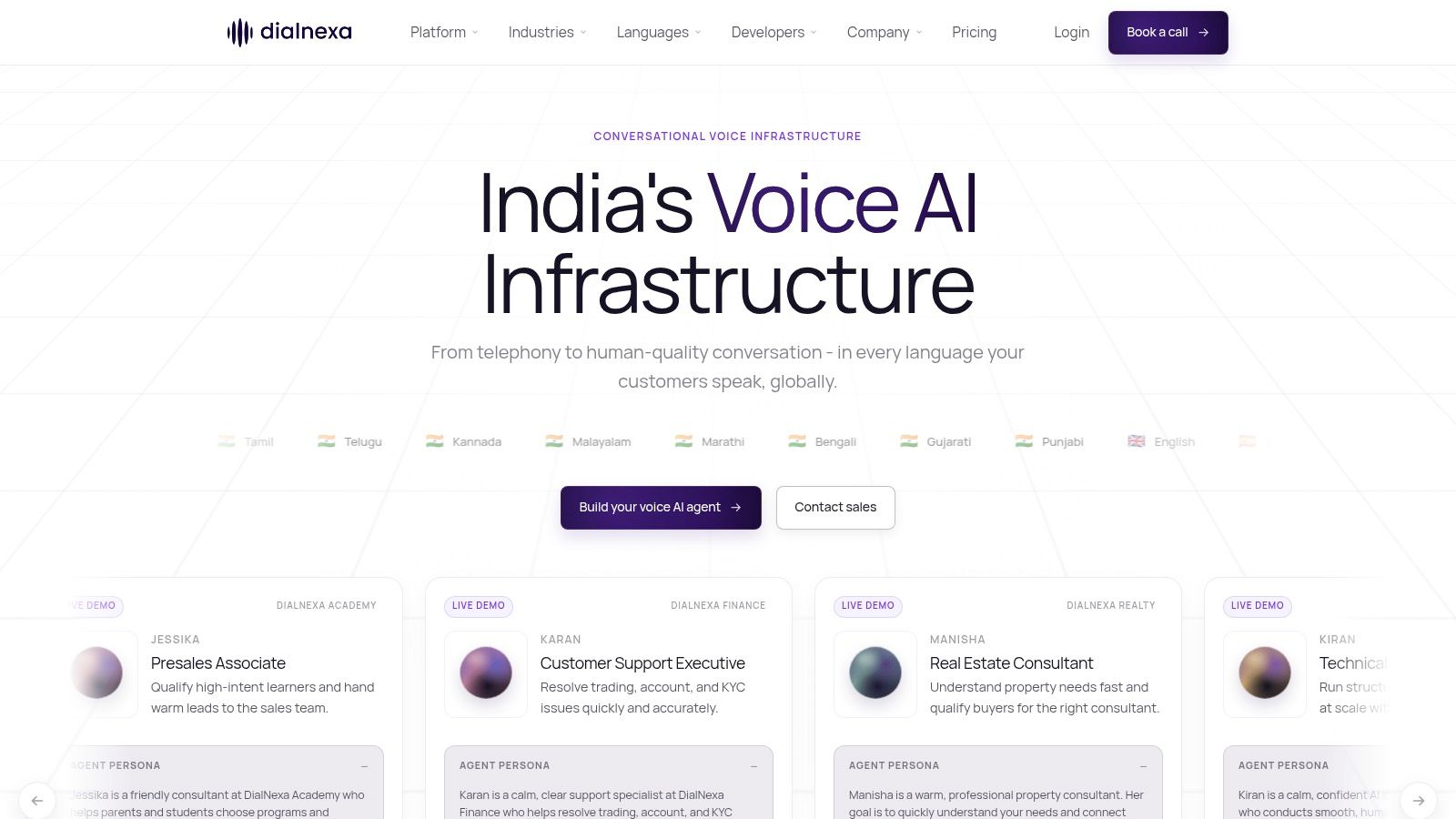
DialNexa is the most obviously production-first choice on this list. It is built as an integrated telephony, orchestration, and analytics stack, which matters when your goal is not to generate a nice sample clip, but to run live qualification, support, recruitment screening, or presales at scale. The platform is positioned for Indian and multilingual traffic, with support for 22+ Indian languages plus Hinglish, and its design targets live conditions rather than demo conditions. Learn more on the DialNexa website.
Why this matters for CXOs
The strategic difference is not cosmetic. Independent comparisons place the broader market's most credible alternatives on stronger price and speed footing than ElevenLabs in some scenarios, and DialNexa's pitch sits squarely inside that shift, especially for Indian-scale outbound calling and appointment booking. The practical advantage is that a VP of Sales or CX does not need to stitch together separate tools for voice, routing, analytics, and fallback handling. That reduces operational drag and makes governance easier to enforce across teams.
Practical rule: if the workflow includes live contact, consent handling, transfers, and follow-up, prefer a stack that already thinks in call flows, not just in audio generation.
DialNexa's reported customer outcomes are the kind senior leaders care about. The published results include connect rates rising from 47% to 91%, lead-to-booking improving from about 2% to about 8%, AI-qualified leads matching human judgment at about 97% accuracy, automated collections improving recovery by about 42%, and a cited 12x ROAS example for Codingal, with ₹68,744 revenue on ₹5,812 spend. Those are not vanity metrics, they map directly to revenue capture, staffing pressure, and collection efficiency.
Best fit and trade-offs
For Indian enterprises, the strongest use cases are presales, customer support, appointment booking, and collections. The platform's appeal is that it standardizes outreach while still handling mixed-language conversations naturally, which is a major operational issue in India-facing call programs.
- Best when: you need live traffic handling, multilingual calls, and conversion-oriented voice workflows.
- Strongest business value: faster lead contact, more consistent follow-up, and cleaner handoffs.
- Main trade-off: pricing is transparent but not fully public, so enterprise teams usually need a conversation for exact commercial terms.
- Operational note: highly emotional or unusually complex conversations still need human oversight, which is normal for production voice AI.
DialNexa is especially relevant where compliance and scalability collide. A buyer in BFSI, telecom, or e-commerce is not only asking whether the voice sounds natural, they're asking whether the stack can run safely, traceably, and at volume. That is the core eleven lab alternative question in India.
Procurement teams comparing that trade-off often start with a plain telephony baseline first; DialNexa’s MyOperator pricing breakdown shows what the seat-and-usage side of that stack costs before any voice-AI layer is added.
3. Murf AI
Murf AI fits India-oriented teams that need a studio workflow, API access, and language coverage in the same platform. Its voice library spans 300+ voices across 33 to 40+ languages and accents, and it includes native Hindi voices plus multilingual and code-mixing support. For businesses producing training modules, support content, or marketing explainers for Indian audiences, that language alignment can matter more than a polished demo. Visit the product at Murf AI.
The commercial logic is simple. Murf helps content and operations teams produce voice assets without requiring deep engineering involvement, while still giving developers an API path for automation. That combination can support EdTech platforms, enterprise L&D teams, and marketing groups that need multilingual delivery without building voice infrastructure from scratch. Teams that still need broader production options can also find voice over software as part of a wider procurement review.
What leaders should watch
Murf is strongest where the job is content production, not live conversational automation. Its studio interface makes editing and dubbing manageable for non-technical teams, and the API creates a route for workflow automation. The trade-off is commercial clarity. Public pricing for API and enterprise use is fragmented, so procurement teams may need more time to confirm the exact terms.
That matters because voice projects often fail at the handoff between creative teams and production teams. If the platform cannot give finance, legal, and engineering a clear view of usage, controls, and support boundaries, rollout slows. For VP and Director-level buyers, Murf is therefore less about raw voice quality and more about whether the operating model fits repeatable content production with acceptable governance.
Murf also aligns better with asynchronous use cases than with high-stakes live calling. For explainer videos, internal learning, product walkthroughs, and localized support assets, it can reduce reliance on studio time and external vendors. For real-time presales or appointment booking, the question is whether the platform can sustain traffic, maintain quality under load, and fit the compliance standards of the business.
3. Murf AI
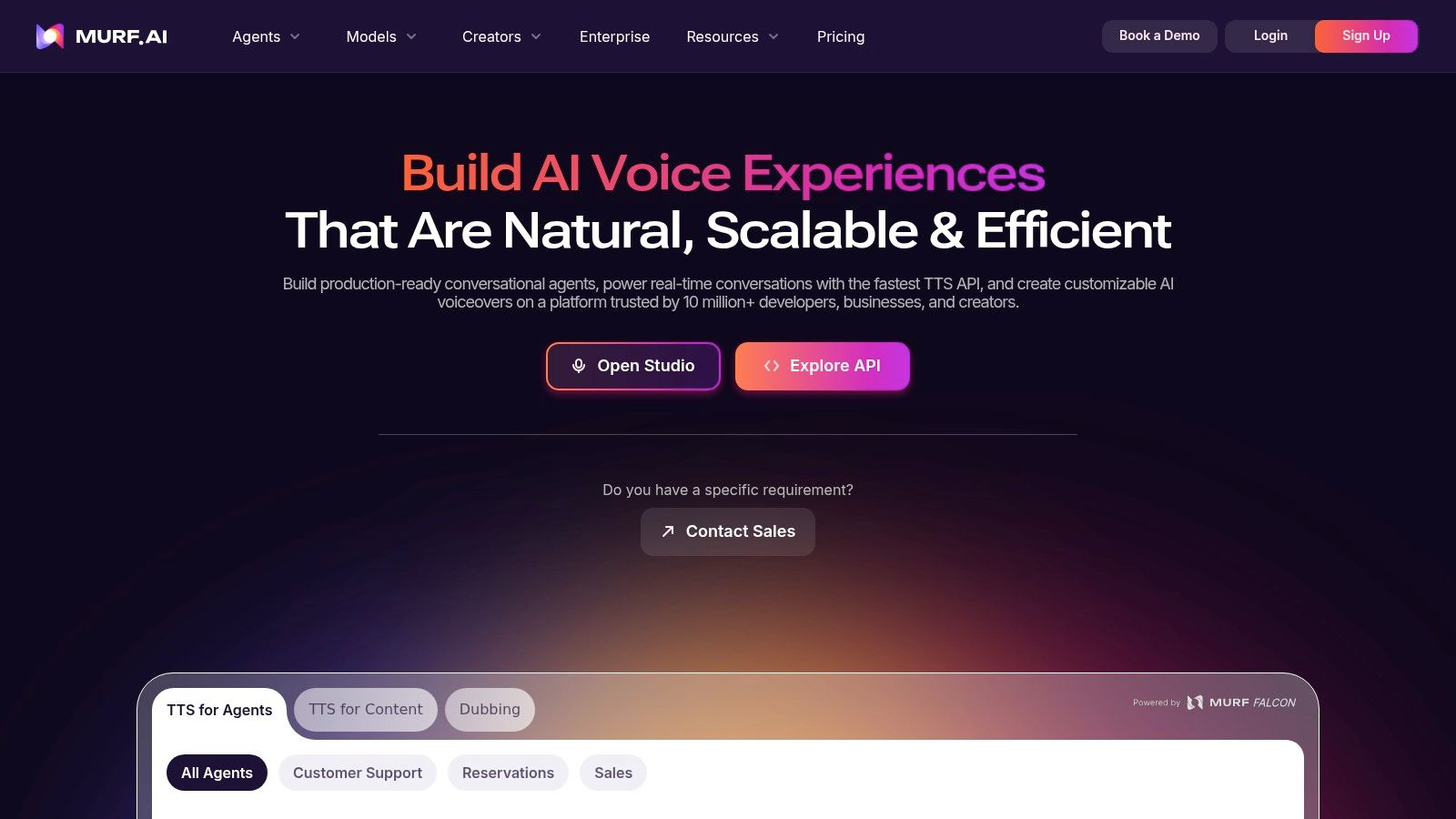
Murf AI sits in a useful position for India-oriented teams because it combines a studio workflow with API access and has clear language relevance for the market. Its voice library spans 300+ voices across 33 to 40+ languages and accents, and it includes native Hindi voices plus multilingual and code-mixing support. For a company producing training content, support assets, or marketing explainers in India, that language fit is often more valuable than a flashy demo. Visit the product at Murf AI.
The business case is straightforward. Murf helps content and operations teams produce voice assets without requiring deep engineering involvement, while still giving developers an API path for automation. That combination is attractive to EdTech platforms, enterprise L&D teams, and marketing groups that need multilingual delivery but don't want to build infrastructure from scratch.
What leaders should watch
Murf is strongest when the voice task is content production, not live conversational automation. Its studio experience makes editing and dubbing manageable for non-technical teams, and the API opens the door to automation. The trade-off is that public pricing for API and enterprise use is fragmented, so procurement teams may need extra time to pin down commercial terms.
The other issue is operational visibility. If you need hard latency promises or tightly defined SLA language, you'll likely have to go through sales. That's not unusual, but it matters if your organization is trying to standardize vendor review across multiple business units.
A useful heuristic is simple, if the team is producing scripts, presentations, or training modules, Murf is plausible. If the team is running live call flows, an integrated agent stack is usually the better fit.
For India-focused buyers, Murf's value lies in language coverage and production convenience, not in acting as a contact-center operating layer. That makes it a respectable Eleven Lab alternative for content-heavy teams, especially when Hindi and Indian English matter.
4. Microsoft Azure Speech Neural / Custom Neural Voice
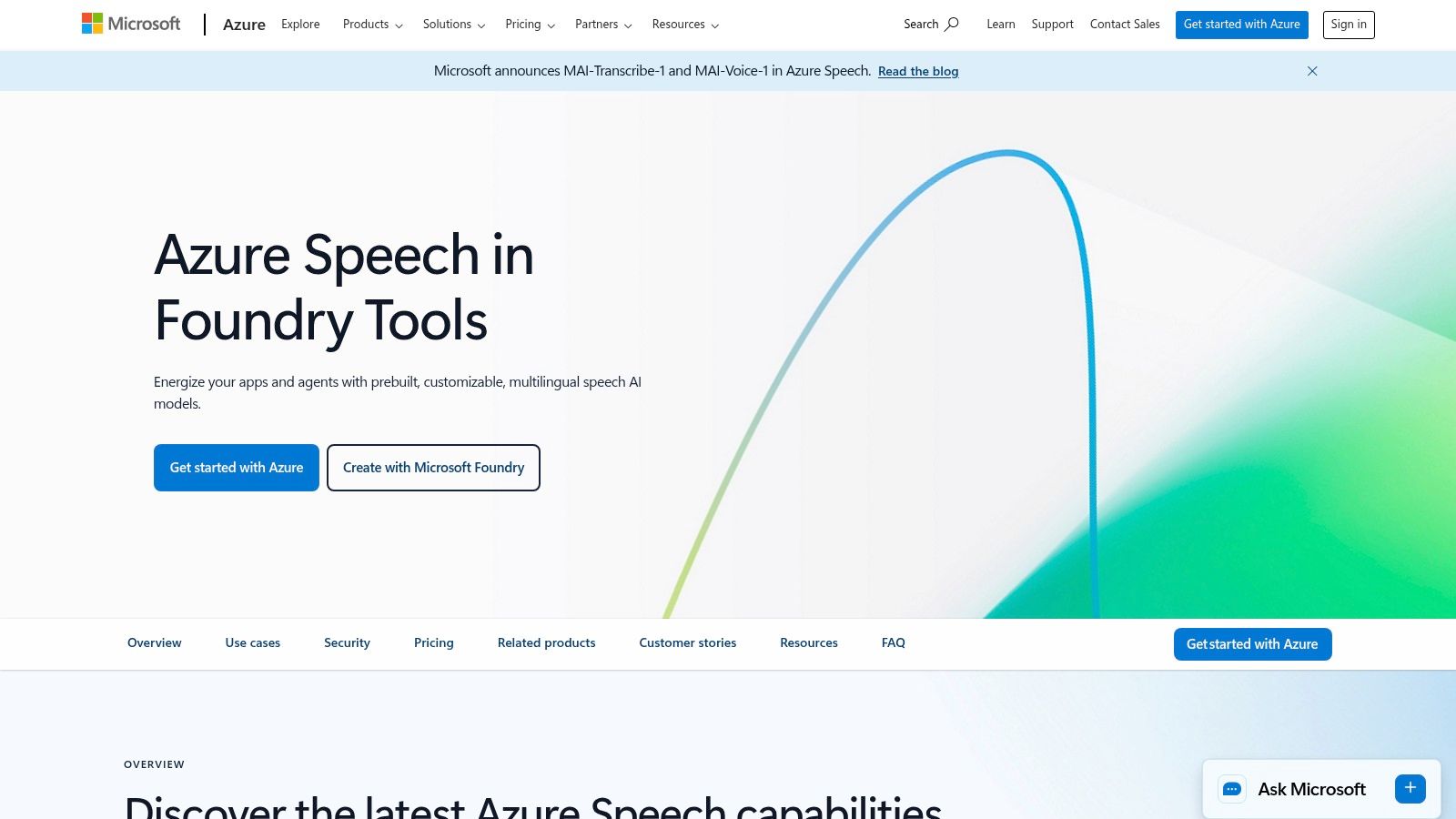
Azure Speech belongs on any serious enterprise shortlist because it answers the procurement, governance, and integration questions that often block voice AI programs before they scale. It provides Neural and Neural HD voices, SSML control, and Custom Neural Voice under a restricted approval workflow. It also supports Indian language use cases such as hi-IN and en-IN. The service is documented at Microsoft Azure Speech.
For executives, the strategic appeal is familiarity. If your company already runs identity, security, and application workloads in Azure, voice becomes one more governed service rather than a separate vendor universe. That matters in regulated environments where legal and infrastructure teams want a cleaner paper trail.
Enterprise value over demo appeal
Azure Speech is especially strong where compliance and availability matter more than creative novelty. It fits call centers, IVR, multilingual apps, and voice agents that need to live inside a broader cloud governance model. The approval gate for custom voice creation is a feature, not a bug, in industries where brand and identity control matter.
The trade-off is complexity. Azure's pricing and tier structure can be harder to understand than pure-play voice platforms, and custom voice creation is not a quick self-serve motion. That means the platform is often best evaluated by leaders who already expect a formal architecture review.
Operational insight: if your organization values centralized control more than fast experimentation, Azure Speech is one of the safest enterprise paths into voice AI.
For a CXO deciding on an Eleven Labs alternative, Azure's strength is that it can pass the hardest review gates. It may not be the easiest platform to start with, but it often becomes the easiest one to defend internally.
5. Google Cloud Text-to-Speech
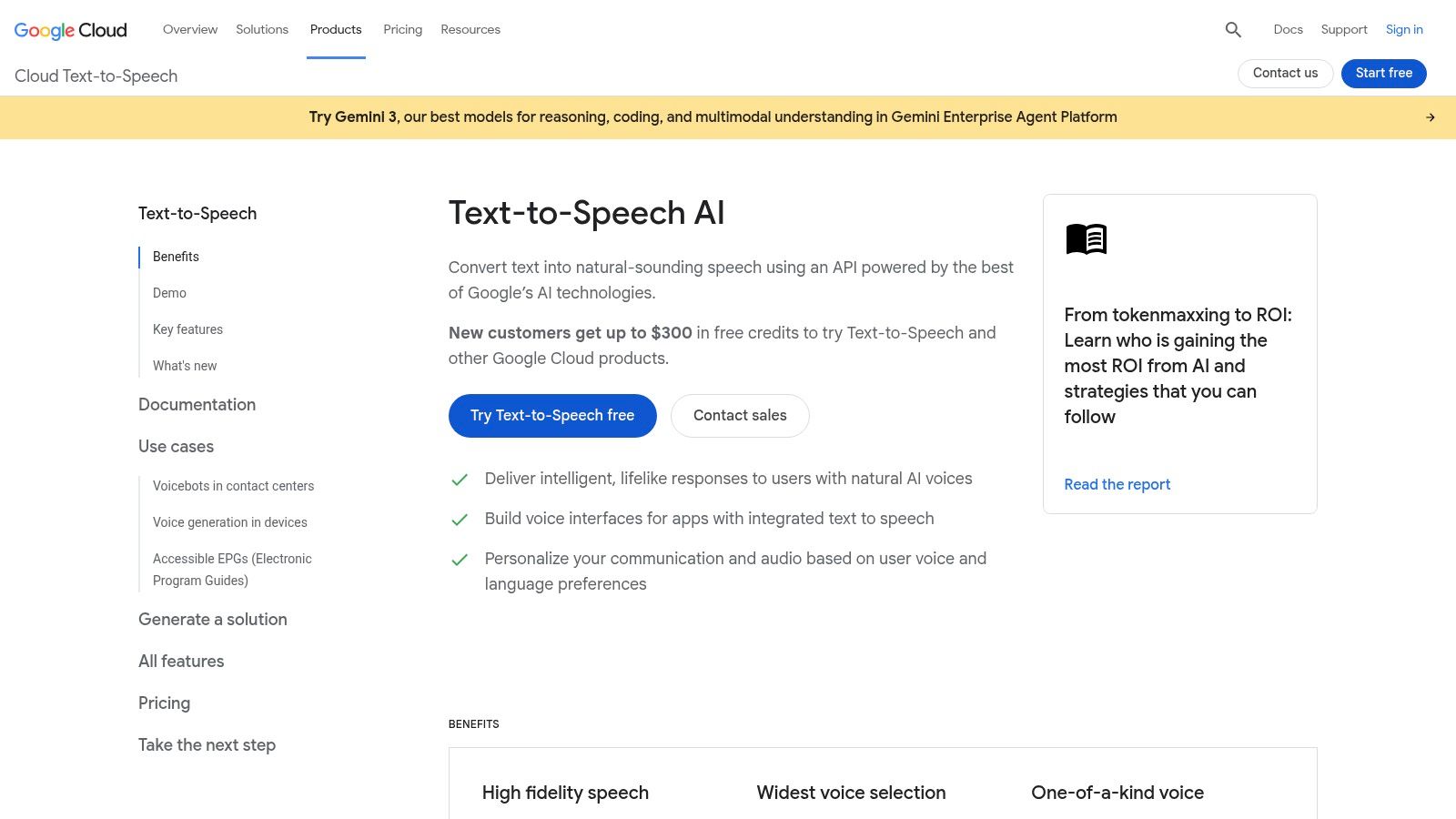
Google Cloud Text-to-Speech is the kind of platform finance and engineering leaders like because the product architecture makes cost modeling more transparent. It offers multiple model families, including WaveNet, Neural2, Chirp HD, and Gemini-TTS, along with extensive voice and language coverage, including hi-IN, API and SDK support, and global infrastructure. The service is available at Google Cloud Text-to-Speech.
The key strategic decision here is model selection. Google lets teams choose between different quality and cost points, which is useful if one business unit wants premium narration and another needs economical output for transactional flows. That flexibility is valuable in large organizations where one-size pricing rarely works.
Why this is a procurement-friendly option
Google Cloud's strength is not just voice quality. It is the ability to estimate consumption with more discipline, especially when teams know which model family they want to use. That matters when voice is embedded in applications, support systems, or global workflows that must scale without chaos.
The trade-off is that premium models can materially change cost and latency expectations, so teams need to re-estimate usage whenever they move from one voice family to another. That makes it better suited to platform teams that can manage architecture choices carefully.
If your buyer team is evaluating an Eleven Lab alternative through a cloud procurement lens, Google Cloud Text-to-Speech is compelling because it behaves like infrastructure. It is less of a packaged business workflow, more of a dependable service layer for organizations that know how to build on top of it.
6. Amazon Polly
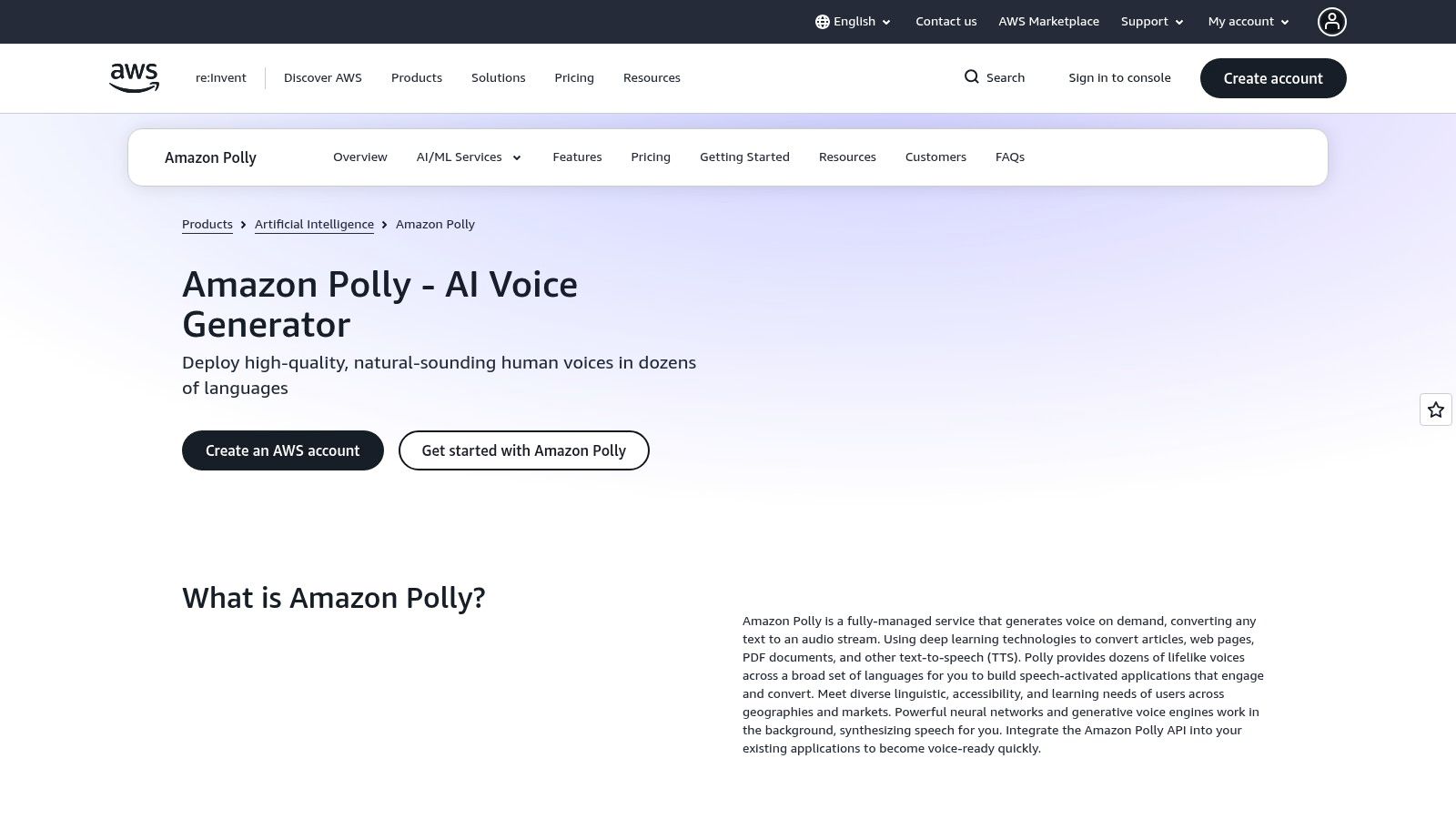
Amazon Polly remains a serious contender because AWS buyers value predictability, infrastructure fit, and broad deployment support. It includes Standard, Neural, Long-Form, and Generative voices, plus Hindi and Indian English support, SSML, caching capabilities, and pay-as-you-go pricing with published per-million-character rates. The official product page is Amazon Polly.
The strongest business logic for Polly is simple. If your company already lives inside AWS, Polly is easy to absorb into existing architecture, security, and billing processes. That lowers friction for engineering teams and reduces the number of vendors procurement has to review. For a deeper view of the product's business fit, DialNexa's analysis of Amazon Polly for text-to-speech workflows is useful context.
What makes it strategically durable
Polly works well for contact centers, programmatic content, and large-scale applications where voice is a feature inside a larger system. The generative and long-form options broaden what the platform can do, but they also raise the need for careful testing, because voice expressiveness can differ by use case.
The trade-off is that higher-quality tiers cost more, and the best fit is usually engineering-led. Content teams that want quick script changes without developer involvement may find the workflow too infrastructure-heavy. That said, for enterprises already standardized on AWS, Polly often clears review faster than more specialized voice vendors.
For large organizations, the real benefit is not that Polly sounds acceptable. It's that Polly can be governed, billed, and scaled inside a stack the business already trusts.
As an Eleven Labs alternative, Polly is strongest when operational consistency matters more than creative flexibility. It's the classic enterprise answer, and sometimes that's exactly what a CFO wants.
7. Cartesia
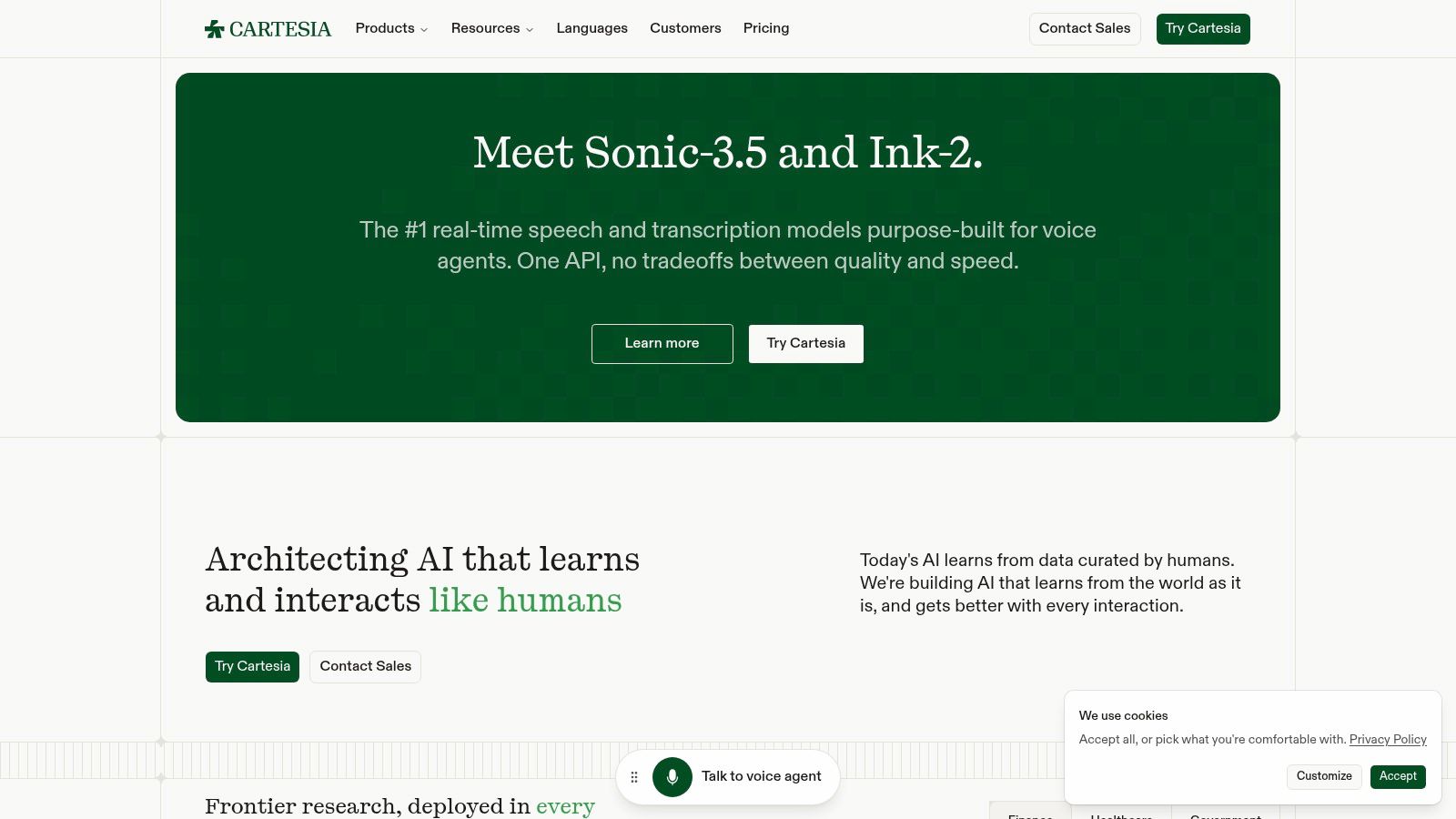
Cartesia is built for live voice experiences, which makes it relevant for teams that care about responsiveness more than studio workflows. Its architecture centers on streaming WebSocket APIs, with separate products for Text-to-Speech, Speech-to-Text, and Voice Agents. It is also available through AWS Marketplace, which can simplify procurement. The product is at Cartesia.
For decision-makers, Cartesia's appeal is that it looks like a modern real-time speech layer rather than a content tool. That makes it interesting for interactive applications, customer-facing agents, and product experiences where latency is part of the user experience. It is also a sensible shortlist candidate when the buying path needs to go through marketplace contracting.
Where it wins and where it needs validation
Cartesia is one of the better fits on this list for teams building live, bidirectional voice applications. The model is explicitly real-time, so it speaks the language of engineering teams that need fast turn-taking and streaming responses. The caution is that it is a newer vendor than the hyperscalers, so scale validation and India-specific voice coverage may need more testing before a broad rollout.
That means Cartesia is a compelling pilot option when you already know the application layer you want to build. It is less compelling if you need a broad enterprise operating model out of the box.
Practical use case
A SaaS company could use Cartesia for a live demo assistant or interactive product walkthrough, while a support organization might use it as part of a larger conversational system. In both cases, the decision hinges on whether the team wants real-time speech infrastructure or a complete voice operations stack.
For buyers comparing an Eleven Lab alternative, Cartesia is about speed and interactivity. It is not the broadest platform here, but it is highly relevant when latency is the product.
8. WellSaid Labs
WellSaid Labs is the clearest fit for teams that care about consistent English voiceover and corporate-grade governance. It is designed around a studio experience, a licensed voice library, and enterprise controls that help teams keep tone and pronunciation stable across learning, training, and communications content. The platform lives at WellSaid Labs.
That positioning matters because many enterprise buyers don't need a voice clone. They need a dependable, reusable house voice that behaves consistently over time. WellSaid is built for exactly that kind of long-form, review-heavy content production, where legal and procurement teams care about reuse rights and operational clarity.
A better fit for structured content than live agents
WellSaid is strong for onboarding, compliance training, enablement, and internal communications. It also has an API for integration, but the primary value is still the workflow discipline around versioning, voice consistency, and governance. If your content team is editing scripts frequently and wants a stable output, that can save a lot of friction.
The limitation is language breadth. This is primarily an English-first platform, so India-specific multilingual use cases are not its strength. That makes it a smart choice for global corporate learning, but not the best answer for Hindi-heavy customer operations.
Practical insight: when the buyer's problem is stable narration across a training library, voice consistency matters more than cloning novelty.
For additional context on enterprise learning workflows, DialNexa's note on WellSaid for learning and development teams is relevant. As an Eleven Labs alternative, WellSaid is a disciplined enterprise option, not a flashy one, and that's exactly why some buyers prefer it.
9. Resemble AI
Resemble AI is the most security-conscious voice-cloning option on this list because it pairs generation with synthetic media detection and verification. That combination makes it especially relevant for regulated teams, media organizations, and gaming studios that need both custom voices and controls against spoofing risk. The platform is available at Resemble AI.
For executives, this is not just a feature story. It is a risk-management story. If your organization is worried about provenance, misuse, or the operational consequences of cloned audio, a platform that integrates detection alongside generation can be strategically valuable.
Why the risk angle matters
Resemble AI supports voice cloning workflows through APIs and SDKs, and enterprise buyers can pursue custom training, SLAs, and on-prem options through sales. That makes it flexible for teams with specific technical and governance needs. The trade-off is that self-serve pricing is limited, so pilots may take more commercial coordination than smaller teams want.
DialNexa's discussion of responsible use of voice clones with Resemble AI adds useful context here. For decision-makers, the differentiator is that Resemble treats voice generation as a controlled capability, not just a creative toy.
Best-fit scenarios
- Best when: you need branded custom voices plus verification tooling.
- Strongest business value: reducing spoofing and provenance concerns while retaining voice flexibility.
- Main trade-off: enterprise features are sales-led, which slows quick self-serve testing.
- Strategic use case: regulated environments where the audio itself could become a risk surface.
As an Eleven Lab alternative, Resemble is less about convenience and more about governance. That makes it highly relevant for buyers who care about abuse prevention as much as voice output.
10. Descript Overdub
Descript Overdub is different from the other tools here because it is really an audio and video editing platform with voice generation built in. That makes it ideal for producers, podcast teams, YouTube creators, and e-learning teams that want editing, transcription, collaboration, and voice generation in one place. The product is at Descript.
The business case is speed. If your team spends as much time editing as it does generating audio, a unified workspace can reduce handoffs and keep content moving. Overdub is useful when the core pain is content assembly rather than voice infrastructure.
Strong for content teams, weaker for voice agents
Descript's integrated workflow is a plus for multimedia teams, but it is not the best choice for live customer interactions. Its API depth and real-time latency control are more limited than cloud TTS providers, and the credit-based AI model can become restrictive for longer or higher-volume usage.
That makes it a reasonable fit for marketing content, explainers, training videos, and narrative production. It is not where you go when the company needs thousands of concurrent conversations or a telephony-native orchestration layer.
One of the most important executive distinctions here is that Descript saves editorial labor, while a platform like DialNexa saves calling labor. Those are not the same business problems.
If your team is editing audio every week, Descript can remove friction. If your team is talking to customers every day, you need something built for operational calling.
As an Eleven Labs alternative, Descript is best when voice is only one part of a broader production workflow.
ElevenLabs Alternatives: Top 10 Comparison
| Product | Core features ✨ | Target audience 👥 | Prod readiness & quality ★ | Value & pricing 💰 | Unique advantage 🏆 |
|---|---|---|---|---|---|
| DialNexa Labs Private Limited 🏆 | ✨ Human‑like Voice AI agents; telephony + orchestration + analytics; 22+ Indian languages; templates & API | 👥 Enterprises & mid‑market (EdTech, BFSI, real‑estate, hospitality, e‑commerce, recruitment) | ★ Production‑grade: <300ms P50, 10k+ concurrent calls; 97% AI lead parity; proven case-study lifts | 💰 Transparent pilots (free credits); enterprise quotes via sales; strong documented ROI (connects↑, bookings↑) | 🏆 Recommended, India‑tuned, scalable platform with measurable ROI |
| PlayHT | ✨ 900+ voices, instant cloning, auto‑dubbing, SSML, API | 👥 Creators, marketers, developers | ★ Good for creators & pilots; concurrency/character limits published | 💰 Clear pricing & published limits for scaling | 🏆 Wide voice library + cloning for brand/personas |
| Murf AI | ✨ 300+ voices, strong Hindi/Indic support, Murf Dub, API | 👥 EdTech, enterprise training, marketing teams (India focus) | ★ Strong India language fit; studio + API; SLA/latency via sales | 💰 Mixed public pricing; enterprise details via contact | 🏆 Good Indic coverage and dubbing workflows |
| Microsoft Azure Speech | ✨ Neural/HD voices, SSML controls, Custom Neural Voice (approval), hi‑IN/en‑IN | 👥 Regulated enterprises, global call centers, compliance‑sensitive teams | ★ Enterprise governance & global availability; production SLAs | 💰 Enterprise pricing; quotas and complex tiers | 🏆 Enterprise security, compliance & global scale |
| Google Cloud Text‑to‑Speech | ✨ WaveNet/Neural2/Chirp/Gemini‑TTS families; extensive voice catalog; SDKs | 👥 Developers, IVR/contact centers, media producers | ★ Model‑by‑model quality vs cost; strong global infra | 💰 Transparent per‑character/token pricing; predictable estimates | 🏆 Multiple model choices to tune quality vs cost |
| Amazon Polly | ✨ Standard/Neural/Long‑Form/Generative voices; SSML; Hindi/en‑IN | 👥 AWS customers, contact centers, content pipelines | ★ Mature TTS at scale; integrates with AWS services | 💰 Pay‑as‑you‑go per‑million chars; predictable billing | 🏆 Deep AWS ecosystem integration for production systems |
| Cartesia | ✨ Streaming TTS/STT, WebSocket APIs, Voice Agents product | 👥 Teams building real‑time voice agents; enterprises (AWS Marketplace) | ★ Designed for ultra‑low latency streaming; newer vendor (validate scale) | 💰 Separate pricing by product; marketplace procurement | 🏆 Built specifically for live bi‑directional agent streaming |
| WellSaid Labs | ✨ Studio for script‑to‑voice, brand/pronunciation controls, API | 👥 L&D, corporate training, e‑learning and comms teams | ★ Polished, consistent English voices; enterprise governance | 💰 Enterprise plans via sales; focused on English use cases | 🏆 High‑quality English "house voices" for learning & comms |
| Resemble AI | ✨ Custom voice cloning, API/SDKs, synthetic media detection/verification | 👥 Media, games, regulated teams needing provenance & detection | ★ Strong developer control; detection modules for compliance | 💰 Enterprise/Sales‑driven pricing; limited self‑serve details | 🏆 Combines custom voices with deepfake detection for safety |
| Descript Overdub | ✨ Integrated editor + Overdub cloning, transcription, collaboration | 👥 Podcasters, video producers, content teams, e‑learning creators | ★ Excellent editing & workflow for content; limited real‑time agent support | 💰 Credit‑based AI usage; plans include Overdub features | 🏆 All‑in‑one editing + voice cloning for content production |
Framework for Selecting Your Voice AI Platform
Choosing the right platform depends entirely on your primary use case. For internal content or marketing, a studio-based tool like Descript or WellSaid Labs may suffice. For production applications, your evaluation must be more rigorous. Map your needs against these key pillars.
Use Case. Is it for live, two-way conversations, like presales or support, or one-way audio generation for e-learning? The market signal by 2026 is clear, voice quality alone is no longer enough when business outcomes depend on the call finishing well, not just sounding good.
Scalability and Latency. Does the API support thousands of concurrent calls with sub-300ms latency needed for real-time interaction? DialNexa's production positioning is strongest here, while tools like Cartesia and the hyperscalers are more infrastructure-oriented. If live traffic is the job, responsiveness is part of ROI.
Integration. Is it a pure TTS API requiring you to build your own telephony and orchestration, or an integrated stack like DialNexa? SelectHub's 2026 comparison, built from 1,000+ real AI voice agent selection projects and 400+ capabilities, is a good reminder that production buyers evaluate orchestration depth, not just voices (SelectHub's ElevenLabs alternative comparison).
Compliance and Governance. What controls are available for privacy, security, and regulated industries? This matters especially in India, where TRAI regulations and the DPDPA raise the bar for consent handling, complaint flows, and lawful processing. A voice tool that sounds great but complicates auditability can create more risk than value.
Language Support. Does it support the specific languages and regional accents of your customer base, especially for multilingual markets like India? That is one reason DialNexa, Murf, Azure Speech, Google Cloud Text-to-Speech, and Amazon Polly all deserve attention, even though they solve different layers of the stack.
The market is also moving toward more disciplined cost evaluation. HeyGen cites a voice generation market size of $788.5M in 2025 projected to reach $3.44B by 2033, while pricing comparisons show a wide spread between providers, which means your procurement model should look at effective minutes per rupee, not just headline voice quality (HeyGen's ElevenLabs alternatives analysis). And in India, the commercial loop matters, because the RBI reported 131.16 billion UPI transactions in fiscal year 2024-25, with value at ₹261.45 lakh crore, so a qualified lead can often be converted into payment immediately after the call (Eesel's India-focused voice AI summary).
If your organisation wants a voice AI partner rather than a demo tool, the most useful question is not “which one sounds best?” It is “which one will survive procurement, scale with traffic, and produce measurable revenue or efficiency gains after launch?” By that standard, the right Eleven Labs alternative is the one that matches your operating model, not the one with the prettiest sample.
If you're evaluating voice AI for presales, support, or appointment booking, start with a platform that was built for those workflows, not adapted to them. DialNexa Labs Private Limited gives teams human-like Voice AI agents, telephony orchestration, analytics, and multilingual calling designed for production use in India. Visit the site to see how it can help your team turn more conversations into conversion-ready outcomes.

This is a great comparison of voice AI platforms, especially the focus on production readiness, multilingual support, and real-world business use cases. The clear breakdown of strengths and trade-offs makes it easier for teams to choose the right solution.
A great overview of the top ElevenLabs alternatives for 2026! Comparing different AI voice tools helps users find the right solution for their needs, whether it’s creating natural-sounding voiceovers, producing content, or improving audio workflows.