
Conversational AI for Customer Service: Benefits, Use Cases & How It Works
Conversational AI for customer service works like a support agent who never needs a script. A customer explains the problem in their own words, by voice or chat, and the system understands it, checks the account, and answers.
A phone menu asks customers to squeeze their problem into one of five options. Conversational AI does the opposite and adapts to whatever the customer says, including a sentence that starts in English and ends in Hindi.
Support leaders are moving quickly on this. A Gartner survey found that 91 percent of customer service leaders feel growing pressure from executives to implement AI in 2026. The harder part is choosing conversational AI for customer service that works in Indian languages, on Indian phone networks, and with the CRM a business already runs.
This guide covers how the technology works, where it helps most, how it compares with traditional automation, and what Indian businesses should check around languages and integrations before choosing a platform.
TL;DR
- Conversational AI for customer service uses AI to understand customer questions in natural language and answer them over phone calls, chat, or messaging.
- It works by turning speech into text, finding the customer’s intent, checking business data such as the CRM, and replying in natural speech or text.
- The main benefits are round-the-clock answers, consistent information, lower cost per contact, and more time for human agents on complex cases.
- Voice AI differs from traditional automation because it understands open questions, while a menu-based IVR or rule-based chatbot only follows fixed paths.
- In India, multilingual conversational AI needs to follow customers who mix Hindi and English, along with regional languages, in the same conversation.
- A good setup hands the customer to a human agent, with the conversation summary, whenever the issue is sensitive, disputed, or too complex.
What Is Conversational AI for Customer Service?
Conversational AI for customer service is software that holds a two-way conversation with customers, over the phone, chat, or messaging, and either resolves the request or passes it to a person. It understands meaning, so it does not depend on customers using the right keyword or pressing the right key.
A basic chatbot reacts to keywords, while conversational AI works out what the customer actually means. The same request can be phrased in many ways and still land on the right answer.
Voice based conversational AI brings this ability to phone calls. It listens, understands, and answers aloud, so a customer can solve a problem on a call without waiting for an agent.
How Conversational AI for Customer Service Works
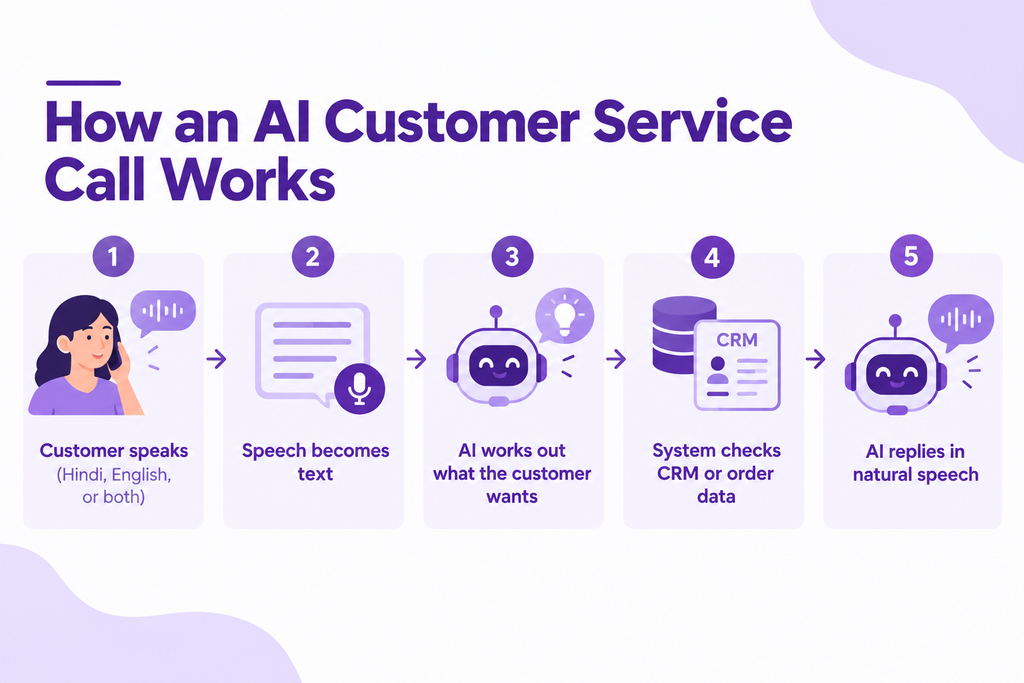
One example call shows the whole process. Imagine a customer phoning an online store and saying, in a mix of Hindi and English, that their order has not arrived.
First, speech recognition turns the audio into text, mixed languages included. Language understanding then works out that the customer wants an order status update and sounds a little frustrated.
Next, the system looks up the customer’s recent orders in the order system or CRM using their phone number, and finds that the parcel is running a day late. The AI replies aloud with the new delivery date and offers to send a tracking link, and text-to-speech turns that reply into natural speech.
Had the customer asked for a refund outside policy, or sounded upset, the AI would have passed the call to a human agent along with a summary of the conversation. Speed matters at every step, since long pauses make callers lose patience and hang up.
Benefits for Customers, Support Teams, and the Business
Businesses adopt conversational AI for customer service for different reasons, depending on who is asking.
Customers get an answer at any hour, without waiting on hold, and in a language they are comfortable with.
Support teams get routine questions off their queue. Agents spend more of the day on complex and sensitive cases, and answers stay consistent because every reply follows approved information.
The business sees a lower cost per contact, and it can handle sale days or billing peaks without hiring extra staff for a few busy hours.
What does real call data say about this? DialNexa’s Voice AI report, covering more than a million AI-assisted business calls, found that fewer than 3 percent of calls ended with the caller hanging up first, and that inbound AI calls reached an 89 percent goal completion rate.
Where Conversational AI Helps Most
Conversational AI for customer service earns its keep on questions that repeat all day. On inbound lines these include order and delivery status, account balances and due dates, appointment changes, and basic policy or eligibility questions.
Outbound calling is the other half. The same technology makes the calls teams rarely have time for, such as payment and EMI reminders (with a way to record a promise to pay or a dispute), appointment and renewal reminders, and follow-ups after a purchase or support case. This kind of contact center automation suits calls that are repetitive and made in large numbers.
Each industry uses it a little differently. A bank handles balance and due date queries, an online store handles order status and returns, a clinic handles appointment changes, and an education company handles admission questions.
Voice AI vs Traditional Automation
Many businesses already run a menu-based IVR or a rule-based chatbot, so a side-by-side comparison with conversational AI for customer service is the most practical way to see what changes.
| Area | IVR or Rule-Based Chatbot | Conversational AI |
|---|---|---|
| Understanding requests | Matches keywords or menu choices | Understands the meaning of what the customer says |
| Unexpected questions | Falls back to a menu or an agent | Asks follow-up questions and adapts |
| Language | A separate script for each language | Can follow language switches in the same call |
| Customer data | Rarely used during the conversation | Reads account details from the CRM |
| Best for | Simple menus and fixed FAQs | Open questions, reminders, and follow-ups |
The first two rows decide most outcomes. Traditional automation only works along paths someone built in advance, so anything unexpected sends the customer to an agent. Conversational AI works out what the customer means, so it resolves many more requests without help.
Multilingual Conversational AI in the Indian Context
Language is one of the biggest practical differences in India, so it deserves a closer look.
What happens when a caller mixes languages?
Callers in India often start in English, move to Hindi mid-sentence, and return to English for a number or a name. A good system follows these switches without asking the customer to start again. Platforms that only offer a language menu at the start of the call work well only when the customer stays in one language.
Which languages should a platform cover?
Strong Indian-language platforms usually cover English and Hindi, plus regional languages such as Tamil, Telugu, Kannada, Malayalam, Gujarati, and Marathi. The best test is how well each language works in live calls, rather than how long the list on a features page looks.
How can accuracy be checked?
Accents and regional speech vary a lot across the country, so accuracy needs checking on real audio. Reading ASR accuracy benchmarks is a useful first step, and running a pilot on recordings of the business’s own customers is even better.
What Enterprise Buyers Should Test Before Signing
Enterprise Voice AI India buyers rarely see answers to these in a demo, so they are worth testing directly when choosing conversational AI for customer service.
- Fit with the CRM and telephony setup already in use, since a gap in CRM and telephony integrations is often the slowest part of a rollout.
- Handling of customer data, call recordings, and audit logs, which this guide to enterprise voice AI compliance covers in more detail.
- How many calls the platform can run at once, and how fast it responds at that load.
- Whether pricing is published or only shared on a sales call.
- Whether a call moves to a human agent with the full context.
When a Human Should Take Over
AI is strongest on routine requests, and CMSWire notes that complex problem solving, emotionally sensitive situations, and negotiation often remain better suited to experienced human agents. Good setups plan for these moments in advance.
A transfer makes sense when a customer asks for a person, when they sound upset or the topic is emotional, when the issue involves a dispute, a complaint about charges, or a high-value refund, and when the AI has misunderstood the request more than once.
The handover itself should be smooth. The agent receives a short summary of the conversation, so the customer never has to explain the problem a second time.
Platforms Indian Businesses Can Choose From
Four kinds of platform offering conversational AI for customer service show up most often in India, and each starts from a different place.
| Type | What It Offers | Examples |
|---|---|---|
| Voice-first | Built around phone calls and Indian languages | DialNexa, SquadStack |
| Chat and voice suites | Several channels in one product | Haptik (owned by Reliance Jio), Kore.ai |
| Enterprise contact center | Large-scale contact center focus | Uniphore |
| Telephony-first | Cloud calling provider that added AI later | MyOperator |
DialNexa, for example, offers a voice AI platform with support for English, Hindi, and regional languages and pricing that starts at Rs 5 per minute, while SquadStack pairs AI voice agents with human telecalling backup.
For a wider view of the market, this list of conversational AI companies in India covers more names and how they differ.
Conclusion
Three questions settle most decisions about conversational AI for customer service. Does it follow the way customers actually speak, connect to the systems already in place, and hand over cleanly when a person is needed?
Teams that answer those well find that the technology fits into everyday contact center automation, taking repeat questions off the queue while agents focus on the cases that need judgment.
Teams that want to see this on real calls can try DialNexa with their own scripts and customer data before committing to a longer plan.
FAQs
1. What customer service tasks can conversational AI automate?
Conversational AI can automate order and delivery status, account and billing questions, appointment booking, common policy questions, and outbound reminders and follow-ups. Platforms such as DialNexa handle both inbound support and outbound calls, while complex or sensitive cases still go to human agents.
2. Can conversational AI answer phone calls?
Yes. Voice based conversational AI listens to the caller, understands the request, and replies aloud in natural speech. DialNexa answers and places phone calls this way and reports response times under one second at the 80th percentile, which keeps the conversation feeling natural.
3. Can it switch between Hindi and English during a call?
Good platforms can. They follow a caller who mixes Hindi and English in the same sentence without restarting. DialNexa supports English and Hindi along with Tamil, Telugu, Kannada, Malayalam, Gujarati, and Marathi. It is still best to test this on real call recordings.
4. When should an AI agent transfer a call to a human?
An AI agent should transfer a call when the customer asks for a person, sounds upset, raises a dispute or a high-value issue, or has been misunderstood more than once. The agent should receive a short summary so the customer does not need to repeat anything.
5. Can conversational AI work with existing CRM and contact-center systems?
Yes. Most platforms connect through APIs, SIP trunking, or ready-made integrations, so existing call routing and CRM records stay in place. DialNexa connects to existing CRMs and offers API and MCP access, letting teams add AI without replacing their current systems.
6. Which conversational AI platforms are available for businesses in India?
Businesses in India can choose from voice-first platforms such as DialNexa and SquadStack, chat and voice suites such as Haptik and Kore.ai, enterprise options such as Uniphore, and telephony-first providers such as MyOperator. The right one depends on languages, integrations, scale, and pricing.

Leave a Reply