
IVR System Cost in India: Pricing Models and TCO Guide
IVR system cost in India typically ranges from ₹999 to ₹1,00,000+ per month, depending on scale, with per-minute usage charges of ₹0.50 to ₹8 and one-time setup fees of ₹42,000 to ₹4,20,000 for CRM integrations. The budget can be materially higher once telecom usage, toll-free access, integrations, language support, maintenance, and human follow-up are included.
A low monthly plan can therefore be misleading. A basic cloud IVR may look inexpensive for a startup, but a growing BFSI, EdTech, healthcare, real estate, or e-commerce operation can quickly move into enterprise spending as call traffic and workflow complexity increase. The decision facing Indian CXOs isn't just which IVR licence costs less. It's whether the system produces the lowest cost per resolved interaction over its useful life.
Table of Contents
- IVR System Cost in India at a Glance
- Understanding IVR Pricing Models
- Key Cost Drivers That Inflate Your IVR Bill
- IVR Pricing Tiers for Indian Businesses
- When Cheap IVR Becomes the Expensive Option
- Calculating Your True Total Cost of Ownership
- Choosing the Right Voice Automation Strategy
IVR System Cost in India at a Glance
The most practical starting point is a range rather than a single price. Basic cloud IVR plans in India commonly begin at ₹600–₹1,500 per month, while SME deployments are often quoted at ₹2,500–₹8,000 per month. Enterprise contact centres can exceed ₹25,000 per month, and toll-free access may add ₹1,000–₹3,000 monthly to the base plan, as outlined in this India IVR pricing reference.
| Cost component | Indicative India benchmark | What it usually covers |
|---|---|---|
| Entry cloud IVR | ₹600–₹1,500/month | Basic routing and menus |
| SME IVR | ₹2,500–₹8,000/month | More routing, numbers, and usage |
| Enterprise contact centre | ₹25,000+/month | Advanced workflows and support |
| Toll-free access | ₹1,000–₹3,000/month extra | Toll-free service over the base plan |
| Core operating usage | ₹0.85–₹8/minute | Telecom and feature-dependent usage |
| CRM integration | ₹42,000–₹4,20,000 one time | Connector, configuration, and integration work |
The wider cost picture confirms why a subscription-only comparison often fails. India pricing references place core IVR operating charges between ₹0.85 and ₹8 per minute, with recurring monthly charges of roughly ₹1,700–₹25,000. One-time CRM integration can range from ₹42,000 to ₹4,20,000, while a full IVR purchase can range from ₹85,000 to ₹42,00,000, according to this detailed IVR pricing guide.
Why the first quote rarely equals the final bill
A quote can exclude recording, storage, multi-language support, maintenance, setup, or usage-based telecom fees. Recording may add ₹0.85–₹4 per minute, support and maintenance can add ₹8,500–₹85,000 per month, and multi-language capability may add ₹8,500–₹42,000 monthly in some configurations, based on the same pricing reference.
Cloud IVR generally offers the lower entry point, while traditional on-premise IVR carries greater upfront and maintenance obligations. For a CXO, the relevant question is therefore not “What is the monthly plan?” but “What will this workflow cost per completed or successfully transferred call?”
Teams assessing the functional differences between legacy menu systems and newer voice workflows can also review IVR software options. The sections below examine pricing structures, cost drivers, and the inflection point where a cheaper menu system can become more expensive than voice automation.
Understanding IVR Pricing Models
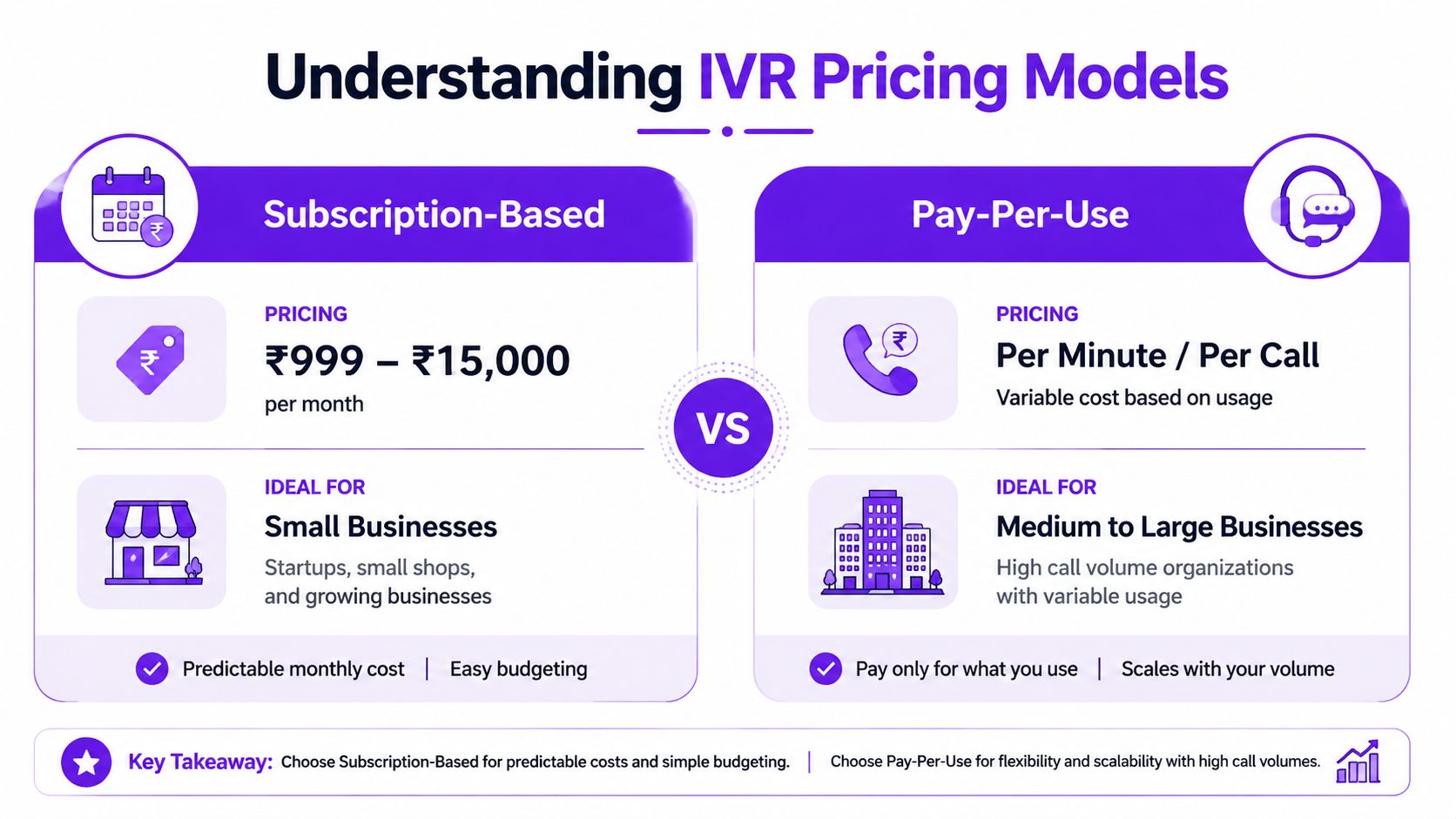
Indian IVR contracts usually combine one or more of four commercial structures. The right model depends on whether call traffic is stable, seasonal, agent-assisted, or heavily automated.
Subscription-based pricing
A fixed monthly subscription provides budget predictability. SME plans can sit within the broader range of ₹999–₹15,000 per month, while enterprise deployments may reach ₹25,000–₹1,00,000+ per month, depending on routing, analytics, support, and integrations. Public India pricing references support the lower cloud entry bands and higher enterprise tiers, but the exact commercial quote depends on the vendor and configuration.
This model suits a business with recurring demand, such as a bank handling regular service calls or an EdTech company managing admissions enquiries throughout the year. It can also make sense for an organisation that needs consistent access to call flows, dashboards, and support, even when monthly traffic fluctuates.
Per-minute pricing
Usage-based billing ties spend directly to call activity. Indian references show charges from ₹0.50 per minute for certain incoming calls answered by agents, while broader IVR operating costs can range from ₹0.85 to ₹8 per minute, depending on features and architecture. The published IVR pricing information illustrates how a low per-minute charge can still become significant when call duration and volume rise.
Startups and businesses with uncertain demand often benefit from this structure because they don't pay for unused capacity. The trade-off is exposure to seasonal spikes, long conversations, repeat calls, and recording or storage add-ons.
One-time setup and integration fees
Setup costs cover configuration, call-flow design, CRM work, API connections, testing, and deployment. CRM integration references place one-time costs between ₹42,000 and ₹4,20,000, while complete IVR purchases can carry much higher upfront costs.
A simple routing tree may require limited professional services. A BFSI workflow that authenticates callers, retrieves account information, records interactions, and transfers context to a CRM demands far more implementation work.
Hybrid pricing
Hybrid plans combine a base subscription with usage charges. They're often the most realistic structure for mid-market and enterprise deployments because the platform remains available while telecom consumption tracks actual activity.
Before signing, ask vendors to separate:
- Platform fees: Licence, dashboards, user access, and support.
- Telephony fees: Incoming minutes, outbound minutes, DID rental, and toll-free access.
- Implementation fees: Flow design, integrations, testing, and migration.
- Change fees: New menus, language prompts, routing updates, and API modifications.
Volume negotiations should focus on the complete billing stack rather than only the licence. Ask for committed-volume discounts, an annual commitment reduction, clear overage rates, and written treatment of unused minutes. Businesses evaluating adjacent voice productivity tools can also see AIDictation subscription costs, while teams comparing broader telephony architectures may find this guide to cloud telephony providers useful.
Key Cost Drivers That Inflate Your IVR Bill
The largest IVR overruns rarely come from the advertised entry plan. They arise when a simple routing product is expanded into an operating system for customer service.
Architecture depth
A single-level IVR can be bundled at a low or even zero setup cost in some cloud plans. Multi-level routing adds roughly ₹500–₹3,000 one time plus ₹500–₹1,500 per month in hosting in some Indian pricing models, according to this cloud telephony pricing analysis.
Every additional menu layer creates more prompts to maintain, more failure paths to test, and more opportunities for callers to abandon the journey. A short flow for store hours or order status is financially different from a heavily branched workflow that validates identity, checks eligibility, retrieves records, and hands off to a specialist.
Integration complexity
CRM and backend integration often becomes the largest one-time line item. Connecting Salesforce, Zoho, a loan management system, an admissions platform, or an order-management database requires more than attaching a phone number. The integration must handle authentication, data retrieval, error states, permissions, and the information an agent receives after transfer.
A CXO should ask whether the quoted integration includes testing, documentation, security review, and post-launch changes. A low implementation quote that excludes these activities can move the cost into internal engineering time.
Language and voice requirements
Multi-language support affects prompt recording, speech recognition, testing, and ongoing updates. The India pricing reference cited earlier indicates that multi-language support can add ₹8,500–₹42,000 monthly in some deployments.
The cost isn't limited to translation. A bank or healthcare provider must also verify that prompts are accurate, natural, compliant, and understandable across the customer base. Every policy change then needs to be reflected consistently across supported languages.
Recording, storage, and maintenance
Recording may add ₹0.85–₹4 per minute, while storage, retention, access controls, and retrieval create additional operational obligations. Support and maintenance can add ₹8,500–₹85,000 per month, particularly where the vendor manages complex flows or integrations.
Architecture complexity also affects agent economics. Mainstream contact-centre platforms in India commonly range from ₹1,499–₹3,599 per agent per month, making agent handoff design a budget decision rather than just a customer-experience choice.
For organisations comparing number management and routing infrastructure, a practical reference on virtual numbers in India can help separate number rental from the broader IVR platform bill.
IVR Pricing Tiers for Indian Businesses
Indian businesses generally fall into three practical buying bands. These are budgeting categories, not universal vendor packages. Actual prices vary according to usage, features, integration scope, and contract terms.
| Tier | Monthly Cost (₹) | Per-Minute Charge (₹) | Call Volume | Key Features | Typical Vendors |
|---|---|---|---|---|---|
| Startup | ₹999–₹4,999 | ₹0.50–₹2 | Lower and variable demand | Basic routing, greetings, limited workflows | MyOperator, entry cloud plans |
| SME | ₹5,000–₹25,000 | ₹0.50–₹8 | Regular multi-team demand | Multi-level menus, integrations, analytics | Exotel, Knowlarity, MyOperator |
| Enterprise | ₹25,000–₹1,00,000+ | Usage dependent | High-volume, complex operations | Advanced speech, APIs, support, workflow controls | Genesys, Twilio, Exotel, Knowlarity |
The entry tier works when the requirement is narrow: route calls to a small team, provide business information, or direct customers to a department. A startup shouldn't buy a full contact-centre stack because it has an enterprise feature list.
The SME tier becomes more relevant when the IVR must connect to a CRM, support several departments, manage more complex routing, or provide reporting for operations managers. At this point, configuration quality matters as much as the monthly plan. A poorly designed menu can create repeat calls that erase the apparent saving.
Enterprise deployments require procurement discipline. Advanced workflows can involve speech recognition, API integrations, dedicated support, compliance controls, and multiple operating teams. The platform fee is only one component, and the final invoice may include usage, storage, support, integrations, and change requests.
Sticker price versus operational spend
A vendor comparison should record the following beside every quote:
- Included usage: Minutes, calls, numbers, and recording.
- Overage treatment: Per-minute charges after the allowance is exhausted.
- Feature exclusions: Languages, analytics, APIs, and agent handoff.
- Support scope: Response commitments, implementation assistance, and maintenance.
- Exit terms: Data access, number portability, and migration support.
A business comparing Exotel pricing can use this Exotel pricing overview as a starting point, but it should still request a quote mapped to actual call patterns. Global platforms such as Twilio and Genesys may offer flexibility, yet their consumption and implementation models can make the total bill harder to estimate without a workload model.
When Cheap IVR Becomes the Expensive Option
The cheapest IVR plan can be the most expensive operating decision when it fails to resolve the customer's reason for calling. A keypad menu may route calls efficiently, but routing isn't resolution. Every unresolved interaction moves cost to an agent, a repeat call, or both.
The India-focused comparison between AI voice agents and human-handled calls places AI-agent costs at about ₹4.7–₹7.1 per call, compared with ₹29.5–₹35.4 for a human-handled call, implying a 75%–85% reduction versus manual handling in that estimate, as described in this India voice AI analysis. These figures don't mean every call should be automated. They show why CXOs must compare the cost of an automated outcome with the cost of a human follow-up.
The hidden bill sits after the IVR
Consider a mid-market operation with rising inbound demand. A low-cost IVR might carry a small subscription, but if it only identifies the department and then transfers most callers, the organisation still pays for agent handling. Customers who abandon or call back add further pressure, while supervisors manage queues, escalations, and repeated explanations.
The operational consequences are qualitative but material:
- Agent capacity: Repetitive calls consume time that could serve complex cases.
- Queue pressure: Weak routing sends customers to the wrong team.
- Repeat demand: Customers call again when the first interaction doesn't resolve the issue.
- Service quality: Agents receive incomplete context and must restart discovery.
- Management overhead: Leaders spend time explaining queue growth instead of improving resolution.
The inflection point is workload-specific
There isn't a universal call-volume threshold at which AI becomes cheaper. The crossover depends on call duration, containment, integration depth, agent cost, and the value of a successful resolution. A voice automation system with a higher usage rate can still produce a lower total cost if it resolves more interactions without human follow-up.
For a practical evaluation, calculate the cost per resolution under three scenarios: basic IVR, IVR with stronger self-service, and an AI voice agent. Change the assumed containment rate and agent handoff rate, then test seasonal peaks separately. The right answer may be a blended design, where deterministic IVR handles authentication and routing while conversational automation handles repetitive enquiries.
An explanatory view of the transition from menu-based routing to intelligent voice workflows is also provided below.
Calculating Your True Total Cost of Ownership
A credible IVR business case needs five cost layers. Calculate them separately first, then combine them into a monthly operating view.
- Platform licensing: Include the subscription, user access, dashboards, routing features, and support package.
- Telephony usage: Add incoming and outgoing minutes, DID rental, toll-free access, and any usage-based charges.
- Implementation: Include call-flow design, CRM integration, API work, testing, and deployment. Amortise one-time setup across the period you expect the system to remain in service.
- Maintenance: Budget for prompt changes, flow updates, language revisions, vendor support, recording administration, and troubleshooting.
- Unresolved demand: Multiply calls that still require an agent by the internal or outsourced cost of handling each call.
The core formula is:
TCO = Platform Cost + (Minutes × Per-Minute Rate) + (Setup ÷ Amortisation Months) + ((Total Calls × (1 − Containment Rate)) × Agent Cost Per Call)
Apply the formula consistently
Suppose an e-commerce operation models 25,000 calls per month, a ₹15,000 monthly IVR, 40% containment, and a ₹30 average agent cost per call. The resulting downstream agent workload is 15,000 calls, creating ₹4,50,000 in agent-handling cost. Adding the platform fee produces a monthly TCO of ₹4,65,000 before telephony charges and setup amortisation.
That example exposes the central budgeting error. The platform's visible price is ₹15,000, but the unresolved-call layer is thirty times the platform fee in this model. The calculation isn't a prediction for every company. It's a disciplined way to identify where the money goes.
Run sensitivity analysis by changing one variable at a time:
- Containment: Test what happens when more routine calls finish without an agent.
- Duration: Model longer calls separately from short authentication or status calls.
- Usage: Apply seasonal call patterns instead of using only an average month.
- Integration: Add one-time setup and recurring maintenance explicitly.
- Failure demand: Track repeat calls caused by unresolved first interactions.
A wider technology TCO review can also include cloud hosting cost efficiency, particularly when data, integrations, storage, and analytics sit across multiple services. For operational readiness, document the hardware and software requirements before comparing vendor proposals.
Choosing the Right Voice Automation Strategy
The decision should follow the workload, not the sales category.
Choose basic cloud IVR for narrow workflows
Start with cloud IVR when call routing is simple, traffic is modest, and the business needs a professional phone layer without deep backend actions. Typical use cases include department routing, business information, appointment instructions, or basic queue handling. Keep the flow short and give customers a clear path to a human when automation can't resolve the request.
Choose enterprise IVR for controlled complexity
Enterprise IVR fits organisations that need structured authentication, CRM integration, analytics, multi-language prompts, recording controls, and coordinated agent handoffs. Banks, insurers, hospitals, and large service teams often need deterministic controls around sensitive workflows, even when they later add conversational automation.
Choose AI voice agents for repetitive, high-volume work
AI voice agents become more compelling when the organisation has a large volume of repetitive conversations and can connect automation to the systems required to complete those tasks. The decision shouldn't rest on novelty. It should rest on measured containment, reliable escalation, transparent usage pricing, and a clear cost per successful outcome.
A useful evaluation sequence is:
- Audit calls: Group inbound and outbound conversations by reason, duration, outcome, and handoff.
- Map containment opportunities: Identify requests that can be answered or completed without an agent.
- Select one workflow: Start with a high-volume, well-defined use case.
- Run a pilot: Compare resolution, transfer quality, repeat demand, and total cost.
- Review the 24–36-month view: Include implementation, maintenance, usage, and labour effects.
Teams that need specialist support for adjacent conversational automation can evaluate options to hire an AI chatbot developer, especially where voice and chat workflows share CRM logic.
For Indian organisations assessing voice automation across BFSI, EdTech, real estate, healthcare, hospitality, e-commerce, and software, DialNexa Labs Private Limited offers custom Voice AI agents for qualification, support, recruitment, presales, reminders, and workflow-specific conversations. Visit DialNexa Labs Private Limited to review the platform, map your call economics, and discuss a deployment based on total cost of ownership rather than the headline IVR subscription.

This is a helpful guide to understanding IVR system costs, pricing models, and total cost of ownership in India. The clear breakdown makes it easier for businesses to evaluate IVR solutions and plan their communication budgets effectively.
This is a detailed and practical guide that clearly breaks down IVR costs in India, including subscriptions, usage charges, integrations, and hidden expenses.
The focus on total cost of ownership and cost per resolved interaction makes the article especially useful for businesses comparing IVR solutions.
This is a useful and detailed breakdown of IVR system costs, especially how pricing changes with usage, integrations, languages, and business scale. The focus on total cost of ownership helps businesses look beyond the initial monthly subscription when evaluating IVR solutions.
This is a helpful guide for businesses evaluating IVR solutions in India. The clear breakdown of pricing models and total cost of ownership makes it easier to compare options, plan budgets, and choose a cost-effective IVR system.
A clear and informative guide explaining the differences between AI voice agents, chatbots, and traditional IVR systems, along with their practical business applications. The balanced discussion of benefits, limitations, and real-world use cases makes this article especially valuable for businesses exploring AI-powered customer communication.