
Urdu Text to Speech: A CXO’s Guide to Implementation
Over 50 million people in India speak Urdu, according to the 2011 Census reference discussed here. That single fact changes how a CXO should think about voice automation. Urdu text to speech isn't a niche accessibility feature. It's a market-access layer for outreach, onboarding, support, collections, reminders, and learning delivery.
In India, the companies that win voice channels don't just automate calls. They match language, tone, script handling, and trust cues to the customer segment. That's especially true in EdTech, BFSI, real estate, healthcare, and citizen-facing services, where comprehension directly affects completion, conversion, and compliance.
Table of Contents
- The Strategic Imperative for Urdu Voice AI
- Why Urdu TTS Is a Revenue Driver Not a Cost Centre
- Navigating Key Urdu Linguistic and Technical Challenges
- Choosing the Right Urdu TTS Engine for Your Business
- Practical Integration and Voice Persona Tuning with SSML
- From Deployment to Dominance Your Urdu Voice Strategy
The Strategic Imperative for Urdu Voice AI
A business leader looking at India can't treat Urdu as an edge case. Urdu is spoken by over 50 million people in India according to the 2011 Census reference, with strong presence across Uttar Pradesh, Bihar, Jharkhand, Telangana, and West Bengal. For any company selling into households, students, traders, patients, or small business owners, that means a large addressable audience already exists. The constraint is often not demand. It's language fit.
Voice becomes especially important when the customer journey includes low-literacy moments, time-sensitive decisions, or mobile-first behaviour. A lead may ignore a text-heavy workflow but respond to a familiar spoken reminder. A student may skim English instructions and miss a key step, but complete the task when the same content is read aloud in Urdu. A borrower may trust a repayment reminder more when it sounds locally intelligible instead of imported and mechanical.
Where CXOs should focus first
The strongest use cases are usually operational, not experimental:
- Lead follow-up: Real estate and admissions teams can qualify inbound demand faster with spoken outreach in the customer's preferred language.
- Instruction delivery: EdTech teams can read course prompts, test guidance, and activation messages aloud.
- Service consistency: BFSI and support operations can standardise disclosures, reminders, and menu guidance across regions.
The strategic point is simple. When language is a barrier, automation underperforms. When language matches the customer's comfort zone, automation starts behaving like distribution.
For leaders comparing menu-based telephony with more conversational systems, this IVR and AI receptionist comparison is useful because it frames the decision around customer experience and operational design, not just telephony features. The same logic applies to Urdu voice journeys in India.
Teams also need to think beyond a standalone TTS widget and evaluate how voice fits into a broader stack. A practical benchmark for that evaluation is this guide to the best voice AI platform in India, particularly if the organisation plans to connect TTS with outbound campaigns, routing, CRM events, or support workflows.
Urdu voice adoption isn't just about sounding local. It's about removing friction where revenue depends on understanding.
Why Urdu TTS Is a Revenue Driver Not a Cost Centre
The common budgeting mistake is to file Urdu text to speech under “localisation overhead”. In practice, it often behaves more like an efficiency layer across revenue operations. It can widen reachable segments, lower dependency on live agents for repetitive calls, and improve message consistency in customer-facing flows.
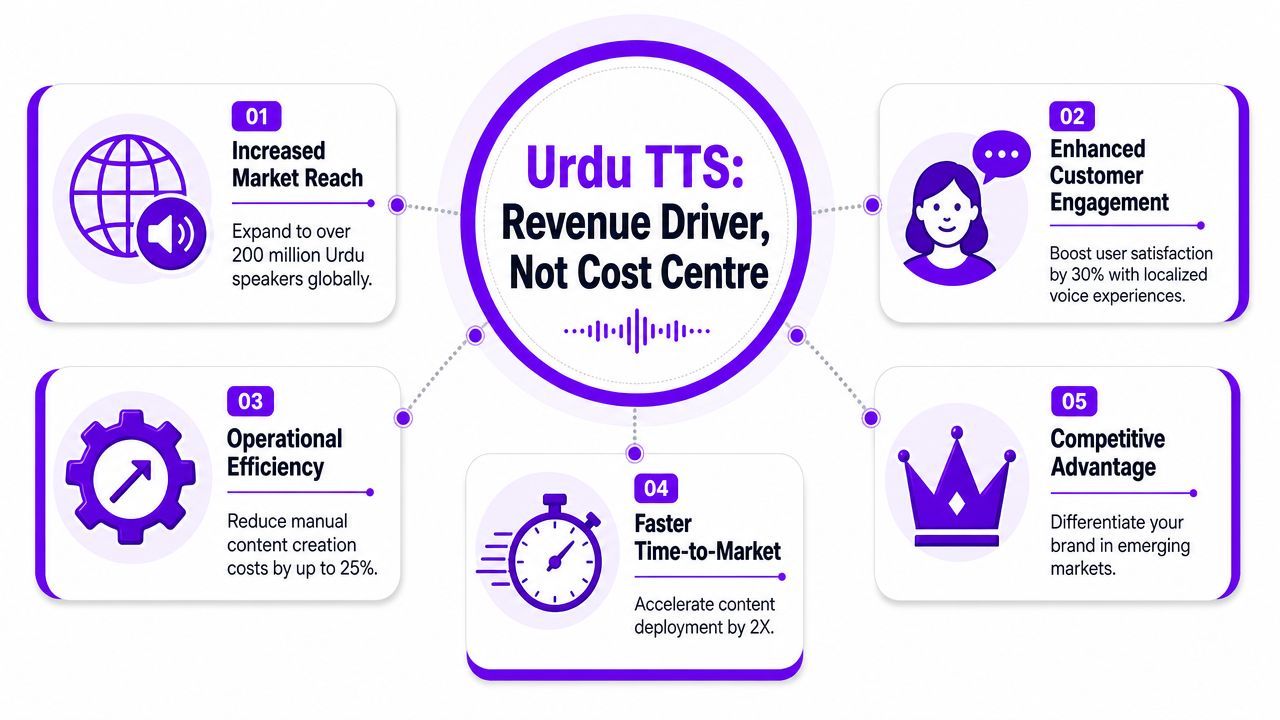
That matters because Indian buyers don't experience voice automation as a back-office technology choice. They experience it as clarity or confusion. If an education platform reads exam instructions in Urdu, comprehension can improve for students who wouldn't reliably process the same content in English. If a BFSI team sends repayment or KYC reminders in Urdu, the interaction becomes more inclusive for customers who prefer vernacular communication.
Revenue impact shows up in multiple places
A strong Urdu TTS rollout usually improves commercial performance through several paths:
- Broader funnel coverage: More prospects can understand first-contact outreach.
- Lower service cost: Routine reminders, FAQs, and notifications move from human effort to automated voice.
- Better compliance delivery: Standardised spoken scripts reduce variation in critical disclosures.
- Higher trust at first touch: Familiar language lowers the perceived distance between brand and customer.
- Faster campaign execution: Marketing and operations teams can update scripts without retraining every caller.
The policy environment also supports this direction. The adoption of multilingual public grievance and voice-enabled service expectations in India signals that speech access is increasingly aligned with digital inclusion and accessibility norms. For a CXO, that makes Urdu-capable voice systems more than a convenience. They support trust, inclusion, and future-facing service design.
Where the return becomes visible
Different functions will see value in different ways.
| Team | Likely Urdu TTS benefit | Practical example |
|---|---|---|
| Sales | Better initial connect quality | Property enquiry follow-up in Urdu rather than English-first scripts |
| Support | Lower repetitive call load | Read-outs for account steps, policy reminders, or ticket updates |
| EdTech operations | Better learner comprehension | Spoken onboarding, class reminders, and exam instructions |
| Compliance | More consistent disclosures | Uniform policy wording across outbound calls and IVR paths |
Commercial lens: If a language layer lets you serve more people with the same operations team, it's not a cost centre.
There's another often-missed benefit. Urdu TTS reduces dependence on the availability and quality variance of multilingual human callers for every repetitive interaction. Human agents should handle objections, escalations, and nuanced support. They shouldn't be spending most of their day reading the same reminder script.
For leadership teams, the right question isn't “Can we afford Urdu voice?” It's “Where are we losing conversions, continuity, or service quality because we still expect text or English-first voice flows to do all the work?”
Navigating Key Urdu Linguistic and Technical Challenges
Urdu TTS fails when teams assume language support on a product page equals production readiness. It doesn't. Urdu in India brings script, phonetic, and register complexity that generic multilingual engines often handle badly.

A technically credible implementation starts with the fact that Urdu is phonetically and prosodically demanding. Research from the Centre for Language Engineering noted that the language is rich in retroflex consonants and Urdu-specific diphthongs, and that high intelligibility, around 96% in controlled conditions, depends on models trained on relevant data in the right context, as discussed in this Urdu TTS comparison study. That isn't an academic footnote. It explains why some systems sound fluent in demos and unreliable in live customer journeys.
Script support is only the first hurdle
Many teams begin by asking whether a tool supports Urdu script. That's necessary, but it's a shallow test.
Production Urdu TTS in India has to manage:
- Right-to-left text handling: Input pipelines, rendering layers, and CMS workflows must preserve script integrity.
- Pronunciation fidelity: Names, loanwords, and compound terms can't be flattened into generic multilingual phonemes.
- Prosody control: A sentence may be technically correct and still sound unnatural if stress and pause patterns are off.
- List reading behaviour: Financial figures, dates, addresses, and policy clauses need careful pacing.
A lot of TTS evaluation misses these cases because the tests are too clean. Real customer content contains abbreviations, mixed numerals, city names, product terms, and partial transliteration.
Code-mixing is where weak systems break
In Indian customer operations, Urdu is rarely isolated. It blends with Hindi and English constantly. That's true in support calls, fee reminders, trading notifications, app onboarding, and admissions counselling. Existing Urdu TTS marketing material rarely explains how engines handle this code-mixing well.
That gap matters because a model can sound competent on monolingual prompts and still struggle with intra-sentence switching. A phrase that blends Urdu sentence structure with Hindi vocabulary or English product terminology needs a front-end that understands how those elements should be normalised and pronounced.
If your product team needs a simple primer on the broader mechanics behind language understanding, this overview of how AI understands human language is a useful grounding resource before diving into speech-specific tuning.
Most enterprise TTS problems are front-end problems first. Text normalisation, script decisions, and pronunciation rules usually break before the acoustic model does.
Data quality decides whether custom work is viable
For organisations considering a custom or fine-tuned system, publicly available corpora have made experimentation more practical. One notable example is the 20,000-file Urdu dataset on Kaggle, released in 2023 by Muhammad Ahmed Ansari. It includes 20,000 audio files paired with Urdu transcriptions, sampled at 16 kHz, covering roughly 10 to 15 hours of speech depending on utterance length.
That kind of corpus helps teams de-risk data acquisition, especially for supervised training and evaluation. But it doesn't remove the need for domain-specific testing. A general corpus can support baseline quality. It won't automatically teach a model how your customers say neighbourhood names, policy terms, or mixed Hindi-English-Urdu prompts.
Choosing the Right Urdu TTS Engine for Your Business
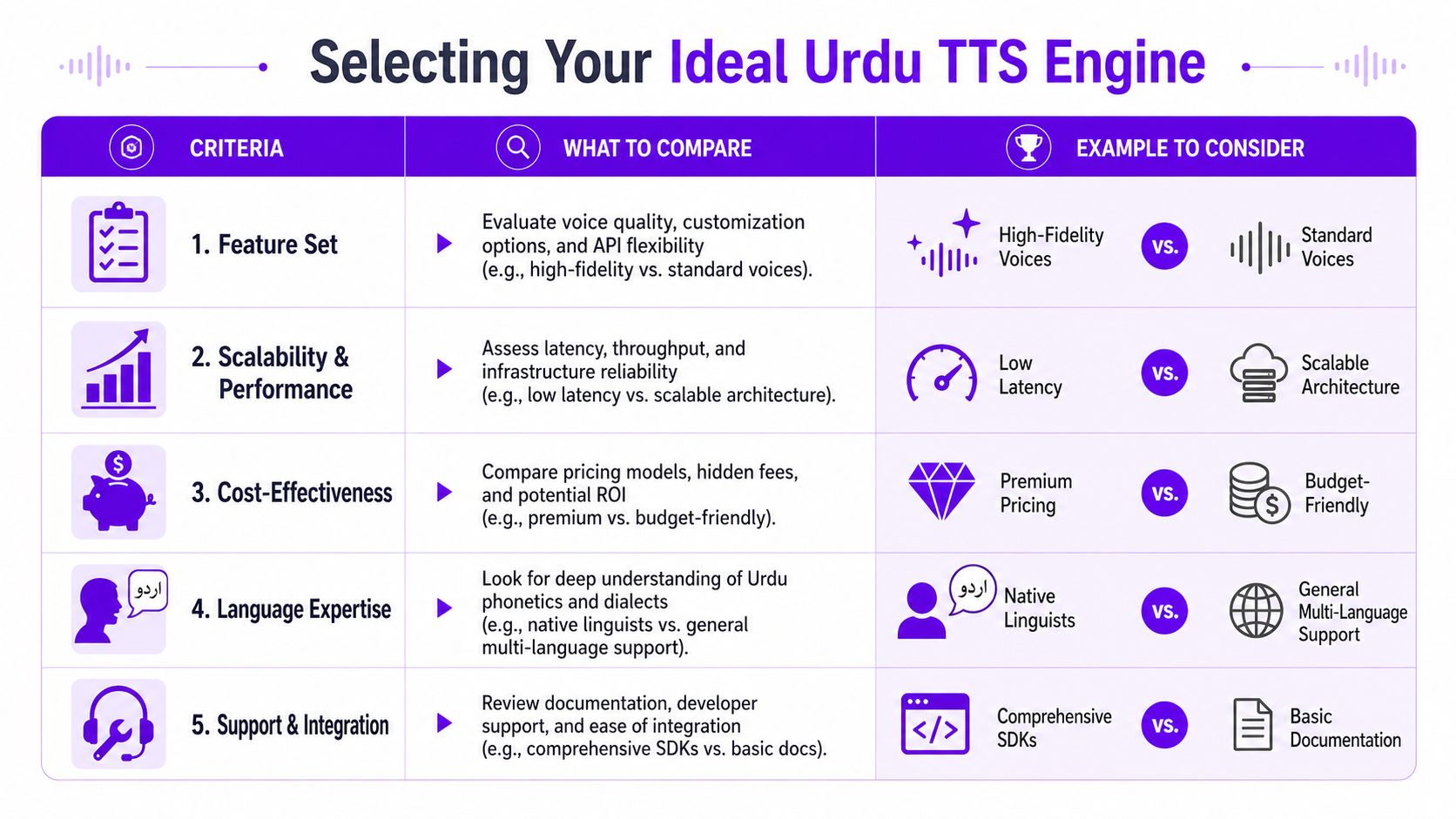
Most businesses end up choosing between three paths. Use a major cloud API, buy from a specialist voice AI platform, or build a custom stack. The right answer depends less on headline features and more on how much control you need over language quality, scaling, compliance, and iteration speed.
Option one for fast deployment
Major cloud tools are often the quickest route to a pilot. Android-based ecosystems already expose Urdu as a selectable language, including device-level usage patterns in India, as illustrated by this Urdu TTS setup walkthrough for Android. That matters because enterprise voice workflows don't always need to introduce a new behavioural model to users. Sometimes they need to fit into an environment where Urdu TTS already feels normal.
Cloud APIs are strongest when you need:
- Speed: Launch a proof of concept without building speech infrastructure.
- Basic coverage: Support standard prompts, notifications, or read-aloud experiences.
- Developer convenience: Standard APIs, documentation, and managed uptime.
They become weaker when pronunciation control, regional variation, or code-mixed dialogue quality starts affecting business outcomes.
Option two for operational voice workflows
Specialist platforms are usually a better fit when TTS is part of a larger voice operation rather than a standalone read-aloud feature. That includes outbound qualification, appointment booking, fee reminders, collections, trading support, and support deflection. In those environments, the TTS layer must work with conversation logic, call routing, analytics, CRM triggers, and persona tuning.
A useful way to think about these platforms is that they aren't selling speech output alone. They are selling speech as part of a business process. That's a very different procurement decision.
For teams benchmarking provider architecture and API depth, this enterprise-focused guide on the ElevenLabs API for enterprise AI offers a practical lens on the integration questions that matter at scale.
Option three for maximum control
Custom builds make sense only when Urdu voice is strategically central and the company can support ongoing speech engineering. That usually means one or more of the following are true:
- Brand voice is highly differentiated
- Compliance wording needs unusually tight control
- The business relies on complex domain vocabulary
- The target audience uses a specific regional register
- Call volume justifies deeper optimisation over time
For this route, model architecture matters. Research focused on low-resource Urdu and Punjabi TTS found that for the Indian context, end-to-end architectures like Tacotron-2 achieved lower Word Error Rates than generic multilingual models, and that using a native Shahmukhi script model is critical to preserving intelligibility, especially for compound Urdu words in customer-service dialogue, as detailed in this Interspeech paper on Urdu and Punjabi TTS.
That finding has direct buying implications. If a vendor's Urdu quality depends heavily on transliteration layers or generic multilingual fallback, expect mistakes in compound words, inflections, and mixed-register phrases.
Selection rule: If your customer hears the voice before they see the interface, naturalness and intelligibility aren't cosmetic. They are product quality.
A practical comparison framework
| Option | Best for | Main strength | Main risk |
|---|---|---|---|
| Cloud API | Quick pilots and standard prompts | Fast setup and managed infrastructure | Limited regional tuning |
| Specialist voice platform | Revenue and support workflows | Better orchestration and business integration | Vendor evaluation becomes more important |
| Custom model | Strategic language ownership | Maximum control over voice and pronunciation | Higher build and maintenance burden |
Before procurement, ask every vendor to synthesise the same test set. Include names, addresses, mixed Hindi-Urdu phrases, numerals, English product terms, and compliance language. If you'd like a simple external benchmark of what a basic web experience to generate speech from text looks like, that's useful for contrast, but enterprise selection should go far beyond web-demo quality.
Practical Integration and Voice Persona Tuning with SSML
Once the engine is chosen, implementation quality depends on text preparation and persona control. Many companies often waste time at this stage. They focus on API connectivity and ignore how the voice should behave in the context of a customer journey.
Start with the workflow, not the voice demo
For CXO-level deployment, the cleanest integration pattern is event-driven:
- CRM or app event triggers a call or audio generation task.
- A text-preparation layer normalises names, numbers, dates, and product terms.
- SSML applies pacing, pronunciation hints, and emphasis rules.
- The TTS engine generates speech.
- Analytics record completion, fallback, and escalation behaviour.
That middle layer matters most. Raw text rarely belongs in production speech. Your system should decide whether “A/C”, “KYC”, “₹”, dates, or account fragments are spoken as letters, words, or grouped numbers.
A simplified API pattern might look like this:
payload = {
    "voice": "urdu_india_female_1",
    "format": "mp3",
    "input": {
        "type": "ssml",
        "text": """
        <speak>
          <prosody rate="90%">
            Assalaam alaikum. Aap ki fee reminder tayyar hai.
            <break time="400ms"/>
            Bara-e-karam aaj hi payment status check kijiye.
          </prosody>
        </speak>
        """
    }
}
The code isn't the hard part. The hard part is deciding what “90% rate” means for a first-time learner, a borrower in a collections flow, or a patient confirming an appointment.
Tune register before you tune pitch
The most valuable voice decision is often not male versus female, or premium versus standard. It's register. Formal Urdu may sound polished but distant. A hybrid Urdu-Hindi delivery may feel more usable in many Indian service journeys.
Voice persona heavily impacts caller trust, and many Indian learners and rural customers respond better to slower, slightly colloquial Urdu-Hindi hybrids than to polished broadcast-style voices. Most demos don't publish meaningful A/B data on these register differences in BFSI, real estate, or EdTech, which leaves teams to discover the issue during rollout.
Use SSML and text conventions to shape that behaviour:
- Pacing controls: Slow down policy clauses, payment instructions, and exam guidance.
- Pause placement: Insert short breaks before deadlines, amounts, or next steps.
- Pronunciation overrides: Lock the spoken form of brand names, localities, and programme titles.
- Emphasis sparingly: Highlight only the action, not every noun in the sentence.
- Variant scripts: Maintain separate prompt sets for formal support, sales outreach, and instructional content.
For teams designing that tonal layer in depth, this guide on AI voice tone tuning is a useful operational reference.
A good Urdu voice doesn't try to impress. It tries to be understood on the first listen.
Build a test set that reflects your business
Don't validate Urdu TTS with generic sample lines. Build a script pack from your actual operation.
Include content like:
- Admissions lines: Course names, deadlines, payment options, scholarship terms
- BFSI wording: KYC prompts, due dates, masked account references, compliance disclosures
- Real estate phrasing: Project names, site-visit slots, landmark descriptions, budget ranges
- Healthcare prompts: Appointment windows, doctor names, fasting instructions, follow-up reminders
Then review outputs with people who understand the target audience, not just the product. A linguist, a QA lead, and an operations manager will catch different failures. One hears phonetic distortion. Another hears policy risk. Another hears whether a customer would hang up.
Know what doesn't work
Several patterns fail repeatedly in production:
- Literal transliteration pipelines: They often degrade compound Urdu words and mixed speech.
- One-voice-for-everything strategy: Sales, compliance, reminders, and support need different pacing and warmth.
- English-first script authoring: Teams write English prompts and “convert later”, which usually produces awkward rhythm.
- No exception dictionary: Proper nouns and local names drift quickly without a pronunciation list.
The brands that get Urdu text to speech right treat it like conversation design, not file generation.
From Deployment to Dominance Your Urdu Voice Strategy
The difference between a pilot and a durable voice advantage is operating discipline. Once Urdu TTS goes live, the work shifts from synthesis quality alone to business governance. You need a review loop that combines technical evaluation with commercial outcomes.
Measure both speech quality and business effect
The technical side should watch intelligibility, failure cases, script handling, and pronunciation consistency. Depending on your stack, that may include Word Error Rate comparisons, listening reviews, and defect tagging for names, numerals, and code-mixed lines.
The business side should focus on whether the voice journey changes customer behaviour. Review:
- Completion patterns: Do customers stay through the important part of the call?
- Escalation behaviour: Which prompts trigger live-agent transfer?
- Journey drop-off: Where do people disengage or repeat menu choices?
- Segment fit: Does the same register work equally well for urban and rural audiences?
Scale with controls, not just volume
As deployments grow, operational hygiene becomes more important than model novelty.
A practical governance model includes:
| Area | What to monitor |
|---|---|
| Prompt library | Versioning, approvals, and retirement of outdated scripts |
| Linguistic QA | Pronunciation drift, mixed-language errors, register mismatch |
| Compliance review | Mandatory wording, disclosure ordering, escalation paths |
| Campaign analytics | Outcome by audience segment, use case, and script variant |
The best Urdu voice strategy is iterative. Launch, review, adjust, and keep tightening the language-to-outcome link.
There's also a strategic timing point. National digital inclusion trends and broader comfort with voice-enabled interfaces mean the window for differentiation won't stay open forever. Early movers get the benefit of learning before competitors standardise the same playbook.
For a CXO, the takeaway is straightforward. Urdu text to speech should be evaluated the same way you'd evaluate a new distribution channel or a service-capacity investment. It expands who you can serve, how consistently you can serve them, and how efficiently you can do it. In India, that's not a localisation detail. It's an execution advantage.
DialNexa Labs Private Limited helps organisations turn voice AI into a working business system rather than a disconnected demo. If your team is evaluating Urdu outreach for admissions, BFSI support, real estate qualification, e-commerce service, or patient communication, DialNexa can help you design the right voice workflow, tune the right persona, and scale deployment with operational control.

Great insights on how Urdu TTS can move beyond localization and become a real business growth driver. The focus on language accessibility, customer trust, and operational efficiency makes this a valuable guide for organizations building inclusive, scalable voice experiences.
Framing Urdu voice as a market-access tool rather than an accessibility feature completely shifts the business case in India. We noticed immediate improvements in customer support workflows where spoken prompts replaced text instructions that users were routinely skipping.
This is a strong and practical perspective on how Urdu TTS can improve customer reach, engagement, and operational efficiency. The focus on natural language, code-mixing, and voice quality makes the business case especially compelling.
This is a well-explained guide to how Urdu TTS can improve customer communication, accessibility, and operational efficiency. The practical use cases and focus on voice quality, integration, and business outcomes make the topic especially valuable.
A valuable overview of how Urdu TTS can improve customer accessibility, operational efficiency, and engagement across diverse Indian markets. The focus on linguistic challenges, code-mixing, engine selection, and practical integration makes this especially useful for businesses planning multilingual voice solutions.