
10 Best Voice AI Platform in India: A CXO’s Guide 2026
Voice AI has moved from an experimental channel to an operating priority for Indian enterprises, with boards now assessing whether it can reduce service cost, increase contactability, and support regulated customer interactions at production scale. That shift raises the real question buyers should be asking: which is the best voice AI platform in India for their specific operating conditions, not which vendor gives the strongest demo.
India’s 22 scheduled languages and hundreds of dialects make this harder than in most markets. A platform has to hold up on multilingual conversations, variable call quality, high concurrent volumes, complex CRM workflows, and compliance requirements that get far stricter in sectors like BFSI. This guide evaluates each platform through that lens: scalability, implementation complexity, compliance posture, integration depth, and commercial outcomes by industry.
TL;DR
- The biggest difference between these platforms is their purpose. Some are built for one specific job, like collections or lead qualification, while others are designed to manage customer conversations across the entire business.
- If you need Voice AI for collections, KYC, admissions, or lead qualification, DialNexa is one of the strongest options.
- If you’re looking for an enterprise-wide conversational AI platform, Uniphore, Yellow.ai, and Kore.ai are better suited. For speech recognition and Indian language support, Gnani.ai, Mihup, and Rezo.ai are worth considering.
- Most Voice AI platforms don’t publish their pricing. Since you’ll usually need a custom quote, compare deployment time, implementation effort, and ongoing costs—not just the license price.
- If you’re in banking, financial services, or another regulated industry, focus on platforms with built-in security, compliance, and audit features. Those requirements will narrow your shortlist quickly.
How We Selected These Platforms
Platforms were selected based on relevance to Indian enterprise buyers specifically, not on funding size or marketing spend. The criteria:
- publicly documented capabilities and positioning on each platform’s own site,
- use-case fit across the industries this guide covers (BFSI, EdTech, real estate, retail, and enterprise CX),
- evidence of production-scale deployment rather than pilot-only claims, and
- compliance posture where relevant to regulated sectors.
Where a platform’s public material didn’t disclose pricing, client names, or performance figures, this guide says so directly instead of estimating or inferring them.
Platforms are grouped by the procurement lens they best serve (outcome-specific deployment, enterprise-wide CX standardization, or speech- and language-intensive use cases) rather than ranked on a single composite score, since the right fit depends on the buyer’s mandate more than any one platform being universally strongest.
10 Best Voice AI Platforms in India
1. DialNexa Labs Private Limited: Best Voice AI Platform for Enterprise Deployment in India
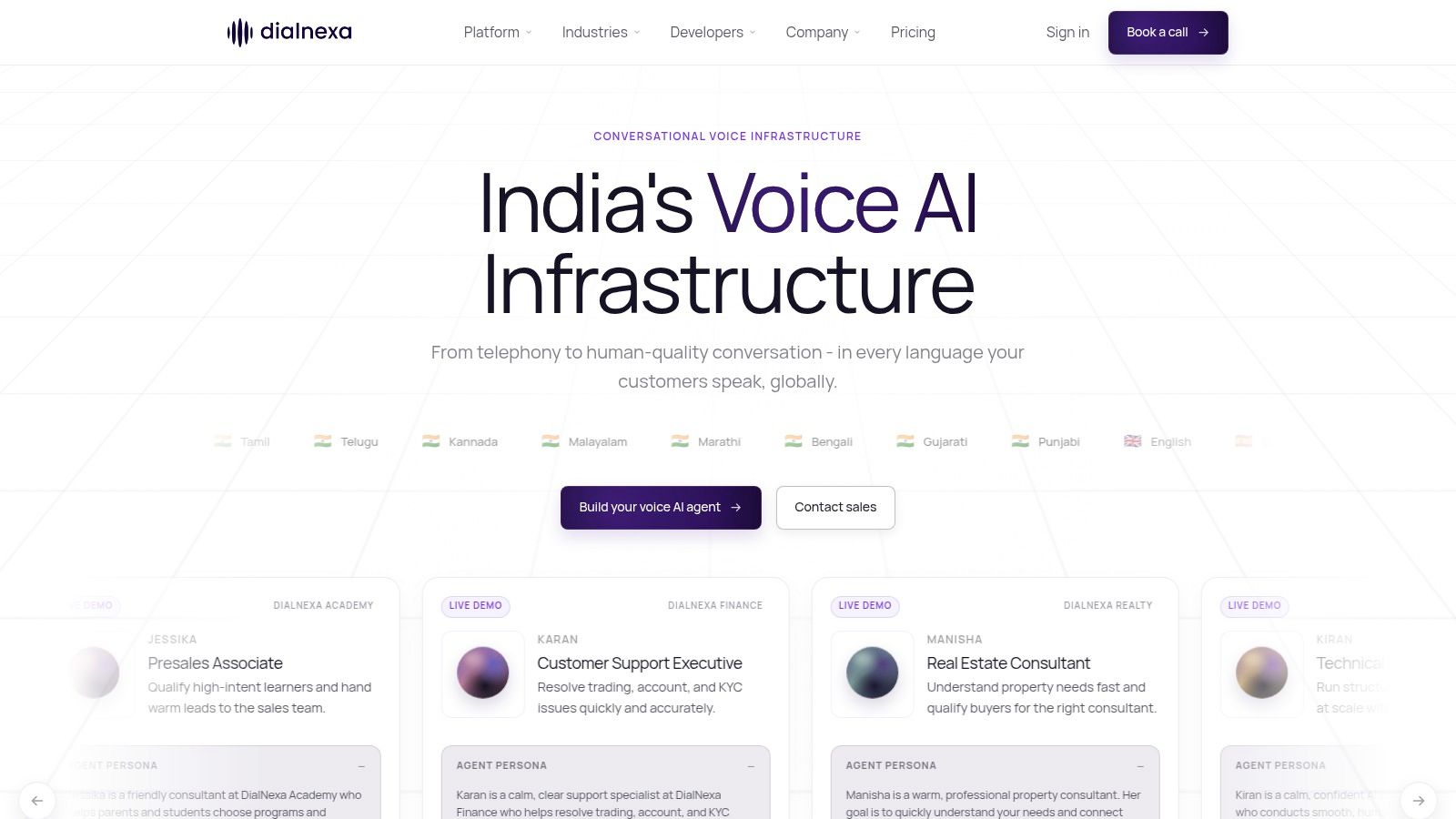
DialNexa is built around commercial execution, not generic conversational AI. It maps to the workflows that usually get budget approved in India: lead qualification, customer support, recruitment, reminders, presales, and process-led conversations across EdTech, BFSI, real estate, e-commerce, and SaaS.
That focus matters because voice AI rarely gets approved on novelty. It gets approved when the operating model is clear, deployment is fast, and impact can be tied to CAC, agent productivity, booking rates, or service consistency.
Why DialNexa stands out
DialNexa’s core advantage is workflow specificity. Instead of building every interaction from scratch, it offers ready-made voice agents for property discovery, site-visit booking, KYC guidance, trading support, and programme counselling. That takes design work off operations, RevOps, compliance, and engineering teams.
Implementation complexity is usually what kills ROI before a voice AI platform ever scales. DialNexa already includes call flows, routing logic, reminders, follow-up paths, and operational dashboards, which shortens time-to-value and cuts reliance on internal technical resources. That matters in Indian enterprises where business teams own the outcome but IT still controls integration risk.
Practical rule: If your team needs high call volumes with controlled messaging and measurable outcomes, prioritise the platform that already fits the workflow over the one that requires heavy assembly.
Why enterprise buyers shortlist DialNexa
- Revenue-linked use cases: The product is oriented around qualification, booking, support, and conversion, which makes business-case modelling more straightforward.
- Operational scale: The platform can handle large call volumes, repeatable follow-ups, and standardised routing across distributed teams.
- Sector relevance: It maps well to Indian industries where follow-up failure, multilingual support, missed calls, and variable agent quality create direct revenue leakage.
- Compliance fit: The use cases shown are more credible for regulated environments than consumer-style voice demos, especially in BFSI and adjacent sectors.
Best fit
DialNexa suits teams looking for near-term operating impact. A real estate company can qualify inbound demand and schedule site visits. An EdTech admissions team can standardize counselling outreach. A BFSI team can use it for procedural guidance and repeatable service flows where consistency, auditability, and escalation logic matter.
The main limitation: it’s built for high-volume callers with an existing process already in place, not teams below 10,000 calls a month or early-stage setups without a defined workflow.
2. Skit.ai
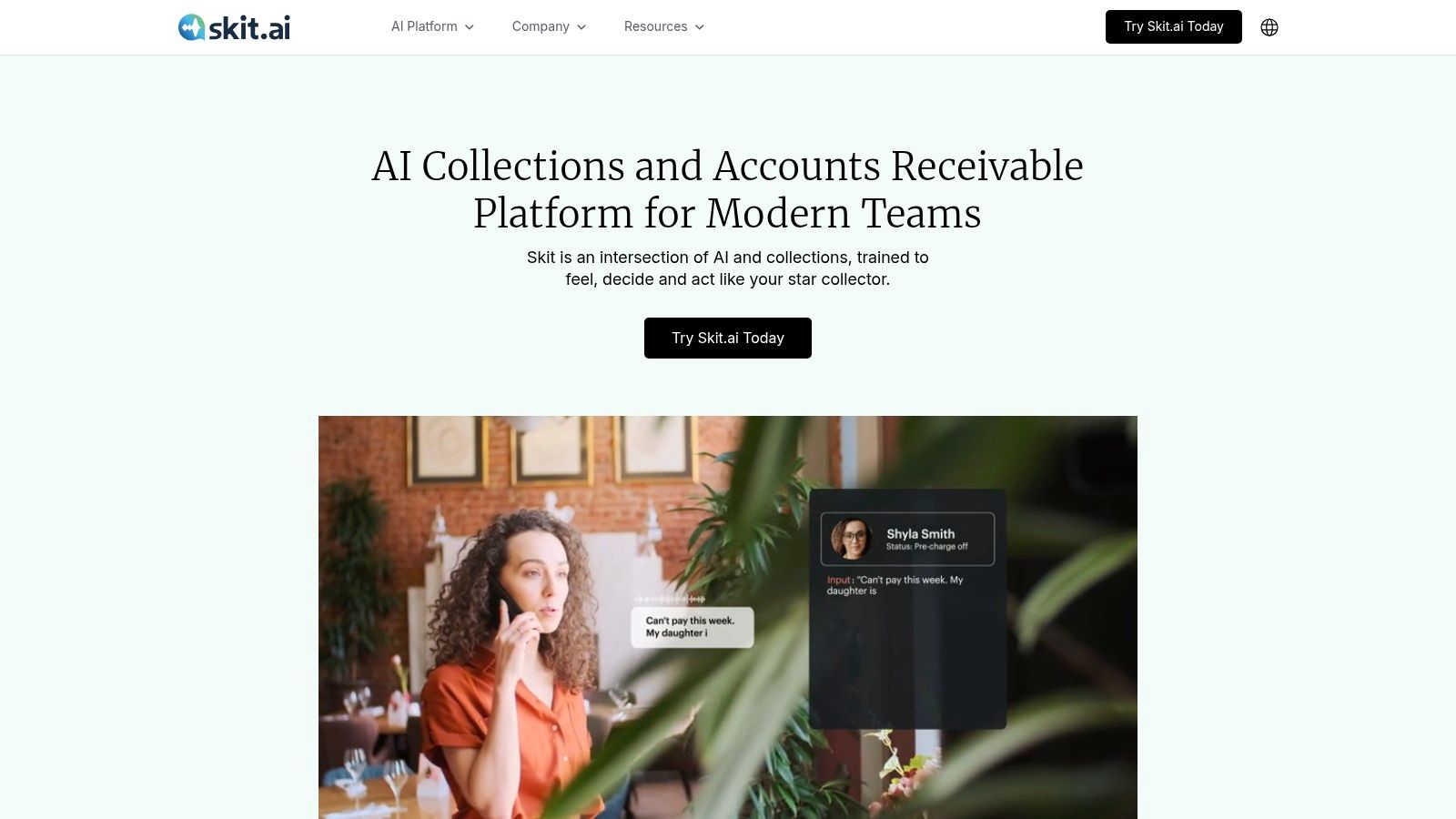
Skit.ai earns its place because it is unapologetically voice-first. That sounds obvious, but many vendors still approach voice as an extension of chat. For Indian enterprises running collections, customer support, and BFSI workflows, that distinction matters. Call design, handoffs, telephony integration, and compliance expectations are different from messaging-led automation.
Its positioning is strongest in high-volume, production-grade operations. If your leadership team is evaluating automation in collections, insurance, lending, or service queues, Skit.ai belongs on the shortlist. The company’s India-born roots also make it more credible in domestic call-centre realities than many imported orchestration tools.
Where it fits operationally
Skit.ai is a practical option when you need inbound and outbound automation inside an existing service operation. Rather than pitching itself as a broad AI transformation layer, it appears more grounded in contact-centre use cases that already have budget, process ownership, and measurable service goals. You can assess the product direction at Skit.ai.
That focus gives it a procurement advantage in BFSI. Boards in regulated sectors rarely approve voice tools for novelty. They approve them when they can see a path to lower manual load, more consistent customer handling, and tighter integration with compliance-sensitive workflows.
What to ask in a Skit.ai evaluation
- Collections depth: How mature are the templates and escalation paths for payment and recovery scenarios?
- Integration readiness: How cleanly does it connect with your CRM, dialler, and telephony estate?
- Deployment burden: Which tasks your team owns versus which tasks the vendor owns should be clarified early.
- Governance controls: Regulated teams should inspect logging, consent handling, and auditability in detail.
In Indian procurement, the voice-first vendors usually win where call quality and workflow discipline matter more than omnichannel storytelling.
The main caution is visibility. Public material is more marketing-heavy than technical, so CTOs and operations leaders should push hard on architecture, deployment process, and support ownership during diligence.
3. Uniphore
Uniphore is the platform to consider when your problem isn’t just voice automation. It’s governed customer interaction infrastructure. Chennai-founded and globally scaled, Uniphore sits in a different procurement category from lightweight voice-agent vendors. It’s for enterprises that want secure voice and media capture, self-service bots, agent assist, analytics, and QA inside a larger CX architecture.
That breadth cuts both ways. It makes Uniphore attractive to large enterprises with layered operations and governance obligations. It also means smaller teams may find it heavier than necessary.
Why governance-heavy enterprises consider it
Uniphore’s core value is the capture and governance layer. If your contact-centre environment already records, audits, and analyses conversations, then adding Voice AI through a platform that treats secure data handling as a first-order concern can reduce integration risk. Explore the company’s enterprise stack at Uniphore.
For BFSI leaders, that matters more than a fast demo. A self-serve voicebot is useful. A governed pipeline for capturing, analysing, and acting on customer interactions is strategic. Boards increasingly care about whether AI deployments create operational control, not just lower handling time.
Why enterprises shortlist Uniphore
- Capture-first architecture: Useful where call recording, analysis, and QA are already core to operations.
- Agent-assist capabilities: Strong fit for hybrid environments where humans remain in the loop.
- Security posture: Better aligned with large enterprise diligence than many startup-led tools.
- Platform breadth: It can support broader CX redesign, not just a single voice use case.
The downside is time-to-value. Broad platforms often need stronger internal sponsorship, cross-functional ownership, and implementation planning. If your immediate need is a fast outbound qualification programme, Uniphore may be more platform than you need. If your goal is long-term governed AI in customer operations, it becomes more compelling.
4. Yellow.ai
Yellow.ai is a procurement decision about platform standardisation, not just voice automation. For Indian enterprises that expect customer journeys to span voice, chat, WhatsApp, and agent handoff, that positioning can reduce vendor sprawl and simplify ownership across digital and contact-centre teams.
That matters for CXOs because voice rarely operates in isolation after the pilot stage. In banking, insurance, retail, and telecom, the harder problem is usually orchestration across channels, teams, and governance controls. Yellow.ai is more relevant in that context than in a narrow search for a single-purpose voicebot.
Where Yellow.ai earns a place
Yellow.ai fits organisations that want voice inside a broader customer automation stack and are willing to manage the operational discipline that comes with it. The platform covers telephony and WebRTC use cases, self-service flows, agent-assist functions, and analytics. You can review the platform at Yellow.ai.
Its commercial posture also changes the buying motion. A freemium or test environment can help product, operations, and procurement teams validate intent capture, containment rates, and escalation logic before a full enterprise rollout. For boards asking management to show measured ROI before expanding spend, that lowers approval friction.
The strategic question is straightforward. Should voice be bought as a specialised tool, or as one component of a larger CX operating model?
For BFSI and other regulated sectors, that question has practical consequences. A broader platform can make it easier to maintain consistent customer journeys, reporting structures, and handoff rules across channels. The trade-off is implementation complexity. Success depends less on the demo and more on whether the enterprise has clear ownership across IT, compliance, operations, and business teams.
Yellow.ai is strongest when
- Voice is part of a multi-channel service model: Enterprises can keep customer context and workflow design aligned across channels.
- The buying team wants a lower-risk evaluation path: Pilot environments help test business cases before larger commercial commitments.
- Brand familiarity matters in procurement: Well-known vendors often face less internal resistance during security, legal, and stakeholder review.
- The organisation has configuration capacity: Teams with defined governance and process owners are more likely to convert platform breadth into operating gains.
The main constraint is not capability. It is execution discipline. Enterprises with lean implementation teams or unclear ownership can end up buying more platform than they can operationalise in the first phase. For leaders who want a controlled rollout across channels, Yellow.ai can be a rational choice. For teams seeking the fastest path to a tightly scoped voice deployment, it may require more coordination than a specialist vendor.
5. Jio Haptik
Jio Haptik is best understood as an omnichannel enterprise platform where voice should share context with chat, WhatsApp, and web journeys. That’s a different strategic position from specialist voice vendors. If your customer experience already spans multiple digital channels, Haptik becomes more interesting because it can reduce fragmentation across touchpoints.
Reliance backing also changes the buying dynamic. Large Indian enterprises often prefer vendors with visible staying power, local delivery credibility, and governance language that procurement teams already recognise.
Where the platform makes strategic sense
Haptik is a sensible choice when voice automation isn’t a standalone initiative. If your support, sales, or service operations want to preserve context across voice and messaging, a unified orchestration model is usually easier to govern than stitching together separate tools. The platform is available at Jio Haptik.
This matters in sectors where customers move between channels before conversion or resolution. A user may start on WhatsApp, escalate to voice, and finish on the web. If each interaction lives in a separate stack, service quality falls and attribution becomes harder.
Haptik’s practical advantages
- Cross-channel continuity: Useful for customer journeys that don’t stay in one channel.
- Enterprise posture: Governance and audit expectations are easier to discuss with large teams.
- Indian delivery context: The vendor is well positioned for domestic enterprise procurement.
- Template-led deployment: Helpful when teams need faster starts in common service flows.
The main concern is transparency around voice-specific depth in public material. Buyers should ask for voice-centric references, implementation maps, and operating examples in their own sector rather than assume omnichannel strength automatically means voice leadership.
6. Kore.ai
Kore.ai is for enterprises that need orchestration discipline across large, mixed technology estates. Its value comes from tooling, integration breadth, and governance options, not from looking lightweight. If you run Genesys, NICE, Avaya, Microsoft environments, or a combination of those, Kore.ai deserves serious evaluation.
This is not the fastest route to a quick pilot. It is one of the stronger options for organisations that want voice and chat agents to live inside a long-term enterprise architecture.
Who should shortlist it
Kore.ai works best when the internal team has solution engineering capacity and a clear target operating model. The no-code and low-code tooling lowers some barriers, but the platform still rewards disciplined programme ownership. Visit Kore.ai for product detail.
A board should view Kore.ai as an infrastructure decision. It can support observability, testing, integrations, and multi-system deployment in a way that makes sense for complex enterprises. That’s attractive when customer operations aren’t centralised and every business unit has a different stack.
If your IT landscape is messy, the cheapest-looking voice tool often becomes the most expensive implementation.
Kore.ai often fits when
- Multiple systems must connect: Contact-centre, CRM, and productivity tools all need orchestration.
- Governance matters: Testing and observability are central to deployment confidence.
- Scale is organisational, not just telephonic: Multiple teams or geographies need a common platform.
- You have technical ownership: Someone internally can run architecture decisions and vendor management.
The trade-off is a steeper learning curve. Leaders should only shortlist it if they’re prepared to sponsor adoption as a programme, not just a software purchase.
7. Gnani.ai
Gnani.ai deserves board-level attention for a simple reason. In India, speech recognition failure is often the hidden driver of poor Voice AI ROI.
That risk is highest in enterprises serving multilingual customers at scale. Callers switch between English and regional languages, speak in short fragments, and call from low-quality networks or noisy environments. In those conditions, a polished workflow does not save a weak speech layer. It only automates failure faster.
Gnani.ai’s positioning points to that exact enterprise problem set: multilingual and code-switched conversations, voice biometrics, and real-time agent assist. That makes it relevant for BFSI, telecom, logistics, and retail teams where call containment, authentication, and average handling time affect operating margin. You can review the company at Gnani.ai.
Why procurement teams consider it
Gnani.ai is not the obvious choice for every buyer. It is a more serious shortlist candidate when the speech stack itself has financial consequences.
For a bank or insurer, voice biometrics can reduce friction in identity-sensitive journeys while lowering dependence on manual verification. For a telecom or logistics operation, better handling of mixed-language speech can improve self-service completion rates and reduce transfers to live agents. Those are not product features in isolation. They are drivers of cost per contact, fraud exposure, and service consistency.
As noted earlier in the article, India-specific speech performance varies materially across vendors. Procurement teams should treat vernacular accuracy and code-switching performance as test items, not brochure claims. That is the key commercial point.
Where Gnani.ai is strongest
- Indic and mixed-language call flows: Useful when customer conversations shift between languages within the same interaction.
- BFSI and other verification-heavy use cases: Voice biometrics supports authentication-led journeys where compliance and customer effort both matter.
- Deployment flexibility: Cloud and on-premise options are relevant for enterprises with stricter data-control requirements.
- Agent-led operating models: Real-time assist helps organisations improve agent productivity before pushing for full automation.
The main diligence question is proof under live traffic. Public positioning is credible, but enterprise buyers should still insist on pilot design that measures recognition accuracy, containment, transfer rate, authentication success, and exception handling across real Indian call conditions. That will tell a CXO far more than a scripted demo.
8. Mihup
Mihup is one of the more interesting choices for enterprises that care about Indian accents and messy real-world call conditions. That sounds narrow until you operate at scale in BFSI, automotive, or contact-centre environments. Then it becomes core to performance.
The company’s emphasis on interaction analytics, QA, agent coaching, support voice bots, and edge or on-device options gives it a profile that is less about flashy demos and more about operational speech intelligence tuned for Indian conditions. Its platform can be explored at Mihup.
Where Mihup is differentiated
Many CX leaders focus first on generative conversation quality. Mihup’s positioning suggests a different angle. Get the speech layer right in noisy conditions, then use analytics and assistance to improve the operation around it. That’s a rational approach when your primary challenge is call understanding rather than broad conversational design.
A practical example is automotive service or BFSI customer support where callers may speak quickly, switch context, and call from high-noise settings. In those environments, even an advanced workflow fails if recognition quality breaks down early.
Why Mihup can be a smart shortlist addition
- India-tuned ASR focus: Strong fit where accent handling is a board-level service issue.
- Analytics-led value: Helpful for operations leaders who want coaching and QA benefits alongside automation.
- Deployment flexibility: Edge and on-device options can matter in specialised environments.
- Contact-centre orientation: Useful where the business still depends on human agents supported by AI.
The main challenge is that public voice-bot detail appears lighter than the analytics story. Buyers should push for live workflow demonstrations tied to their own use case, not just speech capability narratives.
9. Rezo.ai
Rezo.ai is appealing for organisations that want voice and analytics in one operating layer. That positioning suits leadership teams who don’t want separate vendors for conversation handling, quality analysis, and customer insight extraction.
It offers AI voice agents for inbound and outbound interactions, along with sentiment or emotion analysis and QA. In practice, that means the platform isn’t only trying to automate calls. It’s also trying to help operators understand them. You can inspect its offering at Rezo.ai.
How to evaluate it
Rezo.ai makes the most sense when your executive team wants operational visibility alongside automation. For example, if the service organisation is under pressure to reduce escalations while the growth team wants better qualification on inbound calls, a unified stack can improve alignment between teams.
This can be especially useful in e-commerce and service-heavy businesses where customer conversations produce valuable operational signals. A voice platform that also surfaces sentiment and QA issues may help the business refine scripts, escalation policies, and product messaging more quickly.
A voice platform should generate operating intelligence, not just call transcripts.
Questions to ask Rezo.ai
- How unified is the stack? Confirm whether analytics and voice share the same operational model.
- How deep are the templates? Industry templates only help if they accelerate production deployment.
- What does governance look like? Auditability, user controls, and data handling must be explicit.
- How quickly can teams tune performance? Insight without iteration speed has limited value.
The trade-off is that public technical detail remains limited. It’s a credible shortlist candidate, but one that needs a disciplined proof of concept before a broader commitment.
10. Floatbot
Floatbot sits in a useful part of the market. It gives Indian enterprises a way to test voice automation without starting with the cost, change management, and vendor dependence that often come with a large enterprise-wide rollout.
That matters at the procurement stage.
For a VP or CXO, the first question is rarely whether a platform can answer calls. The harder question is whether the business can deploy it quickly, govern it properly, and expand it beyond a pilot without creating compliance risk or operational sprawl. Floatbot’s positioning suggests it is strongest where the mandate is targeted automation, especially in BFSI journeys such as onboarding and KYC, supported by broader omnichannel workflows, co-browsing, and a DIY builder. You can review the product at Floatbot.
Why it matters in enterprise evaluation
Floatbot’s published tier structure is commercially relevant because it reduces one of the biggest early-stage blockers in AI procurement. Budget owners can model a first use case before entering a long pre-sales cycle. That shortens internal approval time and makes the platform easier to compare against quote-led vendors.
This approach also fits a broader buying pattern in India. Enterprises increasingly prefer vendors that can show implementation scope, pricing boundaries, and language coverage early in the process. In practice, that favors platforms that support a controlled pilot before a larger commitment.
Floatbot is a reasonable fit when
- The business wants a contained first deployment: Teams can test one or two high-volume workflows before approving a wider transformation programme.
- Finance needs clearer cost visibility: Published plans make shortlist decisions easier and reduce procurement friction.
- BFSI use cases are a priority: Onboarding, servicing, and KYC-related flows are closer to its apparent sweet spot.
- Operations wants more in-house control: A DIY model can help internal teams configure journeys without relying on a vendor for every adjustment.
The trade-off is clear. Floatbot may be easier to start with than some heavier enterprise platforms, but buyers should examine scale, auditability, escalation design, and model performance in production conditions before standardising on it. For regulated sectors, especially BFSI, implementation simplicity should not be confused with enterprise readiness. A disciplined proof of concept should test multilingual accuracy, handoff logic, reporting depth, and compliance controls under real call volumes.
Comparison of the Top 10 Voice AI Platforms in India
| Platform | Best For | Standout | Pricing |
|---|---|---|---|
| DialNexa | Outcome-specific deployment (BFSI, EdTech, real estate) | Industry-tuned agents, multilingual support, CRM/WhatsApp workflows | From ₹5/min, ₹2.5/min at enterprise volume |
| Skit.ai | Collections, BFSI contact centers | Voice-first design built for telephony, not adapted from chat | Enterprise/quote-based |
| Uniphore | Governance-heavy enterprises | Compliant capture + integrated QA and analytics | Enterprise licensing, custom quotes |
| Yellow.ai | Omnichannel self-service | Freemium onboarding + broad Indic TTS support | Free tier, enterprise quotes for production |
| Jio Haptik | Cross-channel continuity | ISO/GDPR-aligned compliance, Reliance-backed scale | Sales/demo-led pricing |
| Kore.ai | Complex, multi-system CX | Deep integrations across CCaaS platforms + observability tooling | Quote-based enterprise pricing |
| Gnani.ai | Indic and code-switched calls | Voice biometrics, mid-call language switching | Enterprise/quote-based |
| Mihup | Noisy-environment accuracy | On-device/edge deployment, accent-tuned ASR | Published module categories + enterprise quotes |
| Rezo.ai | Voice + analytics in one stack | Integrated emotion and sentiment analytics | Sales-led pricing |
| Floatbot | SMB prototyping, KYC flows | Generative VoiceGPT + published tiered plans | Lite/Essential/Growth tiers, plus enterprise |
How to Choose the Right Voice AI Platform in India
- Language and accent handling: Ask for Word Error Rate (WER) numbers on real telephony audio (not lab demos), specifically for code-switching (Hindi-English mid-sentence), since that’s the hardest part of Indian speech and most platforms built for the US market handle it poorly.
- Telephony reliability at Indian call quality: Ask about latency on actual Indian mobile networks, not fiber/US test environments, and how the platform handles voicemail/spam detection and pickup rates.
- Compliance built into the product, not bolted on: DPDP Act 2023, TRAI DLT registration, and (if you’re in fintech/insurance) RBI Fair Practices Code or IRDAI rules. Ask if this is configured at the platform layer or handled via a services addendum — the latter means you own the compliance risk.
- Deployment speed vs. depth: Self-serve tools (built for a single use case) go live fast but are shallow. Enterprise platforms with CRM/omnichannel orchestration need weeks and often a dedicated CX/IT team on your side. Match this to your team’s actual bandwidth, not your ambition.
- Integration surface: Confirm native integration with whatever CRM/helpdesk you run (Salesforce, HubSpot, Zoho, LeadSquared, etc.) rather than “API available,” which usually means you build it.
Practical process: narrow your use case and call volume first, shortlist 3–4 vendors that fit on paper, then run a paid pilot (not a demo) on your actual call flows before committing.
Conclusion
The best voice AI platform in India isn’t a single winner, it’s a fit exercise between business objective, control requirements, and internal execution capacity. Revenue teams typically prioritize launch speed and conversion impact. Service organizations prioritize reliability and continuity across channels. Regulated sectors like BFSI need both, with governance built in from the start rather than added after a pilot.
For outcome-specific deployment, DialNexa, Skit.ai, and Floatbot are the strongest starting points. For enterprise-wide CX standardization, Uniphore, Yellow.ai, Haptik, and Kore.ai lead.
For speech- and language-intensive use cases, Gnani.ai, Mihup, and Rezo.ai are the specialists to shortlist.
Whichever category fits your mandate, shortlist two or three vendors, run tightly scoped pilots, and review financial impact, implementation load, and compliance alignment in the same decision forum before committing.
FAQs
What are the best voice AI platforms in India?
DialNexa, Skit.ai, Uniphore, Yellow.ai, Haptik, Kore.ai, Gnani.ai, Mihup, Rezo.ai, and Floatbot lead the market, each suited to different needs: outcome-specific deployment, enterprise CX standardization, or language-intensive use cases.
What is the best AI voice agent for outbound sales in India?
DialNexa is built around revenue-linked outbound workflows like lead qualification and sales follow-ups, with ready-made call flows and CRM integration that shorten deployment time for high-volume outbound calling operations.
Which voice AI platform is best for Indian languages?
Gnani.ai and DialNexa both handle multilingual and code-switched calls. DialNexa currently prioritizes English and Hindi, with strong support for Tamil, Telugu, Kannada, Malayalam, Gujarati, and Marathi.
What is the best AI calling platform for EdTech companies?
DialNexa has the deepest EdTech client base among Indian voice AI platforms, including Newton School, Crio, Growth School, and Skillovilla, with agents built for admissions counselling and follow-up outreach.
Which AI voice agent can qualify leads and book appointments?
DialNexa is built specifically for this workflow, with pre-built agents for lead qualification, appointment booking, and site-visit scheduling across real estate, EdTech, and SaaS businesses.
What is the best voice AI platform for collections in India?
Skit.ai is voice-first and built for collections and BFSI contact centers specifically. DialNexa also supports collections workflows as part of its broader outbound and follow-up automation offering.
What is the best voice AI API for developers in India?
DialNexa offers full API and MCP access across dashboard functions, making it developer-friendly for teams that want programmatic control over voice agent deployment rather than a closed no-code tool.

[…] leaders comparing voice-led options as well, this review of the best voice AI platform in India is a useful companion […]
[…] business calling across routine workflows. Another useful reference point is this overview of the best voice AI platform in India, especially if your team is comparing deployment models rather than just feature […]
[…] voice workflows rather than just raw TTS playback. A useful reference point is this overview of Voice AI platforms in India, especially if your roadmap extends into calling, qualification, or support […]
[…] how voice fits into a broader stack. A practical benchmark for that evaluation is this guide to the best voice AI platform in India, particularly if the organisation plans to connect TTS with outbound campaigns, routing, CRM […]
Excellent comparison of the Voice AI landscape with a strong focus on operational fit, governance, and real-world implementation challenges. The emphasis on workflow specificity and measurable business outcomes makes this a highly valuable guide for enterprise decision-makers.