
Voice AI Customer Service: A CXO’s Guide to Scaling Support
74% of consumers now expect 24/7 service because of AI CloudTalk's roundup of AI voice agent statistics surfaces a shift that Indian CX leaders can't ignore. In a market where UPI crossed 100 billion annual transactions in FY 2023-24 and customer contact is still heavily voice-led, the pressure on service teams is no longer theoretical, it's operational Reserve Bank of India data, as cited in the voice AI customer support statistics brief.
That's why voice AI customer service has moved from a nice-to-have experiment to core infrastructure for BFSI, healthcare, EdTech, real estate, and e-commerce. Mature deployments can now handle 35-40% of inbound calls end-to-end without human transfer, while average fully deflected call rates across deployments sit around 22% voice AI customer support statistics. For Indian operators, the point isn't to replace agents, it's to absorb repetitive, high-volume work so human teams can focus on judgement-heavy calls.
Table of Contents
- Why Voice AI Customer Service Matters Now
- How Voice AI Customer Service Works
- Measurable Business Benefits and KPIs
- Industry Use Cases and Real-World Scenarios
- Implementation Roadmap from Pilot to Production
- Compliance and Governance for Regulated Conversations
- Evaluating Voice AI Vendors for Indian Operations
Why Voice AI Customer Service Matters Now
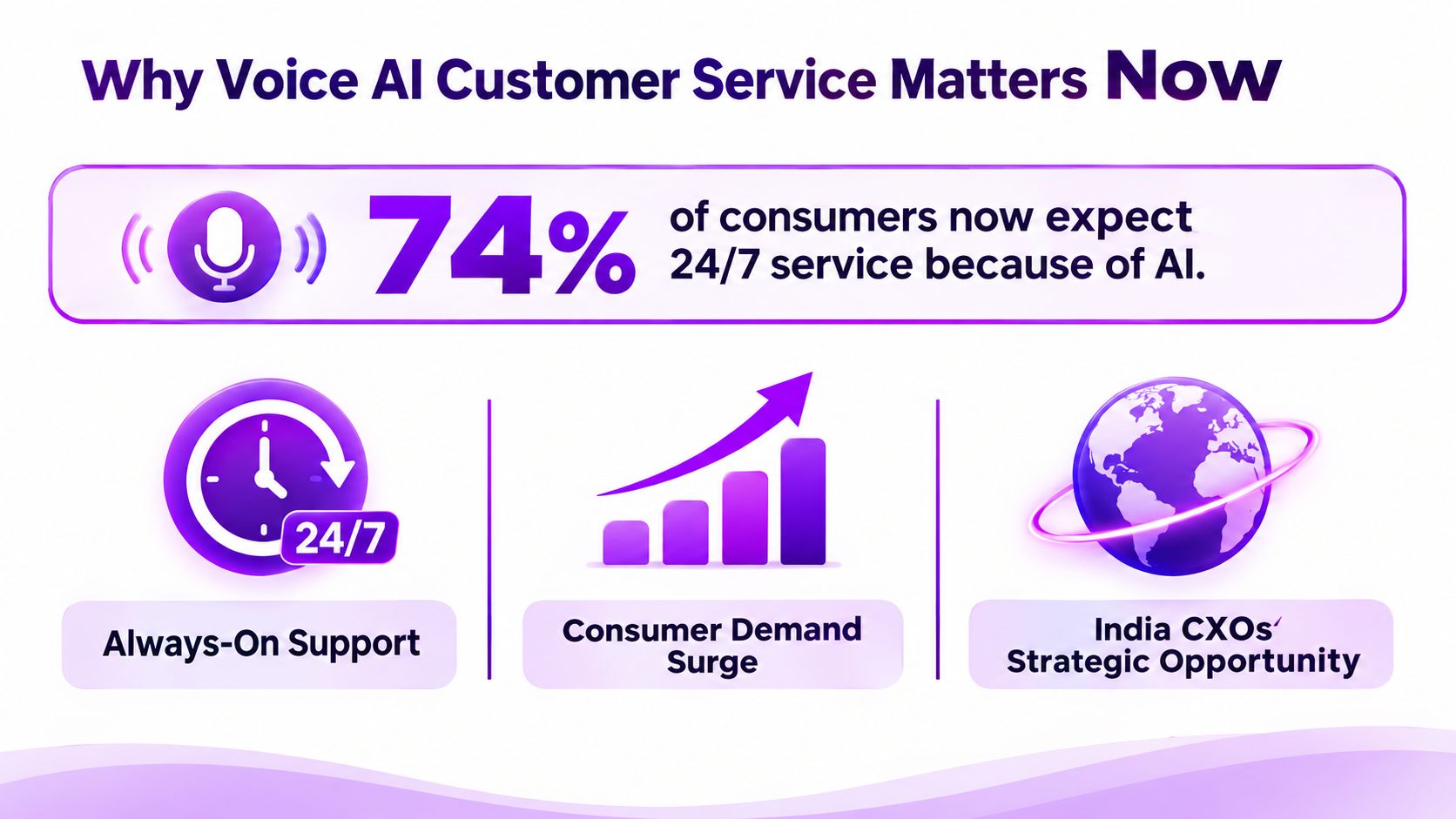
Customers do not wait for office hours, and support teams in India are absorbing that pressure across banking, lending, telecom, retail, and healthcare. A key issue is not just call volume; it is the mix of payment queries, verification steps, status checks, and routine follow-ups that keep arriving in parallel. Traditional staffing models handle peaks poorly, while voice AI can answer consistently and keep more of those calls out of the queue.
India's digital interaction volume has already pushed support operations into a different cost structure. UPI crossing 100 billion annual transactions in FY 2023-24 means customers are used to fast, repeated digital interactions Reserve Bank of India data, as cited in the voice AI customer support statistics brief. In service operations, that volume shows up as repayment reminders, KYC nudges, appointment confirmations, delivery updates, and repeated “what is the status” calls that consume agent time without adding much human judgment.
From IVR routing to full-call resolution
Old IVR systems were built to route calls, not finish them. Voice AI can move through a conversation, retrieve the right account or record, and complete the task while the caller is still on the line. For CXOs, that matters because a voice agent that can update a CRM, create a ticket, or book an appointment is operating inside the workflow, not just acting as a front-end menu.
The practical trade-off is simple. If the goal is only shorter menus, legacy IVR logic is enough. If the goal is to absorb routine demand at scale without losing human handling for complex cases, voice AI becomes a capacity layer.
Practical rule: do not buy voice AI to add automation. Use it to remove friction from repeated call paths that already consume team time.
Indian deployments make this even more concrete. BFSI teams use voice AI for low-risk service and collections prompts, EdTech teams use it for admissions and follow-ups, and e-commerce teams use it for order support and COD-related verification. For a useful Indian market lens, the voice AI in Indian call centres overview is a relevant companion read.
How Voice AI Customer Service Works
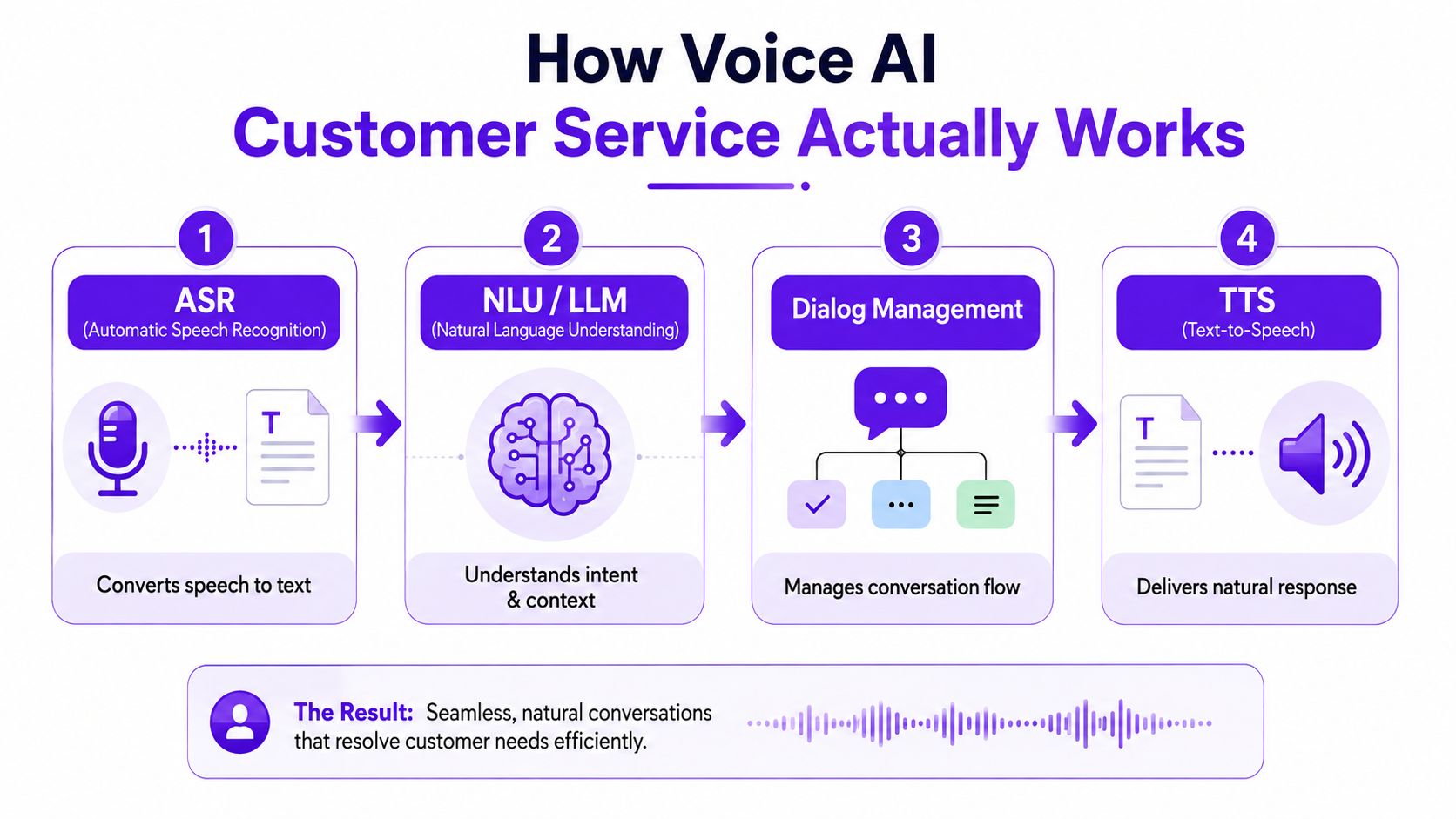
A production-grade voice AI system is usually built on ASR + NLU/LLM + dialog orchestration + TTS + backend integrations implementation guide. Each layer has a defined job, and the system only feels usable when all of them work together fast enough to keep the conversation moving. A simple test is whether the system turns speech into action without forcing the caller to repeat the same details.
The stack that matters in live calls
ASR converts speech into text, which gets harder in Indian deployments because accents vary, mobile lines are noisy, and callers often switch languages mid-sentence. NLU or LLM logic interprets intent, while dialog orchestration decides what to ask next, what to fetch, and when to escalate. TTS then speaks the reply, after the system checks context and confidence.
That sequence is where many programs win or fail. A basic system can identify “loan status” as an intent. A useful system can verify the caller, pull the status from the backend, and explain what is pending, all in one call. Implementation teams focus on confidence scoring, context tracking, escalation triggers, and API integration because keyword spotting alone does not hold up in production. For a more detailed build view, the end-to-end voice AI pipeline guide is a useful reference.
A voice agent earns trust when it completes a transaction cleanly, not when it sounds charming.
Latency is part of the product
Natural turn-taking depends on speed. One industry guide puts the production target at 500-1000 milliseconds for a response, while another treats sub-1-second response latency under load as a differentiator for real voice agents voice assistant latency guide. Once latency stretches beyond that range, people interrupt, barge-in handling gets messy, and the conversation starts feeling like a bad IVR.
That is why telephony-tuned ASR and semantic voice activity detection matter so much in live deployments. The caller should not have to pause unnaturally or wait through obvious processing gaps. In a banking call, for example, the voice agent should verify identity, check account state, and either resolve the request or transfer with full context, not send the caller back to square one.
Measurable Business Benefits and KPIs
The business case for voice AI gets stronger once leaders stop judging whether the system sounds human enough and start looking at where the operational lift shows up. In live deployments, the useful metrics are concrete. They show whether the system is answering more calls, qualifying better leads, and reducing pressure on human agents.
The KPIs worth tracking
The first layer is coverage. Call deflection rate shows how many routine interactions the system handles without transfer, and mature deployments can use that shift to reshape staffing plans. The second layer is quality, which means average handling time, conversion rate, and customer satisfaction. If the system handles more calls but adds friction, the program has not improved the operation.
The third layer is workflow efficiency. Voice AI should cut repetitive work, preserve agent energy for harder calls, and keep after-hours demand from sitting unanswered. That matters in India because voice channels still carry a large share of support and lead qualification work, especially in BFSI and retail. A cleaner routing layer also means the human team spends more time on cases that need judgment.
The numbers CXOs should care about
Publisher-provided deployment data shows that connect rates rose from 47% to 91%, lead-to-booking improved from 2% to 8%, and AI-qualified leads matched human judgment with 97% accuracy. Those outcomes matter because they connect directly to revenue operations and follow-up efficiency. For teams handling high-volume outreach or inbound qualification, even modest gains in answer rate can change how many opportunities enter the pipeline.
The internal metric view should also include cost per conversation and the share of calls completed without agent intervention. A voice system that keeps messaging consistent across thousands of calls has a different economic profile from one that needs human agents to repeat the same script all day. For a more detailed measurement framework, the contact-centre voice AI metrics and deployment strategy guide is a useful reference.
Operational takeaway: the right KPI set is not “how natural does it sound”, it is “how many calls did it resolve, route, or convert without wasting human time”.
Industry Use Cases and Real-World Scenarios
Voice AI becomes easier to trust when you map it to a real call, not a slide deck. Different industries need different conversation shapes, and India's service mix makes that especially obvious. A strong deployment in BFSI won't look identical to one in EdTech or healthcare, even if the underlying stack is the same.
BFSI, EdTech, and real estate on the same framework
In BFSI, the agent may confirm identity, explain a repayment option, and schedule a callback when the issue needs a human decision. That's useful for collections, KYC guidance, and account servicing, but it needs tight escalation rules because the caller may drift into a dispute or complaint. In EdTech, the same voice agent can qualify an enquiry, answer programme questions, and book a counselling session while capturing lead context for the admissions team.
Real estate has a different rhythm. The caller wants availability, location detail, and a site-visit booking slot. Voice AI can handle that without forcing a sales agent to spend half the day repeating the same property basics. Healthcare is similar, but more sensitive. Appointment booking, availability checks, and light triage can be automated, while anything medically ambiguous should go to a person.
For a broader industry view, the how industries use AI resource is useful because it frames voice as one part of a larger workflow strategy, not a standalone gadget.
What the call flow should feel like
A good e-commerce voice agent confirms an order, checks COD readiness, and shares delivery updates without sounding scripted. If the caller asks for a refund, the agent should recognise that the conversation has moved from routine status into a higher-risk path and escalate with context. That context transfer matters more than people admit, because the caller should not have to repeat order number, reason, and prior steps to the human agent.
Getting that handoff wrong is exactly how a support operation ends up in a list of poor customer service examples, and reviewing those failure patterns is a fast way to spot which escalation gaps a voice AI rollout needs to close first.
That same logic applies across sectors. Resolve the predictable parts quickly, preserve the state of the call, and escalate when the issue becomes ambiguous or risky.
The best deployment teams design for one repeated question: “What should this conversation do next?” Once that's clear, the system can be trained to guide, not just reply.
Implementation Roadmap from Pilot to Production
A voice AI rollout usually fails for a simple reason. Teams move from demo to enterprise scope before the call flows, integrations, and escalation rules are proven in live conditions. In Indian operations, that mistake gets expensive fast, especially when multilingual callers, uneven network quality, and regulated conversations all hit the same system at once.
The better path is staged, measurable, and tied to actual call behaviour. Strong programmes start with integration discipline, then add conversational design once the plumbing is stable.
Phase 1 and 2, wiring the system and teaching it the business
Start by connecting the voice layer to the CRM, telephony stack, and backend systems through APIs. If those systems are not available in real time, the agent will speak stale information, and trust drops the first time a caller hears the wrong order status, policy detail, or account update. After that, train the system on your business vocabulary, call reasons, and workflow logic so it can separate a routine status check from a case that needs escalation.
For India, this stage also needs language coverage that matches the call mix. A model that sounds strong in a lab but weakens on code-switching, accented speech, or low-bandwidth audio will fail in production even if the demo looks polished. If the use case touches BFSI, the workflow also has to reflect approved disclosures, escalation paths, and consent handling from day one, not after the pilot goes live. For a practical comparison of deployment options and a production checklist, this best voice AI platform in India guide is a useful reference point for operations teams planning the sequence.
At this stage, the success criterion is straightforward. The system should handle the most common call types without improvising outside approved boundaries. The common failure mode is overgeneralisation, where the agent sounds fluent but does not reflect actual business rules.
Phase 3 to 5, testing, rollout, and monitoring
Run a controlled pilot with real call samples, not only ideal transcripts. Measure accuracy, latency, transfer quality, and failure patterns, then review the conversations that broke under pressure. Calls from noisy homes, weak mobile networks, and mixed-language speakers will surface the gaps faster than any internal script review.
Implementation checkpoint: launch first on low-risk call types, then expand only after the handoff path, logging, and API integrations have been verified under live traffic.
Once the pilot proves stable, roll out gradually. Keep monitoring call outcomes, escalation reasons, and repeated failure points so the model can be tuned continuously. Production readiness is not a one-time go-live event, it is a controlled operating loop that keeps the system aligned with real caller behaviour, policy changes, and changing call volumes.
Compliance and Governance for Regulated Conversations
The biggest mistake in regulated voice AI discussions is pretending that model quality is the main barrier. In India, the harder problem is governance. If a system can talk to customers but can't stay inside approved workflows, the organisation inherits compliance risk instead of operational relief.
What should be automated, and what should be escalated
For BFSI and healthcare, the right question is not whether the agent can speak politely. It's whether it can remain within policy when a caller pushes into complaints, disputes, account closures, or judgement-heavy requests. Mainstream guidance often treats these as edge cases, which is exactly why governance matters. The system should have escalation thresholds that send sensitive calls to humans before it overpromises or gives a wrong commitment voice AI agents guide.
Auditability is essential. Teams need transcript logs, approved-response boundaries, and a clear view of which calls were resolved automatically and which were handed off. Real-time data access also matters because stale policy or account information can create wrong answers even when the model itself is technically strong.
The controls that reduce risk
Consent handling should be explicit. So should call recording policies, retention rules, and the review process for sensitive interactions. If the agent is allowed to handle KYC guidance or collections prompts, it needs guardrails that stop it from offering unauthorised concessions or drifting into advice.
For governance design in larger AI programmes, the guide to scaling AI teams is a useful parallel read because the same operational discipline applies here, approval paths, logging, role clarity, and exception handling. The point is not to slow automation down. The point is to make sure the automation stays inside the lines.
For a more focused compliance perspective, this regulatory compliance for voice AI guide is directly relevant to Indian operations evaluating regulated use cases.
Evaluating Voice AI Vendors for Indian Operations
Indian buyers need a tighter evaluation lens than a generic “supports many languages” promise. A vendor can look strong on paper and still struggle when the call is noisy, the accents vary, or the customer switches between English and a regional language mid-call. If you're serving real Indian traffic, that is the core test.
Vendor criteria that matter in practice
| Capability | What to Ask | Why It Matters |
|---|---|---|
| Multilingual performance | How well does it handle Hindi, Tamil, Telugu, and mixed-language utterances in real calls? | India's callers don't speak in clean product-demo language. |
| Accent resilience | What happens with regionally accented English on mobile lines? | Accent handling affects understanding before any workflow begins. |
| Latency under load | Can it preserve natural turn-taking when traffic spikes? | Slow responses make callers interrupt and transfer more often. |
| Telephony-tuned ASR | Is the speech layer optimised for call audio, not just transcription? | Phone audio is harsher than studio-grade demo audio. |
| Mid-call escalation | Does the human agent receive full context when the bot transfers? | A transfer without context wastes the caller's time. |
| Integration depth | Can it update CRM records and fetch backend data in real time? | Voice AI has to complete work, not just narrate it. |
That table should be paired with a live test on your own call samples. Don't accept a demo that only shows polished English and clean audio. Test noisy mobile calls, language switching, and one or two real workflows that your team handles every day.
For vendor shortlisting, it also helps to read a practical comparison like vendor management solutions in the context of service operations, because governance, support quality, and integration discipline matter as much as speech quality.

One useful option in this space is DialNexa Labs Private Limited, which builds voice AI agents for customer support, qualification, and workflow-led calls across Indian enterprise use cases. For a CXO, the right comparison is not brand hype, it's whether the platform can handle the Indian call mix, connect to your systems, and stay inside the rules your operation needs.
If you're evaluating voice AI for support, collections, admissions, or lead qualification, DialNexa Labs Private Limited can help you map the call flows, compliance constraints, and integration points before you commit to a rollout. Visit DialNexa Labs Private Limited to review its voice AI agents, deployment approach, and use cases for Indian operations, then pressure-test it against your real call data.

This is a clear and practical overview of how Voice AI can improve customer support through faster response, automation, and intelligent call routing.
I especially like the focus on real-world industry use cases, phased implementation, and strong compliance controls.
The focus on compliance, implementation stages, integrations, and measurable ROI makes the article especially useful for CXOs evaluating AI voice solutions.
This is an insightful guide that clearly highlights how Voice AI can transform customer service and support teams. The CXO-focused approach makes the benefits of scaling support with AI practical, relevant, and easy to understand.