
The Executive’s Guide to Outsourcing Contact Center Operations
For senior leadership, outsourcing a contact center is no longer a tactical cost-cutting measure. It's a strategic imperative designed to gain a competitive edge. The decision to engage an external partner is a calculated move to accelerate growth, forge unbreakable customer loyalty, and unlock operational efficiencies that are often unattainable in-house.
Why Leaders Are Turning to Contact Centre Outsourcing
In today’s hyper-competitive market, customer experience (CX) is the definitive battleground. It is the primary differentiator that separates market leaders from the rest. Research from PwC confirms this, revealing that 86% of buyers are willing to pay more for a superior customer experience. This places immense pressure on the C-suite to ensure every customer touchpoint is seamless, professional, and value-adding.
However, building and maintaining a world-class, in-house contact center is a significant drain on capital and focus. It requires massive, ongoing investments in talent acquisition, training, and cutting-edge technology.
Outsourcing transfers this entire operational burden to a specialist partner whose core business is customer interaction excellence. This strategic delegation frees up executive bandwidth and internal resources to concentrate on core competencies—whether that's pioneering new software, engineering innovative products, or managing complex financial portfolios. For many C-level executives, this sharpened focus is the primary driver for making the switch.
It's More Than Just a Cost-Saving Move
While significant cost reduction is a given, the strategic conversation in boardrooms has evolved. The objective is not merely to access cheaper labor but to tap into a global reservoir of specialized talent, leverage state-of-the-art technology without the capital expenditure, and implement best-in-class processes that deliver tangible, measurable business results.
Consider the strategic value unlocked:
Elevated Customer Metrics: A premier outsourcing partner is laser-focused on the metrics that define your business success. For example, a leading BPO partner helped a SaaS client improve their Net Promoter Score (NPS) from +30 to +55 within six months by implementing a proactive customer feedback loop. Similarly, by improving first-contact resolution rates by 15%, they increased Customer Lifetime Value (CLV) by an average of 25% for a retail client.
Instant Access to Top-Tier Tech: Leading BPOs have already made the multi-million dollar investments in AI, automation, and advanced analytics platforms. This provides immediate access to sophisticated tools without the prohibitive upfront cost. For instance, implementing an AI-powered predictive dialer can increase agent connection rates from a typical 47% to over 90%, directly boosting sales productivity.
Agility to Scale on Demand: Business is inherently volatile. A quality outsourcing partnership provides the agility to scale your support team by 300% for a new product launch or seasonal peak—like Black Friday for an e-commerce brand—and then seamlessly scale back down. This elasticity prevents being overstaffed during lulls or, more critically, under-resourced during periods of rapid growth.
Practical Example: A rapidly scaling fintech company was struggling to provide 24/7 support for its global user base, leading to customer churn and spiraling hiring costs. By partnering with a specialized offshore provider, they not only offered round-the-clock, multi-lingual support but also improved their lead qualification process for premium services. This allowed their core engineering team to focus exclusively on product innovation, accelerating their feature roadmap by an entire quarter.
This strategic shift transforms the contact center from a cost black hole into a data-driven engine for enterprise growth. When companies leverage this specialized expertise, the outcomes are compelling. A well-executed outsourcing strategy can increase lead-to-booking conversion rates from a standard 2% to as high as 8%, demonstrating that the right partnership is an indispensable component of any modern growth strategy.
Choosing Your Outsourcing Model for Strategic Advantage
Selecting the appropriate model for an outsourced contact center is a critical strategic decision, not merely a logistical one. It's a choice that directly impacts cost structure, talent acquisition, and regulatory alignment, shaping the company's trajectory. We will analyze the Onshore, Nearshore, and Offshore models from a C-suite perspective, focusing on these key business drivers.
The optimal choice hinges on your specific business priorities. A U.S.-based financial services firm, bound by stringent FINRA and SEC regulations, may find an onshore model non-negotiable due to the ease of compliance and auditing. Conversely, a global e-commerce powerhouse requiring 24/7 "follow-the-sun" support can leverage an offshore model to provide continuous service coverage cost-effectively.
This decision framework provides a high-level view for executives to determine if outsourcing is the right strategic lever to pull to enhance key business metrics.
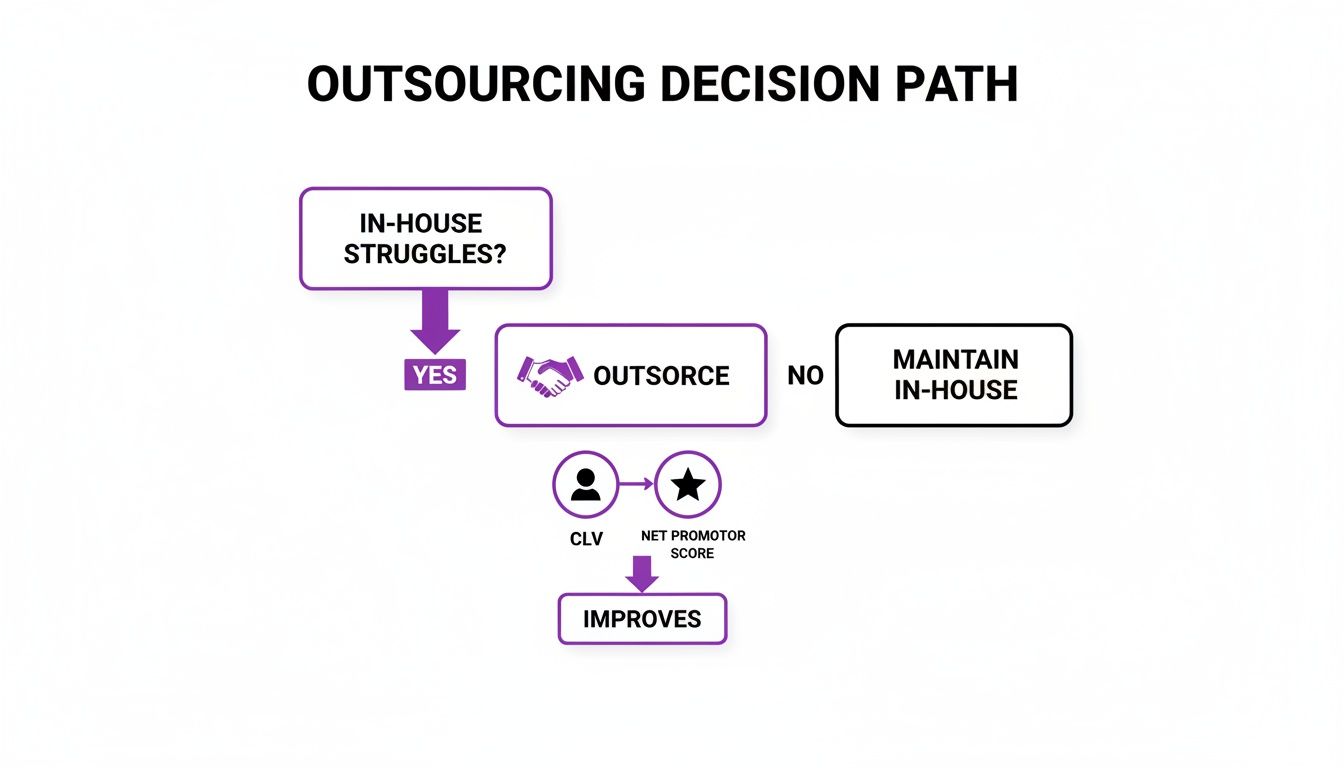
As illustrated, when an in-house operation becomes a bottleneck, outsourcing presents a direct pathway to improving mission-critical metrics like Customer Lifetime Value (CLV) and Net Promoter Score (NPS).
Onshore, Nearshore, and Offshore Models
Each geographical model offers a distinct set of advantages and trade-offs. The correct choice is the one that aligns with your strategic priorities, whether they are cost optimization, access to specialized skills, or cultural affinity. Understanding these nuances is the first step toward a successful partnership.
- Onshore Outsourcing: Partnering with a contact center located within your own country. This ensures maximum cultural and linguistic alignment, simplifies regulatory compliance, and facilitates easy travel for training and strategic reviews. However, it is the most expensive option.
- Nearshore Outsourcing: Engaging a provider in a neighboring country, typically within a similar time zone (e.g., a US company partnering with a center in Mexico or Costa Rica). This model offers a compelling balance, providing significant cost savings over onshore while maintaining strong cultural similarities and convenient travel.
- Offshore Outsourcing: Partnering with a provider in a distant country, often in a completely different time zone (e.g., India or the Philippines). This model delivers the most substantial cost savings and access to a vast, scalable talent pool, making it ideal for 24/7 support operations.
The Asia Pacific (APAC) region, particularly India, is a dominant force in offshoring. The APAC market, valued at over $24.1 billion in 2024, represents 23% of the global total. It is projected to grow at a Compound Annual Growth Rate (CAGR) of 10.0% through 2031. This growth is driven by intense demand from sectors like banking, financial services, and insurance (BFSI), telecom, and healthcare, all requiring scalable and expert contact center solutions.
The Rise of AI-Enabled Hybrid Models
Geography is no longer the sole consideration. A new paradigm is emerging: AI-enabled hybrid models. These intelligent systems are revolutionizing contact center operations by creating a powerful synergy between automation and human expertise.
Practical Example: An AI agent is not merely a replacement for a human; it's an amplifier. For a major airline, an AI-powered Interactive Voice Response (IVR) system can automate 80% of routine inbound queries like flight status checks and baggage allowance questions. This frees up skilled human agents to manage high-stakes, empathetic conversations, such as rebooking passengers from a cancelled flight—a task that builds lasting customer loyalty.
That kind of automation sits inside a much larger discipline covered in our guide to what customer service means in the aviation industry, which maps how airlines coordinate people, process, and technology across the full passenger journey.
This hybrid model drives efficiency across diverse industries. In healthcare, an AI can manage appointment scheduling with 99% accuracy, allowing human staff to handle complex patient insurance queries. In real estate, an AI qualifies initial website leads, enabling the sales team to focus on high-intent buyers. The result is a dual victory: operational efficiency and a superior customer experience. As you explore these models, it is beneficial to understand how AI agent assist can transform real-time interactions.
Choosing the right geographic and technological model is a pivotal executive decision. To clarify the trade-offs, here is a strategic comparison of the three primary location-based models.
Strategic Comparison of Contact Center Outsourcing Models
This table provides a strategic overview for decision-makers, comparing Onshore, Nearshore, and Offshore models across key business criteria like cost, talent, compliance, and cultural alignment.
| Model | Cost Impact | Talent & Skill Access | Regulatory & Compliance Ease | Cultural & Language Proximity | Best Suited For |
|---|---|---|---|---|---|
| Onshore | Highest cost, but potentially higher ROI through quality and efficiency. | Access to local talent pool with native language and cultural understanding. | Easiest to manage, with shared legal and regulatory frameworks. | Highest alignment, minimising misunderstandings and improving rapport. | Companies in highly regulated industries (e.g., Finance, Healthcare) or those serving a domestic-only customer base. |
| Nearshore | Moderate cost savings (20-40% vs. Onshore) with competitive labour rates. | Access to skilled, often bilingual agents in similar time zones. | Relatively straightforward, with many regions having similar legal structures. | High proximity, with strong cultural ties and minimal time zone differences. | Businesses seeking a balance of cost savings and cultural alignment, especially for US/Canada markets. |
| Offshore | Highest cost savings (40-60%+ vs. Onshore) due to lower labour and operational costs. | Access to a vast, diverse talent pool, enabling 24/7 "follow-the-sun" support. | Can be complex, requiring deep knowledge of local laws and data privacy regulations. | Lowest proximity; requires significant investment in cultural and accent training. | Large-scale operations needing round-the-clock support and significant cost reduction, such as global tech companies. |
Ultimately, the 'best' model is the one that aligns most closely with your company’s specific goals, risk tolerance, and customer expectations. By carefully weighing these factors, you can build a partnership that not only cuts costs but also becomes a true driver of growth.
Building the Financial Case for Outsourcing
For any C-suite executive, a significant operational shift demands a robust business case. When evaluating contact center outsourcing, the financial narrative has shifted from simple labor arbitrage to a sophisticated strategy that enhances operational efficiency, reduces capital expenditure, and directly contributes to the bottom line.
A comprehensive financial model reveals savings beyond direct labor costs. Consider the total cost of ownership for an in-house team: recruitment, hiring, and training can exceed $5,000 per agent. Add to this ongoing licensing fees for CRM software, telephony systems, and the substantial capital locked into real estate and IT hardware. Outsourcing converts these large, fixed capital outlays into a predictable, scalable operational expense.
Quantifying the Operational Savings
The most immediate financial impact is the reduction in operating costs. Partnering with a specialist provider, particularly in a strategic offshore or nearshore location, can yield substantial savings.
Data Point: Outsourcing to a mature market like India can reduce overall contact center operating expenses by 20-30% compared to an in-house US operation. The integration of AI-hybrid models can push these savings to as high as 35%. This is why the model is so compelling for BFSI platforms, global hotel chains, and SaaS companies. While a specialized, Tier-2 support agent in North America might command an all-in cost of over $100/hour, equivalent world-class talent in India can be secured for $6-20/hour. This represents access to top-tier service at a fraction of the cost.
Choosing the Right Pricing Structure
Outsourcing partnerships are not one-size-fits-all. The pricing model must align with your business operations and financial objectives to maximize return on investment.
Here are the most common models executives will encounter:
- Per-Agent Model: A straightforward structure where you pay a fixed hourly or monthly rate per agent. This is ideal for businesses with stable, predictable interaction volumes, such as a B2B software company requiring consistent 9-to-5 technical support.
- Per-Minute or Per-Interaction Model: Billing is based purely on usage—either the time agents are actively engaged or the number of tickets resolved. This is highly effective for businesses with significant seasonality, like a retailer during the Q4 holiday season. You pay only for the capacity you consume.
- Outcome-Based Model: The most strategic and aligned model. Here, the partner's compensation is directly tied to achieving specific business outcomes, such as qualified leads generated, sales conversions, or a target CSAT score. This model ensures the partner is financially incentivized to deliver the results that matter most to your business.
To build a compelling financial case, it is essential to understand how to drive growth and accurately measure ROI on outsourced customer service. The focus must shift from cost reduction alone to tangible value creation.
Case Study: Real Estate Lead Qualification
A fast-growing national real estate brokerage was facing a critical inefficiency. Their highly compensated sales agents were spending over 60% of their time on low-quality, unqualified leads, causing their customer acquisition cost (CAC) to skyrocket.
They engaged an AI-powered outsourcing partner to automate initial lead qualification. AI agents instantly engaged every web and social media lead, asked standardized screening questions, and scheduled property tours only for prospects meeting specific criteria (e.g., pre-approved for a mortgage).
The results were transformative. Within the first quarter, their cost-per-qualified-lead dropped by 45%. More importantly, the productivity of the in-house sales team soared as they were now exclusively engaging high-intent buyers. This was not a marginal cost-saving exercise; it was a fundamental re-engineering of their sales velocity and ROI.
Your C-Suite Checklist for Selecting a Strategic Partner
Selecting an outsourcing partner is a high-stakes decision for any leadership team. The right choice creates a strategic alliance that fuels growth and innovation. The wrong one can lead to brand damage, operational disruption, and financial loss. This is not about procuring a vendor to answer phones; it is about selecting a partner who will actively contribute to your strategic objectives.
To make a confident, defensible decision, executives must look beyond the price tag. A true partner aligns with your corporate mission and possesses the technological and operational fortitude to execute on your strategic goals.
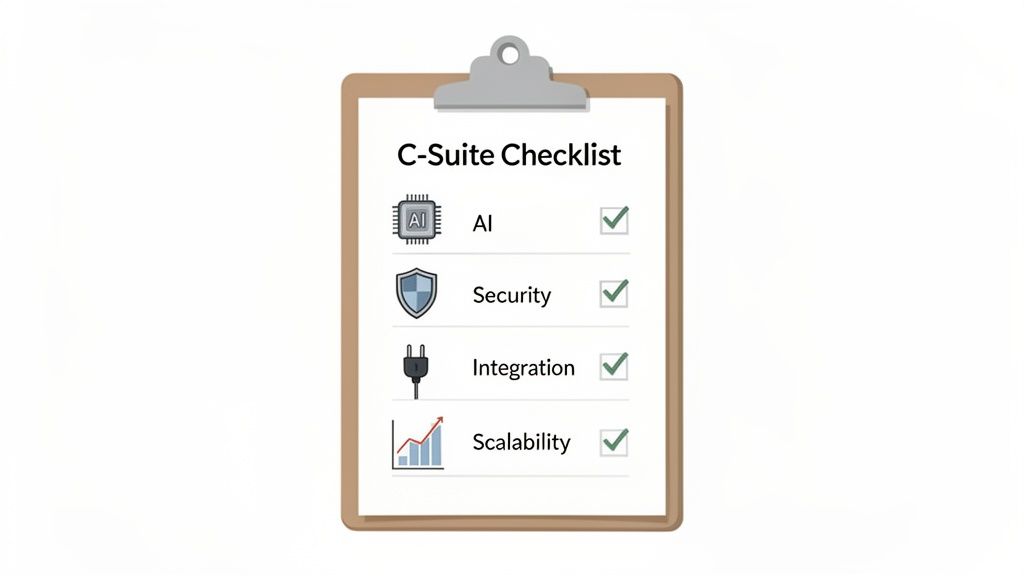
This checklist is designed for senior leaders to rigorously vet potential partners and ensure the selection of an ally capable of delivering long-term strategic value.
Evaluating Technological Prowess
In the digital era, a prospective partner's technology stack is a direct indicator of their capacity for innovation and efficiency. A provider reliant on legacy systems will only replicate the operational inefficiencies you aim to eliminate.
Your due diligence must scrutinize their capabilities in automation and artificial intelligence. A forward-thinking partner will demonstrate how their AI can deflect routine queries, provide real-time intelligence to human agents, and leverage predictive analytics to personalize customer interactions. As you evaluate options, it is valuable to see how industry leaders optimise conversational AI for contact centres.
Furthermore, assess their integration capabilities. A strategic partner must demonstrate proven experience integrating seamlessly with your core enterprise systems, such as Salesforce, HubSpot, or SAP, to create the essential single, unified view of the customer.
Verifying Security and Compliance Posture
For the C-suite, a data breach originating from a third-party vendor is a catastrophic scenario. Therefore, a prospective partner's security and compliance credentials are non-negotiable. This due diligence must be exhaustive.
Demand a portfolio of certifications relevant to your industry and data sensitivity. Key credentials include:
- SOC 2 (Type II): Confirms robust controls for managing customer data based on principles of security, availability, and confidentiality.
- ISO 27001: The global benchmark for information security management systems.
- Industry-Specific Compliance: HIPAA for healthcare, PCI-DSS for financial transactions, and GDPR for operations involving EU citizens are mandatory where applicable.
Executive Action: Do not accept a certificate at face value. Request the full audit reports from their latest cycle. During diligence calls, ask their CISO to walk you through their security incident response plan. A transparent, confident, and detailed response signals a mature and reliable security posture.
Gauging Scalability and Industry Expertise
A strategic partner must be able to scale with your business and possess a deep understanding of your market's unique dynamics. Their ability to scale is not merely about adding more agents; it's about maintaining service quality and operational efficiency during periods of rapid growth or unexpected demand surges.
Practical Example: Ask for a specific case study. A partner who can detail how they successfully scaled to handle a 400% increase in interaction volume for an insurance client following a major weather event has demonstrated proven resilience. This is far more credible than a generic promise of "flexibility."
Equally critical is their vertical expertise. A partner with a substantial track record in your sector—be it EdTech, BFSI, or e-commerce—will understand your customers' expectations and the regulatory landscape from day one. This domain knowledge dramatically reduces onboarding time and training costs, accelerating your time to value.
Incisive Questions for Your RFP Process
The Request for Proposal (RFP) is your opportunity to separate true strategic partners from commodity vendors. Move beyond generic queries and ask pointed, scenario-based questions that reveal their operational DNA.
- On Performance: "Beyond standard KPIs like Average Handle Time, how do you measure and incentivize agent performance tied to our business outcomes (e.g., customer retention)? Provide an anonymized example of a performance scorecard."
- On Scalability: "Detail your operational plan and timeline for handling an unforecasted 50% surge in interaction volume. What are the contractual and cost implications?"
- On Innovation: "Provide a case study where you proactively identified a process improvement for a client that resulted in a quantifiable business impact, such as a 10% reduction in customer churn."
- On Partnership: "Describe your governance model. What is the cadence of strategic business reviews, who from your senior leadership will attend, and what specific data will be presented?"
By focusing your evaluation on these four pillars—technology, security, scalability, and deep industry knowledge—you can confidently choose an outsourcing partner who will act as a true extension of your team and a genuine driver of your success.
Governing the Partnership for Long-Term Success
Executing the contract with an outsourcing partner is the start, not the finish. The real value is realized through diligent governance, continuous improvement, and a collaborative approach to managing the relationship. This is about establishing a framework for mutual success.
The transition from an in-house to an outsourced model requires meticulous planning to avoid disruption. The objective is to align technology, processes, and people to ensure the partnership delivers value from day one. A phased approach is best practice, starting with a deep-dive discovery phase where the partner immerses themselves in your business operations. This is followed by technology integration, where systems like your CRM are linked to create a seamless data flow. A controlled pilot program before full launch is crucial to identify and resolve any issues in a low-risk environment.
Establishing a Joint Governance Committee
To elevate the relationship beyond a simple vendor transaction, a joint governance committee is essential. This body, comprising key leaders from both organizations, serves as the strategic steering group for the partnership.
Its mandate is to ensure ongoing alignment with business objectives, resolve strategic challenges, and drive continuous innovation. This committee should operate under a formal charter defining roles, responsibilities, and communication protocols. Regular meetings (monthly or quarterly) are used to review performance against strategic KPIs, not just operational metrics, and to plan future initiatives. This structure transforms the relationship into a collaborative engine for growth.
Moving Beyond Operational Metrics
A common pitfall is focusing exclusively on traditional, efficiency-based metrics like Average Handle Time (AHT). While AHT indicates speed, it reveals nothing about the quality of the interaction or its impact on the business.
A strategic partnership must be measured by its contribution to the bottom line.
Your Key Performance Indicators (KPIs) and Service Level Agreements (SLAs) must be tied directly to business value. Instead of obsessing over call duration, focus on metrics that correlate with customer loyalty and revenue growth. For example, a retail company should track the impact of service interactions on subsequent purchase frequency and average order value.
Effective governance means shifting the conversation to strategic KPIs. Implementing robust knowledge management best practices is a critical enabler for this, ensuring every agent has the information needed to drive positive business outcomes.
Essential KPIs and SLAs for Your Outsourcing Partner
To build a partnership that drives genuine business value, your Service Level Agreement (SLA) must go beyond basic operational stats. The table below outlines the kind of metrics you should be tracking, moving from efficiency measures to indicators that have a direct impact on your company's success.
| Metric Category | Key Performance Indicator (KPI) | Industry Benchmark (Example) | Strategic Importance |
|---|---|---|---|
| Customer Satisfaction | Customer Satisfaction (CSAT) Score | >80% | Directly measures customer happiness with a specific interaction. |
| Customer Loyalty | Net Promoter Score (NPS) | Varies by industry; +50 is considered excellent | Gauges long-term loyalty and the likelihood of referrals, a key indicator of brand health. |
| Operational Efficiency | First Contact Resolution (FCR) | 70-75% | High FCR reduces operational costs by eliminating repeat contacts and is a major driver of customer satisfaction. |
| Business Impact | Customer Churn Reduction | 5% quarterly improvement | Directly impacts profitability; retaining customers is 5-25x cheaper than acquiring new ones. |
| Sales & Growth | Conversion Rate (Sales/Leads) | Varies by campaign; e.g., 15% for qualified leads | The ultimate measure of success for revenue-focused teams; directly tracks financial contribution. |
By structuring your SLA around these strategic outcomes, you ensure your partner is aligned and incentivized to focus on what matters most: driving sustainable growth for your business.
The Executive Dashboard View
Leading outsourcing partners provide more than static monthly reports; they offer real-time visibility through sophisticated executive dashboards. As a leader, you should be able to log in and see not just call volumes, but a visual breakdown of agent performance correlated directly with conversion rates from your latest marketing campaign.
This high-level oversight provides the C-suite with immediate, data-backed assurance that the partnership is delivering a strong return on investment. You can identify top-performing agents, spot emerging customer trends, and make agile, data-driven decisions. This level of transparency is the hallmark of a true strategic alliance, providing confidence that your contact center is a powerful asset, not a liability.
The Future of CX Innovation Through Outsourcing
Viewing contact center outsourcing as a static, cost-reduction tactic is an obsolete perspective. Today, it represents a dynamic partnership that provides direct access to cutting-edge technology and a global talent pool. For enterprise leaders, outsourcing has evolved from an operational tactic into a continuous source of innovation essential for maintaining market leadership.
The industry has undergone a profound transformation. What was once a straightforward labor arbitrage play has become a hub for customer experience (CX) excellence. The focus has shifted from simply answering calls to intelligently architecting the entire customer journey.

From Cost Centre to Innovation Hub
This evolution is exemplified by the Indian BPO industry. From its origins in the early 2000s as a cost-saving solution, by 2024 it has become a global center of excellence for CX innovation. The industry employs over 1.3 million skilled professionals managing everything from foundational inbound support to complex, AI-driven predictive customer engagement.
This massive, English-speaking talent pool has solidified India's leadership position. The country now captures nearly 40% of the world's sourcing market, with its BPM industry generating $44 billion in annual revenue. This mature technology ecosystem serves as a crucible for developing and deploying next-generation CX technologies.
The modern outsourcing partner is no longer a passive order-taker; they are a proactive strategic consultant. They deliver predictive insights gleaned from analytics and machine learning, helping you anticipate customer needs before they arise. For example, by analyzing interaction data, a partner might identify that 30% of support calls are related to a specific product feature, prompting a proactive update to your knowledge base that deflects future calls.
Using AI for Hyper-Personalised Experiences
The future of CX is hyper-personalization delivered at scale, and AI is the enabling technology. The most advanced outsourcing partners are at the forefront of this movement, using sophisticated tools to craft individualized interactions that foster deep customer loyalty.
- Predictive Analytics: AI algorithms analyze a customer's entire history to predict their current need, enabling intelligent routing to the best-equipped agent or self-service channel. This can reduce customer effort scores by up to 20%.
- Machine Learning: These systems continuously learn from every interaction, refining algorithms to improve response accuracy and relevance over time. This creates a self-improving CX ecosystem.
- Generative AI: Modern AI agents can conduct complex, multi-turn conversations, providing support that is contextual, empathetic, and indistinguishable from a top-performing human agent.
For forward-thinking executives, the strategic implication is clear: an outsourcing contact centre strategy is no longer about marginal efficiency gains. It is about securing a sustainable competitive advantage by integrating into a global ecosystem of talent and technology dedicated to advancing the frontier of customer experience. The tangible impact is evident when exploring how data and AI will transform contact centres for financial services. This strategic partnership model ensures your company can consistently exceed evolving customer expectations.
Frequently Asked Questions for Executives
As a leader, you require answers that address strategic and financial implications. Here are the most pressing questions we hear from executives evaluating an outsourcing contact centre strategy.
How Can We Ensure Our Brand Voice Remains Consistent?
Protecting your brand identity is paramount. The solution lies in treating your outsourcing partner as an embedded extension of your marketing and service teams, not a siloed vendor.
This begins with selecting a partner with proven domain expertise in your industry. From there, you collaboratively build a rigorous training and certification program that goes beyond product knowledge to immerse their agents in your corporate culture, values, and specific communication style.
Governance and technology enforce this consistency. Use shared quality assurance dashboards and AI-powered speech analytics to monitor 100% of interactions for brand voice adherence, sentiment, and compliance. This ensures every conversation is a faithful representation of your brand.
What Are the Primary Data Security Risks?
In the current threat landscape, data security is a board-level concern. Entrusting a third party with customer data demands uncompromising due diligence.
Begin by shortlisting only partners with verifiable, gold-standard compliance certifications like SOC 2 Type II, ISO 27001, and industry-specific mandates such as HIPAA or GDPR. Your contract must contain explicit clauses on data ownership, breach notification protocols, and liability.
For maximum assurance, mandate regular, independent third-party penetration tests and security audits. Elite partners operate on secure, cloud-native platforms, utilizing end-to-end encryption and data masking to protect sensitive information at every touchpoint. This level of security should be a non-negotiable prerequisite.
How Can Outsourcing Manage Seasonal Fluctuations?
This is a core strength of the outsourcing model and a key driver of financial efficiency. Expert providers are architected to manage demand volatility. They maintain large, cross-trained talent pools and employ flexible staffing models to scale resources up or down rapidly.
This creates an "on-demand" workforce. You can instantly increase agent capacity by 200-300% to support a holiday rush or product launch, then scale back down without the burden of fixed overhead or complex HR processes.
Leading providers augment this human elasticity with AI-powered virtual agents that can absorb massive spikes in routine queries (e.g., "Where is my order?"). This strategy converts a fixed operational cost into a variable one, ensuring you only pay for the support capacity you utilize while maintaining consistently high service levels year-round.
Ready to transform your customer interactions into measurable outcomes? DialNexa delivers human-like Voice AI agents that scale your presales, support, and qualification efforts instantly. Discover how our customisable agents can drive your growth by visiting DialNexa's website.

[…] you want extra perspective before making a decision, this Executive's Guide to Outsourcing Contact Center Operations is a useful companion read for leadership teams weighing the […]
Excellent insights on how modern contact center outsourcing has evolved from a cost-saving tactic into a strategic driver of customer experience and business growth. The focus on AI, governance, and measurable outcomes makes this a valuable roadmap for leaders building future-ready CX operations.