
Best AI Tools for Recruitment: Top Picks 2026
Recruiters spend too much time on work that software can handle, especially manual screening, scheduling, and repetitive outreach. In India, that pressure is sharper because hiring demand is concentrated in high-volume roles, digital talent pools are large, and competition for skilled candidates is intense, so speed and consistency matter more than ever.
That is why AI tools for recruitment are no longer a nice-to-have, they’re becoming the operational layer that helps teams process volume, improve recruiter productivity, and shorten time-to-hire.
This ranking focuses on the hiring stage each tool serves best: sourcing, screening, interviewing, scheduling, and voice AI outreach. Where the market data is clear, it’s used directly, including the fact that India’s recruitment-software market is 70% SaaS-delivered in 2025, according to IMARC, and that voice AI and conversational screening represent 38% of enterprise AI hiring deployments in India, per Babblebots’ 2026 hiring statistics.
TL;DR
The best AI tools for recruitment split across five hiring stages: sourcing (Eightfold, SeekOut, hireEZ), screening and conversational engagement (DialNexa, Paradox, impress.ai), structured interviewing (HireVue, Zeko AI), and general-purpose ATS platforms (TurboHire, Zoho Recruit, Manatal).
The right pick depends on where your hiring funnel actually breaks, not on which tool has the longest feature list. Voice-first and conversational tools tend to win on candidate completion rates, sourcing tools win on pipeline volume, and structured interview platforms win on consistency across large hiring programs.
Table of Contents
- 1. DialNexa Labs Private Limited
- 2. Eightfold AI
- 3. SeekOut
- 4. hireEZ
- 5. Paradox Olivia
- 6. HireVue
- 7. TurboHire
- 8. Zoho Recruit
- 9. impress.ai
- 10. Manatal
- 11. Zeko.ai
- Top 11 AI Recruitment Tools Comparison
- Charting Your AI-Powered Hiring Roadmap
1. DialNexa
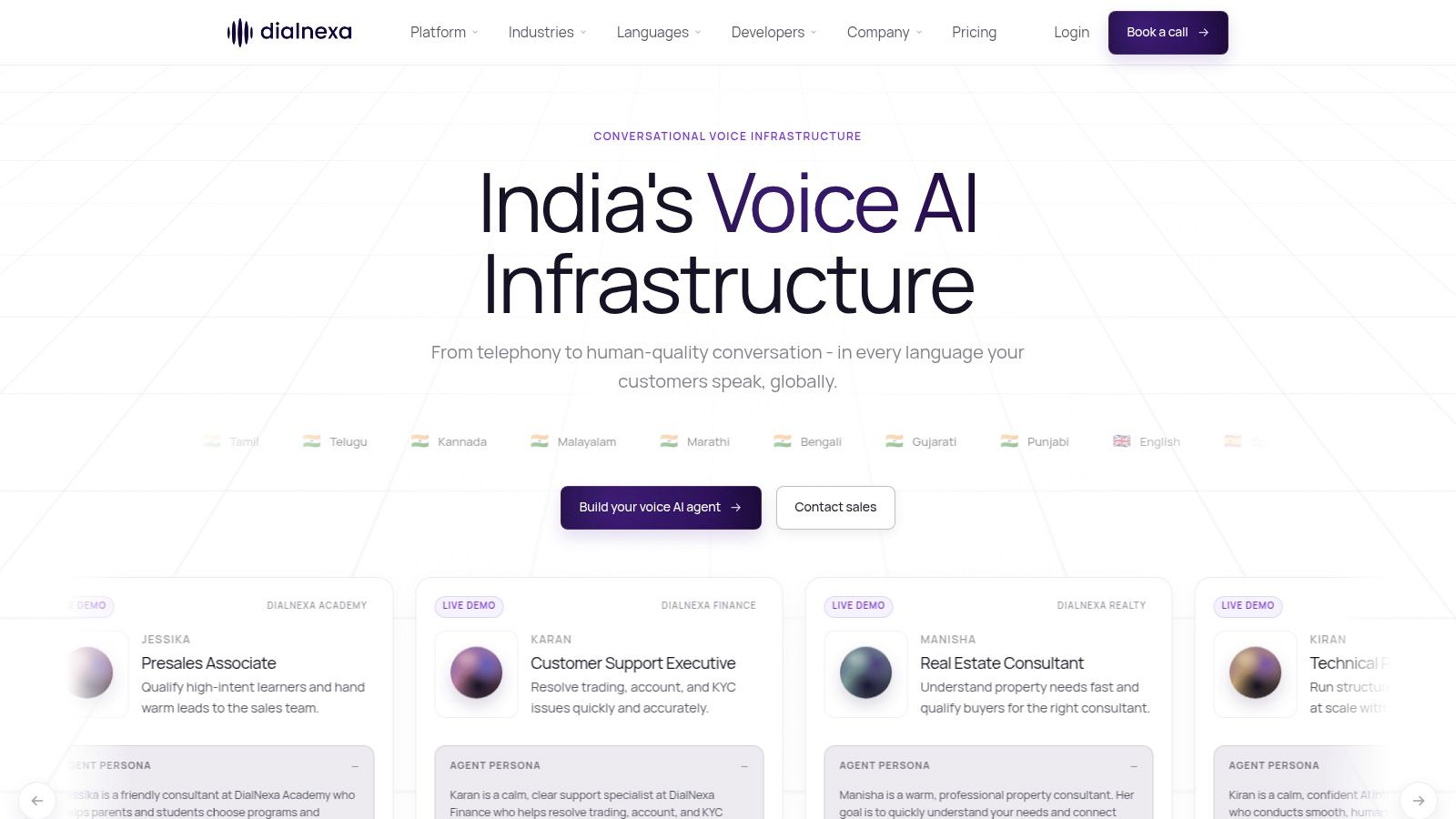
DialNexa treats recruitment screening as a voice workflow, not just a software feature. For Indian hiring teams that need candidate qualification, reminder calls, first-round interviews, or follow-up at scale, that distinction matters.
The platform is built for Hinglish, regional accents, and 22-plus Indian languages, and is designed to run in production with latency under 300ms P50 and support for over 10,000 concurrent calls.
Why it leads the voice AI category
Voice AI and conversational screening are the fastest-growing AI hiring category in India, accounting for roughly 38% of enterprise AI hiring deployments. That makes a voice-first platform especially relevant for frontline hiring, BPO, manufacturing, and any role where email drop-off hurts completion.
DialNexa’s case studies report connect rates improving from about 47% to 91%, lead-to-booking rising from 2% to 8%, and AI-qualified leads matching human judgment at roughly 97% accuracy. A recent India voice AI report covering over a million AI-assisted business calls found similar containment and accuracy patterns across recruitment and sales screening use cases. For recruiters, the logic is simple: if voice outreach is where the funnel leaks, automating that step is more valuable than adding another dashboard.
Best fit for high-volume, multilingual hiring
Ready-made personas make the platform more than a generic telephony layer. A team can start with a prebuilt workflow, then adapt it through dashboards and APIs for recruitment screening, appointment reminders, KYC guidance, or candidate qualification, which matters for HR and talent teams because setup speed can decide whether automation gets adopted or shelved.
If your hiring funnel depends on phone contact, regional-language engagement, or repeated follow-up, voice AI should be evaluated before another sourcing tool.
- Production-first scale: engineered for 10,000-plus concurrent calls and stable performance under load.
- Localized communication: supports 22-plus Indian languages and mixed-language flows for regional candidates.
- Fast deployment: agents can be launched quickly, with free credits available for testing.
- Enterprise controls: telephony, orchestration, analytics, compliance, and human handoff are part of the stack.
- Pricing is not publicly itemized, so enterprise buyers will need a sales conversation.
A talent team hiring customer support across several states can use DialNexa to screen candidates in their preferred language, confirm availability, and reduce no-shows without asking recruiters to make every call themselves.
2. Eightfold AI
Eightfold AI is the strongest choice when the hiring challenge isn’t just filling roles, but understanding skills across a large talent base. It’s built for enterprise environments where recruiters need deep-learning matching, candidate rediscovery, skills inference, and internal mobility in one system.
Where it fits in the hiring stack
Eightfold is best used upstream of interviews. It helps teams match external applicants and internal employees to open roles, then organize that data into a single view for TA and HR leaders. In a large organization, that can reduce the time recruiters spend searching disconnected systems for people who already fit the brief.
Why executives buy it
Eightfold’s value shows up when hiring leaders need consistency across business units. Its enterprise integrations make sense for companies running multiple ATS or HR systems, and its analytics help leaders see where talent sits and where it’s missing.
Choose Eightfold when your recruitment problem is really a skills-visibility problem.
- Strong enterprise matching across internal and external talent pools.
- Consolidates talent data into a broader talent-intelligence view.
- Pricing is custom and premium, which fits large buyers better than lean TA teams.
3. SeekOut
SeekOut is best understood as a sourcing and search engine for recruiters who need structure around hard-to-fill roles. It combines AI-generated searches from a job description, skills adjacency suggestions, AI screening, and centralized workspaces for searches and outreach.
Why it’s strong for specialist hiring
SeekOut works best when recruiters know the role but don’t want to build every search string by hand. The platform organizes work around openings rather than just lists of profiles, and gives teams diversity filters and talent-pool analytics for better pipeline visibility.
Best use case
SeekOut is a good fit for organizations that want to accelerate first-pass sourcing without hiring a large dedicated sourcer bench, and for teams that need more than keyword matching, since skills adjacency helps recruiters discover candidates who don’t mirror the job description word for word.
- Fast first-pass sourcing for niche and technical roles.
- Searches are role-centric, which helps recruiter collaboration.
- Pricing isn’t public, so fit depends on the sales process.
4. hireEZ
hireEZ is an outbound sourcing platform for teams that need to find and engage passive candidates fast. It builds AI searches from job descriptions or skills keywords, discovers contact details, sequences outreach, and keeps everything in a CRM-like pipeline.
Why outbound teams value it
The point of hireEZ is simple: reduce manual sourcing work and keep outreach moving. Its market-insight and pipeline analytics layer helps recruiters understand where talent sits, while ATS sync keeps the sourcing workflow connected to the system of record. One India-specific buying guide warns that platforms relying only on LinkedIn and Indeed can leave a large share of the pipeline unsourced, given how much sourcing in India spans Naukri, Apna, Hirect, Internshala, and regional college boards.
Best fit for global or cross-border recruiting
hireEZ is strongest when you need contact discovery and engagement sequencing, not just candidate storage. Email-centric workflows can still require deliverability tuning, but the trade-off is a cleaner outbound engine than many all-in-one systems offer.
- Strong sourcing and outreach for passive candidates.
- Good ATS sync and CRM functions.
- No public pricing page, so procurement will be sales-led.
5. Paradox Olivia
Paradox, through Olivia, is built for candidate communication at scale. It screens, schedules, answers FAQs, and moves hourly and frontline candidates through the funnel using chat, SMS, web, and WhatsApp.
Why conversational hiring works here
India’s recruitment market rewards speed, and mobile-friendly workflows help reduce drop-off. Independent reporting suggests AI phone screening can reach 74% to 82% candidate completion rates compared with 28% to 35% for email-based screening in frontline and blue-collar roles. Even though Olivia is chat-first rather than voice-first, the core lesson is the same: if the candidate interaction is easier, completion improves.
Where it belongs in the shortlist
Paradox is best when candidate engagement is the bottleneck rather than sourcing. It’s less compelling for niche recruiting, where a smaller applicant volume makes conversational automation less valuable.
If your recruiters spend their day answering the same questions and chasing the same calendar slots, Olivia is aimed at the right friction point.
- 24/7 multilingual engagement across chat and messaging channels.
- Automates screening and scheduling for hourly and frontline roles.
- No public pricing, so evaluation requires a sales process.
6. HireVue
HireVue is the most established choice for structured interviewing, AI-assisted assessment, and interview workflow automation. It offers on-demand and live video interviewing, an AI interviewer, scheduling, and skills or game-based assessments.
Where it adds the most value
HireVue shines when the interview stage is the bottleneck. It standardizes how candidates are evaluated, which is especially relevant in compliance-heavy environments where leaders care about repeatability and documentation.
Best fit for structured hiring
HireVue is a good fit for mid-size and large enterprises that need scalable interview infrastructure and a more formal assessment process. Candidate experience can vary with one-way video, so the tool fits best where standardization matters more than a highly conversational process.
- Enterprise stability and global reach.
- Covers screening, interviewing, scheduling, and assessment in one suite.
- Pricing is not public, and the sales cycle is enterprise-style.
7. TurboHire
TurboHire is one of the most relevant India-born platforms in this list because it combines parsing, matching, workflow automation, interview automation, and analytics in a recruitment orchestration suite.
Why it fits Indian hiring teams
Indian teams often need local support, regional implementation experience, and workflows that respect multi-role, high-volume hiring. TurboHire fits that reality better than many global-first tools because it is built with India use cases in mind, and shows up in environments that care about Microsoft Azure marketplace presence and enterprise integrations.
Best use case
TurboHire is best for teams that need end-to-end orchestration across approvals, SLAs, and interview steps, with more control than a simple ATS and more operational depth than a standalone sourcing tool.
- India-ready support and implementation experience.
- Broad feature coverage across parsing, matching, and interview automation.
- Pricing requires a demo, so procurement is not self-serve.
8. Zoho Recruit
Zoho Recruit is the practical, budget-friendly choice for teams that want an ATS with usable AI instead of a heavy talent-intelligence suite. It includes AI-assisted matching, candidate ranking, scheduling, and video-interview add-ons, plus transparent INR pricing and local billing support.
Why it appeals to India-based buyers
The platform sits inside the broader Zoho ecosystem, so companies already using Zoho products can keep procurement and support inside one vendor family. Local pricing, local billing, and native support are operational advantages, not cosmetic ones, when a team needs quick adoption and predictable spend.
Best use case
Zoho Recruit is a good choice when the team needs a capable ATS with enough AI to speed screening and scheduling, but not a full enterprise transformation. The AI depth is lighter than specialized talent-intelligence platforms, but the ease of adoption is the point.
- Transparent INR pricing and easy onboarding.
- Works for both corporate HR and staffing agencies.
- AI is practical rather than deep, compared with enterprise intelligence suites.
9. impress.ai
impress.ai focuses on conversational screening, candidate Q&A, and assessment flows that standardize early-stage evaluation. It is used across APAC and has India sales and support channels, which makes it relevant for organizations hiring at scale in the region.
Where it helps most
The platform’s value is consistency. By structuring candidate interaction and scoring early responses, impress.ai helps recruiters reduce noise before interviews begin, which matters in volume hiring where reviewing every applicant manually is both slow and uneven.
Best fit for APAC hiring programs
impress.ai works well for enterprises that already know their screening questions and want to enforce them consistently. Its enterprise implementation playbooks are useful for large teams that need repeatability and analytics, not just a chat interface.
Conversational screening works best when the question bank is tightly tied to role outcomes, not broad competency language.
- Good throughput for volume hiring, with a strong APAC footprint.
- Standardizes early screening, which helps reduce inconsistency.
- Pricing is not public, so buyers need discovery calls.
10. Manatal
Manatal is the easiest recommendation for smaller teams that want a modern ATS with AI features and a fast setup. It includes AI-suggested candidates, AI-generated job descriptions, pipeline management, email automation, and job-board posting.
Why it fits lean teams
Manatal works because it lowers the barrier to entry. Smaller HR teams don’t need a complex talent-intelligence rollout to start getting value from AI, they need faster time-to-value and a tool they can adopt. It also integrates with HRIS and payroll tools, which helps it sit inside a broader people stack.
Best use case
Manatal is best for SMEs and mid-market teams that need broad ATS functionality with AI assistance, but not enterprise-level complexity. The main limitation is that some advanced AI features are reserved for higher tiers.
- Transparent pricing and low starting cost.
- Quick setup for lean teams.
- Advanced AI features are tiered, so deeper use may cost more.
11. Zeko AI
Zeko AI is an enterprise-grade AI hiring platform built around a suite of specialized agents, covering sourcing, screening, interviewing, and support, that work across the full hiring lifecycle from job requirement alignment to final interview feedback.
Why it stands out for high-volume enterprise hiring
Zeko AI’s adaptive interviews run live, human-less sessions that adjust in real time to candidate responses, supporting video, audio, and coding assessments in one flow. The platform also holds SOC 2, GDPR, and ISO 27001 credentials, and reports that its automation can cut overall hiring time by as much as 80%, taking cycles that typically run weeks down to days.
Best fit for structured, repeatable enterprise roles
Zeko AI is best suited to enterprises hiring for high-value, recurring roles where interview consistency matters more than a highly conversational candidate experience. It integrates with ATS platforms including Workday and SAP.
Zeko AI fits best when the hiring problem is interview consistency and speed at the enterprise level, not multilingual voice outreach or high-volume phone screening.
- Full-lifecycle agent suite covering sourcing, screening, interviewing, and post-interview alignment.
- Compliance-ready with SOC 2, GDPR, and ISO 27001 credentials for regulated-industry buyers.
- Pricing is not publicly itemized, so enterprise buyers will need a sales conversation.
Top 11 AI Recruitment Tools Compared
|
Tool |
Core Capability |
Best For |
Pricing |
|---|---|---|---|
|
DialNexa |
Voice AI for screening, qualification, reminders |
High-volume, multilingual hiring |
Free credits, custom enterprise |
|
Eightfold AI |
Deep-learning talent matching and skills inference |
Large enterprises with complex hiring |
Custom, premium |
|
SeekOut |
AI sourcing and role-centric search |
Technical and specialist roles |
Custom plans |
|
hireEZ |
Outbound sourcing and contact discovery |
Cross-border and passive candidate outreach |
Custom, contract-based |
|
Paradox Olivia |
Conversational chat and WhatsApp screening |
High-volume frontline and retail hiring |
Custom enterprise |
|
HireVue |
Video interviewing and structured assessment |
Mid-large enterprise interview programs |
Custom, enterprise |
|
TurboHire |
Recruitment orchestration and parsing |
India enterprises, multi-role hiring |
Demo or quote |
|
Zoho Recruit |
ATS with AI matching and scheduling |
SMEs and staffing agencies in India |
Transparent INR plans |
|
impress.ai |
Conversational screening and scoring |
APAC high-throughput screening |
Custom, scoping required |
|
Manatal |
Cloud ATS with AI recommendations |
SMEs and mid-market teams |
Transparent, low starting cost |
|
Zeko AI |
Full-lifecycle AI hiring agents |
Enterprise, high-value recurring roles |
Custom, quote-based |
Charting Your AI-Powered Hiring Roadmap
The smartest way to evaluate AI tools for recruitment is to map them to the stage where your funnel breaks. If your team is losing candidates on calls or struggling with regional language engagement, voice AI deserves first attention, especially because India’s market is already moving toward SaaS delivery and conversational screening is becoming a meaningful part of enterprise deployment.
If your pain is sourcing, tools like SeekOut and hireEZ are stronger fits. If your bottleneck is structured interviews, HireVue or Zeko AI belong on the shortlist. If you need a practical ATS with AI, Zoho Recruit and Manatal are safer entry points.
For executives, the decision should not be based on feature count alone. The right question is where the tool sits in the workflow, how quickly it integrates with your ATS, and whether it improves measurable outcomes such as time-to-fill, match quality, completion rates, or candidate response.
There’s also a governance layer that too many buying guides ignore. Quartz has warned that AI should be used to audit recruiting practices rather than serve as a rubber stamp for algorithmic decisions. That means the best platform is often the one that integrates cleanly, explains its outputs, and leaves room for human review. In practice, that’s the difference between buying automation and buying control.
Pilot before you commit. Start with a free trial or credits where possible, test one high-volume role, and measure whether the tool improves recruiter productivity. Then expand only after you’ve seen how it performs with your own candidates, your own ATS, and your own hiring patterns.
Conclusion
Choosing among AI tools for recruitment comes down to identifying where your hiring funnel actually breaks, sourcing, screening, interviewing, or coordination, rather than picking the platform with the most features.
If voice-led screening or candidate qualification is part of your roadmap, DialNexa is one option worth testing on your own hiring volume and languages before you commit to a longer contract.
FAQs
1. What are the best AI tools for recruitment in 2026?
The best AI tools for recruitment depend on which hiring stage needs the most help. DialNexa and Paradox lead on voice and conversational screening, Eightfold and SeekOut lead on sourcing and talent intelligence, HireVue and Zeko AI lead on structured interviewing, and Zoho Recruit or Manatal work well as general-purpose ATS platforms for smaller teams.
2. Which AI recruitment tool is best for high-volume hiring in India?
Voice AI and conversational platforms tend to perform best for high-volume Indian hiring, since they handle regional languages and reduce the drop-off common with email-based screening. Babblebots’ 2026 hiring statistics found AI phone screening can reach 74 to 82% candidate completion, compared with 28 to 35% for email-based screening in frontline roles.
3. Are AI recruitment tools expensive?
Pricing varies widely. Platforms like Zoho Recruit and Manatal publish transparent, budget-friendly pricing suited to smaller teams, while enterprise platforms like Eightfold, HireVue, and Zeko AI typically require a custom quote after a sales conversation. Several tools, including DialNexa and Manatal, offer free trials or credits for initial testing.
4. Can AI recruitment tools replace human recruiters?
No. These tools are best at repetitive, high-volume tasks like screening, scheduling, and first-pass sourcing. Recruiters and hiring managers still make final decisions, review edge cases, and handle the judgment calls that come with evaluating a candidate for culture fit or long-term potential.
5. What should I check before buying an AI recruitment tool?
Check whether it integrates natively with your existing ATS, which languages and regions it genuinely supports, whether pricing is transparent or sales-led, and whether the vendor allows a pilot on your own hiring data before you commit. The right question is where the tool sits in your workflow, not how many features it lists.

This is a helpful comparison of AI recruitment platforms, especially for understanding how different tools fit different hiring needs. I like how the content focuses on practical use cases, scalability, and candidate experience rather than just listing features.
This is a valuable overview of AI recruiting platforms, especially for high-volume and multilingual hiring needs. The comparison clearly highlights how Voice AI and talent intelligence can improve screening, sourcing, and overall recruitment efficiency.
This is a useful overview of AI tools transforming recruitment in 2026. The guide offers practical insights into how these technologies can streamline hiring workflows, save time, and improve the overall recruitment experience.
A well-structured comparison of AI recruiting platforms, covering voice screening, sourcing, candidate engagement, interviewing, and end-to-end hiring automation.
The clear use cases and practical selection points make this guide helpful for hiring teams choosing the right AI solution for their needs.
A very useful comparison of AI recruiting tools, highlighting how automation can improve candidate engagement, screening efficiency, and hiring outcomes. The platform-wise breakdown makes it easier for HR teams to identify the right solution based on their recruitment needs and budget.