
Narrator Voice App Guide for Enterprise Leaders in 2026
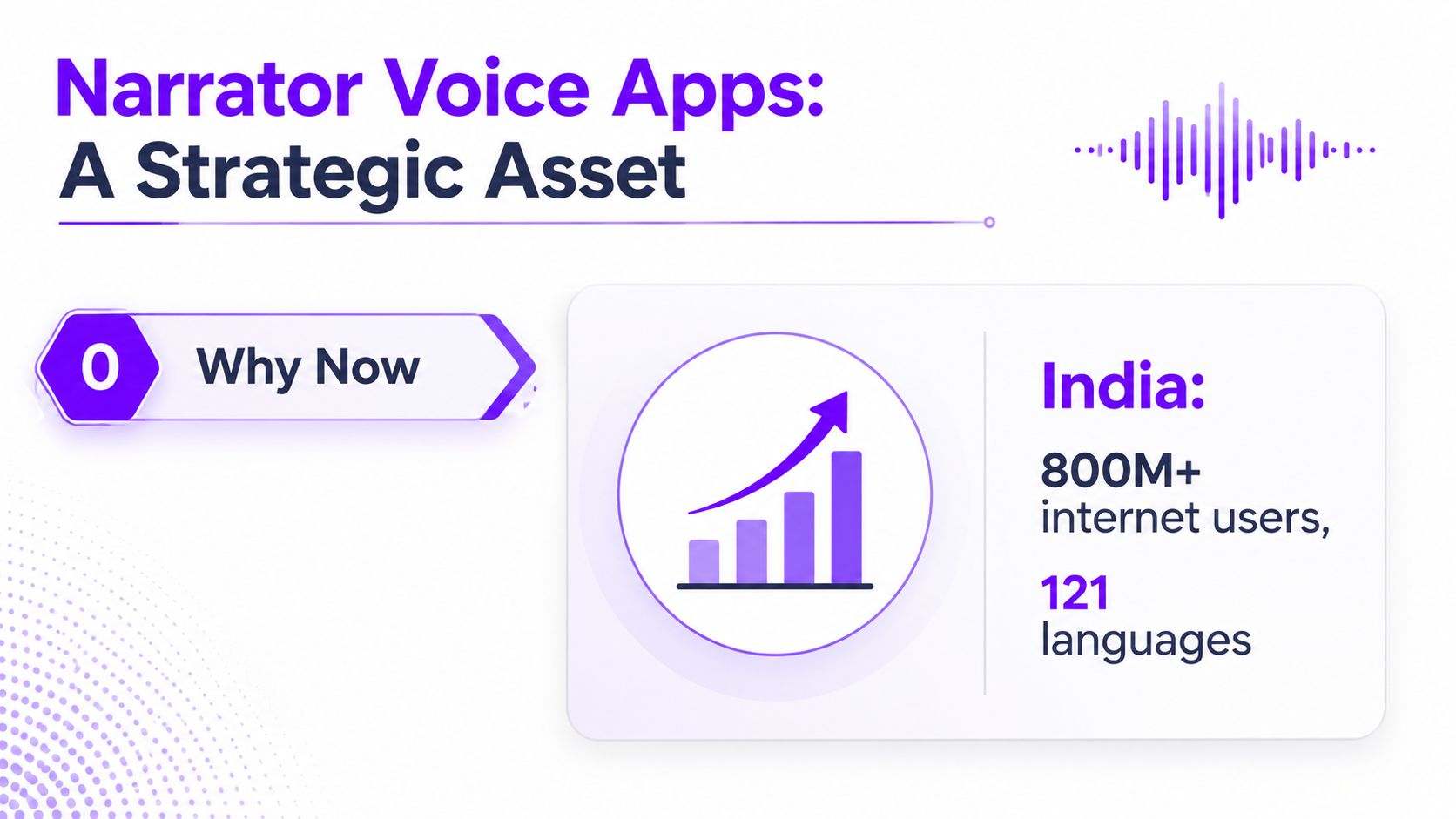
India's 800 million+ internet users by 2023 and its 121 languages spoken by 10,000 or more people in the 2011 Census force a different conclusion about narration software, because scale in India is linguistic as much as digital (bumetric reference). A narrator voice app is no longer a novelty for demos, it's part of the operating layer for teams that need to speak consistently in Hindi, English, and regional languages across education, commerce, support, and outreach.
That shift matters because enterprises don't buy voice for entertainment. They buy it when they need repeatable messaging, lower handling friction, and a voice layer that can sit inside admissions, collections, lead qualification, customer support, and property workflows. In India, that also means the voice layer has to tolerate code-switching, local pronunciation, and short mobile sessions, because the online audience is large enough that poor narration quality becomes a conversion problem, not a cosmetic one.
Table of Contents
- Why Narrator Voice Apps Are Now a Strategic Asset
- How Narrator Voice Apps Actually Work
- AI Narration Versus Recorded Human Voices
- Enterprise Use Cases With Measurable Outcomes
- Integration Architecture and Compliance Essentials
- Vendor Selection Criteria for CXOs
- Measuring Success and Scaling Voice AI
Why Narrator Voice Apps Are Now a Strategic Asset
India makes the case for narration software more clearly than any generic global market slide ever could. The country crossed 800 million+ internet users by 2023, while the 2011 Census recorded 121 languages spoken by 10,000 or more people each, with 22 languages scheduled in the Constitution and Hindi plus English widely used in formal digital services (bumetric reference). That combination changes the buying logic for CXOs, because a voice layer that cannot handle multiple languages and accents is not enterprise-ready in India.
A narrator voice app sits between a basic text-to-speech widget and a full voice operations stack. The widget produces audio. The enterprise version has to sustain brand tone, support multilingual output, and slot into workflows where the same script may be used for a prospect in Bengaluru, a student in Lucknow, and a customer in Surat. In EdTech, BFSI, real estate, and D2C, that difference decides whether narration is a content toy or a production asset.
Practical rule: if a team is already localising email, chat, and landing pages, voice should be treated with the same governance. Otherwise, every recording cycle becomes a manual bottleneck.
| Driver | Enterprise Impact | Owner |
|---|---|---|
| Multilingual reach | Makes one script usable across Indian language markets | Product, CX, Operations |
| High internet adoption | Expands the audience for app-based narration | Growth, Marketing |
| Repeatable voice output | Keeps messaging consistent across high-volume workflows | Contact Centre, Sales Ops |
| Accessibility | Helps users who prefer listening over reading | Learning, Customer Success |
| Workflow integration | Embeds voice into existing systems rather than creating a side channel | CTO, Engineering |
The strategic question for executives is no longer whether AI voice sounds acceptable in a demo. It's whether the tool can support thousands of daily interactions without drift in tone, pronunciation, or routing. That is why procurement teams now need to ask about language coverage, voice governance, and where the narration engine sits in the stack before they evaluate cost.
How Narrator Voice Apps Actually Work
A narrator voice app functions like a production system that converts business text into controlled spoken output. One layer handles the source text, another applies language and intent rules, and a final layer renders the voice with the right pacing and emphasis. That matters because enterprise buyers often reduce voice to “text in, audio out”, while the value sits in how the system manages language, context, and delivery across workflows.
The pipeline behind the voice
The pipeline usually starts with speech recognition when the workflow begins from an inbound voice trigger. It then moves through natural language processing and, in more advanced setups, large language model reasoning when the system needs to interpret intent or generate a response. The last stage is text-to-speech synthesis, where the system turns the prepared text into audio. Microsoft's Narrator guide shows how high-definition voices can be delivered through downloadable models, which provides a useful reference point for low-latency, offline-capable synthesis architecture, even though that published example is for English (United States) (Microsoft Narrator guide).
A vendor demo should answer three questions quickly. Does the system support neural voices that stay natural under repeated use? Does it provide accent-aware output for Indian languages? Can it run within the latency your customer-facing workflow can tolerate? A cloud API may work for a non-urgent explainer clip, but live support or presales flows usually need tighter control over architecture and routing.
Practical rule: treat voice quality and system latency as one decision. A voice that sounds good after a long pause still fails the user experience.
Why controls matter more than “voice quality”
Features such as voice cloning, SSML, and prosody control exist because brand consistency is not just about selecting a pleasant voice. It is about controlling emphasis, pauses, and pace so a compliance disclaimer, a programme introduction, or a property walkthrough sounds deliberate every time. Stronger vendors also separate model selection from export formatting, which matters when teams need editable masters before final delivery.
For teams that evaluate spoken journeys and interface design together, the most useful external reference in the brief is voice UI tips from Wonderment Apps. The point is not that every app needs search UI guidance. Spoken interfaces perform better when the surrounding interaction design is clear, short, and predictable.
For buyers comparing voice realism and deployment fit, DialNexa Labs Private Limited's realistic AI voice overview is a useful benchmark for how vendors frame controllability, output consistency, and turnaround speed.
The common mistake is to treat narrator software as either a file exporter or a chatbot. It is neither. It is a production system that translates business text into controlled spoken output, and in India the vendor's ability to handle language variety is part of the architecture, not a cosmetic add-on.
AI Narration Versus Recorded Human Voices
The core buying decision isn't “AI or human”, it's where each one is strongest in the workflow. AI narration wins when the enterprise needs consistent delivery at scale, fast multilingual switching, and coverage outside working hours. Human narration still wins when the message carries empathy, legal nuance, or high-stakes persuasion that depends on trust earned through a named voice.
The trade-off becomes clearer when you compare the two on enterprise criteria rather than creative preference. A recorded human voice can feel warmer and more convincing in a regulated explanation or a sensitive customer recovery call. An AI voice can keep output standardised across thousands of reminders, qualification calls, or multilingual FAQs without asking a studio to re-record every update.
A useful reference point for enterprise buyers is the more realistic voice tooling category represented by Vocuno's vocal tool. The signal there is not novelty, it's that buyers are now comparing controllability, output consistency, and turnaround speed instead of asking only whether the voice “sounds nice”.
| Criterion | AI Narration | Human Narration | Recommendation |
|---|---|---|---|
| Consistency | Stable across repeated use | Can vary by session and re-recording | Use AI for repeatable scripts |
| Cost structure | Better suited to high-volume workflows | Higher production effort for each update | Use AI for routine journeys |
| Latency | Can be fast when integrated well | Depends on studio and editing cycles | Use AI for responsive workflows |
| Emotional nuance | Improving, but still limited in edge cases | Stronger for empathy and persuasion | Use humans for sensitive moments |
| Compliance | Easier to standardise scripts and disclosures | Strong when a named voice is required | Use a hybrid model |
The shortest way to say it is this. AI narration should handle qualification, reminders, FAQs, and routing, while human voices should be reserved for moments where a customer needs reassurance, a regulator expects a named voice, or a negotiation needs emotional judgement. That hybrid model is especially practical in BFSI, where over-automation can create friction, and in healthcare, where tone matters more than volume.
The other mistake is using human narration for every workflow because it feels premium. In practice, that often slows updates, weakens multilingual agility, and makes it harder to maintain consistent messaging across teams. DialNexa's own positioning around human-like voice AI agents fits this hybrid view, because the platform is built for spoken workflows rather than a single one-off recording (DialNexa's realistic AI voice article).
Enterprise Use Cases With Measurable Outcomes
EdTech gives the clearest operational test case for a narrator voice app. An admissions team handling discovery calls in Hindi and English needs the same explanation repeated with enough discipline that counsellors do not improvise on fees, intake dates, or course structure. The app can pre-qualify, explain the basics, and route the right leads to the right human counsellor, so the workflow starts to protect team time instead of just generating audio.
Where the workflow changes
In BFSI, the problem shifts from lead handling to trust and clarity. The voice layer can support KYC guidance, product education, and trading support across regional languages, but only if the script stays tight and the handoff to a human agent stays clean when the conversation turns account-specific. In real estate, the same system can automate site-visit booking for new launches, where response speed matters because interested buyers move quickly and sales teams cannot manually chase every enquiry.
Healthcare follows a different pattern. Patient reminders and prescription follow-ups work best when the voice is clear, repetitive, and easy to understand in a noisy or rushed environment. In that setting, the app's value comes less from persuasion and more from reliable delivery of essential information.
Practical rule: voice AI should handle standardised work first, then hand over as soon as the conversation becomes emotional, complex, or compliance-heavy.
For procurement teams, the more useful question is what improvement a vendor can support. DialNexa Labs Private Limited reports outcomes that place a realistic ceiling on what to expect, including better connect rates and stronger lead-to-booking performance in its own customer results. Those figures should not be treated as universal, but they do show what a disciplined spoken workflow can change when qualification and booking are built into the flow. For the compliance side of that evaluation, DialNexa's regulatory compliance guide for voice AI is the more relevant internal reference, because the control question matters as much as the speech quality.
A practical way to review these use cases is by workflow, not by industry label.
- EdTech admissions: the app standardises first-touch counselling, so the human team spends more time on fit and conversion.
- BFSI support: the app handles structured guidance and language switching, while agents step in for account-specific questions.
- Real estate booking: the app captures interest quickly and reduces back-and-forth before site visits.
- Healthcare reminders: the app delivers repeatable follow-ups that are easy for patients to understand.
The conclusion directors should draw is straightforward. Narrator voice apps create measurable value when the journey is repetitive, multi-lingual, and time-sensitive. They lose value when every interaction requires deep empathy or individual judgement.
Integration Architecture and Compliance Essentials
A narrator voice app only behaves like an enterprise system if the integration layer is designed for the workflow, not bolted on after the fact. REST fits asynchronous generation and batch jobs, WebSocket fits live conversational flows, and SIP matters once the voice layer connects to telephony. Each option sets a different latency budget, so the architecture has to follow the business case first.
Before committing engineering time to that SIP integration, it's worth benchmarking the underlying telephony spend; DialNexa’s MyOperator pricing breakdown lays out the plan tiers, add-ons, and per-minute costs Indian CXOs are budgeting against.
Deployment model choices
Cloud deployment is usually the fastest way to test a new voice workflow, especially for proof-of-concept work and lower-risk content generation. On-premise or hybrid setups make more sense when data residency, controlled storage, or tighter governance matters, which is often true in BFSI and some healthcare use cases. The correct choice depends on where the audio, transcripts, and call metadata live, and who can reach them.
For a plain-language view of voice automation controls, DialNexa's regulatory compliance guide for voice AI is the more relevant reference. The vendor checklist still needs to be built inside the organisation, because India deployments have to account for local data handling, auditability, and sector-specific recording practices.
What CTOs should validate
Observability usually decides whether a rollout survives beyond pilot stage. Teams should insist on call transcripts, sentiment scoring, barge-in handling, and a clear fallback to human agents. If a vendor cannot show those controls in a live demo, the product is not ready for enterprise traffic.
Security and governance need the same level of scrutiny. In India, DPDP Act alignment matters for personal data handling, while BFSI teams need to verify recording and storage practices against internal risk rules, and healthcare teams should adopt privacy and retention practices that match their own clinical obligations. The engineering team should not wait for legal review to expose weak controls after the pilot starts.
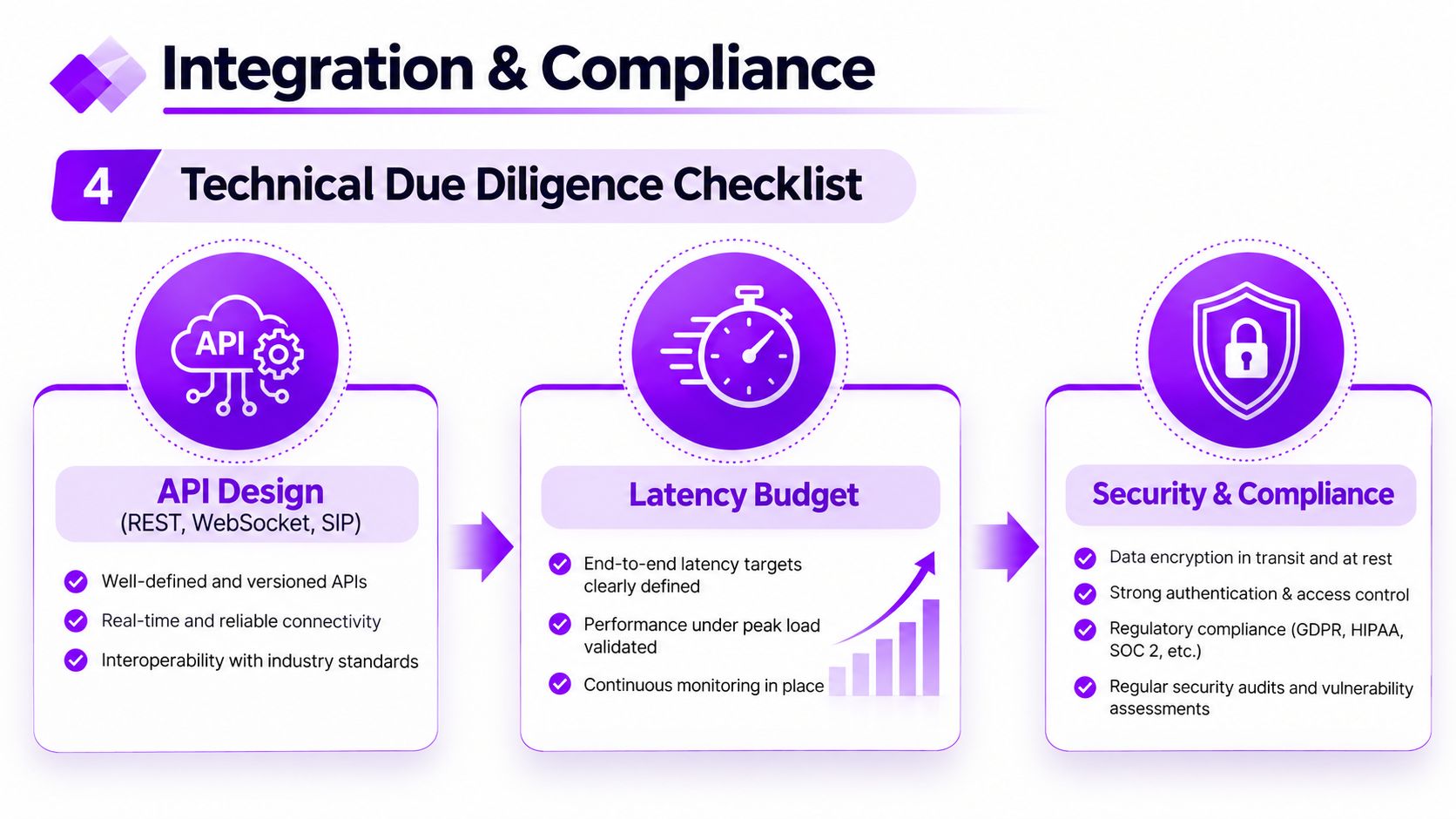
A strong procurement discussion usually comes down to four questions. Can the vendor support the channels your workflow already uses? Can it prove the latency is acceptable for live calls? Can it show where the data resides? And can it fail over to a human without losing context?
Vendor Selection Criteria for CXOs
CXOs should score vendors on language breadth first, because India-specific coverage is not optional if the tool is meant to support scale. The shortlist should include Hindi, Tamil, Telugu, Bengali, Marathi, and any other language relevant to the business footprint, with accent-aware delivery tested on real scripts rather than marketing samples. If a vendor can't show that in a demo, it will struggle in production.
Voice quality matters, but it has to be measured in the context of use. Teams often ask for MOS scoring as a proxy for sound quality, yet an audio score alone won't tell you whether the voice works in a noisy support environment or across code-switched scripts. Security posture matters just as much, so ask for ISO 27001, SOC 2, and encryption at rest and in transit where those controls are relevant to your risk framework.
A useful weighted rubric should keep the conversation grounded.
| Criterion | Weight | Why It Matters | What to Ask |
|---|---|---|---|
| Language coverage | High | India workflows fail without regional coverage | Which Indian languages are live today? |
| Voice quality | High | Poor audio reduces trust and completion | Can you show MOS or equivalent testing? |
| Latency | High | Live calls break when pauses feel unnatural | What is the response path for real-time sessions? |
| Security posture | High | Sensitive data needs formal controls | What certifications and encryption controls are in place? |
| TCO | Medium | Per-minute models can punish long calls | How do per-session and per-minute pricing compare? |
| References | Medium | Similar deployments reduce implementation risk | Which clients use this in the same industry? |
The most common red flags are easy to spot. A vendor who cannot demonstrate natural multi-turn conversation is not ready for enterprise voice. A vendor with weak Indian language coverage will force you into workarounds. A pricing model that charges in a way that punishes longer qualified calls can distort agent behaviour and reduce call quality.
Practical rule: do not buy a voice platform from a polished demo alone. Test it against the longest, messiest conversation your team actually handles.
One more thing matters for executive buyers. Ask whether the vendor can support internal rollout discipline, not just a single use case. If the platform cannot be adapted across presales, support, and follow-up workflows, the organisation will end up with a narrow pilot instead of a reusable voice capability.
Measuring Success and Scaling Voice AI
A narrator voice app becomes strategic only when the operating rhythm around it is disciplined. The KPI triad that matters is conversation quality, operational efficiency, and revenue impact. If leadership tracks only one of those, the rollout will drift into either vanity metrics or cost-cutting theatre.
The KPI triad that leaders should watch
Conversation quality should include containment rate, CSAT, and transfer rate. Operational efficiency should include cost per qualified lead, average handling time, and after-hours coverage. Revenue impact should include conversion rate, booked meetings, and retention lift, with the exact KPI chosen based on the department owning the workflow.
DialNexa's analytics-oriented material is relevant here because it frames voice AI as a measurable system rather than a black box. Its metrics guide on contact centre voice AI analytics deployments is the right kind of reference for leaders who need a dashboard mindset, not a feature list (voice AI analytics metrics guide).
What a 30-60-90 day rollout should look like
The first 30 days should focus on script control, channel integration, and baseline measurement. The next 30 days should add A/B testing across voice personas, call timing, and routing logic. By day 90, the team should know which personas help qualification, which ones create friction, and where the human team still outperforms the automation.
Guardrails matter more than enthusiasm. Escalate to a human agent when the customer asks for a specific exception, shows frustration, or moves into account-specific detail. That rule protects brand trust and stops the system from overreaching.
A few execution habits separate useful deployments from shelf-ware.
- Track by workflow, not by tool: admissions, support, and booking each need different success measures.
- Compare against a control group: if you do not keep a human-only baseline, you will overestimate the lift.
- Review call transcripts weekly: model drift and script decay show up there first.
- Refresh voice personas carefully: a voice that fits one workflow can underperform in another.
The bigger strategic view is that voice AI in 2026 is moving toward more agentic workflows, stricter governance, and more expectation that customer-facing teams will run hybrid human-AI voice stacks. That does not mean humans disappear. It means the voice layer becomes another controlled enterprise channel, like email automation or CRM routing, only more immediate and more sensitive because it talks back.
For leaders in BFSI, EdTech, and real estate, the decision is no longer whether to experiment. It is whether the organisation will standardise voice workflows before competitors do, and whether the vendor chosen can sustain that standard when call volume, language complexity, and compliance scrutiny all rise together.
DialNexa Labs Private Limited builds human-like Voice AI agents for qualification, support, presales, and multilingual workflows, which makes it relevant for teams evaluating a narrator voice app as an enterprise layer rather than a standalone tool. If you want to compare voice automation against your current outreach or support process, visit DialNexa Labs Private Limited and review how its workflows fit EdTech, BFSI, real estate, and other customer-facing teams.

I like how this content goes beyond voice quality and focuses on multilingual support, integration, compliance, and real business use cases.