

How to Change Google Voice: A CXO’s Strategic Guide 2026
A number change usually lands on the leadership team at the worst possible moment. A sales lead owner leaves, a campaign line needs to be retired, compliance asks for cleaner auditability, or customers keep hearing the wrong greeting after a brand refresh. What looks like a simple admin task quickly turns into an operations issue.
That’s why how to change google voice matters far beyond a settings screen. For Indian organisations using Google Voice in legacy setups, the question isn’t only how to replace a number. It’s how to do it without disrupting routing, weakening brand presentation, or creating avoidable compliance exposure.
Table of Contents
- Beyond Basic Settings: Viewing Google Voice as a Strategic Asset
- The Core Procedure for Changing Your Google Voice Number in India
- Optimising Call Flow by Managing Linked and Forwarding Numbers
- Aligning Your Brand Voice with Custom Voicemail and Screening
- Navigating Compliance When Reassigning Numbers in Your Team
- Building an Integrated and Intelligent Communications Stack
Beyond Basic Settings: Viewing Google Voice as a Strategic Asset
A business number holds customer memory, campaign attribution, agent history, and brand trust. When that number sits inside Google Voice, leadership should treat it like a managed asset, not a disposable utility. The cost of casual handling doesn’t show up only in IT tickets. It shows up in missed calls, broken handovers, inconsistent customer experience, and harder internal accountability.

For a VP Sales, the risk is pipeline leakage. For a COO, it’s routing disruption during team changes. For a compliance head in BFSI or real estate, it’s whether customer interactions tied to that number are still governed correctly after an ownership change. The number is part identity, part workflow, part control point.
What changes when leaders take ownership
Teams that manage Google Voice strategically usually make different decisions from the start:
- They separate person from number. An employee may answer calls, but the number belongs to the business.
- They plan routing before they change identity. Forwarding, backups, and after-hours handling get reviewed before any number swap.
- They connect voice settings to brand standards. A premium institution shouldn’t sound like a generic voicemail box.
- They build an audit trail. Every reassignment, unlink, and greeting update needs a record.
Practical rule: If a business-critical number can disappear with one employee exit, the process is broken.
A CXO doesn’t need to click every menu personally. But leadership does need a policy: when a number may be changed, who approves it, how customer-facing systems are updated, and what fallback exists if the transition fails. That’s the difference between reacting to telephony issues and running communications infrastructure with intent.
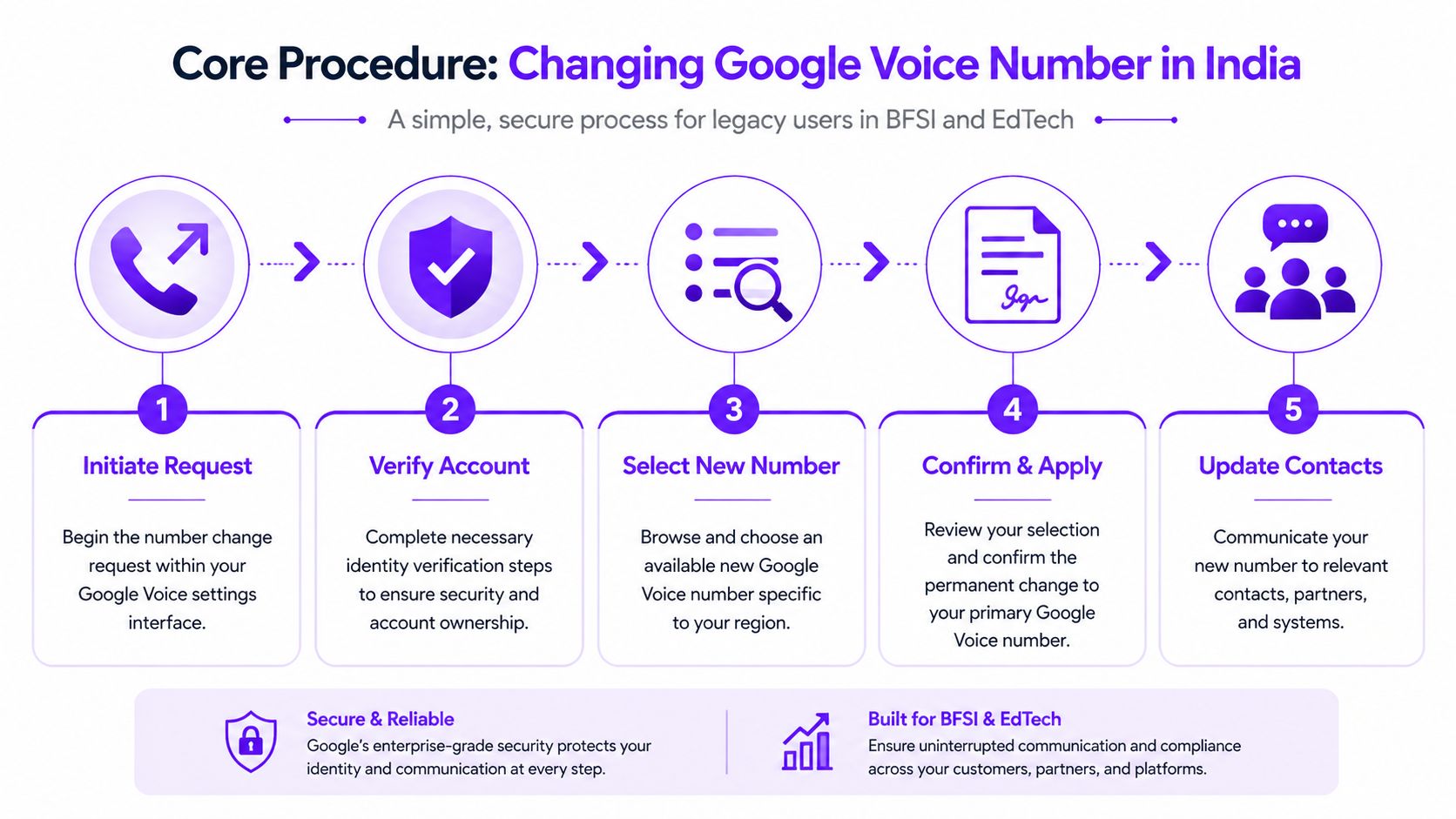
The Core Procedure for Changing Your Google Voice Number in India
A number change looks simple until it interrupts a live admissions line, a collections workflow, or a sales queue mid-day. In Indian organisations using legacy Google Voice setups, the operational risk is not the click sequence. It is the cutover discipline around identity, routing, records, and compliance ownership.
Why the execution details matter
Google documents the core admin flow for changing or deleting a Voice number through account settings, and the company’s support guidance makes one point clear. Administrators need to work from the correct Google account and complete verification steps carefully to avoid losing access or triggering rework. For Workspace-based teams, that matters because the number often sits inside a broader communications stack that includes CRM logging, call recordings, and support handoffs.
Indian businesses have an extra layer to manage. Any number reassignment can affect customer-consent records, retention rules, and call-handling accountability under internal policy. If your team also routes calls into SIP-based tools or cloud telephony gateways, confirm the addressing format and downstream dependencies before the switch. A quick check of SIP URI formatting standards for business voice systems helps technical teams avoid preventable routing errors after the new number goes live.
The exact workflow that works
Use a desktop browser and a controlled admin session. For business accounts, I recommend treating the change like a small cutover, with one owner, one maintenance window, and a rollback checklist for every system that references the old number.
Sign into the correct Google account
Confirm that the administrator is logged into the account currently assigned to the existing Google Voice number. Multi-login browser sessions create avoidable mistakes, especially in shared operations environments.Open Google Voice settings
Go to the gear icon, then open the account settings area where the current Google Voice number is listed.Remove the current number if your policy allows it
Google’s support flow may require deleting the active number before selecting a replacement. Do not do this until your team has documented dependencies such as CRM records, ad assets, support signatures, and escalation trees.Request and verify the replacement number
Follow the prompts to get a new number and complete verification using the linked phone endpoint required by the account setup. Availability can vary, so avoid promising a specific pattern or vanity sequence to internal stakeholders before the search is complete.Run post-change validation immediately
Place test calls in and out. Check voicemail, call recording behaviour, business-hour routing, and any API or telephony integrations tied to the number.
Operating constraints to plan around
A few platform realities should shape policy before anyone touches settings:
| Operational constraint | Why it matters |
|---|---|
| Number changes are limited by platform rules | Teams should avoid frequent swaps and use routing changes for temporary operational needs |
| Activation is usually faster than downstream updates | The number may change quickly, but dependent systems often lag behind |
| Availability is not guaranteed by city or pattern | Marketing, sales, and regional teams should not build campaign assets around an unconfirmed number |
Google’s own Voice help materials are the right source for the click path. For operating practice, the bigger lesson is that number changes should be rare. Stable public numbers protect brand recall, reduce customer confusion, and lower update work across paid media, listings, and support documentation.
What usually goes wrong
The most common failures are administrative, not technical. Teams start the change in the wrong account, miss a linked dependency, or update the number before revising routing logic in adjacent systems. This is also why many operations leaders solve the business problem without changing the public-facing number at all. They keep the customer-visible identity stable and focus on optimizing call routing behind the scenes.
For Indian organisations, one more discipline matters. Record who approved the change, when it happened, what systems were updated, and who now owns the number. That audit trail supports internal governance and makes later reviews far easier if a complaint, consent query, or missed-call dispute surfaces.
Optimising Call Flow by Managing Linked and Forwarding Numbers
The most useful Google Voice changes often aren’t permanent number changes at all. They’re routing changes. A strong operations team keeps the public-facing number stable while shifting where calls land based on staffing, shifts, campaigns, or escalation rules.

Treat forwarding as an operating lever
A linked and forwarding number setup gives leaders tactical flexibility. If an admissions counsellor is on leave, inbound enquiries can move to the team lead. If a real estate campaign goes live on a weekend, calls can route to a duty manager. If after-hours response matters, businesses can send calls to a structured intake workflow instead of a dead-end voicemail.
Routing discipline matters more than raw telephony access. Teams that want a stronger framework for optimizing call routing usually perform better when they define ownership rules by queue, shift, and intent, rather than by individual employee preference.
A practical configuration review should cover:
- Active linked devices that still belong to current team members
- Temporary campaign forwards that were never removed
- Escalation paths for missed or unanswered calls
- Documentation showing which number serves which business function
A practical forwarding audit
Most routing problems come from old links that nobody owns. Audit first, then simplify.
- Check every forwarding destination: Remove numbers tied to former staff, retired handsets, or short-term vendors.
- Map each route to a business reason: If a number forwards to someone’s mobile, there should be a current operational justification.
- Test handoff paths: Call during live hours, after hours, and during agent unavailability.
- Review formatting and interoperability: If your broader telephony environment includes SIP-based systems, this primer on SIP URI format helps teams align routing logic with upstream systems.
Later in the review cycle, it helps to watch a full walkthrough instead of relying only on internal notes:
Stable public numbers and flexible internal routing usually outperform frequent number changes.
One more point matters for leadership. Forwarding is where service continuity lives. If your organisation treats every reassignment or absence as a reason to issue a fresh number, customers keep paying the price. If you keep the number steady and improve routing behind it, the business looks organised even when teams are changing quickly.
Aligning Your Brand Voice with Custom Voicemail and Screening
A customer may never see your brand deck, your product demo, or your office. They will hear your phone system. In sectors like education, healthcare, real estate, and premium services, that first audible impression often decides whether the caller stays engaged.

Generic greetings versus brand-safe voice design
Google Voice can support a custom voicemail workflow on desktop, including uploads of 16kHz mono WAV files, as described in this advanced Google Voice customisation reference. That makes basic brand alignment possible. You can replace a default greeting with a more polished one, set expectations, and tighten the language.
But there’s a strategic limit. The same reference notes that 68% of EdTech calls in India drop due to unnatural English voices from default systems. That’s the problem many leadership teams underestimate. A technically correct greeting can still sound culturally wrong, overly robotic, or misaligned with the caller’s expectations.
A useful comparison looks like this:
| Approach | Strength | Limitation |
|---|---|---|
| Basic Google Voice greeting | Fast to set up, better than a default message | Limited nuance for regional and brand-specific delivery |
| Call screening with simple prompts | Helps filter call intent and reduce noise | Can sound mechanical if not written carefully |
| Custom voice workflow | Better control over tone, pacing, and persona | Requires operational discipline and testing |
What works in practice
If your team wants better voicemail quality, focus on three things. Script, sound quality, and context. A short greeting that states the company name, response expectation, and next step will outperform a long corporate monologue almost every time.
The reference above also reports that DialNexa users in Indian real estate pilots saw an 8% lead-to-booking uplift from a 2% baseline when the Google Voice greeting matched the AI agent persona. That doesn’t mean every firm needs the same setup. It means the audible handoff between voicemail, screening, and live interaction matters more than many operations teams assume.
Brand check: If your website sounds premium and your voicemail sounds generic, callers notice the gap immediately.
Call screening deserves the same scrutiny. Teams often enable it for control, then undermine themselves with stiff prompts that feel hostile or confusing. This guide to effective call screening is useful because it focuses on caller experience, not only gatekeeping.
For teams refining scripts, message structure, and after-hours tone, this resource on automated voicemail message design is also a practical reference.
One final operational point matters for Indian businesses running SMS follow-ups from voice workflows. The same advanced customisation source states that failing to register with TRAI’s DLT platform can pull connect rates down from 91% to 47%. That makes voice branding and message compliance part of the same execution discipline, not separate projects.
Navigating Compliance When Reassigning Numbers in Your Team
The riskiest Google Voice decision in a regulated business often isn’t changing a number. It’s reusing one. What seems efficient at admin level can become a governance problem if the old number still carries residual call history, message context, or customer expectations tied to the prior user.
Where reassignment becomes a governance problem
For Indian teams in BFSI and similar regulated environments, number reassignment sits directly inside privacy and audit concerns. According to Google Workspace guidance on unassigning or reassigning a Voice number, the India-specific compliance gap is significant: BFSI firms reassigning VoIP numbers without robust audit logs face 78% higher compliance audit failures, and manual reassignments can cause 15% to 20% downtime at higher call volumes.
That should change the internal question from “Can we reuse this number?” to “Can we prove the reuse is controlled, logged, and safe?”
The concern isn’t theoretical. Improper reassignment can expose residual call data and create issues under the DPDP Act 2023 and TRAI-related requirements. In practical terms, a new employee may inherit a number with old customer associations attached to it, while the organisation lacks a clean record of what was retained, redirected, or purged.
A safer operating model
A stronger policy usually includes these controls:
- Separate customer-facing identities from employee identities: Don’t bind public numbers too tightly to one person.
- Require logged approvals: Reassignment should sit inside an auditable workflow, not an informal admin request.
- Use routing before reuse: If continuity is the goal, reroute the traffic rather than immediately reassigning the identity.
- Review data retention exposure: Check voicemails, transcripts, linked numbers, and call history before reusing anything.
Reassignment is easy. Defensible reassignment is harder.
For leadership, the main trade-off is straightforward. Reusing numbers can look efficient in the short term, but if the process creates audit failure risk, residual data exposure, or service downtime, the savings are illusory. In regulated operations, communications design has to satisfy business continuity and compliance at the same time.
Building an Integrated and Intelligent Communications Stack
The strongest Google Voice environments aren’t built around one settings page. They’re built around coordinated decisions. Number changes are controlled. Forwarding is deliberate. Voicemail sounds like the brand. Reassignment is governed. Teams know who owns each step.
The stack leadership should standardise
A resilient communications stack usually combines five layers:
Stable number ownership
Public-facing numbers belong to the organisation, with clear approval rules for change.Flexible routing logic
Teams reroute traffic based on business need, not ad hoc personal workarounds.Brand-safe voice experience
Greetings, screening, and handoff language match the customer promise.Compliance controls
Reassignment, retention, and access changes leave an audit trail.System interoperability
Voice tools don’t sit alone. They connect to CRM, workflows, and the broader telephony estate. Teams reviewing alternatives or extensions often compare these needs against resources such as this guide to Twilio phone number options.
That operating model matters even more for distributed teams. If managers are coordinating service, sales, and support across locations, they also need process discipline around handoffs and tool sprawl. This roundup of the best collaboration tools for remote teams is useful because it frames communication systems as part of broader team execution, not isolated software choices.
The executive lens is simple. Don’t treat Google Voice as a stand-alone convenience tool. Treat it as one layer in customer communications. When that layer is managed properly, the business gets cleaner handovers, stronger consistency, fewer avoidable disruptions, and better control over how the brand sounds in the market.
If your team wants a more scalable way to handle inbound and outbound calling without sacrificing consistency, DialNexa Labs Private Limited helps organisations build human-like Voice AI workflows for qualification, support, presales, and bookings. For leadership teams in EdTech, BFSI, real estate, healthcare, e-commerce, and SaaS, that means a communications setup that’s easier to standardise, easier to scale, and easier to align with brand and compliance requirements.

[…] the call flow gets more serious. If you're cleaning up that kind of setup, this walkthrough on addressing Google Voice operational issues is useful because it shows where the consumer workflow starts to […]
Excellent perspective on treating Google Voice as communications infrastructure rather than a simple convenience tool. The emphasis on governance, brand consistency, routing discipline, and compliance makes this especially valuable for growing and regulated businesses.