

Elevating Customer Experience: A Leader’s Guide to Conversational AI for Customer Service
When we discuss Conversational AI for customer service, we’re not just evaluating another software tool. We are architecting a strategic overhaul of the entire customer journey. This is about leveraging intelligent automation to conduct human-like conversations, providing instant, 24/7 support across every touchpoint—your website, WhatsApp, and all other digital channels.
For VPs, Directors, and CXOs, this isn’t a simple tech upgrade. It’s a fundamental re-engineering of how you build and scale customer relationships. It’s about moving beyond basic chatbots to resolve complex issues, drive down operational costs, and unlock unprecedented levels of customer satisfaction and loyalty.
The Executive Case for AI in Customer Service
Let’s be direct: traditional customer service models are breaking under the weight of modern expectations. Customers demand immediate, personalized resolutions, day or night. This relentless pressure creates costly queues, frustrates your customer base, and burns out valuable support talent. Ultimately, it erodes your brand’s reputation and impacts the bottom line.
A classic call center operates like a single-lane road during rush hour—everything grinds to a halt. Every customer, whether they have a simple billing question or a complex technical problem, is stuck in the same inefficient queue. This model is economically unsustainable to scale and incompatible with a 24/7 digital world.
From a Single Lane to a Superhighway
Conversational AI transforms that single lane into a dynamic, multi-lane superhighway. It intelligently triages customer queries, instantly resolving high-volume, low-complexity requests in an automated fast lane.
For example, a major airline can use AI to deflect 60% of its inbound calls by automating flight status checks, baggage allowance queries, and seat selection requests. This immediately frees up its skilled human agents to manage the truly critical issues: rebooking passengers from a canceled flight or assisting high-value frequent flyers with complex itinerary changes.
This isn’t just a theory; it’s a strategic shift from a reactive cost center to a proactive engine for growth. The change is already happening. In India, for instance, data shows that 51% of customers are happy to interact with AI for quick support. Globally, projections suggest AI could soon handle up to 95% of all customer interactions. The market is clearly ready for this. You can explore more data on conversational AI’s impact on customer engagement.
This technology doesn’t just answer questions; it unlocks critical business intelligence. Every automated interaction on your website or WhatsApp gathers valuable data on customer needs, pain points, and buying signals, feeding actionable insights directly back into your product, marketing, and sales strategies.
For a deeper look at how airlines define service across the entire passenger journey, see this guide to customer service in the aviation industry.
Ultimately, implementing conversational AI for customer service is an executive decision to secure a competitive advantage. It’s about building a resilient, scalable operation that slashes costs while creating new opportunities for revenue and deep-seated customer loyalty. As this space evolves, understanding the future of the conversational AI market will be essential for staying ahead.
Legacy Support vs AI-Powered Customer Service
For leaders weighing this transformation, the contrast between the old and new models is stark. The table below highlights the strategic advantages that Conversational AI offers over the limitations of legacy support systems.
| Attribute | Traditional Customer Service | Conversational AI-Powered Service |
|---|---|---|
| Availability | Limited to business hours; 24/7 is costly. | Always-on, 24/7/365 support, globally. |
| Scalability | Linear; requires hiring more agents. | Elastic; scales instantly for peak demand. |
| Response Time | Minutes to hours; long queue times. | Instant; resolves queries in seconds. |
| Cost Model | High operational overhead (salaries, training). | Lower cost-per-interaction; reduces headcount needs. |
| Data & Insights | Manual tracking; limited, unstructured data. | Gathers structured data from every interaction. |
| Consistency | Varies by agent and training. | Guarantees consistent, brand-aligned responses. |
| Proactivity | Reactive; waits for customers to reach out. | Proactive; can initiate engagement and offer help. |
As you can see, the move to an AI-powered service model isn’t just about efficiency—it’s about building a smarter, more agile, and customer-centric organisation from the ground up.
How Conversational AI Actually Works for Your Business
To truly grasp why conversational AI is a game-changer, you need a look under the hood—from a business leader’s perspective. This isn’t a deep dive for developers. It’s an executive’s guide to the powerful engines driving tangible results. Think of it less like coding and more like onboarding a team of brilliant, infinitely scalable digital employees.
At its core, this technology’s business value comes from two key components working in concert.
Your Master Interpreter: Natural Language Processing
First is Natural Language Processing (NLP). Think of NLP as your organization’s master interpreter. When a customer types, “My order hasn’t arrived, where is it?” they’re expressing a clear business need. NLP’s job is to cut through conversational nuances and identify the core intent behind the query, which is “track order status.”
A practical example: A customer of a meal delivery service might type, “yo my food is cold and the drink is wrong.” A basic chatbot fails. An NLP-powered AI understands two separate intents: “report food quality issue” and “report incorrect item,” triggering two distinct resolution workflows simultaneously. This is what separates modern AI from the clunky, frustrating chatbots of the past.
Your Smartest Employee: Machine Learning
The second ingredient is Machine Learning (ML). If NLP is the interpreter, ML is your most dedicated employee—one that learns from every single interaction. With each customer problem it solves, the system is collecting data, spotting patterns, and fine-tuning its approach for the next time.
This constant learning loop means your AI’s performance and resolution rates improve over time without manual intervention. It learns which responses best resolve specific issues, figures out how to handle novel questions, and becomes more adept at identifying situations that require a human touch.
For an executive, this means you’re investing in a system that doesn’t just perform a task, but actively improves its own ROI. This delivers compounding returns without the compounding cost of manual retraining.
This diagram illustrates how these capabilities translate into the high-level business outcomes that leaders care about.
The AI’s growing intelligence directly fuels cost savings, opens up new revenue opportunities, and delivers deeper business insights. It’s a powerful cycle of value creation.
So, how does this all work when a customer reaches out?
- The Conversation Starts: A customer opens a chat on your website or sends a message on WhatsApp.
- The Interpreter Steps In: The NLP engine instantly analyses the message to determine the customer’s intent.
- The Brain Makes a Decision: The “Dialogue Manager” decides the next best action. Should it ask for more information, look up order details in your CRM, or initiate a process like a refund?
- Connecting the Dots: The AI taps into your other business systems—your inventory, billing, or booking platforms—to get the information it needs or to perform a task.
- The Resolution: The AI formulates a clear, helpful response and sends it back to the customer, often solving their problem on the spot.
This entire exchange happens in seconds. It’s this seamless, behind-the-scenes orchestration that allows conversational AI for customer service to handle thousands of concurrent conversations, transforming your support function from a cost center into a strategic, scalable asset.
Measuring the Real Business Impact of AI
https://www.youtube.com/embed/ZAE67ATlqXo
The technology behind conversational AI for customer service is impressive, but for any business leader, what truly matters is the return on investment. The value isn’t buried in technical jargon; it’s measured in clear, quantifiable results that impact the P&L statement. A strategically implemented AI delivers tangible gains across three key business pillars.
Think of these as the framework for proving the value of your investment to your board and key stakeholders.
Driving Operational Efficiency
The first and most immediate ROI from conversational AI is a dramatic increase in operational efficiency. By automating high-volume, repetitive queries, you fundamentally reshape your cost structure and reallocate your skilled human agents to the complex, high-value work they were hired for.
Key metrics to track for your executive dashboard include:
- Reduction in Cost-Per-Contact: Automated interactions are vastly cheaper than agent-handled ones. A practical example: A telco can deflect 40% of its support volume by automating SIM activation and bill payment queries, slashing its overall support costs by 30% or more.
- Improved Agent Productivity: With AI handling Tier-1 issues, your agents can resolve more complex cases per hour, increasing output without increasing headcount or burnout.
- Increased First Contact Resolution (FCR): A well-integrated AI can solve a customer’s entire problem in a single interaction, with no need for an escalation. This is a win for efficiency and a powerful driver of customer satisfaction.
Enhancing the Customer Experience
In a competitive market, superior customer experience is a powerful moat. Conversational AI delivers the instant, accurate, and consistent support that today’s consumers demand, 24/7. This reliability builds trust and loyalty in a way that a traditional 9-to-5 support desk simply cannot.
The strategic goal is to create a frictionless experience. Customers don’t want to wait in queues or repeat themselves. AI eliminates these common pain points, demonstrating that you value their time and business.
To measure success, focus on:
- Customer Satisfaction (CSAT) Scores: Many businesses see a significant jump in CSAT scores post-implementation, driven by speed and 24/7 availability.
- Net Promoter Score (NPS): By providing faster, more effective support, you convert frustrated customers into vocal brand advocates.
- Reduced Customer Effort Score (CES): AI makes getting help easy, which is a key predictor of customer loyalty and repeat business.
Accelerating Revenue Generation
Beyond cost savings and customer delight, a strategic AI is a powerful revenue engine. It can proactively engage with prospects, identify sales opportunities, and guide users through to purchase, transforming your service function into a profit center.
For a deeper look at how AI is reshaping customer conversations, the current state of AI in the speech technology industry offers compelling insights.
Here’s what this looks like in practice:
- Reduced Cart Abandonment: An e-commerce site’s AI can detect when a user is about to abandon a full cart. It can proactively pop up with an offer for free shipping or answer a last-minute product question, cutting cart abandonment rates by up to 20%.
- Increased Lead Conversion: A B2B software company can use an AI assistant on its website to qualify leads 24/7, book demos with sales reps, and route high-value prospects for immediate follow-up, boosting qualified leads by 15%.
- Higher Cross-Sell and Upsell Rates: During a support chat about a mobile plan, the AI can intelligently identify an opportunity to recommend a data add-on or a family plan upgrade, seamlessly blending service and sales.
By focusing on these three pillars—efficiency, experience, and revenue—you can build an undeniable business case for conversational AI and demonstrate its strategic value across the entire organization.
Seeing Conversational AI in Action Across Industries

The strategic value of conversational AI for customer service becomes tangible when you see it applied to real-world business challenges. This is not a one-size-fits-all tool. Its power lies in its adaptability to the unique operational workflows and customer journeys of any given industry. For an executive, observing AI solve these specific problems makes the business case compelling.
Let’s examine how this technology delivers results in three key sectors: Banking, E-commerce, and Telecom, with practical dialogue flows.
Fortifying Security and Service in Banking
The financial world operates on trust and speed, making it an ideal environment for AI-powered support. Conversational AI can manage sensitive queries securely while providing instant answers for common banking tasks, freeing up human advisors to focus on high-value conversations like wealth management or mortgage advisory.
Many leading banks now use AI chatbots for everything from routine balance inquiries and fraud detection to offering support in regional languages, significantly expanding their market reach.
Use Case Example: Proactive Fraud Alert
Imagine a customer receives an automated, interactive alert about a suspicious transaction, enabling immediate action and preventing financial loss.
- AI (WhatsApp): “Hello Priya, we’ve detected an unusual transaction of ₹15,000 on your card ending in 1234. Was this you?”
- Customer: “No that wasn’t me”
- AI (WhatsApp): “Thank you for confirming. I have blocked your card to prevent further fraudulent activity. A replacement card will be sent to your registered address. Can I help with anything else?”
This proactive interaction turns a potential crisis into a smooth, reassuring experience, reinforcing trust in the bank’s security measures.
Driving Sales and Satisfaction in E-commerce
In e-commerce, the customer journey is paramount. Conversational AI acts as a 24/7 personal shopper and support agent, guiding customers from product discovery to post-purchase assistance. It can answer product questions, track orders, and even intervene to reduce cart abandonment, all directly contributing to the bottom line.
Use Case Example: Instant Order Tracking
A customer requires a quick update on their purchase without the friction of logging into an account or calling a support line.
- Customer (Website Chat): “Where’s my latest order?”
- AI: “I can help with that. Could you please confirm the mobile number used for the order?”
- Customer: “98XXXXXX00”
- AI: “Thanks! Your order #5678 is out for delivery and should arrive today by 6 PM. Would you like to view the live tracking map or leave delivery instructions for the driver?”
This simple, fast resolution prevents a support ticket and delivers the instant gratification that modern online shoppers expect. The ability of AI voice agents to transform customer service and sales gives any e-commerce brand a significant competitive edge.
Streamlining Operations in Telecom
Telecom customers often face urgent problems, from network connectivity issues to complex billing inquiries. Conversational AI can offer immediate troubleshooting steps and handle account-related tasks on the spot, drastically reducing call volumes and improving first-contact resolution rates.
By automating routine troubleshooting and plan management, telcos empower customers to self-serve instantly. This reserves human agents for high-stakes issues, such as retaining a customer considering churning or resolving a complex network outage.
Use Case Example: Automated Plan Upgrade
A customer needs to increase their data allowance but wants to avoid waiting on hold to speak with an agent.
- Customer (App Chat): “I need more data”
- AI: “You’re currently on the 2GB/day plan. We have a 3GB/day plan available for an additional ₹50 per month. Would you like to upgrade now?”
- Customer: “Yes please”
- AI: “Excellent. Your plan has been upgraded successfully. The changes will reflect in your account within 5 minutes. You will receive an SMS confirmation shortly.”
This interaction is not just efficient—it’s a revenue-generating activity that required zero human intervention. For any executive, these practical examples demonstrate that investing in conversational AI for customer service is about building a more resilient, responsive, and profitable business.
Building Your Strategic Implementation Roadmap
You’re convinced of the potential of conversational AI for customer service. That’s the first step. The real challenge—and where most initiatives succeed or fail—is translating vision into a fully functional system that delivers measurable business value. This requires more than just purchasing technology; it demands weaving that technology into the fabric of your operations.
A robust implementation roadmap is non-negotiable. Before evaluating vendors, you must define the strategy for integration, data governance, and training. Get these right, and you build a strategic asset. Skip this step, and you risk deploying a very expensive, glorified FAQ bot.
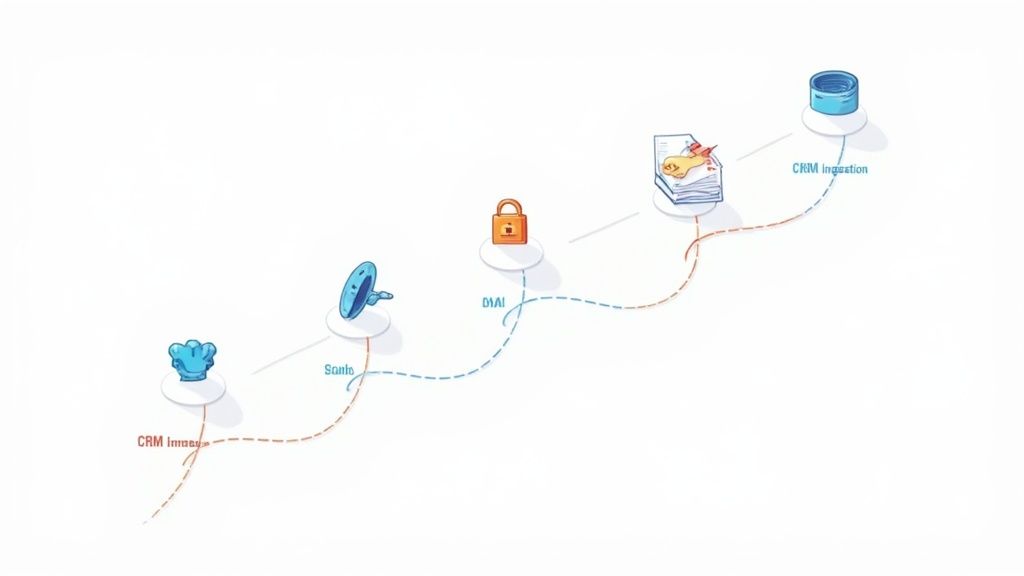
Integrating AI into Your Existing Ecosystem
Your new conversational AI cannot operate in a silo. To deliver real value, it must communicate seamlessly with your core business systems—especially your Customer Relationship Management (CRM) and Enterprise Resource Planning (ERP) platforms. This integration is what enables the AI to pull up a customer’s order history, check an account balance, or update a delivery address in real-time.
For example, when a customer asks “What was the interest rate on my last loan?”, an AI integrated with the core banking system can provide a precise, personalized answer instantly, rather than a generic link to a rate card. Without this deep integration, the AI is handicapped. When plugged into your ecosystem, it gains a 360-degree customer view, enabling it to provide personalized, context-aware support that resolves issues on the first contact.
Navigating Data, Privacy, and Compliance
In today’s regulatory landscape, customer data is both a critical asset and a significant responsibility. As you integrate AI, your approach to data privacy and compliance must be watertight. This requires a clear strategy for handling customer interactions securely, adhering to regulations like GDPR and local data protection laws.
Your data strategy must be designed to feed a learning AI system while ensuring complete customer trust. This means establishing clear governance for what data is collected, how it’s anonymized and stored, and who has access to it.
This becomes even more critical in diverse markets. The adoption of conversational AI for customer service in India is accelerating, largely because modern systems can now handle multiple regional languages like Hindi, Tamil, and Bengali, often within the same conversation. This localization is essential for market penetration, with some projections showing that AI adoption in Indian customer service could hit 80% across industries. You can discover more about key trends in AI customer service in India and see what’s driving this growth.
Training Your AI for Peak Performance
An AI is only as intelligent as the data it’s trained on. This is perhaps the most critical component of your implementation. The AI models must be trained on thousands of high-quality, relevant interaction examples from your own business—past chat transcripts, emails, and internal knowledge base articles. This is how the AI learns your unique business terminology, understands common customer issues, and adopts your brand’s specific tone of voice.
Equally critical is designing the human-AI partnership. You must establish clear, intelligent rules for escalating a conversation to a human agent. No customer wants to feel trapped in an automation loop. A seamless handover for complex, sensitive, or high-frustration scenarios ensures customers receive the empathy they need, perfectly blending the efficiency of automation with the irreplaceable value of human expertise.
Setting Your Business Up for the Future with AI
Integrating conversational AI for customer service is not just about solving today’s operational challenges. It is a strategic move to future-proof your business for the next evolution of customer interaction. The technology is advancing at a breakneck pace, and leaders who anticipate these changes will secure a significant and sustainable competitive advantage.
The objective is shifting from merely answering questions to creating intelligent, proactive experiences. It’s about architecting a service model that is more responsive, more intuitive, and ultimately, more human—all enabled by smarter technology.
From Putting Out Fires to Preventing Them
Historically, customer service has been a reactive function. A customer encounters a problem, they reach out, and you resolve it. The next wave of conversational AI flips this model entirely.
Instead of waiting for a customer to complain about a delayed package, the AI of tomorrow will proactively send them a WhatsApp message. For example: “Hi Sameer, we’ve noticed your delivery is running 24 hours behind schedule due to a logistics issue. We apologize for the inconvenience. We’ve automatically applied a 10% credit to your account for your next purchase.” This occurs before the customer even realizes there’s a problem.
This proactive approach transforms the interaction from a potential negative experience into a positive one, demonstrating respect for the customer’s time and building profound loyalty.
For any leadership team, this marks a fundamental shift away from a cost-center mindset for support towards seeing it as a value-driven relationship engine. Proactive AI doesn’t just reduce support tickets; it builds brand equity one conversation at a time.
Getting Personal: Hyper-Personalisation and Multimodal AI
The future of customer engagement lies in hyper-personalisation—anticipating a customer’s needs before they articulate them. By analyzing behavioral data, purchase history, and real-time on-site activity, AI can predict user intent with remarkable accuracy.
Imagine a customer returns to your travel website. Instead of a generic “How can I help?” chatbot, the AI assistant says, “Welcome back, Anjali. Are you still looking for flights to Goa for the long weekend? I found a boutique hotel near the beach with excellent reviews that has a room available.”
This level of tailored interaction will soon become the standard. And it will extend beyond text. Conversations will become multimodal, seamlessly blending communication formats. A customer might start by asking a question with their voice, then share a photo of a damaged product, and receive a video tutorial on how to process an exchange—all within a single, unified chat interface. This creates richer, more natural, and far more effective resolutions.
Ultimately, adopting conversational AI for customer service is more than a technology upgrade. It is a commitment to becoming an intelligent, agile enterprise that places the customer at the absolute center of its strategy. It is about preparing your entire customer experience for the future, ensuring you are not just keeping pace, but leading the pack.
Questions from the Top: An Executive’s Guide to Conversational AI
As a leader, you’re not just buying technology; you’re investing in a strategic capability. When it comes to conversational AI for customer service, it’s critical to have the tough questions answered. You need to see past the hype and understand the real-world impact on your operations, team, and brand. Here are frank answers to the questions we hear most often from the C-suite.
How Disruptive is the Integration Process?
Fortunately, this is not a rip-and-replace scenario. Modern conversational AI platforms are engineered for interoperability. Leading providers offer pre-built connectors and flexible APIs that integrate directly with major CRM and helpdesk systems like Salesforce, Zendesk, or HubSpot. The objective is to make integration a smooth, manageable process, not a multi-year IT project.
The complexity will depend on your existing tech stack. A strong implementation partner will collaborate with your IT leadership from day one to map data flows, ensuring the AI can pull customer history for personalized conversations and push interaction data back into your CRM. This creates the coveted single, unified view of the customer.
What Kind of Data and Training Do We Need to Get Started?
The AI learns from your historical customer conversations. The process begins by feeding it your existing data—chat logs, email transcripts, and help center articles. This is how it learns the specific ways your customers ask questions and the unique language of your business.
The quality of this initial data set is important. While many platforms offer pre-trained models for industries like e-commerce or finance to accelerate deployment, it’s your proprietary data that customizes the AI to your specific business needs. Post-launch, the system enters a continuous learning cycle, improving its accuracy and effectiveness with every new customer interaction.
How Do We Ensure It Doesn’t Damage Our Brand Voice?
This is a critical concern. You’ve invested heavily in building your brand’s personality, and you don’t want a robotic interaction to undermine that work. The solution lies in meticulous design. We work with you to craft the AI’s persona, its conversational flows, and its library of responses to perfectly align with your brand. Whether your tone is formal and professional, or friendly and approachable, the AI will be a consistent reflection of it.
The goal isn’t to trick customers into thinking they’re talking to a human. It’s to deliver a helpful, on-brand experience that is fast, effective, and consistently high-quality.
A crucial part of protecting your brand is knowing when to escalate. A well-designed system understands its own limitations. When a conversation becomes too complex, emotionally charged, or a customer is clearly frustrated, the AI must intelligently and seamlessly hand off the interaction to a human agent. This strategic blend of automation and human expertise is what protects your brand reputation and ensures customer satisfaction.
At DialNexa, we build custom Voice AI agents that deliver human-like support and sales conversations at scale. Our platform helps you improve connect rates, qualify leads with 97% accuracy, and free your team to focus on high-value work. See how we can turn your conversations into conversions at https://dialnexa.com.

[…] buyers building a broader strategy around conversational AI for customer service, that distinction is important. A platform that can manage multi-minute voice interactions, capture […]
[…] building this workflow can use proven conversational AI for customer service patterns, but billing needs tighter controls than general support. Every material exchange should […]