
Contact Center & BPO: From Strategic Cost to Revenue Engine
For decades, the contact center & bpo industry operated like a finely tuned factory, where every process was engineered to minimize costs. Success was measured in shaved seconds off call times and pennies pinched from operational budgets. That era has ended. A new strategic imperative has emerged, completely rewriting the rules for managing customer operations and transforming them into a powerful growth engine.
From Cost Center to Revenue Driver

The contemporary contact center is no longer just a line item on an expense report. It has evolved into a high-tech innovation lab, a goldmine of strategic data intelligence, and, most critically, a direct driver of business growth. For any VP, Director, or CXO, this isn't just an industry trend—it's a fundamental shift in business strategy, essential for maintaining a competitive edge.
The New Battlefield for Business Leaders
Today’s executives are navigating a perfect storm of pressures that legacy models simply cannot withstand. These challenges are interconnected, demanding a complete strategic rethink of how customer interactions are managed and monetized.
As a leader, you're undoubtedly grappling with these high-stakes issues:
- Sky-High Customer Expectations: Today’s customers expect immediate, personalized, and effortless solutions across every channel. For a retail banking director, this means a customer expects their mobile app chat to seamlessly transition to a phone call with an agent who already knows their issue.
- The Need for Flawless Omnichannel Journeys: Nothing erodes customer loyalty faster than a disjointed experience. A customer of a high-end travel agency shouldn't have to repeat their itinerary details when moving from a web inquiry to a call with a booking agent. The journey must be seamless and intelligent.
- Persistent Agent Attrition: The high churn rate of agents is a chronic drain on resources. For a BPO executive, this translates directly to increased recruitment costs, inconsistent service quality, and a perpetual training cycle that hampers scalability.
This evolution is occurring within a booming market. India's BPO sector is a significant economic force, contributing approximately $44 billion to the GDP with a workforce exceeding 1.3 million professionals.
The core of this transformation is a profound strategic pivot. We're moving from asking, "How can we reduce the cost of this interaction?" to "How can this single interaction generate measurable value for the business?" Every conversation becomes an opportunity to build loyalty, gather market intelligence, or unlock a new revenue stream.
A Roadmap for Strategic Growth
To thrive in this new landscape, you require a new toolkit. The first step is to explore specialised solutions for the contact center industry designed specifically to convert traditional cost centers into strategic revenue drivers.
Technologies like Voice AI are at the epicenter of this change. They address these persistent challenges by automating complex workflows, extracting deep customer insights, and empowering your teams to focus on high-value, strategic initiatives. If you're intrigued, we offer a comprehensive analysis on how AI voice agents are transforming customer service.
This guide is your strategic roadmap. We will detail how modern technology can elevate your contact center from a cost burden to a strategic asset, enabling you to solve your most pressing business challenges and achieve sustainable, top-line growth.
Understanding the Cloud and AI Revolution
Two powerful forces are fundamentally reshaping the contact center & BPO landscape: the cloud and Artificial Intelligence (AI). These are not incremental updates; they represent a paradigm shift in operational strategy. For any business leader, understanding how these technologies directly impact the bottom line is the key to unlocking significant efficiency gains and deep customer intelligence.
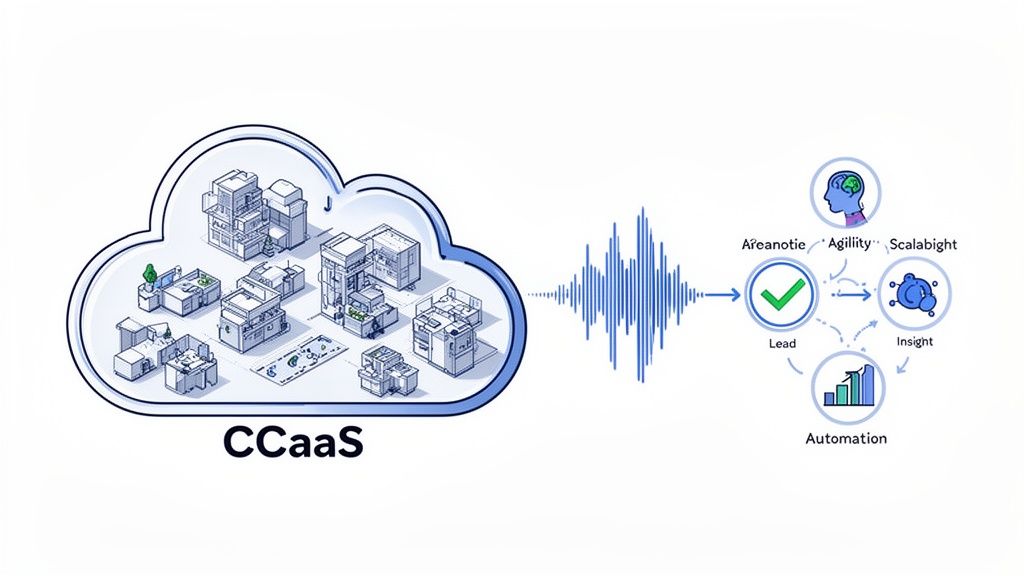
The first force is the migration to the cloud, known as Contact Centre as a Service (CCaaS). Consider the strategic difference: instead of investing capital in building and maintaining a physical office complex (the on-premises model), you adopt a flexible, subscription-based model. This move eliminates massive upfront capital expenditures and the ongoing operational headache of managing obsolete hardware.
With a CCaaS model, you operate on an OpEx basis, paying only for the capacity you use. A Director of Operations for an e-commerce company, for example, can instantly scale agent capacity to handle the Diwali sales surge and just as easily scale back down, optimizing costs without compromising service. This agility is precisely what a CXO requires to manage budgets effectively and respond to market dynamics.
The Strategic Power of Cloud Agility
Transitioning from a rigid on-premises system to a flexible cloud platform is a core business decision, not just a technology upgrade. It enables a distributed global workforce, ensures business continuity, and provides immediate access to the latest innovations without disruptive manual updates. In today's volatile market, this agility is not a luxury; it is a competitive necessity.
The market growth underscores this shift. India's cloud-based contact center market, valued at USD 1.2 billion in 2024, is projected to reach USD 7.5 billion by 2033. This expansion is driven by sectors like BFSI, e-commerce, and EdTech, which are abandoning legacy systems for cloud solutions capable of managing today's complex omnichannel environment. You can explore the market dynamics in this analysis of India's cloud contact centre growth on imarcgroup.com.
Adopting a cloud-first model fundamentally re-engineers your operational DNA. It shifts your strategic focus from infrastructure management to delivering exceptional customer experiences, allowing your leadership to concentrate on growth and innovation rather than server maintenance.
To fully appreciate the strategic advantage, a direct comparison is illuminating.
Traditional On-Premises vs Modern Cloud Contact Centre
| Feature | Traditional On-Premises Contact Centre | Modern Cloud-Based Contact Centre (CCaaS) |
|---|---|---|
| Initial Cost | High capital expenditure (CapEx) for hardware, software, and infrastructure. | Low to no upfront cost. Subscription-based (OpEx) model. |
| Scalability | Rigid and slow. Adding or removing agents is a complex, costly process. | Highly elastic. Scale up or down instantly based on demand. |
| Maintenance | Requires a dedicated in-house IT team for upkeep, updates, and troubleshooting. | The provider manages all maintenance, security, and software updates. |
| Accessibility | Limited to a physical location. Remote work is difficult to implement securely. | Accessible from anywhere with an internet connection, enabling a global workforce. |
| Technology | Features become outdated quickly. Upgrades are expensive and infrequent. | Access to the latest AI, analytics, and omnichannel features automatically. |
| Reliability | Dependent on your own infrastructure's uptime and disaster recovery plan. | High uptime guaranteed by SLAs, with built-in redundancy and business continuity. |
From a leadership perspective, the choice is clear. The CCaaS model is not merely about cost savings on hardware; it's about building a more resilient, agile, and future-proof business operation.
Unpacking AI's Real Impact, Beyond the Hype
The second transformative force is Artificial Intelligence, specifically Voice AI. To move beyond the buzzwords, let's focus on the tangible business outcomes this technology delivers. This is not about rudimentary chatbots handling FAQs. Modern Voice AI is a sophisticated business instrument designed to manage complex, end-to-end conversations that produce measurable results.
Imagine an AI agent engineered not just to respond, but to achieve specific business objectives. A solution like DialNexa acts as a tireless and highly efficient extension of your team. This is where AI transitions from a technological novelty to a genuine strategic asset.
Here are practical examples of its strategic application:
- For a VP of Sales: An AI agent can execute an outbound campaign to 10,000 leads, ask precise qualifying questions based on your BANT criteria, and then book qualified meetings directly into your top sales executives' calendars. This frees your best closers from the inefficiency of cold outreach.
- For a Director of Real Estate Sales: An AI can field inbound inquiries 24/7, provide details on multiple properties, and schedule qualified site visits, ensuring no high-value lead is ever lost to voicemail, even at 2 AM.
- For a CXO in Banking: A Voice AI can guide a customer through a multi-step KYC verification, providing clear instructions and validating information in real-time, ensuring both compliance and a smooth customer onboarding experience.
By automating entire workflows, Voice AI does more than reduce operational costs—it captures deep intelligence from every interaction. It delivers a level of consistency and data aggregation impossible for human teams at scale, providing leadership with a powerful new lever to drive business performance.
How Voice AI Is Redefining BPO Service Delivery
Voice AI is not merely another tool in the technology stack; it represents the single most powerful paradigm shift in the contact centre and BPO sector today. The era of clunky, robotic IVRs that alienated customers is over. Today’s intelligent voice agents manage complete, nuanced conversations that drive tangible business outcomes, acting as a force multiplier for your entire operation.
For executive leaders, the strategic conversation has evolved from if this technology is viable to how it can be deployed to solve our most significant business challenges. The key is to view Voice AI not just as a cost-reduction tool, but as a strategic asset for scaling high-value interactions that were previously impossible to automate efficiently.
From Simple Tasks to Complex Workflows
The true strategic value of modern Voice AI lies in its ability to manage entire business processes end-to-end. These are workflows that require contextual understanding, intelligent decision-making, and a clear, objective-driven approach. This is where theory translates into undeniable value for any Director or VP tasked with elevating performance and efficiency.
Consider these mission-critical scenarios operating for your business 24/7:
- For a Real Estate Firm: A prospective buyer calls at 10 PM after seeing an online ad. Instead of reaching voicemail, an AI agent engages them, understands their interest in a 3BHK apartment, answers questions about amenities and financing options, confirms their budget, and schedules a qualified site visit directly into a sales agent's calendar. No human intervention, no lost lead.
- For a BFSI Company: A new customer needs to complete their KYC process to activate an account. A Voice AI agent guides them through each step, patiently clarifies document requirements, confirms information in real-time, and ensures the entire process is completed with full compliance and an audit trail, freeing up compliance officers for more complex tasks.
- For an EdTech Platform: An AI conducts personalized initial counseling with a prospective student, understanding their career aspirations, recommending suitable courses, and then scheduling a detailed follow-up with a senior admissions expert, ensuring that expert's time is spent only on high-potential candidates.
These are not futuristic concepts; they are active use cases delivering measurable ROI today. By automating these complete workflows, AI liberates your human experts to focus on what they do best: closing high-value deals, managing complex escalations, and cultivating strategic client relationships.
The Undeniable Data Behind the Shift
This operational transformation is supported by significant market momentum. The call center AI market in India, generating USD 103.8 million in 2024, is projected to reach an impressive USD 452.5 million by 2030. This growth is fueled by AI's proven capability to manage everything from lead qualification to customer support with exceptional precision. In sectors like SaaS and healthcare, these tools achieve up to 97% accuracy in lead qualification—a metric that often surpasses human performance at scale.
Voice AI has the power to reshape the entire lead management funnel. For one of our clients, a leading SaaS provider, DialNexa increased their lead connection rates from a respectable 47% to over 91%, fundamentally altering the economics of their customer acquisition strategy and fueling pipeline growth.
Performance metrics like these make the business case irrefutable. A prime example of this redefinition is the emergence of real-time agent assistance, where AI functions as a co-pilot for human agents. This hybrid model leverages technology for scale and data, while humans provide the crucial strategic and empathetic touch. To see this synergy in action, review our case study on transforming customer interactions in real time.
When you automate intelligent conversations at scale, you are doing more than enhancing contact center efficiency. You are architecting a BPO service delivery model that is more resilient, data-driven, and effective—one that directly contributes to top-line revenue growth.
How Voice AI is Making a Real-World Impact Across Indian Industries
Theoretical discussions of technology are insufficient for VPs and Directors; you require evidence of on-the-ground performance. Modern contact centre & bpo solutions excel by delivering measurable outcomes that address the specific, high-stakes challenges of each industry. We are moving beyond simple task automation to deploying intelligent systems that solve core business problems.
Observe how Voice AI now manages complex, objective-driven tasks once reserved for human agents, revolutionizing BPO service delivery.
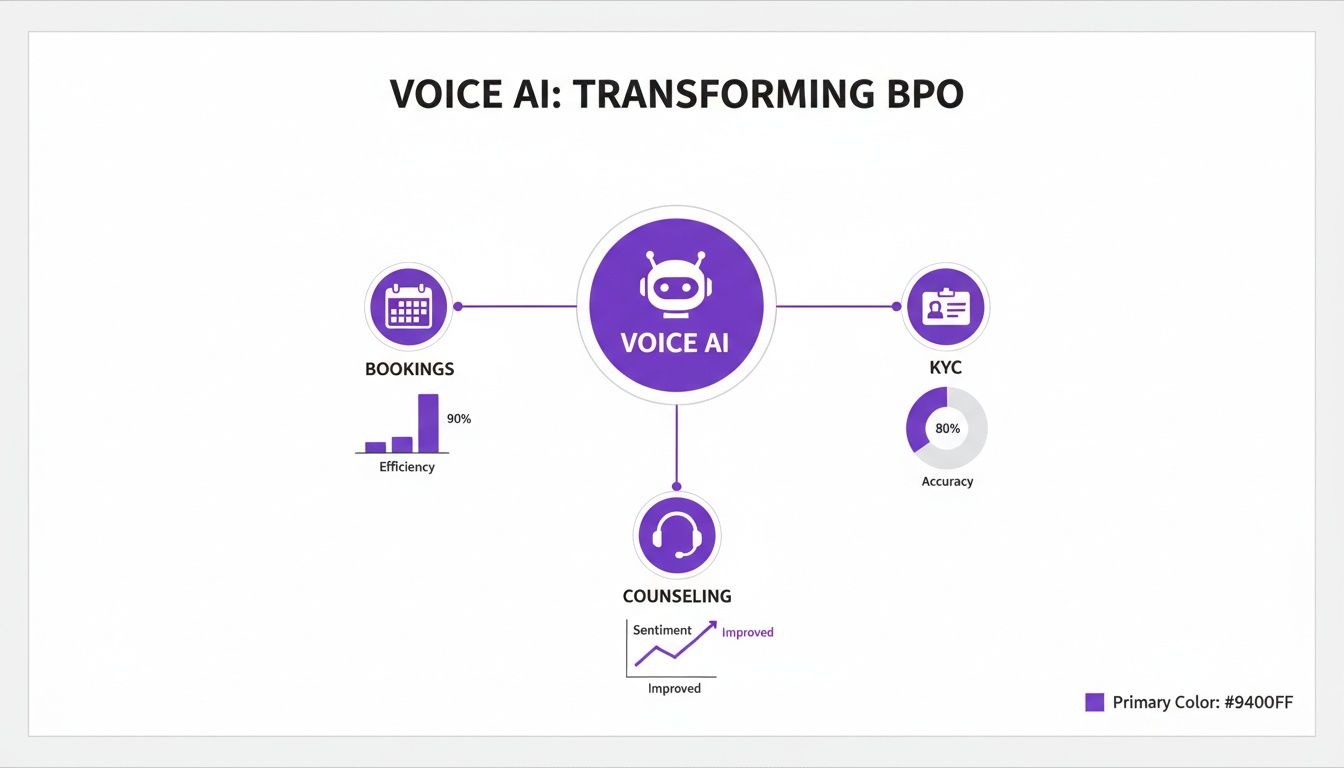
As illustrated, AI's role has expanded from answering basic queries to managing entire business processes critical for revenue generation and regulatory compliance. Let's examine its application in some of India’s key sectors.
EdTech: Scaling Admissions and Counselling
The EdTech sector operates on scale. Your teams face the monumental task of engaging thousands of prospective students, providing personalized guidance, and navigating them through a complex admissions process. A purely human-led approach is slow, costly, and invariably results in missed opportunities.
A modern contact centre & bpo strategy transforms this dynamic. Imagine deploying a Voice AI agent to handle the initial outreach for every single inquiry.
Here’s the practical application:
An AI agent calls a student who inquired about a data science program. It engages in a natural conversation, understanding the student's career goals, explaining the curriculum, and answering questions about faculty. If the student meets pre-defined qualification criteria, the AI seamlessly schedules a detailed counseling session with a senior admissions advisor.
This front-end automation is a strategic game-changer. It ensures your highly skilled counselors invest their time exclusively with pre-qualified, high-intent candidates, which directly increases enrollment conversion rates while significantly reducing the cost per acquisition.
BFSI: Nailing Compliance and Support Automation
In the Banking, Financial Services, and Insurance (BFSI) sector, every customer interaction is governed by strict compliance and security protocols. Processes like loan applications or KYC verification are mission-critical but also highly repetitive, consuming valuable agent time.
Voice AI offers a solution that is both hyper-efficient and compliant by design. It can manage these structured workflows with near-perfect accuracy, ensuring no critical step is ever missed.
A real-world scenario:
A customer needs to complete their KYC for a new trading account. An AI agent calls them, clearly explains the required documents, and patiently guides them through the verification process. The entire interaction is recorded and transcribed for audit purposes, ensuring full regulatory compliance without occupying a human agent's time.
Real Estate: Nurturing Leads Around the Clock
In real estate, speed-to-lead is paramount. A prospect not contacted within five minutes is often a lost opportunity. However, maintaining a 24/7 team to field inquiries from various property portals is a significant operational and financial burden.
An intelligent BPO solution provides a distinct competitive advantage here. An AI agent can engage every lead the moment interest is expressed, regardless of the time.
Picture this:
A potential buyer submits an online inquiry for a luxury property at 2 AM. Seconds later, their phone rings. An AI agent confirms their interest, provides key property details, and asks qualifying questions about their budget and timeline. For genuinely interested buyers, the AI schedules a site visit directly into a sales executive's calendar. No lead ever goes cold.
SaaS: Qualifying Leads and Booking Demos on Autopilot
For any Software-as-a-Service (SaaS) company, the sales pipeline is its lifeblood. The challenge is that pre-sales teams often get mired in low-value activities—chasing leads and scheduling meetings—instead of demonstrating the product.
By integrating Voice AI into your pre-sales motion, you can automate the entire qualification and scheduling process.
A practical example:
A prospect downloads a whitepaper from your website. Within minutes, an AI agent calls them. It qualifies their interest using your specific criteria (like BANT—Budget, Authority, Need, Timeline) and, if they are a strong fit, offers to book a product demo on the spot. This liberates your Account Executives to focus exclusively on high-potential deals, dramatically increasing sales productivity and shortening the sales cycle.
To fully grasp the strategic value, one must look at the data. A compelling business case requires clear, ROI-driven examples. The table below outlines the measurable impact executive leaders can expect from implementing Voice AI for specific industry challenges.
Voice AI Impact Metrics by Industry
| Industry | Common Challenge | Voice AI Solution | Key Performance Indicator (KPI) Improvement |
|---|---|---|---|
| EdTech | High volume of low-quality leads, low counsellor productivity. | AI-powered lead qualification and automated appointment booking. | +30% increase in qualified appointments; -40% cost per acquisition. |
| BFSI | Manual KYC and verification processes are slow and error-prone. | Automated compliance calls for KYC and document verification. | 99.5% accuracy in compliance checks; -60% agent time spent on repetitive tasks. |
| Real Estate | Slow lead response times result in lost opportunities. | 24/7 instant lead engagement and automated site visit scheduling. | +25% increase in scheduled site visits; 90% of leads contacted within 60 seconds. |
| e-Commerce | High volume of order status and return enquiries. | AI-driven self-service for order tracking and return processing. | -70% in inbound call volume for routine queries; improved CSAT. |
| SaaS | Pre-sales teams waste time on unqualified leads. | Automated lead qualification (BANT) and demo booking. | +50% more qualified demos booked per month; -20% shorter sales cycle. |
These are not hypothetical projections; they are the concrete results businesses are achieving today. By automating the right processes, you empower your human capital to focus on high-value, strategic work that drives sustainable growth.
Your Go-Live Checklist for Modernisation
Embarking on a project to modernize your contact centre & bpo operations is a significant strategic initiative. With a structured, outcome-oriented plan, you can transform this challenge into a clear roadmap for business growth. This checklist provides an actionable framework for leaders tasked with driving this critical transformation.
This is not merely a technology installation; it is a fundamental upgrade of your business engine. Each step is designed to link operational changes directly to commercial objectives, ensuring a clear return on investment from day one.
Define Your Business Outcomes First
Before evaluating any technology, you must define what success looks like in measurable, commercial terms. Vague goals like "improving efficiency" are insufficient. Your objectives must be specific, quantifiable, and directly aligned with the company's financial goals.
Examples of Clear Business Outcomes:
- "Increase the volume of sales-qualified leads (SQLs) by 40% within the next six months."
- "Reduce customer acquisition cost (CAC) by 25% this fiscal year."
- "Improve First Call Resolution (FCR) from 65% to 80% to increase customer lifetime value."
With clearly defined goals, every subsequent decision has a strategic purpose. This provides the clarity needed to lead the project and justify the investment to the board and other stakeholders.
Conduct a Candid Technology and Process Audit
Next, conduct a rigorous and honest assessment of your current systems and workflows. Where are the operational bottlenecks? A comprehensive audit will identify the friction points that impede performance and drive up costs. The objective is to identify what is working, what is broken, and what is missing.
A common pitfall is layering new technology onto outdated processes. True modernization requires a fundamental rethinking of workflows. For instance, instead of just automating an existing call script, you might re-engineer the entire lead qualification process. Use the audit to uncover opportunities for deep operational change, not just superficial fixes.
This review must be holistic, encompassing your CRM, ticketing systems, communication platforms, and even the manual workarounds your agents rely on to bridge technology gaps.
Plan for Integration and Security
In a modern enterprise, data must flow seamlessly and securely across all systems. A siloed solution is a liability. Your new platform must integrate tightly with your CRM and other mission-critical applications to create a single, unified view of the customer.
Security is paramount. As you adopt cloud platforms and AI, robust data governance and compliance are non-negotiable, especially in regulated industries like BFSI and healthcare. Your project plan must include clear protocols for data handling, access controls, and privacy from the outset.
Design a Phased Rollout for Minimum Disruption
A "big bang" implementation strategy is high-risk and prone to failure. A phased rollout is a more prudent and effective approach. It allows you to manage change, minimize business disruption, and secure early wins that build momentum. We recommend starting with a pilot program for a single team or a specific workflow.
For example, a VP of Sales could pilot an AI agent for one product line's inbound leads. This creates a controlled environment to test the system, gather real-world feedback, and refine the process before a full-scale deployment. Securing these initial victories builds confidence and drives adoption across the organization, ensuring a smoother transition and long-term success.
Measuring Success and Proving ROI
Implementing new technology in your contact centre & bpo is not merely about modernization; it's about delivering a quantifiable return on investment. For executive decision-makers, this requires looking beyond traditional operational metrics like Average Handle Time. The critical question is: how does this investment directly impact revenue and profitability?
The focus must shift to metrics that resonate in the boardroom—KPIs that prove how Voice AI is driving profitability, operational efficiency, and customer loyalty. This builds a powerful, data-driven business case for the strategic investment.
Key Performance Indicators That Actually Matter
When assessing the impact of your modernized operation, concentrate on high-value KPIs that demonstrate a clear financial return.
- Lead-to-Conversion Rate: This is the ultimate measure of success. It quantifies your operation's effectiveness at converting initial interest into tangible revenue. A significant increase in this rate provides direct evidence of an improved qualification and sales process.
- Customer Lifetime Value (CLV): Superior customer experience fosters loyalty. Tracking CLV demonstrates how enhanced interactions are creating more valuable, long-term customer relationships that contribute to sustained profitability.
- Cost Per Acquisition (CPA): By automating initial outreach and qualification with AI, you can dramatically reduce the cost of acquiring new customers. This is one of the most direct ways to demonstrate immediate operational savings and improved marketing ROI.
- AI Qualification Accuracy: This KPI measures the AI's precision in identifying high-potential leads. An accuracy rate exceeding 97% ensures that your human sales team invests their time exclusively on prospects with a high probability of conversion.
The objective is to draw a direct line from technology implementation to business outcome. The question should evolve from, "How many calls did the AI handle?" to, "What was the revenue generated from the leads qualified by the AI?"
Calculating ROI: A Practical Example
Let's analyze a tangible scenario. Consider a rapidly growing SaaS company inundated with inbound leads. Their pre-sales team is overextended, response times are slow, and valuable opportunities are being lost.
The Challenge:
The company generates 5,000 inbound leads per month. The team can only contact 50% of them effectively. Of those reached, a mere 2% successfully book a product demo.
The Solution:
They deploy a Voice AI agent from DialNexa to instantly call every new lead, qualify them against BANT criteria, and schedule demos.
The Results and ROI Calculation:
- Increased Contact Rate: The AI contacts 100% of the 5,000 leads, immediately doubling their outreach capacity without adding headcount.
- Improved Booking Rate: Due to instant and persistent follow-up, the lead-to-booking rate increases from 2% to 8%. They now schedule 400 demos per month, up from 50.
- Revenue Impact: Assuming an average deal value of ₹5,00,000 and a demo-to-close rate of 20%, the AI is now responsible for sourcing 80 new customers. This translates to ₹4 Crore in new annual recurring revenue (ARR).
This straightforward calculation demonstrates a clear and compelling return on investment, reframing the technology as a core driver of business growth.
For a more detailed methodology, explore our guide on how to measure the success of outbound campaigns with an AI voice agent.
Frequently Asked Questions
When considering a major technology transformation for your contact center or BPO, strategic questions are expected. This is a significant business decision. Let's address some common executive-level queries to provide clarity and confidence.
How Does Voice AI Actually Plug into Our Current Setup?
This is a critical question of operational feasibility. Modern Voice AI platforms like DialNexa are engineered for seamless integration. They are built with an "API-first" architecture, meaning they are designed to connect effortlessly with your existing enterprise systems, such as your CRM, helpdesk software, and marketing automation platforms.
Here's a practical example: When an AI agent qualifies a high-value real estate lead, it doesn't just end the call. It can automatically create a new lead record in your Salesforce or HubSpot CRM, tag it as "hot," assign it to the appropriate sales executive based on territory rules, and schedule a follow-up task. This automated workflow eliminates manual data entry, ensures data integrity, and eradicates information silos.
How Long Does It Take to Get This Up and Running?
Deployment timelines are directly proportional to the complexity of the workflow being automated. However, the speed of implementation is often faster than anticipated.
A well-defined campaign, such as qualifying inbound SaaS leads and booking demos, can typically be designed, trained, and launched within a few weeks. More complex, compliance-heavy processes, like a multi-step KYC verification for a financial institution, will require a more extended timeline for development and testing. The key to accelerating deployment is starting with a clearly defined business objective, which streamlines the entire process from configuration to launch.
What Happens When the AI Needs to Pass a Call to a Person?
Ensuring a seamless and intelligent escalation from AI to a human agent is a core design principle. The process is governed by customizable business rules triggered by customer intent, sentiment analysis, or specific keywords.
Consider this executive escalation scenario: A customer on an e-commerce support call says, “I am extremely dissatisfied with this delay and need to speak with a manager.” The AI instantly recognizes the negative sentiment and the keyword "manager." It politely informs the customer, "I understand your frustration. I am connecting you with a senior support specialist immediately." It then transfers the call along with the full conversation transcript and a summary to a live agent. The human agent is fully briefed before the call connects, allowing them to de-escalate the situation effectively without forcing the customer to repeat themselves. This preserves the customer relationship and protects the brand's reputation.
Ready to see how a custom Voice AI agent could reshape your operations? Explore what DialNexa can do. Book a demo with us and discover how we can help you turn more of your conversations into conversions.

[…] and revenue generation. For more on this evolution, you might find our deep dive into the modern contact centre BPO […]
[…] role of outsourcing can also be a game-changer. You might find our deep dive into the evolution of contact centre BPO services […]
[…] Ultimately, a call centre dashboard gives you the clarity you need to lead. It helps you move from constantly putting out fires to building a proactive, data-informed strategy. It turns your contact centre from a cost centre into a genuine engine for growth. Explore our guide on how to make this happen with our insights on contact centre BPO strategies. […]
[…] For organisations running phone-heavy workflows, the practical question isn’t whether no caller id calls are annoying. It’s whether your operating model can still earn a response in an environment where anonymity and spoofing have weakened confidence in the channel itself. Teams that still treat caller identity as an afterthought usually end up paying for it in poor connect quality, inconsistent follow-up performance, and avoidable reputation damage. Teams that design for trust can create a measurable edge, especially in contact-intensive environments such as contact centre and BPO operations. […]
[…] evaluating outsourcing models often benefit from grounding this discussion in the wider contact centre BPO context. The contract only works when it matches the operating reality underneath […]
[…] and platform adoption, not after them. A useful reference point is how providers structure broader contact centre BPO operations around standardised execution, workforce flexibility, and measurable service […]
[…] journeys. If you're assessing how service operations and communication design connect, contact centre BPO strategy considerations often expose the process gaps […]
[…] across channels. For a broader operating perspective on outsourced and hybrid support design, this contact centre BPO guide from DialNexa is also […]
[…] logic in a governed form. For leaders modernising service operations, the playbook used in a strong contact centre and BPO model now intersects directly with software quality […]
Excellent content that clearly connects customer experience, operational efficiency, and Voice AI adoption with measurable business outcomes. The industry-specific examples and actionable modernization roadmap make this a valuable guide for executives leading digital transformation initiatives.
[…] That is why executive ownership matters. CIOs need control, reliability, and governance. COOs need consistent workflows and lower handling cost. CROs and CX leaders need support interactions tied directly to retention, expansion, and account risk. Companies evaluating outsourced support models face the same requirement. An integrated service layer should sit at the centre of any contact centre BPO operating model. […]