
Contact Center Automation: Executive Guide to 2026 CX Transformation
When we talk about contact centre automation, we're not just discussing another piece of technology. We're talking about a fundamental shift in your operational strategy. For C-suite leaders, this isn't an IT upgrade; it's a strategic imperative that redefines customer engagement and, ultimately, drives profitability. At its core, it means leveraging intelligent systems, primarily AI, to handle customer interactions and internal workflows that would otherwise consume valuable human resources.
For any Director, VP, or C-level executive, the decision to invest hinges on one question: "What is the business impact?" This guide is designed to answer precisely that, providing the data-driven insights and practical examples you need to champion this transformation within your organization.
Why Contact Centre Automation Is Your New Competitive Edge
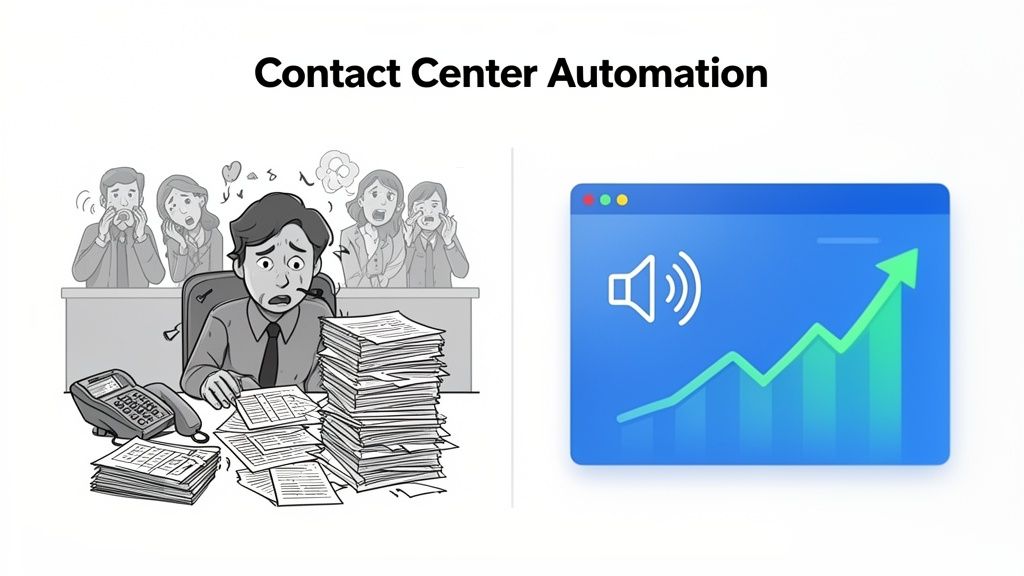
For far too long, the contact centre has been viewed as a necessary cost centre. But clinging to outdated, manual processes in 2026 is like running corporate finance on paper ledgers. It’s not just inefficient; it’s a direct threat to your competitive standing. This legacy thinking actively erodes customer loyalty and brand equity in an era where customers expect instant, 24/7 service on their preferred channel. If you can’t deliver, a competitor will.
A leading e-commerce firm, for example, found that 35% of their negative CSAT scores were directly linked to support wait times exceeding five minutes. This wasn't just a support issue; it was a revenue problem, with repeat purchase rates dropping by 15% among dissatisfied customers.
From Cost Centre to Growth Engine
This is where contact centre automation fundamentally changes the C-suite conversation. It directly addresses the two biggest pressures on any executive team: spiralling operational costs and impossibly high customer expectations. By doing so, it transforms a cost sink into a powerful engine for business growth.
By automating routine, repetitive tasks, you unlock massive efficiencies. Consider the strategic implications:
- You can handle a 500% surge in customer queries during a peak season without a corresponding 500% increase in headcount.
- You can offer consistent, around-the-clock support for high-volume inquiries like "Where is my order?" or "What's my account balance?" with zero human intervention.
- Most critically, you free up your most experienced agents to focus on complex, high-value interactions—like saving a high-value customer from churning or upselling a complex service.
This is a strategic reallocation of your most valuable resource: your people. Instead of being mired in repetitive work, your team becomes a proactive force focused on problem-solving, customer retention, and revenue generation. For more on this evolution, you might find our deep dive into the modern contact centre BPO insightful.
The business case is straightforward: Automation helps you serve more customers, more effectively, at a lower cost per interaction. It’s about creating a scalable framework for excellent service that feeds directly into profitability and sustainable growth.
The Market Shift Towards Cloud-Based Automation
This operational transformation is already well underway, especially in high-growth markets. In a dynamic economy like India's, cloud-based contact centre solutions are becoming essential for sectors like EdTech, BFSI, and real estate.
The Indian market for these solutions is projected to explode from USD 1.4 billion in 2025 to an incredible USD 7.9 billion by 2034. This growth is fueled by an urgent need for AI-driven automation and omnichannel communication. Businesses are finally ditching their old, inflexible on-premise systems for scalable cloud platforms that can actually meet their digital transformation goals. This isn't some far-off trend; it's a competitive reality right now for any leader who wants to defend and grow their market share.
The Three Core Components of a Modern Automated Contact Centre
When we discuss effective contact centre automation, we're not talking about a single piece of software. It’s a complete system built on three essential components that work in concert. As a business leader, you don’t need to get lost in the technical weeds, but understanding what these parts do is key to grasping the powerful business outcomes they deliver.
Think of it as an orchestra. Each section—IVR, Voice AI, and Workflows—is vital. But it's only when they play together that you create operational harmony.
Pillar 1: Intelligent IVR
We’ve all experienced the frustration of traditional Interactive Voice Response (IVR) systems. An intelligent IVR completely flips the script. Instead of a robotic "Press 1 for sales," your customer is greeted with a simple, "How can I help you?". They can state their need in plain English. The AI behind it understands their intent and routes them to the right agent or automated process instantly. A big part of what makes this possible is sophisticated AI transcription software, which accurately converts speech to text for the system to analyse.
- Before: A banking customer trying to report a lost card gets stuck in a six-level menu, presses the wrong number, and is transferred twice, taking over 10 minutes and causing immense frustration.
- After: The customer calls and says, "I need to report my credit card as lost." The intelligent IVR verifies their identity via voice biometrics and immediately initiates the card-blocking process, completing the request in under 90 seconds.
This first component acts as a smart, efficient front door for your entire customer experience, capable of increasing call containment rates by up to 40%. For a deeper dive, check out our guide on improving customer experience with an IVR contact centre.
Pillar 2: Voice AI Agents
Next are Voice AI Agents, the real workhorses of contact centre automation. These are not basic chatbots. They are advanced conversational AI agents capable of handling full, goal-oriented conversations—from qualifying a new sales lead to processing a complex insurance claim—with a remarkably human-like touch.
These agents can manage thousands of concurrent calls without fatigue, ensuring every interaction adheres perfectly to compliance and business rules. For a VP of Sales in real estate, the impact is immediate and measurable.
Before: A high-intent property buyer calls at 10 PM after seeing an online ad, gets voicemail, and books a visit with a competitor the next morning. A lead worth crores is lost forever.
After: The buyer calls at 10 PM. A Voice AI agent engages them, asks about their budget and preferred configuration (e.g., 3BHK), confirms their interest, and books a site visit directly into a sales agent's calendar for the next day. The lead is captured and qualified in under three minutes.
As you can see below, modern platforms are built to handle these kinds of complex, end-to-end interactions.
This interface shows how teams can design, train, and deploy custom agents for specific business objectives without a team of developers. The result is a system where AI can manage high-volume, goal-driven conversations—like booking appointments or completing KYC verification—with up to 97% accuracy compared to human agents.
Pillar 3: Workflow and CRM Automation
The final pillar is the invisible engine that ensures every conversation translates into a concrete business outcome: workflow automation.
When a Voice AI agent qualifies a lead, workflow automation instantly updates your CRM with the contact’s details, call summary, and lead score. It can trigger a follow-up email, create a task in your sales platform, and ensure no opportunity slips through the cracks. This is what turns a conversation into a conversion. It eliminates manual data entry, which is prone to an error rate as high as 4%, and ensures your CRM remains a single, reliable source of truth.
When you're in the boardroom, the decision to green-light new technology always comes down to ROI. With contact centre automation, the proof is in the numbers that matter to your business. We're not talking about incremental improvements; we're talking about fundamental performance transformation.
You can see the impact of automation through a few key areas: how efficiently you run, how happy your customers are, and ultimately, how much revenue you generate. Let's move past the theory and look at the hard data that shows what's possible when you bring smart automation into your contact centre. The core pillars—intelligent IVR, conversational Voice AI, and integrated workflows—all work together to deliver these results.
This journey, from basic call routing to fully integrated AI, is how modern contact centres are built.
Each pillar supports the next, creating a powerful system that drives real, tangible business outcomes.
To see just how significant this shift is, let's compare the before and after.
KPI Transformation Before and After Automation
This table contrasts key performance indicators in a traditional contact centre with the improvements we regularly see after a well-executed AI automation deployment. These are the numbers that should be on every CXO's dashboard.
| Key Performance Indicator (KPI) | Traditional Contact Centre Benchmark | Automated Contact Centre Benchmark | Business Impact |
|---|---|---|---|
| First Contact Resolution (FCR) | 70-75% | 85-95% | Higher customer satisfaction, reduced repeat calls by up to 30%. |
| Average Handle Time (AHT) | 6-8 minutes | 3-4 minutes (for AI-handled calls) | Drastically lower operational costs and 50%+ increased capacity. |
| Agent Occupancy | 80-85% | 60-70% (on automatable tasks) | Agents focus on complex, high-value work, reducing burnout by 25%. |
| Customer Satisfaction (CSAT) | 75-85% | 90%+ | Improved brand loyalty and a potential 5% lift in customer retention. |
| Outbound Connect Rate | 40-50% | 85-95% | Sales teams talk to more qualified leads, doubling their productive selling time. |
| Cost Per Interaction | ₹500 – ₹800 | ₹50 – ₹150 (for automated tasks) | Up to 80% reduction in operational expenditure for routine interactions. |
The numbers speak for themselves. This isn't just an upgrade; it's a complete reimagining of what a contact centre can achieve for the business.
Driving Down Costs and Boosting Efficiency
The most immediate win from automation is on your P&L statement. By delegating high-volume, repetitive tasks to AI, you can slash operational costs while making your team more productive.
Think about an agent's typical day. Instead of mindlessly dialling numbers or answering the same five questions, they're freed to tackle complex issues. The AI takes over lead qualification, appointment booking, and order status checks—flawlessly, 24/7.
For example, a leading logistics company saw its outbound connect rates for delivery confirmation jump from a standard 47% to an incredible 91% by using a Voice AI agent to initiate calls. This freed up their service agents to handle complex rerouting and exception cases, reducing overall delivery exceptions by 18%.
This isn't a one-off. Industry data shows that AI integration can lead to ticket resolutions that are 52% faster and deliver a 30-50% boost in overall agent productivity. As remote work becomes standard—with over 40% of agents expected to work via the cloud by 2026—these efficiency gains are vital for managing a distributed workforce effectively.
Creating a Customer Experience That People Love
A great customer experience is no longer a "nice-to-have"; it's a primary driver of customer loyalty. Automation directly addresses the most common customer pain points: long waits, inconsistent answers, and the frustration of repeating information.
- No More Waiting: AI agents answer instantly, eliminating hold times for common queries, a factor that Gartner finds is a top driver of customer frustration.
- Always On: Your business can offer 24/7 support, meeting customers whenever they need it, not just during business hours.
- Perfectly Consistent: Every interaction adheres to your exact business rules and scripts, ensuring 100% compliance and quality.
This translates directly to happier customers. We consistently see Customer Satisfaction (CSAT) scores climb by up to 35% post-implementation. When a customer can resolve their issue in seconds, their perception of your brand is elevated. You can get a deeper look at what to track in our guide on metrics for contact centre analytics.
Fuelling Real Revenue Growth
Finally, and for many executives, most importantly: contact centre automation is a powerful engine for growth. By making your lead management and sales processes smarter and faster, it directly impacts the top line.
Imagine a Voice AI agent qualifying a new inbound lead and booking a sales meeting in a single, three-minute call. That's a sales cycle shortened from days to minutes, preventing a warm lead from going cold. The results are stark. One of our FinTech clients boosted their lead-to-booking rates from a paltry 2% to a healthy 8%. That’s a 4x improvement in marketing ROI, turning ad spend directly into qualified sales pipeline.
By automating follow-ups and nurturing campaigns, you create a predictable, scalable sales engine you can rely on to hit revenue targets.
Automation Use Cases Across Key Industries
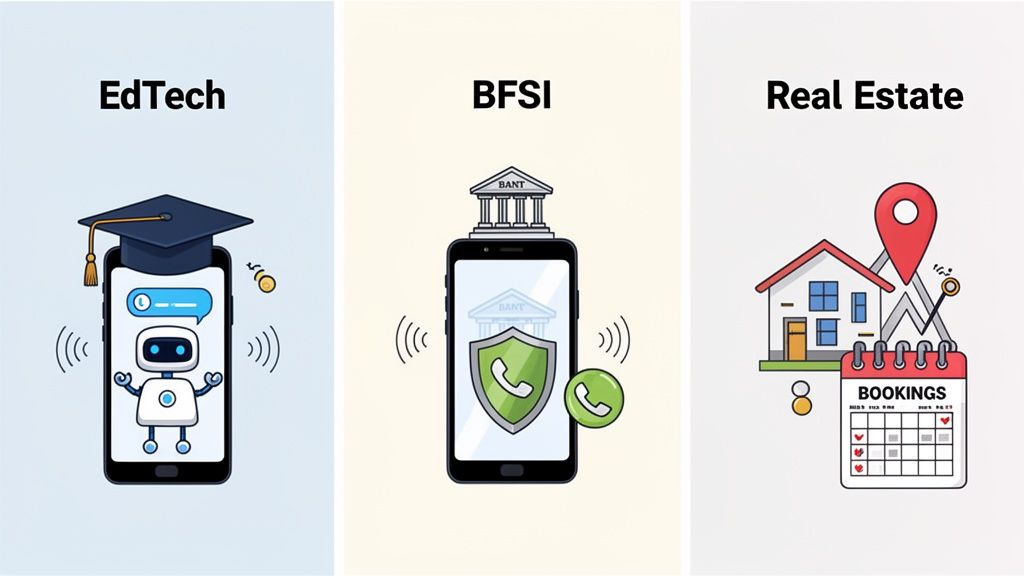
The true power of contact centre automation is realized when you see it solving specific, high-stakes industry problems. For any director or executive, the "aha" moment comes from understanding how this technology resolves concrete business challenges. Theoretical benefits are one thing; measurable results are what drive strategic investment.
Let's examine how intelligent automation is delivering tangible ROI in sectors like EdTech, BFSI, and Real Estate.
EdTech: Streamlining Admissions and Student Counselling
The EdTech market is fiercely competitive. Institutions grapple with managing thousands of inquiries from prospective students who expect personalized, immediate guidance. Human counsellors are quickly overwhelmed, leading to slow response times and a poor applicant experience.
This is a prime use case for a Voice AI agent acting as a 24/7 frontline admissions counsellor.
The Problem: A prominent online university was struggling with a massive 70% drop-off rate for its inbound admission enquiries. Their team of 20 counsellors couldn't handle the call volume after a major marketing campaign, and high-potential leads were being lost.
The Automated Solution: They deployed a Voice AI agent to manage all initial enquiry calls. This agent was trained to:
- Answer common questions about course fees, eligibility, and curriculum.
- Conduct a preliminary qualification based on academic background and course interest.
- Book detailed counselling sessions with human advisors for high-intent candidates.
- Initiate the application form process directly on the call.
The system instantly managed 100% of incoming calls, ensuring no potential student ever hit a busy signal. This immediate engagement was crucial.
The business results were striking. The university reported a 40% increase in qualified applications within the first quarter. By automating the top of the funnel, their human counsellors focused on high-intent students, ultimately boosting overall enrolment conversions by 15%.
BFSI: Ensuring Compliance and Instant Support
In Banking, Financial Services, and Insurance (BFSI), security, compliance, and speed are non-negotiable. Processes like Know Your Customer (KYC) verification are mandatory but often slow and resource-intensive. Simultaneously, customers on trading platforms demand instant support for time-sensitive queries.
A compliant AI agent offers the perfect solution, balancing stringent security protocols with the customer's need for speed.
The Problem: A popular stock trading platform was experiencing high customer churn. Users were frustrated by a 48-hour wait for KYC verification, which delayed account activation, and sluggish support for urgent trading queries, causing them to miss market opportunities.
The Automated Solution: The platform implemented a specialized Voice AI agent integrated with its core systems to handle two key jobs:
- Automated KYC Verification: The AI guides users through the KYC process on a secure, recorded line, verifying documents and collecting data in a fully compliant manner.
- Instant Trading Support: For existing traders, the agent provides real-time answers to queries like, "What is my current margin?" or "How do I place a stop-loss order?", escalating only complex advisory questions to human experts.
This deployment transformed their operations. The average KYC verification time plummeted from 48 hours to just 5 minutes. On the support side, over 60% of routine trading questions were resolved instantly by the AI, drastically cutting call queues. The firm met all its regulatory obligations while delivering the speed its customers demanded.
Real Estate: Qualifying Leads and Booking Visits Around the Clock
In real estate, speed-to-lead is everything. A buyer's interest is highest in the moments after they inquire. A delay of just 5 minutes can decrease the odds of qualifying a lead by 10x. The challenge is that most inquiries come after business hours.
This is a perfect scenario for a 24/7 lead engagement automation strategy.
The Problem: A major real estate developer was generating hundreds of leads from digital ads but converting almost none. Analysis revealed that over 50% of inquiries were submitted after 6 PM, while their sales team logged off at 5 PM. By the next morning, the leads were cold.
The Automated Solution: They deployed a Voice AI agent to handle every incoming lead call, day or night. The agent's goal was simple: qualify the lead and book a site visit.
- It instantly called a lead the moment they submitted an online form.
- It asked key qualifying questions about budget, preferred property type (e.g., 2BHK or 3BHK), and location.
- For qualified leads, it accessed the sales team’s calendar via API and booked a site visit on the spot.
By ensuring every lead was contacted within 5 minutes, the developer saw their lead-to-visit conversion rate jump from a dismal 3% to an impressive 10%. The sales team arrived each morning to a calendar pre-filled with qualified appointments, allowing them to focus on closing deals, not cold calling.
Your Roadmap to Implementing Contact Centre Automation
Embarking on automation is a strategic business initiative, not just an IT project. The most successful deployments are built on a smart, phased plan that demonstrates value, builds momentum, and scales with intelligence.
This roadmap is designed for business leaders, cutting through the jargon to outline four clear stages for a successful transformation.
Stage 1: Audit and Goal Setting
Before you automate, you must know what to automate for the biggest impact. Convene your operational leaders and ask: Where is our team's time being consumed by low-value, repetitive tasks?
Is your sales team wasting hours on outbound calls to qualify leads? Are service agents answering the same "Where is my order?" query 100 times a day? These are your starting points.
- Identify High-Impact Processes: Pinpoint tasks that are both time-consuming and follow clear, rule-based logic. Lead qualification, appointment setting, and status updates are classic low-hanging fruit.
- Define Clear KPIs: Move beyond vague goals like "improving efficiency." Target specific, measurable outcomes, such as reducing Average Handle Time by 30% or increasing the lead-to-booking rate from 2% to 5%.
- Establish a Baseline: You cannot prove ROI without a starting line. Meticulously measure your current performance on these KPIs before you begin.
Stage 2: Vendor Selection and Partnership
Choosing the right technology provider is the single most critical decision in this process. You are not just buying software; you are selecting a strategic partner who understands your industry and can help you build the business case. Look for a team with a proven track record of delivering measurable results in your sector, be it EdTech, BFSI, or real estate.
A strong partner will do more than sell you a platform. They’ll help you build the business case, map out your pilot programme, and make sure your team is ready for success from day one. Their expertise becomes an extension of your own.
As you plan your implementation, using a visual tool like an AutomationBuilder can be a game-changer. It helps you map out and design your workflows, which can seriously speed up the whole deployment process.
Stage 3: Pilot Programme and Integration
The golden rule: start small, prove value, then scale. One of the biggest mistakes is attempting to automate the entire contact centre at once—a recipe for chaos. A focused pilot program allows you to prove the concept, iron out kinks, and build internal champions.
Select one, well-defined use case for your pilot. For an EdTech institution, it could be automating initial admission inquiries. For a real estate firm, it might be 24/7 lead qualification.
Integration is non-negotiable. Your automation platform must seamlessly connect with your existing CRM. When a Voice AI agent books a meeting, that event must instantly appear in your sales team's calendar and update the customer record in your CRM. This creates a single source of truth and eliminates data silos.
Stage 4: Scale and Optimise
Once your pilot demonstrates clear success—backed by hard data—it’s time to expand. Use the lessons learned and the ROI figures from your pilot to build the business case for a wider rollout.
Scaling is a continuous cycle of improvement, not a one-time event.
- Analyse Performance Data: Continuously monitor your KPIs. Are the AI agents hitting their targets? Where are conversations dropping off?
- Refine and Retrain: Use this data to tweak scripts and retrain your AI agents. Modern platforms make it easy to adjust conversational flows to optimize for better outcomes.
- Gather Team Feedback: Your human agents are a goldmine of insight. They understand customer needs and can help you identify the next best process to automate.
By following this phased approach, you de-risk the project, prove value at every stage, and ensure your contact centre automation initiative delivers lasting business results.
Deployment Checklist for Enterprise Leaders
To guide your strategic oversight, use this high-level checklist designed for the executive team. This focuses on key leadership actions required to ensure the project delivers on its strategic promise.
| Phase | Key Action Item for Leadership | Success Metric |
|---|---|---|
| Phase 1: Strategy | Secure executive buy-in with a clear business case linking automation to core business goals (e.g., revenue growth, cost reduction). | Signed-off budget and cross-functional steering committee established. |
| Phase 2: Planning | Approve the selection of a strategic partner, not just a low-cost vendor. Ensure they have relevant industry experience. | Vendor scorecard completed with high marks for strategic guidance and industry proof. |
| Phase 3: Pilot | Champion the pilot programme internally. Communicate its limited scope and specific goals to manage expectations across the company. | Pilot KPIs (e.g., containment rate of 40%, CSAT lift of 10%) met or exceeded. |
| Phase 4: Scaling | Review pilot ROI and approve a phased, data-driven scaling plan. Prioritise the next set of use cases based on business impact. | A clear, funded roadmap for scaling automation over the next 12-18 months. |
This checklist ensures leadership remains actively engaged, steering the project towards strategic success rather than getting lost in tactical details.
Answering Your Key Questions on Automation
A healthy dose of executive skepticism is crucial before any significant investment. Let's address the most common questions from VPs, Directors, and other C-suite leaders with straight, data-backed answers.
Will Automation Replace Our Skilled Contact Centre Agents?
No. The strategic goal is augmentation, not replacement. Automation excels at high-volume, repetitive tasks—checking an order status, qualifying a simple lead, booking a routine appointment. This frees your skilled agents to handle the complex, high-empathy conversations where a human touch is indispensable. Their work becomes more strategic and fulfilling, which directly impacts agent retention.
In fact, we’re seeing that AI copilots actually help new agents ramp up and achieve full productivity 39% faster. You create a blended workforce where AI handles the predictable, and humans manage the pivotal, relationship-defining moments.
How Do We Prove the ROI of Contact Centre Automation?
The ROI is not a fuzzy concept; it appears in three tangible areas that a good partner will help you track from a single dashboard.
- Cost Savings: This is the most direct metric. You will see a significant drop in your cost-per-interaction. For example, if an automated interaction costs ₹50 while a human-led one costs ₹500, handling 100,000 routine queries a month with automation translates to substantial opex reduction.
- Productivity Gains: Track core operational metrics. An increase in First Contact Resolution from 70% to 85% means fewer repeat calls and more efficient use of agent time. A decrease in agent burnout means lower attrition costs.
- Revenue Growth: This is where automation becomes a profit center. You can directly measure the impact on lead conversion rates or customer lifetime value (CLV). A sales VP can point to a 4x increase in meetings booked by an AI agent, while a marketing director can show improved marketing ROI from faster lead follow-up.
Can AI Truly Handle Our Complex Customer Conversations?
Yes, when applied strategically. Modern Voice AI demonstrates up to 97% accuracy in matching human judgment on structured, goal-oriented tasks like lead qualification or KYC verification. The key is to start smart.
Begin by automating interactions with a clear, defined goal—booking demos, collecting feedback, processing payments. For truly complex or emotionally charged issues, the system is designed to intelligently hand off the call to a human agent, passing along the full context so the agent can seamlessly continue the conversation.
How Difficult Is Integration With Our Existing CRM and Systems?
This is a valid concern for any IT or operations leader. Top-tier automation platforms are built with an API-first architecture, designed for seamless integration. They offer pre-built connectors for major CRMs like Salesforce and HubSpot.
The goal is to create a single source of truth. When a Voice AI agent qualifies a lead, the call transcript and data should instantly sync to your CRM. No manual data entry, no delays. Your sales team gets a clean, actionable lead the moment the call ends. When vetting vendors, demand a demonstration of their integration capabilities. The right platform should feel like a natural extension of your existing tech stack, not another silo.
Ready to turn more of your conversations into conversions? DialNexa Labs Private Limited provides human-like Voice AI agents that scale your outreach and free your team to focus on what matters most. Discover how our platform can transform your customer engagement by exploring our solutions.

[…] that gap by connecting interaction data to business outcomes. That is why many firms now treat contact center automation strategies as part of margin improvement, not only as a technology […]
[…] Adam voice ai should be evaluated as an operating asset, not just a text-to-speech option. In practice, the decision is whether your current phone workflows are converting reachable demand efficiently, or losing value through rigid delivery, uneven agent performance, and limited language coverage. That is why Adam is increasingly relevant to leaders prioritizing margin protection and revenue efficiency through contact center automation strategies. […]
[…] precision, and keeps service available outside standard staffing windows. For leaders evaluating contact centre automation strategies, the value isn't cosmetic. It's […]
[…] automation readinessTeams evaluating service workflows often use contact center automation frameworks to determine which interactions are standardised enough for technology-led cost […]
Great insights! This clearly shows that contact centre automation is no longer just about reducing costs—it’s a strategic investment that improves customer experience, boosts productivity, and drives measurable revenue growth. The real power lies in empowering human agents to focus on high-value interactions while AI handles routine tasks at scale.