
What SLA Means in BPO A Strategic Guide for CXOs
Quick answer: what does SLA mean in BPO?
SLA in BPO stands for Service Level Agreement – the contract between a client and its outsourcing provider that defines the performance targets the BPO must hit, how they are measured, and what happens when they are missed. The most common benchmark is the 80/20 service level: 80% of calls answered within 20 seconds, alongside targets for First Call Resolution (FCR), Average Handle Time (AHT), accuracy, and turnaround time. In practice a strong BPO SLA covers four pillars – scope, KPIs, governance, and remedies – so it works less like paperwork and more like a financial control system for the outsourced operation.
A VP of customer operations usually notices the problem before finance does. Customer queues lengthen. Escalations rise. The BPO partner insists performance is “within range”. Your internal teams still absorb the fallout through repeat contacts, missed revenue moments, compliance exposure, and brand irritation.
That’s where many outsourcing programmes go wrong. Leaders treat the SLA as a procurement document signed once and delegated downward. In practice, it’s the operating instrument that determines whether outsourced work protects margin or leaks it.
For teams searching sla means in bpo, the full answer isn’t just “service level agreement”. It’s the commercial logic that translates service promises into cost control, risk discipline, and growth outcomes.
Table of Contents
- Beyond the Acronym What SLA Means for Your Bottom Line
- Deconstructing the SLA A Blueprint for BPO Performance
- The Critical BPO Metrics Every Executive Must Track
- Translating Metrics into Contractual Clauses Real-World SLA Examples
- Effective Governance Monitoring Performance and Navigating Breaches
- The Future of BPOs Redefining SLAs with Voice AI
- From Agreement to Asset Making Your BPO SLA a Strategic Advantage
Beyond the Acronym What SLA Means for Your Bottom Line
An SLA in BPO is a contract, but executives should read it as a financial control system.
In the Indian BPO industry, SLAs are the foundational agreements that define performance benchmarks. A standard service level target is 80% of calls answered within 20 seconds, and that sits inside a sector that employed over 5.4 million people by 2022 and generated $44.5 billion in export revenue according to this industry overview. That scale matters. When a market this large standardises around SLA-driven delivery, the document is no longer administrative. It becomes the core mechanism for managing outsourced outcomes.
Why the board should care
A weak SLA usually creates three types of damage:
- Margin erosion: Poorly defined scope leads to billable exceptions, duplicated handling, and more management overhead.
- Revenue drag: Slow response times and inconsistent qualification mean buyers cool off before your teams engage them properly.
- Risk concentration: If the contract is vague on compliance, escalation, or accountability, your brand carries the downside while the provider debates interpretation.
That’s why the smartest operators don’t ask only whether the vendor can “meet SLA”. They ask whether the SLA itself reflects the economics of the business.
Executive lens: If a metric affects churn, repeat demand, staffing load, or regulatory exposure, it belongs in senior management discussion, not just in delivery meetings.
The commercial meaning behind the acronym
Many teams hear “service level agreement” and think of queue times. That’s too narrow.
A serious BPO SLA governs:
- What work is included
- How quality is measured
- When a miss becomes a breach
- What corrective action follows
- How commercial consequences are applied
If those elements are strong, the SLA protects forecastability. If they’re weak, the provider can remain contractually compliant while your business still suffers.
Leaders evaluating outsourcing models often benefit from grounding this discussion in the wider contact centre BPO context. The contract only works when it matches the operating reality underneath it.
Deconstructing the SLA A Blueprint for BPO Performance
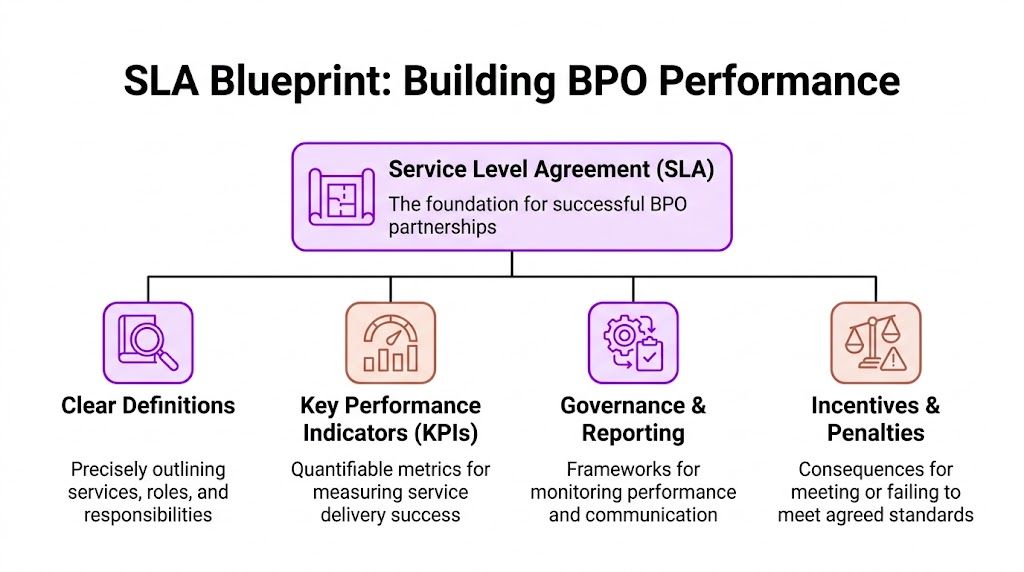
A good SLA works like a building blueprint. It doesn’t just say “build something useful”. It specifies dimensions, tolerances, materials, inspection points, and remedies if the structure fails.
Scope of services
Most disputes begin here.
If the SLA says the provider will “support customer enquiries”, that sounds acceptable until edge cases appear. Does that include billing complaints, KYC clarifications, cancellation requests, multilingual overflow, or after-hours callbacks? If the scope is loose, every exception becomes a negotiation.
A stronger version names channels, hours, exclusions, handoff points, and ownership boundaries. It should also state what happens when volumes change or new workflows are introduced.
For a CXO, this is less about legal wording and more about budget integrity. Undefined scope is one of the fastest routes to hidden cost.
Performance metrics and KPIs
This is the visible centre of the SLA, but it’s often misunderstood.
Metrics shouldn’t exist because they’re common. They should exist because they connect to a business outcome. Service level, resolution quality, turnaround time, and accuracy each tell you something different about customer friction, labour consumption, and risk.
Some executive teams find it useful to decode SLAs by separating the measurement layer from the business intent behind it. That distinction prevents teams from chasing dashboard compliance while missing the economics underneath.
A metric becomes strategic when leadership can answer one question clearly: what financial or operational consequence follows if this number moves in the wrong direction?
Reporting and governance
A static SLA is almost useless.
The contract should specify reporting cadence, dashboard ownership, review forums, exception handling, and escalation paths. Without those rules, data arrives too late or in formats that hide the underlying issue.
Governance clauses matter because they determine whether performance management is proactive or forensic. A provider that reports on breaches after the fact gives you history. A provider that flags early deterioration gives you control.
Consequences and remediation
Penalty clauses aren’t there to create hostility. They’re there to align incentives.
If a provider misses a critical target, the agreement should define service credits, cure periods, escalation requirements, root-cause analysis, and recovery plans. The best contracts also include structured remediation rather than relying on informal promises.
A useful mental model is simple:
| SLA pillar | Strategic purpose |
|---|---|
| Scope | Prevents cost drift and ownership confusion |
| KPIs | Connects service delivery to business outcomes |
| Governance | Creates visibility before issues become expensive |
| Remedies | Enforces accountability and speeds correction |
An SLA fails when one pillar is missing. It succeeds when all four work together.
The Critical BPO Metrics Every Executive Must Track
Most BPO dashboards contain more data than insight. Senior leaders don’t need dozens of lines. They need the handful of metrics that reveal whether the outsourced operation is protecting customer value or creating rework.
In the Indian BPO sector, the standard benchmark is 80% of calls answered within 20 seconds, and missing that threshold directly correlates with a 15-20% increase in customer churn rates according to this BPO SLA reference. That makes service level more than a contact centre statistic. It becomes an early warning signal for revenue loss.
Service level
Service level measures response speed against an agreed threshold.
For a CXO, the key question isn’t whether the queue target was hit on average. It’s whether delayed access is damaging retention, conversion, or customer confidence. A provider can look operationally busy while your customers stop waiting.
If your board reviews only monthly averages, you may miss the periods where service breaks under pressure.
First call resolution
First Call Resolution, or FCR, is one of the clearest indicators of process quality.
When customers get the answer on the first interaction, your business avoids duplicate demand, follow-up handling, and avoidable dissatisfaction. Strong FCR usually reflects better knowledge management, cleaner workflows, and stronger frontline authority.
This is also where operations and economics meet. A low FCR number doesn’t just signal poor service. It signals that the same workload is being paid for more than once.
Average handle time
AHT matters, but only when interpreted correctly.
Leaders often pressure vendors to reduce handling time, then discover that rushed calls drive avoidable callbacks. AHT should be read beside FCR and quality. If handle time falls while repeat contacts rise, the operation hasn’t become efficient. It has shifted work into the future.
Teams trying to interpret staffing pressure and throughput often find it useful to compare SLA metrics with the underlying utilization formula in BPO. Without that context, executives can mistake occupancy strain for productivity.
Accuracy and turnaround time
These metrics matter most in back-office work, claims processing, finance operations, onboarding, and compliance-sensitive environments.
Accuracy protects against downstream correction cost. Turnaround time protects against customer delay and internal bottlenecks. When both are defined clearly, they reveal whether the provider is delivering speed with control, or speed with hidden defects. Catching those hidden defects before they show up in the SLA report is the core job of a dedicated quality function; see DialNexa’s guide on what a quality analyst in BPO actually does for how that audit role feeds the wider scorecard.
Key BPO SLA Metrics and Their Strategic Importance
| Metric | Typical Benchmark | What It Tells a CXO |
|---|---|---|
| Service Level | 80% of calls answered within 20 seconds | Whether access delays are likely to affect customer retention and queue stability |
| First Call Resolution | Qualitatively tracked as a core resolution metric | Whether the operation is solving demand once or paying to handle it repeatedly |
| Average Handle Time | Used with caution, not in isolation | Whether process design is efficient or simply compressing interactions |
| Accuracy | Contract-specific, especially in back-office workflows | Whether quality failures may create rework, complaints, or compliance exposure |
| Turnaround Time | Contract-specific by process type | Whether outsourced delivery supports or slows revenue and service workflows |
Practical rule: Never reward speed without checking resolution quality. Fast failure is still failure, and it often costs more.
Translating Metrics into Contractual Clauses Real-World SLA Examples
Most SLA discussions fail at the same point. Everyone agrees on the metric, but the contract language leaves too much room for interpretation.
That’s why strong operators move from metric names to enforceable clauses.
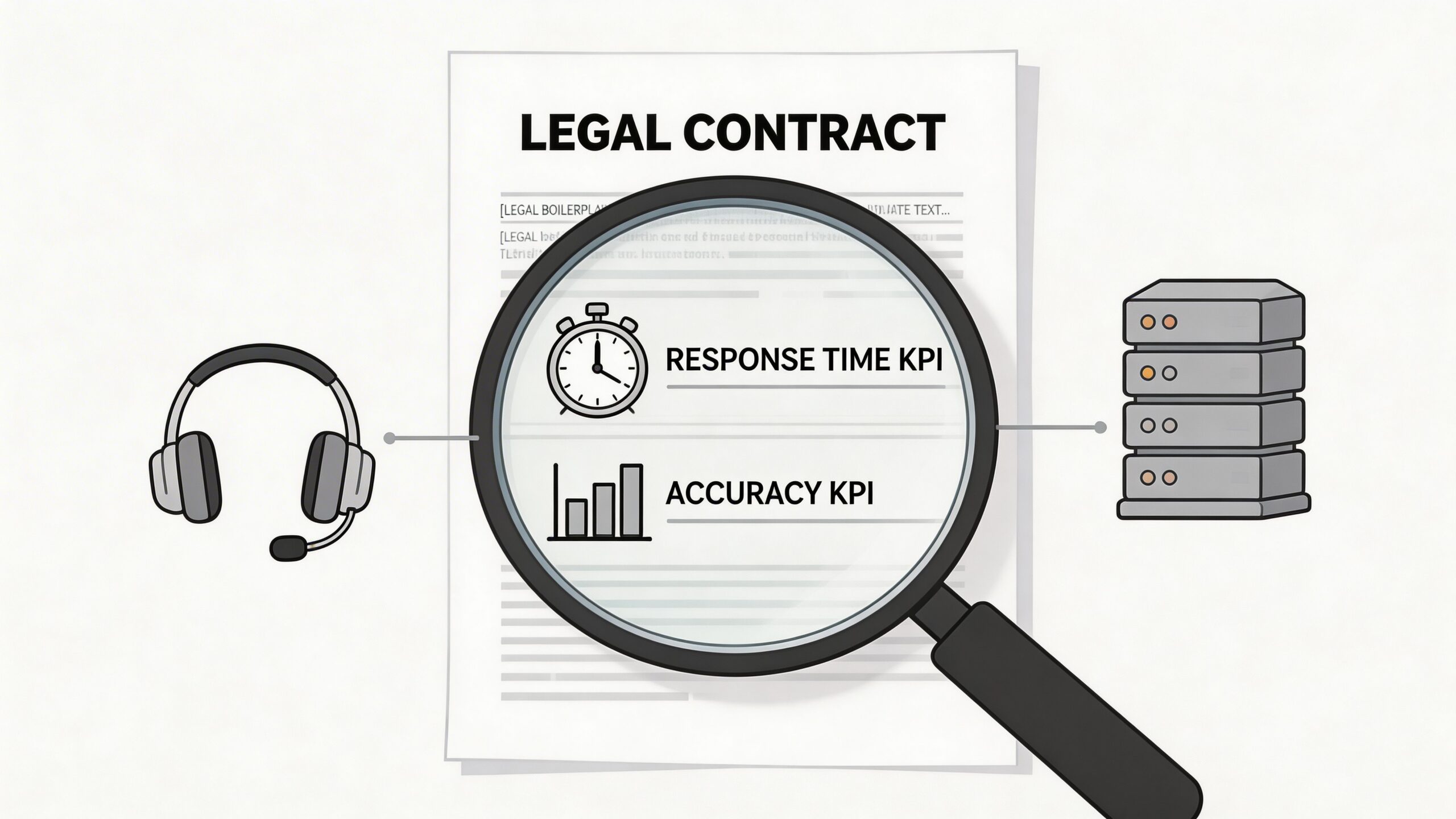
For Indian BPO firms serving BFSI and real estate, SLAs often include FCR targets of 85-90%, while sub-85% FCR causes a 25% rise in repeat calls and operational costs. Top performers reach 92% through integrated CRM-SLA dashboards, as outlined in this outsourcing SLA analysis. That data makes one point clear. Precision in the clause affects real cost.
Customer support clause
A vague version says: “Provider will resolve customer issues promptly.”
A stronger version sounds more like this:
Provider shall maintain First Call Resolution performance within the agreed target band for in-scope enquiries. FCR shall be measured using CRM case closure data and reviewed within the agreed reporting cadence. Where performance falls below the threshold, provider shall submit root-cause findings and corrective action within the defined remediation window.
What’s better here is not legal complexity. It’s operational specificity. The clause names the data source, the review method, and the response obligation.
Lead generation clause
Sales support contracts often fail because “qualified lead” means one thing to the BPO and another to the revenue team.
A stronger clause should reference a qualification framework, mandatory data capture, and acceptance standards by campaign or segment.
Example wording:
- Qualification criteria: Only leads meeting the approved screening conditions in the campaign appendix will count as qualified.
- Data completeness: Required fields must be captured before a lead can be passed to the client team.
- Dispute handling: Rejected leads must be reviewed against the documented standard rather than ad hoc judgement.
Revenue leakage often starts with ambiguity at handoff.
Back-office processing clause
For finance, documentation, onboarding, or fulfilment support, accuracy and turnaround time usually matter more than queue speed.
A useful clause should identify the transaction type, the completion standard, the acceptable error treatment, and the remediation path if quality drops.
For teams reviewing third-party paper, statement-of-work language, or annexures, an AI-powered legal contract analyzer can help surface inconsistencies faster before negotiation rounds begin.
What strong clauses have in common
The best examples usually include four traits:
- A defined metric tied to a clear formula or rule.
- A named source of truth such as CRM, telephony, or workflow data.
- A time boundary covering when measurement occurs and when remediation starts.
- A consequence model if the target is missed.
Good SLA wording removes the sentence “that’s not how we interpreted it” from future meetings.
Effective Governance Monitoring Performance and Navigating Breaches
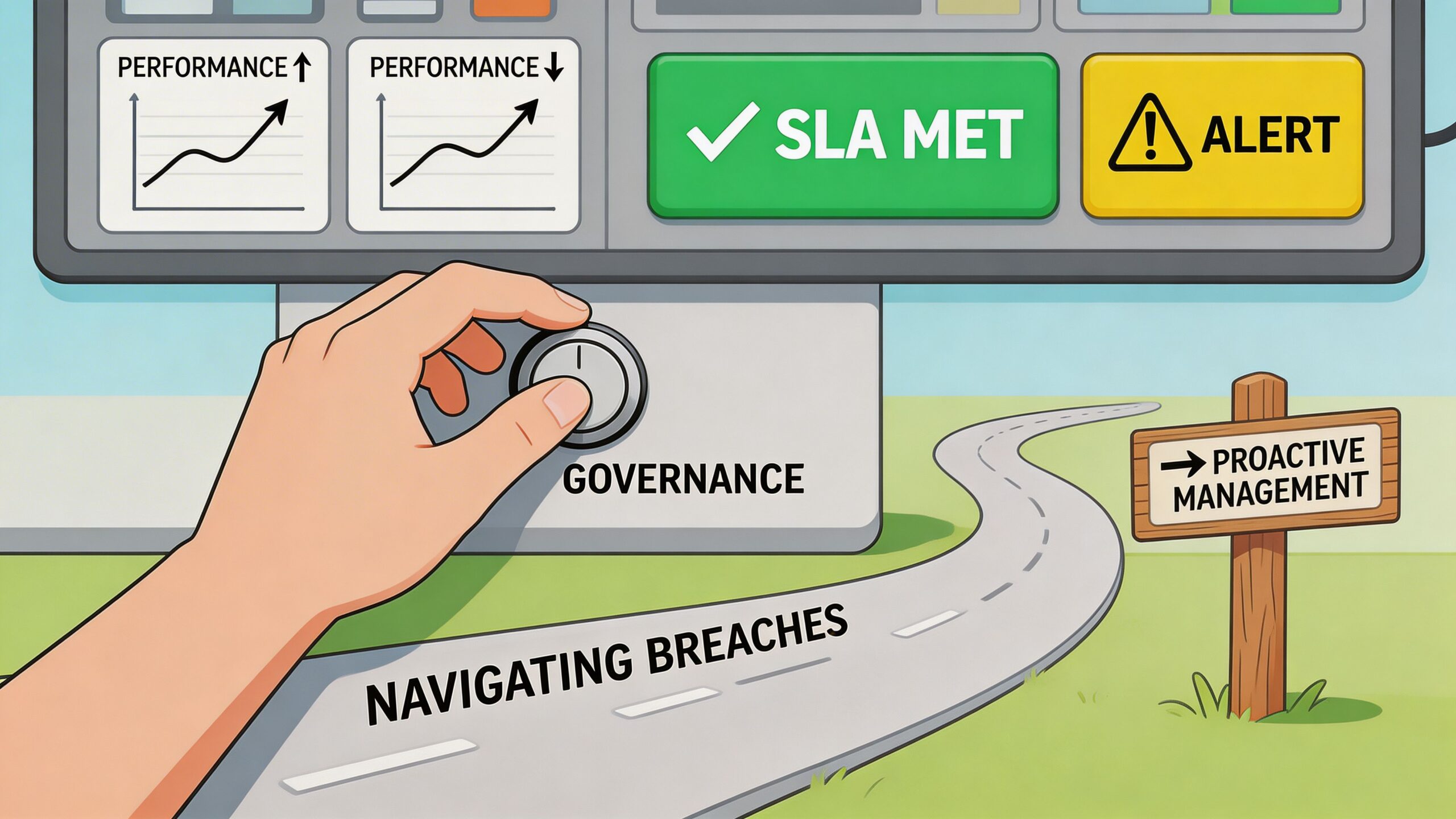
A signed SLA doesn’t protect value on its own. Governance does.
The first discipline is visibility. If management sees service deterioration only at month-end, the SLA has already failed as a control mechanism.
Build the right operating cadence
An effective governance model usually works across three layers.
- Daily operational oversight: Team leaders monitor queue conditions, exceptions, and immediate workflow disruption.
- Weekly service reviews: Managers assess trends, recurring causes, and open remediation items.
- Quarterly executive reviews: Senior stakeholders decide whether the outsourced model still supports business goals, risk appetite, and financial expectations.
What matters is consistency. When reviews drift, vendors optimise for the report rather than the operation.
Real-time observability is part of that discipline. Executives who want earlier warning signals should insist on dashboards that support live oversight rather than retrospective summaries. This becomes much easier when teams already understand the role of real-time monitoring in contact operations.
Treat breaches as managed events
The strongest governance teams don’t dramatise breaches. They operationalise them.
A breach protocol should answer:
- What threshold counts as a breach
- Who gets notified
- How quickly root cause must be documented
- What temporary controls must be applied
- When commercial remedies take effect
That structure keeps meetings focused on recovery, not blame.
The useful question in a breach review isn’t “who missed the target?” It’s “what system failed, and what prevents recurrence?”
A short explainer can help anchor that conversation:
Balance penalties with improvement
Service credits matter because they create commercial accountability. But mature governance doesn’t stop there.
A well-run arrangement also defines:
- Corrective action plans with owners and deadlines
- Escalation paths when misses continue
- Earn-back conditions where sustained recovery can offset part of the penalty
- Change controls if the business itself has altered demand, scope, or complexity
That balance prevents two common failures. One is a passive client who absorbs poor service. The other is a punitive environment where both sides optimise defensively instead of solving the issue.
Governance turns the SLA from a static contract into an executive risk routine.
The Future of BPOs Redefining SLAs with Voice AI
Traditional SLAs were written for human capacity models. That assumption is breaking.

NASSCOM reports that 70% of Indian BPO firms are piloting generative AI, yet only 15% of SLAs have updated clauses for AI metrics. The same source notes that this gap leaves clients underserved because legacy agreements fail to capture outcomes such as lead-to-booking improving from 2% to 8% through more natural AI-led conversations, according to this discussion of SLA evolution in outsourcing.
Why legacy SLAs fall short
Most older contracts still focus on human-era measures such as queue speed, handle time, and manual quality checks.
Those still matter. But AI changes what can be measured and what can be expected. Leaders can now ask different questions:
- Did the system complete the conversation path successfully?
- Did it hand off correctly when confidence was low?
- Was the customer intent captured accurately?
- Did uptime, routing, and integration reliability support continuity?
If the SLA doesn’t include those questions, it ignores the core performance drivers of the model being purchased.
What modern AI clauses should include
AI-centred SLAs should add measures such as:
- Connect performance: Whether automated outreach reaches and engages intended contacts effectively.
- Conversation success: Whether the system completes the intended workflow without avoidable drop-off.
- Escalation quality: Whether handoffs to human teams occur correctly and with context.
- System availability: Whether the underlying service remains dependable enough for business-critical use.
- Auditability: Whether interactions can be reviewed for compliance, dispute resolution, and model improvement.
This isn’t only a technology issue. It’s a board issue.
When contracts ignore AI-specific metrics, companies often under-measure upside and under-govern risk at the same time. They may pay for innovation while still managing the relationship with outdated scorecards.
A future-proof SLA doesn’t ask AI to fit old operational boxes. It rewrites the box around the business outcome you actually want.
From Agreement to Asset Making Your BPO SLA a Strategic Advantage
The phrase sla means in bpo sounds technical. For a CXO, it’s commercial.
A strong SLA protects margin by limiting ambiguity. It supports growth by aligning service delivery to response, conversion, and retention outcomes. It reduces risk by making accountability, escalation, and remediation explicit. And as outsourcing models absorb more AI, it becomes the document that determines whether new capability creates measurable value or unmanaged complexity.
Leaders shouldn’t delegate SLA thinking entirely to procurement, legal, or operations. They should shape it directly. The contract sits too close to customer experience, financial performance, and governance to be treated as paperwork.
The companies that outperform in outsourcing usually do one thing differently. They manage the SLA as an asset, not an obligation.
If your team is rethinking how outsourced conversations should be measured, automated, and governed, DialNexa Labs Private Limited helps organisations deploy human-like Voice AI agents for qualification, support, recruitment, and presales workflows at scale. For CXOs who want SLA design to reflect modern operating reality, that’s a useful place to start.
Frequently asked questions about SLA in BPO
What is the full form of SLA in BPO?
SLA stands for Service Level Agreement. In a BPO context it is the contract that sets out the service performance the outsourcing provider commits to – the metrics, the targets, how they are measured, and the consequences if they are missed.
What does SLA mean in BPO?
An SLA in BPO means a documented, measurable promise of service quality between a client and its BPO partner. It defines what work is in scope, which KPIs are tracked (service level, FCR, AHT, accuracy, turnaround time), how performance is reported, and what remedies apply when a target is breached.
What is the SLA formula in BPO?
The core service-level formula is: Service Level (%) = (Calls answered within the threshold / Total calls offered) x 100. The industry-standard target is the 80/20 rule – 80% of calls answered within 20 seconds. Other SLA metrics such as FCR and accuracy have their own formulas but service level is the one most people mean by “the SLA”.
What is a good SLA in a BPO call center?
The most widely used benchmark is 80% of calls answered within 20 seconds. For resolution quality, strong BPOs target First Call Resolution of 85-90% (top performers reach ~92%). The right numbers depend on the process – back-office work is usually governed by accuracy and turnaround-time targets rather than queue speed.
What SLAs should I expect from a BPO provider?
Expect targets across four areas: scope (exactly what is covered), KPIs (service level, FCR, AHT, accuracy, turnaround time with clear benchmarks), governance (reporting cadence, dashboards, escalation paths), and remedies (service credits, cure periods, root-cause and corrective-action obligations). If AI or voice automation is involved, also expect clauses for connect performance, conversation success, escalation quality, uptime, and auditability.

This is an excellent analysis that shows how SLAs are far more than operational documents—they are strategic tools for protecting revenue, customer experience, and accountability. The connection between traditional metrics and emerging AI-driven performance standards is especially insightful and highly relevant for modern BPO leaders.