
A CXO’s Guide to Cloud Based Networking for a Resilient Enterprise
What exactly is cloud-based networking? In strategic terms, it's the shift from managing a complex, capital-intensive collection of on-premise hardware to orchestrating your entire network infrastructure from a central, cloud-based platform. For a leadership team, this transition unlocks unprecedented agility, operational efficiency, and strategic control, all managed from a single dashboard.
The Strategic Imperative of Cloud-Based Networking

Consider your traditional network as a single, central factory. Every resource originates there, and all traffic must pass through its gates. This model is adequate for a local operation but becomes a significant bottleneck to growth. It's rigid, requires substantial capital expenditure to scale, and a single point of failure can halt operations enterprise-wide. For instance, a hardware failure at the central data centre could cripple a retail chain's point-of-sale systems across dozens of stores, leading to immediate revenue loss.
Cloud-based networking fundamentally inverts this model, transforming it into a dynamic, global logistics network. Instead of one factory, you command an intelligent, distributed system that routes data and services with maximum efficiency, anywhere in the world. This is not merely an IT upgrade; it is a core business strategy for enabling growth, driving efficiency, and building enterprise resilience. For those new to the concept, defining cloud networking and its components is a logical first step.
From Cost Centre to Competitive Edge
For today's business leaders, the networking conversation has elevated from technical specifications to business outcomes. The ability to launch a new service in a new geography, connect a new branch office, or securely enable a remote workforce in hours—not months—is a powerful competitive differentiator. For example, a global consulting firm using cloud networking can onboard a 50-person project team in a new country over a weekend, giving them secure access to all corporate resources and getting them billable almost instantly.
In today's market, network agility directly translates to business agility. Companies that can adapt their infrastructure on demand are better positioned to capture market opportunities and respond to disruptions, turning their network from a simple utility into a strategic asset.
Making this strategic move away from legacy infrastructure is critical. As you evaluate your own systems, understanding how outdated software puts your business at risk can provide valuable context.
Real-World Business Outcomes
The true value of a cloud-native network is demonstrated through measurable results. A distributed EdTech platform can deliver a seamless, low-latency learning experience to students globally, directly impacting user retention and lifetime value. In the high-stakes BFSI sector, it enables the rapid, secure deployment of new digital financial products, meeting both stringent regulatory requirements and evolving customer expectations.
Here are a few practical examples with tangible data points:
- BFSI: A multinational bank deploys a cloud networking solution to securely connect over 500 branch offices. The result is a 40% reduction in operational overhead compared to their legacy MPLS network and a 75% faster rollout time for new in-branch digital services.
- Real Estate: A large commercial real estate firm provides its distributed sales force with reliable, high-speed access to CRM and property data. This leads to a 15% increase in deal-closing speed and a measurable uplift in agent productivity.
- EdTech: An online learning provider leverages cloud networking to elastically scale its capacity during peak exam periods, handling a 500% surge in concurrent users without system degradation and ensuring a 99.99% service uptime.
Ultimately, cloud-based networking is the engine powering the modern, distributed enterprise. It is the definitive answer to "why now?" for any leader focused on building a more responsive, secure, and scalable organisation.
Choosing the Right Cloud Networking Architecture
Selecting the right cloud networking architecture is not a technical exercise; it's a strategic decision that aligns infrastructure with business objectives. For executive leadership, the goal is to understand the strategic trade-offs of each model. Let's examine the primary options through the lens of scalability, security, and cost, using clear business analogies.
Think of these architectures not as complex diagrams, but as different logistics models for your enterprise. Each is designed to solve a specific challenge: how to move your company's most valuable asset—its data—between your employees, customers, and applications with maximum efficiency and security.
Public Cloud: The Global Shipping Network
Public cloud networking is analogous to integrating your entire business into a massive, global shipping network like DHL or FedEx. You don’t own the trucks, warehouses, or delivery routes; you simply procure the services you need, when you need them. Major providers include AWS, Google Cloud, and Microsoft Azure.
This model provides virtually limitless on-demand scalability. Imagine your e-commerce platform experiences a 300% traffic surge during a flash sale. A public cloud network absorbs this spike instantaneously, without any manual intervention or pre-purchased hardware. This pay-as-you-go model converts capital expenditures into operational expenditures, freeing up capital for investment in core business activities like product development or market expansion.
Public cloud is the architecture of speed and scale. For organisations targeting rapid growth or experiencing unpredictable demand, it removes infrastructure as a barrier, allowing full focus on customer acquisition and service excellence.
Hybrid Cloud: Your Private Warehouse with a Global Reach
A hybrid cloud architecture offers a synthesis of control and flexibility. Picture owning a highly secure, private warehouse for your most sensitive assets, which is seamlessly integrated with the same global shipping network. This is the strategic principle of hybrid cloud networking.
This allows you to house sensitive customer data, financial records, or proprietary intellectual property on private infrastructure to meet stringent compliance mandates—a non-negotiable requirement in sectors like BFSI and healthcare. Concurrently, you can leverage the public cloud’s vast resources for less sensitive workloads like software development, testing, or customer-facing applications.
This model is particularly prevalent in regions with strict data sovereignty laws. In fact, the hybrid cloud segment is currently leading India's cloud computing market, which was valued at USD 16,721.4 million in 2024. Projections show it could reach a massive USD 156,874.6 million by 2035, largely because hybrid setups enable businesses to scale with the public cloud while keeping sensitive data securely on-premise. You can get a deeper look into these figures by reading the full research on India's cloud computing market trends.
SD-WAN and SASE: The Smart GPS with a Security Detail
As your business becomes more distributed with remote employees and branch offices, simple cloud connectivity is insufficient. You require an intelligent layer to manage traffic securely and efficiently. This is the role of Software-Defined Wide Area Networking (SD-WAN) and Secure Access Service Edge (SASE).
SD-WAN: Think of SD-WAN as an intelligent GPS for your corporate data. It continuously analyzes all available network paths—broadband, 4G/5G, MPLS—and dynamically routes application traffic over the optimal route. For a retail chain, this ensures that point-of-sale transactions are always processed over the fastest, most reliable connection, minimizing checkout delays and improving customer experience.
SASE (pronounced "sassy"): SASE elevates this concept by converging networking and security into a single, cloud-delivered service. It’s not just the GPS; it's a dedicated security detail assigned to every data packet. SASE ensures that regardless of user or device location, consistent, robust security policies are enforced, protecting the organisation without compromising performance.
These advanced architectures are now mainstream. A 2023 Gartner report indicates that 92% of organisations are either in the process of adopting or are planning to adopt SD-WAN. SASE adoption follows closely, as enterprises prioritize a secure, work-from-anywhere model as a core business strategy.
Choosing the right cloud networking architecture is a strategic decision that directly impacts operational efficiency, data security, and the ability to scale.
Cloud Networking Architecture Comparison For Business Leaders
For leaders, the "best" architecture is the one that best supports the business strategy. This table cuts through the technical jargon to compare these models based on what matters most at a strategic level.
| Architecture | Best For (Business Scenario) | Key Benefit | Primary Consideration |
|---|---|---|---|
| Public Cloud | Digital-native startups, e-commerce, and businesses with fluctuating demand. | Rapid scalability and cost efficiency (pay-as-you-go). | Less direct control over data locality; potential for unpredictable costs without governance. |
| Hybrid Cloud | Regulated industries (finance, healthcare) or enterprises with significant legacy systems. | Balances security and compliance with public cloud flexibility. | Higher management complexity and integration costs for two distinct environments. |
| SD-WAN | Geographically distributed enterprises with multiple branch offices or a large remote workforce. | Optimised application performance and up to 50% lower connectivity costs than MPLS. | Primarily focused on network performance; requires separate security solutions. |
| SASE | Distributed, cloud-first organisations prioritising a Zero Trust security posture. | Converged security and networking for simplified, robust protection and a better user experience. | Requires a cultural and operational shift toward cloud-centric security policies. |
Ultimately, there's no single right answer. The ideal choice depends entirely on your company's specific needs for security, performance, cost-management, and future growth.
Calculating the ROI of Cloud-Based Networking
For any business leader, investment decisions hinge on the bottom line. Advanced technology and industry buzzwords are irrelevant if they do not translate into measurable financial value. Calculating the return on investment (ROI) for cloud-based networking is therefore critical. It transforms the conversation from abstract technical benefits to tangible business results.
Before an ROI model can be built, you must select the right architecture for your business goals. Your choice of public, hybrid, or another model is the foundational decision that shapes your ROI narrative.
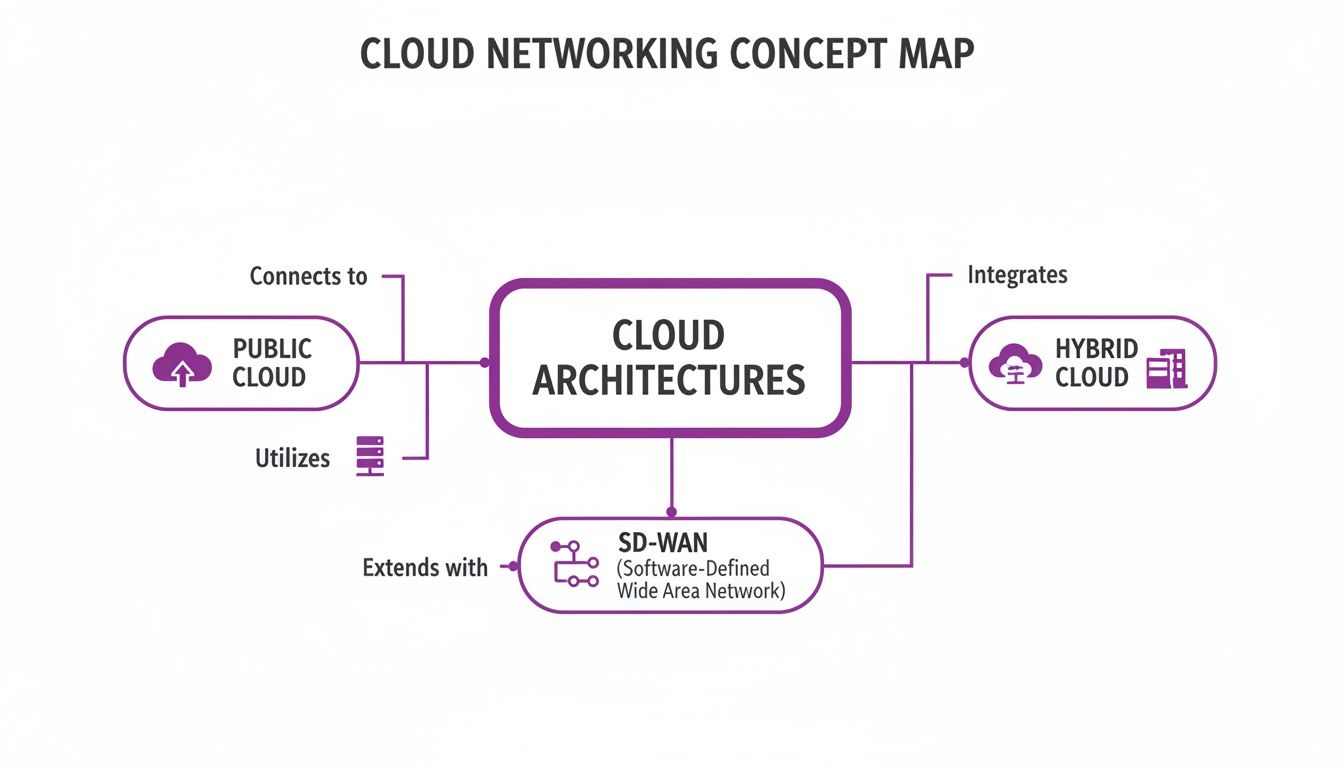
As this illustrates, each architectural path is designed for a specific outcome, such as enhancing security or enabling massive scale. This choice is the cornerstone of a compelling ROI analysis.
Reduced Operational Costs
The most immediate financial gain comes from shifting away from a capital-intensive model. Traditional networking entails significant upfront costs for routers, switches, and firewalls, plus the recurring operational drain of maintenance, upgrades, and specialized IT staff. Companies often see a 30-50% reduction in total cost of ownership (TCO) within the first three years of migrating.
Cloud-based networking converts these unpredictable capital expenditures (CapEx) into a predictable operational expense (OpEx). Instead of purchasing depreciating hardware, you subscribe to a service. This strategic shift frees up significant capital that can be reinvested into core business initiatives, such as product innovation or market expansion. A key part of realizing this ROI is understanding pricing structures, like those offered in an AWS Savings Plan.
This financial model is a key driver of growth globally. India’s cloud market, for example, is projected to reach USD 37.11 billion in 2025 and is expected to grow to USD 266.90 billion by 2034. This explosive growth is powered by public cloud models that allow businesses to scale without massive upfront hardware investments.
Enhanced Scalability and Revenue Protection
Scalability is not just a technical feature; it is a direct mechanism for revenue protection and generation. Consider an e-commerce business preparing for a Black Friday sale. With a legacy on-premise network, preparing for the traffic surge requires weeks of planning and hardware procurement. A miscalculation can lead to a site crash, costing millions in lost sales and causing significant brand damage.
A cloud network, by contrast, scales elastically. It automatically expands to meet peak demand and contracts as traffic subsides, ensuring you only pay for the capacity you use. A real-world example is a major online retailer that handled a 400% increase in traffic during a holiday promotion with zero downtime, attributing an estimated $2 million in protected revenue directly to its cloud network's elasticity. This capability turns a potential operational crisis into a record-breaking sales event.
The real value of cloud networking isn't just about saving money on hardware; it's about making money by never missing an opportunity. The ability to scale on demand is a powerful competitive advantage.
Driving Tangible Business Outcomes
Ultimately, the most compelling ROI is derived from linking network performance directly to core business objectives. A reliable, high-performance cloud network is the essential foundation for revenue-generating tools, including sophisticated AI platforms.
For example, a robust cloud network is what allows our Voice AI agents to perform optimally. For one client in the lead generation space, this translated directly to:
- A 94% increase in Call Connect Rates: They went from 47% to 91%, dramatically improving their ability to engage prospects.
- A 300% lift in Lead-to-Booking Conversions: This key metric increased from a meager 2% to an impressive 8%.
- A 97% Lead Quality Score: This score reflects the accuracy in matching AI-qualified leads with the criteria for high-value leads as defined by human sales agents.
These are not IT metrics; they are core sales and revenue metrics. They represent a fundamental improvement in business efficiency and have a direct, quantifiable impact on revenue, making the business case for cloud networking undeniable. For another example of this in action, see our case study on scaling spend and growing ROAS. Read the full story here.
Navigating Security and Compliance Challenges

For any C-suite leader, the conversation around cloud-based networking inevitably focuses on a critical question: how do we manage the risk? While the operational benefits are compelling, perceived security trade-offs can halt strategic initiatives. The key is to move beyond fear and implement a concrete strategy for governance and control.
The vulnerabilities are real. Data breaches, often stemming from simple cloud misconfigurations, carry catastrophic financial and reputational consequences. The average cost of a data breach has now reached an all-time high of $4.45 million—a figure that commands boardroom attention. Attempting to secure a modern cloud environment with a legacy security model is a recipe for failure.
Traditional network security is akin to a medieval castle: high walls, a deep moat, and the assumption that everything inside is trusted. This perimeter-based defense is obsolete. With data distributed across clouds, SaaS applications, and mobile devices, there is no longer a defensible perimeter.
The Modern Security Paradigm
Modern cloud security requires a paradigm shift. It is less like a castle and more like assigning every piece of data its own personal, biometrically-secured bodyguard, regardless of its location. This approach is known as Zero Trust, and it operates on a simple, powerful principle: never trust, always verify.
In a Zero Trust model, no user or device is trusted by default, regardless of whether they are inside or outside the network. Access is granted on a "least-privilege" basis, meaning users only get the precise access they need to do their job, and not an inch more. This dramatically shrinks the potential attack surface.
Frameworks like Zero Trust Network Access (ZTNA) operationalize this principle. ZTNA solutions create secure, one-to-one encrypted tunnels between a specific user and a specific application. Unlike a traditional VPN which grants broad network access, ZTNA ensures that even if a user's device is compromised, the threat is contained to that single connection and cannot move laterally across the network.
Automated Compliance and Data Sovereignty
For businesses in highly regulated industries like finance or healthcare, compliance is not negotiable. Manually tracking and reporting on compliance standards (e.g., PCI-DSS, HIPAA) across a distributed cloud environment is prone to human error and creates significant audit risk. Cloud-native security platforms with automated monitoring are the solution.
These modern tools provide continuous compliance checks against frameworks like ISO 27001, GDPR, and SOC 2. They can automatically detect and flag misconfigurations and policy violations, generating real-time alerts that enable teams to remediate issues before they escalate into security incidents. We discuss similar principles in our guide on secure cloud adoption for today’s law firms.
Furthermore, hybrid cloud architectures directly address data sovereignty and residency laws. For instance, a bank facing regulations that mandate customer data remain within national borders can implement a hybrid model to:
- Store sensitive KYC and transaction data on a private, on-premise cloud to guarantee full compliance and auditability.
- Utilize the public cloud for less sensitive workloads like marketing analytics or application development, thereby capturing the benefits of scale and cost-efficiency.
This strategic approach integrates security and compliance into the network architecture from the outset, providing the organisation with the confidence to innovate securely.
Your Strategic Roadmap for Implementation
The transition to cloud-based networking is not just a technical project; it's a fundamental business transformation. A successful outcome requires a clear, executive-led plan. This roadmap is designed for leaders to guide the process, ensuring every decision aligns with overarching strategic objectives.
This framework enables you to manage teams, track progress against business goals, and ensure the project delivers its intended value.
Phase 1: Start with a Hard Look at Your Current Setup
Before migrating a single service, you must conduct a comprehensive audit of your current infrastructure. This goes beyond a simple inventory of hardware. It requires a deep analysis of performance, bottlenecks, and true operational costs.
Crucially, you must connect network performance directly to core business metrics. For example, instead of measuring "network uptime," measure the impact of that uptime on your sales team's ability to access the CRM and, subsequently, the impact on lead conversion rates. A retail company might find that a 200-millisecond lag in its POS network translates to a 1% drop in revenue due to cart abandonment at checkout. This reframes the network from a cost centre to a direct revenue driver.
A successful cloud network isn't measured by technical stats alone. Its real value lies in its direct impact on your business's speed, customer experience, and bottom line. Your strategy needs to reflect that from day one.
When the project is aligned this way, the investment becomes easy to justify, simple to measure, and clearly tied to C-suite priorities.
Phase 2: Decide How to Make the Move
With a clear strategy, the next decision is the migration methodology. There are two primary approaches.
A “full cutover” or "big bang" approach involves switching the entire organisation to the new cloud network at once. While potentially faster, it carries significant risk; any unforeseen issue can cause widespread business disruption.
A “phased migration” is the more prudent and common approach for established enterprises. It involves moving applications, departments, or locations in manageable stages.
- Run a Pilot: Start with a low-risk, high-impact area. A non-critical development environment or a single branch office makes an ideal pilot. This allows your team to test the new system and resolve issues without affecting core operations.
- Roll Out Iteratively: Based on the pilot's success, begin migrating more critical functions according to business priority. Each phase provides learnings that optimize the next, creating a virtuous cycle of improvement.
- Keep Disruption Minimal: This iterative method contains the "blast radius" of any potential problem, safeguarding primary business operations.
Phase 3: Choose Your Partner Wisely
Selecting a vendor is not a procurement exercise; it is the formation of a long-term strategic partnership.
Your ideal partner functions as a trusted advisor, not just a technology supplier. They must possess a deep understanding of your business objectives and industry landscape. Define your selection criteria rigorously, focusing on providers with a proven track record in your sector, robust 24/7 support capabilities, and a clear product roadmap. A strong partner will help you navigate complexity and ensure your network evolves in lockstep with your business.
This is especially critical in a rapidly expanding market. For instance, India's data centre market—the physical foundation of cloud networking—is projected to hit USD 27.2 billion by 2032. This growth is fuelled by massive new builds in hubs like Mumbai and Chennai, designed to meet the low-latency demands of over a billion internet users. A strategic partner helps you leverage that powerful infrastructure effectively. You can get more details on India's data centre growth trajectory.
Phase 4: Don't Just Set It and Forget It
The go-live date is the beginning, not the end. Continuous monitoring and optimisation are essential to ensure the network delivers sustained value.
Establish business-centric KPIs to track progress. Monitor metrics such as application response times for key services, cost savings from hardware decommissioning, and the reduction in time required to deploy new services. This ongoing optimisation process is what ensures your cloud network remains a strategic asset long after the initial implementation is complete.
Future-Proofing Your Business with Cloud Networking
Viewing cloud based networking as just another IT project is a strategic error. This is not about replacing routers; it is about building the foundational platform for every business innovation you will pursue over the next decade. This shift positions your organisation to adapt and win in a constantly evolving market.
A robust cloud network is the invisible engine ensuring your most critical applications perform flawlessly, especially under pressure. Whether it's your sales team needing instantaneous access to client data or your customer support relying on perfect call quality, the network is the critical enabler. It is the backbone of an agile and resilient enterprise.
The Foundation for Future Technologies
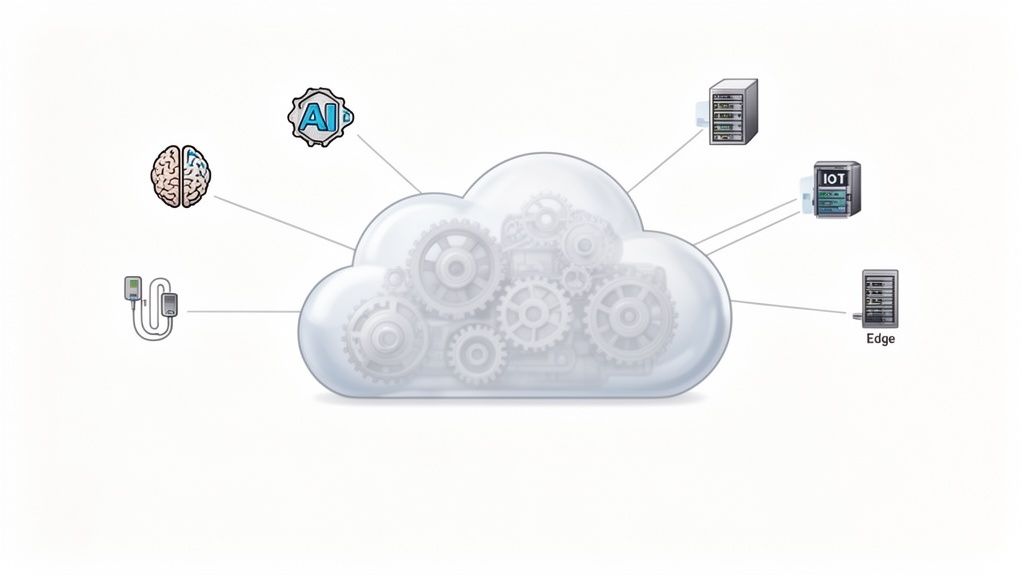
The transformative technologies that will define the next era of business—AI, the Internet of Things (IoT), and edge computing—are entirely dependent on a network that is fast, flexible, and intelligent. A rigid, on-premise network lacks the capacity and low-latency capabilities to support them.
- Artificial Intelligence: AI platforms, like DialNexa’s Voice AI, require flawless, low-latency connectivity to process vast datasets and provide real-time insights. For example, an AI-powered logistics platform needs to process thousands of data points per second from a fleet of trucks to optimize routes in real-time; cloud networking provides the necessary bandwidth and reliability.
- Internet of Things (IoT): A modern manufacturing facility might deploy tens of thousands of IoT sensors on its factory floor. A cloud network can scale effortlessly to ingest, process, and analyze this continuous stream of data for predictive maintenance, reducing equipment downtime by up to 30%.
- Edge Computing: By processing data closer to its source—for instance, in a retail store for real-time inventory tracking—businesses can reduce latency and enhance application performance. Cloud networking models like SASE are explicitly designed to securely manage these distributed edge environments.
Without this modern network foundation, investments in these next-generation technologies will fail to deliver their promised ROI.
From Cost Centre to Strategic Asset
The most critical shift for any leader is to fundamentally re-evaluate the role of the network. For decades, it has been treated as a utility—a necessary but burdensome expense. This legacy mindset is now a significant liability.
Your network is no longer just a cost to be managed; it is a strategic asset that directly drives revenue, builds competitive advantage, and creates a truly future-ready enterprise.
By embracing cloud based networking, you are investing in your organisation's capacity for rapid adaptation. The next time a new market opportunity arises or a competitor makes a disruptive move, your speed of response will be dictated by your infrastructure's agility. This transformation turns your network from a reactive operational burden into a proactive engine for growth.
Ultimately, this decision transcends technology. It is about building an organisation with the speed and resilience to master any challenge and seize any opportunity.
A Few Questions from the Corner Office
As a leader, you're not just thinking about technology; you're thinking about strategy, people, and the bottom line. When considering a move to cloud-based networking, you need straightforward answers to the big-picture questions. Let's get right to them.
What Happens to Our IT Team When We Move to the Cloud?
This is a critical question. The answer is that their role evolves to become significantly more strategic and value-additive. Currently, your IT experts likely spend 60-70% of their time on routine "keep the lights on" activities like hardware maintenance and manual configurations. This is not an optimal use of high-skilled talent.
Migrating to a cloud network automates this operational burden, freeing your team to focus on high-impact initiatives: optimizing application performance to improve user experience, implementing advanced security policies to reduce risk, and collaborating with business units to accelerate new projects. This transition requires upskilling in cloud technologies, but it ultimately transforms your IT department from a reactive cost centre into a proactive driver of business innovation.
For a Company Our Size, How Long Does This Migration Actually Take?
A realistic timeline is essential for planning. For a typical mid-sized enterprise, a full migration is a strategic journey, not a weekend project. A practical timeframe is between 6 and 18 months, depending on the complexity of your current environment and business dependencies.
A phased approach is the most effective and lowest-risk strategy:
- Phase 1 (2-3 months): This phase involves a comprehensive assessment of your existing infrastructure and the development of a detailed migration plan. We then execute a pilot project on a small, low-risk segment of the business—such as a single application or a small branch office—to validate the technology and refine the process.
- Phase 2 (4-15 months): Leveraging the insights from the pilot, we begin the broader rollout. This is executed in carefully planned waves, migrating departments, regions, or applications sequentially. This iterative process minimizes disruption to business operations and ensures a controlled, predictable transition.
This step-by-step methodology builds momentum and ensures that each stage of the rollout is more efficient than the last.
How Do We Measure the Payback Beyond Just Cutting Costs?
The shift from capital expenditure (CapEx) for hardware to a predictable operational expense (OpEx) model is a clear financial benefit, but it's only the beginning. The most significant ROI from cloud networking is reflected in direct business performance improvements.
The ultimate measure of a successful cloud network is not just what it saves, but what it enables. Focus on metrics that reflect increased revenue, greater market agility, and a stronger security posture.
To capture the full value, you must track business-centric KPIs:
- Increased Revenue: Quantify the cost of application downtime during peak business hours. A resilient cloud network that reduces unplanned outages from, for example, 10 hours per year to less than 1 hour can directly translate into millions of dollars in protected revenue.
- Faster Time-to-Market: Measure the time it takes to launch a new digital service or bring a new branch office online. Reducing this cycle time from months to weeks is a direct measure of enhanced business agility.
- Improved Customer Satisfaction: Correlate network performance—like faster application response times—with key customer metrics such as Net Promoter Score (NPS). A 10% improvement in application performance can often lead to a measurable increase in customer satisfaction scores.
- Reduced Financial Risk: With the average cost of a data breach at $4.45 million, a modern, secure cloud network architected with Zero Trust principles is one of the most effective forms of risk mitigation your business can invest in.
At DialNexa, we know that a world-class network is the backbone of world-class communication. Our Voice AI agents need flawless connectivity to hold the natural, multi-minute conversations that turn leads into customers. See how our technology can reshape your customer outreach by visiting us at https://dialnexa.com.

[…] surprisingly lean infrastructure. For more on optimizing your digital infrastructure, our guide on cloud-based networking offers valuable […]
[…] distributed access, which is why firms evaluating customer service modernisation often review their cloud-based networking architecture at the same time. The strongest business case comes from treating the call centre as part of a […]
This is an excellent explanation of how cloud networking transforms infrastructure from a cost centre into a true business enabler. The practical examples, ROI focus, and strategic roadmap make it highly valuable for leaders planning scalable and secure digital growth.