

Flight Reservation Software: A CXO’s Strategic Guide 2026
Over 280 million domestic flight bookings moved through India in 2024, and that volume was up 22% year over year according to Credence Research's airline reservation system software market analysis. That number changes how boards should think about flight reservation software. This isn't a back-office utility. It is one of the few technology layers that can influence revenue capture, cost discipline, customer trust, and repeat purchase behaviour in the same motion.
For airline groups, OTAs, travel management companies, and hospitality brands expanding into air distribution, the platform decision now sits close to the P&L. The strongest systems don't just confirm seats. They shape the economics of search, merchandising, qualification, conversion, servicing, and retention.
Table of Contents
- Why Flight Reservation Software Is a Strategic Asset
- Understanding the Core Distribution Models
- Evaluating Features for Strategic Business Impact
- Choosing Your Deployment Model
- Integrating for a Seamless Customer Journey
- Defining KPIs and Calculating the ROI
- Implementing Your Flight Reservation Strategy
Why Flight Reservation Software Is a Strategic Asset
Airlines generated USD 918 billion in global revenue in 2023, according to IATA's industry outlook. A reservation platform sits directly in the path of that revenue. It shapes which offers a customer sees, how quickly they can buy, what ancillaries are attached, and how expensive the booking is to service after payment.
That makes flight reservation software a capital allocation decision, not a back-office systems purchase.
The strategic question for a board is straightforward. Does the platform merely process transactions, or does it raise revenue per customer while lowering servicing cost per booking? The difference shows up in conversion, ancillary attach rates, call center volume, refund handling, and repeat purchase behavior.
A modern reservation layer influences four parts of the P&L at the same time:
- Demand capture: Faster search responses, accurate availability, and cleaner checkout flows reduce abandonment and recover revenue that weak booking paths lose.
- Yield expansion: Better merchandising increases the share of bookings that include seats, bags, meals, upgrades, insurance, or fare bundles.
- Service cost control: Integrated servicing reduces manual intervention across schedule changes, cancellations, and post-booking support.
- Customer value retention: Better data continuity across booking and support improves the odds that a one-time buyer becomes a repeat customer.
This is why the strongest operators no longer evaluate reservation software on uptime and ticketing alone. They evaluate it on margin impact.
India illustrates the urgency. As noted earlier, digital flight booking volume has reached a scale where even small improvements in conversion, ancillary sales, or service automation can translate into meaningful profit expansion. In a high-volume, price-sensitive market, the economics favor platforms that can personalise offers, maintain channel control, and reduce dependency on manual service workflows.
The service layer matters more than many teams assume. A booking system that hands off incomplete context to support creates avoidable cost and lost loyalty. A platform connected to modern servicing tools can resolve routine itinerary changes, payment questions, and status updates faster, which protects both revenue and retention. For leadership teams reassessing that operating model, this broader view of airline customer service operations is directly relevant because the reservation stack and the service stack now shape the same customer lifetime value equation.
That same passenger-experience lens extends beyond reservations into the full anatomy of customer service in the aviation industry, from pre-flight communication through post-flight resolution, where the same coordination failures that hurt booking conversion also drive avoidable contact volume.
The board-level conclusion is simple. Flight reservation software should be judged as a revenue and customer value engine. The right platform improves monetisation before the sale, lowers cost after the sale, and creates a data foundation for higher-ROI integrations such as Voice AI and advanced analytics.
Understanding the Core Distribution Models
Not all flight reservation software accesses inventory in the same way. That choice affects margin, offer depth, and negotiating power long before the customer sees a search result.
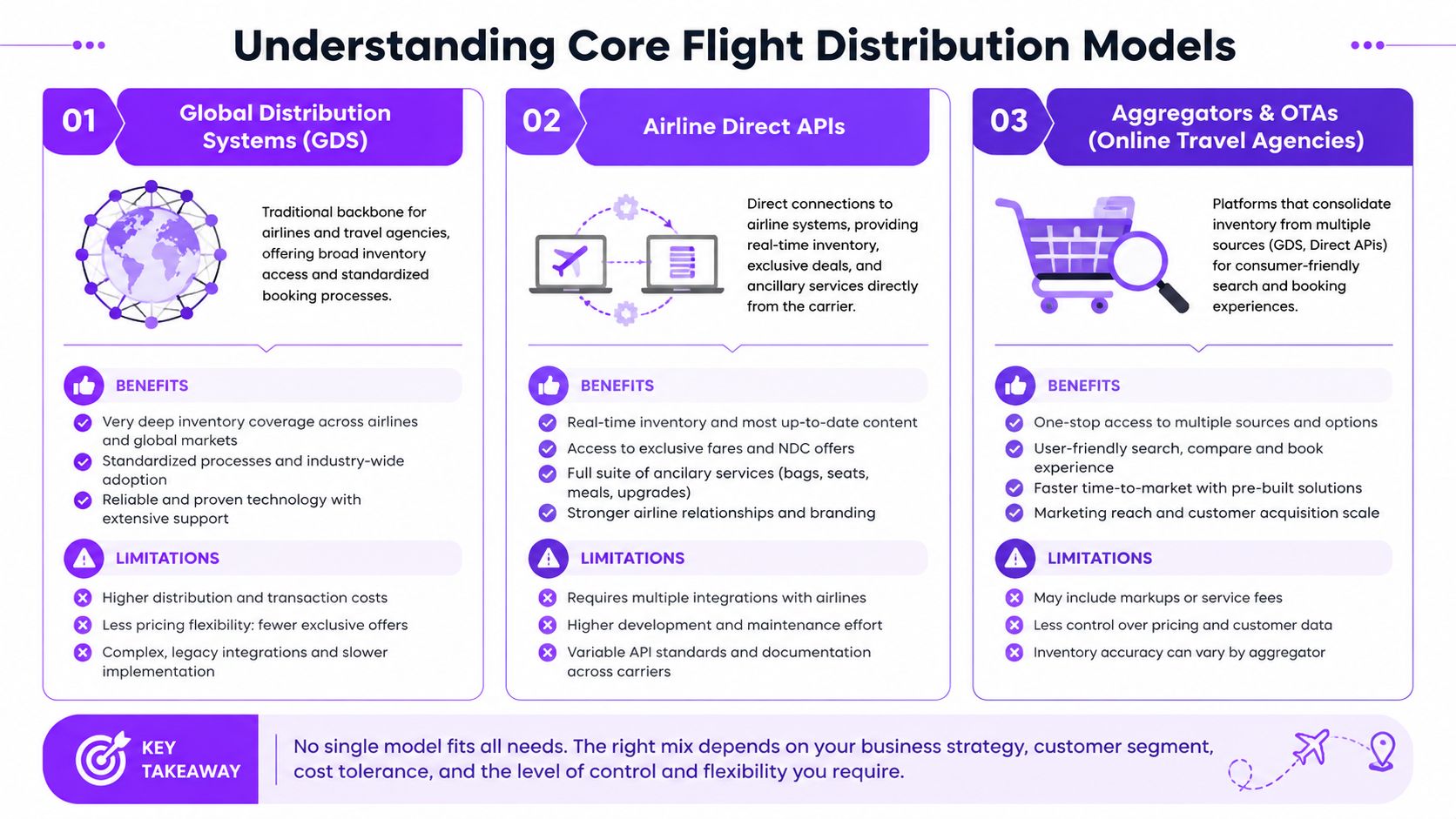
Why distribution architecture matters to margin
India's cloud-based Airline Reservation Systems have enabled travel agencies to reduce operational costs by 30% while increasing booking throughput by 45%, with access to real-time inventory from over 200 global carriers and a 25% improvement in connect rates, according to Spherical Insights' airline reservation system software market report. For a CXO, that isn't a technical footnote. It is evidence that distribution architecture alters unit economics.
A practical example helps. A corporate travel platform serving multinational accounts may prioritise broad carrier coverage and consistency across international routes. A leisure OTA, by contrast, may prioritise richer branded fares and ancillary upsell opportunities. Both need inventory, but they don't need the same commercial outcome from the inventory source.
A practical way to think about GDS NDC and Direct Connect
Think of the three models as different sourcing strategies.
GDS works like a global wholesale market. It gives broad access, standard processes, and operational familiarity. If your team needs reach across many carriers and markets, GDS is often the fastest route to coverage.
NDC behaves more like a premium direct channel inside a standard framework. It was designed to let airlines present richer offers, more contextual bundles, and stronger ancillary merchandising than traditional legacy messaging allows.
Direct Connect is the closest thing to a private supply agreement. It can give you highly specific access to a carrier's content and commercial logic, but it also increases integration complexity and dependency on that airline's specific technology choices.
A board doesn't need to know the protocol details. It does need to know who controls content, who owns the customer context, and where the margin pool sits.
Here's the strategic trade-off in plain terms:
- Choose GDS when coverage, standardisation, and speed of multi-carrier access matter most.
- Choose NDC when richer offers and merchandising flexibility are central to growth.
- Choose Direct Connect when a specific airline relationship or differentiated content justifies deeper integration effort.
GDS vs NDC vs Direct Connect Comparison
| Model | Primary Benefit | Content Richness | Cost Structure | Strategic Control |
|---|---|---|---|---|
| GDS | Broad multi-carrier access and proven workflows | Moderate, usually standardised | Typically tied to intermediary distribution economics | Shared control with intermediaries |
| NDC | Richer airline offers and ancillary merchandising | High | Can improve commercial flexibility depending on airline setup | Higher control than legacy indirect channels |
| Direct Connect | Direct access to airline inventory and logic | High, often airline-specific | Can be efficient for targeted partnerships but raises integration burden | Highest control, with highest dependency on bilateral relationships |
The mistake many operators make is choosing one model as if it must serve every route, segment, and customer type. Stronger businesses usually combine them. They use one model for reach, another for merchandising, and a third for strategic airline relationships.
Evaluating Features for Strategic Business Impact
Most vendor demos overweight table stakes. Search, booking, ticketing, and payment are necessary, but they won't create durable advantage on their own. The essential executive question is simpler. Which capabilities improve commercial decisions and protect revenue under scale?
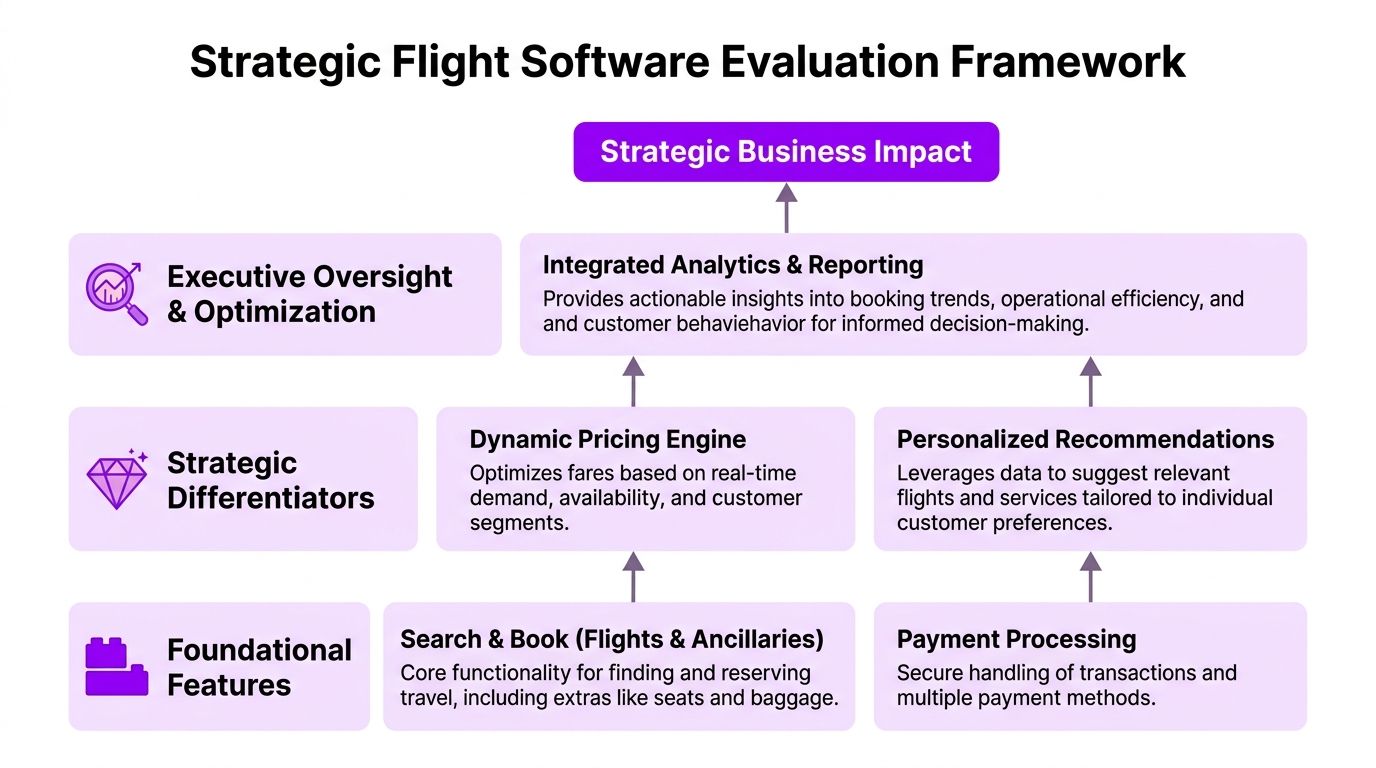
Table stakes versus real differentiators
Foundational features should be assumed. Your shortlist shouldn't reward a platform merely because it can display fare options or process a card. The higher-value features are the ones that improve yield, customer selection, and management visibility.
Focus executive evaluation on capabilities like these:
- Integrated analytics dashboards: Leaders need visibility into search behaviour, route demand, booking drop-off, servicing load, and channel performance.
- Dynamic pricing and offer logic: The software should support fare presentation that adapts to availability, demand, and customer context.
- CRM and loyalty integration: Reservation systems should enrich customer profiles, not create isolated records.
- Ancillary merchandising controls: If your team can't easily test and present seats, baggage, bundles, or upgrades, revenue is being left on the table.
- Exception handling workflows: Rebooking, schedule changes, and customer service recovery should be designed into the platform, not patched around it.
A practical example: two platforms may show similar search results, but only one may tell a revenue leader which routes have high search volume but weak completion, which ancillaries underperform by channel, and which customer cohorts produce the strongest repeat booking value. That second system becomes a management instrument, not merely a booking engine.
Why UX belongs in the board deck
The most underestimated feature category is user experience. That's a mistake because poor interface design directly destroys conversion.
According to the discussion and cited figures in this Frontend community analysis of flight booking interfaces, 85% of booking interfaces are classified as “horrific”, 70% of resources are consumed by legacy integration work rather than user experience, and 94% of users cite confusing interfaces as the primary reason for abandoned bookings.
Those numbers explain a pattern many executives misread. Teams often blame media efficiency, weak demand, or price sensitivity when the core problem sits inside the booking path itself.
Confusing booking flow is not a design issue. It is a revenue leakage issue.
A strong evaluation framework should therefore test UX in operational scenarios, not static screenshots:
- A first-time mobile customer searching, modifying dates, and completing payment.
- A returning loyalty member expecting saved details, fare clarity, and faster checkout.
- An agent or service user handling disruption, changes, or ancillary additions under time pressure.
The platform with the most features isn't always the best investment. The better platform is the one whose interface helps customers finish high-intent actions with less effort while giving leadership better commercial visibility.
Choosing Your Deployment Model
The deployment decision is often framed as cloud versus on-premise. That's accurate technically, but incomplete financially. A board should read this as a choice about speed, cost structure, governance, and scaling discipline.
Where cloud wins
The strongest argument for cloud deployment is alignment with growth volatility. Travel demand changes by season, route, and disruption cycle. Cloud models let operators scale infrastructure with less procurement friction and with more predictable operating expenditure.
That commercial logic aligns with market structure. The B2B travel portal segment is projected to hold 53.2% of the total airline reservation software market share by 2025, according to Future Market Insights' airline reservation software market view. Enterprise-grade booking workflows tend to favour scalable platforms because they need reliability across multiple users, suppliers, and markets.
Cloud is usually the stronger fit when your business needs:
- Rapid market expansion: New routes, suppliers, or partner channels can be added faster.
- Financial predictability: Subscription and managed-service structures are easier to model than large infrastructure refresh cycles.
- Distributed teams: Sales, operations, and servicing functions often need access across regions and business units.
- Frequent integration updates: Modern commerce and customer stacks change too quickly for rigid release cycles.
Where on premise still deserves consideration
On-premise can still be defensible in specific cases. Organisations with strict internal control requirements, deep in-house infrastructure capability, or highly customised legacy ecosystems may prefer tighter ownership of the runtime environment.
But the hidden question isn't “Can we host it ourselves?” It's “Should our technology leadership spend scarce time operating infrastructure that doesn't differentiate us?” For many boards, the answer is no.
A useful executive test is to score both models across five lenses:
| Decision lens | Cloud or SaaS tendency | On-premise tendency |
|---|---|---|
| Cost profile | More OpEx oriented | More CapEx oriented |
| Deployment speed | Faster | Slower |
| Elasticity | Higher | Lower unless heavily overbuilt |
| Internal admin load | Lower | Higher |
| Custom control | Moderate to high, depending on vendor | Highest |
If your growth plan depends on partner expansion, channel agility, and faster iteration, cloud usually wins. If your operating model depends on exceptional control and your IT team is built for long-cycle platform management, on-premise may still be justified.
Integrating for a Seamless Customer Journey
A reservation platform creates financial value only when the customer can move from discovery to booking to servicing without friction. Boards often underestimate this point because the failure rarely appears inside one system. It appears in the handoff between systems, where abandoned carts rise, support contacts increase, and repeat purchase intent falls.
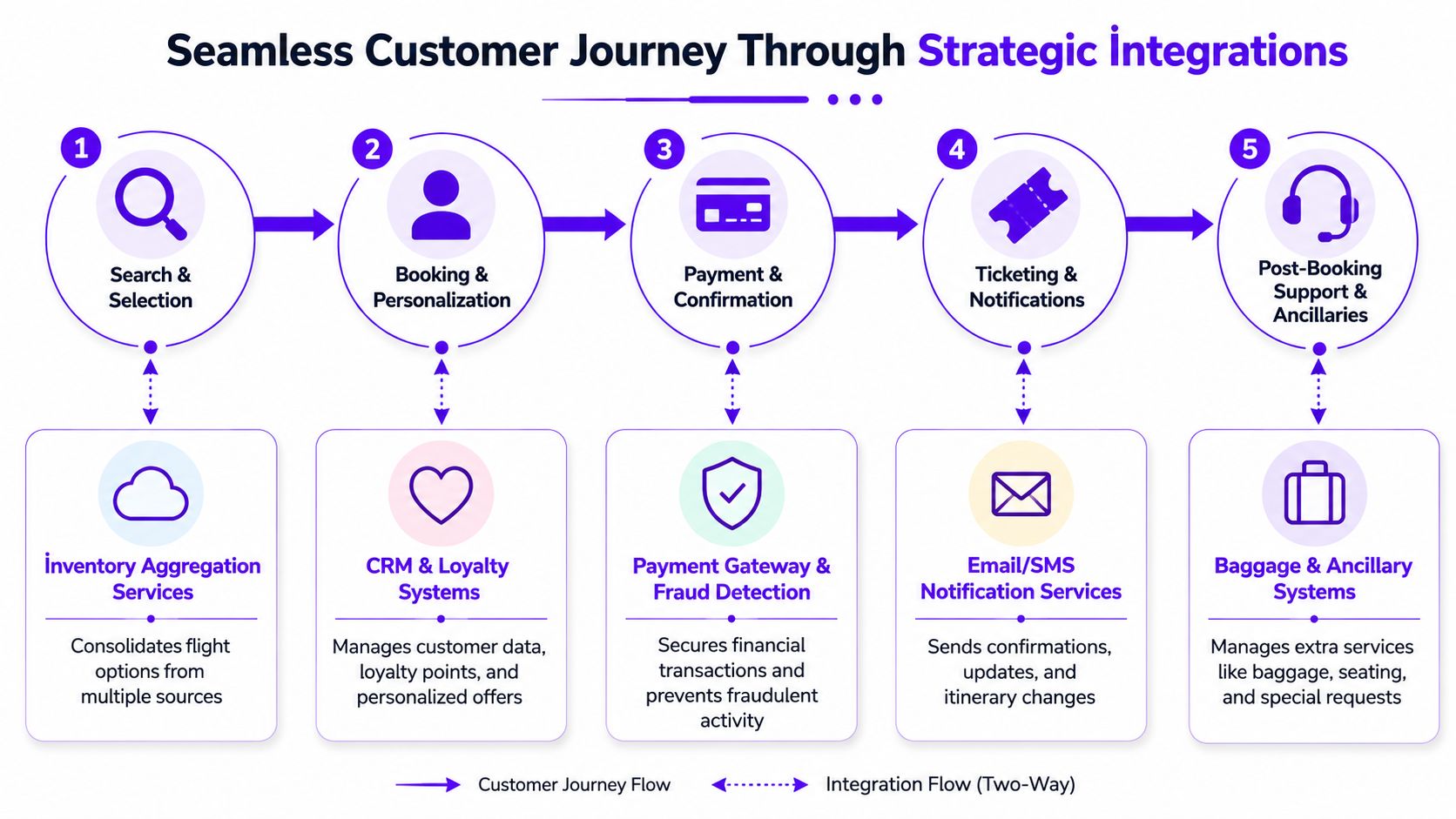
The integration stack customers feel
Flight reservation software becomes a strategic asset when it coordinates the commercial systems around it, not when it operates as an isolated booking engine. The priority is not integration for its own sake. The priority is protecting revenue at each stage of the journey and reducing avoidable servicing cost after purchase.
Five integration points usually drive the largest business impact:
- Inventory aggregation services: These shape the breadth, price accuracy, and freshness of available flight options.
- CRM and loyalty systems: These connect identity, booking history, tier status, and offer relevance.
- Payment and fraud controls: These protect approved transactions while limiting unnecessary checkout friction.
- Notification systems: Confirmation, schedule updates, and disruption alerts influence trust and inbound support volume.
- Ancillary and servicing tools: These determine how effectively the business captures post-booking revenue from bags, seats, upgrades, and changes.
A common failure pattern is easy to miss in dashboard reporting. A traveller selects a fare on mobile, completes payment, receives confirmation late, and then cannot change baggage online. The booking engine records a success. The customer experiences a broken journey. Commercially, that gap matters because it suppresses repeat booking and pushes a simple servicing task into a higher-cost support channel.
That is why mature operators invest in understanding user behavior across the full journey, not only at the point of sale. Journey analytics shows where users hesitate, where system handoffs fail, and where poor orchestration creates support demand that should never have existed.
Why voice AI has become a revenue integration
Voice AI now deserves board-level attention because it affects both conversion and cost-to-serve. In flight retail, many high-value journeys still contain friction that forms and static filters handle poorly, especially on mobile or in multi-passenger, multi-condition bookings.
According to Otto the Agent's analysis of flight reservation software for business travel, 89% of travellers prefer voice-assisted booking over complex forms, yet only 12% of reservation systems integrate voice AI. The same analysis says voice qualification can produce an 8% conversion gain, with 97% of voice-qualified leads matching human judgment for accuracy.
The commercial logic is straightforward. If voice AI helps qualify demand earlier, resolve intent faster, and route only higher-complexity cases to agents, the business gains in three places at once. Conversion rises. Agent utilisation improves. Revenue leakage from abandoned or poorly serviced bookings declines.
The strongest use cases tend to be concentrated in a few moments:
- Pre-booking qualification: Travellers can describe dates, budgets, routes, and flexibility in natural language, which reduces search friction and improves match quality.
- Complex itinerary assistance: Families, corporate travellers, and international passengers often need guided selection rather than a longer set of filters.
- Post-booking support: Changes, upgrades, baggage questions, and confirmations can be resolved in lower-cost automated flows when the reservation system and servicing stack are connected properly.
The strategic value of voice AI is not novelty. It is its ability to recover purchase intent that would otherwise be lost, and to do it at a lower servicing cost than fully agent-led models.
For teams redesigning these touchpoints, disciplined customer journey mapping for service and conversion workflows helps identify where voice produces measurable ROI and where self-service remains the better design choice. The strongest operators do not automate every interaction. They apply voice where friction is expensive, qualification quality affects revenue, and speed materially improves customer lifetime value.
Defining KPIs and Calculating the ROI
A one-point gain in booking conversion can be worth more than months of marginal cost cutting if traffic acquisition is already expensive. That is why boards should evaluate flight reservation software as a revenue system first and an operations system second. The investment case rests on whether the platform increases yield from existing demand, improves ancillary monetisation, lowers avoidable service cost, and raises repeat purchase rates over time.
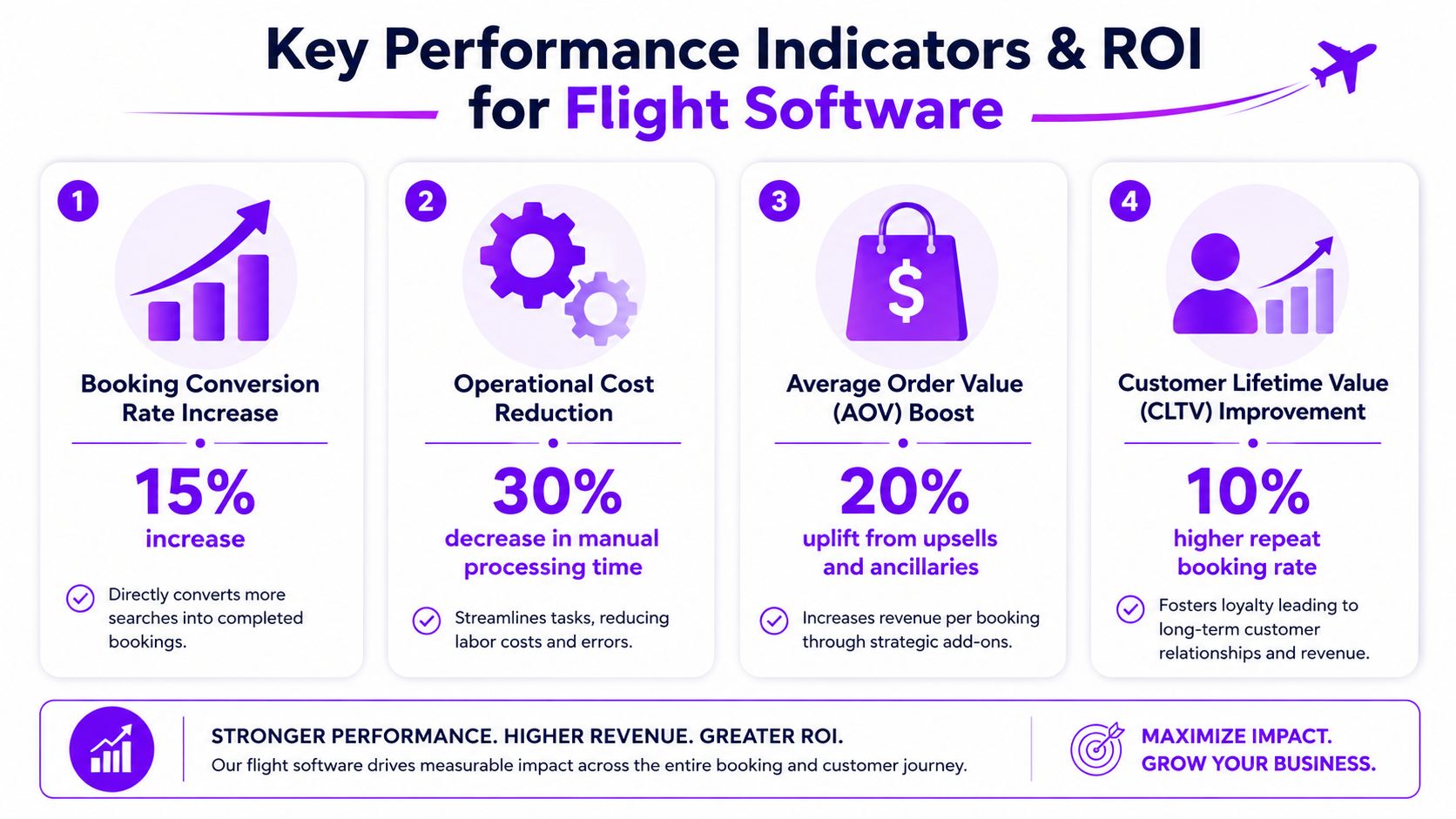
The KPI set that matters to finance
Technical performance still matters, but it is not the primary scorecard for capital allocation. Finance teams need evidence that the system changes commercial outcomes. The strongest KPI model ties platform capability to four P&L effects: more bookings from the same traffic base, higher revenue per booking, lower cost to serve, and stronger customer retention.
A practical KPI framework should include:
- Lead-to-booking conversion rate: Measures whether search, offer presentation, pricing logic, and checkout design are turning intent into revenue.
- Booking abandonment rate: Quantifies where demand is dropping out before payment or ticketing.
- Ancillary attachment rate: Shows whether the reservation flow is increasing margin through seats, baggage, insurance, and bundled services.
- Cost per serviced booking: Captures the operating impact of automation in changes, cancellations, confirmations, and disruption handling.
- Repeat booking rate: Indicates whether the experience supports customer lifetime value rather than one-off transactions.
- Agent escalation rate: Helps teams see whether automation is removing low-value contacts or shifting complexity into the service queue.
This mix matters because a reservation platform can improve one metric while damaging another. A checkout redesign may raise conversion but increase post-booking contacts if fare rules, baggage terms, or itinerary details are poorly communicated. In that scenario, reported growth overstates real ROI.
How to build the ROI case
Start with your current economics. Measure present booking volume, average order value, ancillary revenue per passenger, contact rate per booking, average handling cost, and repeat purchase behaviour. Then model improvement scenarios against those baselines using assumptions the finance team can audit.
A simple executive model looks like this:
| ROI component | What to measure | Why it matters |
|---|---|---|
| Revenue lift | Change in booking conversion and ancillary sales | More revenue captured from existing demand |
| Cost reduction | Lower manual servicing and faster issue resolution | Direct margin improvement |
| Capacity gain | More bookings handled without matching headcount growth | Better operating efficiency at scale |
| Customer value | Repeat purchase and retention over time | Higher lifetime value and lower acquisition pressure |
The most persuasive ROI cases isolate cause and effect. If conversion rises after implementation, determine whether the gain came from better merchandising, faster search response, fewer payment failures, or improved support during complex purchases. That level of attribution matters because it shapes future investment. A company that knows voice support drives recovery of high-intent travellers will fund that channel differently from one where revenue growth comes mainly from ancillary presentation.
Consider a common pattern. A travel brand generates healthy search traffic but loses high-value passengers during a long, rules-heavy checkout. If the new reservation stack shortens the path to purchase, presents ancillaries more clearly, and reduces support demand for itinerary changes, the business captures more gross revenue while lowering cost per booking. The strategic advantage is not only higher conversion. It is the ability to expand volume without adding service overhead at the same rate.
Boardroom test: Identify the specific revenue lines, cost lines, and retention metrics that improve if the platform performs as designed.
Reservation software ROI should also be tested against service performance after the sale. If bookings increase but post-booking contacts rise faster, margin can erode even while revenue grows. For that reason, many operators pair commerce metrics with a broader contact centre KPI framework for service performance when support quality has a direct effect on retention and lifetime value.
Implementing Your Flight Reservation Strategy
The best strategy fails in procurement if the project is framed too narrowly. Successful flight reservation software programmes are led as business transformation initiatives with technology, operations, finance, and commercial ownership at the table.
A board level implementation checklist
Start with an internal audit. Most organisations already know they have pain points, but they often haven't mapped them cleanly. Identify where value is being lost today across search, merchandising, payment, ticketing, support, and disruption management.
Then work through a disciplined sequence:
Audit current friction
Review booking abandonment patterns, agent workload, supplier dependencies, and customer complaints. Separate process issues from platform limitations.
Define commercial goals
Be precise. Your priority may be better conversion, stronger ancillary capture, lower servicing cost, improved enterprise account handling, or faster expansion into new channels.
Build a cross-functional steering group
Include IT, operations, finance, sales, customer support, and compliance. Reservation platforms fail when one function buys them and five others inherit the consequences.
Write an RFP around business outcomes
Ask vendors to show how their architecture supports your route mix, channel strategy, servicing model, and reporting requirements. Don't let the evaluation drift into feature theatre.
Test with real workflows
Use live scenarios. A mobile leisure booking, a managed corporate itinerary, a post-booking baggage request, and a schedule-change recovery flow will expose more than a scripted demo.
Plan phased rollout
Start with a controllable channel, market, or customer segment. Learn, refine, then expand.
What strong programme governance looks like
The implementation leader should report in business language, not only technical language. Boards need to know whether the programme is reducing friction, protecting revenue, and improving service economics.
Good governance usually includes:
- A clear success scorecard: Commercial, operational, and customer metrics should be agreed before launch.
- Vendor accountability: Integration speed, support responsiveness, and roadmap commitments should be contractually visible.
- Change management discipline: Front-line teams need training on new workflows, not just access credentials.
- Post-launch review cycles: Teams should review exceptions, abandoned paths, service escalations, and merchandising performance early and often.
One practical caution. Don't pursue total replacement just because the current estate is frustrating. In some businesses, the highest-return path is a staged architecture that modernises distribution, customer interaction, and analytics first, while legacy elements are retired over time.
The winning move is usually not the most ambitious one. It is the one that compounds commercial improvement without destabilising revenue operations.
If your team is evaluating how Voice AI can strengthen booking qualification, customer support, and post-booking service inside a modern reservation strategy, DialNexa Labs Private Limited is worth a close look. The company builds human-like Voice AI agents that help organisations automate high-volume conversations, standardise customer interactions, and improve conversion-ready outcomes without adding avoidable operational complexity.

This is a strong and insightful overview of how flight reservation software can directly impact revenue, customer experience, and operational efficiency.
The focus on distribution, seamless integrations, KPIs, and Voice AI makes the content especially valuable for businesses planning to modernize their travel operations.
This is a clear and insightful look at how flight reservation software can directly influence revenue, customer experience, and operational efficiency. The practical comparison of GDS, NDC, and Direct Connect makes the strategic considerations especially valuable for travel industry leaders.
A valuable perspective on how flight reservation software can directly influence revenue, customer experience, and operational efficiency rather than simply processing bookings. The focus on distribution strategy, integrations, voice AI, and measurable ROI makes this especially useful for aviation leaders.