
The Inbound Sales Definition Your Executive Team Needs
Inbound sales is a modern sales philosophy where you attract interested buyers rather than chasing uninterested prospects. It focuses on solving problems for customers who are already looking for a solution, making your sales team trusted advisors instead of cold callers.
What Is Inbound Sales, Really? A Strategic Overview
Let’s skip the textbook definition. Think of inbound sales as a complete shift in mindset, one built for the way modern leaders actually make purchasing decisions. Instead of your team chasing down prospects with disruptive tactics (that’s outbound), inbound turns your company into a magnet for informed, motivated buyers.
This approach is all about aligning your sales process with the customer's journey. It’s the difference between being an interruptive telemarketer and being the trusted expert everyone in your industry wants to consult. For VPs and Directors, this isn't just another buzzword; it's a direct path to higher conversion rates and a more predictable sales pipeline.
From Interruption to Invitation
The core idea is simple: give value before you ask for anything back. By creating genuinely helpful content—like blog posts, webinars, or detailed reports—you draw in prospects who are already actively researching solutions like yours. This builds a foundation of trust from the very first interaction.
Practical Example: A manufacturing company's COO is struggling with supply chain inefficiencies. She searches online for "optimizing logistics for industrial parts" and finds your company's in-depth whitepaper on the topic. She downloads it. Your team's follow-up is not a generic pitch but a relevant conversation about the specific challenges mentioned in the whitepaper, instantly positioning you as a knowledgeable partner.
An inbound strategy isn't about finding customers for your products. It's about creating products and services for your customers, and then helping them find you.
The Business Impact of Inbound
For senior leaders, the most important question is how this affects the bottom line. Adopting an inbound model has a direct and measurable impact on key business metrics.
Companies that fully integrate inbound strategies have seen a 35% higher close rate and experienced 27% shorter sales cycles compared to those still relying solely on outbound methods. This means your team closes more deals, faster, translating directly into accelerated revenue growth.
This approach is especially powerful in complex B2B sales cycles, as it ensures your team invests its valuable time on leads who are already educated and engaged. But the principles are just as vital for building a loyal customer base in the consumer space. You can explore our guide on brand growth strategies for D2C and e-commerce marketers to see how.
For leaders who need a quick takeaway, here’s a high-level summary of the core principles.
Inbound Sales at a Glance
| Principle | Description for Business Leaders |
|---|---|
| Attract, Don't Chase | Focus on creating valuable content that pulls in qualified leads, reducing the cost and effort of traditional prospecting. |
| Educate First, Sell Later | Build trust by providing solutions and insights before asking for the sale, establishing your team as industry experts. |
| Align with the Buyer | Match your sales process to the customer's decision-making journey, engaging them at the right time with the right message. |
| Data-Driven Decisions | Use analytics to understand what content attracts the best leads, allowing you to refine your strategy and improve ROI. |
Ultimately, inbound sales isn't just a set of tactics; it's a strategic framework for building a more sustainable and efficient sales engine.
The Four Stages of the Inbound Sales Process
To really nail an inbound strategy, you have to get your head around its four-stage framework. Think of it less like a rigid checklist and more like a journey you take with your customer, one that’s built on trust and delivering real value. It’s about transforming your team from people who just push products into genuine consultants who solve real-world business problems.
The goal is to stop being the interruptive telemarketer and start being a magnetic force that pulls in the right kind of buyers.
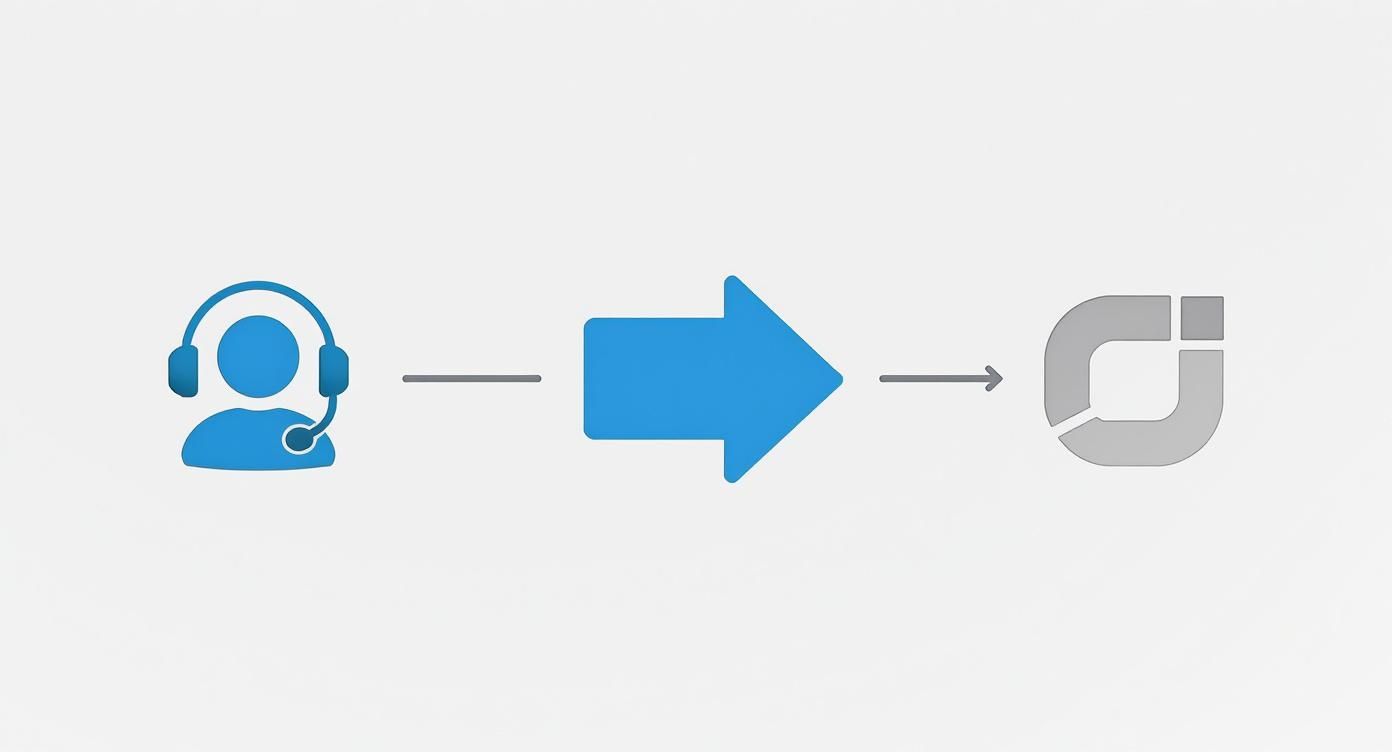
This simple visual captures the whole philosophy: move away from interrupting people and focus on attracting them. That's what these four stages are all about.
Stage 1 & 2: Identify and Connect
The whole process kicks off long before anyone picks up a phone. The Identify stage is all about being a proactive observer. Your team uses the tools they already have—like your CRM and website analytics—to spot prospects who are showing they're interested.
Practical Example: A Director of Finance at a target company downloads your "ROI Calculator for New Software" and then visits your pricing page multiple times. This data signals they've moved beyond general research into active consideration. This is a priority lead.
Next up is the Connect stage, where the aim is to prove you're relevant and worth talking to. Every bit of outreach is personalised based on what that prospect has already done. Instead of a generic pitch, your rep might email the Director with the subject line, "Questions about your ROI calculation?" and offer a brief consultation. The interaction feels helpful, not pushy.
Stage 3 & 4: Explore and Advise
Once you've got a conversation going, you move into the Explore stage. This is where your best salespeople really come into their own, acting more like business consultants. They ask smart, open-ended questions to dig deep and find the root of the problem, going way beyond the surface-level stuff.
Practical Example: During the call, a sharp sales rep discovers that the Director's quest for "better software" is driven by pressure from the CEO to cut departmental overhead by 15% before the next quarter. The real pain isn't clunky software; it's a critical business objective.
The Explore stage is the pivot point. It's where a salesperson stops selling a product and starts diagnosing a problem. The quality of their questions directly shapes the quality of the opportunity.
Finally, we arrive at the Advise stage. With a solid grasp of the prospect’s unique situation, your team can now position your solution as the perfect answer. They're not just rattling off a feature list; they're presenting a clear business case. This approach cements their status as a trusted advisor and makes the sale feel like a natural partnership, not just another transaction.
Inbound Versus Outbound Sales Strategy
As a leader, deciding where to focus your sales efforts isn't just a small-time tactical choice. It's a major strategic decision that will define how your company grows. The whole game boils down to one simple difference: do you push your message out, or do you pull interested people in?
Outbound sales is the classic "push" approach. Think cold calls, mass emails, and hitting the pavement. It can definitely drum up some immediate action, but the results are often unpredictable. You're interrupting someone's day, so you spend a ton of energy trying to connect with people who might have zero interest in what you're selling. This often leads to lower conversion rates and can even wear out your brand's welcome.
Inbound, on the other hand, is about playing the long game and building something that lasts. You create genuinely useful content—think insightful reports, helpful webinars, or expert articles—that attracts people who are already looking for answers. When they finally talk to your team, the conversation is warm and relevant because they've already seen what you know.
Strategic Comparison Inbound vs Outbound Sales
To figure out where to put your money and people, you need to look at these two methods side-by-side, focusing on what really impacts the bottom line. This table breaks down the core differences between inbound and outbound sales methodologies based on key business considerations.
| Factor | Inbound Sales (Attract) | Outbound Sales (Pursue) |
|---|---|---|
| Lead Quality | Higher; leads are pre-qualified by their interest and engagement with your content. | Variable; leads are often unqualified and require extensive nurturing. |
| Sales Cycle | Often shorter, as leads are already educated and have identified a need. | Typically longer; requires building awareness and trust from a cold start. |
| Customer Acquisition Cost (CAC) | Decreases over time as content assets mature and continue to attract leads organically. | Tends to be higher and less predictable, relying on paid channels and high-volume outreach. |
| Scalability | Highly scalable; content can serve an unlimited number of prospects simultaneously. | Less scalable; directly tied to the headcount and activity levels of your sales team. |
An outbound campaign might give you a nice spike in leads for one quarter, but a solid inbound strategy consistently lowers your customer acquisition cost (CAC) over the long haul. Why? Because your library of valuable content keeps working for you, day in and day out.
Inbound sales turns your marketing into an appreciating asset. Every piece of content you create works to generate qualified leads for years, continuously improving your ROI without a corresponding increase in spend.
Here’s another way to think about it: outbound is like renting an audience for a one-off event. Inbound is like buying the land and building a permanent venue that people want to visit on their own. One provides temporary traffic; the other builds a destination.
How to Measure Inbound Sales Performance
A solid inbound strategy lives and dies by its metrics. As a business leader, it’s easy to get lost in vanity numbers, but you need to focus on the key performance indicators (KPIs) that actually reveal the financial impact of your inbound sales efforts. This is how you prove its worth and justify every pound spent.
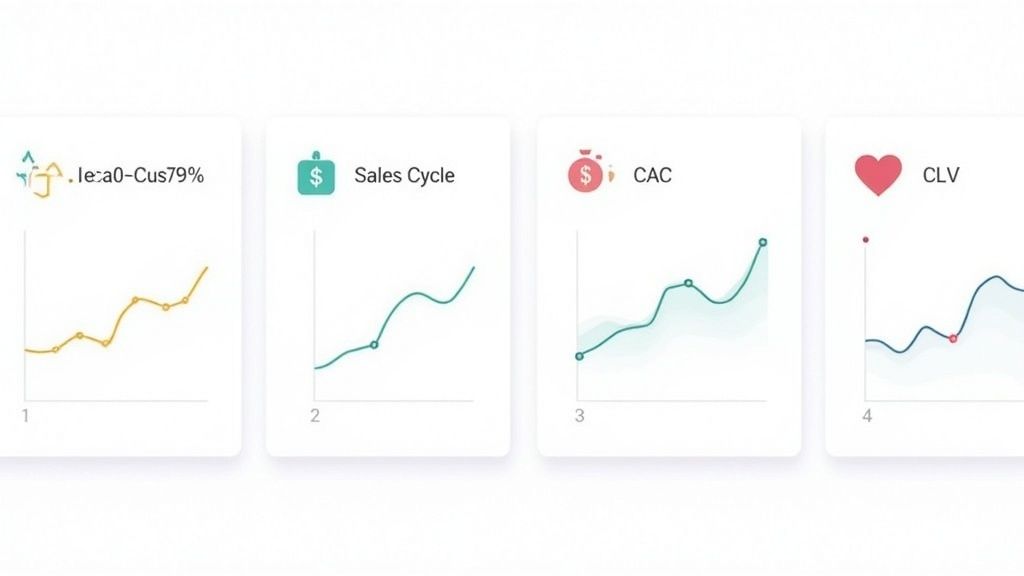
Forget just counting the number of leads coming in. Instead, track the metrics that tell you a story about efficiency and profitability. Are the right people finding you, and are you turning them into valuable, long-term customers?
Key Metrics for Inbound Success
To get a true grip on your performance, you need to be looking at these four core KPIs:
- Lead-to-Customer Conversion Rate: This is the ultimate litmus test for lead quality. A high rate means your marketing is hitting the mark and your sales team is closing deals effectively. If it’s low, it may indicate a misalignment between the content attracting leads and the solution you're selling. We've got more tips on how to measure and audit your conversion analytics to get to the root of the problem.
- Customer Acquisition Cost (CAC): Put simply, this is what it costs you to win a new customer. A successful inbound engine should see this number drop over time. Why? Because your content starts to work for you, generating leads organically without you having to constantly pump money into ads.
- Sales Cycle Velocity: This metric tracks how fast a lead goes from "hello" to "welcome aboard." Since inbound leads have often done their homework and are already interested, you should see a much shorter and more efficient sales cycle compared to outbound methods.
- Customer Lifetime Value (CLV): CLV tells you the total revenue you can expect from a single customer over their entire relationship with your business. Inbound leads tend to be a better fit, which means they often stick around longer and spend more. For more on this, check out these insights on customer value from Salesforce.com.
Building Your Inbound Sales Tech Stack
Let’s be honest, any inbound sales strategy is just a nice idea on paper without the right technology to back it up. For leaders, viewing tech as a cost centre is a mistake. It’s a direct investment in making your team more efficient and, ultimately, driving more revenue. The whole point is to get the repetitive, soul-crushing tasks off your team's plate so they can focus on what humans do best.
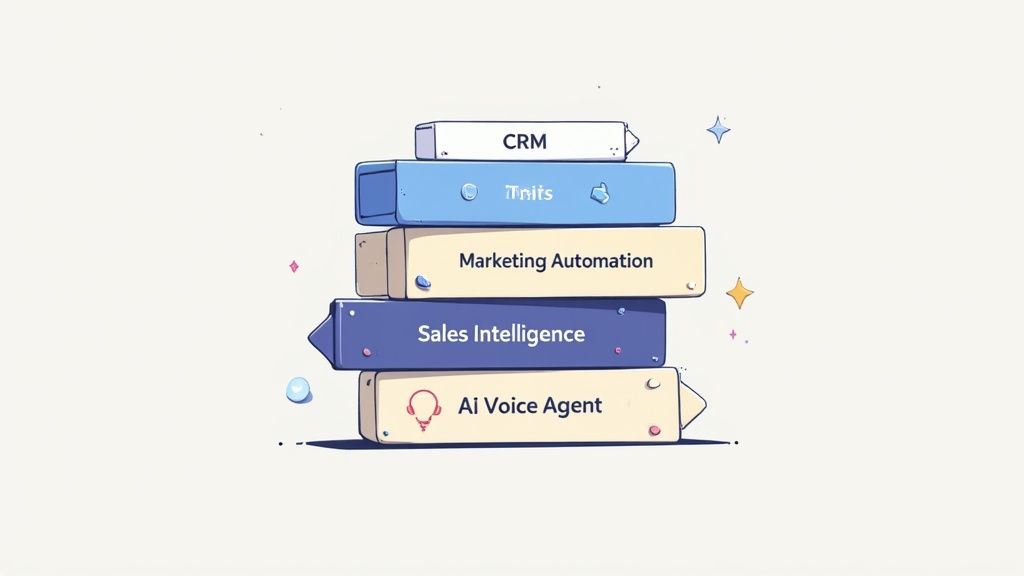
With a solid tech foundation, your sales pros can stop drowning in admin and start building relationships and closing deals that matter.
Core Components of a Modern Stack
Think of your inbound sales engine as needing a few essential parts to run smoothly. Each tool has its own job, but they all work together to guide prospects from initial curiosity to becoming loyal customers.
-
Customer Relationship Management (CRM): This is your central nervous system. A good CRM like Salesforce or HubSpot acts as the single source of truth for every bit of customer data, giving your team a 360-degree view of every conversation and touchpoint.
-
Marketing Automation: Tools like Pardot or Marketo are the perfect hand-off specialists between marketing and sales. They do the heavy lifting of nurturing leads with relevant content and scoring them based on engagement, ensuring sales only talks to people who are genuinely ready for a conversation.
-
Sales Intelligence: This is where you get your competitive edge. Platforms such as Gong or SalesLoft dig deep into your sales calls and emails, analysing what’s working (and what isn't) so your team can fine-tune their pitch based on real-world feedback.
The AI Advantage in Inbound Sales
Now, here's where things get really interesting. The next layer to add to your stack is artificial intelligence, and it’s a complete game-changer. Picture this: a high-value lead from a Fortune 500 company submits a "Contact Us" form on your website at 8 PM. Instead of that lead sitting in an inbox overnight, imagine an AI Voice Agent calling them instantly.
The AI has a natural conversation, qualifies their needs ("Are you looking to solve for X or Y?"), collects key information ("What's your typical project timeline?"), and books a meeting directly into the right sales director's calendar—all within seconds.
This isn't some far-off future concept; it's happening right now. It dramatically shrinks your speed-to-lead time and makes sure you never miss a hot opportunity because someone was tied up on another call. We dive deeper into this in our guide on how AI voice agents are transforming customer service and sales. By automating these crucial first-touch interactions, you empower your most skilled people to focus exclusively on closing.
Frequently Asked Questions About Inbound Sales
Even after grasping the basics, it's natural to have questions about what inbound sales looks like in practice. Let's tackle some of the most common queries we hear from leaders who are making the switch.
How Long Does It Take to See Results from Inbound Sales?
This is the big one, and the answer requires a shift in mindset. Inbound isn't a quick-win tactic like a cold calling blitz; it's about building a valuable, long-term asset for your business.
You'll likely see the first signs of life—more website traffic, a trickle of new leads—within the first three to six months. But the real magic happens later. The significant financial payoff, like a lower Customer Acquisition Cost (CAC) and a reliable flow of genuinely interested buyers, usually starts to kick in around the nine to twelve-month mark. Think of it as planting an orchard. It takes time to grow, but it eventually yields fruit year after year with far less effort.
What Is the Biggest Mistake Companies Make When Starting?
Hands down, the most common pitfall is a disconnect between sales and marketing. It happens all the time. Marketing will be celebrating a huge win after generating hundreds of leads from a new eBook, while the sales team is frustrated because they see those leads as tyre-kickers who aren't ready to buy.
The root of the problem is a lack of shared goals. To get it right, both teams need to sit down and agree on a single, unified definition of what a "good lead" actually is. For example, a lead who only downloaded one introductory guide is a Marketing Qualified Lead (MQL). But a lead who attended a pricing webinar and used your on-site calculator is a Sales Qualified Lead (SQL). This clarity builds a seamless handoff, ensuring sales only spends time on conversations with real revenue potential.
Is Inbound Sales Only for B2B or SaaS Companies?
Not at all. While the strategy became famous in the B2B and SaaS worlds, its principles are industry-agnostic. The core idea works for any business where customers do their homework before making a significant purchase.
Practical Example: A wealth management firm wants to attract high-net-worth individuals. Instead of cold calling, they create a series of exclusive webinars on "Estate Planning for Entrepreneurs." A CEO attends, finds immense value, and requests a consultation. The firm attracted an ideal client by first offering expert advice, not a sales pitch. It’s all about attracting people with valuable information, and that's a universal strategy.
Ready to supercharge your inbound strategy? DialNexa provides AI Voice Agents that instantly qualify and book meetings with your warmest leads, ensuring you never miss an opportunity. See how you can increase conversion rates and free up your sales team by visiting https://dialnexa.com.

Excellent explanation of how inbound sales transforms selling from interruption to trust-based engagement. The focus on customer education, data-driven decisions, and long-term value creation offers a practical blueprint for sustainable business growth.
A well-written and informative guide that highlights the value of inbound sales for building trust, improving ROI, and creating long-term customer relationships. Great resource for sales and marketing professionals.